Effe ct o f SX-3 2 2 8 , a se le ctive ligand fo r
the BZ
1
re ce pto r, o n sle e p and waking
during the light-dark cycle in the rat
1Department of Pharmacology and Therapeutics,
Clinics Hospital, Montevideo, Uruguay
2Department of Psychiatry, University of Utah at
Salt Lake City, Salt Lake City, UT, USA F. Alvariño1,
J.M. Monti1, H. Jantos1 and D. Monti2
Abstract
The effects of the benzodiazepine1 (BZ1) receptor agonist SX-3228
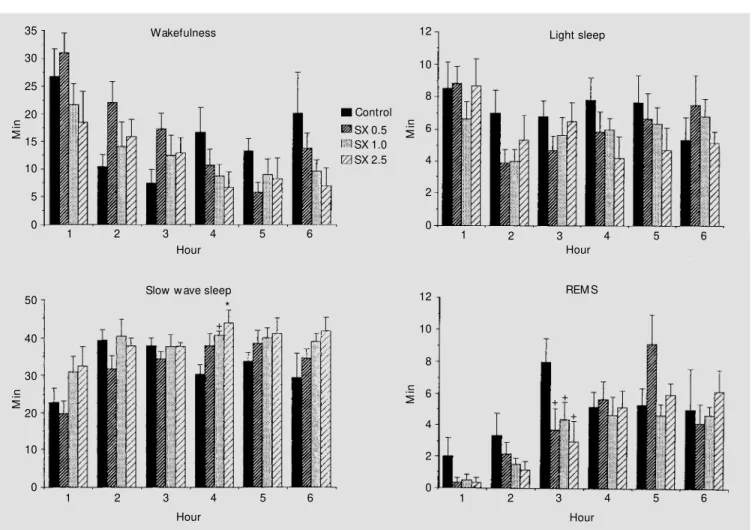
were studied in rats (N = 12) implanted for chronic sleep procedures. Administration of 0.5, 1.0 and 2.5 mg/kg SX-3228, sc, to rats 1 h after
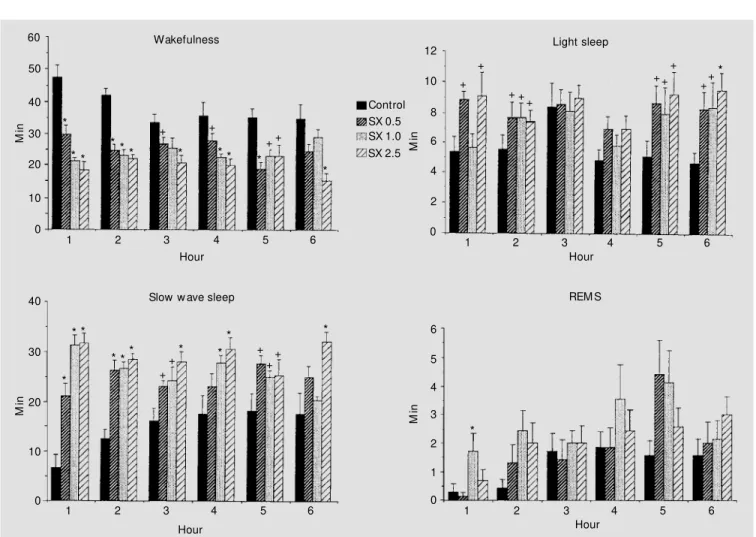
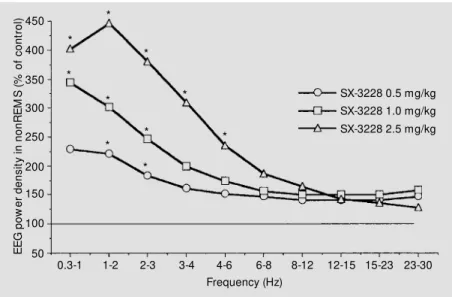
the beginning of the light phase of the light-dark cycle induced a significant reduction of rapid-eye-movement sleep (REMS) during the third recording hour. Moreover, slow wave sleep (SWS) was increased during the fourth recording hour after the two largest doses of the compound. Administration of 0.5, 1.0 and 2.5 mg/kg SX-3228 one hour after the beginning of the dark period of the light-dark cycle caused a significant and maintained (6-h recording period) reduction of waking (W), whereas SWS and light sleep (LS) were increased. REMS values tended to increase during the entire recording period; however, the increase was statistically significant only for the 1.0 mg/ kg dose during the first recording hour. In addition, a significant and dose-related increase of power density in the delta and the theta regions was found during nonREM sleep (LS and SWS) in the dark period. Our results indicate that SX-3228 is a potent hypnotic when given to the rat during the dark period of the light-dark cycle. More-over, the sleep induced by SX-3228 during the dark phase closely resembles the physiological sleep of the rat.
Co rre spo nde nce J.M. Monti
2833/602 Zudañez Street Montevideo 11300 Uruguay
Fax: + 598-2-487-3787 E-mail: jmonti@ chasque.apc.org
Received December 30, 1998 Accepted May 18, 1999
Ke y wo rds
·SX-3228
·Benzodiazepine1 receptor
·Sleep ·Waking ·REM sleep ·Zolpidem ·Light-dark cycle
Intro ductio n
Gamma-aminobutyric acid (GABA) is the most important inhibitory transmitter in the central nervous system (CNS). GABA is re-leased from GABAergic neurons and binds to both GABAA and GABAB receptors (1). The GABAA receptor is a protein that con-tains specific binding sites for GABA, ben-zodiazepines (BZD), barbiturates, neuroster-oids and convulsants. The interaction of
for the BZ1 than the BZ2 site. The relative potency of zolpidem, an imidazopyridine hypnotic, to displace [3
H]-flunitrazepam from the cerebellum (BZ1-site) was 5.5 nM (IC50), while that corresponding to the dentate gy-rus (BZ2-site) was 400 nM (4).
A compound with similar selectivity, SX-3228 [6-benzyl-3-(5-methoxy-1,3,4-oxadia- zol-2-yl)-5,6,7,8-tetrahydro-1,6-naphtyridin-2 (1H) one], has been shown to bind to BZ receptors, but not to dopamine (D1, D2), serotonin (5-HT1, 5-HT2 and 5-HT3 sub-types), noradrenaline (a1, a2, ß), GABA or acetylcholine (muscarinic) subtypes. Among the BZ-receptor subtypes, SX-3228 prefer-entially binds to the BZ1 receptor (cerebel-lum: IC50 = 17 nM). It has very weak affinity for the BZ2 receptor (spinal cord: IC50 = 127 nM), and virtually no affinity for the periph-eral type BZ receptor(kidney: IC50 >10.000 nM) (5). Pretreatment with SX-3228 antago-nized pentylenetetrazole-induced myoclonic convulsions in mice and rats, decreased lo-comotor activity in mice, and mitigated at-tack responses in cynomolgus monkeys. Tol-erance did not develop to the antipentylene-tetrazole effect of SX-3228 (6).
Earlierstudies with the BZDs midazolam and triazolam, and with zopiclone and zolpidem have demonstrateddifferences in their pharmacological profiles. Thus, whereas the BZDs and zopiclone are effective in blocking pentylenetetrazole-induced convul-sions at very low doses, the sedative and sleep-inducing effect of zolpidem is exerted at doses that are 10-20 times lower than those needed for anticonvulsant or myore-laxant activities (7). Available evidence sug-gests that SX-3228 possessesa similar pro-file (8).
Attempts have been made to test the ef-fectsof drugs with putative hypnotic activity in situations in whichsleep is impaired by nonpharmacological or pharmacological pro-cedures. Nonpharmacological models have included the induction of insomnia by envi-ronmental changes (the animal is moved to a
novel individual cage or is connected for the first time to the recording cables), or by decreasing the duration of the dark period (16-h light:8-h dark) in animals kept previ-ously on a 12-h light:12-h dark cycle (9,10). Pharmacological procedures have included the injection of amphetamine or caffeine (11,12). All these procedures generate con-siderable amounts of stress andalter a criti-cal balance between neurotransmitter sys-tems at central sites.
In order to circumvent these limitations, we tested the effectsof compound SX-3228 in animals either sleeping ad libitum (light period) or being predominantly awake (dark period). Since the increase in sleep time induced by CNS depressants is inversely related to the baseline values, characteriza-tion of SX-3228 during the dark period con-stitutes an adequateapproach to test its hyp-notic action.
The present study was designed to quan-tify the effects of SX-3228 on sleep and waking (W) in the rat. For this purpose, compound SX-3228 was given over a range of doses at the beginning of either the light or the dark phase to rats prepared for chronic sleep recordings.
Mate rial and Me tho ds
Twelve male Wistar rats (School of Medi-cine Breeding Laboratories, Montevideo, Uruguay) weighing 350-380 g were im-planted with Nichrome electrodes (200 µm in diameter) under general anesthesia with 40.0 mg/kg sodium pentobarbital for chronic sleep recordings from the frontal and occipi-tal cortices and from the dorsal neck muscu-lature. The animals were housed individu-ally in atemperature-controlled room (22 ± 1o
The period of adjustment of the second group of rats used in our study lasted 4 weeks and was followed by a stable cycle of W and sleep (13). Both groups of animals were habituated for 4 days to a chamber fitted with slip-rings and cable connectors and to the injection procedure. Thereafter, they were given either a control solution orthe drug to be tested.
Expe rim e nt 1
We studied the effects of SX-3228 (Dainippon Pharmaceutical, Osaka, Japan) 0.5-2.5 mg/kg in one group of animals (N = 6) during the light phase of the 12-h light:12-h dark cycle, starting 1 h after the beginning of the light period. Poly-somnographic recordings were started im-mediately after control solution or drug ad-ministration. Each rat received all four treat-ments(control, and 0.5, 1.0, 2.5 mg/kg SX-3228).
Expe rim e nt 2
We examined the effectsof 0.5-2.5 mg/ kg SX-3228 in animals (N = 6) adapted to a 12-h dark:12-h light cycle for 4 weeks, starting 1 h after the beginning of the dark period. Each animal received all four treat-ments (control, and 0.5, 1.0, 2.5 mg/kg SX-3228).
Pro ce dure s
SX-3228 was mixed with a small volume of Tween-80 and suspended in saline. Sub-cutaneous (sc) injections were given in a final volume of 1.0 ml/kg. All rats were given the corresponding volume of control solution (saline + Tween-80) in the control sessions. Following sc injection, a 6-h sleep recording was started at approximately 8:00 a.m. At least 4 days were allowed to elapse between injections to avoid long-lasting and rebound effects on sleep.
D ata analysis
The electrographic activity of 25-s ep-ochs was analyzed in a blind manner and assigned to the following categories based on the waveform: W, light sleep (LS), slow wave sleep (SWS), and rapid-eye-movement sleep (REMS). SWS and REMS latencies were also determined (14). In the group of animals maintained on a 12-h dark:12-h light cycle, one EEG signal derived from the fron-tal cortex was filtered, digitized at a sam-pling of 128 Hz, and saved to an optical disk. A time code was also written every 20 s on both the paper tracing and the disk. Time code-delimited epochs enabled precise cor-respondence between the visual scoring of sleep recordings and the computer analysis. Epochs containing artifacts in the EEG lead were eliminated from the analysis. Data saved to the optical disk corresponding to non-REMS (LS and SWS) episodes were ana-lyzed off-like in the range of 0.3-30 Hz with PASS PLUSS (Delta Software, St. Louis, MO, USA) spectral analysis software.
Statistical analysis
One-way analysis of variance with mul-tiple measures was used for statistical com-parison of three or more samples, with mul-tiple post-hoc comparisons performed with the Newman-Keuls test when ANOVA was significant (P<0.05).
Re sults
Expe rim e nts carrie d o ut during the light
phase
in-M
in
35
Control 30
25
20
15
10
5
0
Wakefulness
SX 0.5 SX 1.0 SX 2.5
1 2 3 4 5 6
1 2 3 4 5 6
M
in
50
40
30
20
10
0
Hour
Hour Slow w ave sleep
M
in
12
10
8
6
4
2
0
Light sleep
1 2 3 4 5 6
Hour
M
in
12
10
8
6
4
2
0
REM S
1 2 3 4 5 6
Hour *
+
+ + +
Figure 1 - The effect of SX-3228 (SX) on w akefulness, light sleep, slow w ave sleep and rapid-eye-movement sleep (REM S) during the light phase of the light-dark cycle. Ordinate: mean amount in minutesof behavioral state according to EEG criteria. All values are the means (min) ± SEM collected at 1-h intervals. Six animals w ere in each experimental group. Doses are reported in mg/kg. +P<0.05; * P<0.01 compared to control (New man-Keuls test).
Table 1 - Effect of SX-3228 on sleep latencies during the light phase of the light-dark cycle.
Data are reported as means ± SEM . Six animals w ere in each experimental group. The doses are reported as mg/kg. * P<0.05 compared to control (New man-Keuls test). REM S, Rapid-eye-move-ment sleep.
Slow w ave sleep REM S latency (min) latency (min)
Control 9.8 ± 2.2 65.3 ± 17.7
SX-3228
0.5 9.2 ± 2.0 61.8 ± 9.1 1.0 4.8 ± 2.2 85.5 ± 17.9 2.5 7.7 ± 3.4 104.5 ± 13.5*
creased (P<0.05-0.01) during the fourth re-cording hour after the two largest doses of the compound.
Expe rim e nts carrie d o ut during the dark
phase
pe-riod (P<0.05-0.01) (Figure 2); however, sig-nificant changes during the last recording hourwere restricted to the 2.5 mg/kg dose (P<0.01). The quantity of LS also increased significantly during the first, second, fifth and sixth recording hours. REMS values tended to augment during the entire record-ing period; however, the increase attained significance (P<0.01) only with the 1.0 mg/ kg dose during the first recording hour. As shown in Table 2, there was anoverall de-crease of SWS and REMS latencies during the dark phase, which attained significance (P<0.05-0.01) with the two largest doses.
The effect of SX-3228 on EEG power density in nonREMS during the dark phase
M
in
60
Control 50
40
30
20
10
0
Wakefulness
SX 0.5 SX 1.0 SX 2.5
1 2 3 4 5 6
1 2 3 4 5 6
M
in
40
30
20
10
0
Hour
Hour Slow w ave sleep
M
in
12
10
8
6
4
2
0
Light sleep
1 2 3 4 5 6
Hour
M
in
5
4
3
2
1
0
REM S
1 2 3 4 5 6
Hour *
* * * * * * * * * *
+ +
++
+ +
+ ++
+ + +
++ *
+
+ +++
* * *
* ** * *
* *
* 6
Figure 2 - The effect of SX-3228 (SX) on sleep and w aking during the dark phase of the light-dark cycle. All values are the means (min) ± SEM collected at 1-h intervals.Six animals w ere in each experimental group. Doses are reported in mg/kg. +P<0.05; * P<0.01 compared to control (New man-Keuls
test). REM S, Rapid-eye-movement sleep.
Table 2 - Effect of SX-3228 on sleep latencies during the dark phase of the light-dark cycle.
Values are reported as means ± SEM . Six animals w ere in each experimental group. The doses are reported as mg/kg. * P<0.05; * * P<0.01 compared to control (New man-Keuls test). REM S, Rapid-eye-movement sleep.
Slow w ave sleep REM S latency (min) latency (min)
Control 22.6 ± 6.2 141.3 ± 38.5
SX-3228
0.5 8.7 ± 2.7 119.4 ± 21.4
1.0 4.9 ± 2.2* 52.7 ± 17.0* *
is shown in Figure 3. The values are ex-pressed for each frequency band relative to the corresponding value of the control night (= 100%). The spectrum computed for nonREMS (light sleep and slow wave sleep) of the 6-h recording period revealed a sig-nificant increase (P<0.05) of power density in the low frequency range (delta = 0.3-3 Hz; theta = 4-6 Hz) after the 2.5 mg/kg dose. Significant changes after the 0.5 and 1.0 mg/ kg dose were restricted to the 1-3 Hz and 0.3-3 Hz band, respectively. Moreover, values corresponding to higher frequencies (alpha = 8-12 Hz; sigma = 12-15 Hz; beta = 23-30 Hz) did not differ significantly from the con-trol levels.
D iscussio n
Injection of compound SX-3228 at the beginning of the light period increased SWS during the fourth hour after treatment, and suppressed REMS during the third hour of recording. Administration of SX-3228 at the beginning of the dark period gave rise to a significant and maintained (6-h recording
period) reduction of W, whereas SWS and LS were augmented. Moreover, SWS and REMS latencies became significantly smaller after injection of the 1.0 or the 2.5 mg/kg dose of the compound. In addition, a signifi-cant and dose-dependent increase of power density in the delta and theta regions was found during the administration of SX-3228. On the other hand, the relative EEG power density corresponding to the alpha, sigma and beta bands showed no significant changes.
Thus, the effect of SX-3228 on sleep in animals sleeping ad libitum was modest and short-lived. In contrast, SX-3228 induced a robust and maintained increase of nonREMS in predominantly awake animals. In other words, under our experimental conditions the sleep-inducing and maintaining effects of SX-3228 weremainly evident when the compound was given at the beginning of the dark period.
In the study by Kurumiya et al. (8) in which SX-3228 (0.3-3.0 mg/kg, po) was given to rats during the light period, SWS was increased and LS was reduced during the 12-h recording period. REMS showed an initial decrement (first 4 h) after the highest dose. In addition, SX-3228 (1.0 or 5.0 mg/ kg, po) produced an increase in power in the low frequency band (1-4 Hz). The relatively large amounts of SWS observed by Kurumiya et al. (8) after injection of SX-3228 during the light phase could be due to the limited duration of the habituation period (1 h) of the experimental animals to the recording chamber. Thus, the authors may have in-duced a nonpharmacological insomnia in their rats.
In cortical recordings of curarized rats, zolpidem induced sleep periods of 10 to 60 min duration with doses in the range of 0.1 to 1.0 mg/kg, ip. Power spectral analysis of the electrocorticogram during zolpidem admin-istration showed a dominant peak in the delta frequency band (1-4 Hz) (15).
Administration of the BZD hypnotics
E
E
G
p
o
w
e
r
d
e
n
s
it
y
i
n
n
o
n
R
E
M
S
(
%
o
f
c
o
n
tr
o
l) 450
400
350
300
250
200
150
100
50
0.3-1 1-2 2-3 3-4 4-6 6-8 8-12 12-15 15-23 23-30 Frequency (Hz)
SX-3228 0.5 mg/kg SX-3228 1.0 mg/kg SX-3228 2.5 mg/kg *
Figure 3 - Effect of SX-3228 on the mean EEG pow er density of nonREM S (non-rapid-eye-movement sleep) (relative to baseline) during the dark period of the light-dark cycle. The curves indicate mean values of successive frequencies w hich are reported as percent of the placebo reference value (= 100% ) during a 6-h period. SX-3228 significantly and dose-dependently increased pow er density in the delta and theta regions (*P<0.05; New
man-Keuls test).
*
*
* * *
*
* *
midazolam (0.1-1.0 mg/kg, ip) or triazolam (0.03-0.3 mg/kg, ip) to curarized rats in-duced the appearance of frequent bursts of sleep spindles,particularly in the sensorimo-tor cortex. Sequential spectral analysis showed that both compounds preferentially affected frequencies of 12 to 14 Hz (8,16).
When given tofreely moving rats during the light phase, zolpidem (1.0-3.0 mg/kg, po) failed to alter sleep patterns. At much higher doses (10.0 mg/kg, po), zolpidem significantly increased SWS and delayed the appearance of REMS (16). As compared to zolpidem, midazolam (10.0 mg/kg, po) also induced an increase of SWS without disrupt-ing REMS. On the other hand, nitrazepam (3.0 mg/kg, po) induced no significant changes insleep or waking (16,17).
Thus, administration of zolpidem to curarized animals, or ofcompound SX-3228 tofreely moving rats during the dark phase increased SWS and energy peaks in the 1- to 4-Hz frequency band, which is typical of physiological sleep (8,18). On the other hand, midazolam ortriazolam induced the appear-ance of sleep spindles in the cortical EEG, and a large increase in energy between 12 and 14 Hz when given to freely moving rats. Thus, unlike the sleep induced by BZD, the sleep induced by either zolpidem or SX-3228 closely resembles physiological sleep in the rat.
What are the mechanisms involved in the SX-3228-induced increase of nonREMS and REMS during the dark period of the light-dark cycle? As mentioned before, SX-3228 preferentially binds to BZ1 receptor and in-creases GABA-induced chloride currents (2). Gamma-aminobutyric acid is the most im-portant inhibitory transmitter in the CNS, and has been proposed to play an essential role in the generation of nonREMS (19). In this respect, the GABAA agonist gaboxadol promoted nonREMS and enhanced delta ac-tivity in the rat (20). In addition, the highly selective GABAA agonist muscimol
dose-dependently increased both nonREMS and REMS and enhanced delta and sigma activ-ity (21).
Pertinent to our discussion is the recipro-cal interaction hypothesis of REMS genera-tion proposed by McCarley and Hobson (22), which identifies cholinergic neurons in the laterodorsal and pedunculopontine tegmen-tal nuclei as promoting REMS, and their inhibition by serotonergic (5-HT) afferents from the dorsal raphe nucleus (DRN) and noradrenergic afferents from the locus coe-ruleus (LC). The activity of DRN serotoner-gic neurons and LC noradrenerserotoner-gic neurons is at its highest during W, it diminishes during SWS and is virtually suppressed when the animal starts REMS (23). It has been pro-posed that a GABA input from the reticular formation could inhibit DRN and LC cells during REMS. In this respect, Nitz and Siegel (24,25) described higher GABA levels dur-ing REMS compared with W at the DRN and LC site. Reports indicating that direct micro-injection of the GABAA receptor agonist muscimol into the DRN increases REMS, whereas microinjection of the GABAA re-ceptor antagonists bicuculline and picrotoxin induce opposite effects, further support the participation of GABA in the inhibition of 5-HT neurons and facilitation of REMS pro-duction (24).
In the past, animal data obtained after administration of BZD hypnotics predicted clinical effects in humans with primary in-somnia and inin-somnia related to anxiety dis-orders. Thus, it could be worthwhile to test the effect of SX-3228 in patients with diffi-culty in initiating or maintaining sleep.
Ackno wle dgm e nts
Re fe re nce s
1. M acdonald RL & Olsen RW (1994). GABAA receptor channels. Annual Review
of Neuroscience, 17: 569-602.
2. Besnard F, Avenet P, Itier V, Granger P, Partiséti M , Depoortere H, Graham D & Langer SZ (1996). GABAA receptor
sub-types and the mechanism of action of zolpidem. In: Freeman H, Puech AJ & Roth T (Editors), Zolpidem: An Update of its Pharmacological Properties and Thera-peutic Place in the M anagement of In-somnia. Elsevier, Paris, 21-31.
3. M uller WE (1995). Pharmacology of the GABAergic/benzodiazepine system. In: Kales A (Editor), Pharmacology of Sleep. Springer, Berlin, 211-242.
4. Langer SZ, Arbilla S, Benavides J, Depoortere H & Scatton B (1990). Recep-tors involved in the mechanism of action of t he im idazopyridine zolpidem . In: Barthouil P (Editor), Insomnie et Imidazo-pyridines. Excerpta M edica, Amsterdam, 207-218.
5. Furukaw a K, Oka M , Kohayakaw a H, Kurumiya S, Saruw atari T, Ono K, Odai O & Karasaw a T (1994). SX-3228, a putative nonbenzodiazepine hypnotic. I. Neuro-pharmacological profile. Neuropsycho-pharmacology, 10 (Suppl): 227S (Abstract P-174-60).
6. Oka M , Furukaw a K, Noda Y, Ochi Y, Kitazono Y, Ono K, Odai O & Karasaw a T (1994). SX-3228, a putative non-benzodi-azepine hypnotic. II. Behavioral effects.
Neuropsychopharmacology, 10 (Suppl): 227S (Abstract P-174-61).
7. Zivkovic B, Perrault G, M orel E & Sanger DJ (1990). Neuropsychopharmacological profile of zolpidem, a new imidazopyridine hypnotic. In: Barthouil P (Editor), Insomnie et Imidazopyridines. Excerpta M edica, Amsterdam, 219-230.
8. Kurumiya S, Nagai R, Furukaw a K, Oka M & Karasaw a T (1994). SX-3228, a putative non-benzodiazepine hypnotic. II.
Electro-encephalographic and sleep studies. Neu-ropsychopharmacology, 10 (Suppl): 228S (Abstract P-174-62).
9. Halperin JM , M iller D & Iorio LC (1981). Sleep inducing effects of three hypnotics in a new model of insomnia in rats. Phar-macology, Biochemistryand Behavior, 14: 811-814.
10. M ichaud JC, M uyard JP, Capdevielle G, Ferran E, Geiordano-Orsini JP, Veyrun J, Roncucci R & M ouret J (1982). M ild in-somnia induced by environmental pertur-bations in the rat: A study of this new model and of its possible applications in pharmacological research. Archives Inter-nationales de Pharmacodynamie et de Therapie, 259: 93-105.
11. M onti JM (1979). The effects of neurolep-tics w ith central dopamine and noradrena-line receptor blocking properties in the l-dopa and (+)-amphetamine-induced w ak-ing EEG in the rat. British Journal of Phar-macology, 67: 87-91.
12. Radulovacki M , M iletich RS & Green RD (1982). N6 (L-phenylisopropyl)adenosine
(L-PIA) increases slow -w ave sleep (S2)
and decreases w akefulness in rats. Brain Research, 246: 178-180.
13. Grant L, Hopkinson P, Jennings G & Jenner FA (1971). Period of adjustment of rats used for experimental studies. Na-ture, 232: 135.
14. M onti JM , Haw kins M , Jantos H, Labraga P & Fernandez J (1988). Biphasic effects of dopamine D-2 receptor agonists on sleep and w akefulness in the rat. Psycho-pharmacology, 95: 395-400.
15. Arbilla S, Depoortere H, George P & Langer SZ (1985). Pharmacological profile of the imidazopyridine zolpidem at benzo-diazepine receptors and electrocortico-gram in rats. Archives of Pharmacology, 330: 248-251.
16. Depoortere H, Zivkovic B, Lloyd KG, Sanger DJ, Perrault G, Langer SZ &
Bartholini G (1986). Zolpidem, a novel nonbenzodiazepine hypnotic. I. Neuro-pharmacological and behavioral effects.
Journal of Pharmacology and Experimen-tal Therapeutics, 237: 649-658.
17. Depoortere H & Granger P (1985). Differ-entiation of EEG sleep stages in the rat and the cat by automatic analysis. In: Kubicki S & Herrmann WM (Editors),
M et hods of Sleep Research. Gust av Fischer, Stuttgart, 37-45.
18. Depoortere H (1985). A comparative EEG study of some benzodiazepine (BZD) and non-BZD sedative or hypnotic drugs. Phar-macopsychiatry, 18: 17-19.
19. M cCormick DA (1992). Neurotransmitter actions in the thalamus and cerebral cor-tex and their role in neuromodulation of thalamocortical activity. Progress in Neu-robiology, 39: 337-388.
20. Lancel M & Faulhaber J (1996). The GABAA agonist THIP (gaboxadol)
in-creases non-REM sleep and enhances delta activity in the rat. Neuroreport, 7: 2241-2245.
21. Lancel M , Crönlein TAM & Faulhaber J (1996). Role of GABAA receptors in sleep
regulation: Differential effects of musci-mol and midazolam on sleep in rats. Neu-ropsychopharmacology, 15: 63-74. 22. M cCarley RW & Hobson JA (1975).
Neu-ronal excitability m odulation over the sleep cycle: a structural and mathematical model. Science, 189: 58-60.
23. Trulson M E & Jacobs BL (1979). Raphe unit activity in freely moving cats: correla-tion w ith level of behavioral arousal. Brain Research, 163: 135-150.
24. Nitz D & Siegel J (1997). GABA release in the dorsal raphe nucleus: role in the con-trol of REM sleep. AmericanJournal of Physiology, 273: R451-R455.