THE IN FLU ENCE OF THE IRON SHIELD OF THE
SO LE NOID ON SPIN TRACK ING
by
Dragan TOPREK
Re ceived on March 10, 2005; ac cepted in re vised form on April 5, 2005
The in flu ence of the iron shield of the so le noid on spin track ing is stud ied in this pa per. In the case of the 200 MeV pro ton, the study has been nu mer i cally done in the ZGOUBI code. The dis tri bu tion of the mag netic field was done by POIS SON. We have come to the con clu sion that the in flu ence of the so le noid’s shield ing on spin track ing is the same at its en trance and exit and that is di rectly pro por tional to the in -ten sity of the mag netic in duc tion B on the axis of the so le noid. We have also de ter -mined that the in flu ence of the so le noid’s shield ing is much stron ger on transversal com po nents of the spin than on its lon gi tu di nal com po nent. The dif fer ences be tween com po nents of the spin for the shielded and not-shielded so le noid di min ish with the in crease in the dis tance from the so le noid.
Key words: spin, so le noid, fringe field
IN TRO DUC TION
In many sit u a tions, so le noids are used to cap -ture and con tain a beam of par ti cles. A num ber of pa pers in which the so le noids are be ing stud ied (see, for ex am ple, [1-4]) al ready ex ist. The so le noid may be used to ro tate the spin of a par ti cle, the so called “spin ro ta tor”. Many pa pers on spin dy nam -ics and track ing (see, for ex am ple, [5, 6]) have also been pub lished. In prac tice, this gives rise to ques -tions such as: how strong is the in flu ence of the so le -noid’s shield on spin track ing? The re sult worth re
-port ing is an ex plicit an swer to the pre vi ous ques tion. This pa per deals with spin track ing through the shielded and non-shielded so le noid, in other words, with the in flu ence of fringefield shap -ing of the so le noid on spin track -ing. In both cases, the dis tri bu tion of the mag netic fields, the shielded and not-shielded one, is done in POIS SON [7]. In or der to de ter mine how the in ten sity of the mag -netic in duc tion B on the axis of the so le noid in flu
-ences the dif fer -ences in spin track ing of the shielded and notshielded so le noid, two cases of the in ten -sity of the mag netic in duc tion B were taken into con sid er ation; the first one be ing B = 1.30 T, the sec ond B = 4.00 T. In the case of the 200MeVpro -ton, the nu mer i cal anal y sis was done by us ing the ZGOUBI code [8]. Our find ings lead us to the con -clu sion that in the case of ey = ez = 10 p mm mrad
for the beam rms emittions in the transversal planes (x axis is the lon gi tu di nal di rec tion) and 0.5% mo -men tum spread at half width.
THE ORY
Spin track ing
The the ory of spin mo tion is de scribed in [5, 6]. Here we re peat it briefly.
The mo tion of the spin r
S is gov erned by the Thomas-BMT first or der dif fer en tial equa tion:
d d r
r r S
t q
mS
= ´
g W (1)
where r
W is the spin pre ces sion given by:
r r r
W=(1+gG b G) + (1-g)b|| (2)
where q is the charge of the par ti cle, m – the rest mass of the par ti cle, g – the Lo rentz rel a tiv is tic fac -tor, G – the anom a lous mag netic mo ment of the Tech ni cal pa per
UDC: 537.84/.87
BIBLID: 1451-3994, 20 (2005), 1, pp. 81-85
Au thor's ad dress:
VIN^A In sti tute of Nu clear Sci ences
P. O. Box 522, 11001 Bel grade, Ser bia and Montenegro
tial path, Br=gmv q/ is the ri gid ity of the par ti cle. In tro duc ing the de riv a tive of the spin with re -spect to the path:
¢ = = r r r S S s v S t d d d d 1 (3)
as well as r r
B=b Br and r r
B|| =b|| Br, and
r r
r r
w
r g g
= W = + +
-B (1 G B G) (1 )B|| (4)
eq. (1) can be re writ ten as fol lows [6, 8]:
¢ = ´
r r r
S S w (5)
This equa tion is then solved us ing a highly symplectic nu mer i cal method based on the trun -cated Taylors se ries [6, 8].
Nu mer i cal method
The symplectic nu mer i cal method is based on the res o lu tion of the equa tion by means of the Tay -lor ex pan sion. In the case of eq. (5), from the val ues of the mag netic fac tor r
w(M0) and the spin r S M( 0) of the par ti cle at po si tion M0 of its tra jec tory, the spin
r
S M( 1) at po si tion M1, fol low ing a dis place ment ds, is given by the Tay lor ex pan sion:
r r
r r
r
S M S M S
s M s
S
s M
s
S s
( 1) ( 0) ( 0) ( )
2 2 0 2 3 3 2 = + + + + d d d d d d d
d (M ) ! ( ) !
s S s M s 0 3 4 4 0 4 3 4 d d d d + r (6)
The de riv a tives r
r
S S
s
n n
n
( ) =d
d of r
S at M0 are ob -tained by dif fer en ti at ing eq. (5)
¢ = ´
r r r
S S w (7a)
¢¢ = ¢ ´ + ´ ¢
r r r
r r
S S w S w (7b)
¢¢¢ = ¢¢ ´ + ¢ ´ ¢ + ´ ¢¢ r r r r r r r
S S w 2S w S w (7c)
r r r r r r r r r SIV = ¢¢¢ ´S + S¢¢ ´ ¢ + S¢ ´ ¢¢ + ´ ¢¢¢S
w 3 w 3 w w (7d)
where the de riv a tives r r
w( )n =dnw/dsnare ob tained from eq. (4).
The next step is get ting r
B|| and its de riv a tives. This can be done in the fol low ing way. Let r r
u=v/ v be the nor mal ized ve loc ity of the par ti cle, then:
¢¢ = ¢¢ × + ¢ × ¢ + × ¢¢ + + ¢ × + × r r r r r r r r r r r r
B B u B u B u u
B u B
|| ( )
(
2
2 u u¢)r¢ +(B u u× ) ¢¢
r r r
(8c)
etc. where
r r
B||( )n =dnB|| dsn.
The last point con sists in geting r r
u, B, and their nthde riv a tives. This can be done by means of the Lo rentz equa tion which gov erns the mo tion of a charged par ti cle q, mass m and ve loc ity r
v in mag -netic field r
b:
d d (mv)
t qv b
r r
r
= ´ (9)
Tak ingjjjr r r r r
u=v /v, sd =v t, d u¢ =du/ s, mv d =
=mvur=qB ur
r where Br is the ri gid ity of the par ti cle, r r
B=b Br, the Lo rentz equa tion can be re writ ten:
¢ = ´
r r r
u u b (10a)
From eq. (10a) we have:
¢¢ = ¢ ´ + ´ ¢
r r r
r r
u u B u B (10b)
¢¢¢ = ¢¢ ´ + ¢ ´ ¢ + ´ ¢¢ r r r r r r r
u u B 2u B u B (10c)
r r r r r r r r r
u u B u B
u B u B
IV = ¢¢¢ ´ + ¢¢ ´ ¢ +
+ ¢ ´ ¢¢ + ´ ¢¢¢
3
3 (10d)
where r r
B( )n =dnB sd n.
From B
X X
B
Y Y
B
Z Z
d d d d
r
r r r
= ¶ + + ¶ ¶ ¶ ¶ ¶ B = = =
å
¶ ¶ r B Xi Xi id
1 3
(see [6, 8]) we get:
¢ = =
å
r
r
B B u
i i

¶Xi
1 3 (11a) r r r ¢¢ = + ¢ = =
å
å
B B u u B
X u j i j i j i i i ¶ ¶ ¶ ¶ ¶ 2 1 3 1 3
Xi X
, (11b) r r r ¢¢¢ = + + =
å
B BX X X u u u
B
X X
i j k
i j k i j k
i j i j ¶ ¶ ¶ ¶ ¶ ¶ ¶ 3 1 3 2 3 , , ,= =
å
¢ +å
¢¢1 3
1 3
u u B
r
r
r
B B
X X X X u u u u
B X IV
i j k l
i j k l i j k l
i
= +
+ =
å
¶¶ ¶ ¶ 


4
1 3
3
6
, , ,
¶ 

¶ 
X X u u u
B
X X u u
j k i j k i j k
i j i
i j j
¢ +
+ ¢¢ +
+ =
=
å
å
, ,
, 1 3
2
1 3
4
r
3
2
1 3
1
3 
¶ 


r r
B
X X u u
B
X u
i j i j
i i i
i j
¢ ¢ + ¢¢¢
= =
å
å
, (11d)
Now, us ing eqs. (4), (7), (8), (10), and (11), eq. (6) can be solved nu mer i cally.
RE SULTS
Mag netic field dis tri bu tion
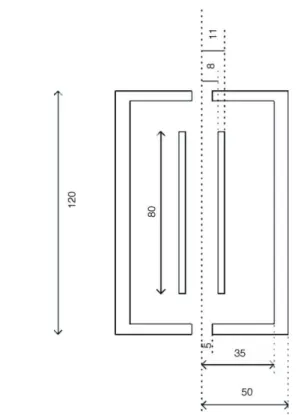
The nu mer i cal re sults pre sented here re gard a so le noid of a length of L = 80 cm and with the Bore ra dius of Rb = 8 cm . Other di men sions re gard ing the shielded so le noid are pre sented in fig. 1.
The dis tri bu tion of the mag netic fields, cal cu -lated by means of POIS SON with the mesh spac ing of 1 mm, are pre sented in fig. 2, in the case when the so le noid is shielded (dot ted line) and when the so le noid is not shielded (full line).
Spin track ing
This anal y sis has been car ried out by means of the ZGOUBI code in the case of the 200 MeV pro ton beam of ey = ez = 10 p mm mrad for the
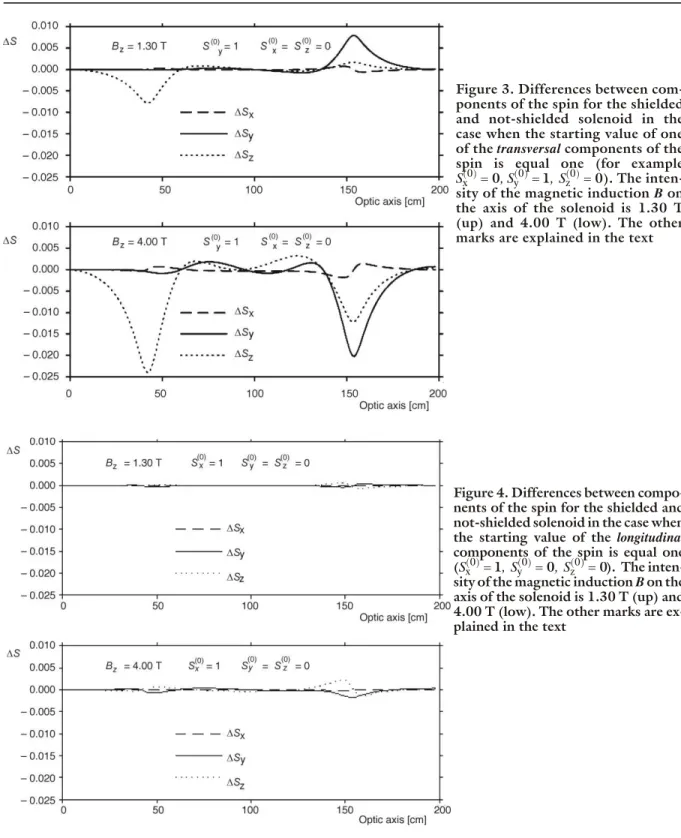
beam rms emittances in the transversal planes (x axis is the lon gi tu di nal di rec tion) and 0.5% mo men tum spread at half width. We have con sid -ered the case when the start ing value of one of the transversal com po nents of the spin equals one (for ex am ple, Sx( )0 =0,Sy( )0 =1,S( )z0 =0 see fig.,
3), as well as the one when the start ing value of the lon gi tu di nal com po nent of the spin equal ing one (S( )x0 =1, S( )y0 =0,Sz( )0 =0 see fig. 4). In,
figs. 3 and 4 the vari ables DS DS D
x, y,and Sz, are
de fined as the dif fer ences be tween cor re spond -ing com po nents of the spin for the shielded and not-shielded so le noid.
From figs. 3 and 4 it can be de duced that the in flu ence of the so le noid’s shield ing on spin track -ing does not dif fer at its en trance and exit. It is also pos si ble to con clude that the in flu ence of the
so le noid’s shield ing on spin track ing is di rectly pro por tional to the in ten sity of the mag netic in -duc tion B on the axis of the so le noid and that the in flu ence of the so le noid’s shield ing is much stron ger on the transversal com po nents of the spin com pared to the lon gi tu di nal one. The dif -fer ences be tween com po nents of the spin for the shielded and not-shielded so le noid fade with the in crease of the dis tance from the so le noid.
Fig ure 1. Sketch of the shielded so le noid. The di men -sions are in centrimeters
REF ER ENCES
[1] Dragt, A., Nu mer i cal Third-Order Transfer Map
for Solenoid, Nu clear In stru ments and Meth ods A
298, (1990), pp. 441-459
[2] Weidemann, H., Par ti cle Ac cel er a tor Phys ics II,
Springer Verlag, New York, 1994, Sec. 3
[3] Lee, S. Y., Ac cel er a tor Phys ics, World Sci en tific
Pub lish ing Co. Pte. Ltd. 1999, Sec. 6
[4] Xu, G., Trans fer Ma trix of Lin ear So le noid Fringe
Su per im pose Mag net, Phys. Rev. ST Accel. Beams, Vol. 7, 044001, 2004
[5] Bargmann, V., Michel, L., Telegdi, V. L., Pre ces sion
of the Po lar iza tion of Par ti cles Mov ing in a Ho mo
-ge neous Elec tro mag netic Field, Phys. Rev. Lett. 2
(1959), pp. 435-436
[6] Meot, F., A Numerical Method for Combined Spin
Track ing and Ray Track ing of Charged Par ti cles,
Nu clear In stru ments and Meth ods A 313 (1992),
pp. 492-500
[7] ***, POIS SON SUPERFISH (Eds. J. H. Billen,
L. M. Young), LAUR961834, Los Alamos Na -tional Lab o ra tory, USA, 2001
[8] ***, ZGOUBI User’s Guide, Ver sion 4.3 (Eds. F.
Meot, S. Valero), CEA DSM DAPNIA-02-395, 2002
po nents of the spin for the shielded and not-shielded so le noid in the case when the start ing value of one of the transversalcom po nents of the spin is equal one (for ex am ple
Sx(0)=0, Sy(0)=1, Sz(0)=0). The in ten
-sity of the mag netic in duc tion B on the axis of the so le noid is 1.30 T (up) and 4.00 T (low). The other marks are ex plained in the text
Fig ure 4. Dif fer ences be tween com po -nents of the spin for the shielded and not-shielded so le noid in the case when the start ing value of the lon gi tu di nal
com po nents of the spin is equal one (Sx(0)=1, Sy(0)=0, Sz(0)=0). The in ten
Dragan TOPREK
UTICAJ GVOZDENOG KU]I[TA SOLENOIDA NA ORIJENTACIJU SPINA
U radu je razmatran uticaj gvozdenog ku}i{ta solenoida na orijentaciju spina naelektrisane ~estice koja se kre}e kroz so le noid. Rezultati su dobijeni kori{}ewem ZGOUBI
programa, koji koristi numeri~ke metode zasnovane na razvoju u Tejlorov red, u slu~aju protona energije 200 MeV. Distribucija magnetnog poqa du` solenoida dobijena je kori{}ewem programa
POIS SON. Uticaj gvozdenog ku}i{ta solenoida na orijentaciju spina je ista, kako na ulazu, tako i na izlazu iz solenoida i direktno je proporcionalna intenzitetu magnetne indukcije du` ose solenoida. Uticaj ku}i{ta solenoida je mnogo ja~i na transverzalne komponente spina nego na longitudinalnu komponentu. Razlika u orijentaciji spina u slu~aju solenoida sa i bez ku}i{ta opada sa pove}awem rastojawa du` ose solenoida.