Share the Fame or Share the Blame? The Reputational
Implications of Partnerships
Luís Almeida Costa
yUniversidade Nova de Lisboa
Faculdade de Economia
[email protected]
Luís Vasconcelos
zUniversidade Nova de Lisboa
Faculdade de Economia
[email protected]
September 2008
Abstract
We use an adverse selection model to study the dynamics of …rms’ reputations when …rms implement
joint projects. We show that in contrast with projects implemented by a single …rm, in the case of joint
projects a …rm’s reputation does not necessarily increase following a success and does not necessarily decrease following a failure. We also study how reputation considerations a¤ect …rms’ decisions to
participate in joint projects. We show that a high quality partner may not be preferable to a low quality
partner, and that a high reputation partner is not necessarily preferable to a low reputation partner.
JEL classi…cation: L14, L15, L24, D82, D85.
Keywords: reputation, partnership, joint project, project performance, Bayesian updating
We would like to thank Adeline Delavande, Fabio Braggion, Heski Bar-Isaac, Iliyan Georgiev, Jon Levin, José Mata, Juan Carrillo, Pedro Santa-Clara, Ran Abramitzky, Ste¤en Hoernig and seminar participants at the London School of Economics, Tilburg University, Maastricht University, Universidade Nova de Lisboa, the 2007 International Industrial Organization Con-ference in Savannah, and the 2007 North American Summer Meetings of the Econometric Society in Duke for helpful comments and suggestions. Financial support of the Fundação para a Ciência e Tecnologia under grant POCI/EGE/58934/2004 and of Nova Forum is gratefully acknowledged.
yUniversidade Nova de Lisboa, Faculdade de Economia, Campus de Campolide, 1099-032 Lisboa, Portugal. Tel. (+351)213801600. E-mail: [email protected]
1
Introduction
Firms often engage in joint projects, i.e., projects that involve the contributions of two or more parties. In the case of a joint project, …rms are only partially responsible for the project and others may not be able to precisely evaluate each party’s contribution to the performance of the project. Consider, for example, the dispute between Ford and Firestone, following the deadly accidents involving Ford Explorers equipped with Firestone ATX tires in the summer of 2000. Was it merely a case of poor tires, as claimed by Ford, or was the design of the Explorer partly responsible for the accidents, as Firestone asserted? The strong controversy that surrounded this dispute and …rms’ attempts to pass the blame to their partner illustrate how di¢cult it is to assign responsibility for performance in joint projects. This di¢culty makes the reputational dynamics in the case of joint projects rather intricate. In this paper, we study the reputational implications of situations where two …rms implement a joint project, sharing the responsibility for its performance. In particular, we address the following questions: How do …rms’ reputations evolve following the implementation and performance of a joint project? How do the qualities and reputations of the potential partners a¤ect the decision to participate in joint projects? How do reputation considerations a¤ect the choice between individual and joint implementation of projects, when both alternatives are feasible?
Although most of the insights generated in this article apply to many di¤erent settings where reputation is important, for concreteness we focus on the situation where …rms produce “experience goods”, i.e., goods whose performance consumers can only infer after their purchasing decision. Formally, we consider an adverse selection model where …rms face the opportunity to implement a joint project through a partnership. We de…ne a partnership broadly as any situation where two or more parties contribute to the performance of a given project. Thus, our de…nition of partnership encompasses not only joint-ventures, but also vertical relationships where, for example, a …rm outsources the production of an important component of a product to another …rm as in the case of Ford and Firestone. In our model, …rms’ qualities are observable only by …rms. Consumers hold beliefs about …rms’ qualities. These beliefs are updated upon observing …rms’ decision to form a partnership and the performance of the jointly implemented project. We model a …rm’s reputation as the expected value of its quality, according to consumers’ beliefs. Firms’ reputations are crucial because consumers base their purchasing decisions on them. In contrast, …rms’ true qualities are important because they a¤ect the performance of the projects in which …rms participate and, thereby, …rms’ future reputations. We assume that consumers observe the identity of the …rm or …rms that implement a project. In our context, this means that …rms can associate their reputations (and qualities) to a project if and only
if they participate in the project.1
1An implication of this assumption is that the reputation and quality (or other fundamental characteristics) of a …rm are
We identify an important di¤erence between projects that are implemented jointly and projects that are implemented by a single …rm. Unlike the case of projects implemented by a single …rm, in the case of joint projects a …rm’s reputation may worsen following a success; conversely, a …rm’s reputation may improve following a failure. The intuition for these results is the following. Consider a partnership where one of the …rms contributes more to the implementation of the joint project than its partner. When updating their beliefs about …rms’ qualities, consumers will tend to attribute the responsibility for a success or a failure of the joint project mainly to that …rm. If partners’ qualities are perceived by consumers as being negatively correlated, a success of the joint project may then harm the reputation of the other …rm and a failure may enhance it. In our model this negative correlation is endogenously generated by the …rms’ equilibrium implementation strategy of the joint project.
Most of the analysis in the article focuses on projects that cannot be implemented by a single …rm. This corresponds to situations where …rms have complementary assets or capabilities. In such cases, …rms’ choice is between implementing the project through a partnership, or simply not pursuing the project. The dynamics of …rms’ reputations associated with joint implementation crucially depends on …rms’ equilibrium implementation decisions, as these decisions may signal information about …rms’ qualities to the market. We focus on equilibria in which …rms form a partnership and develop the joint project if and only if their qualities
are high.2 In these equilibria, a success of the joint project may a¤ect negatively the reputation of one of the
…rms. However, the overall impact of a success of the joint project on …rms’ reputations and future pro…ts is positive. Thus, if we de…ne the best partner as the one for which the increase in total pro…ts associated with a partnership is the largest, a high quality partner is preferable to a low quality partner. Regarding the desired reputation of a partner, we identify a basic trade-o¤. While a high reputation partner enhances the reputation of the joint project, such a partner tends to absorb most of the credit associated with a success and to be disregarded as responsible for a failure. As a result, the impact on a …rm’s reputation of having a high reputation partner may be negative. If the …rm’s future projects are su¢ciently important relative to the joint project, this negative reputational e¤ect may lead to lower total pro…ts. This implies that a high reputation partner is not necessarily preferable to a low reputation partner.
In the last part of the article, we relax the assumption that individual implementation of the project is not possible. This allows us to discuss the reputational trade-o¤s involved in the choice between individual and joint implementation. In such cases, a …rm that owns a project faces several implementation options. First, it may stretch its reputation to the new project, implementing it alone. Second, it may combine its reputation with that of another …rm, implementing the project through a partnership. Third, it may
2As we shall see, equilibria in which …rms develop the joint project if and only if their qualities are low exist in some cases.
fully associate the reputation (and quality) of another …rm to the project, by letting that …rm implement
the project alone. This may be accomplished by selling the project to that …rm.3 We …nd that when a
…rm is particularly concerned about its future reputation, the optimal implementation strategy is largely determined by the relative position of its quality and initial reputation. Speci…cally, if the …rm’s quality is substantially lower than its initial reputation, the …rm tends to protect its reputation by selling the project to another …rm. On the other hand, if the …rm’s quality is substantially higher than its initial reputation, the …rm tends to implement the project alone in order to prove its quality. Finally, if the …rm’s quality and initial reputation are close, the …rm is more prone to form a partnership. In such cases, the …rm is neither very reluctant to participate in new projects, nor very eager to implement them alone.
There is an important di¤erence between the case where only joint implementation is possible and the case where individual implementation is also possible. In the former case, …rms’ qualities are always substitutes, meaning that the higher the quality of a given …rm the lower the required quality of a partner for a partnership to be formed. In the latter case, …rms’ qualities may either be substitutes or complements, where complements means that the higher the quality of a given …rm the higher the required quality of a partner for a partnership to be formed. This di¤erence stems from the fact that, when individual implementation is possible, the higher the quality of a …rm the more attractive individual implementation by that …rm becomes. The fact that …rms’ qualities may be complements implies that …rms’ incentive to form a partnership may decrease when the quality of one of the …rms increases. Thus, a high quality partner is not necessarily preferable to a low quality partner. This result contrasts with that obtained for the case where individual implementation is not possible.
Related Literature. There are two approaches in the literature to the modeling of reputations. Fol-lowing the seminal article of Klein and Le-er (1981), several authors have developed moral hazard models of reputation, i.e., models where …rms’ actions are not observable, and analyze the conditions under which …rms have the incentive to exert costly e¤ort to develop or protect a valuable reputation (e.g., Shapiro, 1983; Tirole, 1996; Holmström, 1999; Hörner, 2002). A complementary research stream, which builds on the important articles of Kreps and Wilson (1982) and Milgrom and Roberts (1982), uses adverse selection models of reputation, i.e., models where there is incomplete information about …rms’ characteristics and reputation corresponds to others’ beliefs about those characteristics (e.g., Wernerfelt, 1988; Tadelis, 1999; Cabral, 2000). Ours in an adverse selection model of reputation.
The existing literature on reputation largely focuses on projects developed by a single entity, overlooking the reputational implications of shared responsibility. There are, however, some exceptions. Jeon (1996) analyzes parties’ incentives to exert e¤ort in situations of joint production when they are concerned with
3Since a …rm’s reputation and quality are nonseparable, the only way to fully associate another …rm’s reputation to the
their individual reputations, and compares how di¤erent organizational forms perform in solving the parties’ moral hazard problem. Bar-Isaac (2007) shows that the concern of a “senior” member about the reputa-tion of a professional partnership (or, more speci…cally, about the reputareputa-tion of a “junior” member) may
induce him/her to exert e¤ort when only the output of the partnership is observed.4 Anderson and Smith
(2006) study matching decisions when parties’ reputations are important, and show that positive assortative matching (in reputations) is generally not an equilibrium. An important di¤erence between our paper and Anderson and Smith (2006), as well as between our paper and Jeon (1996) and Bar-Isaac (2007), is that we consider a setting where …rms have better information about their qualities than the market. Thus, the contribution of our paper to this literature is to study the dynamics of …rms’ reputations when not only the performance of the joint project, but also …rms’ decision to implement it reveals information about …rms’ qualities to the market. In this setting, …rms’ implementation decisions of joint projects depend on the reputational implications (of both the implementation and the performance) of those projects, and, in turn,
these reputational implications depend on …rms’ implementation decisions.5
Our paper is related to the articles by Wernerfelt (1988), Cabral (2000) and Miklós-Thal (2008) on brand stretching and to the article by Tadelis (1999) on reputation as a tradeable asset. Wernerfelt (1988), Cabral (2000) and Miklós-Thal (2008) study a …rm’s choice between stretching its reputation to a new project through brand stretching and marketing the new project under a new brand. Tadelis (1999) focuses on situations where reputations are embedded in names and, as a result, the market for names corresponds to a market for reputations, and analyzes the incentives to buy a name and associate it with a project. These papers assume that reputation and quality are separable. We focus on situations where reputation
and quality are nonseparable and study the intermediate case where a …rm partially associates an existing
reputation to a new project by implementing it through a partnership. Furthermore, we analyze a …rm’s choice between stretching its reputation, combining its reputation with that of another …rm, and fully associating the reputation (and quality) of another …rm to the project.
Our paper is also related to the literature on multidimensional signalling (and multidimensional screening)
4Morrison and Wilhelm (2004) also study the incentives of partners to mentor juniors in order to protect the reputation
of a professional partnership. The authors focus on the aggregate reputation of the partnership, not on the reputation of its members. In their model, there is no role for individual reputations. This precludes them from analyzing the impact of joint projects on individual reputations, which is our concern here. Tirole (1996) does study the joint dynamics of individual and collective reputations when modeling the idea of group reputation as an aggregate of individual reputations. However, Tirole focuses on how individual members’ incentives (and actions) a¤ect individual and collective reputations, not on how collective actions (for which individual members are jointly responsible) a¤ect those reputations.
5In formalizing a theory of scapegoats, Segendor¤ (2000) shows that a leader may choose an incompetent co-worker so that
(e.g., Quinzii and Rochet, 1985; Wilson, 1985; Engers, 1987; Rochet and Chone, 1998). We assume that side payments between …rms are possible and, as a result, …rms maximize their joint pro…t. Hence, conceptually our problem is similar to that of a monopolist with private information about several characteristics which are unknown to consumers. The main concern in the literature on multidimensional signalling has been the existence and characterization of (fully) separating equilibria. In our model, such equilibria cannot exist because the characteristics about which …rms have private information (…rms’ qualities) are continuous and …rms’ signal space has two elements - to form a partnership or not to do so.
Plan of the Paper. This paper is organized as follows. In Section 2, we present the model. In Section 3, we analyze the impact of the performance of joint projects on partners’ reputations. In Section 4, we analyze …rms’ incentives to form partnerships and characterize all the reputational implications of those decisions. In this section, we focus on projects that cannot be implemented individually. In Section 5, we analyze the case of projects that can be implemented jointly or individually, and study the main reputational trade-o¤s involved in the choice between joint and individual implementation. In Section 6, we present concluding remarks.
2
Basic Model
Consider an economy with a continuum of …rms with measure one and two periods, period one and period two. At the beginning of period one a countable (i.e., measure zero) subset of the set of possible pairs of
…rms are endowed with ajoint project, which they may decide to implement or not. Joint projects can only
be implemented in period one and last one period if implemented. To capture the dynamic reputational e¤ects of implementing a joint project, we consider that each …rm in the economy is endowed with a basic
product that it sells individually in period two.6 Let …rm A and …rm B be a pair of …rms that is endowed
with a joint project. The implementation of the joint project requires the participation of both …rms.7
The required contribution of …rm A to the partnership is A 2 (0;1), which implies the complementary
contribution B = 1 Aof …rm B. Firms’ decision is whether or not to form a partnership and implement
the joint project in period one. We assume that side payments between …rms are possible. This implies that the division of surplus between …rms is immaterial to the decision to form a partnership and implement the joint project. Firms take the decision that maximizes their joint pro…t.
For concreteness, suppose that the joint project consists of producing and selling a new product. To push reputation to the fore, assume that both this product and …rms’ basic products are experience goods. Thus, consumers base their purchasing decisions on their expectations of the performance of the products.
6We could assume that …rms also sell their basic products in period one. However, this would unnecessarily complicate the
analysis of the basic model without bringing any additional insight.
We assume that each of the products either performs well or not. Consumers value the new (joint) product
V if it performs well, and 0 if otherwise. Similarly, consumers value …rmi’s basic product Vi if it performs
well, and 0 if otherwise, for alli2 fA,Bg. Throughout, we say that the joint project is a success if the joint
product performs well and a failure if it does not.8
Technology. Firms are endowed with qualities that a¤ect the performance of their products. More
speci…cally, …rmi’s quality,qi2[0;1], represents the probability that its products perform well. We assume
that the quality of the joint product, i.e., the probability that the joint product performs well, is a weighted average of the …rms’ qualities, where the weights are the …rms’ participation levels in the joint project. Thus,
the quality of the joint product given …rms’ qualitiesq (qA; qB), which we denote byqJ(q), is given by
qJ(q) = AqA+ BqB.9 (2.1)
Information. The following is common knowledge. Firms know their qualities. Speci…cally, each …rm knows its own quality and the quality of the potential partner. Consumers do not know …rms’ qualities.
They hold beliefs about these qualities. Consumers’ initial beliefs about …rmi’s quality, i.e., consumers’
beliefs about qi at the beginning of period one, are described by the (correct) prior Gi(qi) (with density
gi(qi)), for all i2 fA,Bg. Consumers may have di¤erent priors about …rms A and B, as the two …rms may
di¤er in dimensions (not explicitly modelled here) that are observable by consumers.10 We assume that
these priors are atomless distributions, thatgi(qi)>0 for allqi2[0;1]and i2 fA,Bg, and that consumers
initially perceive …rms’ qualities as independent. The prior joint distribution of …rms’ qualities is denoted
byG(q)(with density g(q)).
Consumers do not observe whether …rms are endowed with a joint project at the beginning of period one. However, they do observe …rms’ decision to form a partnership and implement a joint project. Thus, consumers only learn about the existence of a joint project in case it is implemented. At the end of period one, consumers observe the performance of the joint project in case …rms implemented it. We denote the
performance of the joint product by '2 ff; sg, where '=s if the joint project is a success, and'=f if
it is a failure. Joint product performance is public information. Although consumers know the identity of each partner and its required contribution to the partnership, they do not observe which …rm is responsible for a success or a failure of the joint project.
8In this model, a …rm’s production of a given product can be interpreted either as the situation where the …rm produces one
unit of the product or many units that perform equally.
9Alternatively, we could assume a more general functionq
J(q). As long as this function is increasing in qA andqB, the
characterization of the equilibria would not change. It should be noted, however, that to ensure the existence of some of the equilibria analyzed in the paper, continuity ofqJ(q)inqis required.
10Suppose, for example, that …rms in the economy are distributed in a two-dimensional space(q; ), where is observable
by consumers. Then, Gi(qi)corresponds to consumers’ (correct) prior about …rm i’s quality given i, for i 2 fA;Bg. The
Consumers update their beliefs about …rms’ qualities both after observing the implementation of the joint project and after observing its performance. Since consumers do not observe whether …rms have a joint project available and the set of …rms that have one is of measure zero, consumers’ posterior beliefs are equal to their prior beliefs if …rms do not implement the joint project. This is consistent with the fact that, in practice, consumers typically do not revise their perception about a …rm’s quality if they observe
that no (unexpected) partnership has been formed.11 We denote consumers’ beliefs after they observe the
formation of a partnership and the implementation of the joint project byH1(q)(with densityh1(q)) and call
them interim beliefs. Similarly, we denote consumers’ beliefs following the observation of the performance
of the joint project by H2(qj') (with density h2(qj')) and call themex-post beliefs. Consumers observe
the performance of the joint project at the end of period one, before they purchase …rms’ basic products in
period two.12
Reputation.We de…ne a …rm’s reputation as the expected value, from the consumers’ perspective, of the …rm’s quality given the information that consumers possess. In our context, a …rm’s reputation can be interpreted as the expected probability that the …rm’s products perform well.
There are three types of reputations that are relevant for decision making. First, the initial reputations,
which correspond to …rms’ reputations at the beginning of period one. The initial reputation of …rm i 2
fA;Bg, denoted byri, is the expected value of its quality according to consumers’ initial beliefsG(q). Second,
the interim reputations, which correspond to …rms’ reputations after consumers observe …rms’ decision to
form a partnership and implement the joint project. The interim reputation of …rm i 2 fA;Bg, denoted
byr0
i, is the expected value of its quality according to consumers’ interim beliefsH1(q). Third, theex-post
reputations, which correspond to …rms’ reputations at the beginning of period two, after consumers observe the formation of a partnership and the performance of the joint project. The ex-post reputation of …rm
i 2 fA;Bg, denoted by r00
i('), is the expected value of its quality according to consumers’ ex-post beliefs
H2(qj').
Expected Pro…ts. For simplicity, we assume that …rms’ production costs of the joint product and of their period two products are zero. Furthermore, we assume that the market is short on the sellers’ side and that consumers bid competitively for all the products. Thus, …rms’ pro…ts associated with a given product
11Consider, for example, the recent partnership between Harley Davidson and Porsche to produce the V-Rod motorcycle.
Suppose that, after considering the implementation of the project, the two companies had instead decided not to pursue it. If consumers were unaware that Harley Davidson and Porsche were considering such a project, it is unlikely that they would update their beliefs about …rms’ qualities following …rms’ decision not to implement it.
12The results in the paper hold if the measure of …rms that have a joint project available to be implemented in period one
correspond to the consumers’ willingness to pay for that product.13
Consumers’ willingness to pay for a product is given by their expected bene…t from consumption. Hence,
consumers’ valuation of the joint product when …rms implement it is the expected value of( AqeA+ BqeB)V
according to consumers’ interim beliefs.14 By de…nition of reputation, this is equal to
( ArA0 + BrB0 )V. (2.2)
In a similar way, consumers’ valuation of the basic product of …rm i 2 fA,Bg sold in period two is the
expected value ofqeiVi according to ex-post beliefs if …rms implement the joint project and to initial beliefs
if …rms do not implement the joint project. Thus, in case of implementation and performance'of the joint
project, this valuation is
r00
i(')Vi. (2.3)
In case of no implementation of the joint project this valuation isriVi.
When considering the decision to form a partnership, …rms compare their expected joint pro…t with and without implementation of the joint project. Since, in general, these pro…ts depend on …rms’ qualities, we
denote them by P(q)and 0(q), respectively. From (2.2) and (2.3) it follows that
P(q) = [ Ar0A+ BrB0 ]V +
X
i=A;B r00
i(f)Vi+qJ(q)
X
i=A;B
[r00
i(s) r00i(f)]Vi. (2.4)
The …rst term in (2.4) corresponds to the direct pro…ts from implementing the joint project. The second and third terms in (2.4) correspond to …rms’ expected pro…ts associated with selling their basic products in period two. Firms’ period two pro…ts depend on their ex-post reputations, which are the reputations
associated with a success of the joint project with probabilityqJ(q) and the reputations associated with a
failure with the complementary probability. Note that the qualities of …rms A and B do not a¤ect the pro…t associated with the joint project; they a¤ect pro…ts only by a¤ecting the performance of the joint project and, thereby, …rms’ future reputations.
By deciding not to implement the joint project, …rms forego the potential pro…t associated with it, but
insulate their reputations from the performance of the joint project.15 Firms’ joint pro…t associated with
not implementing the joint project is given by
0(q) =rAVA+rBVB. (2.5)
Equilibrium. We characterize …rms’ equilibrium decision of whether to form a partnership and
imple-ment the joint project for …xed initial beliefs. We denote …rms’ strategy by (q), which represents the
13As, for example, in Tadelis (1999) and Cabral (2000), this assumption allows us to ignore signalling through prices. This
allows us to focus on the decision to form a partnership.
14Throughout the paper we use tilde signs to denote random variables.
15This closely parallels Cabral (2000), where the reputation of an existing brand remains unchanged if the …rm decides not
probability that they form a partnership given their qualities. We assume that …rms form a partnership if
and only if P(q)> 0(q). Thus, as a tie-breaking rule we assume that …rms do not form a partnership if
P(q) = 0(q). We use Bayesian Equilibrium as the equilibrium concept. In equilibrium, …rms’ decision
of whether to form a partnership and implement the joint project maximizes their joint pro…t given their future reputations, and …rms’ future reputations are Bayesian consistent with …rms’ strategy regarding the decision to form a partnership and implement the joint project.
3
Joint Project Performance and Reputation
In this section, we characterize the impact of the performance of the joint project on …rms’ reputations, taking …rms’ decision to implement it and consumers’ interim beliefs as given. This is only a …rst step in our analysis. In Section 4, we then consider all the reputational implications of implementing the joint project by endogenizing …rms’ implementation decision and, therefore, consumers’ interim beliefs.
Suppose that at the beginning of period one …rms A and B formed a partnership and implemented the joint project. Following the observation of the performance of the project at the end of the period, consumers
update their beliefs about …rms’ qualities. They do so by applying Bayes’ rule to interim beliefsH1(q). Thus,
consumers’ ex-post beliefs satisfy
h2(qj') = Z Pr['jq]h1(q)
Pr['jbq]dH1(bq)
(3.1)
for all'2 ff; sg, wherePr['=sjq] =qJ(q)andPr['=f jq] = 1 qJ(q)represent, respectively, the
prob-ability that the joint project succeeds and the probprob-ability that it fails. Using (3.1) one can characterize the impact of the performance of the joint project on …rms’ reputations. Lemma 1 o¤ers a useful characterization of …rms’ ex-post reputations, relating them to the interim reputations.
Lemma 1 The ex-post reputations of …rm i2 fA;Bg in case of a success ('=s) and of a failure ('=f) of the joint project are such that
r00
i(s) r0i=
ivar(qei) + (1 i)cov(eqA;qeB)
r0
J
; (3.2)
r00
i(f) ri0=
ivar(eqi) + (1 i)cov(eqA;eqB)
1 r0
J
(3.3)
and
r00
i(s) r00i(f) =
ivar(qei) + (1 i)cov(qeA;qeB)
r0
J(1 r0J)
, (3.4)
wherer0
J= ArA0 + Br0B, andvar(eqi)andcov(eqA;eqB)are, respectively, the variance ofqeiand the covariance
Proof. See Appendix A.2.
Lemma 1 characterizes the updating that takes place on …rms’ reputations when consumers observe the performance of a joint project. In particular, it emphasizes that the change in a …rm’s reputation depends on consumers’ perceived variance of its quality, as well as on consumers’ perceived correlation between its quality and the quality of the partner (captured in (3.2)-(3.4) by the covariance term). Note that even if consumers initially perceive …rms’ qualities as not correlated, this is not necessarily the case after they observe that a partnership has been formed.
When consumers’ interim beliefs are such that the correlation between …rms’ perceived qualities is non-negative, (3.2) and (3.3) reveal that …rms’ reputations necessarily increase with a success of a joint project
and decrease with a failure.16 Observe, however, that if consumers’ interim beliefs are such that …rms’
qualities are negatively correlated, the numerator in (3.2)-(3.4) may eventually be negative. This raises the
possibility that a …rm’s reputationdecreases with a success of a joint project andincreases with a failure.
One important question is whether such an updating may occur in equilibrium when …rms’ decisions to form partnerships are taken into account. We next analyze this issue among others.
4
Partnership Formation and Reputation Dynamics
In this section, we analyze …rms’ decision to form a partnership and the evolution of …rms’ reputations following this decision. We take into account both the signalling e¤ect of the decision to form a partnership and the e¤ect of the performance of the joint project on …rms’ reputations.
In equilibrium, consumers’ beliefs about …rms’ qualities must be consistent with …rms’ strategy (q).
Thus, in equilibrium, consumers’ interim beliefs result from applying Bayes rule to initial beliefsG(q). That
is, consumer’s interim beliefs must satisfy
h1(q) =
(q)g(q)
Z
(qb)dG(bq)
. (4.1)
Clearly, these beliefs may di¤er from consumers’ initial beliefs. Intuitively, this is because …rms’ decision to form a partnership may signal information about their qualities to consumers. By a¤ecting interim beliefs,
16This is the case, for example, when consumers’ interim beliefsH
1(q)are such that …rms’ qualities are independent. In this
case,cov(qeA;qeB)in Lemma 1 is0, which implies thatr00i(s)> r0i,r00i(f)< ri0and, consequently,ri00(s)> ri00(f)for alli2 fA;Bg.
Note that the case where consumers’ interim beliefsH1(q)are such that …rms’ qualities are independent comprises the case
this signalling e¤ect also a¤ects ex-post beliefs. Indeed, from (4.1) and (3.1) it follows that consumers’ ex-post beliefs must satisfy
h2(qj') =
Pr['jq] (q)g(q)
Z
Pr['jqb] (qb)dG(bq)
: (4.2)
From (4.1) and (4.2) it is immediate that …rms’ interim and ex-post reputations critically depend on …rms’
equilibrium strategy (q). Thus, one cannot study the reputational implications of joint projects without
analyzing …rms’ equilibrium decisions regarding the implementation of such projects.
Equipped with the above characterization of consumers’ interim and ex-post beliefs, we now investigate how …rms’ qualities a¤ect their decision to form a partnership and implement the joint project. When deciding whether to form a partnership and implement the joint project, …rms consider two main e¤ects. While the implementation of the joint project allows …rms to capture the pro…ts associated with this project, it also a¤ects …rms future reputations and thereby their future pro…ts. The …rst e¤ect is always non-negative. The second e¤ect may be negative or positive.
As it is typically the case in signalling games, there always exists a pooling equilibrium in which …rms
A and B abstain from implementing the joint project regardless of their qualities, i.e., in which (q) = 0
for all q2[0;1]2. This equilibrium exists because the notion of Bayesian equilibrium does not impose any
restriction on beliefs associated with zero-probability events. In our case, if we make consumers’ beliefs su¢ciently unfavorable to …rms in the event they implement the joint project, we can support a pooling equilibrium in which …rms never implement it. In this equilibrium, …rms’ reputations remain unchanged but would be very low in the event they decided to implement the joint project. A well-known problem of this type of equilibrium is that it crucially relies on the arbitrary assumption of “su¢ciently unfavorable” beliefs o¤-the-equilibrium path. Because of this arbitrariness and the fact that in our model consumers’ beliefs determine …rms’ reputations, which are the major driver of …rms’ decisions, we ignore this equilibrium in
the remainder of the paper. In fact, this equilibrium is not a universally divine equilibrium.17
We now focus on equilibria with implementation of the joint project, i.e., equilibria in which at least some (types of) …rms A and B form a partnership and implement the joint project. If the value of the joint
projectV is su¢ciently high relative to the values of …rms’ future projectsVA andVB (and of course …rms’
17To be more precise, this equilibrium does not survive the Universal Divinity criterion (criterion D2) in a discretized version
of the model where there is a …nite (although possibly arbitrarily large) number of …rms’ types – i.e., …rms’ qualities – which includes types 0 and 1. In each iteration, criterion D2 eliminates a quality vector (qA; qB) di¤erent from (0,0) and (1,1).
Intermediate vectors are eliminated, rather than those with the lowest combined quality AqA+ BqB because, as we shall
interim reputations are bounded away from 0), …rms will have the incentive to form a partnership regardless of their qualities. This is because …rms’ direct pro…t associated with the joint project will always o¤set …rms’ eventual losses in future projects due to reputational implications of the joint project. To make this claim
more precise, letV denote the value ofV that satis…es the following condition,
V( ArA+ BrB) =
X
i=A;B
ivar(qei)
(1 ArA BrB)
Vi, (4.3)
where var(qei)corresponds to the variance of eqi according to consumers’ initial beliefsG(q). Then, we can
state the following.
Proposition 1 A pooling equilibrium in which …rms form a partnership and implement the joint project independently of their qualities exists if and only ifV > V .
Proof. See Appendix A.2.
In this equilibrium, …rms’ decision to form a partnership and implement the joint project is uninformative about …rms’ qualities. Since no signalling e¤ect exists, consumers update their beliefs about …rms’ qualities only after observing whether the joint project was a success or a failure. Furthermore, since consumers’ interim beliefs and initial beliefs are identical and consumers’ initial beliefs are that qualities are uncorrelated, in this equilibrium a success (resp. failure) of the joint project always increases (resp. decreases) both …rms’
reputations. Condition V > V ensures that the joint project is implemented when both …rms have the
lowest possible quality, i.e., whenqi= 0for alli2 fA;Bg. The left-hand side of condition (4.3) corresponds
to …rms’ pro…t associated with the joint project. The right-hand side represents …rms’ future losses (in their basic products) triggered by the ex-post reputation implications of the performance of the joint project, when both …rms have the lowest possible quality. Since the probability of success of the joint project increases with …rms’ qualities and, in this equilibrium, a success of the joint project increases …rms’ reputations, when
V > V all …rms are better o¤ implementing the joint project.
We devote the remainder of this section to the analysis of joint projects with valueV V . ForV V ,
…rms’ direct pro…t associated with the joint project is no longer su¢cient to always compensate …rms’ eventual losses in future projects due to reputational implications of the joint project. Consequently, no equilibrium where …rms form a partnership and implement the joint project regardless of their qualities exists. In such cases, the only equilibria with implementation of the joint project are semiseparating equilibria, i.e., equilibria where some but not all (types of) …rms A and B form a partnership. As we will see below, these equilibria
emerge because …rms with a di¤erent combined quality AqA+ BqBmay have a di¤erent incentive to form
a partnership.
and (ii) under some conditions, a semiseparating equilibrium where …rms implement the joint project i¤ their combined quality is below a threshold quality level (lower quality partners equilibrium) exists.
Proof. See Appendix A.2.
Proposition 2 identi…es two types of equilibria: higher quality partners equilibria and lower quality partners equilibria. Higher quality partners equilibria correspond to situations where the impact of the performance of the joint project on …rms’ reputations is such that a success leads to a higher future joint pro…t than does a failure. In this case, …rms implement the project whenever they can guarantee a success with a su¢ciently high probability. Since the probability of success increases with …rms’ qualities, for a given quality of one of the …rms, …rms implement the joint product when the quality of the other …rm is su¢ciently high. Technically, this equilibrium emerges because …rms’ expected joint pro…t from implementing the joint project satis…es the single-crossing property with respect to qualities. In our context, this means that …rms’ incremental gain from implementing the joint project increases with …rms’ qualities. An immediate implication is that low quality …rms do not have the incentive to imitate high quality …rms and implement the joint project.
Bayesian updating by consumers implies only that the reputation of one of the …rms in the partnership
increases with a success of the joint project and decreases with a failure. In fact, it may happen that
the reputation of the other …rmdecreases with a success of the joint project andincreases with a failure.
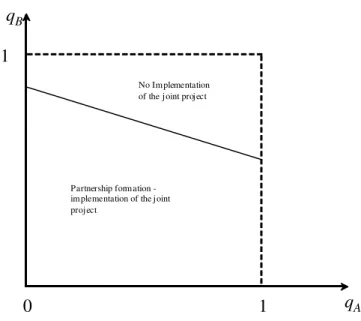
The idea that a …rm’s reputation may decrease following a success of a project in which it participates and increase following a failure may seem somewhat counter-intuitive. One typically expects that being associated with a successful event is better in terms of reputation than being associated with an event that is perceived as a failure. To understand these results let us go back to our model. For concreteness, consider the case of …rm A and assume that its participation level in the partnership is low. In case of a success of the joint project, consumers infer that …rm B (the one whose contribution to the project is high) has a high quality. Moreover, following implementation of the joint project, consumers perceive …rms’ qualities as negatively correlated, as implementation occurs more often when …rms’ qualities are signi…cantly di¤erent (i.e., one is high and the other low) than when they are similar. This negative correlation is endogenously generated by the implementation strategy itself, since by assumption …rms’ qualities are initially perceived
as independent.18 If this negative correlation is su¢ciently high (in absolute value), consumers infer that
…rm A has a low quality. In case of a failure of the joint project, a similar reasoning would lead to the
opposite conclusion.19
18In Miklós-Thal (2008) in equilibrium brand stretching introduces endogenous positive correlation between the quality of
the new product and the quality of the initial product, even if qualities were initially perceived as independent. In contrast, in our model the endogenous quality correlation generated in equilibrium by the decision to form a partnership is negative.
19The reputational consequences for Health Maintenance Organizations (HMOs) of the release in 2002 of the movie “John Q”
In a higher quality partners equilibrium, a success of the joint project may have a negative e¤ect on the reputation of one of the …rms. However, if this negative e¤ect is present it is always dominated by the positive e¤ect of a success on the other …rm’s reputation. Hence, a higher combined quality implies a higher expected joint pro…t. We next present an example of a higher quality partners equilibrium where the reputation of one of the …rms (…rm A) decreases following a success of the joint project and increases following a failure. Because of its extreme simplicity, we provide here an example with two-type …rms.
Example 1 Suppose that qi 2 f0;1g and that consumers initially believe that qi = 1 with probability pi,
for alli2 fA; Bg. In this two-type case, a …rm’s reputation is the consumers’ perceived probability that the …rm is of quality 1. Thus, pi is the initial reputation of …rm i. Consider now an implementation strategy
where …rms implement the joint project i¤q2 f(1;0);(0;1);(1;1)g, i.e., they abstain from implementing the joint project only if both have quality 0. Given this strategy, Bayesian updating implies that …rmi’s interim reputation satis…es r0
i = pi=(pA+pB pApB), for all i 2 fA; Bg. In a similar way, Bayesian updating
implies that …rmi’s ex-post reputations satisfy
r00
i(f) =
jpi(1 pj)
BpA(1 pB) + A(1 pA)pB
and r00
i(s) =
ipi(1 pj) +pApB
ApA(1 pB) + B(1 pA)pB+pApB
, (4.4)
wherej2 fA; Bg withj6=i, for alli2 fA; Bg.
Let pA =pB = 1=2. From (4.4), it follows that r00i(s) < ri00(f) if and only if i < 1=3. Suppose, for
concreteness, that A= 1=4. In this case, …rms’ interim reputations are identical,r0i= 2=3 fori2 fA; Bg,
…rm A’s ex-post reputations arer00
A(f) = 3=4>5=8 =rA00(s), and …rm B’s ex-post reputations arer00B(f) = 1=4
< 7=8 = r00
B(s). Given these interim and ex-post reputations and the fact that …rms’ reputations remain
unchanged if they do not implement the joint project, it can easily be veri…ed that when, for example,V = 1, VA = 2 and VB = 5, …rms are (strictly) better o¤ implementing the joint project precisely if and only if
q2 f(1;0);(0;1);(1;1)g.
Lower quality partners equilibria correspond to situations where a success of the joint project has a negative impact on …rms’ joint pro…t. This is the case because the negative e¤ect of a success of the joint project on the reputation of one of the …rms exists and dominates the positive e¤ect of a success on the other …rm’s reputation. Since …rms have a higher joint pro…t when the joint project fails than when it succeeds,
…rms with high qualities are more reluctant to implement the joint project than …rms with low qualities. As in higher quality partners equilibria, here …rms’ expected joint pro…t from implementing the joint project satis…es the single-crossing property with respect to qualities. In this case, however, …rms’ incremental gain from implementing the joint project decreases with …rms’ qualities. Lower quality partners equilibria may provide an explanation for the fact that …rms may implement joint projects of moderate value even when
their qualities are low and there is a good chance that the project fails.20
We identi…ed all possible types of equilibria. In our setting, there are only two possible types of semi-separating equilibria, higher quality partners equilibria and lower quality partners equilibria, depending on whether a success of the joint project has a positive or negative impact on …rms’ future pro…ts. It follows from Propositions 1 and 2 that a higher quality partners equilibrium always exists when an equilibrium in which …rms implement the joint project regardless of their qualities does not. Proposition 2 also states that there are situations where a lower quality partners equilibrium exists. Note, however, that a lower quality
partners equilibrium in which the reputation of …rm i 2 fA;Bg decreases following a success of the joint
project can exist only if i< Vi=(VA+VB). Furthermore, a lower quality partners equilibrium can exist only
if the value of the joint project V is strictly positive. Indeed, whenV is zero only higher quality partners
equilibria exist among those equilibria with implementation of the joint project.21
In a lower quality partners equilibrium, …rms are better o¤ if the joint project fails than if it succeeds. Since partners typically have the possibility to in‡uence the performance of a joint project, the fact that …rms are better o¤ if the joint project fails than if it succeeds suggests the possibility of sabotage, i.e., the
possibility that partners may make the joint project fail on purpose.22 When sabotage is possible, lower
quality partners equilibria do not exist. To see why this is the case consider the following. Suppose that a lower quality partners equilibrium exists and sabotage is possible. In such an equilibrium, all …rms that implement the joint project will sabotage it. Thus, a failure of the joint project is no longer informative about …rms’ qualities and …rms’ joint pro…t under implementation of the joint project is independent of their qualities. It follows that either all pairs of …rms or no pair of …rms implement the joint project. This leads to a contradiction, since by de…nition in a lower quality partners equilibrium no full pooling exists.
In the remainder of this section, we focus on higher quality partners equilibria. When V < V , higher
quality partners equilibria are the only equilibria with implementation of the joint project that are
sabotage-free; they are also the only universally divine equilibria that are sabotage-free.23
20In the equilibrium identi…ed in Proposition 1, low quality …rms also implement the joint project. However, such an
equilibrium exists only if the value of the joint project is high enough to o¤set the negative reputational e¤ect associated with its failure.
21For a formal proof of these results see Appendix A.2.
22Although sabotage is unlikely to occur in some situations because of ethical or legal reasons (e.g., medical doctors performing
a surgery together), in most cases it is certainly a real possibility.
In a higher quality partners equilibrium, …rms’ qualities are substitutes, in the sense that the marginal rate at which …rms’ qualities can be exchanged so that their incentives to form a partnership remain constant is negative. This is because …rms want to ensure a success of the joint project with a certain probability. Thus, the higher the quality of a given …rm, the lower the minimum required quality of the partner. More speci…cally, the rate at which …rms’ qualities can be substituted so that the joint project is implemented depends on the required contributions of …rms A and B to the partnership. This rate, which is given by
A= B (or equivalently by A=(1 A)), is increasing (in absolute value) in …rm A’s contribution A.
This implies that the higher A, the higher the increment in …rm B’s quality required to compensate for a
given reduction in …rm A’s quality for the project to be implemented.
We now characterize how a partnership a¤ects the evolution of …rms’ reputations in a higher quality partners equilibrium. Although the impact of a success or a failure of the joint project on …rms’ reputations has already been discussed, for completeness we include this result in Proposition 3. In Proposition 3, we also characterize the impact of the decision to form a partnership on …rms’ reputations, and the combined impact of the decision to form a partnership and of the performance of the joint project on …rms’ reputations.
Proposition 3 In any higher quality partners equilibrium (i) …rms’ reputations (weakly) increase following the decision to implement the joint project, (ii) a …rm’s reputation may increase or decrease following a success or a failure of the joint project, and (iii) …rms’ reputations following a success of the joint project are higher than their initial reputations.
Proof. See Appendix A.2.
The …rst part of Proposition 3 compares …rms’ interim and initial reputations. The di¤erence between them is that interim reputations incorporate the signalling e¤ect associated with the decision to implement the joint project. Since in a higher quality partners equilibrium …rms implement the joint project if and only
if their qualities are relatively high, the decision to implement the joint project signals high quality.24 This
explains why …rms’ interim reputations are higher than their initial reputations. Thus, the decision to form a partnership and implement the joint project signals high quality. The second part of the Proposition, which compares a …rm’s ex-post and interim reputations, highlights an important di¤erence between joint projects and projects implemented by a single …rm. While in the case where a …rm implements a project alone its reputation always increases following a success and decreases following a failure, in the case where a …rm implements a project through a partnership the opposite may happen. The third part of the Proposition relates …rms’ ex-post and initial reputations. The di¤erence between the two re‡ects the combined impact of
there are situations where it is unique. This is the case, for example, whenGA andGB are uniform distributions and …rms’
contributions to the partnership are identical (i.e., A= B= 1=2).
24The only possible case of a higher quality partners equilibrium in which …rms’ reputations do not strictly increase following
the signalling e¤ect associated with the decision to form a partnership and of the e¤ect of the performance of the joint project on consumers’ beliefs. The Proposition states that when the e¤ect of a success of the joint project on a …rm’s reputation is negative, this e¤ect is dominated by the positive signalling e¤ect.
We now study how …rms’ initial reputations a¤ect the impact of a partnership on …rms’ joint pro…t and, therefore, the decision to form a partnership. By a¤ecting the reputation with which the joint project is launched, a …rm’s reputation has an obvious positive impact on …rms’ joint pro…t under a partnership. However, a …rm’s reputation may also have a negative impact on its partner’s reputation and, thereby, on joint pro…t. This is so because the higher the …rm’s reputation, the more consumers will tend to give this …rm the credit in case of a success of the joint project and to disregard its responsibility in case of a failure. Proposition 4 captures this e¤ect by showing that a …rm may be more demanding in terms of a partner’s quality when the partner’s reputation is high than when it is low. For convenience, we focus on the higher quality partners equilibrium in which the set of …rms’ qualities for which a partnership is formed
is the greatest.25 In our setting, this corresponds to the higher quality partners equilibrium with the lowest
combined quality threshold above which …rms form a partnership.
Proposition 4 A higher reputation of one of the …rms may increase the lowest combined quality threshold level above which …rms implement the joint project in a higher quality partners equilibrium.
Proof. See Appendix A.2.
An immediate consequence of Proposition 4 is that …rms’ joint pro…t under a partnership and, as a result, …rms’ incentive to form a partnership do not necessarily increase with the reputation of a given partner. A partner’s reputation has a positive or negative impact on joint pro…ts depending on the relative strength of the two e¤ects mentioned above. In particular, when the other …rm’s future projects are su¢ciently important relative to the joint project, the second e¤ect is likely to dominate.
The results presented in this section have important implications for partner selection in situations where individual implementation of the joint project is not possible. The existing literature on partner selection largely focuses on …rms’ need to access complementary assets or on organizational learning as the key
deter-minants of partner selection (e.g., Geringer, 1988; Hittet al, 2000). In contrast, we take complementarity as
given and analyze how the quality and reputation of the potential partners a¤ect the dynamics of reputation formation and, thereby, …rms’ incentives to form a partnership. We de…ne a partnership broadly as any situation where two or more parties contribute to the performance of a given project. Thus, our results apply, for example, not only to partner selection in joint-ventures, but also to the selection of trading part-ners such as retailers or suppliers. In our setting, the best partner is the one for which the increase in total pro…ts associated with a partnership is the largest. In a higher quality partners equilibrium, a higher quality
25We say that a setS
partner is always preferable to a lower quality partner. This is because a success of the joint project leads to a higher future joint pro…t than a failure and the probability of success increases with …rms’ qualities. However, a higher reputation partner is not always preferable to a lower reputation partner, because the impact on a …rm’s reputation of having a higher reputation partner may be negative.
5
Individual
vs.
Joint Implementation
In this section, we assume that the joint project may be implemented not only jointly but also by either of
the two …rms alone.26 This allows us to analyze the main reputational trade-o¤s associated with the choice
between joint and individual implementation of a project.
When individual implementation is possible, the best alternative to a partnership may be implementation by a single …rm. If this is the case, an increase in the quality of that …rm a¤ects not only …rms’ joint pro…t under a partnership, but also under the best alternative to a partnership. As shown below, this introduces two main di¤erences relative to the results presented in Section 4. First, in a higher quality partners equilibrium, where a success of the joint project leads to a higher joint pro…t than a failure, an increase in …rms’ combined
quality may decrease …rms’ incentive to form a partnership. Second, …rms’ qualities may be complements,
meaning that at the margin a higher quality …rm may require a higher quality partner to form a partnership. In general, a …rm that has the opportunity to develop a new project faces di¤erent implementation options. First, the …rm may stretch its reputation to the new project, by implementing it alone. This may be accomplished by marketing the product resulting from the project under the …rm’s existing brand, a practice that has been designated as “brand stretching” or “umbrella branding” (e.g., Wernerfelt, 1988; Cabral, 2000). In addition, the …rm may combine its reputation with that of another …rm, by implementing the project through a partnership. Finally, the …rm may associate the reputation (and quality) of another …rm to the project, by selling the project to that …rm, who would implement it alone. In our setting, a …rm’s reputation and quality are nonseparable. Hence, the only way to fully associate the reputation of another …rm to the new project is by letting that …rm implement the project alone.
The decision of how to implement the joint project involves a basic trade-o¤. Through individual imple-mentation, …rms associate the reputation of one of them to the project. However, doing so may create too much “exposure” for that …rm, as it is fully responsible for the performance of the project. Thus, even if the reputation of, let us say, …rm A is high and can therefore be used to boost consumers’ perceptions of the project, individual implementation by …rm B and joint implementation have the advantage of allowing …rm
A to insulate its reputation fully or partially from the performance of the project.27
26In spite of the fact that in this section the period one project may be implemented by either of the two …rms alone, for
convenience we continue to call it the joint project.
Throughout this section, we continue to assume that only a subset of measure zero of the set of possible pairs of …rms are endowed with a joint project at the beginning of period one. We also assume that a subset of positive measure of those …rms that are not endowed with a joint project are endowed with an individual project that they always implement. Thus, while consumers do not expect …rms to form partnerships and implement joint projects in period one, they do expect …rms to implement individual projects. Moreover, since …rms always implement their individual projects, a …rm’s reputation does not change following the
decision to implement an individual project.28 Finally, we assume that consumers are unable to distinguish
a …rm’s individual project from a joint project that is implemented individually by the …rm. This assumption, together with the fact that …rms are expected to implement individual projects (but not joint projects) with positive probability imply that after observing a …rm implementing a project alone consumers always infer that it is an individual project of that …rm. This means that, from a reputational point of view, consumers treat joint projects implemented by a single …rm as individual projects of that …rm, and so do we in this section.
Since we are interested in analyzing …rms’ decisions to form partnerships, we consider the case of two …rms that are endowed with a joint project at the beginning of period one. We denote them by …rm A and …rm B. For simplicity, we consider throughout this section the case where only …rm A is endowed with a basic product in period two. Thus, the performance of the joint project is relevant only to the extent that it may a¤ect …rm A’s ex-post reputation. As before, we assume that if …rms A and B form
a partnership to implement the joint project, they do so with exogenous participation levels A and B.
Firms’ implementation decision is denoted by 2 fA; B; Pg, where =Aif …rm A implements the project
alone, =B if …rm B implements the project alone, and =P if …rms form a partnership.
We now study how …rms’ qualities a¤ect the implementation decision of the joint project. We start by characterizing the best alternative to a partnership. In our setting, if …rm B implements the joint project alone, it associates its reputation to the joint project and …rm A associates its reputation – which remains
unchanged – to its period two product. Thus, …rms’ joint pro…t isrBV+rAVA. This is greater than the joint
pro…t in the situation where the joint project is not implemented, which isrAVA. Thus, the best alternative
agents, who are concerned with their reputations, to pool their productions by forming a team, when they could continue to produce separately. As in our case, the decision to work jointly (rather than remain separate) allows agents to mitigate the impact of their own performance on their reputation. While in Lang (2003) forming a partnership is a signal of quality because teaming costs decrease with qualities, we consider that partnership formation is cost neutral. In our case, forming a partnership is a signal of quality because quality a¤ects performance, which in turn a¤ects future reputations.
28The assumption that …rms always implement individual projects simpli…es the analysis, but is not crucial to obtain the
to a partnership is either implementation by …rm A alone or implementation by …rm B alone.
Lemma 2 The best alternative to a partnership is implementation by …rm A alone if
qA rA+
rA(1 rA)
var(eqA)VA
(rB rA)V qA; (5.1)
where var(qeA) is the variance of qeA according to the prior GA( ). Otherwise, the best alternative to a
partnership is implementation by …rm B alone.
Proof. See Appendix A.2.
Condition (5.1) highlights the main trade-o¤s involved in the choice between individual implementation by …rm A or by …rm B. One the one hand, …rms take into account the pro…ts associated with the joint project.
If V is high, the reputation with which the project is launched is important. This favors implementation
by the …rm with the highest reputation. On the other hand, …rms take into account the impact of the performance of the joint project on the future reputation of …rm A, which a¤ects its period two pro…t. If …rm A has a high quality and implements the joint project, a success occurs with high probability. This implies an improvement in the reputation of …rm A. In contrast, if …rm A has a low quality and implements the joint project the reverse happens. Hence, a high quality of …rm A favors individual implementation by …rm A relative to individual implementation by …rm B, and vice-versa.
We now study …rms’ choice between individual implementation of the joint project (…rm A or …rm B) and joint implementation through a partnership. An implementation strategy of the joint project by …rms A and
B is a mapping (q; )that for each quality vectorq assigns …rms’ probability of choosing implementation
form 2 fA; B; Pg.
As in the case where only joint implementation of the project is possible (Section 4), here there also exists an equilibrium in which …rms never form a partnership. Again, this equilibrium exists because the notion of Bayesian equilibrium does not impose any restriction on beliefs associated with zero-probability events. Thus, making consumers’ beliefs su¢ciently unfavorable to …rms in the event they form a partnership, we can support an equilibrium in which …rms never implement the joint project jointly.
Proposition 5 states that when individual implementation of the joint project is also possible there exists no equilibrium where …rms implement the joint project through a partnership regardless of their qualities.
Proposition 5 Suppose that the joint project can be implemented either through a partnership or individu-ally. Then, a pooling equilibrium in which …rms form a partnership independently of their qualities does not exist.
Proof. See Appendix A.2.
The result in Proposition 5 contrasts with that in Proposition 1, where we establish that when only joint
joint project regardless of their qualities. When only joint implementation is possible, the only alternative to a partnership is not to implement the project at all. This creates pressure on …rms to form a partnership to appropriate the high value generated by the joint project. In contrast, when individual implementation is possible …rms can capture the pro…ts associated with the joint project without forming a partnership.
We now analyze semiseparating equilibria. Again, we focus on higher quality partners equilibria, where …rms are better o¤ if a joint project that is implemented through a partnership succeeds than if it fails. As in Section 4, lower quality partners equilibria, where …rms are better o¤ if a joint project that is implemented through a partnership fails than if it succeeds, do not exist if sabotage is possible.
In contrast with Section 4, here the characterization of equilibria depends on whether the best alternative
to a partnership is individual implementation by …rm A (i.e.,qA> qA) or by …rm B (i.e.,qA< qA).
Proposition 6 Suppose that the joint project can be implemented either through a partnership or individually and consider any higher quality partners equilibrium. For qA< qA, …rms form a partnership if and only if
their combined quality AqA+ BqB is above a threshold quality level. ForqA> qA, such threshold quality
levels no longer exist, since …rms’ incentive to form a partnership may decrease as …rms’ combined quality increases.
Proof. See Appendix A.2.
For qA < qA, the characterization of higher quality partners equilibria is similar to that in the case
where individual implementation is not possible: …rms form a partnership whenever their combined quality
is su¢ciently high. ForqA > qA, …rms’ decision to form a partnership is no longer characterized by such a
cuto¤ rule in terms of …rms’ combined qualities.
The intuition is the following. In a higher quality partners equilibrium, the joint pro…t under a partnership
is increasing in …rms’ combined quality. For qA < qA, the best alternative to a partnership is individual
implementation by …rm B. As in the case where individual implementation is not possible, the joint pro…t under the best alternative to a partnership is independent of …rms’ qualities. Thus, the higher the …rms’
combined qualities the higher their incentives to form a partnership. ForqA> qA, the joint pro…t under the
best alternative to a partnership (individual implementation by …rm A) is increasing in …rm A’s quality. This implies that an increase in …rms’ combined quality – which may involve, for example, a signi…cant increase
inqA and a decrease inqB – no longer implies that …rms’ incentive to form a partnership increases. Indeed
it may decrease.
Proposition 6 implies that, for qA< qA, qualities are always substitutes, in the sense that the marginal
rate at which …rms’ qualities can be exchanged so that their incentive to form a partnership remains constant
is negative. More speci…cally, this rate is A= B, which is the rate at which qualitiesqA and qB can be
in the sense that the marginal rate at which …rms’ qualities can be exchanged so that their incentive to form
a partnership remains constant is positive. WhenqA> qA, an increase in …rm A’s quality increases the joint
pro…t under the best alternative to a partnership, individual implementation by …rm A. Thus, the marginal rate at which …rms’ qualities can be exchanged so that their incentive to form a partnership remains constant
is greater whenqA> qAthan whenqA< qA. It may even happen that when …rm A’s quality increases, …rm
B’s quality also has to increase for …rms’ incentive to form a partnership to remain constant. In Example 2, we present a higher quality partners equilibrium where this is the case.
The fact that in a higher quality partners equilibrium qualities may be complements implies that …rms’
incentive to form a partnership may decrease when the quality of one of the …rms increases. Thus, when
both individual and joint implementation of the joint project are possible, a higher quality partner is not
necessarily preferable to a lower quality partner.29 This contrasts with the results obtained in Section 4
for the case where individual implementation is not possible. In that case, qualities are always substitutes and in a higher quality partners equilibrium a higher quality partner is always preferable to a lower quality partner.
Example 2 Suppose that …rms’ qualities, as initially perceived by consumers, are uniformly distributed, i.e., gi(qi) = 1 for all qi 2 [0;1], i2 fA; Bg. Suppose also that A = 0:95, B = 0:05, V = 0 and VA = 20.
In this case, qA = rA = 0:5. The following strategy constitutes a higher quality partners equilibrium: (i)
if qA 0:5, form a partnership if 0:95qA+ 0:05qB > 0:1943 and let …rm B implement the joint project
alone if otherwise; and (ii) if qA > 0:5, form a partnership if qB 12:4917qA > 11:860 and let …rm A
implement the joint project alone if otherwise. In this equilibrium, the decision to form a partnership is a good signal of …rms’ qualities – …rm A’s and …rm B’s initial reputations are 0.5, whereas their interim reputations in the event a partnership is formed are 0:5811and 0:5111, respectively. Further, following the formation of a partnership, …rm A’s ex-post reputation is 0:4589 if the joint project fails and 0:6706 if it succeeds. Finally, when …rms choose individual implementation (either by …rm A or by …rm B), their initial and interim reputations are identical (and equal to 0.5), and only the ex-post reputation of the …rm that implements the project is a¤ected by the project’s performance. This reputation is 2/3 if the project performs well, and 1/3 if it does not. The equilibrium implementation strategy of the joint project is represented in Figure 1.
In this example, since the value of the joint project is zero, the implementation decision of the joint project is important only because it a¤ects …rm A’s future reputation. In the example, qualities are complements
29Segendor¤ (2000) obtains a similar result. Segendor¤ shows that a competent leader may choose an incompetent co-worker
1
q
Aq
B0
1
REGION 2: Im plem entation
through a Partnership
q* A=rA=1/2 REGION 1:
Individual Im plem entation
by Firm B REGION 3:Individual Im plem entation
By Firm A
Figure 1: A higher quality partners equilibrium when individual implementation is feasible.
when …rm A’s quality is high. The intuition is the following. When …rm A has a high quality, the best alternative to a partnership is individual implementation by …rm A. In addition, the higher the quality of …rm A, the more attractive this alternative becomes relative to a partnership. Since in this equilibrium …rms’ pro…t from a partnership increases with …rm B’s quality, the higher the quality of …rm A the higher the required quality of …rm B for a partnership to be formed.
In Figure 1, we can identify three regions in the space of …rms’ qualities. Each region corresponds to a di¤erent implementation decision of the joint project. In Region 1, …rm B implements the joint project alone. In this region, since …rm A’s quality is relatively low and this …rm is the major contributor to the partnership ( A= 0:95), the probability of success of the joint project is low both when …rm A implements the project