Article
J. Braz. Chem. Soc., Vol. 24, No. 6, 895-903, 2013. Printed in Brazil - ©2013 Sociedade Brasileira de Química
0103 - 5053 $6.00+0.00
A
http://dx.doi.org/10.5935/0103-5053.20130115*e-mail: [email protected]
Green and Selective Synthesis of N-Substituted Amides using
Water Soluble Porphyrazinato Copper(II) Catalyst
Sara S. E. Ghodsinia,
aBatool Akhlaghinia,*
,aElham Safaei
band Hossein Eshghi
aa
Department of Chemistry, Faculty of Sciences, Ferdowsi University of Mashhad,
9177948974 Mashhad, Islamic Republic of Iran
b
Department of Chemistry, Institute for Advanced Studies in Basic Sciences (IASBS),
45137-66731 Zanjan, Islamic Republic of Iran
N,N’,N’’,N’’’-Tetrametil tetra(2,3-piridil)porfirazinato metil sulfato de cobre(II) ([Cu(2,3-tmtppa)](MeSO4)4) catalisou com sucesso a conversão direta de nitrilas a amidas
N-substituídas. A síntese seletiva do tipo one pot de amidas N-substituídas a partir de nitrilas e aminas primárias foi realizada em refluxo de água. O catalisador foi recuperado e reusado no mínimo 4 vezes, mantendo a sua eficiência.
N,N’,N’’,N’’’-Tetramethyl tetra-2,3-pyridinoporphyrazinato copper(II) methyl sulfate ([Cu(2,3-tmtppa)](MeSO4)4) efficiently catalyzed the direct conversion of nitriles to N-substituted
amides. The one pot selective synthesis of the N-substituted amides from nitriles and primary amines was performed in refluxing H2O. The catalyst was recovered and reused at least four times,
maintaining its efficiency.
Keywords: [Cu(2,3-tmtppa)](MeSO4)4, N-substituted amide, nitrile, amine
Introduction
Amide bond formation is a fundamental reaction
of great interest in organic and bioorganic chemistry,
peptides and proteins include these bonds. Synthesis
of
N
-alkyl amides has been of great interest because
they are versatile synthetic intermediates used in the
manufacture of several pharmacological products,
polymers, detergents, lubricants and drug stabilizers,
as well as key structural motifs present in numerous
natural products.
1-5Current popular synthesis strategies
of amides are the reaction of amines with carboxylic
acids, transamidation of amides with amines, or with
the reaction of carboxylic acid derivatives such as acyl
halides, anhydrides, esters and other activated species
usually in the presence of coupling reagents.
6-27Reactions
promoted by coupling reagents are fundamental in organic
synthesis. The majority of amide bond syntheses is
merely stoichiometric, making these methods generally
expensive and wasteful procedures.
28As the society needs
forward-looking environmentally acceptable technology,
the development of catalytic reactions that use
transition-metal complex catalysts under neutral and mild reaction
conditions is particularly important. These criteria include
atom efficiency, formation of little inorganic waste, and
selective synthesis of desired products, encouraging an
effort towards using environmentally friendly catalytic
processes that will not produce such waste. The conversion
of aldehydes,
29-36oxime
34,37-46and nitriles
47-54constitute
effective methods to access amides.
31,55-61A little-known reaction which yields amides is
the hydrolytic amidation of nitriles with amines. A
platinum and an iron catalysts were found to perform the
coupling.
53,54Nitriles can also be coupled with alcohols
to form amides in the Ritter reaction. As an alternative
to sulfuric acid, the Ritter reaction can be catalyzed
by metal complexes such as bismuth triflate
62and iron
complexes.
63Our group recently reported that [Cu(2,3-tmtppa)]
(MeSO
4)
4(
N,N’,N’’,N’’’
-tetramethyl
tetra-2,3-pyridino-porphyrazinato copper(II) methyl sulfate) could be used as
catalyst for protection of hydroxyl and carbonyl groups.
64-66Green and Selective Synthesis of N-Substituted Amides using Water Soluble Porphyrazinato Copper(II) Catalyst J. Braz. Chem. Soc.
896
Experimental
General
The products were purified by column chromatography.
The purity determinations of the products were accomplished
by thin layer chromatography (TLC) on silica gel polygram
STL G/UV 254 plates. The melting points of the products
were determined with an Electrothermal type 9100 melting
point apparatus. The Fourier transform infrared (FTIR)
spectra were recorded on an Avatar 370 FTIR Therma
Nicolet spectrometer. The nuclear magnetic resonance
(NMR) spectra were provided on Brucker Avance 100 and
400 MHz instruments in CDCl
3. Elemental analyses were
performed using an Elementar Vario EL V5.19.1121 and
Thermofinnigan Flash EA 1112 Series instruments.
Mass spectra (MS) were recorded with a Shimadzu
GC-MS-QP5050 and CH7A Varianmat Bremem instruments
at 70 eV. The known products were characterized by
FTIR and
1H NMR spectra and comparisons of their melting
points (or those of the derivatives) were done with authentic
samples. The catalyst was prepared and purified by the
method described in the literature.
67-69Results and Discussion
The optimization of the reaction conditions was carried
out for the reaction of phenylacetonitrile with benzylamine
in the presence of [Cu(2,3-tmtppa)](MeSO
4)
4under various
reaction parameters in order to achieve the maximum
chemical yield at the lowest reaction time and lowest
reaction temperature. The general reaction is outlined
in Scheme 2 and the representative results are shown in
Table 1.
In the absence of any catalyst, there was no conversion to
N
-benzyl-2-phenylacetamide (Table 1, entries 1, 20 and 21).
In solvent free condition and applying different molar ratios
of phenylacetonitrile, benzylamine, [Cu(2,3-tmtppa)]
4+was
identified as a catalyst for
N
-benzyl-2-phenylacetamide
formation but in prolonged reaction time and low yield
(Table 1, entries 2-5). In an effort to develop better
reaction conditions, different solvents were screened for
the preparation of
N
-benzyl-2-phenylacetamide from the
reaction of phenylacetonitrile with benzylamine in the
presence of 0.5 mol% of [Cu(2,3-tmtppa)](MeSO
4)
4. No
product was obtained when the reaction was performed in
dimethyl sulfoxide (DMSO), dimethylformamide (DMF),
CH
2Cl
2and Et
2O (Table 1, entries 6-9). The catalytic effect
of [Cu(2,3-tmtppa)](MeSO
4)
4was efficiently decreased in
aprotic polar solvents such as DMSO and DMF because
of the strong coordination of solvent with Cu
II. As shown
in Table 1, when the reaction was performed in refluxing
1,4-dioxane and H
2O,
N
-benzyl-2-phenylacetamide
was obtained in good to excellent yields. To improve
amide formation, the effect of different molar ratios
of phenylacetonitrile, benzylamine was examined in
1,4-dioxane and H
2O (Table 1, entries 10-19). Also, the
effect of temperature was studied in 1,4-dioxane and
H
2O. No conversion was observed when the reaction was
carried out at room temperature (Table 1, entries 22-23).
It seems that the temperature is an important factor in the
preparation of
N
-benzyl-2-phenylacetamide. The best
results were obtained in 1,4-dioxane, H
2O, toluene and
tetrahydrofuran (THF) (Table 1, entries 10-19,25-26).
Because of safety, economic and handling considerations,
H
2O was chosen for further experiments. Maximum yield
was observed in refluxing H
2O with a 1:2 molar ratio of
phenylacetonitrile:benzylamine (Table 1, entry 18). To
investigate the effect of catalyst loading, the formation of
N
-benzyl-2-phenylacetamide was carried out in refluxing
H
2O in the presence of 1 mol% of catalyst. According to
this study, increasing the catalyst loading did not lead to
higher conversion (Table 1, entry 24). It is noteworthy
that no evidence for reaction of phenylacetonitrile with
water was observed in the absence of benzylamine and
any tendency between phenylacetonitrile and H
2O can be
prohibited (Table 1, entry 27).
To explore the generality and scope of the
N
-substituted
amides formation catalyzed by [Cu(2,3-tmtppa)](MeSO
4)
4,
the optimized reaction conditions (1:2 molar ratio of
nitrile:amine, 0.5 mol% catalyst, refluxing H
2O) were used
for the synthesis of a series of amide derivatives (Table 2).
According to the results obtained (Table 2),
N-
substituted
amides were prepared from the reaction of aromatic and
aliphatic nitriles with primary aliphatic amines in the
Ghodsinia et al. 897 Vol. 24, No. 6, 2013
presence of [Cu(2,3-tmtppa)](MeSO
4)
4in high isolated
yields. The mechanism of this transformation is unclear. On
the basis of proposed mechanism in Scheme 3, the catalytic
activity of [Cu(2,3-tmtppa)](MeSO
4)
4could well be attributed
to the Lewis acidity of the complex. The catalytic reaction
of alkyl and aryl nitriles with primary amines was achieved
by refluxing aqueous solution of the corresponding nitriles,
in the presence of 0.5 mol% [Cu(2,3-tmtppa)](MeSO
4)
4,
which initially generates the nitrile bound copper species
I. This idea is supported by performing the reaction in the
absence of catalyst. Without any catalyst, the reaction is not
completed even after long period of time (Table 1, entries 1,
20 and 21). Nucleophilic attack of primary amines to I affords
intermediate II, which upon reaction with H
2O, produces
hydrolyzed product III. The formation of II and III was
confirmed by the fact that nucleophilic attack of amine can
be catalyzed by [Cu(2,3-tmtppa)](MeSO
4)
4, according to the
result obtained from Table 1, entry 27
(any tendency between
nitrile compound and H
2O can be prohibited). Copper
complex III produces
N
-substituted amide with concomitant
loss of an ammonia molecule. Finally, the regeneration of
catalyst initiates a second catalytic cycle. Nevertheless, at
this time, there is no experimental evidence for I, II and
III formation
and
action in this manner. However, further
Table 1. Synthesis of N-benzyl-2-phenylacetamide in the presence of 0.5 mol% of [Cu(2,3-tmtppa)](MeSO4)4 in various solvents, different molar ratios and different temperatures
entry Molar ratio
(phenylacetonitrile:benzylamine) Solvent Temperature / ºC time / h Isolated yield / %
1a 1/1 none 90 30 0
2 1/1 none 90 32 60
3 1/1.5 none 90 30 65
4 1/1.7 none 90 27 68
5 1/2 none 90 24 68
6 1/1 DMSO 90 24 0
7 1/1 DMF 90 24 0
8 1/1 CH2Cl2 reflux 24 0
9 1/1 Et2O reflux 24 0
10 1/1 1,4-dioxane reflux 30 80
11 1/1.5 1,4-dioxane reflux 25 85
12 1/1.7 1,4-dioxane reflux 22 90
13 1/2 1,4-dioxane reflux 20 95
14 1/2.2 1,4-dioxane reflux 20 98
15 1/1 H2O reflux 23 85
16 1/1.5 H2O reflux 23 90
17 1/1.7 H2O reflux 22 95
18 1/2 H2O reflux 19 98
19 1/2.2 H2O reflux 19 97
20a 1/2 1,4-dioxane reflux 20 0
21a 1/2 H
2O reflux 20 0
22 1/2 1,4-dioxane rt 20 0
23 1/2 H2O rt 20 0
24b 1/2 H
2O reflux 19 98
25 1/2 toluene reflux 19 98
26 1/2 THF reflux 23 90
27 1/0 H2O reflux 20 0
aThe reaction was performed in the absence of catalyst; bthe reaction was performed in the presence of 1 mol% of catalyst.
Green and Selective Synthesis of N-Substituted Amides using Water Soluble Porphyrazinato Copper(II) Catalyst J. Braz. Chem. Soc.
898
Table 2. Synthesis of different structurally N-substituted amides in the presence of [Cu(2,3-tmtppa)](MeSO4)4
entry Nitrile Amine Product time / h Yield / %
1 19 98
2 24 92
3 15 95
4 22 83
5 17 90
6 14 85
7 24 98
8 11 98
9 13 92
Ghodsinia et al. 899 Vol. 24, No. 6, 2013
entry Nitrile Amine Product time / h Yield / %
11 16 90
12 19 90
13 14 92
14 17 91
15 16 92
16 15 90
17 18 96
18 10 97
19 15 98
20 12 97
Green and Selective Synthesis of N-Substituted Amides using Water Soluble Porphyrazinato Copper(II) Catalyst J. Braz. Chem. Soc.
900
entry Nitrile Amine Product time / h Yield / %
21 13 95
22 15 93
23 17 95
24 24 73
25 23 78
Table 2. continuation
mechanistic studies are required to confirm this mechanism.
The catalytic activity of [Cu(2,3-tmtppa)](MeSO
4)
4was examined for the reaction of alkyl and aryl nitriles with
Scheme 3. A proposed mechanism for the formation of N-substituted amides.
Ghodsinia et al. 901 Vol. 24, No. 6, 2013
[Cu(2,3-tmtppa)](MeSO
4)
4acts as a recyclable catalyst
for one pot amide formation from various nitriles and
primary amines in refluxing H
2O, which provides a new and
green catalytic system for
N
-substituted amide synthesis.
The catalyst can be easily recovered from the reaction
mixture by extraction of organic compounds (3 × 5 mL
CH
2Cl
2). The aqueous layer was evaporated and the catalyst
was washed with CH
2Cl
2three times to remove the products
followed by drying in air at room temperature. Using this
treatment, the recyclabilty of the catalsyt was evaluated
for the reaction of phenylacetonitrile with benzyl amine
(Table 3). The recovered catalyst was reused at least four
times without any decrease in the yield of the
N
-benzyl-2-phenylacetamide. The 5
thrun gave 95% conversion
after 19 h, but complete conversion and similar yield was
obtained after 25 h.
The results obtained (Table 2) clearly demonstrate that
this method is inapplicable to synthesis of primary and
N,N-
disubstituted amides. The catalytic activity of
[Cu(2,3-tmtppa)](MeSO
4)
4in this reaction is selective.
In our experiments, the completion of the reaction
was confirmed by the disappearance of the nitrile on TLC
followed by the disappearance of CN stretching frequency
at 2230 cm
-1in the FTIR spectra. Also, absorption bands
at 1677-1612 and 3396-3284 cm
-1due to carbonyl and NH
group of
N
-substituted amide in FTIR spectra confirmed the
amide formation. In the
1H NMR spectrum, the NH proton of
N-
substituted amide showed a downfield shift as compared
to the NH
2protons of amine. In the
13C NMR spectrum, a
signal at 173-161 ppm is assigned to the quaternary carbonyl
carbon. The structure of all products was further confirmed
by mass spectroscopy and CHN analysis.
Conclusions
In this study, our group not only investigated another
catalytic activity of [Cu(2,3-tmtppa)](MeSO
4)
4in organic
synthesis, but also introduced an efficient, clean, convenient,
practical and selective synthesis of
N
-substituted amides
from the reaction of alkyl and aryl nitriles with amines in
green solvent.
This process is attractive in comparison with the
conventional methods because this method offers several
advantages: (
i
) the reaction proceeds smoothly and
selectively with a wide range of amides (aliphatic and
aromatic
N
-substituted); (
ii
) the catalyst is stable and
reusable that offers easy handling and simple work-up;
(
iii
) this method has satisfactory yields of a variety of
amides;
49(
iv
) in contrast to the previously reported catalytic
systems, which proceeded by hydration of nitrile to the
primary amide and subsequent transamidation with amine,
in the present method, amides are produced by direct
reaction of nitriles with amines; (
v
) in comparison with
the previous methods, nitriles are storage-stable and less
corrosive substrates.
Supplementary Information
Supplementary data and spectra of the synthesized
compounds are available free of charge at http://jbcs.sbq.org.br
as PDF file.
Acknowledgment
The authors gratefully acknowledge the partial support
of this study by Ferdowsi University of Mashhad Research
Council (Grant No. p/3/20196).
References
1. Carey, J. S.; Laffan, D.; Thomson, C.; Williams, M. T.; Org. Biomol. Chem. 2006, 4, 2337.
2. Zabicky, J.; The Chemistry of Amides; Wiley: New York, USA, 1970.
3. Greenberg, A.; Breneman, C. M.; Liebman, J. F.; The Amide LinkageStructural Significance in Chemistry Biochemistry and Materials Science; Wiley: New York, USA, 2000.
4. Deopura, B. L.; Gupta, B.; Joshi, M.; Alagirusami, R.;
Polyesters and Polyamides; CRC Press: Boca Raton, FL, USA, 2008.
5. Johansson, I.; Kirk-Othmer Encyclopedia of Chemical Technology, vol. 2; Wiley: New York, USA, 2004, p. 442. 6. Benz, G. In Comprehensive Organic Synthesis, vol. 6; Trost,
B. M.; Fleming, I., eds.; Pergamon: Oxford, UK, 1991, p. 381. 7. Larock, C.; Comprehensive Organic Transformations, 2nd ed.;
Wiley-VCH: New York, USA, 1999, p.1932.
8. Naik, S.; Bhattacharjya, G.; Talukdar, B.; Patel, B. K.; Eur. J. Org. Chem. 2004, 1254.
9. Katritzky, A. R.; He, H. Y.; Suzuki, K.; J. Org. Chem. 2000,65, 8210.
Table 3.Reaction of phenylacetonitrile with benzylamine in the presence of reused catalyst
entry time / h Conversion / % Isolated yield / %
1 19 100 98
2 19 100 98
3 19 100 95
4 19 100 97
5a 25/19 100/95 95
6a 25/19 100/95 96
Green and Selective Synthesis of N-Substituted Amides using Water Soluble Porphyrazinato Copper(II) Catalyst J. Braz. Chem. Soc.
902
10. Katritzky, A. R.; Cai, C.; Singh, S. K.; J. Org. Chem. 2006, 71, 3375.
11. Hosseini-Sarvari, M.; Sharghi, H.; J. Org. Chem. 2006, 71, 6652.
12. Shekhar, A. C.; Kumar, A. R.; Sathaiah, G.; Paul, V. L.; Sridhar, M.; Rao, P. S.; Tetrahedron Lett. 2009, 50, 7099. 13. Kim, J. G.; Jang, D. O.; Synlett. 2000, 1231.
14. Ranu, B. C.; Dutta, P.; Synth. Commun. 2003, 33, 297. 15. Arora, R.; Paul, S.; Gupta, R.; Can. J. Chem. 2005, 83, 1137.
16. Maki, T.; Ishihara, K.; Yamamoto, H.; Org. Lett. 2006, 8, 1431.
17. Al-Zoubi, R. M.; Marion, O.; Hall, D. G.; Angew. Chem., Int. Ed. 2008,47, 2876.
18. Marcelli, T.; Angew. Chem., Int. Ed. 2010, 49, 6840.
19. Charville, H.; Jackson, D.; Hodge, G.; Whiting, A.; Chem. Commun. 2010, 46, 1813.
20. Arnold, K.; Batsanov, A.S.; Davies, B.; Whiting, A.; Green Chem. 2008, 10, 123.
21. Starkov, P.; Sheppard, D. T.; Org. Biomol. Chem. 2011,9, 1320. 22. Stephenson, N. A.; Zhu, J.; Gellman, S. H.; Stahl, S. S.; J. Am.
Chem. Soc. 2009, 131, 10003.
23. Hoerter, J. M.; Otte, K. M.; Gellman, S. H.; Cui, Q.; Stahl, S. S.;
J. Am. Chem. Soc. 2008, 130, 647.
24. Hoerter, J. M.; Otte, K. M.; Gellman, S. H.; Stahl, S. S.; J. Am. Chem. Soc. 2006,128, 5177.
25. Kissounko, D. K.; Hoerter, J. M.; Guzei, I. A.; Cui, Q.; Gellman, S. H.; Stahl, S. S.; J. Am. Chem. Soc. 2007, 129,1776. 26. Eldred, S. E.; Stone, D. A.; Gellman, S. H.; Stahl, S. S.; J. Am.
Chem. Soc. 2003, 125,3422.
27. de Oliveira, V. M.; de Jesus, R. S.; Gomes, A. F.; Gozzo, F. C.; Umpierre, A. P.; Suarez, P. A. Z.; Rubim, J. C.; Neto, B. A. D.;
ChemCatChem2011, 3, 1911.
28. Constable, D. J. C.; Dunn, P. J.; Hayler, J. D.; Humphrey, G. R.; J. L.; Linderman, R. J.; Lorenz, K.; Manley, J.; Leazer, B. A.; Pearlman, Wells, A.; Zaks, A.; Zhang, T. Y.; Green Chem. 2007,
9, 411.
29. Hamid, M.; Allen, C. L.; Lamb, G. W.; Maxwell, A. C.; Maytum, H. C.; Watson, A. J. A.; Williams, J. M. J.; J. Am. Chem. Soc.
2009, 131, 1766.
30. Ekoue-Kovi, K.; Wolf, C.; Chem. Eur. J.2008, 14, 6302. 31. Suto, Y.; Yamagiwa, N.; Torisawa, Y.; Tetrahedron Lett. 2008,
49, 5732.
32. Qian, C.; Zhang, X.; Zhang, Y.; Shen, Q.; J. Organomet. Chem.
2010, 695, 747.
33. Naota, T.; Murahasi, S. I.; Synlett1991, 693.
34. Gunanathan, C.; Ben-David,Y.; Milstein, D.; Science2007, 317, 790.
35. Nordstrom, L. U.; Vogt , H.; Madsen, R.; J. Am. Chem. Soc.
2008, 130, 17672.
36. Zhang, Y.; Chen, C.; Ghosh, S. C.; Li, Y.; Hong, S. H.;
Organometallics2010, 29, 1374.
37. Hyan, D.; Jang, C. D. O.; Tetrahedron Lett. 2004, 45, 2285. 38. Fujiwara, H.; Ogasawara, Y.; Kotani, M.; Yamaguchi, K.;
Mizuno, N.; Asian J. Chem. 2008, 3, 1715.
39. Gnanamgari, D.; Crabtree, R. H.; Organometallics2009, 28, 922.
40. Owston, N. A.; Parker, A. J.; Williams, J. M. J.; Org. Lett. 2007,
9, 3599.
41. Owston, N. A.; Parker A. J.; Williams, J. M. J.; Org. Lett. 2007,
9, 73.
42. Ramon, R. S.; Bosson, J.; Diez-Gonzalez, S.; Marion, N.; Nolan, S. P.; J. Org. Chem. 2010, 75, 1197.
43. Ali, M. A.; Punniyamurthy, T.; Adv. Synth. Catal. 2010, 352, 288.
44. Allen, C. L.; Burel, C.; Williams, J. M. J.; Tetrahedron Lett.
2010, 51, 2724.
45. Kim, M.; Lee, J.; Lee, H. Y.; Chang, S.; Adv. Synth. Catal. 2009,
351, 1807.
46. Gnanamgari, D.; Crabtree, R. H.; Organometallics2009, 28, 922. 47. Fujiwara, H.; Ogasawara, Y.; Yamaguchi, K.; Mizuno, N.;
Angew. Chem., Int. Ed. 2007, 46, 5202.
48. Shie, J. J.; Fang, J. M.; J. Org. Chem. 2003, 68, 1158. 49. Tamura, M.; Tonomura, T.; Shimizu, K-I.; Satsuma, A.; Appl.
Catal., A2012,417, 6.
50. Murahashi1, Sh. I.; Takaya, H.; Naota,T.; Pure Appl. Chem. 2002, 74, 19.
51. Dijk, A. J. M.; Heyligen, T.; Duchateau, R.; Meuldijk, J.; Koning, C. E.; Chem. Eur. J.2007, 13, 7664.
52. Rousselet, G.; Capdeviclle, P.; Maumy, M.; Tetrahedron Lett.
1993,34, 6395.
53. Liana Allen, C.; Lapkin , A. A.; Williams, J. M. J.; Tetrahedron Lett.2009,50, 4262.
54. Cobley, Ch. J.; Heuvel, M.; Abbadi , A.; Vries, J. G.; Tetrahedron Lett.2000, 41, 2467.
55. Perreux, L.; Loupy, A.; Volatron, F.; Tetrahedron 2002, 58, 2155.
56. Wu, X.; Wannberg, J.; Larhed, M.; Tetrahedron 2006, 62, 4665. 57. Sureshbabu, V. V.; Hemantha, H. P.; ARKIVOC 2008, 2, 243. 58. Moorthy, J. N.; Singhal, N. J.; Org. Chem. 2005, 70, 1926. 59. Kabalka, G. W.; Despande, S. M.; Wadgaonkar, P. P.; Synth.
Commun. 1990, 20, 1445.
60. Yasushi Imada,Y.; Shibata, O.; Murahashi, S. I.; J. Organomet. Chem. 1993, 451, 183.
61. Allen, C. L.; Williams, J. M. J.; Chem. Soc. Rev. 2011, 40, 3405. 62. Callens, E.; Burton, A. J.; Barrett, A. G. M.; Tetrahedron Lett.
2006, 47, 8699.
63. Anxionnat, B.; Guerinot, A.; Reymond, S.; Cossy, J.;
Tetrahedron Lett. 2009, 50, 3470.
64. Akhlaghinia, B.; Asadi, M.; Safaei, E.; Heydarpoor, M.;
J. Porphyrins Phthalocyanines2004, 8, 1285.
65. Akhlaghinia, B.; Asadi, M.; Safaei, E.; Heydarpoor, M.;
Ghodsinia et al. 903 Vol. 24, No. 6, 2013
66. Akhlaghinia, B.; Tavakoli, S.; Asadi, M.; Safaei, E.;
J. Porphyrins Phthalocyanines 2006, 10, 167.
67. Smith, T. D.; Livorness, J.; Taylor, H.; J. Chem. Soc., Dalton Trans. 1983, 7, 1391.
68. Marti, C.; Nonell, S.; Nicolau, M.; Torres, T.; Photochem. Photobiol.2000, 71, 53.
69. Thamae, M.; Nyokong, T.; J. Electroanal. Chem. 1999,470, 126.
Supplementary Information
S
I
J. Braz. Chem. Soc., Vol. 24, No. 6, S1-S72, 2013.Printed in Brazil - ©2013 Sociedade Brasileira de Química 0103 - 5053 $6.00+0.00
*e-mail: [email protected]
Green and Selective Synthesis of
N
-Substituted Amides using
Water Soluble Porphyrazinato Copper(II) Catalyst
Sara S. E. Ghodsinia,
aBatool Akhlaghinia,*
,aElham Safaei,
band Hossein Eshghi
aa
Department of Chemistry, Faculty of Sciences, Ferdowsi University of Mashhad,
9177948974 Mashhad, Islamic Republic of Iran
b
Department of Chemistry, Institute for Advanced Studies in Basic Sciences (IASBS),
45137-66731 Zanjan, Islamic Republic of Iran
Experimental
General
The products were purified by column chromatography.
The purity determinations of the products were
accomplished by thin layer chromatography (TLC)
on silica gel polygram STL G/UV 254 plates. The
melting points of products were determined with an
Electrothermal Type 9100 melting point apparatus. The
Fourier transform infrared (FTIR) spectra were recorded
on an Avatar 370 FTIR Therma Nicolet spectrometer. The
nuclear magnetic resonance (NMR) spectra were provided
on Brucker Avance 100 and 400 MHz instruments in CDCl
3.
Elemental analyses were performed using an Elementar,
Vario EL V5.19.1121 and Thermofinnigan Flash EA 1112
Series instruments. Mass spectra (MS) were recorded with a
Shimadzu GC-MS-QP5050 and CH7AV arianmat Bremem
instruments at 70 eV.
Preparation of N-benzyl-2-phenylacetamide from phenyl acetonitrile and benzylamine (1)
To a solution of phenylacetonitrile (0.1171 g, 1 mmol)
in H
2O (1 mL), [Cu(2,3-tmtppa)](MeSO
4)
4(0.0054 g,
0.5 mol%) was added at room temperature with continuous
stirring. Benzylamine (0.2143 g, 2 mmol) was added with
stirring at room temperature. The temperature was raised
up to 100 °C. The progress of the reaction was followed
by TLC. Upon completion of the reaction, the reaction
mixture was extracted with 3 × 5 mL CH
2Cl
2. The organic
layer was dried with anhydrous Na
2SO
4and concentrated
under reduced pressure. The resultant crude viscous product
was recrystallized from
n
-hexane:dichloromethane (4:1)
obtaining 0.2207 g of pale yellow crystals (98% yield).
Characterization data of spectra for representative compounds
N-Benzyl-2-phenylacetamide(1)
mp 118-120 °C (lit. 118-120 °C);
1FTIR (KBr)
ν
max/cm
-13289 (N
−
H), 3080, 3062, 3030, 2917, 1638 (C=O), 1551,
1493, 1453, 1028, 771, 694;
1H NMR (400 MHz, CDCl
3
)
d
/ppm 7.34-7.24 (m, 9H, ArH), 7.17 (d, 1H,
J
4.76 Hz,
ArH), 6.06 (br, 1H, NH), 4.42 (d, 2H,
J
5.6 Hz, CH
2NH),
3.61 (s, 2H, CH
2CO);
13
C NMR (100 MHz, CDCl
3
)
d
/ppm
170.6, 137.5, 135.0, 129.6, 129.6, 128.9, 128.8, 127.3,
126.7, 43.9, 42.9.
N-(2-Methoxybenzyl)-2-phenylacetamide(2)
mp 88-90 °C; FTIR (KBr)
ν
max
/cm
-13281(N
−
H),
3076, 3027, 2917, 1645 (C=O), 1603, 1550, 1491, 1455,
1242, 1028, 753, 699;
1H NMR (400 MHz, CDCl
3
)
d
/ppm 7.35-7.21 (m, 7H, ArH), 6.91 (t, 1H,
J
7.6 Hz, ArH),
6.83 (d, 1H,
J
8.4 Hz, ArH), 6.05 (br, 1H, NH), 4.42 (d,
2H,
J
5.6 Hz, CH
2NH), 3.69 (s, 3H, OCH
3), 3.61 (s, 2H,
CH
2CO);
13C NMR (100 MHz, CDCl
3)
d
/ppm 170.6, 157.5,
135.0, 129.6, 129.6, 128.9, 128.8, 127.3, 126.0, 120.7,
110.2, 55.1 , 43.9, 39.9; MS (EI)
m/z
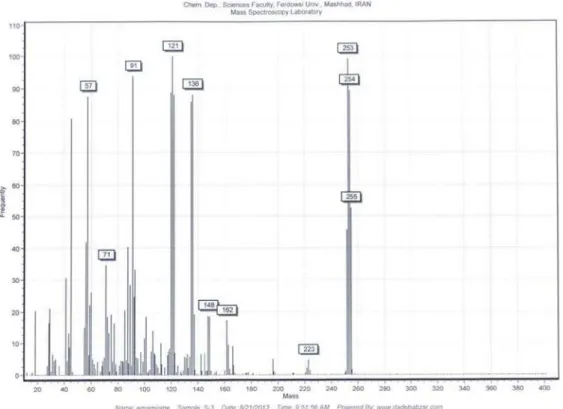
(%) 255 [M
+], 254
(100) [M
+−
H], 253 (100) [M
+−
2H], 136 [M
+−
C
7
H
8O],
121 (100) [M
+−
C
8
H
8NO], 91 [C
7H
7+]; CHN (C
16H
17NO
2)
calc. (%) C (75.27), H (6.71), N (5.49); found (%) C
(74.99), H (6.78), N (5.52).
N-Butyl-2-phenylacetamide (3)
mp 35-37 °C (Lit. 37-38 °C);
2FTIR (Neat)
ν
max/cm
-1
3354 (N
−
H), 3178, 3080, 3064, 3027, 2802, 1638 (C=O),
1491, 1416, 1286, 1180, 747, 698;
1H NMR (400 MHz,
CDCl
3)
d
/ppm 7.40-7.29 (m, 5H, ArH), 5.61 (br, 1H, NH),
3.56 (s, 2H, CH
2CO), 3.18 (q, 2H,
J
6.8 Hz, NHCH
2CH
2),
1.38 (qn, 2H,
J
6.8 Hz, CH
2CH
2Et), 1.23 (sx, 2H,
J
7.2 Hz,
CH
2CH
2CH
3), 0.85 (t, 3H,
J
7.2 Hz, CH
2CH
3);
Green and Selective Synthesis of N-Substituted Amides using Water Soluble Porphyrazinato Copper(II) Catalyst J. Braz. Chem. Soc.
S2
(100 MHz, CDCl
3)
d
/ppm 173.5, 134.9, 129.5, 129.1,
127.5, 43.6, 39.5, 31.2, 19.7, 13.4.
N-(3-Ethoxypropyl)-2-phenylacetamide (4)
mp 136-138 °C; FTIR (KBr)
ν
max/cm
-1
3352 (N
−
H),
3180, 3062, 3028, 2974, 2867, 1647 (C=O), 1550, 1496,
1453, 1416, 1289, 1114, 747, 700;
1H NMR (400 MHz,
CDCl
3)
d
/ppm 7.41-7.29 (m, 5H, ArH),5.85 (br, 1H, NH),
3.81 (s, 2H, CH
2CO), 3.64-3.59 (m, 4H, NHCH
2CH
2CH
2O),
3.542 (q, 2H,
J
7.2 Hz, OCH
2CH
3), 1.95 (qn, 2H,
J
6.4 Hz,
CH
2CH
2CH
2O), 1.29 (t, 3H,
J
7.2 Hz, CH
2CH
3);
13
C NMR
(100 MHz, CDCl
3)
d
/ppm 171.1, 135.1, 129.5, 129.1,
127.5, 69.4, 66.3, 41.8, 38.5, 29, 15.1; MS (EI)
m/z
(%)
221 [M
+], 219 [M
+−
2H], 191 [M
+−
C
2
H
5], 134 (100)
[M
+−
C
5
H
11O], 91 [C
7H
7+
]; CHN (C
13
H
19NO
2) calc. (%)
C (70.56), H (8.65), N (6.33); found (%) C (69.94), H
(8.26), N (6.24).
N-Benzyl-2-(4-chlorophenyl)acetamide(5)
mp 150-151 °C (Lit. 151-153 °C);
3FTIR (KBr)
ν
max
/cm
-1
3279 (N
−
H), 3056, 3027, 2913, 2872, 1644
(C=O), 1594, 1542, 1492, 1453, 1417, 1086, 1013, 800,
742, 692:
1H NMR (100 MHz, CDCl
3
)
d
/ppm 7.52–6.97 (m,
9H, ArH), 5.74 (br, 1H, NH), 4.44 (d, 2H,
J
6 Hz, CH
2NH),
3.56 (s, 2H, CH
2CO).
N-Butyl-2-(4-chlorophenyl)acetamide (6)
mp 80-81 °C; FTIR (KBr)
ν
max
/cm
-13301 (N
−
H),
3066, 2959, 2931, 2872, 1649 (C=O), 1595, 1543, 1492,
1417, 1089, 804, 740;
1H NMR (400 MHz, CDCl
3
)
d
/ppm
7.36 (d, 2H,
J
8 Hz, ArH), 7.21(d, 2H,
J
8.4 Hz, ArH),
5.47 (br, 1H, NH), 3.53 (s, 2H,
J
6 Hz, CH
2CO), 3.22
(q, 2H,
J
6.8 Hz, NHCH
2CH
2), 1.43 (qn, 2H,
J
6.8 Hz,
CH
2CH
2Et), 1.29 (sx, 2H,
J
7.2 Hz, CH
2CH
2CH
3), 0.90
(t, 3H,
J
7.2 Hz, CH
2CH
3);
13
C NMR (100 MHz, CDCl
3)
d
/ppm 170.3, 133.5, 133.3, 130.8, 129.1, 43.1, 39.5, 31.6,
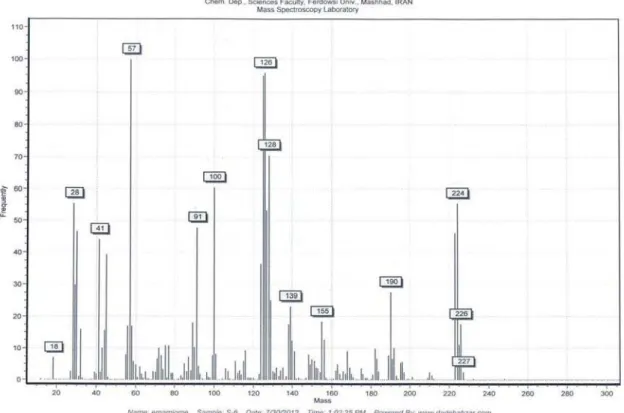
20.0, 13.7; MS (EI)
m/z
(%) 227 [M
++ 2], 225 [M
+], 190
[M
+−
Cl], 125 [M
+−
C
5
H
10NO], 100 [M
+−
C
7H
6Cl], 57
(100) [C
4H
9+
]; CHN (C
12
H
16ClNO) calc. (%) C (63.85), H
(7.14), N (6.21); found (%) C (64.32), H (7.49), N (6.63).
N-Benzylbenzamide (7)
mp 89-90 °C (Lit. 90-91 °C);
4FTIR (KBr)
ν
max/cm
-1
3342(N
−
H), 3088, 3063, 3029, 2861,1643(C=O), 1603,
1540, 1494, 1453,1361, 1207, 1071, 1027, 736, 697;
1H NMR (100 MHz, CDCl
3
)
d
/ppm 7.92-7.18 (m, 10H,
ArH), 6.46 (br, 1H, NH), 4.68 (d, 2H,
J
5.56 Hz, CH
2NH).
N-Benzylpicolinamide (8)
mp 84-85 °C (Lit. 85 °C);
5FTIR (KBr)
ν
max
/cm
-13305
(N
−
H), 3080, 3031, 2920, 1660(C=O), 1527, 1457, 1433,
1355, 1251, 1081, 999, 744, 702, 689;
1H NMR (400 MHz,
CDCl
3)
d
/ppm 8.55 (d, 1H, Pyr), 8.42 (br,
1H, NH), 8.26
(d, 1H, Pyr), 7.88 (td, 1H,
J
17.6 Hz,
J
21.2 Hz, Pyr),
7.46-7.43 (m, 1H, Pyr), 7.41-7.29 (m, 5 H, ArH) 4.70
(d, 2H,
J
6.0 Hz, CH
2NH);
13
C NMR (100 MHz, CDCl
3)
d
/ppm 164.3, 149.8, 148.1, 138.2, 137.4, 128.7, 127.9,
127.5, 126.3, 122.4, 43.5; CHN (C
13H
12N
2O) calc. (%) C
(73.56), H (5.7), N (13.2); found (%) C (73.15), H (5.7),
N (3.16).
N-(2-Methoxybenzyl)picolinamide (9)
mp 89-91°C; FTIR (KBr)
ν
max
/cm
-13396 (N
−
H),
3072, 2966, 2835, 1665 (C=O), 1593, 1524, 1493,1462,
1437,1247, 1119, 997, 816, 755, 616;
1H NMR (400 MHz,
CDCl
3)
d
/ppm 8.56 (d, 1H,
J
4.4 Hz, Pyr ), 8.49 (br, 1H,
NH), 8.24 (d, 1H,
J
8 Hz, Pyr ), 7.82 (td, 1H,
J
17.6 Hz,
J
21.6 Hz, Pyr), 7.44-7.41 (m, 1H, Pyr), 7.39-7.27 (m,
2H, ArH), 6.97-6.91 (m, 2H, ArH), 4.70 (d, 2H,
J
6 Hz,
CH
2NH), 3.92 (s, 3H,CH
3);
13
C NMR (100 MHz, CDCl
3)
d
/ppm 164.1, 157.7, 150.2, 148.1, 137.3, 129.6, 128.8,
126.3, 126.0, 122.4, 120.6, 110.3, 55.4, 39.1.
N-(2-Chlorobenzyl)picolinamide (10)
mp 84-85 °C (Lit. 84-85 °C);
6FTIR (KBr)
ν
max/cm
-13321 (N
−
H), 3076, 3056, 2913, 1663(C=O), 1593, 1564,
1528, 1464, 1444, 1432, 1286, 1041, 1004, 745, 686;
1H NMR (400 MHz, CDCl
3
)
d
/ppm 8.56 (d,
J
4.4 Hz, 1H,
Pyr ), 8.53 (br, 1H, NH), 8.23 (d, 1H,
J
7.6 Hz, Pyr ), 7.86
(td, 1H,
J
17.6 Hz,
J
21.2 Hz, Pyr), 7.48-7.24 (m, 5H, Pyr,
ArH), 4.78 (d, 2H,
J
6 Hz, CH
2NH);
13C NMR (100 MHz,
CDCl
3)
d
/ppm 164.4, 149.7, 148.2, 137.4, 135.7, 133.7,
130.0, 129.6, 128.9, 127.1, 126.3, 122.4, 41.4; CHN
(C
13H
11ClN
2O) calc. (%) C (63.29), H (4.49), N (11.36);
found (%). C (62.86), H (4.22), N (10.93).
N-(3-Ethoxypropyl)picolinamide(11)
Oil; FTIR (neat)
ν
max/cm
-1
3350 (N
−
H), 3060, 2974,
2930, 2867, 2798, 1675 (C=O), 1569, 1527, 1464, 1434,
1377, 1282, 1112, 997, 824, 751, 691;
1H NMR (400 MHz,
CDCl
3)
d
/ppm 8.56 (
d
, 1H,
J
4 Hz, Pyr), 8.50 (br, 1H,
NH), 8.21 (d, 1H,
J
8 Hz, Pyr ), 7.86 (td, 1H,
J
17.6 Hz,
J
21.6 Hz, Pyr), 7.44 -7.41 (m, 1H, Pyr), 3.64-3.59 (m,
2H, CH
2CH
2OEt, 2H, OCH
2CH
3), 3.54 (q, 2H,
J
7.2 Hz,
NHCH
2CH
2), 1.93 (qn, 2H,
J
6.4 Hz, CH
2CH
2CH
2),
1.28 (t, 3H,
J
6.8 Hz, OCH
2CH
3);
13
C NMR (100 MHz,
CDCl
3)
d
/ppm 164.3, 150.9, 148.1, 137.3, 126.00, 122.1,
69.3, 66.5, 37.8, 29.3, 15.2; MS (EI)
m/z
(%) 208 [M
+],
179 [M
+−
C
2
H
5], 163 [M
+−
C
2H
5O], 149 [M
+−
C
3H
7O],
135 [M
+−
C
4
H
9O], 106 [C
6H
4NO
+
], 78 [C
5H
4N
+
]; CHN
Ghodsinia et al. S3 Vol. 24, No. 6, 2013
N-Cyclohexylpicolinamide(12)
mp 50-51 °C; FTIR (KBr)
ν
max
/cm
-13345 (N
−
H),
3064, 2931, 2850, 2965, 1677 (C=O), 1568, 1525, 1462,
1425, 1323, 1278, 1164, 1084, 996, 976, 891, 821, 753,
651, 619;
1H NMR (400 MHz, CDCl
3
)
d
/ppm 8.56 (d, 1H,
J
4.4 Hz, Pyr), 8.22 (d, 1H,
J
7.6 Hz, Pyr), 7.98 (br, 1H,
NH), 7.85 (td, 1H,
J
17.8 Hz,
J
22 Hz, Pyr), 7.44-7.42 (m,
1H, Pyr), 4.04-3.94 (m, 1H, CHNH), 2.05-2.01 (m, 2H,
CH
2CH
2CH), 1.82-1.76 (m, 2H, CH
2CH
2CH), 1.70-1.20
(m, 6H, CH
2CH
2CH
2);
13C NMR (100 MHz, CDCl
3)
d
/ppm 163.3, 150.3, 147.9, 137.3, 126.0, 122.2, 48.2, 33.1,
30.4, 25.6, 24.9, 23.0.
N-Butylpicolinamide(13)
Oil; FTIR (Neat)
ν
max/cm
-1
3391 (N
−
H), 3056, 2958,
2930, 2871, 1670 (C=O), 1590, 1568, 1527, 1464, 1434,
1275, 1261, 997, 765, 749, 691;
1H NMR (100 MHz,
CDCl
3)
d
/ppm 8.54-8.43 (d, 1H,
J
3.5 Hz, Pyr), 8.25-8.15
(d, 1H,
J
7.5 z, Pyr), 8.05 (br, 1H, NH), 7.93-7.7 (t,
1H,
J
7.6 Hz, Pyr), 7.5-7.3 (m, 1H, Pyr), 3.49 (q, 2H,
NHCH
2CH
2), 1.84-1.19 (m, 4H, CH
2CH
2CH
2CH
3),
1.12-0.79 (t, 3H,
J
7.3 Hz, CH
2CH
3).
N-(Furan-2-ylmethyl)picolinamide(14)
mp 100-102 °C; FTIR (KBr)
ν
max/cm
-1
3344 (N
−
H),
3133, 3105, 3047, 2925, 1661 (C=O), 1525, 1464, 1352,
1306, 1212, 1148, 1014, 927, 745, 664, 600;
1H NMR
(400 MHz, CDCl
3)
d
/ppm 8.56 (d, 1H,
J
3.6 Hz, Pyr),
8.37 (br, 1H, NH), 8.24 (d, 1H,
J
7.6 Hz, Pyr), 7.87 (td,
1H,
J
17.6 Hz,
J
21.2 Hz, Pyr), 7.40 (t, 1H,
J
6.4 Hz, Pyr
), 6.52 (d, 1H,
J
0.8 Hz, furan), 6.36-6.31 (m, 2H, furan),
4.68 (d, 2H,
J
6 Hz, CH
2NH);
13C NMR (100 MHz,
CDCl
3)
d
/ppm 164.2, 151.3, 149.7, 148.1, 142.3, 137.4,
126.3, 122.4, 110.4, 107.5, 36.5; MS (EI)
m/z
(%) 202
[M
+], 106 [M
+−
C
5
H
6NO], 96 (100) [M
+
−
C
6
H
4NO], 81
[M
+−
C
6
H
5N
2O]; CHN (C
11H
10N
2O
2) calc. (%) C (65.34),
H (4.98), N (13.85); found (%) C (66.09), H (4.93), N
(13.91).
N-Benzylnicotinamide(15)
mp 72-74 °C (Lit. 73-74 °C);
7FTIR (KBr)
ν
max/cm
-1
3295, 3088, 3055, 3038, 2930, 1634, 1592, 1547, 1482,
1457, 1453, 1420, 1306, 1233, 1157, 1081, 1024, 750,
704 , 670;
1H NMR (400 MHz, CDCl
3
)
d
/ppm 9.01 (s, 1H,
Pyr), 8.75 (d, 1H,
J
4 Hz, Pyr), 8.17 (d, 1H,
J
8 Hz, Pyr),
7.44-7.29 (m, 5H, ArH ,1H, Pyr); 6.50 (br, 1H, NH); 4.70
(d, 2H,
J
5.6 Hz, CH
2NH);
13
C NMR (100 MHz, CDCl
3)
d
/ppm 165.55, 152.23, 147.9, 137.78, 135.32, 130.13,
128.87, 127.99, 127.80, 123.57, 44.21; CHN (C
13H
12N
2O)
calc. (%) C (73.56), H (5.7), N (13.2); found (%) C (73.08),
H (5.64), N (13.52).
N-Benzylisonicotinamide (16)
mp 81-83 °C (Lit. 83-85 °C);
7FTIR (KBr)
ν
max/cm
-13313 (N
−
H), 3060, 3027, 2880, 2843, 1646 (C=O), 1599,
1543, 1494, 1452, 1413, 1300, 845, 735, 697;
1H NMR
(400 MHz, CDCl
3)
d
/ppm 8.91 (d, 2H,
J
4.4 Hz, Pyr), 7.77
(d, 2H,
J
4.8 Hz, Pyr), 7.45-7.29 (m, 5H, ArH ), 6.95 (br, 1H,
NH), 4.64 (d, 2H,
J
5.2 Hz, CH
2NH);
13
C NMR (100 MHz,
CDCl
3)
d
/ppm 165.6, 150.4, 141.3, 137.5, 128.9, 128.0,
127.7, 122.0, 44.3.
N-Butylisonicotinamide(17)
mp 41-42 °C (Lit. 41-42 °C);
4FTIR (KBr)
ν
max/cm
-13312 (N
−
H), 2958, 2931, 2872, 1650 (C=O), 1600, 1552,
1491, 1409, 1308, 1218, 1066, 998, 847, 758, 670;
1H NMR
(100 MHz, CDCl
3)
d
/ppm 8.67 (d, 2H,
J
4.7 Hz, Pyr), 7.63
(d, 2H,
J
3.09 Hz, Pyr), 6.95 (br, 1H, NH), 3.43 (q, 2H,
J
4 Hz, CH
2CH
2NH), 1.85-1.17 (m, 4H, CH
2CH
2CH
2CH
3),
0.91 (t, 3H,
J
4.5 Hz, CH
2CH
3).
N-Benzylthiophene-2-carboxamide(18)
mp 116-118 °C (Lit. 119.5-120.5 °C);
8FTIR (KBr)
ν
max
/cm
-13351 (N
−
H), 3109, 3088, 3064, 3031, 2929,
1622 (C=O), 1545, 1511, 1422, 1303, 1246, 861, 772,
718, 696;
1H NMR (100 MHz, CDCl
3
)
d
/ppm 7.62-7.45
(m, 2H, thiophene), 7.4-7.2 (m, 1H, thiophene, 4H, ArH),
7.04 (t, 1H,
J
4 Hz, ArH), 6.36 (br, 1H, NH), 4.61 (d, 2H,
J
6 Hz, CH
2NH); CHN (C
12H
11NOS) calc. (%) C (66.33),
H (5.10), N (6.45), S (14.76); found (%) C (66.8), H (5.33),
N (6.95), S (13.99).
N-Butylthiophene-2-carboxamide (19)
mp 64-66 °C (Lit. 67-68 °C);
9FTIR (KBr)
ν
max/cm
-13280 (N
−
H), 3105, 3084, 2953, 2924, 2876, 1612 (C=O),
1557, 1421, 1356, 1307, 1247, 1220, 1139, 980, 869, 772,
735;
1H NMR (100 MHz, CDCl
3
)
d
/ppm 7.65-7.38 (m,
2H, thiophene), 7.05 (t, 1H,
J
3.8 Hz, thiophene), 6.11(br,
1H, NH), 3.4 (q, 2H,
J
4.8 Hz, NHCH
2CH
2), 1.75-1.13
(m, 4H, CH
2CH
2CH
2CH
3), 0.94 (t, 3H,
J
6 Hz, CH
2CH
3);
CHN (C
9H
13NOS) calc. (%) C (58.98), H (7.15), N (7.64),
S (17.50); found (%) C (59.02), H (7.38), N (7.66), S
(17.28).
N-(2-Methoxybenzyl)thiophene-2-carboxamide (20)
mp 154-156 °C (Lit. 157-159 °C);
9FTIR (KBr)
ν
max
/cm
-1
3311 (N
−
H), 3084, 3015, 2831, 1618 (C=O),
Green and Selective Synthesis of N-Substituted Amides using Water Soluble Porphyrazinato Copper(II) Catalyst J. Braz. Chem. Soc.
S4
N-(2-Chlorobenzyl)thiophene-2-carboxamide (21)
mp 116-118 °C; FTIR (KBr)
ν
max
/cm
-13306 (N
−
H),
3080, 2958, 2908, 2851, 1620 (C=O), 1553, 1442, 1417,
1301, 1246, 1147, 1037, 755, 724, 681;
1H NMR (400 MHz,
CDCl
3)
d
/ppm 7.55 (dd, 1H,
J
13.8 Hz,
J
22.8 Hz, thiophene);
7.51-7.47 (m, 2H, thiophene), 7.42-7.37 (m, 1H, ArH),
7.32-7.23 (m, 2H, ArH), 7.09 (dd, 1H,
J
15 Hz,
J
21.2 Hz,
ArH), 6.56 (br, 1H, NH), 4.72 (d, 2H,
J
6.4 Hz, CH
2NH);
13C NMR (CDCl
3
, 100 MHz)
d
/ppm 162.1, 138.7, 135.5,
133.5, 130.3, 129.5, 129.0, 128.4, 127.7, 127.4, 127.1, 41.8;
MS (EI)
m/z
(%) 253 [M
++2], 251 [M
+], 216 [M
+−
Cl], 139
[M
+−
C
5
H
4OS], 126 [C
7H
6C
+l], 111 [M
+−
C
7H
7ClN], 57
[C
2H
3NO
2+
]; CHN (C
12
H
10ClNOS) calc. (%) C (57.25), H
(4.00), N (5.56), S (12.74); found (%) C (57.41), H (4.25),
N (5.75), S (12.55).
N-(Furan-2-ylmethyl)thiophene-2-carboxamide(22)
mp 97-100 °C (Lit. 100-102 °C);
10FTIR (KBr)
ν
max/cm
-13284 (N
−
H), 3076, 2933, 2835, 1620 (C=O), 1550, 1515,
1413, 1308, 1200, 1148, 1003, 859, 711, 668;
1H NMR
(100 MHz, CDCl
3)
d
/ppm 7.67-7.22 (m, 3H, thiophene),
7.02 (t, 1H,
J
3.2 Hz, furan), 6.65 (br, 1H, NH),
6.42-6.18 (m, 2H, furan), 4.6 (d, 2H,
J
5.5 Hz, CH
2NH); CHN
(C
10H
9NO
2S) calc. (%) C (57.95), H (4.38), N (6.76), S
(15.47); found (%) C (8.35), H (4.63), N (7.04), S (15.43).
N-(3-Ethoxypropyl)thiophene-2-carboxamide(23)
mp 56-58 °C; FTIR (KBr)
ν
max
/cm
-13309 (N
−
H), 3084,
2979, 2872, 2796, 1615 (C=O), 1555, 1515, 1354, 1221,
1105, 1053, 953, 861, 812, 719;
1H NMR (400 MHz,
CDCl
3)
d
/ppm 7.48 (dd, 1H,
J
13.6 Hz,
J
21.2 Hz,
thiophene), 7.46 (dd, 1H,
J
14.8 Hz,
J
21.2 Hz, thiophene),
7.08 (t, 1H,
J
2.4 Hz, thiophene), 6.21 (br, 1H, NH ),
3.63 (t, 2H,
J
5.6 Hz, CH
2CH
2OEt), 3.60-3.51 (m, 4H,
CH
2CH
3,CH
2NH), 1.89 (qn, 2H,
J
5.6 Hz, CH
2CH
2CH
2),
1.27 (t, 3H,
J
7.2 Hz, CH
2CH
3);
13C NMR (CDCl
3,
100 MHz)
d
/ppm 161.8, 139.5, 129.5, 127.7, 127.5, 70.3,
66.6, 39.2, 28.9, 15.4; MS (EI)
m/z
(%) 213 [M
+], 183
[M
+−
C
2
H
6], 168 [M
+−
C
2
H
5O], 140 [M
+−
C
4
H
9O], 111
(100) [C
5H
3OS
+]; CHN (C
10H
15NO
2S) calc. (%) C (56.31),
H (7.09), N ( 6.57), S (15.03); found (%) C (56.86), H
(7.64), N (6.88), S (14.79).
N-Benzyl-3-methylbutanamide(24)
mp 56-58 °C (Lit. 58-59 °C);
11FTIR (KBr)
ν
max/cm
-1
3275 (N
−
H), 3062, 3028, 2960, 2949, 2873, 1643 (C=O),
1578, 1495, 1425, 1336, 737, 695.
N-Benzylpropionamide (25)
mp 40-42 °C (Lit. 42-43 °C);
12FTIR (KBr)
ν
max/cm
-13266 (N
−
H), 3130, 3063, 3032, 2975, 2937, 1658 (C=O),
1463, 1278, 1172, 1075, 997, 813, 700.
References
1. Starkov, P.; Sheppard, T. D.; Org. Biomol. Chem.2011, 9, 1320. 2. Pelletier, G.; Bechara, W. S.; Charette, A. B.; J. Am. Chem. Soc.
2010, 132, 12817.
3. Nordstrom, L. U.; Vogt , H.; Madsen, R.; J. Am. Chem. Soc.
2008, 130, 17672.
4. Kim, B. R.; Lee, H. G.; Kang, S. B.; Sung, G. H.; Kim, J. J.; Park, J. K.; Lee, S. G.; Yoon, Y. J.; Synthesis2012, 42. 5. Benincori, T.; Brennaand, E.; Sannicolo, F.; J. Chem. Soc.,
Perkin Trans.11993, 675.
6. Strupinska, M.; Rostafinska-Suchar, G.; Stables, J. P.; Paruszewski, R.; ActaPol. Pharm. 2009, 66, 155.
7. Bukhtiarova, T. A.; Trinus, F. P.; Danilenko, V. F.; Danilenko, G. I.; Ovrutskii, V. M.; Sharykina, N. I.; Pharm. Chem. J.1997,
31, 597.
8. Kametani,T.;Ogaswara, K.;Kozuka, A.; Yakugaka Zasshi 1966,
86, 815.
9. Khelili, S.; Florence, X.; Bouhadja, M.; Abdelaziz, S.; Mechouch, N.; Mohamed, Y.; de Tullio, P.; Lebrun, P.; Pirotte, B.; Pirotte, B.; Bioorg. Med. Chem. 2008, 16, 6124.
10. Katritzky, A. R.; Cai, C.; Singh, S. K.; J. Org. Chem. 2006, 71, 3375.
11. Starkov, P.; T Sheppard, D.; Org. Biomol. Chem. 2011,9, 1320. 12. Takeda, K.; Kobayashi, T.; Ogura, H.; Chem. Pharm. Bull. 1979,
Ghodsinia et al. S5 Vol. 24, No. 6, 2013
Figure S2. 1H NMR spectrum (400 MHz, CDCl
3) of N-benzyl-2-phenylacetamide (1).
Green and Selective Synthesis of N-Substituted Amides using Water Soluble Porphyrazinato Copper(II) Catalyst J. Braz. Chem. Soc.
S6
Figure S4. 1H NMR spectrum (400 MHz, CDCl
3) of N-benzyl-2-phenylacetamide (1) expanded.
Figure S3. 1H NMR spectrum (400 MHz, CDCl
Ghodsinia et al. S7 Vol. 24, No. 6, 2013
Figure S6. 13C NMR spectrum (100 MHz, CDCl
3) of N-benzyl-2-phenylacetamide (1) expanded.
Figure S5. 13C NMR spectrum (100 MHz, CDCl
Green and Selective Synthesis of N-Substituted Amides using Water Soluble Porphyrazinato Copper(II) Catalyst J. Braz. Chem. Soc.
S8
Figure S8. 1H NMR spectrum (400 MHz, CDCl
3) of N-(2-methoxybenzyl)-2-phenylacetamide (2).
Ghodsinia et al. S9 Vol. 24, No. 6, 2013
Figure S10. 1H NMR spectrum (400 MHz, CDCl
3) of N-(2-methoxybenzyl)-2-phenylacetamide (2) expanded.
Figure S9. 1H NMR spectrum (400 MHz, CDCl
Green and Selective Synthesis of N-Substituted Amides using Water Soluble Porphyrazinato Copper(II) Catalyst J. Braz. Chem. Soc.
S10
Figure S12. 13C NMR spectrum (100 MHz, CDCl
3) of N-(2-methoxybenzyl)-2-phenylacetamide (2) expanded.
Figure S11. 13C NMR spectrum (100 MHz, CDCl
Ghodsinia et al. S11 Vol. 24, No. 6, 2013
Figure S14. Elemental analysis data of N-(2-methoxybenzyl)-2-phenylacetamide (2).
Green and Selective Synthesis of N-Substituted Amides using Water Soluble Porphyrazinato Copper(II) Catalyst J. Braz. Chem. Soc.
S12
Figure S16. 1H NMR spectrum (400 MHz, CDCl
3) of N-butyl-2-phenylacetamide (3).
Ghodsinia et al. S13 Vol. 24, No. 6, 2013
Figure S18. 1H NMR spectrum (400 MHz, CDCl
3) of N-butyl-2-phenylacetamide (3)expanded.
Figure S17. 1H NMR spectrum (400 MHz, CDCl
Green and Selective Synthesis of N-Substituted Amides using Water Soluble Porphyrazinato Copper(II) Catalyst J. Braz. Chem. Soc.
S14
Figure S20. 13C NMR spectrum (100 MHz, CDCl
3) of N-butyl-2-phenylacetamide (3).
Figure S19. 1H NMR spectrum (400 MHz, CDCl
Ghodsinia et al. S15 Vol. 24, No. 6, 2013
Figure S22. FTIR spectrum of N-(3-ethoxypropyl)-2-phenylacetamide (4).
Figure S21. 13C NMR spectrum (100 MHz, CDCl
Green and Selective Synthesis of N-Substituted Amides using Water Soluble Porphyrazinato Copper(II) Catalyst J. Braz. Chem. Soc.
S16
Figure S24. 1H NMR spectrum (400 MHz, CDCl
3) of N-(3-ethoxypropyl)-2-phenylacetamide (4) expanded.
Figure S23. 1H NMR spectrum (400 MHz, CDCl
Ghodsinia et al. S17 Vol. 24, No. 6, 2013
Figure S26. 13C NMR spectrum (100 MHz, CDCl
3) of N-(3-ethoxypropyl)-2-phenylacetamide (4).
Figure S25. 1H NMR spectrum (400 MHz, CDCl
Green and Selective Synthesis of N-Substituted Amides using Water Soluble Porphyrazinato Copper(II) Catalyst J. Braz. Chem. Soc.
S18
Figure S28. MS spectrum (EI, 70 eV) of N-(3-ethoxypropyl)-2-phenylacetamide (4).
Figure S27. 13C NMR spectrum (100 MHz, CDCl
Ghodsinia et al. S19 Vol. 24, No. 6, 2013
Figure S30. FTIR spectrum of N-benzyl-2-(4-chlorophenyl)acetamide (5).
Green and Selective Synthesis of N-Substituted Amides using Water Soluble Porphyrazinato Copper(II) Catalyst J. Braz. Chem. Soc.
S20
Figure S32. FTIR spectrum of N-butyl-2-(4-chlorophenyl)acetamide (6).
Figure S31. 1H NMR spectrum (400 MHz, CDCl
Ghodsinia et al. S21 Vol. 24, No. 6, 2013
Figure S34. 1H NMR spectrum (400 MHz, CDCl
3) of N-butyl-2-(4-chlorophenyl)acetamide (6) expanded.
Figure S33. 1H NMR spectrum (400 MHz, CDCl
Green and Selective Synthesis of N-Substituted Amides using Water Soluble Porphyrazinato Copper(II) Catalyst J. Braz. Chem. Soc.
S22
Figure S36. 1H NMR spectrum (400 MHz, CDCl
3) of N-butyl-2-(4-chlorophenyl)acetamide.
Figure S35. 1H NMR spectrum (400 MHz, CDCl
Ghodsinia et al. S23 Vol. 24, No. 6, 2013
Figure S38. 13C NMR spectrum (100 MHz, CDCl
3) of N-butyl-2-(4-chlorophenyl)acetamide (6) expanded.
Figure S37. 13C NMR spectrum (100 MHz, CDCl
Green and Selective Synthesis of N-Substituted Amides using Water Soluble Porphyrazinato Copper(II) Catalyst J. Braz. Chem. Soc.
S24
Figure S40. Elemental analysis data of N-butyl-2-(4-chlorophenyl)acetamide (6).
Ghodsinia et al. S25 Vol. 24, No. 6, 2013
Figure S42. 1H NMR spectrum (100 MHz, CDCl
3) of N-benzylbenzamide (7).
Green and Selective Synthesis of N-Substituted Amides using Water Soluble Porphyrazinato Copper(II) Catalyst J. Braz. Chem. Soc.
S26
Figure S44. 1H NMR spectrum (400 MHz, CDCl
3) of N-benzylpicolinamide (8).
Ghodsinia et al. S27 Vol. 24, No. 6, 2013
Figure S46. 13C NMR spectrum (100 MHz, CDCl
3) of N-benzylpicolinamide (8).
Figure S45. 1H NMR spectrum (400 MHz, CDCl
Green and Selective Synthesis of N-Substituted Amides using Water Soluble Porphyrazinato Copper(II) Catalyst J. Braz. Chem. Soc.
S28
Figure S48. 13C NMR spectrum (100 MHz, CDCl
3) of N-benzylpicolinamide (8) expanded.
Figure S47. 13C NMR spectrum (100 MHz, CDCl
Ghodsinia et al. S29 Vol. 24, No. 6, 2013
Figure S50. FTIR spectrum of N-(2-methoxybenzyl)picolinamide (9).
Green and Selective Synthesis of N-Substituted Amides using Water Soluble Porphyrazinato Copper(II) Catalyst J. Braz. Chem. Soc.
S30
Figure S52. 1H NMR spectrum (400 MHz, CDCl
3) of N-(2-methoxybenzyl)picolinamide (9)expanded.
Figure S51. 1H NMR spectrum (400 MHz, CDCl
Ghodsinia et al. S31 Vol. 24, No. 6, 2013
Figure S54. 13C NMR spectrum (100 MHz, CDCl
3) of N-(2-methoxybenzyl)picolinamide (9).
Figure S53. 1H NMR spectrum (400 MHz, CDCl
Green and Selective Synthesis of N-Substituted Amides using Water Soluble Porphyrazinato Copper(II) Catalyst J. Braz. Chem. Soc.
S32
Figure S56. FTIR spectrum of N-(2-chlorobenzyl)picolinamide (10).
Figure S55. 13C NMR spectrum (100 MHz, CDCl
Ghodsinia et al. S33 Vol. 24, No. 6, 2013
Figure S58. 1H NMR (400 MHz, CDCl
3) of N-(2-chlorobenzyl)picolinamide (10) expanded.
Figure S57. 1H NMR spectrum (400 MHz, CDCl
Green and Selective Synthesis of N-Substituted Amides using Water Soluble Porphyrazinato Copper(II) Catalyst J. Braz. Chem. Soc.
S34
Figure S60. 13C NMR spectrum (100 MHz, CDCl
3) of N-(2-chlorobenzyl)picolinamide (10).
Figure S59. 1H NMR spectrum (400 MHz, CDCl
Ghodsinia et al. S35 Vol. 24, No. 6, 2013
Figure S62. Elemental analysis data of N-(2-chlorobenzyl)picolinamide (10).
Figure S61. 13C NMR spectrum (100 MHz, CDCl
Green and Selective Synthesis of N-Substituted Amides using Water Soluble Porphyrazinato Copper(II) Catalyst J. Braz. Chem. Soc.
S36
Figure S64. 1H NMR spectrum (400 MHz, CDCl
3) of N-(3-ethoxypropyl)picolinamide (11).
Ghodsinia et al. S37 Vol. 24, No. 6, 2013
Figure S66. 1H NMR spectrum (400 MHz, CDCl
3) of N-(3-ethoxypropyl)picolinamide (11) expanded.
Figure S65. 1H NMR spectrum (400 MHz, CDCl
Green and Selective Synthesis of N-Substituted Amides using Water Soluble Porphyrazinato Copper(II) Catalyst J. Braz. Chem. Soc.
S38
Figure S68. 13C NMR spectrum (100 MHz, CDCl
3) of N-(3-ethoxypropyl)picolinamide (11).
Figure S67. 13C NMR spectrum (100 MHz, CDCl
Ghodsinia et al. S39 Vol. 24, No. 6, 2013
Figure S70. MS spectrum (EI, 70 eV) of N-(3-ethoxypropyl)picolinamide (11).
Figure S69. 13C NMR spectrum (100 MHz, CDCl
Green and Selective Synthesis of N-Substituted Amides using Water Soluble Porphyrazinato Copper(II) Catalyst J. Braz. Chem. Soc.
S40
Figure S72. FTIR spectrum of N-cyclohexylpicolinamide (12).
Ghodsinia et al. S41 Vol. 24, No. 6, 2013
Figure S74. 1H NMR spectrum (400 MHz, CDCl
3) of N-cyclohexylpicolinamide (12)expanded.
Figure S73. 1H NMR spectrum (400 MHz, CDCl
Green and Selective Synthesis of N-Substituted Amides using Water Soluble Porphyrazinato Copper(II) Catalyst J. Braz. Chem. Soc.
S42
Figure S76. 1H NMR spectrum (400 MHz, CDCl
3) of N-cyclohexylpicolinamide (12)expanded.
Figure S75. 1H NMR spectrum (400 MHz, CDCl
Ghodsinia et al. S43 Vol. 24, No. 6, 2013
Figure S78. 13C NMR spectrum (100 MHz, CDCl
3) of N-cyclohexylpicolinamide (12)expanded.
Figure S77. 13C NMR spectrum (100 MHz, CDCl
Green and Selective Synthesis of N-Substituted Amides using Water Soluble Porphyrazinato Copper(II) Catalyst J. Braz. Chem. Soc.
S44
Figure S80. FTIR spectrum of N-butylpicolinamide (13).
Figure S79. 13C NMR (100 MHz, CDCl
Ghodsinia et al. S45 Vol. 24, No. 6, 2013
Figure S82. FTIR spectrum of N-(furan-2-ylmethyl)picolinamide (14).
Figure S81. 1H NMR spectrum (100 MHz, CDCl
Green and Selective Synthesis of N-Substituted Amides using Water Soluble Porphyrazinato Copper(II) Catalyst J. Braz. Chem. Soc.
S46
Figure S84. 1H NMR spectrum (400 MHz, CDCl
3) of N-(furan-2-ylmethyl)picolinamide (14) expanded.
Figure S83. 1H NMR spectrum (400 MHz, CDCl
Ghodsinia et al. S47 Vol. 24, No. 6, 2013
Figure S86. 1H NMR spectrum (400 MHz, CDCl
3) of N-(furan-2-ylmethyl)picolinamide (14) expanded.
Figure S85. 1H NMR spectrum (400 MHz, CDCl
Green and Selective Synthesis of N-Substituted Amides using Water Soluble Porphyrazinato Copper(II) Catalyst J. Braz. Chem. Soc.
S48
Figure S88. 13C NMR spectrum (100 MHz, CDCl
3) of N-(furan-2-ylmethyl)picolinamide (14) expanded.
Figure S87. 13C NMR spectrum (100 MHz, CDCl
Ghodsinia et al. S49 Vol. 24, No. 6, 2013
Figure S90. MS spectrum (EI, 70 eV) of N-(furan-2-ylmethyl)picolinamide (14).
Figure S89. 13C NMR spectrum (100 MHz, CDCl
Green and Selective Synthesis of N-Substituted Amides using Water Soluble Porphyrazinato Copper(II) Catalyst J. Braz. Chem. Soc.
S50
Figure S92. FTIR spectrum of N-benzylnicotinamide (15).
Ghodsinia et al. S51 Vol. 24, No. 6, 2013
Figure S94. 1H NMR spectrum (400 MHz, CDCl
3) of N-benzylnicotinamide (15)expanded.
Figure S93. 1H NMR spectrum (400 MHz, CDCl
Green and Selective Synthesis of N-Substituted Amides using Water Soluble Porphyrazinato Copper(II) Catalyst J. Braz. Chem. Soc.
S52
Figure S96. 13C NMR spectrum (100 MHz, CDCl
3) of N-benzylnicotinamide (15)expanded.
Figure S95. 13C NMR spectrum (100 MHz, CDCl
 4 in various solvents, different molar ratios and different temperatures](https://thumb-eu.123doks.com/thumbv2/123dok_br/18997275.462592/3.892.95.823.155.673/synthesis-phenylacetamide-presence-various-solvents-different-different-temperatures.webp)