From the Children’s Institute, Hospital das Clínicas, Faculty of Medicine, University of São Paulo.
Received for publication on January 22, 2003.
REVIEW
CRITICAL ANALYSIS OF OLD AND NEW VACCINES
AGAINST N. MENINGITIDIS SEROGROUP C,
CONSIDERING THE MENINGOCOCCAL DISEASE
EPIDEMIOLOGY IN BRAZIL
Lucia Ferro Bricks
BRICKS LF - Critical analysis of old and new vaccines against N. meningitidis serogroupC, considering the meningococcal
disease epidemiology in Brazil. Rev. Hosp. Clín. Fac. Med. S. Paulo 58(4):231-240, 2003.
Worldwide, the impact of meningococcal disease is substantial, and the potential for the introduction and spread of more virulent strains of N. meningitidis or strains with increased resistance to current antibiotics causes concern, making prevention essential.
OBJECTIVES: Review the indications for meningococcal disease vaccines, considering the epidemiological status in Brazil.
METHODS: A critical literature review on this issue using the Medline and Lilacs databases.
RESULTS: In Brazil, MenB and MenC were the most important serogroups identified in the 1990s. Polysaccharide vaccines available against those serogroups can offer only limited protection for infants, the group at highest risk for meningococcal disease. Additionally, polysaccharide vaccines may induce a hypo-responsive state to MenC. New meningococcal C conjugate vaccines could partially solve these problems, but it is unlikely that in the next few years a vaccine against MenB that can promote good protection against multiple strains of MenB responsible for endemic and epidemic diseases will become available.
CONCLUSIONS: In order to make the best decision about recommendations on immunization practices, better quality surveillance data are required. In Brazil, MenC was responsible for about 2,000 cases per year during the last 10 years. New conjugate vaccines against MenC are very effective and immunogenic, and they should be recommended, especially for children less than 5 years old. Polysaccharide vaccines should be indicated only in epidemic situations and for high-risk groups. Until new vaccines against MenC and MenB are available for routine immunization programs, the most important measure for controlling meningococcal disease is early diagnosis of these infections in order to treat patients and to offer chemoprophylaxis to contacts.
DESCRIPTORS: Neisseria meningitidis. Epidemiology. Vaccine. Efficacy. Children.
Meningococcal diseases (MD) are endemic everywhere in the world, but they have a great potential to cause epidemics. Due to the high mortality rates and serious sequelae when epi-demics develop, even a small number of cases cause great concern. Although there are commercially available polysaccharide vaccines to prevent MD caused by the main meningococ-cus serogroups, such vaccines are
un-able to produce long-lasting immunity and are poorly effective in preventing MD in infants, the largest group at risk for these infections1-11.
In February 2002, a new conjugate vaccine against serogroup C
Immunity against N. meningitidis
Newborns acquire IgG class anti-bodies from their mothers through the placenta; these antibodies are effective against a few meningococcus serogroups. As these antibodies be-come catabolized, the child bebe-comes susceptible to infections, which occur in general after the third month of life. Non-vaccinated children exhibit a progressive growth of the geometric mean titer (GMT) of antibodies against meningococci in response to the colo-nization of the airways by different kinds of Neisseria (typed or not, in-cluding related strains such as N. lactamica). A few strains of E. coli and other bacteria that normally colonize the intestine have a polysaccharide capsule or other antigens in the cap-sule wall that are immunologically identical or very similar to the N. meningitidis antigens, thus contribut-ing to natural immunization1,4,7,12,13.
Asymptomatic carriers of N. meningitidis begin to produce anti-bodies, on the average, 2 weeks after nasopharyngeal colonization has started. Acquisition of natural immu-nity against serogroup A meningococ-cus (MenA) occurs earlier than immu-nity to other serogroups. In the United States, more than 90% of children aged 18 months have MenA antibodies; the same protection level against MenC is only reached after 6 to 8 years. It is be-lieved that the majority of these anti-bodies are acquired due to cross-reac-tivity between N. meningitidis anti-gens and those of enterobacteriae4,7,12,13. Tolerance to serogroup B meningococ-cus (MenB) polysaccharides antigens occurs due to the similarity between MenB capsular antigens and nervous tissue antigens; the majority of the an-tibacterial antibodies against MenB target sub-capsular antigens14-16.
Since the 1960’s, it has been dem-onstrated that there is a direct associa-tion between the absence of serum
an-tibacterial antibodies and MD suscep-tibility; however, so far, the titer of an-tibodies required to protect against the disease is unknown. During epidemics, it has been observed that the majority of children and adults who had anti-body titers higher than 2 mg/L (10 times more than those found in patients with agammaglobulinemia) were pro-tected against serogroups A and C in-fections. There are no studies available on protection titers against serogroups Y and W1351,3,7,8 .
Complement, especially the C5 and C9 fractions, is also important in protecting against MD, and the spleen plays an essential role in removing in-completely opsonized bacteria from the blood stream. People with comple-ment deficiency or asplenia exhibit a greater risk for MD, and frequently these infections are caused by uncom-mon serogroups1,3,5,7,8.
Polysaccharide vaccines against
Neisseria meningitidis
Currently available polysaccharide vaccines (monovalent A and C, biva-lent A/C, and quadrivabiva-lent A, C, Y and W135) are safe and effective in reduc-ing the number of cases durreduc-ing epi-demics1-9,17. However, their immunogenicity is low, especially for younger children1-9,12-28.
During epidemics, polysaccharide vaccines against MenA and MenC, ad-ministered to school age children, ado-lescents, and adults, demonstrated above 85% efficacy; however, in chil-dren under 2, the vaccine against MenC has a low efficiency1-9,17-28.
In a controlled study performed in Brazil involving 135,000 children aged between 6 and 36 months, Taunay et al.18 found that the vaccine was effec-tive in only 55% of the individuals be-tween 24 and 36 months of age, and no efficacy was observed in those below 2 years of age, after 17 months of follow-up. Probably, the low efficacy of the
vaccine against MenC is due to its re-duced capacity to stimulate formation of antibacterial antibodies in children less than 2 years of age19.
The low immunogenicity of MenA and MenC polysaccharide vaccines in younger children1-11,20-28 is due to the inability of the polysaccharide anti-gens to stimulate a T-dependent immu-nologic response24-28. Repeated doses of polysaccharide antigens are not only unable to cause a booster response, but they may actually cause immunologic tolerance29-33 . Studies conducted with children29-32 and adults33 previously vaccinated against MenC who were vaccinated again 1 to 4 years after re-ceiving the first vaccine dose showed low antibacterial antibody titers against MenC (< 1:8), in contrast with those individuals who had never been vaccinated or who had received a new conjugated vaccine against MenC.
It is difficult to assess the clinical importance of these findings. Theoreti-cally, it is possible that individuals who received the MenC polysaccha-ride vaccine become more prone to de-veloping invasive disease caused by these bacteria due to reduced antibody levels after exposure to MenC1,29-33 .
Polysaccharide vaccines against MenB have low immunogenicity in hu-mans despite the fact that MenB and MenC polysaccharides are very similar 14-16. Low immunogenicity of MenB
cap-sule polysaccharides has been one of the main barriers in the development of vaccines against this serogroup of N. meningitidis. There are, however, a few indications that antibacterial antibodies against MenB subcapsular antigens may produce some degree of immunity against these bacteria; therefore, the de-velopment of new vaccines against MenB is based on these antigens1,7,15-16.
Conjugated vaccines against MenA and MenC
developed and had proven to be highly effective against Haemophilus influenzae type b (Hib) in infants, there have been many attempts to develop new vaccines against N. meningitidis by conjugating the bacteria capsule polysaccharides with the same carrier proteins used in the development of conjugated vaccines against Hib. Al-though MenA, MenC, MenY, and MenW-135 polysaccharides have been conjugated with different kinds of pro-teins, published data on safety and immunogenicity of these vaccines in humans only deal with MenA ad MenC31-41 .
A number of studies have already demonstrated that the new conjugated vaccines against MenA and MenC are highly immunogenic in children, ado-lescents, and adults9,29-40. Twumasi et al.34 assessed the immunologic re-sponse in 304 children (aged between 8 and 10 weeks) after 3 doses of a con-jugated vaccine A/C, compared with the polysaccharide vaccine. The con-jugated vaccine was found to be as safe as the polysaccharide vaccine. Moreover, antibody titers after 2 doses of the conjugated vaccine were higher than those obtained after the use of the polysaccharide vaccine. In children over 6 months of age, a conjugated vaccine dose induced higher antibody titers against MenC than 2 doses of the same vaccine administered at 2 and 6 months.
Similar results have been observed
by different investigators in studies performed in the United States36, United Kingdom9,35,39,41, and Af-rica29,31,34. In all these studies, MenC bactericidal antibody production after administration of conjugated vaccines was much higher than that obtained after the use of the polysaccharide vaccine. One month after the menin-gococcal conjugated vaccination, 91% to 100% of children had serum bactericidal antibody (SBA) ≥ 8, and 89% to 100% had a ≥ 4-fold increase. Serum bactericidal geometric mean titers (GMTs) of anti-MenC antibodies increased more than 50 times after ad-ministration of 3 different meningococ-cal C conjugated vaccines. By 6 months, GMTs decreased, but IgG an-tibody avidity increased. After a polysaccharide vaccine booster, there is a further increase in avidity and higher GMT, suggesting that conju-gated vaccines can induce immuno-logic memory1,42.
Conjugated MenC vaccines con-tain no live component and cannot give anyone meningitis or septicemia. The main adverse events include local transient reactions that normally re-solve within 1 or 2 days. Less than 5% of vaccinated infants and toddlers de-velop local erythema or swelling ≥ 3 cm within 7 days at the meningococ-cal conjugated vaccine injection site, and 2% have low fever. Children above 5 years and adolescents pre-sented the highest rate of local
reac-tions that include redness and/or edema (25%) and pain in the injection site (1%), and the same rate of in-creased temperature. All such reactions remitted within 1 or 2 days and were not significantly higher than those ob-served after administration of vaccines against hepatitis B, Hib, and inacti-vated poliovirus vaccine1,31-42.
Presentations and dosage admin-istration – Three MenC conjugated vaccines licensed in Europe and 2 in Brazil are currently commercially available. Two of the 3 meningococ-cal conjugated vaccines contain short-chain oligosaccharides (10 µg) derived from serogroup C capsular polysaccharide (O-acetylated), coupled to CRM197 , a nontoxic mutant of diph-theria toxin (Chiron Vaccines and Wyeth Lederle Vaccines and Pediatrics). The third contains serogroup C polysaccharide (10 µg of O-acetylated), conjugated to tetanus toxoid (MCC-TT; North American Vac-cine – NAVA)42.
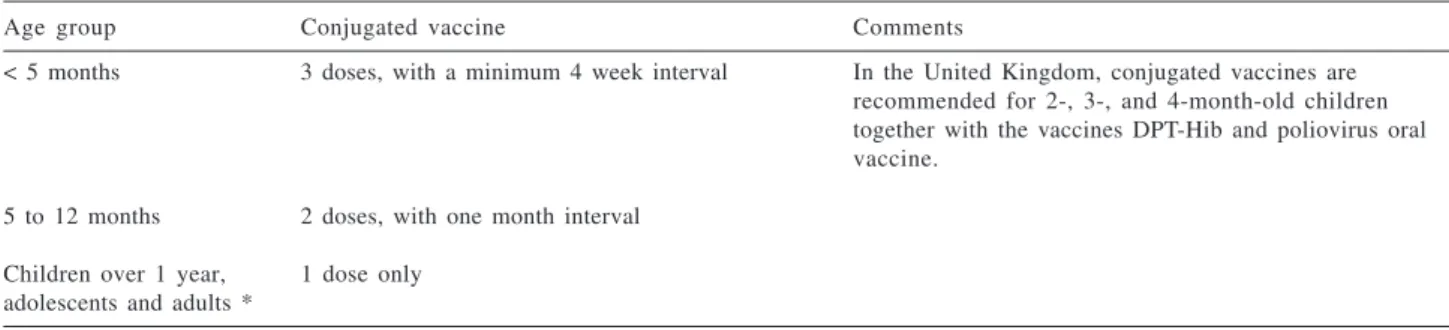
The United Kingdom was the first country to license and recommend rou-tine immunization with MenC conju-gated vaccines in 1999. Single dose vaccine is recommended for children older than 1 year; when the immuni-zation program is initiated in children aged 5 to 12 months, 2 doses were rec-ommended, and between 2 and 5 months, 3 doses, with a 1-month inter-val (Table 1)10,11,42 .
Table 1 - Immunization schedule for conjugated vaccines against N. meningitidis C used in the United Kingdom.
Age group Conjugated vaccine Comments
< 5 months 3 doses, with a minimum 4 week interval In the United Kingdom, conjugated vaccines are recommended for 2-, 3-, and 4-month-old children together with the vaccines DPT-Hib and poliovirus oral vaccine.
5 to 12 months 2 doses, with one month interval Children over 1 year, 1 dose only
adolescents and adults *
In Brazil, the first conjugated MenC vaccine was licensed in Febru-ary 2002 (Meningitec, Wyeth Labora-tories). The serogroup C polysaccha-ride conjugated to tetanus toxoid (NeisVac-C, Baxter) was also licensed in 2002. The manufacturer’s recom-mendations should be followed with regard to the number of doses and ad-ministration intervals.
Efficacy of conjugated vaccines in the United Kingdom (UK) – Conju-gated MenC vaccines have had a high efficacy against MD41,42. From Novem-ber 1999 until NovemNovem-ber 2000, about 14 million people younger than 18 years had been immunized with con-jugated MenC vaccines in the UK. Age-specific vaccine efficacy had been estimated to be 88% in children aged 12 to 30 months and 96% in
ado-lescents aged 15 to17 years. Addition-ally, conjugated MenC vaccines re-duced carriage of serogroup C menin-gococci in 15 to 17 year-old school students in the UK by 66% and pro-duced no significant changes in car-riage of meningococci expressing other disease-associated serogroups42. These vaccines were highly immunogenic and induced immuno-logic memory after a single dose in UK toddlers. There was no serious adverse event associated with their use in chil-dren and adolescents41-43.
Comments on the use of conjugated MenC vaccines, considering the epi-demiology of MD in Brazil.
In Brazil, local meningococcal meningitis outbreaks caused by
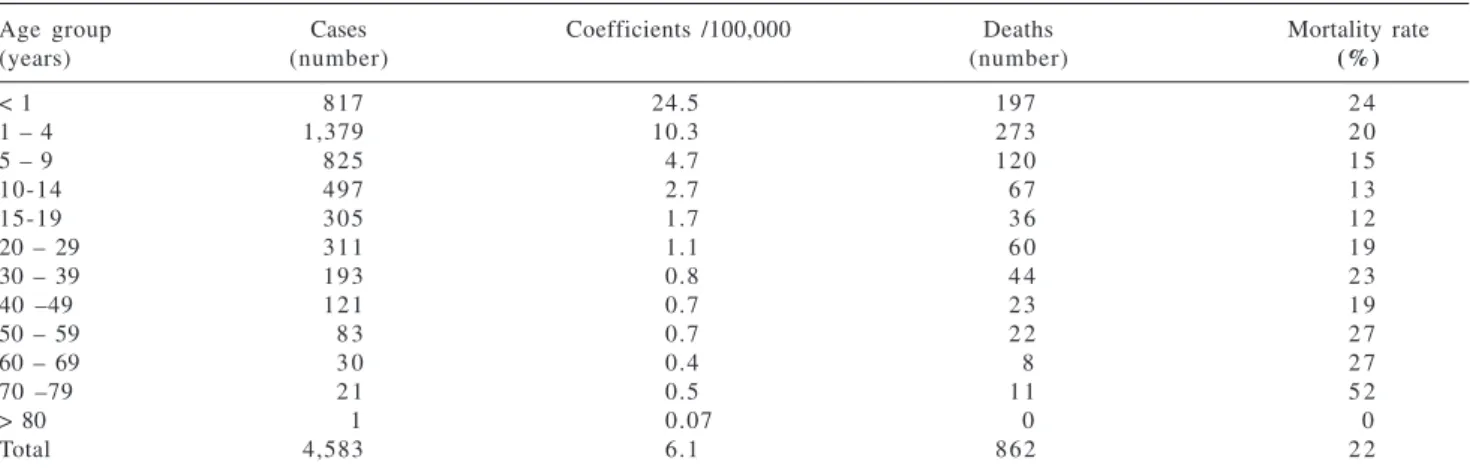
serogroups B and C have occurred since the 1980s.44-46 The Health Min-istry and the State of São Paulo Health Secretary data indicate that in this country prevalence and mortality rates of MD are extremely high, especially in children younger than 5 years (Ta-bles 2 and 3)45,46. Although serogroup B is the most prevalent in children with MD, a progressive increase in the number of serogroup C cases has been recorded. While in the 1980s, over 80% of meningitis cases due to N. meningitidis were ascribed to MenB, in the 1990s, this rate came down to 50% to 60%, while MenC reached a 40% to 50% level (Table 4)1,45,46.
In different countries, there has been an increase not only in the inci-dence rate of MD caused by MenC, but also an increase in the mortality
Table 2 - Meningococcal disease in Brazil. Distribution of confirmed cases, prevalence coefficient, mortality numbers, and rates, in the year 2000.
Age group Cases Coefficients /100,000 Deaths Mortality rate
(years) (number) (number) (%)
< 1 817 24.5 197 2 4
1 – 4 1,379 10.3 273 2 0
5 – 9 825 4.7 120 1 5
10-14 497 2.7 6 7 1 3
15-19 305 1.7 3 6 1 2
20 – 29 311 1.1 6 0 1 9
30 – 39 193 0.8 4 4 2 3
40 –49 121 0.7 2 3 1 9
50 – 59 8 3 0.7 2 2 2 7
60 – 69 3 0 0.4 8 2 7
70 –79 2 1 0.5 1 1 5 2
> 80 1 0.07 0 0
Total 4,583 6.1 862 2 2
Source: Health Ministry, “Fundação Nacional de Saúde” (unpublished and not final data, March 2002).
Table 3 - Number of cases, mortality numbers, and rate of Meningococcal diseases according to age group. State of São Paulo, year 2000.
Age group Cases Deaths Mortality rate
(years) (number) (number) (%)
< 1 343 7 6 2 2
1 – 4 592 118 2 0
5 – 9 263 3 4 1 3
10-14 105 1 6 1 5
15-19 8 8 9 1 0
20 – 39 166 3 2 1 9
³ 40 8 6 2 1 2 4
Total 1,643 306 1 9
rate associated with this serogroup 4,6-9-11. This problem has been attributed
to the emergence and spread of highly aggressive MenC strains belonging to the ET-37 complex1,47-49. Unfortu-nately, in Brazil, the etiological agent is identified in less than 50% of the cases and serogrouping is performed in approximately one-third of the cases1,45,46.
Since it is not always possible to isolate the bacterial meningitis agents, and very often, the isolates are not typed, the prevalence of MD is under-estimated. Even so, during the last 10 years, the number of MD cases has been extremely high. In the 1990’s, an average of 5,680 MD cases and 1,085 deaths (19%) have been reported each year. Distribution of the number of MD cases and deaths, and mortality rate due to MD in Brazil in 2000,
sepa-rated by age-groups, is reported in ta-ble 21. Almost half the cases and deaths (45%) occurred in children un-der 5 years45. In the state of São Paulo, the incidence rate of MD in children under 1 year ranged between 40 and 69 per 100,000, and in the age group of 1 to 4 years, between 15 and 30 per 100,000, a definitely higher number than in other age groups44. In children under 1 year and in the cases of septi-cemia, mortality rates due to MD are also very high when compared to the rest of the population, reaching 28% and 40%, respectively1,44-46.
Assuming that MenC is responsi-ble for at least 40% of all MD cases and deaths in Brazil, the annual number of cases and incidence of death ascribed to that agent is ex-tremely high (over 2,200 cases and 400 deaths each year). Considering the epi-demiological hazard caused by the MenC disease, as well as the safety and efficacy of the conjugated vaccine, there is no doubt that this new vaccine should contribute significantly to the reduction of morbidity and mortality caused by MD in this country1. It should be pointed out that conjugate vaccines against MenC do not offer protection against MenB; therefore, these vaccines will not confer full pro-tection against MD.
The licensed vaccine has a high cost (approximately R $140.00), which should hinder its use in public health. Additionally, the vaccine is recom-mended as a 3-dose schedule, intra-muscular, for infants. Many parents and doctors may feel reluctant to ad-minister more injections to such very young persons.1
Lastly, there are some issues asso-ciated with the duration of immunity provided by the vaccine and also with the impact of immunization in the community. Since this is a new prod-uct, the duration of the protection pro-vided by conjugated vaccines is un-known10,11. All studies conducted so far
have shown that the conjugated vaccines against MenC should pro-vide long-term immunity, just like the Hib vaccines29-43. However, it is only through the follow-up of vaccinated populations that a definitive answer may be provided in this case1,10,11,39-43.
A few studies have demonstrated that the new conjugated MenC vaccines are capable of eliminating the carrier condition similar to what occurred with vaccination against Hib8,9,42,50-52. With the reduction of both oropharyngeal colonization and the number of MenC carriers, it is quite likely that conjugated vaccines will significantly contribute to herd immu-nity42,49-52; however, there are some in-dications that different N. meningitidis strains may, through a gene exchange that controls production of the polysaccharide capsule, switch their serogroup. The switch of serogroup C to B and of B to C has already been confirmed both in vitro and in vivo4,54,55. The United Kingdom’s Epi-demiologic Surveillance Service has not observed this kind of problem so far. However, it is still unknown whether massive use of these vaccines in a set population may cause a selec-tive pressure for such genetic switches. Strict epidemiologic surveillance should be maintained in order to se-cure early identification of this phe-nomenon1,39-43,49.
Recommendations for MD preven-tion
It is estimated that in Brazil, MenC is responsible for about 2,000 cases of MD every year. Due to the high preva-lence and mortality rates of MD, we consider that the conjugated MenC vaccine should be primarily prescribed for children under 5 years, who con-stitute the largest risk group. The vac-cine, because of its enhanced immunogenicity, should also be of-fered to other risk groups, such as Table 4 - Meningococcal disease cases
rate, by serogroup. State of São Paulo, 1982 - 2001.
Year Serogroup B Serogroup C
1982 70.1 4.6
1983 77.3 5.9
1984 86.1 3.4
1985 83.1 6.1
1986 63.6 11.0
1987 75.2 10.9
1988 78.5 8.6
1989 76.6 16.6
1990 62.3 33.7
1991 45.8 50.0
1992 57.3 39.5
1993 58.1 39.5
1994 59.7 36.8
1995 57.0 41.8
1996 61.0 36.7
1997 61.2 33.3
1998 62.1 34.4
1999 65.6 30.8
2000 59.9 35.9
2001 56.5 38.4
immunocompromised patients (chil-dren, adolescents, and adults with complement deficiency, HIV infection, functional and anatomical asplenia, or undergoing bone marrow transplanta-tion). MD risk groups should receive the quadrivalent vaccine in order to broaden the protection spectrum against serogroups A, Y, and W-135, which are not included in the conju-gated vaccine against MenC. Polysac-charide vaccines should only be indi-cated in the case of epidemics, due to their low efficacy and lack of induc-tion of immunologic memory.
It should be emphasized that con-jugated MenC vaccines provide spe-cific serogroup protection; therefore, they will not protect against the serogroups that are not included in the vaccine. If MD is suspected in the ab-sence of prior vaccinations, blood and liquor culture should be performed, and treatment should be initiated as soon as possible. Individuals with in-timate contacts with MD victims should receive chemoprophylaxis, when so indicated, because vaccines will only give protection after at least 2 weeks, and the majority of second-ary cases occur during the first 2 weeks after contact20.
It is essential to improve epidemio-logic surveillance and to establish laboratories capable of promptly iden-tifying the primary MD pathogens with serogrouping and identification of serogroups, subtypes, and immune types responsible for the epidemics. Unfortunately, in Brazil, many of the MD diagnostics are still based on clini-cal and laboratory data without isola-tion of N. meningitidis in culture, and even when the type of bacteria is iden-tified, the serogroup is not identified in most cases.
Regarding the possibility of vacci-nation against MenB, one of the most common MD pathogens in Brazil, the problem is even more serious, because of the need to identify not only the
serogroup, but also the serotypes, subtypes, and immune types of that pathogen. Although, since the 1980’s, the strain ET-5 has been the most prevalent cause of epidemics, there is large variability among the strains that have been identified in different coun-tries and at different times1,4,7-9,52,53. Currently, at least 14 serotypes, 12 subtypes, and 12 immunotypes of MenB are known. In addition, a large portion of the invasive disease strains is still not typed. Consequently, the indications for vaccination against this pathogen remain questionable, espe-cially when the serotype causing the MD is unknown and the 2-dose regi-men is used to immunize children un-der 4 years1,16.
The finding that class-1 OMP pro-teins play an essential role in the in-duction of bactericidal antibodies has stimulated research in the field of poly-valent vaccines, in an attempt to pro-vide protection against several subtypes of MenB. Although it has been evident that hexavalent vaccines may induce response to more than one OMP-1 type57, such vaccines need im-provement to offer a broader clinical protection spectrum against the dreaded MD1-9,48.
By the end of 2000, the genetic sequencing of N. meningitidis was completed58,59,and it is expected that in a few years vaccines with a broader protection spectrum against several strains of this bacteria will become available. In the meantime, it is fun-damental that the population and doc-tors watch for the primary signs and symptoms of the disease to allow a prompt diagnosis and adequate treat-ment as well as chemoprophylaxis for the contacts.
It is estimated that the incidence of sporadic cases of MD in household contacts is 4 cases per 1,000 people exposed, that is, 500 to 800 times higher than that reported in the popu-lation as a whole. The majority of
sec-ondary cases occur in the first days af-ter development of the index case; it is thus recommended that prophylaxis be administered early to the following groups, and if possible, within 24 hours after confirmation of the index case1-3:
1) household contacts; 2) day care units contacts;
3) people exposed to oral secretions of infected individuals (kissing, mouth-to-mouth breathing, en-dotracheal intubation).
Chemoprophylaxis may be per-formed with rifampicin, ciprofloxacin, or ceftriaxone and is 90% to 95% ef-fective in reducing the N. meningitidis carrier status. It is recommended up to 14 days after exposure; after this pe-riod, it is likely that this procedure will bring little or no benefit to the contacts. Throat and nasopharyngeal cultures are of no value for deciding who should receive chemoprophylaxis because of the asymptomatic coloni-zation of the respiratory tract3,4.
Current indications for polysaccha-ride vaccines:
1. Epidemics: according to the expe-rience acquired in control of menin-gococcal C epidemics, an epidemic is defined as the occurrence of 3 or more cases (confirmed or probable) of meningitis caused by this patho-gen in a period shorter than 3 months or an incidence rate of at least 10 in 100,000 inhabitants. This rate is calculated based on the whole population data and not on specific age groups. These param-eters also apply to other meningo-coccal groups (A, Y, and W135); 2. High-risk groups for
3. Military: the high incidence of MD in non-vaccinated recruits and the excellent efficacy of MenA and MenC vaccines warrant indication for this group;
4. Individuals traveling to hyperen-demic disease areas or where the
disease occurs as epidemics: espe-cially those traveling, during the dry season (December to June) to Africa’s sub-Sahara, where the dis-ease is prevalent.
At-risk children, especially if vacci-nated before they are 4 years, should
be vaccinated again after 2 to 3 years; although there are no studies on the need to revaccinate individu-als over 4 years; if they remain as high-risk individuals, revaccination may be considered 3 to 5 years after the initial dose1-3.
RESUMO
BRICKS LF - Análise crítica das anti-gas e novas vacinas contra a N. meningitidis do sorogrupo C, considerando a epidemiologia da doença meningocócica no Brasil. Rev. Hosp. Clín. Fac. Med. S. Paulo 58 (4):231-240, 2003.
Em todo o mundo, o impacto das doenças meningocócicas é enorme e o
potencial para a introdução e dissemi-nação de cepas da N. meningitidis mais virulentas ou com aumento da resistên-cia aos antibióticos atualmente utili-zados causa grande preocupação, tor-nando a prevenção essencial.
OBJETIVO: Rever as indicações das vacinas para doenças meningo-cócicas, considerando a situação epi-demiológica do Brasil.
MÉTODOS: Revisão crítica sobre o tema, usando as bases de dados Medline e Lilacs.
conjugadas contra o MenC podem so-lucionar parcialmente esse problema, mas é improvável que, em curto pra-zo, sejam licenciadas novas vacinas contra o MenB.
CONCLUSÕES: Para tomar as me-lhores decisões sobre as recomenda-ções em práticas de imunização, é ne-cessário que se disponha de dados pre-cisos da vigilância epidemiológica, com identificação dos sorogrupos mais prevalentes em cada faixa etária.
Esti-ma-se que, no Brasil, o MenC seja res-ponsável por 2.000 casos de doenças meningocócicas , a cada ano. As no-vas vacinas conjugadas contra o MenC são seguras, efetivas e imuno-gênicas, devendo ser recomendadas, particularmente, para crianças menores de 5 anos. As vacinas polissacarídicas devem ser recomendadas apenas para os grupos de alto risco ou em situa-ções epidêmicas. Enquanto novas
va-cinas contra o MenC e MenB não fo-rem incorporadas ao calendário de va-cinação de rotina, as mais efetivas me-didas para controlar as doenças menin-gocócicas são o diagnóstico e trata-mento precoces e a quimoprofilaxia para contactantes.
DESCRITORES: N. meningitidis. Epidemiologia. Vacina. Eficácia. Crianças.
REFERENCES
1. BRICKS LF - Vacinas conjugadas: novas perspectivas na prevenção das doenças meningocócicas causadas pelos sorogrupos A e C. Imunizações 2001; 2:39-62.
2. AMERICAN Academy of Pediatrics - Meningococcal infections. In: PICKERING LK - 2000 Red Book: Report of the Committee on infectious Diseases. 25th. Elk Grove Village,
American Academy of Pediatrics, 2000. p. 396-401. 3. CDC - Prevention and control of meningococcal disease.
Recommendations of the Advisory Committee on Immunization Practices (ACIP). MMWR 2000; 49 (RR-07): 1-10.
4. LEPOW ML, PERKINS BA, HUGHES PA et al. - Meningococcal vaccines. In: PLOTKIN AS, ORENSTEIN WA - Vaccines. 3rd
Philadelphia, Saunders, 1999. p. 711-27.
5. LINDBERG AA - Glycoprotein conjugates vaccines. Vaccine 1999; 17:S28-S36.
6. MORLEY SL, POLLARD AJ - Vaccine prevention of meningococcal disease, coming soon? Vaccine 2002; 20: 666-87.
7. PELTOLA H - Meningococcal vaccines. Drugs 1998; 55(3): 347-66.
8. PERKINS BA - New opportunities for prevention of meningococcal disease. JAMA 2000; 283: 2842-3. 9. ROSENSTEIN NE, PERKINS BA - Update on Haemophilus
influenzae serotype b and meningococcal vaccines. Pediatr Clin N Amer 2000; 47: 337-52.
10. BRADBURY J - New meningitis C vaccine to be used in UK. Lancet 1999; 354: 310.
12. GOLD R, LEPOW ML, GOLDSCHNEIDER I et al. - Immune response of human infants to polysaccharide vaccines of group A and C Neisseria meningitidis. J Infect Dis 1979; 136 (Supp): S31-5.
13. GOLD R, LEPOW ML, GOLDSCHNEIDER I et al. - Kinetics of antibody production to group A and group C meningococcal polysaccharide vaccines administered during the first six years of life: prospects for routine immunization on infants and children. J Infect Dis 1979; 140: 690-70.
14. FINNE J, LEINONEN M MÄKELA PH - Antigenic similarities between brain components and bacteria causing meningitis. Lancet 1983; 2 355:7.
15. FINNE J, BITTER-SUERMANN D, GORIDIS C et al. - An IgG monoclonal antibody to group B meningococci cross-reacts with developmentally regulated polysialic acid units of glycoproteins in neural and extra neural tissues. J Immunol 1987; 38: 4402-7.
16. TAPPERO JW, LAGOS R, BALLESTEROS AM et al. -Immunogenicity of 2 serogroup outer-membrane protein meningococcal vaccines: a randomized controlled trial in Chile. JAMA 1999; 281:1520-27.
17. SCHEIFELE DW, BJORNSON G, BORASTON S - Local adverse effects of meningococcal vaccine. CanMed Assoc J 1994; 150: 14-5.
18. TAUNAY AE, FELDMAN RA, BASTOS CO et al. - Evaluation of the protective effect of anti-meningococcal serogroup C polysaccharide vaccine in children aged 6 – 36 months. Rev InstAdolpho Lutz 1978; 32: 77-82.
19. MILAGRES LG, LEMOS AP, MELES CE et al.- Antibody response after immunization of Brazilian children with serogroup C meningococcal polysaccharide noncovalently complexed with outer membrane proteins. Braz J Med Biol Res 1995; 28: 981-9.
20. DE WALS P, DIONNE M, DOUVILLE-FRADET M et al. - Impact of a mass immunization campaign against serogroup C meningococcus in the Province of Quebec, Canada. Bull World Health Organ 1996; 74: 407-11.
21. AMATO NV, FINGER H, GOTSCHLICH EC et al. - Serologic response to serogroup C meningococcal vaccine in Brazilian preschool children. Rev Inst Med Trop São Paulo 1974; 16: 149-53.
22. KAYHTY H, KARANKO V, PELTOLA H et al. - Serum antibodies to capsular polysaccharide A vaccine. Lancet 1985; 2:114-8. 23. REINGOLD AL, BROOME, CV, HIGHTOWER AW et al. - Age-specific differences in duration of clinical protection after vaccination with meningococcal polysaccharide a vaccine. Lancet 1985; 2: 114-8.
24. CEESAY SJ, ALLEN SJ, MENON A et al. - Decline in meningococcal antibody levels in African children 5 years after vaccination and the lack of an effect of booster immunization. J Infect Dis 1993; 167: 1212-6.
25. ZANGWILL KM, STOUT RW, CARLONE GM - Duration of antibody response after meningococcal polysacharide vaccination in US Air Force personnel. J Infect Dis 1994; 169: 847-52.
26. KING WJ, MACDONALD N, WELLS G - Total and functional antibody response to a quadrivalent meningococcal polysaccharide vaccine among children. J Pediatr 1996; 128: 196-202.
27. LAW BJ, ROSENBERG T, MACDONALD NE - Age-related immunogenicity of meningococcal polysaccharide vaccine in aboriginal children and adolescents living in a northern Manitoba reserve community. Pediatric Infect Dis J 1998; 17: 860-4.
28. ESPIN RIOS I, GARCIA-FULGUERIRAS A, NAVARRO ALONSO JA et al. - Seroconversion and duration of immunity after vaccination against group C meningococcal infection in young children. Vaccine 2000; 18: 2656-60.
29. LEACH A, TWUMASI PA, KUMAH S et al. - Induction of immunologic memory in Gambian children by vaccination in infancy with a group A plus group C meningococcal polysaccharide-protein conjugate vaccine. J Infect Dis 1997; 175: 200-4.
30. MacDONALD NE, HALPERIN AS, LAW BJ et al. - Induction of immunologic memory by conjugates vs. plain meningococcal C polysaccharide vaccine in toddlers. JAMA 1998; 280: 1685-9.
31. MacLENNAN JM, OBARO S, DEEKS J et al. - Immune response to revaccination with meningococcal A and C polysaccharides in Gambian children following repeated immunization during early childhood. Vaccine 1999; 17: 3086-93.
32. MacLENNAN JM, SHACKLEY F, HEATH PT et al. - Safety, immunogenicity, and induction of immunologic memory by a serogroup C meningococcal conjugate vaccine in infants. JAMA 2000; 283: 2791-801.
33. GRANOFF DM, GUPTA RK, BELSHE RB et al. - Induction of immunologic refractoriness in adults by meningococcal C polysaccharide vaccination. J Infect Dis 1998; 178: 870-4. 34. TWUMASI PA JR, KUMAH S, LEACH A et al. - A trial of a group
A plus group C meningococcal polysaccharide-protein conjugate vaccine in African infants. J Infect Dis 1995; 175: 632-8.
35. FAIRLEY CK, BEGG N, BORROW R ET et al. - Conjugate meningococcal serogroup A and C vaccine: reactogenicity and immunogenicity in United Kingdom infants. J Infect Dis 1996; 174: 1360-63.
36. LIEBERMAN JM, CHIU SS, WONG VK et al. - Safety and immunogenicity of a serogroups A/C Neisseria meningitidis
oligosaccharide-protein conjugate vaccine in young children. A randomized controlled trial. JAMA 1996; 275: 1499-503. 37. RICHMOND P, BORROW R, MILLER E et al. - Meningococcal serogroup C conjugate vaccine is immunogenic in infancy and primes for memory. J Infect Dis 1999; 179: 1569-72. 38. CHOO S, ZUCKERMAN J, GOILAV C et al. - Immunogenicity
40. MacLENNAN JM, OBARO S, DEEKS J et al. - Immunologic memory 5 years after meningococcal A/C conjugate vaccination in infancy. J Infect Dis 2001; 183: 97-104. 41. RAMSAY ME, ANDREWS N, KACZMARSKI EB et al.- Efficacy
of meningococcal serogroup C conjugate vaccine in teenagers and toddlers in England. Lancet 2001; 357: 195-6. 42. MAIDEN MCJ, STUART JM - UK meningococcal carriage group.
Carriage of serogroup C meningococci 1 year after meningococcal C conjugate polysaccharide vaccination. Lancet 2002; 359: 1829-0.
43. RICHMOND P, BORROW R, GOLDBLAT D et al. - Ability of 3 different meningococcal C conjugate vaccines to induce immunologic memory after a single dose in UK toddlers. J Infect Dis 2001; 183: 160-3.
44. SÃO PAULO. Secretaria de Estado da Saúde, Centro de Vigilância Epidemiológica Alexandre Vranjack. Vacina contra o meningococo BC, 1998.
45. BRASIL. Fundação Nacional de Saúde. Ministério da Saúde. Disponível no site http:www.funasa.gov (acesso em 02 de maio de 2002)
46. SÃO PAULO. Secretaria de Estado da Saúde. Centro de Vigilância Epidemiológica Alexandre Vranjac. Disponível no site: www.cve.saude.sp.gov.br. (acesso em 30 de abril de 2002) 47. JACKSON LA, SCHUCHAT A, REEVES MW et al. - Serogroup
C meningococcal outbreaks in the United States: an emerging threat. JAMA 1995, 273: 383-9.
48. WHALEN CM, HOCKIN JC, RYAN A et al. - The changing epidemiology of invasive meningococcal disease in Canada, 1985 through 1992: emergence of a virulent clone of Neisseria meningitidis. JAMA 1995; 273: 390-4.
49. MAIDEN MCJ, SPRATT BG - Meningococcal conjugate vaccines: new opportunities and new challenges. Lancet 1999; 354: 615-6.
50. SBYRAKIS S, GALANAKIS E - Meningococcal vaccine and herd immunity Lancet 1999; 354: 1733.
51. BORROW R, FOS AJ, CATWRIGHT K, BEGG NT et al. - Salivary antibodies following parenteral immunization of infants with a meningococcal serogroup A and C conjugate vaccine. Epidemiol Infect 1999; 123: 201-8.
52. ZHANG Q, CHOO S, EVERARD J et al. - Mucosal immune responses to meningococcal group C conjugate and group A and C polysaccharide vaccines in adolescents. Infect Immun 2000; 68: 2692-7.
53. BORROW R, ANDREWS N, GOLDBLAT D et al. - Serological basis for use of meningococcal serogroup C conjugate vaccines in the United Kingdom: reevaluation of correlates of protection. Infect Immun 2001: 69:1568-73.
54. SWARTLEY JS, MARFIN AA, EDUPUGANTI S et al. - Capsule switching of Neisseria meningitidis. Proc Natl Acad Sci USA 1997; 94:271-6.
55. VOGEL U, CLAUS H, FROSCH M - Rapid serogroup switching in Neisseria meningitidis. N Engl JMed 2000; 342: 219-20. 56. ALA’ ALDEEN DA, NEAL KR, AIT-TAHAR K - Dynamics of meningococcal long-term carriage among university students and their implications for mass vaccination. J Clin Microbiol 2000; 38: 2311-6.
57. CARTWRIGHT K, MORRIS R, RUMKE H et al. -Immunogenicity and reactogenicity in UK infants of a novel meningococcal vesicle vaccine containing multiple class 1 (PorA) outer membrane proteins. Vaccine 1999; 17: 2612-9. 58. TETTELIN H, SAUNDERS MJ, HEIDELBERG et al. - Complete genome sequence of Neisseria meningitidis serogroup B strain MC58. Science 2000: 287 (5459): 1809-15.
59. PARKHILL J, ACHTMAN M, JAMES V et al. - Complete DNA sequence of serogroup A strain of Neisseria meningitidis