INTEGRATED MICROCHANNEL COOLING IN A
THREE DIMENSIONAL INTEGRATED CIRCUIT
A Ther mal Man age ment
by
Kang-Jia WANG and Zhong-Liang PAN *
School of Phys ics and Tele com mu ni ca tions En gi neer ing, South China Nor mal Uni ver sity, Guangzhou, China
Orig i nal sci en tific pa per DOI: 10.2298/TSCI1603899W
Microchannel cool ing is a prom is ing tech nol ogy for solv ing the three-di men sional in te grated cir cuit ther mal prob lems. How ever, the re la tion ship be tween the microchannel cool ing pa ram e ters and ther mal be hav ior of the three di men sional in te grated cir cuit is com plex and dif fi cult to un der stand. In this pa per, we per form a de tailed eval u a tion of the in flu ence of the microchannel struc ture and the pa ram e ters of the cool ing liq uid on steadystate tem per a ture pro files. The re sults pre sented in this pa per are ex pected to aid in the de vel op ment of ther mal de sign guide -lines for three di men sional in te grated cir cuit with microchannel cool ing.
Key words: thermal, three-dimensional integrated circuit, microchannel
In tro duc tion
Three-di men sional in te grated cir cuit (3D-IC) tech nol ogy, emerg ing as a pow er ful tool for sat is fy ing the chal leng ing in te grated cir cuit pack ag ing re quire ments, has re ceived con sid er -able at ten tion in the semi con duc tor com mu nity [1-3]. By ex pand ing the de sign space into the third di men sion, 3D-IC of fer sev eral ad van tages over the tra di tional mi cro elec tronic de signs, in clud ing re duced av er age wire length, wire de lay, power con sump tion and foot print, etc. [4, 5]. Al though the elec tri cal ben e fits are proved to have great im prove ments in stacked in te grated cir cuit (IC) pack ages, as the pack age den sity in creases, the heat quan tity in each unit vol ume be -comes higher, which will greatly in crease the work ing tem per a ture of the de vice. The prob lems of heat dis si pa tion are more se ri ous and catch ing lots of at ten tions than those in the tra di tional sin gle IC pack age. Hence, ther mal man age ment for 3D-IC is be com ing a ma jor con cern [6-8]. In re cent years, the microchannel cool ing tech nol ogy is a prom is ing tech nol ogy for solv ing the ther mal prob lems of the 3D-IC [9,10]. How ever, the microchannel struc ture and the pa ram e ters of the cool ing liq uid, which have a ma jor im pact on the ther mal be hav ior, are com pli cated and hard to be well un der stood. In this pa per, we char ac ter ize the in flu ence of these pa -ram e ters on the steady-state tem per a ture pro files of the dies in 3D-IC. The re sults pre sented in this pa per are ex pected to of fer help for the de vel op ment of ther mal de sign guide lines for 3D-IC with microchannel cool ing.
Wang, K.-J., et al.: Integrated Microchannel Cooling in a Three Dimensional ...
THERMAL SCIENCE: Year 2016, Vol. 20, No. 3, pp. 899-902 899
The phys i cal ther mal model
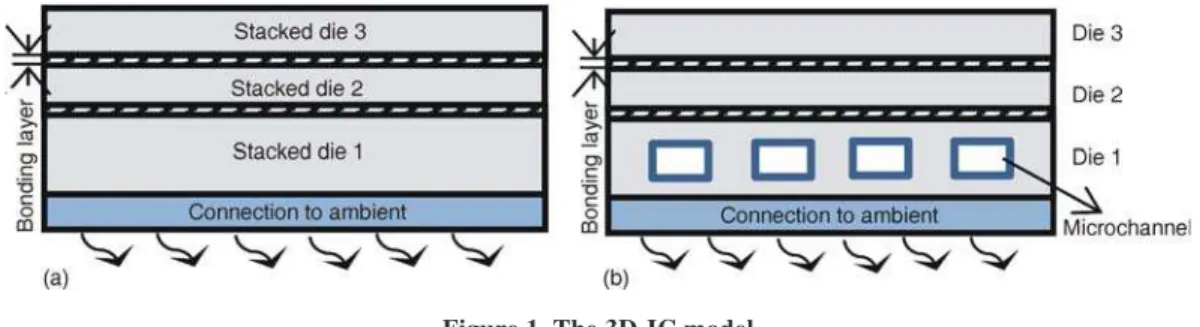
The phys i cal ther mal model of the 3D-IC is shown in fig. 1, where fig. 1(a) shows the 3D-IC with out the microchannel cool ing, while fig. 1(b) shows the 3D-IC with the in te grated microchannel cool ing.
The 3DIC are com posed of mul ti ple stacked dies in ter con nected us ing throughsil i -con vias, while the num ber of de vices that can be in te grated within the sys tem is lim ited as [8]:
aN E
t g T
G
pd
£ D (1)
where NG is the num ber of gates that can be in te grated within a sys tem with a clock pe riod tpd, g – the av er age ther mal con duc tance, DT – the tem per a ture gra di ent be tween the dis si pat ing el e -ments and the am bi ent air, E – the en ergy dis si pa tion, a – their ac tiv ity rate. Heat flow in the 3D-IC is gov erned in a con trol vol ume of a solid that with the iso tro pic ther mal con duc tiv ity by the fol low ing equa tion [11]:
C T
t k T q
v d
d
+ - Ñ( 2 )= & (2)
where Cv is the vol u met ric spe cific heat of the ma te rial, T – the tem per a ture of the con trol vol -ume, k – the ther mal con duc tiv ity of the ma te rial, q& – the vol u met ric rate of gen er a tion of the heat in side the vol ume. In the microchannel cooled 3D-IC, the en ergy con ser va tion equa tion for heat trans fer in a con trol vol ume of the liq uid can be writ ten:
C T
t k T Cv T q
v d
d u
+ - Ñ( 2 )+ rÑ = & (3)
When com pared to eq. (2), the pre vi ous equa tion con tains an added term on the left hand side, where u is the ve loc ity of out flow of the fluid at the sur face of the con trol vol ume.r
Ex per i men tal re sults
As shown in fig. 1, the 3D-IC model that we use to study has three dies, which in te grates four microchannels in die-1. The microchannels have the same struc ture, where the height and width are 1.0 mm and 2.0 mm, re spec tively. The die-1, die-2, and die-3 that have the same ther mal con duc tiv ity of 120 W/mK are as sumed to be 10 mm ´ 10 mm ´ 3 mm, 10 mm ´ 10 mm ´ 2 mm, and 10 mm ´ ´.10 mm ´ 2 mm, re spec tively. The two bond ing lay ers are both 10 mm by 10 mm by 0.5 mm with the same ther mal con duc tiv ity of 2 W/mK. From the top view, the heat gen er a tions of the three dies are shown in fig. 2, they are 1.0·109 W/m3 (Postion: 1 mm < x < 3 mm, 1 mm < y < 3 mm, and 1 mm < z < 3 mm), 2.0·109 W/m3 (Po si tion: 4 mm < x < 6 mm, 4 mm < y < 6 mm, and 4.5 mm < < z < Wang, K.-J., et al.: Integrated Microchannel Cooling in a Three Dimensional ...
900 THERMAL SCIENCE: Year 2016, Vol. 20, No. 3, pp. 899-902
5.5 mm), 1.0·109 W/m3 (Po si tion: 7 mm < x < 9 mm, 7imm < y < 9 mm, and 8 mm < z < 9 mm), re -spec tively. At the bot tom of the bot tom-most die, the con vec tive heat trans fer co ef fi cient is set to be 1000 W/m2K, while the other side sur faces are as -sumed to be adi a batic.
Case (1). The im pact of the in tro duced microchannels
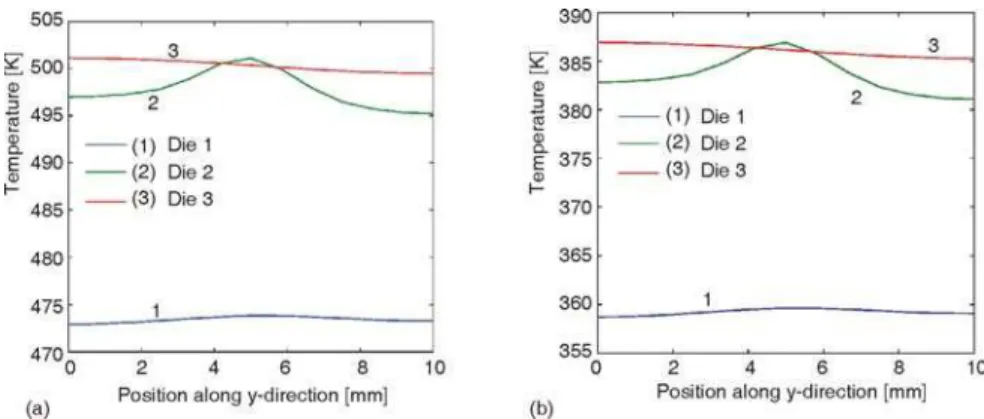
In this case, we study the im pact on tem per a ture rise as the microchannels are in tro -duced in the 3D-IC. Fig ure 3(a) shows the tem per a ture curves along the y-di rec tion in the three dif fer ent dies of the 3DIC that with out microchannel cool ing. When the microchannels are in -tro duced, the tem per a ture curve is plot ted in fig. 3(b). Com pared with fig. 3(a), we find that the tem per a ture has about 24% de cline when the microchannels are in tro duced.
Case (2). The struc ture of the microchannel
In this case, we change the struc ture of the microchannels to find out the im pact on the tem per a ture rise, that is, tak ing the sur face ar eas of the microchannel as in vari ant while chang -ing both the width and height of the microchannel to be 1.5 mm. As shown in fig. 4, the tem per a ture of the die1 along the ydi rec -tion de creases a lit tle when the microchannel struc ture is changed.
Case (3). Ve loc ity of the cool ing liq uid
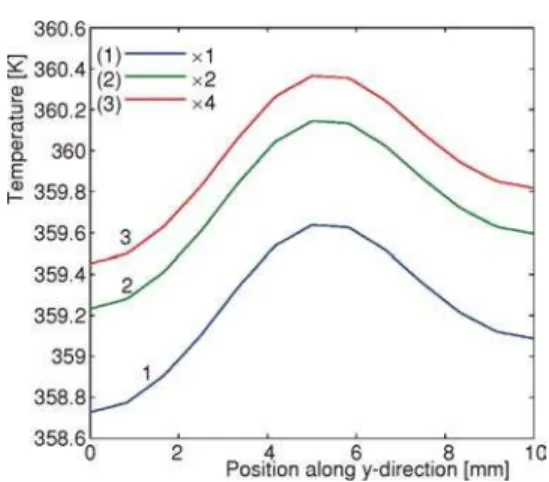
In this case, we study the in flu ence of the cool ing liq uid ve loc ity on tem per a ture rise via in creas ing the ve loc ity by 2 and 4, re spec tively. Fig ure 5 shows the tem per a ture curves of the
Wang, K.-J., et al.: Integrated Microchannel Cooling in a Three Dimensional ...
THERMAL SCIENCE: Year 2016, Vol. 20, No. 3, pp. 899-902 901
Figure 2. Heat generation distribution in each die from the top view
Figure 3. Influence of the microchannel cooling on temperature rise in 3D-IC
dif fer ent ve loc i ties in die2 along the ydi rec tion. It can be found that the tem per a ture in -creases as the ve loc ity in -creases.
Con clu sion
In this pa per, we stud ied the in flu ence of the microchannel struc ture and the pa ram e ters of the cool ing liq uid on the ther mal be hav ior of the 3D-IC. We an a lyzed the im pact of the microchannel, the microchannel struc ture, and the ve loc ity of the cool ing liq uid on tem per a -ture rise of 3D-IC. This pa per is ex pected to aid in de vel op ing tem per a ture char ac ter iza tion and pre dic tion tools for 3D-IC with microchannel cool ing. In ad di tion, this pa per may also be help ful in the char ac ter iza tion of var i ous ther -mal man age ment strat e gies be ing pro posed for 3D-IC with microchannel cool ing.
Ref er ences
[1] Banerjee, K., et al., 3D ICs: A Novel Chip De sign for Im prov ing DeepSubmicrometer In ter con nect Per -for mance and Sys tems-On-Chip In te gra tion, Proc. IEEE, 89 (2001), 5, pp. 602-633
[2] Patti, R. S., Three-Di men sional In te grated Cir cuits and the Fu ture of Sys tem On-Chip De signs, Proc. IEEE, 94 (2006), 6, pp. 1214-1224
[3] Banerjee, K., Mehrotra, A., Global (Interconnect) Warm ing, IEEE Circ Dev Mag, 17 (2001), 5, pp. 16-32 [4] Kim, Y. J., et al., Ther mal Char ac ter iza tion of Interlayer Microfluidic Cool ing of ThreeDi men sional In te
-grated Cir cuits with Non uni form Heat Flux, J. Heat Trans fer, 132 (2010), 4, pp. 1009-1017
[5] Dang, B., et al., In te grated Microfluidic Cool ing and In ter con nects for 2D and 3D Chips, IEEE T Adv Pack ag ing, 33 (2010), 1, pp. 79-87
[6] Zhu, Z. M., et al., An An a lyt i cal Ther mal Model for 3D In te grated Cir cuit Con sid er ing through Sil i con Via, Acta Physica Sinica, 60 (2011), 11, pp. 2509-2515
[7] Li, P., et al., IC Ther mal Sim u la tion and Mod el ing via Ef fi cient Multigrid-Based Ap proaches, IEEE Trans. Comput. Aided Des. Integr. Cir cuits Syst, 25 (2006), 9, pp. 1763-1776
[8] Nagata, M., Lim i ta tions, In no va tions, and Chal lenges of Cir cuits and De vices into a Half Mi crom e ter and Be yond, IEEE J Solid-St Circ, 27 (1992), 4, pp. 465-472
[9] Mizunuma, H., et al., Ther mal Mod el ing and Anal y sis for 3D-ICs with In te grated Microchannel Cool ing,
IEEE T Comput Aid D, 30 (2011), 9, pp. 1293-1306
[10] Yu, W. J., et al., Fast 3-D Ther mal Sim u la tion for In te grated Cir cuits with Do main De com po si tion Method, IEEE T Comput Aid D, 32 (2013), 12, pp. 2014-2018
[11] Sridhar, A., et al., 3D-ICE: A Com pact Ther mal Model for Early-Stage De sign of Liq uid-Cooled ICs,
IEEE T Comput, 63 (2014), 10, pp. 2576-2589
Paper submitted: December 10, 2015 Paper revised: February 1, 2016 Paper accepted: March 31, 2016
Wang, K.-J., et al.: Integrated Microchannel Cooling in a Three Dimensional ...
902 THERMAL SCIENCE: Year 2016, Vol. 20, No. 3, pp. 899-902