Printed in Brazil - ©2007 Sociedade Brasileira de Química 0103 - 5053 $6.00+0.00
ArticleArticleArticleArticleArticle
*e-mail: [email protected]
#Present Address: Department of Chemistry, Addis Ababa University, P.O. Box 1176, Addis Ababa, Ethiopia. Tel.: +251911487557
Photoelectrochemical Cells based on Emeraldine Base Form of Polyaniline
Assefa Sergawie,*
,#,aTeketel Yohannes,
bSerap Günes,
aHelmut Neugebauer
aand Niyazi S. Sariciftci
aa
Linz Institute for Organic Solar Cells (LIOS), Physical Chemistry, Johannes Kepler University Linz, Altenbergstraβe 69, A-4040 Linz, Austria
b
Department of Chemistry, Addis Ababa University, P.O.BOX 1176, Addis Ababa, Ethiopia
Células fotoeletroquímicas (PECs) têm sido fabricadas usando a forma base esmeraldina de polianilina (EB) como um material fotoativo e o par redox Eu2+/Eu3+ em metanol como
eletrólito. Uma célula fotoeletroquímica com a estrutura: Vidro/ITO/ EB:Nc-TiO2/Eletrólito/ Pt produz uma voltagem de circuito-aberto (VOC) de –0,132 V e uma corrente de curto-circuito (ISC) de 0,64 µA cm-2 sob 50 mW cm-2 de iluminação com luz branca de lâmpada de Xe. Num
esforço para aumentar a foto-resposta, uma PEC com estrutura: Vidro/ITO/ EB:Nc-TiO2/
Eletrólito/Pt foi construída, na qual um filme composto de EB e TiO2 (Nc-TiO2) nanocristalino
é usado como material fotoativo. A célula mostra uma VOC de –0,205 V e uma ISCde 105 µA cm-2 quando iluminada sobre as mesmas condições.
Photoelectrochemical cells (PECs) have been fabricated using the emeraldine base form of polyaniline (EB) as a photoactive material and Eu2+/Eu3+redox couple in methanol as an
electrolyte. A PEC with a structure: Glass/ITO/EB/electrolyte/Pt produces an open-circuit voltage (VOC) of –0.132 V and a short-circuit current (ISC) of 0.64 µA cm-2 under 50 mW cm-2 white light
illumination from Xe lamp. In an effort to increase the photoresponse, a PEC with a structure: Glass/ITO/EB:Nc-TiO2/Electrolyte/Pt has been devised in which a composite film of EB and
nanocrystalline TiO2 (Nc-TiO2) is used as a photoactive material. The cell shows a VOC of
–0.205 V and an ISCof 105 µA cm-2 when illuminated under the same conditions.
Keywords: emeraldine base form of polyaniline, nanocrystalline TiO2, Eu
2+/Eu3+redox
couple, photoelectrochemical cell
Introduction
The need for inexpensive, renewable energy sources has led to the development of photovoltaic cells based on organic molecules and conjugated polymers.1-3 For such applications, stable photoactive materials that absorb light in the longer wavelength region of the solar spectrum are required. Polyaniline (PAni) is such material, whose absorption can be switched to the longer wavelength region of the solar spectrum.4 Different researchers have studied the photoelectro-chemical properties of PAni. Kaneko and Nakamura5 reported that a PAni film gives a cathodic photocurrent response at negative applied potentials (vs. Ag/AgCl) and a low anodic photocurrent response at positive
applied potentials when dipped into an aqueous electrolyte solution (pH = 6) containing LiClO4. The catalytic effect of PAni on the photoelectrochemical reductions of chloral in NH3/HF solution and of potassium peroxodisulphate in aqueous H2SO4 solution has also been investigated.5,6 Based on these preliminary investigations, PAni was considered as a p-type semiconductor that can be useful for the photoelectro-chemical conversion of light to electricity and for photoassisted electrosynthesis. The effect of redox couples on the photoelectrochemical behavior of PAni at different applied potentials (between –0.2 V and +0.8 Vvs. SCE) has been studied by Shen and Tian.7 It was observed that the redox couples (Fe(CN)63–/Fe(CN)
6 4–
membrane favored the swelling of the film thereby increasing the surface area of the conductive PAni exposed to the electrolyte solution. This has been reported to intensify the process of charge transfer and mass transport during the cyclic voltammetry of PAni under illumination with concomitant increment in the photocurrent.
The emeraldine base form of polyaniline (EB) has been used as a hole transporting material in solid-state dye-sensitized TiO2 solar cells.9 EB that is protonated with different acids has been investigated as a hole-transporting layer in polymer light emitting diodes, as a photoactive layer in Schottky diodes, and as a sensitizer for nanocrystalline TiO2(Nc-TiO2) film in the presence of KI/I2 in an aqueous electrochemical cell and in a solid-state photoelectrochemical cell (PEC).10-13 In the later case the device consists of EB doped with dodecylbenzene sulphonic acid and blended with ethylene-propylene-diene terpolymer as a working electrode, poly(ethyleneoxide-co-epichlorohydrine)/ NaI-I2 as a polymer electrolyte and Pt as a counter electrode. According to the report, the VOC of the device was zero both in the dark and under illumination while a cathodic current was observed in the dark at negative applied potentials, the magnitude of which increased under illumination.
There has been no report on the photovoltaic effect of EB in a liquid-state PEC. In this paper we report on the properties of PECs that consist of EB as a photoactive material and Eu2+/Eu3+redox couple in methanol as an electrolyte.
Experimental
Preparation of Nc-TiO2 film electrode
Sheets of indium-doped tin oxide coated glass (ITO-glass), each of dimension 4.5 × 0.8 cm, were cleaned successively with toluene, acetone and isopropyl alcohol and dried in air. A colloidal solution of Nc-TiO2 was prepared by the hydrolysis of titanium tetraisopropoxide following a literature procedure.14Accordingly, 0.5 mL titanium tetraisopropoxide (Aldrich, 99%) was slowly added with stirring to a mixture of 2.5 mL glacial acetic acid (Sigma Aldrich), 7.5 mL isopropanol (Sigma Aldrich) and 2.5 mL deionized water. The solution was stirred till a viscous solution was formed. The viscous solution was coated on ITO-glass by doctor blading and sintered at 450 °C for half an hour. A non-coated area of the ITO-glass was left at the edge of the longer side for electrical contact.
Preparation of polyaniline
Cyclic voltammetry was used to prepare PAni in a three-electrode electrochemical cell. The working electrodes used were ITO-glass and ITO-glass coated with Nc-TiO2. The reference and the counter electrodes were saturated calomel electrode (SCE) and Pt foil, respectively. The potential range used was between –0.15 V and +0.9 V. The potential was applied with a Jaissle Potentiostat/ Galvanostat 1030PC.T. The polymerization was carried out in a solution of 1.0 mol L-1 aqueous HClO
4(Fluka), 0.1 mol L-1 NaClO
4 (Fluka) and 0.1 mol L
-1 freshly distilled
aniline (Fluka). The solution was purged with argon for 20 min before polymerization and remained under argon atmosphere throughout the polymerization process. PAni was initially prepared in its emeraldine salt form by holding the potential at 0.4 V. The EB was prepared by treating the emeraldine salt with excess 25% NH3. The blue EB was then dried under nitrogen. Its UV-Vis absorption spectrum on ITO-glass was measured by Hewlett Packard 8453 spectrometer.
Photoelectrochemical studies
For photoelectrochemical studies, EB and a composite of EB and Nc-TiO2 on ITO-glass were used as photoactive materials. 0.02 mol L-1 EuCl
2(Aldrich) and 0.02 mol L -1
EuCl3 (Aldrich) in methanol (Baker) were used as a redox couple. EB did not show a photoresponse in the presence of KI/I2(Eo = 0.53 V vs. NHE). This may be due to a mismatch in the energy positions between the redox couple and the highest occupied molecular orbital of EB. Because of this, the redox couple Eu2+/Eu3+ (Eo = –0.36 V vs. NHE) was chosen as electron mediator. Methanol was used as a solvent to avoid the protonation of EB and because both EuCl2and EuCl3are soluble in it. The photoactive electrode and the Pt counter electrode immersed in a cuvette that contains the electrolyte solution formed the PEC.
and in the range from 550 to 800 nm, respectively. All measurements were made when the open-circuit voltage came to a steady state.
Results and Discussion
Current-voltage characteristics
Polyaniline grown on ITO-glass electrode
Figure 1 illustrates the surface morphology of EB film on ITO-glass as determined by atomic force microscope (AFM) in contact mode.
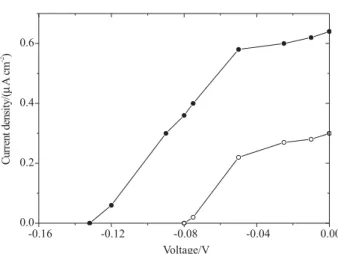
The film grew in bundles of fibers and its average thickness, as determined by scanning electron microscopy, was in the range 3-4 µm. The PAni adhered poorly on the ITO-glass and its thickness was not uniform. Thick films detached rather easily while thin films showed a very weak photocurrent response. Figure 2 shows the current-voltage (I-V) charac-teristics of the EB-based PEC in dark and under white light illumination with intensity of 50 mW cm-2. Illumination of the PEC produced an anodic current under short-circuit condition and the negative value of the VOC observed indicates that the photoactive electrode is higher in energy than the counter electrode. The VOC, the ISC and the fill factor (FF) obtained under illumination were –0.132 V, 0.64 µA cm-2 and 0.35, respectively. The dark current may be a result of an electrochemical reaction on the EB film that involves the redox couple. The FF was calculated using equation 1:
V I
V I FF
OC SC
P P
= (1)
where the product IPVP is the maximum power delivered by the PEC under illumination.
Polyaniline grown on Nc-TiO2-coated ITO-glass
In an effort to increase the photoresponse of EB and its possible use to sensitize TiO2, aniline was electropolymerized on Nc-TiO2-coated ITO-glass. PAni started to grow on the ITO surface between the Nc-TiO2 grains and extended to the surface. The electropoly-merization process and the electrochromic properties of the PAni film were not affected by TiO2except that the rate of formation was slower than that on a bare ITO-glass. The PAni:Nc-TiO2 composite film adhered strongly to the ITO-glass. The average thickness of the composite film was 1 µm. Figure 3 shows the I-V characteristics of the PEC, Glass/ITO/EB:Nc-TiO2/Electrolyte/Pt, in dark and under white light illumination with intensity of 50 mW cm-2.
Illumination of the PEC produced an anodic current under short-circuit condition and the negative value of
Figure 1. AFM picture of EB film on ITO-glass.
Figure 2.I-V characteristics for the PEC, Glass/ITO/EB/Electrolyte/Pt,
in dark (open circles) and under 50 mW cm-2 white light illumination
from Xe lamp (closed circles). Electrolyte: CH3OH + 0.02 mol L-1 EuCl 2
+ 0.02 mol L-1 EuCl 3.
-0.16 -0.12 -0.08 -0.04 0.00
0.0 0.2 0.4 0.6
C
ur
re
nt
de
ns
it
y/
(
Ac
m
-2 )
Voltage/V
Figure 3.I-V characteristics for the PEC, Glass/ITO/EB:Nc-TiO2
/Elec-trolyte/Pt, in dark (open circles) and under 50 mW cm-2 white light
illu-mination from Xe lamp (closed circles). Electrolyte: CH3OH + 0.02 mol L-1 EuCl
2+ 0.02 mol L -1 EuCl
3.
-0.20 -0.15 -0.10 -0.05 0.00 0
20 40 60 80 100 120
C
u
rr
ent
densi
ty/
(
A
cm
-2 )
theVOC observed indicates that the photoactive electrode is higher in energy than the counter electrode. The cell has a VOC of –0.205 V, an ISC of 105 µA cm-2and a calculatedFF of 0.44. The photoresponse of the PEC and its stability were more than the EB-based PEC.
The photocurrent action spectra
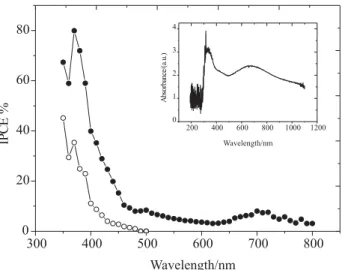
The photocurrent action spectrum for the EB:Nc-TiO2 -based PEC is shown in Figure 4. The action spectrum for Nc-TiO2-based cell is also shown for comparison. The inset shows the UV-Vis absorption spectra of EB film. The maximum incident photon-to-current conversion efficiency (IPCE) for the EB:Nc-TiO2-based cell was 80%. The high value corresponds to the absorption of light both by EB and TiO2 at 370 nm. The IPCE due to absorption by EB at 700 nm was 8%. The photoresponse of Nc-TiO2 is negligible above 420 nm. The IPCE % is calculated using equation 2:
) ( ) ( ) ( 1240 % 2 2 − − = m W I nm cm A I IPCE in SC λ µ (2)
whereλ is the excitation wavelength and Iinis the incident photon intensity.
A schematic energy level diagram for the device: Glass/ITO/EB:Nc-TiO2/Electrolyte/Pt is shown in Figure 5. The onset potentials for oxidation (Eox
onset) and reduction (Ered
onset) can be used to estimate the energies of the highest occupied molecular orbitals (EHOMO) and the lowest unoccupied molecular orbitals (ELUMO) of conducting polymers.15 According to de Leeuwet al.,16E
HOMO (eV) = –( E ox
onset + 4.4) and ELUMO
(eV) = –(Ered
onset + 4.4), where the onset potentials are in V vs. SCE. Using cyclic voltammetry, Eox
onset and Ered
onset of the EB film were found to be 0.8 V and –0.6 Vvs. SCE, respectively. This yields an estimated energy level of –5.2 eV for the HOMO and –3.8 eV for the LUMO of EB. The position of Eu2+/Eu3+ redox system (Eo = –0.36 V vs. NHE) is approximately at –4.14 eV (0 V vs. NHE = –4.5 eV).
From the experimental results observed above, it is possible to suggest that EB shows photovoltaic effect in the presence of the Eu2+/Eu3+. An anodic photocurrent has been produced when a potential is applied between zero and the open-circuit voltage. This observation indicates that upon illumination, electrons from the HOMO of EB excite to its LUMO from which they are transferred to the ITO (in EB-based cell) or to the conduction band edge of Nc-TiO2 and then to the ITO (in EB:Nc-TiO2-based cell). In the mean time, holes can be transferred from (EB)+to Eu2+. The Eu2+ is recovered at the counter electrode where Eu3+ accepts electrons from the external circuit. Such transfer of charges can however take place only if the Fermi energy levels of the ITO (–4.7 eV) and the Nc-TiO2 (–4.4 eV) are raised to a level higher than the energy of the counter electrode, probably by pinning with the excited-state of EB. The Nc-TiO2 film, in addition to its use as a matrix for the growth of PAni, participates in the light absorption (in the short wavelength region) and in the effective injection of electrons from the LUMO of the EB to the ITO contact. The photocurrent observed in the longer wavelength region is due to the absorption of light by EB.
Figure 4. The photocurrent action spectra of the PECs
Glass/ITO/EB:Nc-TiO2/Electrolyte/Pt (closed circles) and Glass/ITO/Nc-TiO2/Electrolyte/Pt (open circles). Electrolyte: CH3OH + 0.02 mol L-1 EuCl
2+ 0.02 mol L -1
EuCl3. Inset: UV-Vis absorption spectra of EB film on ITO-glass. 300 400 500 600 700 800 0
20 40 60 80
200 400 600 800 1000 1200 0 1 2 3 4 A bs or bance/ (a. u. ) Wavelength/nm IP C E % Wavelength/nm
Figure 5. A schematic energy level diagram for the PEC: Glass/ITO/
EB:Nc-TiO2/Electrolyte/Pt. The excitation of EB at 700 nm is shown. ITO TiO2
LUMO HOMO VB CB EB h Pt counter electrode - 2 - 4 - 6 - 8
Conclusions
Photoelectrochemical cells have been fabricated using the emeraldine base form of polyaniline as a photoactive material in the presence of Eu2+/Eu3+. The photoresponse of EB:Nc-TiO2-based PEC is significantly higher than that of EB-based and Nc-TiO2-based PECs. The EB/Nc-TiO2 -based cell shows a VOCof –0.205 V and an ISC of 105 µA cm-2 under 50 mW cm-2white light illumination from a Xe lamp. The cell shows an IPCE of 80% and 8% at 370 nm and 700 nm, respectively. Though the performances of the PECs under the present experimental conditions are low, the results indicate that we can make use of the high environmental stability of PAni for solar cell application.
References
1. Peumans, P.; Uchida, S.; Forrest, S.R.; Nature 2003,425, 158.
2. Hagfeldt, A.; Grätzel, M.; Acc. Chem. Res.2000,33, 269.
3. Ma, W.; Yang, C.; Gong, X.; Lee, K.; Heeger, A.J.; Adv. Funct.
Mater.2005,15, 1617.
4. Sariciftci, N.S.; Kuzmany, H.; Synth. Met.1987,21, 157.
5. Kaneko, M.; Nakamura, H.; J. Chem. Soc., Chem. Commun.
1985, 346.
6. Genies, E.M.; Lapkowski, M.; Santier, C.; Vieil, E.; Synth. Met.
1987,18, 18.
7. Shen, P.K.; Tian, Z.Q.; Electrochimica Acta1989,34, 1611.
8. Das Neves, S.; De Paoli, M.-A.; Synth. Met.1998,96, 49.
9. Tan, S.X.; Zhai, J.; Wan, M.X.; Jiang, L.; Zhu, D.B.; Synth.
Met.2003,137, 1511.
10. Higgins, R.W.T.; Zaidi, N.A.; Monkman, A.P.; Adv. Funct.
Mater.2001,11, 407.
11. Chen, S.-An.; Fang, Y.; Synth. Met.1993,60, 215.
12. Hao, Y.; Yang, M.; Yu, C.; Cai, S.; Liu, M.; Fan, L.; Li, Y.; Sol.
Energy Mater. Sol. Cells1998,56, 75.
13. Carinhana Jr., D.; Faez, R.; Nogueira, A.F.; De Paoli, M.-A.;
Synth. Met.2001,121, 1569.
14. Tennakone, K.; Kumara, G.R.R.A.; Kottegoda, I.R.M.;
Wijayantha, K.G.U.; Perera, V.P.S.; J. Phys. D: Appl. Phys.
1998,31, 1492.
15. Cervin, R.; Li, X.C.; Spencer, G.W.C.; Holmes, A.B.; Moratti,
S.C.; Friend, R.H.; Synth. Met.1997,84, 359; Liu, Y.; Liu,
M.S.; Jen, A.K.-Y.; Acta Polym.1999,50, 105.
16. de Leeuw, D.M.; Simenson, M.M.J.; Brown, A.R.; Einerhand,
R.E.F.; Synth. Met.1997,87, 53.