Quick stimulation of
Alcanivorax
sp. by bioemulsificant EPS
2003on microcosm oil
spill simulation
Simone Cappello
1, Maria Genovese
1, Renata Denaro
1, Santina Santisi
1, 3, Anna Volta
1, 2,
Martina Bonsignore
1, Giuseppe Mancini
2, Laura Giuliano
1,
Lucrezia Genovese
1, Michail M. Yakimov
11
Istituto per l’Ambiente Marino Costiero (IAMC)-CNR of Mesina, Italy.
2
Dep. Industrial Engineering”, University of Catania, Catania, Italy.
3
PhD School “Cellular Biology and Biotechnology”, University of Messina, Messina, Italy.
Submitted: December 11, 2013; Approved: April 17, 2014.
Abstract
Oil spill microcosms experiments were carried out to evaluate the effect of bioemulsificant exo-polysaccharide (EPS2003) on quick stimulation of hydrocarbonoclastic bacteria. Early hours of oil
spill, were stimulated using an experimental seawater microcosm, supplemented with crude oil and EPS2003(SW+OIL+EPS2003); this system was monitored for 2 days and compared to control
micro-cosm (only oil-polluted seawater, SW+OIL). Determination of bacterial abundance, heterotrophic cultivable and hydrocarbon-degrading bacteria were carried out. Community composition of marine bacterioplankton was determined by 16S rRNA gene clone libraries. Data obtained indicated that bioemulsificant addition stimulated an increase of total bacterial abundance and, in particular, selec-tion of bacteria related toAlcanivoraxgenus; confirming that EPS2003could be used for the dispersion
of oil slicks and could stimulate the selection of marine hydrocarbon degraders thus increasing bioremediation process.
Key words:Alcanivorax, bioemulsificant exopolysaccharide (EPS2003), oil spill.
Introduction
Environmental pollution caused by oil spills is one of the major threat for the marine ecosystem. Anthropogenic activities (i.e.storing and transport operations) have been identified as critical point for catastrophic accidents and potential sources of chronic pollution (i.e.ships, ports, oil terminals, freshwater runoff, rivers and sewage systems). One of the main reasons for prolonged persistence of hy-drocarbons in polluted environments is their low water sol-ubility which limits their availability to biodegrading mi-croorganisms (Barkay et al., 1999). Biodegradation of crude oil spilled in water, is limited by the extent of the ex-change phenomena occurring at the interface between the water phase, that hosts microbial life, and the insoluble hy-drocarbons. Thus several methods to enhance oil biodegra-dation have been tested, in attempting to rise the apparent solubility of hydrophobic hydrocarbons by the addition of
emulsifier molecules of biological or synthetic origin (Hanget al., 2009; Wenet al., 2010). Currently, application of bioemulsificants is an effective tool which could be ap-plied to increase oil recovery and hydrocarbon bioreme-diation in aquatic environments (Banat, 1995). Bioreme-diation is based upon the use of nutrients or aeration to enhance the activity of indigenous organisms ( biostimu-lation) and/or the addition of microbial inocula ( bioau-gmentation) to enhance the clean-up pills (Supaphol et al., 2006; Hassanshahian et al., 2010; Cappello et al., 2012). The addition of bioemulsificant (biostimulation) can stimu-late the indigenous bacterial population to degrade hydro-carbons at higher rates and the use of these substances can be an effective tool in the management of crude oil spilled in aquatic environments The understanding of the effect of these substances on microbial community dynamics and selection of bacteria able to participate at the
Send correspondence to S. Cappello. Istituto per l’Ambiente Marino Costiero, Messina, Sp. San Raineri 86, 98122 Messina, Italy. E-mail: [email protected].
biodegradation process is essential for predicting long-term persistence following an oil spill (Lindstrom and Braddock, 2002) and optimized the use of this substances in these pro-cesses. Moreover the knowledge of microbial diversity and metabolism in oil-polluted sites are helpful for oil spill bioremediation activities, as the use of specific microbial consortia can be planned as part of cleaning up procedures upon oil pollution (Gertleret al., 2012).
The aim of the present study has been to evaluate the shift of the composition of bacterial community structure and quick stimulation of hydrocarbonoclastic bacteria in first days of an oil spill phenomena consequently to rapid introduction of bioemulsifier EPS2003.
Materials and Methods
Set-up of experimental microcosms systems
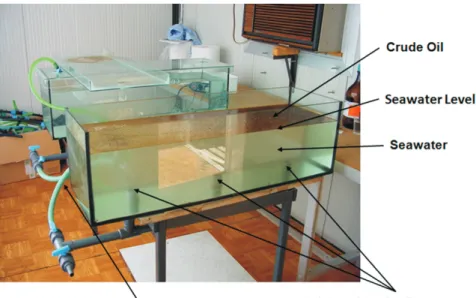
The experiment was performed in two rectangular glass tanks (Figure 1, closed systems) of 90 L capacity (100 cm long, 30 cm deep, 30 cm wide). Each microcosm was filled with 70 L of natural surface seawater collected, in June 2005, from Messina Harbour (Italy). Natural seawater was filtered through a 200mm nylon mesh to remove large meta-zoans and detritus. Mean water temperature was 18±2°C. Microcosm water was aerated and stirred by a pump (35 L h-1), placed at the exit of each tank, that takes water from two opposite bottom corners and drives it below the surface (Cappelloet al., 2007).
Experimental planning for microcosms and mesocosms experimentations
Both microcosms (SW+OIL and SW+OIL+EPS2003)
were supplemented with 70 mL of Arabian Light Crude Oil (900 mg L-1). Microcosm SW+OIL+EPS2003was also
sup-plemented with dry EPS2003 (45 mg L-1). As described
(Crescenziet al., 3003; Cappelloet al., 2011), the molecular structure of the bioemulsificant EPS2003 corresponds to a
polysaccharidic chain with hydrophobic fatty acids substitu-tions of 12-18 carbon atoms length. EPS2003is obtained by
Acinetobacter calcoaceticus CBS 962.97, a hydrocar-bon-degrading bacterium isolated in laboratory.
Sampling strategy
A total of two litres (2 L) of seawater have been col-lected, at the begging (T0) and after two days (T2) of
experi-mentation, from each experimental microcosm. Analysis of the total bacterial abundance [4’,6-diamidino-2-phenyl-indole 2HCl, (DAPI count)], heterotrophic cultivable bacte-ria [Colony Forming Units, (CFU count)], enumeration of hydrocarbon-degrading bacteria [Most Probable Number, (MPN count)] and phylogenetic diversity [cloning library of 16S complimentary rDNA (crDNA)] were carried out.
Bacterial abundance (DAPI Count)
Cell counts were performed by DAPI (4’,6-diami-dino-2-phenylindole 2HCl, Sigma-Aldrich S.r.L., Milan, It-aly) staining on samples (10 mL) fixed with formaldehyde (2% final concentration), according to Porter and Feig (1980). Slides were examined by epifluorescence with Axioplan 2 Imaging (Zeiss; Carl Zeiss Inc., Thornwood, N.Y.) microscope. All results were expressed as number of cells mL-1. All measures were repeated three times.
Heterotrophic cultivable bacteria (CFU)
Enumeration of heterotrophic cultivable bacteria were estimated by spreading 100mL of tenfold dilutions of microcosm samples on plates of Marine agar 2216 medium (Difco S.p.a, Milan, Italy), incubated at 20 ±1 °C for 7
days. Results were expressed as colony forming units (CFU) mL-1. All measures were repeated three times.
Most Probable Number (MPN)
Hydrocarbon-degrading bacteria were enumerated, in sterile Bushnell-Hass (B-H) medium (Difco Products) added with 2% NaCl (pH 70) and 10mL of sterile Arabian light crude oil, by a miniaturized Most Probable Number (MPN) method (Brown et al., 1990), slightly modified (Cappello et al., 2007). The MPN of hydrocarbon-de-grading microorganisms was determined, from the appro-priate MPN tables according to the American Public Health Association (A.P.H.A., 1992). All measures were repeated three times.
Molecular and taxonomic analysis (cloning library of 16S crDNA)
Total RNA extraction of each seawater samples were performed by Master Pure Complete DNA & RNA Purifi-cation Kit (Epicentre Biotechnologies, Madison, WI) in ac-cordance with the manufacturer’s instructions. RNA was converted to cDNA using First-Strand cDNA Synthesis SuperScriptTM II Reverse Transcriptase (Life Technol-ogies, Carlsbad, CA, USA). RT reaction mixtures (20mL) contained 1mL using the Random Hexamere Primer Mix (Bioline, Italy), 30 ng of RNA, 1mL 10 mM dNTPs (Gibco, Invitrogen Co., Carlsbad, CA) and sterile distilled water to 14mL. After heating to 65 °C for 5 min, and incubate on ice for 1 min, the mixture was added with 4mL of 5 x First-Strand Buffer, 1mL of DTT and 1mL of SuperScriptTM. The mixture was mixed and incubated at 50 °C for 30 min. Finally enzyme was inactivated by heating at 70 °C for 15 min. PCR reaction was performed as above described. The quality of amplification products were examinated by agarose electrophoresis and purified using Qiaquick Gel Extraction kit (QIAGEN, Valencia, CA).
16S rRNA genes were amplified from cDNA total
community with the 530F
(5’-GTGCCAGCMGCCGCGG-3’) and universal primer
Uni-1492R (5’-TACGGYTACCTTGTTACGACT-3’).
The PCR was performed using a 50-mL (total volume) mix-ture containing 1 x solution Q (Qiagen, Hilden, Germany), 1 x Qiagen reaction buffer, 1mM of each forward and re-verse primer, 10 mM dNTPs (Gibco, Invitrogen Co., Carlsbad, CA), 2.0 mL (50-100 ng) of template and 2.0 U of Qiagen Taq Polymerase (Qiagen). The reaction started with a 3 min hot-start at 95 °C; 1 min at 94 °C, 1 min at 50 °C, 2 min at 72 °C, 35 cycles; extension: 10 min at 72 °C was performed with GeneAmp 5700 (PE Applied Biosystems, Foster City, CA, USA).
After gel electrophoresis of PCR products, purified amplicons representing 16S crDNA sequences were cloned into the pGEM T-easy Vector II (Promega, Madison, Wis., USA), and inserts from the transformedE. coliDH10b
col-onies were subsequently PCR amplified with primers
spe-cific for the vector, M13F
(5’-TGTAAAACGACGGCCAGT-3’) and M13R
(5’-TCACACAGGAAACAGCTATGA C-3’). The PCR products, after purification, were sequenced by Macrogen (Korea).
The sequences similarity was analysed with the pro-gram FASTA Nucleotide Database Query available through the EMBL- European Bioinformatics Institute. The phylogenetic affiliation of the sequenced was per-formed as described by Yakimovet al.(2005).
Rarefaction analysis, diversity index and coverage values
For statistical analyses clones of each library were separately considered to define phylotypes at 97% of simi-larity, using DNADIST of the Philips package and Se-quencer software previously described. PAST
(PAleon-tological STatistics v1.19 software from
http://folk.uio.no/ohammer/past/) website was used to per-form different diversity indices [Rarefaction analysis, taxa, total clones, singletons, Dominance (D), Coverage (C), Shannon (H) and Simpson (D’)] for each clone library. To perform rarefaction analysis, total number of obtained clones compared with the number of clones representing each unique phylotype was used to produce the rarefaction curves.
Coverage values were calculated to determine how efficient our clones libraries described the complexity of a theoretical community such as original bacterial commu-nity. The coverage value is given as C = 1 - (n1/N) where n1 is the number of clones which occurred only once in the li-brary.
Results
Total cell abundance (DAPI count), heterotrophic cultivable (CFU) and hydrocarbon-degrading bacteria (MPN) counting
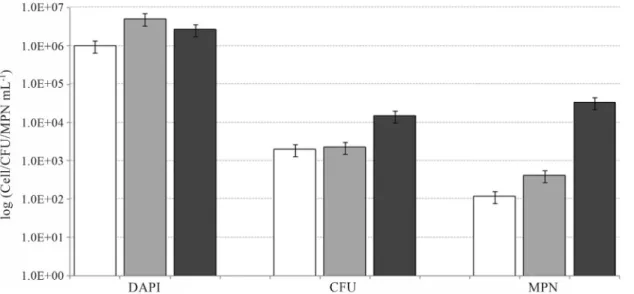
The bacterial abundance were measured by DAPI staining (Figure 2). After two days of experimentation, the value of microbial abundance shown an increment of one order of magnitude (value~106cell mL-1) in SW+OIL and SW+OIL+EPS2003microcosm.
In two days of experimentation, stable values (~103CFU mL-1) in the amount of heterotrophic bacteria (CFU) were observed. In microcosm SW+OIL, the addic-tion of bioemulsificant EPS2003determined a progressive
increment with values that passing from 2.1x10³CFU mL-1 (T0) to 1.5x10⁴ CFU mL-1 (T2). Values of
5.4x10⁴MPN mL-1were observed after two days in experi-mentation performed with the introduction of EPS2003. In
control experiment (SW+OIL) values of MPN
Taxonomic analysis of clone libraries.
Bacterial community at the begging (T0) and after two
days (T2) of experimentation from microcosms SW+OIL
and SW+OIL+EPS2003was subjected to 16S rRNA clone
li-braries taxonomic analysis. A total of 300 randomly picked clones containing 16S crDNA inserts have been sequenced and their phylogenetic affiliation was determined. No chi-meric sequences were detected among the clones. Sequen-ces that were > 97% similar were considered to have the same phylotype, or operational taxonomic units (OTUs).
At the begging of experimentation (SW, T0), in terms
of absolute number of clones and the diversity of their se-quences, Gammaproteobacteria and Bacteroidetes/Chlo-robi (B/C) were the most prominent groups bacteria present in the16S crDNA clone library (Figures 3 and 4).
The group of the Gammaproteobacteria is the pre-dominant bigger group (92%) whit sequences related to the genus of Alteromonas (Alteromonadaceae, 64%),
Marinobacter (Alteromonadaceae, 13%) and
Oceanospirillum(Oceanospirillaceae, 4%) were detected.
Figure 3- Relative abundance (%) of principal bacterial class obtained with 16S crDNA clone libraries at time zero (white bars) and after 20 days of ex-perimentation in SW+OIl (grey bars) and SW+OIL+EPS2003(dark grey bars) system. Alpha, Alphaproteobacteria, Beta, betaproteobacteria, Gamma,
gammaproteobacteria and BC, Bacteroidetes/Chlorobi.
Figure 2- Bacterial abundance (DAPI staining mL-1) , distribution of heterotrophic cultivable bacteria (Colony Forming Units, CFU mL-1) and
Sequences related to unclassified and uncultured Gamma-proteobacteria (g-Cluster 1 and g-Cluster 2) were also de-tected. The Bacteroidetes/Chlorobi group was made up of one genus represented principally by Flavobactyerium (Flavobacteriaceae, 4%).
After two days from introduction of crude oil in ex-perimental system (SW+OIL) the structure of microbial population is represented principally for Gammaproteo-bacteria (69%). During the first two days of analysis it was possible to observe a disappearance of sequences correlated to theAlteromonasgenus. The absence of such sequences coincided with the increment of those associates to the ge-nus of Pseudomonas (15%), Alteromonas (44%) and
Oceanospirillum (8%). Sequences related to
Alpha-proteobacteria (12%) and B/C group (5%) are also de-tected.
The taxonomic analysis of the 16S crDNA among the 100 sequences obtained from SW+OIL+EPS2003
micro-cosm revealed as the more abundant clones (93%) are affil-iated to the Gammaproteobacteria group. The disappear-ance of sequences correlated to the Alteromonas genus coincided with the increment of those associates to the ge-nus ofPseudomonas(17%), Alcanivorax(61%) and che-mio-organothrophic Oceanospirillum (15%). Sequences
related to the Cytophaga (7%) genus are also present (Fig-ures 3 and 4).
Measure of “Diversity indices” of SW+OIL and SW+OIL+EPS2003experiment show as the abundance of
sequences related to Alcanivorax genus determined high values of Dominance (D) were shown in Table 1.
Discussion
The aim of the present study has been to evaluate the shift of the composition of bacterial community structure and quick stimulation of hydrocarbonoclastic bacteria in Figure 4- The overview of the procaryotic diversity and relative abundance of representatives of phylogenetic groups recovered (by 16S rRNA clone librariers) at begging (T0) and after two days (T2) of microcosm oil spill experimenations. a-, Alphaproteobacteria; b-, Betaproteobacteria; g-,
Gammaproteobacteria; BC, Bacteroidetes Chlorobi Group. Black circles and little yellow circles, represent, respectively the Crude Oil and the biosurfactant EPS2003insert in the systems in study.
Table 1- Diversity indices calculated for the five clone libraries from dif-ferent time of experimentation in microcosms SW+OIL and SW+OIL+EPS2003.
SW Microcosm SW+OIL
Microcosm SW+EPS2003+OIL
T0 T2 T2
Taxa (S) 7 10 4
Total clones 100 100 100
Single clones 1 2 0
first days of an oil spill phenomena consequently to rapid in-troduction of bioemulsifier EPS2003. In marine environments
the structure and function of the bacterial population change fast due to anthropogenic impacts, adapting to the new con-ditions. In fact, microbial community response to an envi-ronmental stressor (e.g. the toxic effect of oil) is the transition to a specific surviving condition (Cappello and Guglielmino, 2006) which favours hydrocarbon tolerating species or hydrocarbonoclastic bacteria that consuming it (Cappelloet al., 2007). Study of the structure of microbial population, during the SW+OIL+EPS2003 experimentation,
showed a rapid increment of the microbial population with increasing from 105 cell mL-1 to 106 cell mL-1. Also in mesure of heterotrophic cultivable bacteria (CFU) shown as the introduction of oil determined a toxic effect; this effect already described in literature (MacNaugthtonet al., 1999) as “a phase of adaptation”, characterized by a reduction of bacterial taxonomical group with selection of genera able to tolerate and/or to degrade the oil. In the early phase of simu-lation of oil spill it was possible to observe a variation of mi-crobial community with selection of bacteria belonging to
g-Proteobacteria and Bacterioidetes/Chloroby group which are affiliates whit hydrocarbons degrading bacteria. Inside
g-Proteobacteria group, some genera (i.e. Oceanospirillum andPseudomonas) persisted by the start until the end of the experimentation. The Bacterioidetes/Chloroby group pres-ent a relative increase over time with sequences related to Cytophagagenus (belonging to the Flavobacteriaceae fam-ily). Bacteria belonging to this group are suggested to con-tribute to the biodegradation phenomena occurring in natural environment, with particular reference to the degradation of cyclical hydrocarbons and polycyclic aromatic hydrocar-bons (PAHs). The 16S rRNA clone library reveal as the most fraction of sequences obtained after two day from the SW+OIL system are affiliated to the Alteromonas, Oceanospirillum, Pseudomonasgenera; simultaneously did not allowed the presence of sequences belonging to marine obligate hydrocarbonoclastic bacteria (OHCB) group (i.e. Alcanivorax sp). As already observed by other authors (Kasaiet al., 2002; MacNaughtonet al., 2009), the develop-ment of OHCB bacteria in petroleum polluted environdevelop-ments poor of nutrients (N and P) is limited respect to other heterotrophic microbial genera, able to tolerate (and/or to de-grade) the presence of oil. Bacteria developed in the SW+OIL system have probably obviated the lack of nutri-ents using as alternative sources of additional nitrogen and phosphorus the compounds released by the microbial bio-mass died as a result of the toxic effect of the crude oil. The measure of the number of vital cells (data not shown), during the first 2 days of incubation, supports such hypothesis. This hypothesis is consistent with the taxonomic analysis of mi-crobial community at the beginning of experimentation (T0),
which does not reveal the presence of OHCB bacteria that have been suggested as bioindicator of regressed pollution (Yakimovet al., 2008). These results are in according to data
obtained by Rolinget al.(2002) that evidenced that in oil polluted systems, any process of degradation takes place without addition of the nourishing. According to the data present in literature, the “adaptation” to oil presence is a very complex process that requires a variable time (from several days to weeks) just at the moment that the composition of the oil continue “to force” the system. Soon after the occurring of “stress” conditions (determined by the presence of oil), the microbial population tries to restore the original diversity (Mac Nauhgthonet al., 1999).
Overall results indicated that the addition of bio-surfactant EPS2003determine quali-, quantitative changes in
the microbial population and enhance processes of oil degra-dation. These results are in line with observation of Yoshida et al.(2006). Data particularly interesting is obtained from analysis of 16S crRNA clone libraries after introduction of biosurfactant. Data shown as sequences belonging to the Alcanivoraceae family become, in two days, quantitatively dominant in the system in study (61%). The increase of bac-teria related toAlcanivorax spp. was presumably favoured by the greater availability of inorganic nourishing present in the system from the bacterial cells died due to toxic effect of the bioemulsificant and oil (Cappelloet al., 2007).
As reported bacteria closely related toAlcanivorax be-came a dominant bacterial population in petroleum-conta-minated seawater when nitrogen and phosphorus nutrients were supplied in adequate quantity; different study demon-strate asAlcanivoraxplays a fundamental role in the degra-dation of linear hydrocarbons in environments polluted by oil and different studies have confirmed as bacteria related to Alcanivorax are major players in the bioremediation of oil-contaminated marine environments (Kasaiet al., 2002; Rolinget al., 2002; Yakimovet al., 2004).
The growth ofAlcanivoraxin crude or heavy oil was not particularly rapid in comparison with other oil-degrading bacteria inhabiting seawater; however the EPS2003seem
de-termine a massive increment of this bacterium in system in study. These findings further confirm thatAlcanivoraxnot only degrades oil hydrocarbons in vitro, but seems to play a crucial role in the natural cleaning of oil-polluted marine sys-tems. Our results concerning EPS2003 effectiveness are in
agreement with findings of Bruheimet al.(1999) who sug-gests that the efficacy of a biosurfactant in the oxidation of paraffins does not depend exclusively on the physico-chemical characteristic of chemicals but also on the link whit microbial community (interaction, stimulation etc.) and in this case from selection of hydrocarbonoclastic bacte-ria with high degradative capability.
Conflict of Interest
Acknowledgments
This work was supported by grants of National Counsel of Research (CNR) of Italy and by: i) Italian Project PRIN2010-2011 “System Biology”; ii) National Operative Pro-ject PON R&C 2007-2013 “STI-TAM”; iii) National Operative Project PON R&C 2007-2013 “SEA-PORT”; iv) PNRA2013
“STRANgE”; v) European Project KILL-SPILL
(KILL-SPILL-FP7-KBBE-2013.3.4-01).
References
American Public Health Association (A.P.H.A.). (1992) Standard Methods for the Examination of Water and Waste Water. 18th edi-tion. American Public Health Association, Washington, DC. Banat IM (1995) Biosurfactants production and possible use in
micro-bial enhanced oil recovery and oil pollution remediation. Bios Tech 51:1-12.
Brown EJ, Braddock FG (1990) Sheen Screen, a miniaturi-zed Most-Probable-Number method for enumeration of oil-de-grading microorganisms. Appl Env Microbiol 56:3895-3896. Bruheim P, Bredholtand H, Eimhjellen K (1999) Effects of surfactant
mixtures, including Corexit 9527, on bacterial oxidation of ace-tate and alkanes in crude oil. Appl Env Microbiol 65:1658-1661. Cappello S, Caruso G, Zampino D, Monticelli LS, Maimone G, Denaro R, Tripodo B, Troussellier M, Yakimov MM, Giuliano L (2007) Microbial community dynamics during assays of har-bour oil spill bioremediation: a microscale simulation study. J Appl Microb 102:184-94.
Cappello S, Guglielmino SPP (2006) Growth temperature on polysty-rene adhesion ofPseudomonas aeruginosaATCC 2785. Braz J Microbiol 37(3):205-207.
Cappello S, Denaro R, Genovese M, Giuliano L, Yakimov MM (2007) Predominant growth ofAlcanivoraxduring experiments on “oil spill bioremediation” in mesocosms. Microb Res 162:185-90.
Cappello S, Crisari A, Denaro R, Crescenzi F, Porcelli F, Yakimov MM (2011) Biodegradation of a Bioemulsificant Exo-polysaccharide (EPS2003) by Marine Bacteria. Water Air and
Soil Pollution 214:645-652.
Cappello S, Genovese M, Della Torre C, Crisari A, Hassanshahian M, Santisi S, Calogero R, Yakimov MM (2012) Effect of bioemulsificant exopolysaccharide (EPS2003) on microbial
community dynamics during assays of oil spill bioremediation: A microcosm study. Mar Poll Bull 64:2820-2828.
Desai JD, Banat IM (1997) Microbial production of surfactans and their commercial potential. Microb Mol Biol Rev 61:47-64. Gertler C, Na DJ, Cappello S, Gerdts G, Quilliam RS, Yakimov MM,
Golyshin PN (2012) Composition and dynamics of biostimulated indigenous oil-degrading microbial consortia from the Irish, North and Mediterranean Seas: a mesocosm study.” FEMS Microb Ecol 81:520-36.
Hang XF, Liu J, Lu LJ, Wen Y, Xu JC, Yang DH, Zhou Q (2009) Evaluation of screening methods for demulsifying bacteria and characterization of lipopeptide bio-demulsifier produced by
Alcaligenessp. Bior Tech 100:1358-1365.
Hassanshahian M, Emtiazi G, Kermanshahi RK, Cappello S (2010) Comparison of oil degrading microbial commu-nities in sediments from the Persian Gulf and Caspian Sea. Soil and Sed Cont 19(3): 277-291.
Kasai Y, Kishira H, Sasaki T, Syutsubo K, Watanabe K, Harayama S (2002) Predominant growth of Alcanivorax strains in oil-contaminated and nutrient-supplemented seawater.” Envi-ron Microb 7:141-147.
Lane DJ (1991) 16/23S rRNA sequencing. In: Stackerbrandt, E., Goodfellow, M. (eds) Nucleic Acid Techniques in Bacterial Systematics. Wiley, New York, pp 115-175.
Lindstrom, J.E. and Braddock, J.F. (2002) Biodegradation of petro-leum hydrocarbons at low temperature in the presence of the dispersant Corexit 9500. Mar Poll Bul 44:739-747.
MacNaughton SJ, Stephen JR, Venosa AD, Davis GA, Chang YJ, White DC (1999) Microbial Population Changes during Bioremediation of an Experimental Oil Spill. Appl Environ Microb 65:3566-3574.
Porter KG, Feig YS (1980) The use of DAPI for identifying and counting aquatic microflora. Limn Ocean 2:943-948. Roling WFM, Milner MG, Jones DM, Lee K, Daniel F, Swannell
RJP, Head IM (2002) Robust hydrocarbon degradation and dy-namics of bacterial communities during nutrient-enhanced oil spill bioremediation. Appl Environ Microb 68:5537-5548. Saeki H, Sasaki M, Komatsu K, Miura A, Matsuda H (2009) Oil spill
remediation by using the remediation agent JE1058BS that contains a biosurfactant produced by Gordonia sp. strain JE-1058. Bios Tech 100:572-577.
Supaphol S, Panichsakpatana S, Trakulnaleamsai S, Tungkananuruk N, Roughjanajirapa P, O’Donell AG (2006) The selection of mixed microbial inocula in environmental biotechnology: ex-ample using petroleum contaminated tropical soils. J Microb Meth 65:432-441.
Wen Y, Cheng H, Lu LJ, Liu J, Feng Y, Guan W, Zhou Q, Huang XF (2010) Analysis of biological demulsification process of wa-ter-in-oil emulsion by Alcaligenes sp. S-XJ-1. Bior Tech 100:8315-8322.
Yakimov MM, Gentile G, Bruni V, Cappello S, D’Auria G, Golyshin PN, Giuliano L (2004) Crude oil-induced structural shift of costal bacterial communities of Rod Bay (Terra Nova Bay, Ross Sea, Antarctica) and characterization of cultured cold adapted hydrocarbonoclastic bacteria. FEMS Microb Ecol 49:419-432.
Yakimov MM, Denaro R, Genovese M, Cappello S, D’Auria G, Chernikova TN, Timmis KT, Golyshin PN, Giuliano L (2005) Natural microbial diversity in superficial sediments of Milazzo Harbour (Sicily) and community successions during micro-cosm enrichment with various hydrocarbons. Environ Microb 7:1426-1441.
Yakimov MM, Cappello S, Crisafi E, Tursi A, Corselli C, Scarfì S, Giuliano L (2006) Phylogenetic survey of metabolically active microbial communities associated with the deep-sea coral
Lophelia pertusafrom the Apulian Plateau, Central Mediterran Sea. Deep Sea Research 53:62-75.
Yakimov MM, Timmis KN, Golyshin PN (2007) Obligate oil-degrading marine bacteria. Curr Opin Biotech 18:257-266. Yoshida A, Nomura H, Toyoda K, Nishino T, Seo T, Yamada M,
Nishimura M, Wada M, Okamoto K, Shibata A, Takada H, Kogure K, Ohwada K (2006) Microbial responses using dena-turing gradient gel electrophoresis to oil and chemical disper-sant in enclosed ecosystems. Mar Poll Bull 52:89-95.