ABSTRACT:Introduction: The use of secondary data for health service research has been increasingly common, having the advantage of acquiring information faster and cheaper, in addition to its larger population, temporal and geographical amplitude. Objectives: The aim of this study was to describe problems in the quality of information about hospitals characteristics and hospitalizations in Brazil. Methods: The National Database on Health Units (CNES), the Public Hospital Information System (SIH), and the Private Hospital Information System (CIH) were analyzed. We explored “coverage,” “completeness,” “consistency,” and “validity” as quality dimensions. Results: There are complete and consistent basic registration data for hospitals, and most of them sent some information about the production of hospitalization. CIH covered 55% of admissions, and SIH exceeded 100%. The inadequate illing of the “procedure,” “main,” and “secondary diagnosis” ields is higher than expected, especially for CIH. Conclusion: Improvements in databases are required to qualify the analysis and increase its potential use, contributing with strategic studies that support decision-making in the planning of hospitals and health care networks.
Keywords: Database. Hospital information systems. Hospitalization. Evaluation. Health care quality. Access and evaluation. Information dissemination.
Quality of hospital databases
in Brazil: some elements
Qualidade das bases de dados hospitalares no Brasil: alguns elementos
Juliana Pires MachadoI, Mônica MartinsII, Iuri da Costa LeiteIII ORIGINAL ARTICLE / ARTIGO ORIGINAL
IBoard of Sectoral Development, National Agency of Supplementary Health.
IIDepartment of Administration and Health Planning, National School of Public Health, Fundação Oswaldo Cruz.
IIIDepartment of Epidemiology and Quantitative Methods in Health, National School of Public Health, Fundação Oswaldo Cruz. Corresponding author: Juliana Machado. Agência Nacional de Saúde Suplementar. Diretoria de Desenvolvimento Setorial. Avenida Augusto Severo, 84, 8º andar, Glória, CEP: 20021-040, Rio de Janeiro, RJ, Brasil. E-mail: [email protected]
INTRODUCTION
The use of secondary databases for the development of studies about health services has been more frequent, especially when it comes to studies that assess the quality of hospital care1,2. The main advantages of these databases are the fast and less expensive
acquirement of information and the possibility to conduct a temporal follow-up, besides the large volume of information with population and geographic amplitude. On the other hand, the main limitation is related to purposes, especially those originally cre-ated for payment, often limited in terms of availability of clinical information, besides issues with reliability and validity.
There are diferent interests associated with the illing out of data in information systems, but all of them can cause quality problems that require adaptation, so that it can be used in scientiic studies or surveillance programs3,4. In a study conducted in the
Netherlands, Anema et al.5 mentioned the fact that the main issues in hospital databases
are related to the manipulation of information to get better results in the performance surveillance applied by local authorities and to the nonstandardization of procedures and terminological speciications. Regarding research, the disadvantage of these databases is the lack of control from the researcher about data collection4,6.
However, it is unrealistic to assume there is any database completely free of error, even after strict auditing procedures2. Besides, the use of these databases in studies can
be useful to improve the quality of care and information systems7.
RESUMO: Introdução: O uso de bases de dados secundárias para o desenvolvimento de pesquisas sobre serviços de saúde tem sido cada vez mais frequente, tendo como vantagem a obtenção mais rápida e menos custosa das informações, além da maior amplitude populacional, temporal e geográica. Objetivo: O objetivo deste estudo foi descrever problemas na qualidade das informações sobre a rede e a produção hospitalar no Brasil. Métodos: Foram analisados o Cadastro Nacional de Estabelecimentos de Saúde (CNES), o Sistema de Informações Hospitalares do SUS (SIH) e a Comunicação de Internação Hospitalar (CIH). Exploraram-se as dimensões “cobertura”, “completitude”, “consistência” e “validade”. Resultados: Há preenchimento completo e consistente dos dados cadastrais básicos de hospitais, e a maioria deles enviou alguma informação sobre produção via CIH e SIH. Enquanto a CIH alcançou cobertura de 55% das internações, o SIH ultrapassou 100%. O preenchimento inadequado dos campos “procedimento realizado”, “diagnóstico principal” e “secundário” é maior que o desejável, especialmente na CIH. Conclusão: As melhorias em bases de dados são necessárias para qualiicar as análises e aumentar seu potencial uso, contribuindo para estudos estratégicos que subsidiem a tomada de decisões no planejamento de hospitais e redes de atenção à saúde.
The definition of quality and of the dimensions composing the quality of databases, especially those of health, is usually ambiguous or unspecific, making the internal eval-uation of a database and its comparison with similar or related ones complex. To deal with this problem, Arts et al.2 suggest that its dimensions be clearly predefined, as well
as the way of measuring them and the reference patterns of quality.
Considering the advantages and the limited use of secondary databases, it is essen-tial to approach the aspects related to the quality of this information, which potenessen-tially influences the results of the studies2,5. In this sense, considering that the credibility of
data affects the practical use of information by administrators and by the society itself, the objective of this study is to describe problems regarding the quality of information about the service network and hospital production in Brazil.
METHODS
STUDY SCOPE AND UNIVERSE
This is a descriptive and exploratory study about the quality of Brazilian hospi-tal information systems. National Database on Health Units (CNES), Public Hospihospi-tal Information System (SIH), and Private Hospital Information System (CIH) databases were analyzed. The study universe includes all of the hospitalizations registered in the locations considered to be active in at least one year, from 2008 to 2010.
The Records of Health Insurance Plans (RPS/ANS 2008–2010) were used, as well as the National Household Sample Survey (PNAD 2008), the Study on Sanitary Medical Care (AMS 2009), the System of Mortality Information (SIM 2009), and the Live Birth Information System (SINASC 2009), in order to compare with the information about hospitals and hospitalizations.
All data were accessed in the irst semester of 2013, through iles made publically avail-able in Datasus websites (Department of Informatics at SUS), except for RPS, obtained after a formal request was sent to the Supplementary National Health Agency (ANS)
The study is part of the research “The public–private arrangement and the quality of hospital care in Brazil,” approved by the Ethics Committee of the National School of Public Health, CAAE no. 02234312.3.0000.5240. There are no conlicts of interests related to this study.
DESCRIPTION OF THE BRAZILIAN HOSPITAL INFORMATION SYSTEM
SIH records information about the hospitalizations that were financed by SUS in either public or private contracted hospitals. Data are sent through a virtual Hospitalization Authorization (AIH) form, whose main goal is reimbursement. The system has been through a lot of changes toward its improvement; however, its content and purpose have been basically the same since 19919.
The Private Hospital and Outpatient Clinic Information System (CIHA) is the offi-cial and mandatory instrument to register the hospitalizations in the country that were not financed by SUS; therefore, it is not in the scope of the data that have to be sent to SIH.
Established as the Private Hospital Information System (CIH) in 1999, its name was altered to CIHA in 2011, aggregating outpatient clinics as well. It is mandatory to send information via CIHA, since it provides concession and renovation of the Certificate of Charitable Organization for Social Assistance (CEBAS); renovation of the Sanitary Surveillance permit; and processing of any request to the Ministry of Health regard-ing arrangements, records, and exemption of importation taxes. For units integratregard-ing the SUS network, sending the CIHA is a requirement to process and pay the hospital-izations covered by SIH, as well as to the transfer of monthly financial resources from the Ministry of Health10.
APPROACH AND ANALYSIS OF THE QUALITY OF THE INFORMATION SYSTEM
The conceptual alignments presented in the studies by Sorensen et al.6 and Lima
et al.3 were used to delimit the quality analyses of the CNES, SIH, and CIH databases.
Lima et al.3 listed nine quality dimensions in the health information systems:
accessibility (availability and facility to understand), methodological clarity (good documentation, contributing with the understanding and use of data), coverage (level of coverage of the events), completeness (level of noninvalid values), reliability (level of agreement in different analyses), consistency (coherence between related variables), absence of duplicity (single representation of each event), opportunity (availability in place and time), and validity (level that measures what is supposed to be measured).
On the other hand, the model of evaluation of secondary databases proposed by Sorensen et al.6 stands out seven aspects that influence the value and credibility of these
databases; some of the factors are in common with those related by Lima et al.3, but
there are also some others such as size of the databases, period of data records, data formatting, and the possibility of linkage with other databases.
Considering the analyzed approaches, in this study we especially observed the dimen-sion “coverage of databases,” applying the following strategies: description of available data, comparison with the expected result according to the obligation to send it, and comparison with other databases providing similar information.
For the comparison of information about the hospital network, AMS was used as a reference. Considering AMS as a gold standard, the estimated coverage of CNES was calculated as the product between the number of hospitals and beds in this system, divided by the number of hospitals and beds in AMS.
To analyze the validity of information regarding the connection with health insurance plans or SUS registered in CNES, the categorization according to the field “contract” in CNES was compared to:
1. Database of RPS, which registers hospitals that work with private insurance health plans;
2. Hospitalizations reported in SIH and CIH, indicating, respectively, a connection with SUS and the plans.
About the sending of data regarding hospitalizations, the number of hospitals that should inform the SIH and the CIH was estimated based on the contracts registered in CNES and RPS, comparing it to the number of hospitals that, in fact, sent data to the systems. Regarding hospitalizations, the total number of hospitalizations in SIH and in CIH was compared, in 2008, with the total number of hospitalizations SUS and not-SUS estimated based on the information of PNAD 2008. The total of hospital deaths, deliveries, and births recorded in SIH and CIH was compared, respectively, with the information from SIM and SINASC for 2009.
To complement the coverage analysis in the databases about hospitalizations, com-pleteness, consistence, and validity were analyzed based on the description and evaluation of the level of fulfillment of the variables. The fields “procedure concluded” and “main diagnosis” were analyzed; in the first case, the validity deficit was considered when the filled out data consisted of procedure codes without specification, that is, those with only the first 6 digits filled out from a total of 10; in this case, it is not possible to identify the procedure effectively. In the second case, the proportion of poorly defined diagnoses was assessed, belonging to chapter XVIII of ICD-10 “Abnormal symptoms, signals and findings of clinical and laboratory tests, not classified elsewhere.”
RESULTS
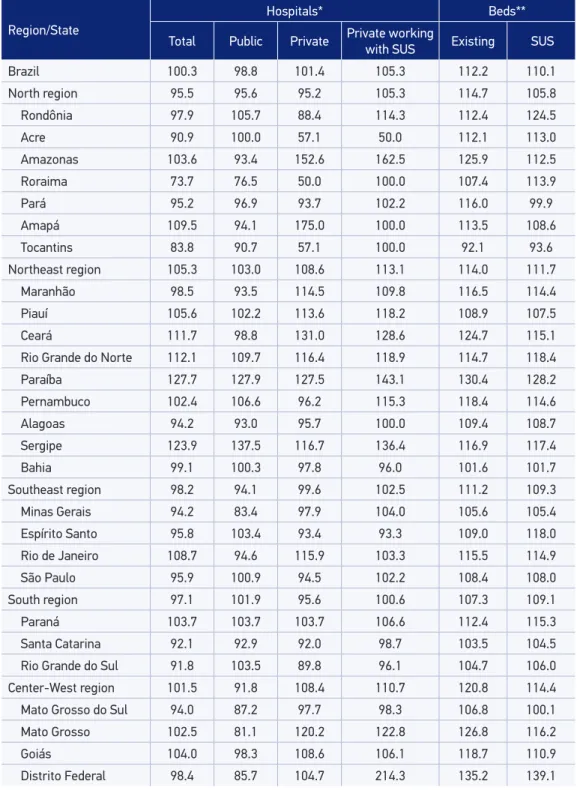
Source: CNES, RPS, AMS.
*Ratio of the number of hospitals in CNES/RPS and number of hospitals in AMS; **Ratio of the number of beds in CNES and number of beds in AMS.
Table 1. Coverage of information about hospitals and beds per region and state, according to
juridical nature and work with SUS. Brazil, 2009.
Region/State
Hospitals* Beds**
Total Public Private Private working with SUS Existing SUS
Brazil 100.3 98.8 101.4 105.3 112.2 110.1
North region 95.5 95.6 95.2 105.3 114.7 105.8
Rondônia 97.9 105.7 88.4 114.3 112.4 124.5
Acre 90.9 100.0 57.1 50.0 112.1 113.0
Amazonas 103.6 93.4 152.6 162.5 125.9 112.5
Roraima 73.7 76.5 50.0 100.0 107.4 113.9
Pará 95.2 96.9 93.7 102.2 116.0 99.9
Amapá 109.5 94.1 175.0 100.0 113.5 108.6
Tocantins 83.8 90.7 57.1 100.0 92.1 93.6
Northeast region 105.3 103.0 108.6 113.1 114.0 111.7
Maranhão 98.5 93.5 114.5 109.8 116.5 114.4
Piauí 105.6 102.2 113.6 118.2 108.9 107.5
Ceará 111.7 98.8 131.0 128.6 124.7 115.1
Rio Grande do Norte 112.1 109.7 116.4 118.9 114.7 118.4
Paraíba 127.7 127.9 127.5 143.1 130.4 128.2
Pernambuco 102.4 106.6 96.2 115.3 118.4 114.6
Alagoas 94.2 93.0 95.7 100.0 109.4 108.7
Sergipe 123.9 137.5 116.7 136.4 116.9 117.4
Bahia 99.1 100.3 97.8 96.0 101.6 101.7
Southeast region 98.2 94.1 99.6 102.5 111.2 109.3
Minas Gerais 94.2 83.4 97.9 104.0 105.6 105.4
Espírito Santo 95.8 103.4 93.4 93.3 109.0 118.0
Rio de Janeiro 108.7 94.6 115.9 103.3 115.5 114.9
São Paulo 95.9 100.9 94.5 102.2 108.4 108.0
South region 97.1 101.9 95.6 100.6 107.3 109.1
Paraná 103.7 103.7 103.7 106.6 112.4 115.3
Santa Catarina 92.1 92.9 92.0 98.7 103.5 104.5
Rio Grande do Sul 91.8 103.5 89.8 96.1 104.7 106.0
Center-West region 101.5 91.8 108.4 110.7 120.8 114.4
Mato Grosso do Sul 94.0 87.2 97.7 98.3 106.8 100.1
Mato Grosso 102.5 81.1 120.2 122.8 126.8 116.2
Goiás 104.0 98.3 108.6 106.1 118.7 110.9
number of hospitals are many; coverage regarding AMS ranges from 73.7% (Roraima) to 127.7% (Paraíba). Besides Roraima, Tocantins also presented percentage lower than 90%. The comparison between information from both sources indicated 12.2% more beds in CNES than in AMS. In all regions, it was possible to observe more existing and available beds in SUS registered in CNES (Table 1). The states of Pará, Mato Grosso do Sul, Bahia, Santa Catarina, Rio Grande do Sul, Minas Gerais, São Paulo, Alagoas, Piauí, and Amapá presented less than 10% of difference between the number of beds in both sources of information.
Among the problems of incompleteness or inconsistence in CNES, the absence of CNPJ (29.7%) and the error in the information about payment sources stand out: 4.2% of the SUS hospitals, in CNES, were in the health insurance networks of RPS, and 1.3% of the hospitals that informed exclusive private services in CNES had hospitalizations by SUS in SIH (Table 2).
Source: CNES, RPS, SIH, CIH.
Table 2. Quality of illed out information in CNES, SIH, and CIH. Brazil, 2008 – 2010.
Main problems identiied n %
CNES (hospitals)
CNPJ not illed out in CNES 2,134 29.7
Working only with SUS in CNES X Present in RPS as a plan network 304 4.2
Inactive in CNES X Has hospitalization informed by SIH or CIH (2008) 162 2.3
Inactive in CNES X Has hospitalization informed by SIH or CIH (2009) 97 1.3
Only private services in CNES X Has hospitalization informed by SIH 94 1.3
Inactive in CNES X Has hospitalization informed by SIH or CIH (2010) 68 0.9
Working only with SUS in CNES X Has hospitalization informed by CIH 15 0.2
SIH
Non illing out of the hospital’s CNPJ 7,397,056 22.3
Non illing out of the secondary diagnosis 29,354,013 88.4
Invalid CNES for vinculation with the CNES database 446,023 1.3
Invalid CNPJ for vinculation with the CNES database 2,095,428 6.3
Hospitalizations with poorly deined causes 423,754 1.3
CIH
Non illing out of the hospital’s CNPJ 312,734 5.0
Non illing out of the secondary diagnosis 5,181,953 82.7
Non illing out of ICU days 256,340 4.1
Invalid CNES for vinculation with the CNES database 65,699 1.1
Invalid CNPJ for vinculation with the CNES database 151,185 2.4
Hospitalizations with poorly deined causes 418,523 6.7
Regarding the illing out of the ields of each hospitalization in SIH and CIH (Table 2), most presented good completeness in both systems, except for the CNPJ number, with partial presence, and the secondary diagnosis, with high proportion of absence. With rela-tion to the ields of hospitalizaWith rela-tion regarding each hospitalizaWith rela-tion in SIH and CIH, despite the complete illing out of the ield “main diagnosis” in both databases, in 6.7% of non-SUS hospitalizations and 1.3% of the non-SUS hospitalizations the codes were unspeciic, that is, codes regarding chapter XVIII in ICD-10 were used (“Abnormal symptoms, sig-nals and indings of clinical and laboratory tests, not classiied elsewhere”). In 8.8% of the hospitalizations informed in CIH, the ield referring to the procedure only indicated the procedure group; only the irst two digits, of a total of 10, were illed out (Table 2).
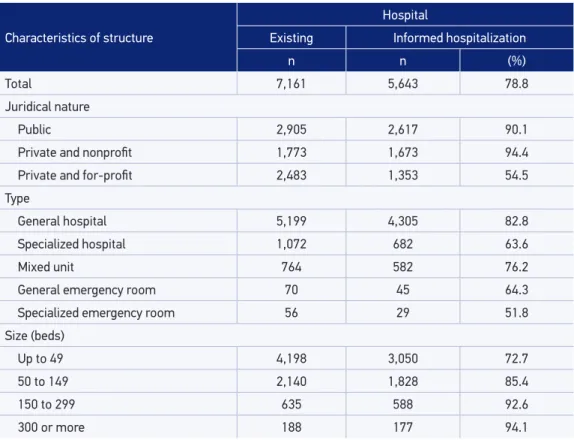
Of the 7,161 hospitals, more than 5.6 thousand informed at least one hospitaliza-tion from 2008 to 2010, representing 78.8% of the total of hospitals analyzed (Table 3). The legal analysis showed that, among public hospitals, 90.1% informed hospitalizations in the period. The higher proportion of data about hospitalizations came from private and nonprofit hospitals (94.4%); among the private and for-profit hospitals, this per-centage was 54.5%. General hospitals were more prevalent and presented the highest proportion of information among the analyzed hospitals. The sending of information
Source: CNES, SIH, CIH.
Table 3. Number and structure of hospitals and sending of information about hospitalizations. Brazil, 2008 – 2010.
Characteristics of structure
Hospital
Existing Informed hospitalization
n n (%)
Total 7,161 5,643 78.8
Juridical nature
Public 2,905 2,617 90.1
Private and nonproit 1,773 1,673 94.4
Private and for-proit 2,483 1,353 54.5
Type
General hospital 5,199 4,305 82.8
Specialized hospital 1,072 682 63.6
Mixed unit 764 582 76.2
General emergency room 70 45 64.3
Specialized emergency room 56 29 51.8
Size (beds)
Up to 49 4,198 3,050 72.7
50 to 149 2,140 1,828 85.4
150 to 299 635 588 92.6
about hospitalizations seems to be directly proportional to the size of the hospital; 94.1% of the information came from hospitals with 300 beds or more (Table 3).
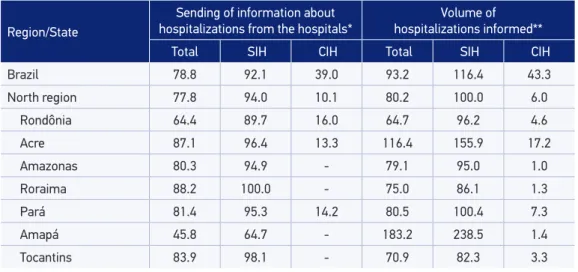
Out of the 5,778 hospitals that worked with SUS, 92.1% informed hospitalizations via SIH; at the same time, of the 4,719 hospitals working with insurance plans, only 39.0% informed hospitalizations via CIH (Table 4). The Northeast region presented lower percentage of information of hospitalizations via SIH, and the North region had the lowest percentage of information of hospitalizations via CIH (Table 4). States with largest CIH coverage were Santa Catarina (75%), São Paulo (71%), Rio Grande do Sul (71%), and Minas Gerais (51%). Hospitals from Amazonas, Roraima, Amapá, Tocantins, and Alagoas did not inform any hospitalization outside of SUS between 2008 and 2010. The total number of hospitalizations obtained by the addition of SIH and CIH, when compared to PNAD 2008, indicates coverage of 93.2% in the information about hos-pitalizations in the country (Table 4). By comparing the SIH and CIH coverages with the number of hospitalizations collected from PNAD, when the patient referred using SUS, the coverage of SIH would reach 116.4% (SIH – 10.7 million and PNAD – 9.2 mil-lion). Regarding the non-SUS hospitalizations, CIH would represent 43.3% of the cases estimated by PNAD (CIH – 1.8 million and PNAD – 4.3 million; Table 4). Four states presented coverage of SUS hospitalizations lower than 90%: Roraima (86.1%), Tocantins (82.3%), Maranhão (83.0%), and Rio Grande do Norte (88.3%). As to non-SUS hospi-talizations, only three states presented coverage higher than 50%: São Paulo (96.6%), Santa Catarina (53.1%), and Rio Grande do Sul (50.7%). In the Southeast region, the low coverage of non-SUS hospitalizations in Rio de Janeiro (5.5%) stands out (Table 4).
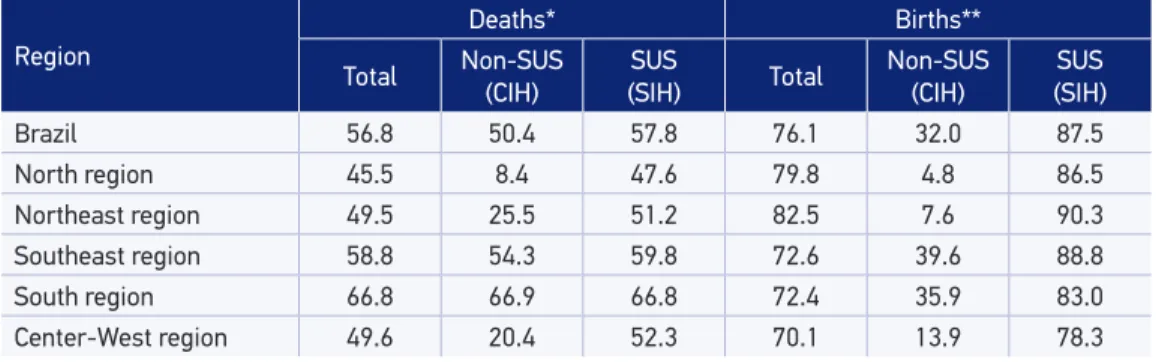
When comparing the hospital deaths informed in SIM with those informed as a result of SUS and non-SUS hospitalizations, respectively registered in SIH and CIH, the cov-erage in Brazil was 56.8% in 2009 (Table 5). For non-SUS hospitalizations, considering the estimation of mortality among users of health plans made available by ANS (ANS
Region/State
Sending of information about
hospitalizations from the hospitals* hospitalizations informed**Volume of
Total SIH CIH Total SIH CIH
Brazil 78.8 92.1 39.0 93.2 116.4 43.3
North region 77.8 94.0 10.1 80.2 100.0 6.0
Rondônia 64.4 89.7 16.0 64.7 96.2 4.6
Acre 87.1 96.4 13.3 116.4 155.9 17.2
Amazonas 80.3 94.9 - 79.1 95.0 1.0
Roraima 88.2 100.0 - 75.0 86.1 1.3
Pará 81.4 95.3 14.2 80.5 100.4 7.3
Amapá 45.8 64.7 - 183.2 238.5 1.4
Tocantins 83.9 98.1 - 70.9 82.3 3.3
Table 4. Coverage of information about hospitalization, per great region and state, 2008 – 2010.
Source: SIH, CIH, SIM, SINASC.
*Deaths outside of SUS estimated based on the number of deaths of beneiciaries, publicized by ANS in the Internet, and deaths inside SUS estimated by the diference with SIM; **Births outside of SUS estimated based on the number of beneiciaries of up to 1 year old publicized by ANS in the Internet, and births inside SUS estimated by the diference with SINASC.
Table 5. Coverage of information about hospital deaths and births. Brazil, 2009.
Region
Deaths* Births**
Total Non-SUS (CIH)
SUS
(SIH) Total
Non-SUS (CIH)
SUS (SIH)
Brazil 56.8 50.4 57.8 76.1 32.0 87.5
North region 45.5 8.4 47.6 79.8 4.8 86.5
Northeast region 49.5 25.5 51.2 82.5 7.6 90.3
Southeast region 58.8 54.3 59.8 72.6 39.6 88.8
South region 66.8 66.9 66.8 72.4 35.9 83.0
Center-West region 49.6 20.4 52.3 70.1 13.9 78.3
Source: CNES, RPS, SIH, CIH, PNAD.
*Ratio between hospitals that informed SIH and/or CIH and hospitals that should inform them according to the contracts registered in CNES and RPS; **Ratio between hospitalizations informed via SIH and/or CIH and hospitalizations estimated by PNAD.
Table 4. Continuation.
Region/State
Sending of information about
hospitalizations from the hospitals* hospitalizations informed**Volume of
Total SIH CIH Total SIH CIH
Northeast region 78.9 87.9 11.9 85.4 100.5 16.1
Maranhão 84.3 92.9 5.1 72.1 83.0 4.6
Piauí 79 84.6 6.2 81.8 91.9 21.7
Ceará 81.2 92.1 21.9 84.2 98.8 24.5
Rio Grande do Norte 80.5 83.8 3.1 74.4 88.3 13.2
Paraíba 70.9 75.8 14.1 88.4 99.6 35.1
Pernambuco 77.8 90.7 1.9 88.0 110.4 0.6
Alagoas 84.7 92.2 - 116.7 136.2 1.0
Sergipe 61.7 69.8 46.2 80.8 96.0 33.6
Bahia 78.7 89.8 15.1 89.6 105.2 17.5
Southeast region 76.4 94.3 50.0 101.9 130.7 61.2
Minas Gerais 84.5 95.9 51.4 83.5 109.1 26.4
Espírito Santo 76.2 95.6 36.4 74.6 98.7 29.7
Rio de Janeiro 52.4 90.9 11.5 72.3 134.5 5.5
São Paulo 84.9 94.4 71.4 125.0 148.8 96.6
South region 87.8 95.4 62.4 102.4 133.8 44.0
Paraná 86.8 94.0 48.4 96.2 129.7 33.2
Santa Catarina 86.3 99.0 75.0 104.3 130.9 53.1
Rio Grande do Sul 90.2 95.3 70.8 108.2 140.0 50.7
Center-West region 74.0 93.1 24.9 75.9 109.8 12.8
Mato Grosso do Sul 78.9 95.9 42.9 72.7 98.8 12.9
Mato Grosso 77.1 93.2 35.2 76.2 92.9 34.4
Goiás 73.8 93.3 14.2 63.4 100.4 2.5
TabNet), the coverage of information about hospital mortality in CIH was of 50.4%. Based on the difference between the total of hospital deaths registered in SIM and those informed by ANS, the coverage of SIH was estimated in 57.8%. Being a part of SUS or not, the South and Southeast regions presented the largest coverages of mortality information, and the North region, the lowest coverage (Table 5).
The comparison between births in hospitals, informed by CIH and SIH, and those registered by SINASC, indicated coverage of 76.1% in Brazil (Table 5). Specifically for information about not SUS, considering the number of beneficiaries younger than 1 year old, used to estimate the total number of births (ANS 2009), approximately 584 thousand births would have occurred in 2009, indicating coverage of 32.0% of CIH. Based on the difference between the total of births informed in SINASC and the estimation among beneficiaries, the coverage estimated in SIH for Brazil was 87.5% (Table 5).
DISCUSSION
Despite the relatively short time since the implantation of CNES, approximately 13 years, and the lack of scientific papers using it as a data source about the Brazilian care network, the analysis in this study indicated the complete and consistent ful-fillment of records in hospitals with hospitalization. The coverage of CNES can be considered as satisfactory, based on the information of AMS, study with great scien-tific acknowledgment11-13.
The importance of this national record for the investigation and auditing of ser-vices, physical structures, and human resources had been mentioned by Nascimento14.
Before that, Carvalho15, reporting to the implantation of CNES, had already indicated
its pertinence, viability, and advantages. These qualities, together with the results in this study — which indicate good coverage, completeness, and consistence of CNES for information about hospitalization units —, increase the legitimacy of its use, even if it is necessary to invest in improvements. Therefore, CNES is a relevant source of infor-mation about the infrastructure of the National Health Service, especially because its information is not limited to the network that provides services to SUS.
Despite its flaws, SIH has been used in different studies of collective health4; its use is
common in hospital performance analyses16. Even if the information available is limited
for the risk adjustment of the indicators, SIH constitutes a single source with national comprehension, so it can be valuable in the management process.
The analysis of the quality of CIH conducted in this study showed important flaws in its coverage, thus making it impossible to use it in a national level. On the other hand, CIH presented consistency in some states, with higher coverages that were compatible with other sources of data, especially in São Paulo, Santa Catarina, and Rio Grande do Sul. These results corroborate those presented by Moreira and Novaes17, pointing out
Regarding the flow of data on hospitalizations, most hospitals have sent some infor-mation via SIH and CIH. However, hospitals in the SUS network presented higher coverage, especially because of the payment system, besides the need to fulfill the demands required to obtain the philanthropy certificate, since most private hospitals working with SUS (about 58%) are nonprofit18. Regarding the differences in the CIH
coverage among private hospitals, the for-profit ones were less representative than the nonprofit ones. These differences can also be related to the interest in filling out the form, because of the connection between the hospital and SUS.
By assessing the coverage of CIH, based on the comparison of information about deliveries, Pinheiro et al.19 found rates that were even lower than those observed in the
analyses of this study, even though the regional differences had been similar. About SUS and non-SUS hospitalizations, Moreira and Novaes17 identified problems as to the
valid-ity in the field “main diagnosis,” even more than those found in this study. Considering that the authors analyzed it before we did, it is possible to infer that there has been slight qualification in the diagnostic information.
With regard to the reasons for the low coverage of the death records informed in CIH and SIH in relation to SIM, it is possible to assume the high occurrence of deaths in emergency that did not result in hospitalization, so no records were found in those databases20. This finding stands out, since these cases are commonly registered in some
services, aiming at the importance of the record. Besides, it is worth to mention the absence of an information system that can register, individually, the type of emer-gency service in the country. It is also possible that not all deaths are notified, especially because the outcome of the hospitalization does not affect the payment of the proce-dures conducted. Inconsistencies of data referring to proceproce-dures carried out in non-SUS hospitalizations can be associated with the use of the SUS table of procedures in CIH. Until 2009, there were several existing tables of medical procedures, with variations in codes and prices. From that year on, the Single Table of Procedures in Supplementary Health (TUSS)21 was validated. Then, there was a unified terminology for all of the
services addressed to patients with health insurance plans. Still, considering the inex-istence of a mechanism to convert the tables in the CIH system, the problem of the quality of this information continues.
Finally, the nonduplicity was not the focus of this study, but instead, in the analyses con-ducted, the idea was to control its effect by using identification keys with the numbers of CNES and CNPJ, besides the exclusion of hospitalization notifications by continuity. It is important to mention that, on a daily basis, before the dissemination of data files, a treatment to reduce duplicities is conducted. Specifically regarding CNES, this analy-sis focused on registers of hospitals with hospitalization, thus limiting any conclusions beyond this universe, such as the ones referring to the outpatient clinics or other data about the service supplier, like services or human resources.
CONCLUSION
Considering that the complete dimensioning of the issues found in the quality of information recorded in secondary data sources about hospitals and hospitalizations in Brazil can be, alone, a research line, the analyses conducted here represent an approx-imation of their effect on studies using these databases.
It is possible to conclude there are basic registration data with good coverage, com-pleteness, and consistence for hospitals with hospitalization registered in CNES, increasing the legitimacy of its use as a source of information about hospitals in Brazil. Regarding the information about hospitalizations in the country, there is much to be done when it comes to improving the quality of the existing systems, especially concerning CIH.
In this sense, it is very important that the databases be used to show the main flaws to be corrected. It is even more important that the results of these studies be incorpo-rated by managers of the information systems. This does not seem to have happened on a regular basis, and one example is the filling out of information about secondary diagnosis in SIH. Twenty years after the publication of the first evidence of subnotifi-cation5, this percentage is still high.
Even though the lack of diagnostic and clinical information is inherent to the sec-ondary databases originally created with the purpose of payment, this information was improved in other countries, being very relevant for risk adjustments and validity of indicators of care, as well as for the description of the morbidity profile of the popula-tion, currently aging, and with multiple chronic diseases. In Brazil, ordinance no. 1,324 was published only in November 2014, and increased the number of fields to register this information; still, initiatives to encourage the registration are essential.
of strategic analyses. Such improvements are essential to get to know the morbidity profile of the population, enabling to understand health needs better, therefore sub-sidizing the decision-making in the planning of hospitals and health care networks.
The second recommendation concerns the creation of fields to fill out clinical data, especially “secondary diagnosis, which, ideally, should allow the record of all existing comorbidities and their presence at the time of hospital admission. It is a known fact that this action depends on financial investments, hiring, and training of human resources. However, it seems to be inevitable to invest in the quality of the databases and in the qualification of services and professionals working with the record of information, in a context management innovation including, among other strategies, systems of pay-ment by performance which demand more accurate information.
ACKNOWLEDGMENTS
The authors thanks the support of Conselho Nacional de Desenvolvimento Científico e Tecnológico (CNPq).
1. Martins M, Blais R, Leite Ida C. Mortalidade hospitalar e tempo de permanência: comparação entre hospitais públicos e privados na região de Ribeirão Preto, São Paulo, Brasil. Cad Saúde Pública 2004; 20 Supl 2: S268-82. 2. Arts DG, De Keizer NF, Schefer GJ. Deining and
improving data quality in medical registries: a literature review, case study, and generic framework. J Am Med Inform Assoc 2002; 9(6): 600-11.
3. Lima CR, Schramm JM, Coeli CM, da Silva ME. Revisão das dimensões de qualidade dos dados e métodos aplicados na avaliação dos sistemas de informação em saúde. Cad Saúde Pública 2009; 25(10): 2095-109. 4. Bittencourt SA, Camacho LA, Leal Mdo C. O Sistema de Informação Hospitalar e sua aplicação na saúde coletiva. Cad Saúde Pública 2006; 22(1): 19-30. 5. Anema HA, Kievit J, Fischer C, Steyerberg EW,
Klazinga NS. Influences of hospital information systems, indicator data collection and computation on reported Dutch hospital performance indicator scores. BMC Health Serv Res 2013; 13: 212. 6. Sorensen G, Thompson B, Glanz K, Feng Z, Kinne S,
DiClemente C, et al. Work site-based cancer prevention: primary results from the Working Well Trial. Am J Public Health 1996; 86(7): 939-47.
7. Davidof F. Databases in the next millennium. Ann Intern Med 1997; 127(8 Pt 2): 770-4.
8. Brasil. Agência Nacional de Saúde Suplementar – ANS. Resolução Normativa nº 42 de 07/07/2003. Estabelece os requisitos para a celebração dos instrumentos jurídicos firmados entre as operadoras de planos de assistência à saúde e prestadores de serviços hospitalares. Rio de Janeiro: ANS; 2003.
9. Mendes ACG, Silva Junior JB, Medeiros KR, Lyra TM, Melo Filho DA, Sá DA. Avaliação do Sistema de Informações Hospitalares - SIH/SUS como fonte complementar na vigilância e monitoramento de doenças de notiicação compulsória. Inf Epidemiol SUS 2000; 9(2): 67-86.
10. Brasil. Ministério da Saúde. Portaria GM/MS nº221 de 24 de março de 1999. Estabelece que os hospitais públicos e privados, integrantes ou não do SUS, apresentem a Comunicação de Internação Hospitalar. Brasília: CIH; 1999.
11. Viacava F, Bahia L. Oferta de serviços de saúde: uma análise da pesquisa assistência médico-sanitária (AMS) de 1999. Texto para discussão nº 915. Brasília: IPEA; 2002. 48 p. 12. Campos TP, Carvalho MS. Assistência ao parto no
município do Rio de Janeiro: peril das maternidades e o acesso da clientela. Cad Saúde Pública 2000; 16(2): 411-20.
13. Oliveira ES. Assistência médico-sanitária: notas para uma avaliação. Cad Saúde Pública 1991; 7(3): 370-95.
14. Nascimento EGQ. A importância do Cadastro Nacional de Estabelecimentos de Saúde (CNES) como instrumento na auditoria em saúde. [trabalho de conclusão do curso de Pós-Graduação em Auditora dos Serviços de Saúde]. Curitiba: Faculdades Pequeno Príncipe – FPP; 2012.
15. Carvalho CA. Cadastro Nacional de Estabelecimentos de Saúde - CNES: seu desenvolvimento, implantação e uma proposta para sua manutenção [dissertação de mestrado proissional]. Rio de Janeiro: Escola Nacional de Saúde Pública, Fundação Oswaldo Cruz; 2004. 16. Machado JP, Martins ACM, Martins MS. Avaliação da
qualidade do cuidado hospitalar no Brasil: uma revisão sistemática. Cad Saúde Pública 2013; 29(6): 1063-82. 17. Moreira ML, Novaes HMD. Internações no sistema
de serviços hospitalares, SUS e não SUS: Brasil, 2006. Rev Bras Epidemiol 2011; 14(3): 411-22.
18. Machado JP. O arranjo público-privado e a qualidade da assistência hospitalar no Brasil [tese de doutorado]. Rio de Janeiro: Escola Nacional de Saúde Pública, Fundação Oswaldo Cruz; 2014.
19. Pinheiro RS, Silva JRN, Lima CRA, Coeli CM. Cobertura da Comunicação de Informação Hospitalar e Ambulatorial (CIHA) utilizando os partos registrados no Sistema de Informações sobre Nascidos Vivos, Brasil, 2006 a 2009. Cad Saúde Pública 2012; 28(5): 991-7. 20. Melo EC, Travassos C, Carvalho MS. Qualidade dos
dados sobre óbitos por infarto agudo do miocárdio, Rio de Janeiro. Rev Saúde Pública 2004; 38(3): 385-91. 21. Brasil. Agência Nacional de Saúde Suplementar – ANS. Instrução Normativa DIDES nº 34, de 13/02/2009. Dispõe sobre a instituição da Terminologia Uniicada da Saúde Suplementar – TUSS do Padrão TISS para procedimentos em saúde para a troca de informações entre operadoras de plano privado de assistência à saúde e prestadores de serviços de saúde sobre os eventos assistenciais realizados aos seus beneiciários. Rio de Janeiro: ANS; 2009.
Received on: 12/15/2014