* Corresponding author.
E-mail: [email protected] (C.P. Fernandes).
0102-695X/$ - see front matter © 2014 Sociedade Brasileira de Farmacognosia. Published by Elsevier Editora Ltda. All rights reserved. http://dx.doi.org/10.1016/j.bjp.2014.10.013
Original article
Development of a larvicidal nanoemulsion with Copaiba
(
Copaifera duckei
) oleoresin
Escarleth da C.R. Rodrigues
a, Adriana M. Ferreira
b, Jessica C.E. Vilhena
b,
Fernanda B. Almeida
a,b, Rodrigo A.S. Cruz
a, Alexandro C. Florentino
c, Raimundo N.P. Souto
d,
José C.T. Carvalho
b, Caio P. Fernandes
a,b,*
aLaboratório de Nanobiotecnologia Fitofarmacêutica, Colegiado de Farmácia, Universidade Federal do Amapá, Macapá, AP, Brazil bLaboratório de Pesquisa em Fármacos, Colegiado de Farmácia, Universidade Federal do Amapá, Macapá, AP, Brazil
cLaboratório de Absorção Atômica e Bioprospecção, Colegiado de Farmácia, Universidade Federal do Amapá, Macapá, AP, Brazil dLaboratório de Artrópodes, Universidade Federal do Amapá, Macapá, AP, Brazil
A RT I C L E I N F O
Article history: Received 26 July 2014 Accepted 3 November 2014
Keywords: Aedes aegypti Copaiba Larvicidal Nanoemulsion Oleoresin
A B S T R A C T
Copaiba (Copaifera duckei Dwyer, Fabaceae) oleoresin is an important Amazonian raw ma-terial. Despite its insecticidal potential, poor water solubility remains a challenge for the development of effective and viable products. Nanotechnology has emerged as a promis-ing area to solve this problem, especially oil-in-water nanoemulsions. On this context, the aim of the present study was to develop oil-in-water nanoemulsions using copaiba oleo-resin dispersed through a high internal phase; and evaluate its potential insecticidal action against Aedes aegypti larvae. Overall, 31 formulations were prepared, ranging from 11.5 ± 0.2 to 257.3 ± 4.1 nm after one day of manipulation. Some of them reached small mean droplet sizes (< 200 nm) and allowed achievement of a nanoemulsion region. The formulation con-sisted of 5% (w/w) of copaiba oil, 5% (w/w) of surfactant and 90% (w/w) of water, which pre-sented mean droplet size of 145.2 ±0.9 nm and polidispersity of 0.378 ± 0.009 after one day of manipulation, and these were evaluated for larvicidal potential. According to mortality level (250 ppm - 93.3 after 48 h), this nanoemulsion was classified as a promising insecticid-al agent against Aedes aegypti larvae. The present study allowed the development of low-cost ecofriendly green natural-based nanoformulations with potential larvicidal activity, using a nanobiotechnology approach.
© 2014 Sociedade Brasileira de Farmacognosia. Published by Elsevier Editora Ltda. All rights reserved.
Introduction
Species from the genus Copaifera are distributed throughout the Amazon and Midwestern regions of Brazil and yield a transparent yellow-brownish oleoresin, which is obtained by
been attributed to copaiba oleoresin, including antinoceptive (Gomes et al., 2007), anti-inflammatory (Carvalho et al., 2005; Veiga-Júnior et al., 2007) and antileishmanial (Santos et al, 2008) activities. Moreover, copaiba oil is used as raw material for several products, being exported to many countries, including France, Germany and the United States (Gomes et al., 2007).
Oleoresin from Copaifera sp. and its isolated substances have been successfully tested against Aedes aegypti (Geris et al., 2008; Leandro et al., 2012; Trindade et al., 2013), which is the biological vector responsible for the transmission of the tropical disease known as “dengue” (Rawani et al., 2013). However, an intrinsic characteristic of the oleoresin, the presence of poor water-soluble substances remains a challenge for the development of a stable product for this purpose.
Nanotechnology has been considered a promising area regarding ecofriendly pesticides, including those with natural products incorporated as active ingredients (Rawani et al., 2013; Angajala et al., 2014). These natural product-based nanoformulations have been developed in order to evaluate their larvicidal potential against several insects, such as Aegle marmelos, Aedes aegypti, Culex quinquefasciatus, Anopheles stephensi (Rawani et al., 2013; Angajala et al., 2014; Suganya et al., 2014; Veerakumar et al., 2014). Strategies in the development of pesticides using this approach have been associated to repellent or water-soluble formulations, including nanoemulsions (Nuchuchua et al., 2009). This special type of kinetically stable formulation is constituted by two immiscible liquids and one or more surfactants, with small droplet size (20-200 nm) (Solans et al., 2005; Solè et al., 2012), translucent or transparent appearance and bluish aspect (Forgiarini et al., 2000; Solè et al., 2006). Nanoemulsions have a wide range of applications, including pharmaceutical, cosmetic and for food uses (Solans et al., 2005), also a promising tool to control insects (Wang et al., 2007). The aim of the present study was to develop oil-in-water nanoemulsions with copaiba oleoresin dispersed through the internal phase, and to evaluate its potential insecticidal action against Aedes aegypti larvae.
Materials and methods
Chemicals
Copaiba oleoresin (Copaifera duckei Dwyer, Fabaceae) was obtained from Beraca Ltda. Sorbitan oleate (HLB: 4.3) and Polysorbate 80 (HLB: 15) were purchased from Praid Produtos Químicos Ltda (São Paulo, Brazil).
Required HLB determination
Each formulation was prepared at a final mass of 25 g, containing 90 % (w/w) of distilled water, 5% (w/w) of copaiba oil and 5% (w/w) of a mixture of emulsifiers (Fernandes et al., 2013, Costa et al., 2014). A series of formulations were prepared using sorbitan monooleate as the most hydrophobic emulsifier, and polysorbate 80 as the most hydrophilic emulsifier. HLB values ranging from 4.3 (5% w/w of sorbitan oleate) to 15 (5% w/w of polysorbate 80) were prepared by blending together these emulsifiers. Sorbitan monooleate:polysorbate 80 ratios
were used as follows: 100:0 (HLB 4.3), 93.5:6.5 (HLB 5), 84.1:15.9 (HLB 6), 74.8:25.2 (HLB 7), 65.4:34.6 (HLB 8), 56.9:43.9 (HLB 9), 46.7:53.3 (HLB 10), 37.4: 62.6 (HLB 11), 28.0:72.0 (HLB 12), 18.7:81.3 (HLB 13), 9.3:90.7 (HLB 14), 0:100 (HLB 15). Analysis of creaming and phase separation after one day of manipulation supported the identification of the most stable formulation required for HLB determination.
Emulsification method
Required amounts of both emulsifiers were dissolved in the oil phase (copaiba oil) and heated at 65 ± 5ºC. Aqueous phase was separately heated at 65 ± 5ºC, gently added to and mixed with the oil phase, furnishing a primary formulation. Final homogenization was achieved using a T25 Ultra-Turrax homogenizer (Ika-Werke, Staufen, Germany) equipped with a 25 N-18 G disperser for 5 min (8000 rpm) (Costa et al., 2014).
Pseudo-ternary phase diagram
Nanoemulsion region was determined using pseudo-ternary phase diagram. Each corner corresponded to 100% of water, surfactant and copaiba oil. Composition (w/w), which allowed required HLB value determination was used as starting point (90% of distilled water, 5% of oil and 5% of surfactants blend) and mean droplet size of each prepared composition was performed in order to determine nanoemulsion region (Fernandes et al., 2014).
Macroscopical analysis
Stability of all nanoemulsions was evaluated immediately and after 1 and 30 days of manipulation by macroscopic analysis, such as color, visual aspect, phase separation, creaming and sedimentation. During this period all nanoemulsions were maintained under room temperature (25 ± 2ºC) in screw capped glass test tubes (Fernandes et al., 2013). Nanoemulsion type (oil-in-water or water-in-oil) was characterized by dilution of each formulation in deionized water.
Droplet size analysis
Droplet size and polydispersity of nanoemulsions were determined by photon correlation spectroscopy using a Zetasizer 5000 (Malvern Instruments, Malvern, UK). Each nanoemulsion was diluted using ultra-pure Milli-Q water (1:25). Measures were performed in triplicate and the average droplet size was expressed as the mean diameter.
Larvicidal assay
distilled water, ranging from 500 to 200 ppm. One gram of each dilution was added to 99 g of distilled water in a plastic pot. All experiments were performed in triplicate with 10 fourth-instar larvae in each sample replicate. Mean temperature of aqueous media was 25ºC. Negative controls were performed using surfactant at the same concentration of the tested samples. Mortality levels were recorded after 24 and 48 h of exposure. Larvae were considered dead when they were not able to reach the water surface.
Statistical Analysis
Significance of the insecticidal data was performed using a G test with 95% confidence interval, using R 3.02 software (R Core Team, 2013). Differences between treated groups and untreated groups were considered significant when p ≤ 0.05.
Results and discussion
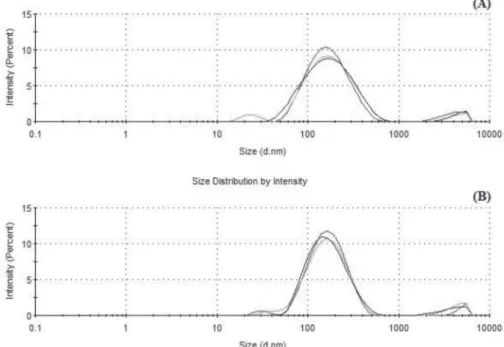
Several formulations were prepared by blending a hydrophobic surfactant (sorbitan monooleate, HLB=4.3) with a hydrophilic surfactant (polysorbate 80, HLB = 15). Most of them (HLB 4.3, 5, 6, 7, 8, 9, 10, 11, 12, 13 and 14) had an unstable behavior after one day of manipulation, such as phase separation or different degrees of creaming, and therefore were discarded. The formulation prepared with 5% (w/w) of polysorbate 80 (HLB = 15) was characterized as an oil-in-water nanoemulsion, and was consider the most stable formulation since it was not observed any creaming, phase separation or macroscopical changes after one day of manipulation. Thus, mean droplet
size of this formulation was monitored (Fig. 1), indicating small droplet size and low polidispersity after one day (145.2 ± 0.9 nm) (0.378 ± 0.009) and 30 days (156.5 ± 0.7 nm) (0.286 ± 0.027) of manipulation. Creaming, phase separation or other signals of unstable behavior were not observed even after 30 days, also observing that this formulation presented a bluish reflection, characteristic for nanoemulsions (Forgiarini et al., 2000). A prospective study with copaiba oleoresin performed by Xavier-Júnior et al. (2012) using different blends of surfactants indicated a required HLB value of 14.8 for the oil phase, which is in accordance with our results. Required HLB value of the oil phase is one of most important parameters that should be considered during the development of nanoemulsions (Schmidts et al., 2010; Fernandes et al 2013). It can be determined by calculating the HLB of the surfactant or mixture of surfactants, which allows achieving an emulsion with minimum droplet size, among a set of prepared emulsions (Rodríguez-Rojo 2012, Fernandes et al., 2013; 2014; Costa et al., 2014). Thus, HLB value of copaiba oleoresin used in the present study could be considered around 15.
According to mean droplet size (< 200 nm after 1 and 30 days of manipulation), the nanoemulsion constituted by 5% (w/w) of copaiba oil, 5% (w/w) of polysorbate 80 and 90% (w/w) of water was considered a nanoemulsion. It was used to perform the larvicidal bioassay and as a starting point for the pseudo-ternary phase diagram. Nanoemulsions are also referred as miniemulsions or ultrafine emulsions (Forgiarini et al., 2000; Solè et al., 2006) and have mean droplet size ranging from 20 to 200 nm (Solè et al., 2012). Despite the fact that nanoemulsions are not thermodynamically stable (Forgiarini et al, 2000; Ostertag et al., 2002), they are kinetically stable (Bruxel et al.,
2012) and have a long-term physical stability (Solè et al., 2006). Moreover, small droplets can be achieved even at relative low surfactant concentrations (Solè et al., 2012). They have a wide range of advantages, such as solubility enhancement of poor water-soluble substances (Bruxel et al., 2012; Wang et al., 2009; Zhang et al., 2011), including insecticidal natural products (Wang et al., 2007).
The surfactant used during the pseudo-ternary phase diagram construction was polysorbate 80 (HLB - 15), since it coincides with the required HLB value of copaiba oil used in the present study. Overall, the 31 nanoemulsions prepared, ranged from 11.5 ± 0.2 nm to 257.3 ± 4.107 nm after one day of preparation (Table 1). According to the concept that nanoemulsions have a mean droplet size below 200 nm (Solè et al., 2012), it was possible to delineate a nanoemulsion region (Fig. 2), constituted by 25 formulations. The high percentage of nanoemulsions obtained (approximately 80%) may be attributed to heating and mechanical energy achieved by the T25 Ultra-Turrax, which have been associated to an extended oil-in-water miniemulsion region (Mahdi et al., 2011). It was also observed that some formulations within nanoemulsion region were transparent and reached mean droplet size below 100 nm. Considering that microemulsions are isotropic, thermodynamically systems with very small droplet size, usually around 5-100 nm (Pakpayat et al., 2009), further investigations with these formulations (12.5 % (w/w) of surfactant/5% (w/w) of oil/82.5 (w/w) of water; 17.5 % (w/w) of surfactant/2.5% (w/w) of oil/80 (w/w) of water; 20 % (w/w) of surfactant / 5% (w/w) of oil/75 (w/w) of water; 20 % (w/w) of surfactant/2.5% (w/w) of oil/77.5 (w/w) of water) should be carried out to confirm whether they can be classified as microemulsions or nanoemulsions.
It is well recognized that not every composition allows achievement of nanoemulsions (Shakeel et al., 2010; Mahdi et al., 2011). Thus, nanoemulsion region obtained in the
present study may be important for further studies with copaiba oleoresin, since these types of formulations could be obtained with compositions within this zone. Mean droplet size and polidispersity after 30 days of manipulation of the nanoemulsions prepared during pseudo-ternary phase diagram are presented in Table 1.
The oleoresin from Copaifera multijuga was also used to prepare nanoemulsions, which were achieved using high-pressure homogenization. Mean droplet analysis revealed droplets around 120 and 140 nm (Dias et al., 2012). Copaiba oleoresins are mainly constituted by sesquiterpene hydrocarbons, which often correspond to almost 90% of the total relative composition of the oil, being beta-caryophyllene considered the main constituent. Previous chemical characterization of the oleoresin used in the present study confirmed this profile (Lima et al., 2011). Diterpenes are also found in smaller quantities in copaiba oleoresin (Sousa et al., 2011). Beta-caryophyllene has also been considered an important substance involved in the pharmacological activities of Copaifera spp., and is considered a phytochemical marker and standard for quantification studies (Lima et al., 2011; Dias et al., 2012). The development of a nanoemulsion with copaiba oleoresin is also important for the stability of this sesquiterpene. A reduced degradation of caryophyllene from a nanoemulsion was observed with copaiba oleoresin dispersed through the internal phase after acid hydrolysis, exposure to UV-A irradiation, oxidative (H2O2) and thermolytic (60oC)
conditions, when compared to beta-caryophyllene content after exposure to same conditions (Dias et al., 2012).
The natural product-based nanoformulations have been developed in order to evaluate their larvicidal potential, including nickel nanoparticles, silver nanoparticles, nanoemulsions among others (Rawani et al., 2013; Angajala et al., 2014; Suganya et al., 2014; Veerakumar et al., 2014; Sugumar et al., 2014). Larvicidal evaluation of copaiba oleoresin has been related against Aedes aegypti, the main vector of dengue, a serious Brazilian health problem (Prophiro et al., 2012). Kanis et al., (2012) achieved microformulations using different polymers which were able to disperse copaiba oleoresin in water. However, despite some of them were able to affect
Aedes aegypti larvae, mean droplet size ranged from 12100 nm to 578000 nm. To our knowledge, the role of copaiba oleoresin nanoformulations as active agents against A. aegypti remains unexplored.
On this context, the present study aimed to evaluate the potential larvicidal activity of a nanoemulsion with copaiba oleoresin, considering that this type of formulation has a mean droplet size below 200 nm. The chosen nanoemulsion within the region obtained in the pseudo-ternary diagram was constituted by 5% (w/w) of copaiba oil, 5% (w/w) of polysorbate 80 and 90% (w/w) of water. The experimental groups treated with concentrations higher than 250 ppm presented mortality levels above 95 % after 24 h and 48 h of observation. It was not possible to estimate LC50 of copaiba oleoresin using tested nanoemulsion dilutions, since the lowest concentration (200 ppm) was able to induce 70.0 ± 26.5 % and 90.0 ± 10.0 % of mortality after 24 h and 48 h of experiment, respectively. A mortality of 73.3 ± 11.5% and 93.3 ±11.5% was observed after 24 h and 48 h of , exposure to the nanoemulsion with copaiba
Composition After 1 Day After 30 Days
% of Surfactant (w/w)
% of Oil (w/w)
% of Water (w/w)
Mean diameter ± SD (nm)
Polidispersity ± SD
Mean diameter ± SD (nm)
Polidispersity ± SD
1a 5 5 90.0 145.2 ±0.9 0.378 ± 0.009 156.5 ± 0.7 0.286 ± 0.027
2 2.5 5 92.5 235.4 ± 16.3 0.613 ± 0.020 201.0 ± 1.6 0.551 ± 0.028 3a 5 2.5 92.5 157.0 ± 2.2 0.432 ± 0.004 124.5 ± 1.4 0.506 ± 0.004
4a 7.5 2.5 90.0 171.3 ± 1.6 0.300 ± 0.006 192.6 ± 14.8 0.314 ± 0.046
5a 7.5 5 87.5 134.5 ± 1.0 0.271 ± 0.010 139.6 ± 2.1 0.238 ± 0.006
6a 5 7.5 87.5 175.5 ± 2.1 0.370 ± 0.006 191.3 ± 7.7 0.388 ± 0.025
7 2.5 7.5 90.0 227.2 ± 6.5 0.561 ± 0.029 266.7 ± 7.1 0.623 ± 0.017 8a 12.5 2.5 85.0 116.3 ± 1.2 0.216 ± 0.002 127.6 ± 1.3 0.192 ± 0.008
9a 12.5 5 82.5 86.9 ± 2.9 0.520 ± 0.035 119.4 ± 2.8 0.304 ± 0.040
10a 10 7.5 82.5 144.6 ± 2.1 0.201 ± 0.010 156.0 ± 0.9 0.220 ± 0.006
11 7.5 10 82.5 215.1 ± 6.0 0.569 ± 0.020 218.8 ± 2.9 0.409 ± 0.012 12a 5 10 85.0 169.7 ± 1.0 0.292 ± 0.025 292.9 ± 9.0 0.673 ± 0.057
13 5 12.5 82.5 247.1 ± 6.9 0.598 ± 0.008 246.3 ± 5.0 0.619 ± 0.058 14a 7.5 12.5 80.0 182.3 ± 2.2 0.376 ± 0.005 186.2 ± 4.7 0.375 ± 0.009
15a 10 10 80.0 144.2 ± 1.4 0.251 ± 0.003 141.2 ± 0.7 0.217 ± 0.008
16a 12.5 7.5 80.0 171.3 ± 1.5 0.442 ± 0.036 151.9 ± 0.9 0.277 ± 0.005
17a 15 5 80.0 123.2 ± 1.1 0.215 ± 0.009 117.0 ± 0.8 0.253 ± 0.012
18a 15 2.5 82.5 101.0 ± 0.9 0.227 ± 0.004 94.7 ± 0.89 0.248 ± 0.011
19 5 15 80.0 257.3 ± 4.1 0.532 ± 0.091 284.7 ± 13.7 0.609 ± 0.026 20 7.5 15 77.5 214.9 ± 1.3 0.391 ± 0.019 316.8 ± 27.5 0.597 ± 0.110 21a 10 12.5 77.5 187.5 ± 0.8 0.238 ± 0.009 240.5 ± 15.1 0.402 ± 0.012
22a 12.5 10 77.5 157.9 ± 1.7 0.209 ± 0.008 228.5 ± 17.9 0.329 ± 0.030
23a 15 7.5 77.5 133.2 ± 1.6 0.454 ± 0.011 119.7 ± 11.0 0.731 ± 0.208
24a 17.5 5 77.5 109.7 ± 1.7 0.212 ± 0.010 117.1 ± 2.7 0.191 ± 0.007
25a 17.5 2.5 80.0 60.28 ± 2.0 0.506 ± 0.035 63.5 ± 1.1 0.488 ± 0.012
26a 10 15 75.0 200.0 ± 2.8 0.268 ± 0.003 198.8 ± 1.3 0.265 ± 0.006
27a 12.5 12.5 75.0 188.1 ± 1.4 0.212 ± 0.003 195.6 ± 1.2 0.187 ± 0.011
28a 15 10 75.0 177.7 ± 0.6 0.218 ± 0.005 200.8 ± 1.3 0.230 ± 0.013
29a 17.5 7.5 75.0 151.1 ± 0.5 0.458 ± 0.006 105.4 ± 10.9 0.428 ± 0.034
30a 20 5 75.0 93.0 ± 0.6 0.221 ± 0.008 147.8 ± 4.5 0.334 ± 0.024
31a 20 2.5 77.5 11.5 ± 0.2 0.318 ± 0.003 13.9 ± 3.6 0.243 ± 0.102
Oil - Copaifera duckei oleoresin. Surfactant – Polysorbate 80.
aFormulation in the nanoemulsion region.
Table 1
Composition, mean droplet size and polydispersity of each formulation prepared during the construction of pseudo-ternary phase diagram for delimitation of nanoemulsion region. All nanoemulsions were maintained under room temperature (25 ± 2ºC) in screw capped glass test tubes.
oleoresin concentration of 250 ppm, respectively. Significant differences between treated groups and control groups were detected at all observation periods (p < 0.05) (Table 2). Regarding to the mortality levels of larvae after 48 h of treatment with samples at 250 ppm, larvicidal agents can be classified as promising (> 75%), partially promising (> 50% and < 75%), weakly promising (> 25% and < 50%) or inactive (< 25%) (Montenegro et al., 2006). Our results suggest that a nanoemulsion containing copaiba oil may be a promising formulation for Aedes aegypti
larvae control, which also supports the concept that natural products nanoformulations may be considered an alternative as potential larvicidal agents.
Conclusion
products. At the present study, a series of oil-in-water nanoemulsions containing Copaifera duckei oleoresin dispersed through internal phase were developed. One of them was considered an effective agent against A. aegypti. Moreover, nanoemulsions with increasing amounts of copaiba oleoresin may be obtained from the nanoemulsion region. The present study supports the concept that an oil-in-water nanoemulsions containing copaiba oleoresin may be used as a potential larvicidal.
Authors’ contributions
ECRR (undergraduate student) contributed by running the laboratory work, analysis of the data and drafting the paper. ADF, JCEV and FBA contributed in nanoemulsions characterization. RASC contributed to critical reading of the manuscript. ACF and RNPS contributed to biological assay and statistical analysis. JCTC and CPF designed the study, supervised the laboratory work and contributed to critical reading of the manuscript. All the authors have read the final manuscript and approved the submission.
Conflicts of interest
The authors declare no conflicts of interest.
Acknowledgements
Authors would like to thank CNPQ (402332/2013-0), CAPES and FAPEAP (250203035/2013) for the financial support.
R E F E R E N C E S
Angajala, G., Ramya, R., Subashini, R., 2014. In-vitro anti-inflammatory and mosquito larvicidal efficacy of nickelnanoparticles phytofabricated from aqueous leaf extracts of Aegle marmelos Correa. Acta Tropica 135, 19-26.
Biavatti, M.W., Dossin, D., Deschamps, F.C., Lima, M.P., 2006. Análise de óleos-resinas de copaíba: contribuição para o seu controle de qualidade. Rev. Bras. Farmacogn. 16, 230-235.
Bruxel, F., Laux, M., Wild, L.B., Fraga, M., Koester, L.S., Teixeira, H.F., 2012. Nanoemulsões como sistemas de liberação parenteral de fármacos. Quim. Nova 35, 1827-1840.
Carvalho, J.C.T., Cascon, V., Possebon, L.S., Morimoto, M.S.S., Cardoso, L.G.V., Kaplan, M.A.C., Gilbert, B., 2005. Topical antiinflammatory and analgesic activities of Copaifera duckei Dwyer. Phytother. Res. 19, 946-950.
Costa, I.C., Rodrigues, R.F., Almeida, F.B., Favacho, H.A., Falcão, D.Q., Ferreira, A.M., Vilhena, J.C.E., Florentino, A.C., Carvalho, J.C.T., Fernandes, C.P., 2014. Development of jojoba oil (Simmondsia chinensis (Link) C.K. Schneid.) based nanoemulsions. Lat. Am. J. Pharm. 33, 459-463.
Custódio, D.L., Veiga-Junior, V.F., 2012. True and common balsams. Rev. Bras. Farmacogn. 22, 1372-1383.
Dias, D.O., Colombo, M., Kelmann, R.G., Souza, T.P., Bassani, V.L., Teixeira, H.F., Veiga Jr. V.F., Limberger, R.P., Koester, L.S., 2012. Optimization of headspace solid-phase microextraction for analysis of β-caryophyllene in a nanoemulsion dosage form prepared with copaiba (Copaifera multijuga Hayne) oil. Anal. Chim. Acta 721, 79-84.
Fernandes, C.P., Almeida, F.B., Silveira, A.N., Gonzalez, M.S., Mello, C.B., Feder, D., Apolinário, R., Santos, M.G., Carvalho, J.C.T., Tietbohl, L.A.C., Rocha, L., Falcão, D.Q., 2014. Development of an insecticidal nanoemulsion with Manilkara subsericea (Sapotaceae) extract. J. Nanobiotechnology 12, 22, DOI: 10.1186/1477-3155-12-22.
Fernandes, C.P., Mascarenhas, M.P., Zibetti, F.M., Lima, B.G., Oliveira, R.P.R.F., Rocha, L., Falcão, D.Q., 2013. HLB value, an important parameter for the development of essential oil phytopharmaceuticals. Rev. Bras. Farmacogn. 23, 108-114. Forgiarini, A., Esquena, J., González, C., Solans, C., 2000. Studies of the
relation between phase behavior and emulsification methods with nanoemulsion formation. Prog. Coll. Pol. Sci. S. 115, 36-39. Geris, R., Silva, I.G., Silva, H.H.G., Barison, A., Rodrigues-Filho,
E., Ferreira, A.G., 2008. Diterpenoids from Copaifera reticulata Ducke with larvicidal activity against Aedes aegypti (L.) (Diptera, Culicidae) Rev. Inst. Med. Trop. S. Paulo 50, 25-28 Gomes, N.M., Rezende, C.M., Fontes, S.P., Matheus, M.E.,
Fernandes, P.D., 2007. Antinociceptive activity of Amazonian Copaiba oils. J. Ethnopharmacol. 109, 486-492.
% Mortality ± SD
Group Treated Control
24 h 48 h 24 h 48 h
200 ppm 70.6 ± 26.5 90.0 ± 10.0 3.3 ± 5.8 6.7 ± 11.5 250 ppm 73.33 ± 11.5 93.3 ± 11.5 3.3 ± 5.8 6.7 ± 11.5 500 ppm 100 ± 0 100 ± 0 0 6.7 ± 5.8 Concentrations are expressed as copaiba oil content (treated groups) or polysorbate 80 (control groups).
Significant differences were observed between treated groups and their respective control groups (p < 0.05) at all observation periods. The percentage of total insects (n = 10) was calculated in each group (in triplicates) at the beginning of the experiment.
Table 2
Kanis, L.A., Prophiro, J.S., Vieira, E.S., Nascimento, M.P., Zepon, K.M., Kulkamp-Guerreiro, I.C., Silva, O.S., 2012. Larvicidal activity of Copaifera sp. (Leguminosae) oleoresin microcapsules against Aedes aegypti (Diptera: Culicidae) larvae. Parasitol. Res. 110, 1173-1178.
Leandro, L.M.., Vargas, F.S., Barbosa, P.C.S., Neves, J.K.O., Silva, J.A., Veiga-Junior, V.F., 2012. Chemistry and biological activities of terpenoids from Copaiba (Copaifera spp.) oleoresins. Molecules 17, 3866-3889.
Lima, C.S., Medeiros, B.J.L., Favacho, H.A.S., Santos, K.C., Oliveira, B.R., Taglialegna, J.C., Costa, E.V.M., Campos, K.J., Carvalho, J.C.T., 2011. Pre-clinical validation of a vaginal cream containing copaiba oil (reproductive toxicology study). Phytomedicine 18, 1013-1023.
Mahdi, E.S., Noor, A.M., Sakeena, M.H., Abdullah, G.Z., Abdulkarim, M.F., Sattar, M.A., 2011. Formulation and in vitro release evaluation of newly synthesized palm kernel oil esters-based nanoemulsion delivery system for 30% ethanolic dried extract derived from local Phyllanthus urinaria for skin antiaging. Int. J. Nanomed. 6, 2499-2512.
Medeiros, R.S., Vieira, G., 2008. Sustainability of extraction and production of copaiba (Copaifera multijuga Hayne) oleoresin in Manaus, AM, Brazil. Forest Ecol. Manag. 256, 282-288.
Montenegro, L.H.M., Oliveira, P.E.S., Conserva, L.M., Rocha, E.M.M., Brito, A.C., Araujo, R.M., Trevisan, M.T.S., Lemos, R.P.L., 2006. Terpenoides e avaliacao do potencial antimalarico, larvicida, anti-radicalar e anticolinesterasico de Pouteria venosa (Sapotaceae). Rev. Bras. Farmacogn. 16, 611-617.
Nuchuchua, O., Sakulku, U., Uawongyart, N., Puttipipatkhachorn, S., Soottitantawat, A., Ruktanonchai, U. 2009. In vitro
characterization and mosquito (Aedes aegypti) repellent activity of essential-oils-loaded nanoemulsions. AAPS PharmSciTech. 10, DOI: 10.1208/s12249-009-9323-1. Ostertag, F., Weiss, J., McClements, D.J., 2012. Low-energy
formation of edible nanoemulsions: Factors influencing droplet size produced by emulsion phase inversion. J. Colloid Interf. Sci. 388, 95-102.
Pakpayat, N., Nielloud, F., Fortuné, R., Tourne-Peteilh, C., Villarreal, A., Grillo, I., Bataille, B., 2009. Formulation of ascorbic acid microemulsions with alkyl polyglycosides. Eur. J. Pharm. Biopharm. 72, 444-452.
Prophiro, J.S., Silva, M.A.N., Kanis, L.A., Rocha, L.C.B.P., Duque-Luna, J.E., Silva, O.S., 2012. First report on susceptibility of wild Aedes aegypti (Diptera: Culicidae) using Carapa guianensis (Meliaceae) and Copaifera sp. (Leguminosae) Parasitol. Res. 110, 699-705.
Rawani, A., Ghosh, A., Chandra, G., 2013. Mosquito larvicidal and antimicrobial activity of synthesized nano-crystalline silver particles using leaves and green berry extract of Solanum nigrum L. (Solanaceae: Solanales). Acta Tropica 128, 613-622. Rodríguez-Rojo, S., Varona, S., Núnez, M., Cocero, M.J., 2012.
Characterization of rosemary essential oil for biodegradable emulsions. Ind. Crops Prod. 37, 137-140.
Santos, A.O., Nakamura, T.U., Filho, B.P.D., Veiga Junior, V.F., Pinto, A.C., Nakamura, C.V., 2008. Effect of Brazilian copaiba oils on Leishmania amazonensis. J. Ethnopharmacol. 120, 204-208. Schmidts, T., Dobler, D., Guldan, A.C., Paulus, N., Runkel, F., 2010.
Multiple W/O/W emulsions - using the required HLB for emulsifier evaluation. Colloid. Surface. A 372, 48-54. Shakeel, F., Ramadan, W., Faisal, M.S., Rizwan, M., Faiyazuddin,
M., Mustafa, G., Shafiq, S., 2010. Transdermal and topical delivery of anti-inflammatory agents using nanoemulsion/ microemulsion: an updated review. Curr. Nanosci. 6, 184-198.
Solans, C., Izquierdo, P., Nolla, J., Azemar, N., Garcia-Celma, M.J., 2005. Nano-emulsions. Current Opinion in Colloid In. 10, 102-110.
Solè, I., Maestro, A., Pey, C.M., González, C., Solans, C., Gutiérrez, J.M., 2006. Nano-emulsions preparation by low energy methods in an ionic surfactant system. Colloid. Surface. A 288, 138-143.
Solè, I., Solans, C., Maestro, A., González, C., Gutiérrez, J.M., 2012. Study of nano-emulsion formation by dilution of microemulsions. J. Colloid Interf. Sci. 376, 133-139. Sousa, J.P.B., Brancalion, A.P.S., Souza, A.B., Turatti, I.C.C.,
Ambrósio, S.R., Furtado, N.A.J.C., Lopes, N.P., Bastos, J.K. 2011. Validation of a gas chromatographic method to quantify sesquiterpenes in copaiba oils. J. Pharmaceut. Biomed. 54, 653-659.
Suganya, G., Karthi, S., Shivakumar, M.S., 2014. Larvicidal potential of silver nanoparticles synthesized from Leucas aspera leaf extracts against dengue vector Aedes aegypti. Parasitol. Res. 113, 1673-1679.
Sugumar, S., Clarke, S.K., Nirmala, M.J., Tyagi, B.K., Mukherjee, A., Chnadrasekaran, N., 2014. Nanoemulsion of eucalyptus oil and its larvicidal activity against Culex quinquefasciatus. B. Entomol. Res. 104, 393-402.
Trindade, F.T.T., Stabeli, R.G., Pereira, A.A., Facundo, V.A., Silva, A.A., 2013 Copaifera multijuga ethanolic extracts, oilresin, and its derivatives display larvicidal activity against Anopheles darlingi and Aedes aegypti (Diptera: Culicidae). Rev. Bras. Farmacogn. 23, 464-470.
Veiga-Junior, V.F., Rosas, E.C., Carvalho, M.V., Henriques, M.G.M.O., Pinto, A.C., 2007. Chemical composition and anti-inflammatory activity of copaiba oils from Copaifera cearensis Huber ex Ducke, Copaifera reticulata Ducke and Copaifera multijuga Hayne - A comparative study. J. Ethnopharmacol. 112, 248-254.
Wang, L., Dong, J., Chen, J., Eastoe, J., Li, X., 2009. Design and optimization of a new self-nanoemulsifying drug delivery system. J. Colloid Interf. Sci. 330, 443-448.
Wang, L., Li, X., Zhang, G., Dong, J., Eastoe, J., 2007. Oil-in-water nanoemulsions for pesticide formulations. J. Colloid Interf. Sci. 314, 230-235.
WHO, 1970. Insecticide resistance and vector control. World Health Organization Technical Reports Series. 443. 53p. WHO, 1980. Resistance of vectors of diase to pesticides. World
Health Organization Technical Report Series 655. Genebra. 48p.
WHO, 1984. Chemical methods for the control of arthropod vectors and pets of public health importance, World Health Organization, Geneve, 108p.
Veerakumar, K., Govindarajan, M., Rajeswary, M., Muthukumaran, U., 2014. Low-cost and eco-friendly green synthesis of silver nanoparticles using Feronia elephantum (Rutaceae) against Culex quinquefasciatus, Anopheles stephensi, and Aedes aegypti (Diptera: Culicidae). Parasitol. Res. 113,1775-1785.
Xavier-Júnior, F.H., Silva, K.G.H., Farias, I.E.G., Morais, A.R.V., Alencar, E.N., Araújo, I.B., Oliveira, A.G., Egito, E.S.T., 2012. Prospective study for the development of emulsion systems containing natural oil products. J. Drug Deliv. Sci. Tec. 22, 367-372.
Zhang, Y., Gao, J., Zheng, H., Zhang, R., Han, Y., 2011. The preparation of 3,5-dihydroxy-4-isopropylstilbene