ISSN 0104-6632 Printed in Brazil
www.abeq.org.br/bjche
Vol. 23, No. 01, pp. 37 - 43, January - March, 2006
Brazilian Journal
of Chemical
Engineering
USING A MEDIUM OF FREE AMINO ACIDS TO
PRODUCE PENICILLIN G ACYLASE IN
FED-BATCH CULTIVATIONS OF
Bacillus megaterium
ATCC 14945
R. G. Silva, V. R. Souza, E. R. Nucci, L. M. Pinotti, A. J. G. Cruz,
R. C. Giordano and R. L.C. Giordano
*Departamento de Engenharia Química, Universidade Federal de São Carlos, Phone: +(55) (16) 3351-8707; fax+(55) (16) 3351-8266, Rodovia Washington Luis, km 235,
C P. 676, CEP 13565-905, São Carlos - SP, Brasil E-mail: [email protected]
(Received: October 20, 2004 ; Accepted: October 19, 2005)
Abstract - The production of penicillin G acylase (PGA, an important industrial enzyme) from a wild strain of Bacillus megaterium using a pool of free amino acids as substrate was studied in a bench-scale bioreactor. Experiments carried out in shakers showed that the substitution of casein for free amino acids in the presence of cheese whey was the culture medium that provided the highest productivity. Several cultivations were carried out in a bioreactor operated in either batch or fed-batch mode. Batch runs showed that enzyme production is associated with microorganism growth. The following set of amino acids was preferentially consumed: Ala, Arg, Asp, Gly, Lys, Ser, Thr and Trp. On the other hand, the rates of consumption of His, Ile, Leu, Met, Phe, Pro, Tyr and Val were lower.
Keywords: Penicillin G acylase production; Bacillus megaterium; Amino acids; Fed-batch cultivation.
INTRODUCTION
Enzymes are highly specific and active under mild (typical biological) environmental conditions. They are the ideal catalyst for environment-friendly processes, following the paradigm of the so-called green chemistry. These characteristics explain the increase in their use in industrial processes (Illanes et al., 1994). Penicillin G acylase, PGA (E.C.3.5.1.11), is an enzyme of great importance to the pharmaceutical industry, which is mostly used in the production of 6-aminopenicillanic acid (6-APA) and 7-aminodesacetoxycephalosporanic acid (7-ACA), key components in the production of β-lactam antibiotics. PGA is the second most commonly used enzyme worldwide, after glucose isomerase.
Industry has been using immobilized PGA from different microorganisms of which B. megaterium
and A. viscosus are the only ones that reportedly
secrete the enzyme into the external medium, thus helping in the process of purification and decreasing the cost of the end-product. PGA production is commonly reported in the literature as coming from
Escherichia coli, but Proteus rutgeri and Bacillus megaterium are also mentioned (Ospina, 1992).
nutrient concentration affect productivity or even cause a change in metabolic routes of the microorganism, fed-batch processes are usually better than conventional batches. Some advantages are (Yamane and Shimizu, 1984; Schmidell et al., 2001): (1) Minimization of the undesirable effects of cell metabolism control, such as catabolic repression; (2) prevention of inhibition by substrates or precursors; (3) minimization of the formation of toxic products, a particularly critical factor in high-cell-density cultivations. The objective in fed-batch cultivations is to control nutrient concentrations in the medium along the bioreactor trajectory.
Nutrient requirements studies are important for optimizing the medium composition (for example, carbon and nitrogen sources), avoiding the addition of unnecessary components that would make downstream processing more complex. Acevedo and Cooney (1973), Illanes et al. (1994) and Gentina et al. (1997) presented studies on optimization of the culture medium for the production of PGA by B. megaterium. Pinotti et al. (2000) confirmed the
glucose repression of PGA production by B. megaterium and that the presence of cheese whey
was necessary for this purpose – probably due to micronutrients in the whey, since lactose consumption was negligible. Therefore, a medium with free amino acids, acting as both nitrogen and carbon sources, was a natural choice at this point, and Souza et al. (2002) studied the effect of the concentration of different free amino acids on the production of the enzyme in shaking flasks.
PGA production experiments were carried out in a bench-scale 5-L bioreactor operated in batch and fed-batch modes, using free amino acids and phenyl acetic acid for both carbon and nitrogen sources. Previous studies carried out in the shaker showed that replacement of casein by free amino acids in the
presence of cheese whey provided higher productivity. Batch and fed-batch runs were planned to verify whether enzyme production were strictly associated with microorganism growth and amino acids consumption for this specific medium and whether a preferential consumption of some of the amino acids took place.
MATERIALS AND METHODS
Materials
Amino acids (Synth and Sigma), cheese whey (Sigma), phenyl acetic acid (Carlo Erba), mineral salts (Synth-Mallinckrodt) and penicillin G (Paraquímica do Brasil) were used in this work. Other reactants were of analytic grade and were obtained from different suppliers.
Microorganism
The strain Bacillus megaterium ATCC 14945 was
from Fundação Tropical (Campinas, SP, Brazil). It was kept in cryogenic vials at –60 oC.
Preparation of the Inoculum
The inoculum was prepared in Erlenmeyer flasks using the medium described in Table 1. After adding the microorganism, the liquid germination medium was incubated during 24h at 300 rpm (in a rotary shaker) and 30oC. Each
nutrient was prepared at a higher concentration, and the amount required to completely fill the flasks was added. The germination medium represented 10% of the total volume of the reactor used for enzyme production.
Table 1: Composition of the germination medium.
Nutrients Concentration (g/L)
Solution of amino acids1 10.0
Cheese whey 7.0
Solution of salts2 0.9
1 Mixture of amino acids, 40 g/L: alanine (Ala) = 1.04; arginine (Arg) = 1.48; aspartic acid (Asp) = 2.28; cystine (Cys) = 0.12; glutamic acid (Glu)
= 8.04; glycine (Gly) = 0.4; histidine.HCl (His) = 0.88; isoleucine (Ile) = 1.92; leucine (Leu) = 3.76; lisine.HCl (Lys) = 2.72; DL-methionine (Met) = 2.24; phenylalanine (Phe) = 2.2; proline (Pro) = 3.88; serine (Ser) = 2.24; threonine (Thr) = 1.72; tyrosine (Tyr) = 1.76; tryptophane (Trp) = 0.48; valine (Val) = 2.48.
2 Concentrations in mg/L: MgCl
Enzyme Production
The experiments were carried out in an aerated and stirred bioreactor with a volume of 5 liters (BIOFLO II-C, New Brunswick Scientific), operated in batch and fed-batch modes during 48 hours. The temperature was maintained at 30.0 ºC, the airflow rate at 2.0 SLPM (standard liter per minute) and dissolved oxygen at 20% of the saturation through automatic control of the
stirring speed during the cultivation process.
Samples were taken from the bioreactor periodically (two-hour or four-hour intervals) and centrifuged at 14,000 g for 20 minutes at 4o C. The
sedimented material was collected and dried to determine cell concentration, and the supernatant was used to carry out further analyses (amino acids and enzyme concentrations). The composition of the production medium is shown in Table 2.
Table 2: Composition of the production medium.
Nutrients Concentration (g/L)
Solution of amino acids 10.0 Cheese whey 19.6 Phenyl acetic acid (inductor) 2.7 Solution of salts 0.9
Analytical Methods
a) Enzyme Activity
Enzyme activity was determined by hydrolysis of 0.2 M penicillin G at pH 8.0 (10 mM phosphate buffer) and 37 °C. The 6-APA produced was measured spectrophotometrically at 415 nm after reaction with p-dimetilaminebenzaldehyde (PDAB), following Balasingham et al. (1972). An international
unit (IU) is the amount of enzyme that catalyzes the formation of 1μmol of 6-APA from penicillin G in 1min under these conditions.
b) Amino Acids Concentration
Amino acids were quantified using an LC gradient system (Shimadzu) with two high-pressure piston pumps. A Shim-Pack Amino NA column (Shimadzu) was employed at 60ºC in a Model CTO-10A column oven. Sodium citrate (0.2N, pH 3.2) in 7% ethanol, sodium citrate (0.6 N, pH 10) and sodium hydroxide (0.2 N) were the eluents. A pump (Model LC–10AD) was used for post-column addition of the derivatization solution, consisting of o-phthalaldehyde and an alkali buffer solution. Fluorescence detection (excitation at 360nm and emission at 450nm) was obtained with an RF-10A detector.
c) Phenyl Acetic Acid Concentration
Phenyl acetic acid was measured by high performance liquid chromatography (HPLC): column C18 (Waters Nova-Pak) 60Å, 4 mm
diameter, 3.9×150 mm. The eluent consisted of 25% acetonitrile, 10mM of H3PO4 and 5mM of K2H2PO4
(pH 4.6 and 25ºC). The wavelength was 225 nm and the flow rate 1 ml/min.
RESULTS AND DISCUSSION
After intense study by experiments in shaking flasks to determine a medium composition that would maximize enzyme production, the medium with the free amino acids described in Table 1 was used at 10g/L. In the first experiments using casein hydrolyzed by alcalase, the highest production of PGA achieved was 90 IU/L. The enzymatic hydrolysis of casein releases, besides free amino acids, peptides of wide-ranging molecular weights. Thus, one possible reason for this low value of enzyme activity could be the need of the microorganism to activate mechanisms to hydrolyze these peptides. Therefore, a solution of amino acids reproducing the composition of casein was employed. Several experiments were carried out in shaking flasks with the new medium and enzyme activities rose to 200 UI/L.
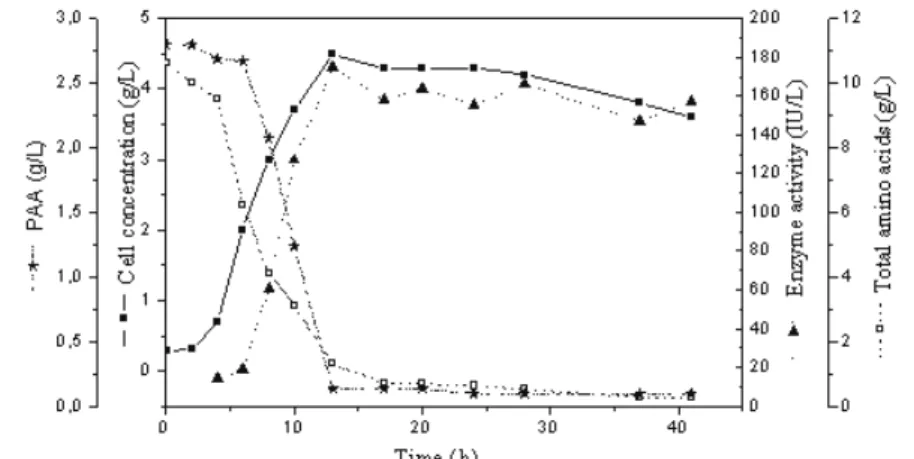
of cultivation, a working volume of 4.5L (4.0L of medium and 0.45 of inoculum) and a duration of 41 h. Figure 1 shows graphs of cell and PAA concentrations, enzyme activity and total concentration of aa. It can be observed in Figure 1 that the cell concentrations did not exceed 4.6 g/L and that enzyme activity reached a maximum of 180 IU/L, confirming the results obtained in the shaking flasks. PAA was depleted in the initial 15 hours of
cultivation, indicating its use as a carbon source for the microorganism. The depletion of PAA and amino acids caused stagnation of the cell concentration and enzyme activity. Analysis of the consumption of each amino acid (Figure 2) shows that some were quickly consumed (Figure 2a), while others had a slower rate of assimilation (Figure 2b). The preferential amino acids were consumed in less than 10 hours and the others mostly after that period.
Figure 1: Cell concentration, enzyme activity, PAA concentration and total amino
acid concentration during the batch cultivation.
(a) (b)
Figure 2: Amino acids concentrations: (a) preferential consumption; (b) slow consumption.
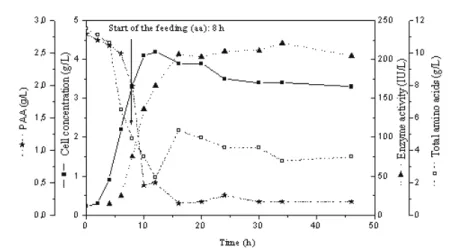
The stagnation of cell growth and of enzyme production, coinciding with the depletion of PAA and amino acids, indicated the possibility of expanding the exponential growth phase. Therefore, a fed-batch culture (Experiment BA1) was carried out. The supplementary medium was the same solution of amino acids. This was an attempt to extend the exponential growth phase, consequently increasing the amounts of PGA produced. The results in Figure 1 clearly indicate
Figure 3: Cell concentration, enzyme activity, PAA concentration and total amino
acids concentration during the fed-batch cultivation (Experiment BA1).
(a) (b)
Figure 4: Amino acids concentration: (a) preferential consumption; (b) slow consumption.
Figure 3 shows a small improvement upon the experiment in batch culture, with slightly higher values of enzyme activity (200 IU/L). The exponential phase, however, could not be extended beyond the same 12h time span (approx.) that was observed in the batch run. It is interesting to observe that, in the fed-batch, some aa were depleted (their consumption continued even during the stationary phase), while others accumulated (see Figure 4 for the details). These data surely reflect changes in the metabolic pathways when the exponential growth is completed.
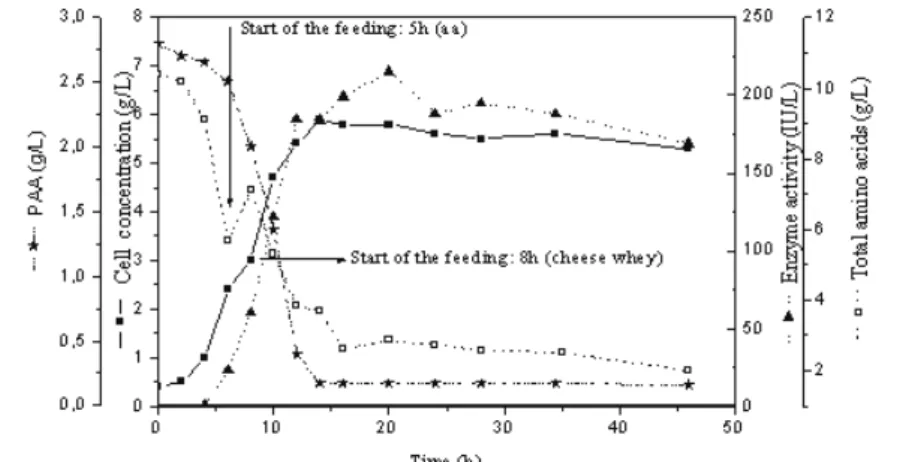
A second fed-batch experiment was conducted (Experiment BA2) with separate feeds of amino acids and cheese whey, which provides essential micronutrients for microorganism growth: there is no
germination of the spores without whey. The experimental conditions were the same as those in BA1, except that the feeding of amino acids began after 5 h instead of 8 h of cultivation, as in the one with cheese whey. Feeding amino acids after 5 hours was an idea suggested by the results of experiment BA2 (see Figure 4-a) where some amino acids were depleted in less than 8 hours.
Figure 5: Cell concentration, enzyme activity, PAA concentration and total amino
acids concentration during the fed-batch cultivation (Experiment BA2).
(a) (b)
Figure 6: Amino acids concentration: (a) preferential consumption; (b) slow consumption.
CONCLUSIONS
The substitution of hydrolyzed casein by a solution of free amino acids during the cultivation of
Bacillus megaterium resulted in higher rates of
biomass growth and of PGA production. Fed-batch cultivations showed a small improvement upon batch operation with higher values of enzyme activity and of cell concentration. Nevertheless, the exponential growth phase could not be extended appreciably with the strategies tested here. Enzyme production was shown to be associated with cell growth after a delay of approximately 2 hour.
The wild B. megaterium strain ATCC 14945
grew satisfactorily in a medium with free amino
acids. A set of these amino acids, Ala, Arg, Asp, Gly, Lys, Ser, Thr and Trp was preferentially consumed by the microorganism. On the other hand, the rates of consumption of His, Ile, Leu, Met, Phe, Pro, Tyr and Val were lower. Further single omission assays will be carried out to verify whether some of these amino acids are essential.
ACKNOWLEDGEMENTS
REFERENCES
Acevedo, F. and Cooney, C.L., Penicillin Amidase Production by Bacillus megaterium.
Biotechnology and Bioengineering, 15, pp. 493-503 (1973).
Balasingham, K., Warburton, D. Dunnil, P. and Lilly, D., The Isolation and Kinetics of Penicillin Amidase from Escherichia Coli. Biochimica ET
Biophysica Acta, pp. 250-256 (1972).
Gentina, J.C., Acevedo, F. and Villagra, M.P., Short Communication: Effect of Complex Nitrogen Sources on the Production of Penicillin Acylase by Bacillus megaterium. World Journal of
Microbiology and Biotechnology, 13, pp. 127-128 (1997).
Illanes, A., Acevedo, F., Gentina, J.C., Reyes, I., Torres, R., Cartagena, O. and Ruiz, M. A., Production of Penicillin Acylase from Bacillus megaterium in Complex and Defined Media.
Process Biochemistry, 29, pp. 263-270 (1994). Illanes, A., Biotecnologia de Enzimas, Ediciones
Universitarias de Valparaíso de la Universidad Católica de Valparaíso, Chile (1994).
Modak, J.M. and Lim, H.C., Optimal Mode of Operation of Bioreactor for Fermentation
Process. Chemical Engineering Science, 47, no. 15-16, pp. 3869-3884 (1992).
Ospina, S.S., Characterization and Use of a Penicillin Acylase Biocatalyst. Journal of Chemical Technology and Biotechnology, 53, pp. 205-214 (1992).
Pinotti, L.M., Silva, A.S., Silva, R.G and Giordano, R.L.C., Study of Different Media for Production of Penicillin G Acylase from Bacillus megaterium ATCC 14945. Applied Biochemistry
and Biotechnology, 84-86, pp. 655-663 (2000). Schmidell, W., Lima, U.A., Aquarone, E. and
Borzani, W., Biotecnologia Industrial: Engenharia Bioquímica, Editora Edgard Blucher LTDA, 2, Brazil (2001).
Souza, V.R., Pinotti, L.M., Inocêncio, G.E.M. and Giordano, R.L.C., Influence of Amino Acids Composition in the Production of Penicillin G Acylase by Bacillus megaterium ATCC 14945. 7th SHEB, Maringá, PR (2002).
Whitaker, A., Fed-batch Culture. Process Biochemistry, 15, pp. 10-15 (1980).