i
Understanding the drivers of repurchase
intention in the sharing economy context
Mayssa Mrabet
Dissertation report presented as partial requirement for
obtaining the Master
’
s degree in Statistics and Information
Management
i
LOMBADA MEGI
Understanding the drivers of repurchase intention in the sharingeconomy context
Mayssa Mrabet
MEGI
ii
NOVA Information Management School
Instituto Superior de Estatística e Gestão de Informação
Universidade Nova de Lisboa
UNDERSTANDING THE DRIVERS OF REPURCHASE INTENTION IN THE
SHARING ECONOMY CONTEXT
by
Mayssa Mrabet
Dissertation report presented as partial requirement for obtaining the Master’s degree in Statistics and Information Management
Advisor: Tiago Oliveira, PhD
iii
Acknowledgement
I would like to express my sincere appreciation to my advisor Professor Tiago Oliveira for his insightful advices and guidance throughout the completion of this research.
I am grateful for my family and friends for sharing their support and encouragement throughout this experience.
iv
Abstract
The sharing economy is a fast-growing competitive market and a greatly debated phenomenon. Its success depends on customer repurchase intention. We anticipated a theoretical model integrating the literature of information systems (IS) success model, Expectation-confirmation theory (ECT), and overall trust. This integration allows the evaluation of the determinants of repurchase intention in the sharing economy context. The empirical evidence is grounded on an online questionnaire of 314 respondents. The outcomes disclose that overall trust, continuance intention, user satisfaction, and net benefits are the main determinants of repurchase intention of the sharing economy experience. The research model resulted in a mediation effect where continuance intention plays the role of a partial mediator of user satisfaction on repurchase intention, user satisfaction on net benefits, and use on net benefits. User satisfaction also presents a partial mediator of perceived usefulness on continuance intention. Implications and limitations are discussed.
Keywords
v
Index
1. Introduction ... 1
2. Literature review... 3
2.1. The concept of the sharing economy ... 3
2.2. DeLone & McLean ... 3
2.3. Expectation-confirmation theory of IS continuance ... 4
2.4. Trust Dimensions ... 4
3. Research Model ... 5
4. Research methodology ...10
4.1. Measurement instruments ... 10
4.2. Data collection ... 10
5. Data analysis and results ...12
5.1. Measurement model ... 12
5.2. Structural model ... 15
6. Discussion and conclusion ...17
6.1. Hypotheses discussion ... 17
6.2. Theoretical implications ... 18
6.3. Managerial contributions ... 19
6.4. Limitation and future research ... 20
7. Conclusion ...21
8. References ...22
vi
List of Figures
Figure 1 - Research Model ... 5 Figure 2 - Research Model with results ... 15
vii
List of Tables
Table 1 - Demographic Characteristics ... 11
Table 2 - Measurement model results... 13
Table 3 - Square root of AVE and correlations between constructs ... 14
Table 4 - HTMT criterion ... 14
Table 5 - Results of the hypotheses test ... 17
1
1. Introduction
The sharing economy occurs in structured networks; in which members carry out sharing actions such as renting, transportation facilities, and lending. We are shifting towards an economy where real assets are shared as facilities. The sharing economy is a competitive business model and it has exploded in recent years mainly because of consumers’ increased awareness of idle assets
(Botsman and Rogers 2010). The most well-known examples are; Airbnb, which is a platform providing offers for temporary accommodation, Zipcar which is considered among the first car sharing
businesses, and TaskRabbit which is a platform where one can immediately mediate personal services, castles and house boating in more than 34,000 cities in 192 countries (Statista 2015). While 68% of employees in the sharing economy have an age-range between 18 years and 34 years old, their operators are extended across all ages. The peer-to-peer model is defined as an intermediation utilizing web and/or mobile technology to join holders, meaning private individuals, not in the form of organizations of sub-optimized goods with potential drivers (B. Cohen and Kietzmann 2014).
By 2016, the statistics for the transportation field affirmed that about 160,000 people drive for Uber in 450 cities (Simona Frazzani, Gabriele Grea 2016). These are examples of the sharing economy which do not only offer a broad diversity of services that is a transformation from proprietorship to access but can also be formed through dispersed connected people. For instance, in North America the annual growth rate of the car-sharing market is expected to reach 1.7% between 2016 and 2020 which will be worth 53.7 million units by 2020 (Statista 2018). Moreover, PricewaterhouseCoopers (PwC) highlighted that the sharing economy evolution is among the five key sharing fields in Europe; chiefly automotive, hospitality, finance, staffing, and media streaming, in which $14 billion in earnings were engendered, that is predictable to reach $335 billion by 2025 (Yaraghi and Ravi 2017). This budding notion of the Sharing Economy is based on reinforcing the reciprocity through contribution, producing happier, enhanced and more sustainable lifestyles (Voytenko Palgan et al. 2017).
It can be noted that the sharing economy is generating huge amounts of wealth. Even though we are in a large competitive market, the notion of the sharing economy is still standing and becoming a human habit. This aspect leads to the decrease in switching costs between the sharing economy market players. Thus, a persistent research question requiring an answer arises: What are the
determinants that affect user repurchase intention of the sharing economy? There is a lack of reliable findings and empirical support between user repurchase intention and the sharing economy context in the literature. Moreover, the research involvement addressing elements of user repurchase intention in the sharing economy services persists uncommonly and has a figure of omission (Diamantopoulos A. and Winklhofer H. M. 2001). Based on our knowledge, previous research emphasizes sharing economy adoption factors; our approach diverges from the majority by assessing the determinants that
influence user intention, user satisfaction, IS continuance, trust, net benefits, and repurchase intention of the sharing economy. These terms have been subject to scientific investigation before, but have never been published in research together, which presents the originality of the subject in question. Thus, the contributions of this research are presented as the following: (1) measuring the motivation of user repurchase intention that is believed to be affected by overall trust, user satisfaction, IS
2 continuance, and net benefits that result from participation in the sharing economy. (2) validating the mediation analysis of continuance intention on user satisfaction and repurchase intention, on user satisfaction and net benefit, and on use and net benefit. (3) verifying the mediation effect of user satisfaction on perceived usefulness and continuance intention. This study admits that the findings can be helpful for both researchers and practitioners in gaining visions into how to endorse customer repurchase intention.
The paper is organized as follows. First, an overview of the sharing economy and its importance is presented, in the next section we define the literature review in support of the theories used. Then, we represent the research model and the suggestion of the hypotheses. Next, we designate the research methodology, pursued by data analysis. After that, the study results are conferred, followed by an examination of the main conclusions. Finally, we display the connotation of the results, outline the restrictions of the study, and propose guidelines for future research.
3
2. Literature review
2.1. The concept of the sharing economy
The sharing economy is based on digital platforms in which customers have access to goods and services, rather than property either tangible or intangible assets. This economizes on rare resources and frequently engages rooted social exchanges than regular market activity (PwC 2014). Countless parties have recommended different names for the sharing economy, such as the platform economy, access economy, and collaborative consumption (Figueiredo and Scaraboto 2016).
It is true that the sharing economy not only allows individuals to make money from underutilized property but also provides social and environmental benefits. Lately, the sharing economy has facilitated participants to create new social networks on which they can depend and offered the chance to interact with different people (Zhang et al. 2018). Thus, as can be noticed, due to the recognition of the sharing economy, new networks of trust are created. The sharing economy generates the reduction of middleman costs, flexibility for users and suppliers through previous reviews shared by different customers as well as identity checks that lead to completely new transactions. In an article from Today.com, Brian Chesky who is the CEO of Airbnb declared that it is fundamental to admit that people no longer desire to just buy a product, but rather they are looking for an experience and interaction with others.
2.2. DeLone & McLean
The established rational utility model upholds the assumptions of success existing by many well-known theories, such as tragedy of the commons (Dutta and Sundaram 1993), the game theory’s prisoner’s dilemma (Wichman 1970) and the sense of cumulative action (Olson, 1966), as behaviors intended to exploit expected benefits as well as maximize utility with instant efficiency. Ten years after the publication of the first model, DeLone and McLean (2003) revised the definition of IS success theory. After rectification and many contributions as well as their corresponding measures, six classes were grouped, namely; information quality, system quality, use, user satisfaction, individual impact, and organizational impact. The updated model contains two additional constructs which are service quality and net benefits. In which net benefits combine the individual and organizational impact in the
previous model. The model propounds that the match between the quality measures; jointly influence IS use and user satisfaction. In turn, all these directly affect net benefits.
Numerous authors demonstrated that D&M can be combined with different theories; for instance with the unified theory of acceptance and usage of technology (UTAUT) that aims to clarify electronic patient archives (Maillet et al. 2014), with continuance intention of mobile expense services (Zhou 2013), or D&M combined with trust measurement to analyze repurchase intention in online services (Chang et al. 2015). Recently, consumers’ recognition of a company has been defined as a driver of relationships (Popp and Woratschek 2017). Therefore, we may consider that the position of customer use and satisfaction in the sharing economy context, are significant as a core relationship driver (O’Malley and Tynan 2000). Based on the extent of our familiarity, the literature on the D&M model in the sharing economy context does not exist.
4
2.3. Expectation-confirmation theory of IS continuance
Expectation confirmation theory has been widely used to test customer satisfaction specifically in the service of marketing quality literature as well in the online reuse of IS. In fact, the theory examines both pre-behavior which is expectation and post-purchase behavior which is defined as repurchase intention. The theoretical grounding of this theory is to explain the repurchase intention that comes from Oliver (1980). Moreover, expectation confirmation theory theorizes that the principal incentive for the survival of a product or service is its consumer satisfaction. The procedure in which consumers achieve repurchase intentions in an ECT framework was adapted by Bhattacherjee (2001) in the specific domain of post acceptance of computer technology, merging the pre/post consumption ECT model into a single post acceptance IS model.
Following these steps, users achieve continuance: first, consumers form a preparatory prospect of a precise technology (product or service). The second step is the recognition of the actual usage of the technology. After early utilization, users create insights concerning its performance such as the perceived usefulness construct (to be discussed later in the model). Regarding the third step, they evaluate its recognized performance in respect of the preliminary belief and settle to the level until their anticipation is proved; here we find the confirmation or the disconfirmation feature. At the fourth stage, consumers perform a satisfaction analysis based on the two aspects which are the confirmation and expectation level, that were based earlier. Finally, one of two consequences will be generated; a satisfied user will form an IS continuance purchase intention, while a dissatisfied user will withdraw its succeeding use (Bhattacherjee, 2001). In fact, customer satisfaction has habitually
remained as an elemental basis of durable period consumer behavior. Satisfaction is considered as an vital element to maintain a base long-term customer relationship (Boshoff and Leong 1998). Thus, the motivation for applying the Bhattacherjee theory (2001) is to develop more insights for user
repurchase intention in the sharing economy context.
2.4. Trust Dimensions
Satisfaction in itself may not be sufficient to ensure the enduring promise of the customer to a service provider (Ranaweera and Prabhu 2003). It might be crucial to look beyond satisfaction with further variables that could strengthen buyback retention like trust (Hart and Johnson 1999). Trust can be conceptualized as a state including the spiritual intention of accepting the susceptibility to another person's expectations (Austin et al. 2013). Moreover, trust has been considered as a crucial construct for transactional relationships; mainly when it comes to being theorized as a measurement of the technology acceptance model. One would also think about having a notable impact on the users willingness to hold online money transactions and private conscious information (Austin et al. 2013). Meanwhile, by taking trust as a concept, it still has no generally established description and there is no other way to forecast the combined real worth of trust (Chang et al. 2015).
Built on an extensive examination of literature, three scopes of trust exist, namely competence, integrity, and benevolence; which sequentially will determine the overall trust. In fact, competence states to the ability of a company to fulfill the commitments made to consumers (Palvia 2009). The construct integrity explained by the consistency, reliability, and the honesty approach of a company. Benevolence stands for the company’s ability to grasp the interests of its clients before its own interest and indicates genuine anxiety for the benefit of customers (Palvia 2009).
5
3. Research Model
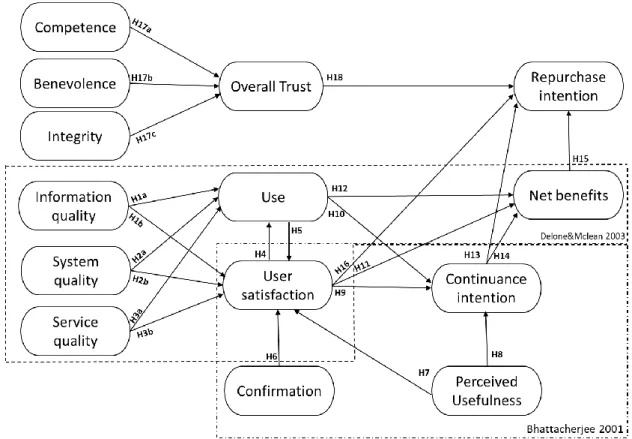
Grounded on the theoretical context, the research model and its assumptions are presented in Figure 1. We recommend a research model theory based on two well-established theories: Delone & Mclean (2003) and Bhattacherjee (2001) which shed light on repurchase intention and its antecedents in the sharing economy context. Our research model draws together the sparse literature on repurchase intention and a number of important factors referring to overall trust that have mainly been overlooked from additional literature (Oliveira et al. 2017).
Figure 1 - Research Model
The strengths and weaknesses of the model are completed by merging up together. Meaning that the Delone & Mclean model (2003) and Bhattacherjee theory (2001) match each other, thus their
aggregation is beneficial for examining the drivers of repurchase intention in the sharing economy context. As mentioned previously, the Delone & Mclean model (2003) suggested that the measures of quality insight should comprise three features which are mainly; system quality, information quality, and service quality. At the broad sense, if customers have full practice with sharing economy, they are able to assess system quality, information quality, and service quality of this context ( Lee, Chan, Balaji, & Chong, 2018). However, the Bhattacherjee theory (2001) does not include the measures of quality perception toward user satisfaction in the sharing economy. Moreover, the weakness of the D&M model is the failure to consider the user's intention to continue. The literature review section
supported that satisfaction results in continuance and persistence; thus, user repurchase intention in the sharing economy occurs. The mixture of constructs for both models reinforces our comprehension of repurchase intention in the sharing economy.
6 Furthermore, investigators submit that trust is a tool that ease the doubt of online transactions and thus allows customers to participate in an online exchange relationship (Mccole et al. 2010). Since, the use, user satisfaction, continuance intention, overall trust, and repurchase intention become
significant issues of the sharing economy, the incorporation of both models might posit beneficial visions to the sharing economy managers.
Information quality
Information quality characterizes the favorite features (e.g., understandability, precision, conciseness, usability, and fullness) of the system outputs. Rai, Lang, & Welker (2002) affirm that information quality and system quality mutually impact the use and the user satisfaction positively. Moreover, Nils Urbach & Benjamin Müller (2012) claimed that information quality is frequently regarded as a crucial anterior of user satisfaction. Also, information quality outlines manner about information and system satisfaction which consequently, effects user continuance intention of the sharing economy service. Therefore, we propose the following:
H1a: Information quality positively influences use in the sharing economy context.
H2a: Information quality positively influences user satisfaction in the sharing economy context. System quality
System quality contains enviable characteristics such as accessibility, system reliability, and system flexibility of an information system (Petter and McLean 2009). Gauging the quality of information systems is a multidimensional procedure that emphasizes several structures of a system such as usability aspects, quality features, and other structures associated to technical problems (Nils Urbach and Benjamin Müller 2012). In classical studies, regular dimensions of system quality comprise reply time, facility of use, resilience and constancy (Wu and Wang 2006). Based on this background we might suggest that advanced system quality is likely to point out to larger usage of the sharing economy as well as user satisfaction. Hence, we suggest:
H2a: System quality positively influences use in the sharing economy context.
H2b: System quality positively influences user satisfaction in the sharing economy context. Service quality
Service quality is composed of receptiveness, precision, consistency, practical ability, and sympathy of the IT operator (Delone and Mclean 2003). The quality of service is often defined as the level of service provided matches the customer's expectations. Pitt, Watson, & Kavan (1995) claimed that service quality revised for the marketing domain, is considered as a familiar tool for estimating IS function. Service quality was the second enhancement in the IS success model as it was seen as being among the factors that lead to an increasing experience in using a system, in turn, this will guide to the growing procedure of the life cycling of the system. Michael Munger detects that individuals don’t essentially want objects, rather they look for service flow that workers deliver over time (Yaraghi and Ravi 2017). Thus, we expect the service quality of the sharing economy experience to be fundamental to
maintaining the level of user satisfaction. Hence, we posit the following: H3a: Service quality positively influences use in the sharing economy context.
7 H3b: Service quality positively influences user the satisfaction in the sharing economy context.
Confirmation
Confirmation stands for the cognitive belief of the degree to which prior customers prospects of service or product use have been met (Y. Lee and Kwon 2011). Bhattacherjee theory (2001) suggests that user satisfaction is resolute by mainly two constructs which are the perceived usefulness of the IS and confirmation of actual use. Confirmation is dignified by users to settle on their evaluative answers or approval. Confirmation is significantly associated with satisfaction of the use of the sharing
economy, as it suggests comprehension of the anticipated advantages. However, disconfirmation expresses failure to attain expectation. Considering the confirmation-satisfaction association; users of the sharing economy are dissatisfied with late responsiveness, lack of professionalism, and the incredibility of items and pictures posted on online sites (Sliwa, Computerworld, 2000). Hence; we suggest:
H6: Confirmation positively influences user satisfaction in the sharing economy context. Perceived usefulness
Perceived usefulness is characterized by the amount at which the user estimates that online shopping will improve his or her activity conduct (Chiu, MacMillan, & Chen, 2009). Perceived usefulness is the instrumentality of IS use and the main reason is the major incentives of IS acceptance. It is believed that perceived usefulness can also stimulate the continuity of participation of sharing economy decisions. Thus, perceived usefulness is predictable to be the most outstanding ex-post belief that determine users’ post approval affects which lead to satisfaction. Prior literature asserts that a practical online product might make users more likely to practice greater pleasure and enjoyment at an online store that uses high- quality marketing and information attributes and recommends it to peers (Ha, Research, & 2009). Furthermore, perceived usefulness is expected to inspire users to expand referrals by word of mouth, in doing so, the user's continuance intention of sharing economy increases. Based on the research done by Hong, Thong, & Tam (2006), they consider that the
continuance usage behaviors of the information technology are dependent on the users’ prospects and values. Thus, to efficiently boost the explanations of maintenance practices, users’ perceived usefulness and perceived entertainment were included in the Bhattacherjee theory (2001) post-acceptance model of IS continuance. Considering this background, we can posit the following: H7: Perceived usefulness positively influences user satisfaction in the sharing economy context. H8: Perceived usefulness positively influences continuance intention in the sharing economy context. User satisfaction
In this study, satisfaction is considered as the emotional response of a customer transaction to practice in the online sharing economy (Carrillat et al. 2009). That is, the satisfaction of the sharing economy reflects the customers’ emotional response to experience buying products or services. Consequently, satisfaction is treated as a crucial feature influencing repurchase intention (Luga et al. 2012). In addition, the standpoint of exit-voice theory Hirschman (1970) postulates that satisfaction will rise customer confidence in a product or service, while dissatisfaction can allow clients to waive their complaint to seek benefits. Similarly Bhattacherjee (2001) and Oliver (1980), also propose that
8 satisfied customers will maintain repurchase intention, while dissatisfied customers possibly will abandon their successive use. Satisfaction then incites trust, loyalty and encouraging repurchase behaviors (Cohen, 2014). Increasing user satisfaction will result in a greater user intent, which will later affect the users benefits (Petter and McLean 2009). Hence, we suggest the following:
H4: User satisfaction positively influences use in the sharing economy context.
H9: User Satisfaction positively influences continuance intention in the sharing economy context. H11: User satisfaction positively influences net benefits in the sharing economy context.
H16: User satisfaction positively influences repurchase intention in the sharing economy context. Use
The amount of use, the frequency of use, the nature of use, and the purpose of use are all derived from an information system in the technology acceptance model. Ease of use is considered to improve the continuance usage behavior of users (Venkatesh et al. 2003). In the sharing economy context, it is the capability to perform service operations with the minimum amount of time and energy, thus expanding user welfare. In the sharing economy, use and user satisfaction are strictly interconnected. The optimistic practice of use will main to higher user satisfaction in the model of Delone & Mclean (2003); some net benefits will occur by reason of usage and user satisfaction. Thus, we suggest; H5: Use positively influences user satisfaction in the sharing economy context.
H10: Use positively influences continuance intention in the sharing economy context. H12: Use positively influences net benefits in the sharing economy context.
Continuance intention
Two key aspects are supposed to influence the choice of consumers to continue to use e-commerce services, namely satisfaction and perceived usefulness (Anol Bhattacherjee 2001). As previously mentioned, based on the expectation-confirmation theory (ECT) that theorizes satisfaction with a product or service is the prime inspiration for its continuance. Preceding examination has shown that satisfaction has a concrete effect on further repurchase intentions (Chumpitaz and Paparoidamis 2004). Thus, satisfied consumers continue to use sharing economy facilities, while dissatisfied users interrupt it and shift to substitute services Oliver (1980).
H13: Continuance intention positively influences repurchase intention in the sharing economy context. H14: Continuance intention positively influences net benefits in the sharing economy context.
Net benefits
Net benefits translate into enhanced decision-making, enhanced output, upgraded sales, cost reductions, increased returns, and market proficiency. People who voluntarily conclude a sharing economy transaction do so only if it is advantageous to both parties. Regarding the sharing economy context, both providers and users might gain emotional experience and physical benefits such as saving and earning costs throughout interaction and contacts based on community (Möhlmann 2015). The sharing of cars (e.g. Zipcar, RelayRides, and Uber) and sharing of accommodation, for instance,
9 Airbnb, are considered to be the most ideal cases of sharing systems that deliver customers with the enjoyment of products and services without ownership (Lamberton and Rose 2012). Furthermore, sharing economy platforms usually have impacts far beyond those for which they were originally settled. Based on these benefits, we recommend the following;
H15: Net benefits positively influence repurchase intention in the sharing economy context. Overall Trust
Overall trust is explained by three dimensions: competence, integrity, and benevolence that affect the overall trust of a user (Oliveira et al. 2017). Therefore, trust is considered a key factor in building trust in social commerce (Chong et al. 2012). Recommendation through word-of-mouth, scoring, and reviews obtainable by the network may contribute to establishing reputation (Hussain et al. 2018). Also, third-party brokers such as Airbnb, Uber, and Lyft do provide notification and scores systems which enable users to share their positive or negative post experience concerning the service
delivered. Although the question that remains, whether these evaluations by themselves are enough to build trust. It is true that more information shared on an online platform can guide to greater trust between users, but it can also produce to ethnic and gender bias. Generally, trust is presented as a significant determinant of consumer’s behavior (Botsman and Rogers 2010). For instance, Kassim and Abdullah defined trust as an engine for the customer relationship (Figueiredo and Scaraboto 2016). They revealed that trust has a substantial positive impact on relationship promise. To be successful in this new and exciting world of business, one has to build trust among users as well as express
legitimacy and precision (Schau et al. 2009). This study hypothesized that the perception of trust affects repurchase intention.
H17a, b, c: The three dimensions of trust positively influence overall trust in the sharing economy context.
10
4. Research methodology
4.1. Measurement instruments
The items for all the constructs, which were assembled from the relevant literature, are included in Appendix A. Several studies have established and validated the Delone & Mclean (2003) measuring instruments. Thus, the elements of this instrument were derived from the present literature and adjusted to fit in the sharing economy context. Items for measuring information quality, system quality, service quality, use, and user satisfaction were derived from Wang & Liao (2008), Costa, Ferreira, Bento, & Aparicio (2016), and Palvia (2009). Confirmation was adapted from Anol
Bhattacherjee (2001). Perceived usefulness was adapted from Palvia (2009). Continuance intention was adapted from Venkatesh, Thong, Chan, Hu, & Brown (2011). The items referring to net benefits were developed from Chen et al (2015). Competence, benevolence, integrity, and overall trust were measured using items adapted from Oliveira, Alhinho, Rita, & Dhillon (2017). Lastly, repurchase intention was derived from Hsu, Chang, & Chuang (2015).
4.2. Data collection
The current research targets students who are users of any service or product of the sharing economy. We consider students as an important group in sharing economy services mainly because they are a representative group of early adopters of IS and their limited resources. To assess the theoretical constructs, a survey was conducted in a European country.
The data was accumulated through an online survey operated via a common survey website between December 2017 and February 2018. The questionnaire was administered in English where each item was weighed on a range scale, ranging from ‘‘strongly disagree’’ (1) to ‘‘strongly agree’’ (7). A pilot questionnaire was conducted with 32 answers to get some insights and ideas about the structure and content. Based on the respondent’s feedback and demands; some descriptions were added under each question that helped to improve and facilitate the mission for them and minimize errors of misunderstanding. A hyperlink was sent to a university database and was posted on several online discussion forums. An alternative strategy was dedicated for those who were contacted by e-mail. The e-mails were personalized and incorporated with a reminder to the recipient that his contribution is highly valuable, hoping to emphasize the sample return rate. The online survey yielded 314 usable response questionnaires. The respondents were comprised of 187 males and 127 females. The demographic characteristics that are involved in the questionnaire are represented in Table 1. A proportion of 31.2% was under 24 years of age, slightly more than half of the respondents were aged between 25 and 35 years old. Most participants (75.7%) indicated that their usage of frequency is more than once in three months.
11
Table 1 - Demographic Characteristics
Measure Items Frequency Percentage
Gender Male 187 59.6% Female 127 40.4% Age Below 24 103 31.2% 25-35 154 50.2% 36-45 38 12.5% Over 45 19 6.1%
Education High school diploma 11 3.5%
Bachelor's Degree 91 30%
Master's Degree 189 60.2%
Doctoral Degree 23 6.3%
Usage Frequency Once a year 38 12.2%
Once every six months 19 7.3%
Once every three months 58 18.7%
Once a month 74 23.8%
Once a week 46 16.6%
Once every 4 to 5 days 23 8.6%
Once every 2 to 3 days 27 9.6%
12
5. Data analysis and results
The partial least squares (PLS) method is a variance-based procedure which is a structural equation model (SEM) technique. We used this approach in the study since the research model has not yet been verified in the literature, and the research model is examined as complex. This method aims to assess and measure statistical causal relations, with the association of statistical data and qualitative causal assumptions (Sarstedt et al. 2011). For this study, data analysis was achieved by conducting smart PLS 3.2.7 (Ringle, Christian M., Wende, Sven, & Becker 2015). Data analysis ensued in two stages: at first, the measurement model was accomplished to confirm the research instrument, followed by the structural equation model analysis to discuss the hypothesized associations of our research model.
5.1. Measurement model
Results of the analysis are posed in Table 2, along with descriptive statistics; the loadings, composite reliability, Cronbach’s alpha, and Average Variance Extracted are derived for all the deliberated items from PLS. Starting by assessing the composite reliability, since by using PLS which emphasizes
indicators based on their individual consistency’s intensity. Therefore, the composite reliability for all the items should be higher than 0.7. The outcomes for composite reliability are superior than 0.9, which indicates that the model has convenient internal consistency. For an appropriate indicator reliability, it is vital that loadings are statistically significant and greater than 0.7 (ranging from 0.817 to 0.977), else if the outer loading is less than this threshold value; it should be deleted from the model. At this stage of measurement, all items were retained therefore, all items are correspondingly reliable. Additionally, the latent variables should at least explain half of the variance of the indicators, hence it is measured by the Average Extracted Variance (AVE) that should be higher than 0.5. As can be noticed in Table 3, this condition is extremely fulfilled; all items assemble and share major proportion of variance and resulted in a minimum AVE of 0.772, ensuring convergence.
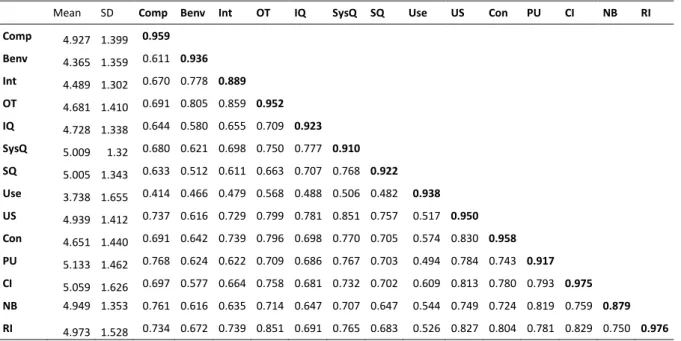
To ensure the discriminant validity of the constructs; three criteria were assessed: Fornell-Larcker criterion, cross-loadings criterion, and HTMT criterion (Ringle, Christian M., Wende, Sven, & Becker 2015). Fornell-Larcker designates that the square root of AVE should be larger than all correlations between each pair of constructs (Esposito Vinzi et al. 2010). As seen in Table 3, all diagonal values (square root of AVE) are greater than off-diagonal values (correlations between the construct). The loadings criterion proposes that the loading of each indicator should be higher than all cross-loadings (Fornell and Larcker 1981). All the cross-loadings are greater than the correspondent cross-cross-loadings. The third criterion necessitates that the HTMT ratio should be lower than 0.9 as shown in Table 4 (Henseler et al. 2015). HTMT ratios are below the threshold of 0.9. Consequently, all measures are fulfilled for all constructs as well as for all indicators which deliver proof of the discriminant validity of the scales.
13
Table 2 - Measurement model results
Likert-Scaled Constructs Cross- Loadings Composite Reliability Cronbach's α AVE
Benevolence 0.934 0.860 0.877 Benv1 0.943 Benv2 0.930 Competence 0.958 0.913 0.920 Comp1 0.963 Comp2 0.956 Confirmation 0.971 0.955 0.917 Con1 0.958 Con2 0.965 Con3 0.950 Continuance Intention 0.983 0.974 0.950 CI1 0.970 CI2 0.975 CI3 0.970 Information Quality 0.945 0.913 0.852 IQ1 0.934 IQ2 0.941 IQ3 0.894 Integrity 0.963 0.955 0.790 Int1 0.817 Int2 0.904 Int3 0.912 Int4 0.901 Int5 0.939 Int6 0.905 Int7 0.835 Net Benefits 0.931 0.901 0.772 NB1 0.888 NB2 0.874 NB3 0.819 NB4 0.930 Overall Trust 0.975 0.965 0.906 OT1 0.932 OT2 0.965 OT3 0.947 OT4 0.962 Perceived Usefulness 0.964 0.953 0.841 PU1 0.909 PU2 0.930 PU3 0.929 PU4 0.919 PU5 0.899 Repurchase Intention 0.984 0.975 0.952 RI1 0.977 RI2 0.982 RI3 0.969 Service Quality 0.920 0.870 0.793 SQ1 0.884 SQ2 0.893 SQ3 0.894 System Quality 0.951 0.931 0.829 SYQ1 0.899 SYQ2 0.934 SYQ3 0.907 SYQ4 0.901 Use 0.956 0.932 0.880 U1 0.909 U2 0.957 U3 0.947 User Satisfaction 0.973 0.964 0.902 US1 0.947 US2 0.938 US3 0.948 US4 0.964
14
Table 3 - Square root of AVE and correlations between constructs
Mean SD Comp Benv Int OT IQ SysQ SQ Use US Con PU CI NB RI
Comp 4.927 1.399 0.959 Benv 4.365 1.359 0.611 0.936 Int 4.489 1.302 0.670 0.778 0.889 OT 4.681 1.410 0.691 0.805 0.859 0.952 IQ 4.728 1.338 0.644 0.580 0.655 0.709 0.923 SysQ 5.009 1.32 0.680 0.621 0.698 0.750 0.777 0.910 SQ 5.005 1.343 0.633 0.512 0.611 0.663 0.707 0.768 0.922 Use 3.738 1.655 0.414 0.466 0.479 0.568 0.488 0.506 0.482 0.938 US 4.939 1.412 0.737 0.616 0.729 0.799 0.781 0.851 0.757 0.517 0.950 Con 4.651 1.440 0.691 0.642 0.739 0.796 0.698 0.770 0.705 0.574 0.830 0.958 PU 5.133 1.462 0.768 0.624 0.622 0.709 0.686 0.767 0.703 0.494 0.784 0.743 0.917 CI 5.059 1.626 0.697 0.577 0.664 0.758 0.681 0.732 0.702 0.609 0.813 0.780 0.793 0.975 NB 4.949 1.353 0.761 0.616 0.635 0.714 0.647 0.707 0.647 0.544 0.749 0.724 0.819 0.759 0.879 RI 4.973 1.528 0.734 0.672 0.739 0.851 0.691 0.765 0.683 0.526 0.827 0.804 0.781 0.829 0.750 0.976
Notes: Diagonal elements (in shade) are the square root of the average variance extracted (AVE). Off-diagonal elements are
the correlations among constructs. Competence (Comp), Benevolence (Benv), Integrity (Int), Overall trust (OT), Information quality (IQ), System quality (SysQ), Service quality (SQ), Use, User satisfaction (US), Confirmation (Con), Perceived usefulness (PU), Continuance intention (CI), Net benefits (NB), and Repurchased intention (RI).
Table 4 - HTMT criterion
comp Benv Int OT IQ SysQ SQ Use US Con PU CI NB RI
comp Benv 0.688 Int 0.716 0.855 OT 0.735 0.882 0.894 IQ 0.706 0.652 0.701 0.754 SysQ 0.737 0.693 0.739 0.791 0.842 SQ 0.730 0.608 0.689 0.744 0.814 0.877 Use 0.449 0.520 0.510 0.599 0.525 0.543 0.549 US 0.785 0.674 0.760 0.828 0.832 0.898 0.850 0.545 Con 0.739 0.708 0.774 0.830 0.747 0.817 0.796 0.608 0.865 PU 0.819 0.688 0.649 0.738 0.732 0.813 0.792 0.524 0.816 0.778 CI 0.739 0.629 0.688 0.782 0.721 0.768 0.784 0.638 0.840 0.809 0.821 NB 0.839 0.701 0.683 0.765 0.710 0.769 0.748 0.589 0.803 0.779 0.880 0.808 RI 0.776 0.732 0.765 0.877 0.732 0.803 0.763 0.551 0.853 0.834 0.808 0.850 0.798
Notes: Competence (Comp), Benevolence (Benv), Integrity (Int), Overall trust (OT), Information quality (IQ), System quality
(SysQ), Service quality (SQ), Use, User satisfaction (US), Confirmation (Con), Perceived usefulness (PU), Continuance intention (CI), Net benefits (NB), and Repurchased intention (RI).
Based on the represented results, the measurement model has satisfactory internal consistency, indicator reliability, convergent validity, and discriminant validity. Consequently, the constructs of our suggested model are practical and statistically definite to test the structural model.
15
5.2. Structural model
The theoretical model’s quality and theorized relationships were evaluated using the bootstrap approach; grounded on a resampling technique that draws many subsamples recovered based on the original dataset. In this case, 5000 subsamples were used to generate t-values, aiming to establish the path’s significance within the structural model (Sarstedt et al. 2011). The variance inflation factor (VIF) was calculated to detect multicollinearity among independent variables. Test outcomes displayed that no multicollinearity problems exist; all variance inflation factors found were lower than 4.196, which is less than the conventional threshold of 5 (Hair et al. 2013). Model fit was attained after running the analysis, and all the details of the results are presented in Figure 2 with results.
Figure 2 - Research Model with results
Notes: *** p < 0.01, ** p < 0.05 and *p < 0.10.
After determining the validity of the structural model, the structural paths were measured to test the research hypotheses. H4 and H5 include a mutual impact between use and user satisfaction that cannot be verified concurrently. Thus, two different models were examined. Model 1 assumes that the impact is from use to user satisfaction (H4), and Model 2 runs from user satisfaction to use (H5).
16 The model explains 29.1% in Model 1 and 30% in Model 2 of the variation in sharing economy use. User satisfaction ( =0.200, >0.05) is not statistically significant in explaining use, thus not confirming hypothesis H5. Information quality ( =0.191, <0.05 in Model 1), System Quality ( =0.222, <0.05 in Model 1), and service quality ( =0.177, <0.05 in Model 1) are statistically significant in explaining use in model 1, however in Model 2 they are not statistically significant. Thus, partially confirming
hypotheses H1a, H2a and H3a.
Model 1 and Model 2 explain 82.6% of the variation in user satisfaction. Use ( = -0.015, >0.1) is not statistically significant, thus H4 is not supported to explain user satisfaction. The hypotheses of information quality ( =0.172, <0.01 in Model 1 and =0.170, <0.01 in Model 2), system quality ( =0.307, <0.01 in Model1 and =0.306, <0.01 in Model 2), service quality ( =0.082, <0.10 in Model 1 and =0.081, <0.10 Model 2), confirmation ( =0.317, <0.01 in Model 1 and =0.311,
<0.01 in Model 2), perceived usefulness ( =0.145, <0.05 in Model 1 and =0.144, <0.05 in Model 2), all are statistically significant in explaining user satisfaction. Thus, H1b, H2b, H3b, H6, and H7 are supported.
Continuance intention is explained in 75.7% by both models. The constructs of perceived usefulness ( =0.355, <0.01 in Model 1 and 2), user satisfaction ( =0.424, <0.01 in Model 1 and 2) and use ( =0.214, <0.01 in Model 1 and 2). Hence, all three hypotheses H8, H9, and H10 are statistically significant and explain continuance intention.
User satisfaction ( =0.382, <0.01 in Model 1 and 2), use ( =0.116, <0.01 in Model 1 and 2), and continuance intention ( =0.378, <0.01 in Model 1 and 2) are statistically significant in demonstrating net benefits by 63.6% of variation in both models. Thus, H11, H12, and H14 are confirmed.
The model explains 79.8% (in both models) of the variation in overall trust. The hypotheses of
competence ( =0.160, <0.01), benevolence ( =0.311 <0.01), and integrity ( =0.509, <0.01) are all statistically significant in explaining overall trust for both models. Thus, hypotheses H17a, H17b, and H17c are confirmed.
Finally, the research Model explains 81.9% of variation in repurchase intention in both models. The hypotheses of continuance intention ( =0.289, <0.01 in Model 1 and =0.290, <0.01 in Model 2), net benefits ( =0.090, p<0.10 in both models), user satisfaction ( =0.196, p<0.01 in both models), and overall trust ( =0.411, p<0.01 in both models) are statistically significant and explain repurchase intention. Thus, hypotheses H13, H15, H16, and H18 explain and support repurchase intention.
17
6. Discussion and conclusion
6.1. Hypotheses discussion
We believe this is the first experimental investigation that examines the relationship assimilating the Delone & McLean, Bhattacharjee, and overall trust dimensions in the sharing economy context. The results of the testing hypotheses reported in Table 5, reveal that all hypotheses are partially supported or totally supported, except for H4 and H5.
Table 5 - Results of the hypotheses test
Hypo-theses
Independent variables
→Dependent
variables Findings Conclusion f²
H1b Information quality →User Satisfaction Positively & statistically significant Supported with small effect 0.059/0.058 H2b System Quality →User Satisfaction Positively & statistically significant Supported with small effect 0.129/0.129 H3b Service Quality →User Satisfaction Positively & statistically significant Supported with small effect 0.014/0.013 H6 Confirmation →User Satisfaction Positively & statistically significant Supported with medium effect 0.177/0.183 H7 Perceived Usefulness →User Satisfaction Positively & statistically significant Supported with small effect 0.041/0.040 H5 Use →User Satisfaction Not statistically significant Not supported 0.001 H1a Information quality →Use Positively & statistically significant Partially supported with small effect 0.019/0.009 H2a System quality →Use Positively & statistically significant Partially supported with small effect 0.021/0.005 H3a Service quality →Use Positively & statistically significant Partially supported with small effect 0.017/0.010 H4 User satisfaction →Use Not statistically significant Not supported 0.013 H8 Perceived Usefulness →Continuance
Intention Positively & statistically significant Supported with medium effect 0.194/0.194 H9 User Satisfaction →Continuance
Intention Positively & statistically significant Supported with medium effect 0.269/0.269
H10 Use →Continuance
Intention Positively & statistically significant Supported with medium effect 0.135/0.135 H14 Continuance Intention →Net Benefits Positively & statistically significant Supported with medium effect 0.114/0.114 H12 Use →Net Benefits Positively & statistically significant supported with small effect 0.023/0.023 H11 User Satisfaction →Net Benefits Positively & statistically significant Supported with medium effect 0.135/0.135 H17a Competence →Overall Trust Positively & statistically significant Supported with small effect 0.067/0.067 H17b Benevolence →Overall Trust Positively & statistically significant Supported with medium effect 0.182/0.182 H17c Integrity →Overall Trust Positively & statistically significant Supported with large effect 0.430/0.430 H15 Net Benefits →Repurchase
Intention Positively & statistically significant Supported with small effect 0.016/0.016 H13 Continuance Intention →Repurchase
Intention Positively & statistically significant Supported with medium effect 0.127/0.127 H18 Overall Trust →Repurchase
Intention Positively & statistically significant Supported with medium effect 0.295/0.295 H16 User Satisfaction →Repurchase
Intention Positively & statistically significant Supported with small effect 0.052/0.052
Notes: Effect size: >0.350 large; >0.150 and =<0.350 medium; >0.20 and =< 0.150 small.
Use is described by information quality, system quality, and service quality. The hypotheses are significantly and partially supported. The results are consistent with quality measures and with those stated in comparable studies Urbach, Smolnik, & Riempp (2010). However, the interdependent relationship between use and user satisfaction does not present a statistically significant reciprocal relationship.
We also find that quality measures, confirmation, and perceived usefulness uphold significant relations with consumer satisfaction. They are classified in rank as follows: confirmation, system quality,
information quality, service quality, and perceived usefulness. The discoveries prove how important it is to increase quality measures and their effect on the user satisfaction. The findings indicate that confirmation and system quality are the major drivers of client gratification comparable to Roca, Chiu, & Martínez (2006) .
18 The outcomes show that user satisfaction, perceived usefulness, and use present a significant
relationship over continuance intention. There was a strong affirmative influence of satisfaction and perceived usefulness on continuance intention than use, which is consistent with the result of (Sharma 2017). Prior study has shown that satisfaction has a positive impact on future repurchase intentions Liao, Lin, Luo, & Chea (2017).
The results also disclose that continuance intention, user satisfaction, and use are statistically significant supporting the net benefits. As was expected, continuance intention and user satisfaction have the strongest impact on the net benefits that users of the sharing economy gain, which is similar to another study, namely Ramayah, Ahmad, & Hong (2012). This finding posts the literature of Delone & Mclean (2003) that quality perception in the sharing economy has a positive stimulus on predictable net benefits. The strong significant impact of user satisfaction on user benefits from the sharing economy, leads to propose that user satisfaction may assist as a valid surrogate for net benefits similar to the study of Urbach, Smolnik, & Riempp (2010).
Our research model confirms the relationship between trust dimensions and overall trust, similar to the study of Cazier, Shao, & Louis (2007). In turn, overall trust explains the repurchase intention of the sharing economy which is comparable with the study Oliveira et al. (2017) and constant with the theory of planned behavior Ajzen (1991), that trust creates favorable feelings towards the online provider which increases a user’s intention to purchase products from the supplier, which is in line with the results Xiao, Mi, Zhang, & Ma (2017)
The results reveal that overall trust, satisfaction, continuance intention, and net benefits are the four key factors affecting customers repurchase intention. Overall trust, continuance intention, and user satisfaction were discovered to be solid determinants of repurchase intention than net benefits. The results are persistent with prior studies Hsu et al. (2015) and Möhlmann (2015). According to Oliveira et al. (2017) whose previous study deducted that a company has to enlarge consumer trust by dealing with its precise constituent (competence, benevolence, and integrity). For successful collaborative action, C. Chiu, Chang, Cheng, & Fang (2009) stress the vital role of trust. Consequently, customers involve in long-term transaction relationships. Hence, delivering additional evidence to prove that quality relationships in the sharing economy do matter.
6.2. Theoretical implications
The theoretical contributions and the strength of this research center on assessing repurchase intention in the sharing economy field, based on the combination of the IS success model Delone & Mclean (2003), the Bhattacherjee (2001) model and overall trust (Oliveira et al. 2017). The
experiential analysis results deliver robust support for our hypotheses. The current study implies that competence, benevolence, and integrity are the three most antecedents of customers’ trust that in turn affect user repurchase intention. Overall trust was found to be the strongest determinants of the repurchase intention. Our findings imply that net benefits are not sufficient to increase repurchase intention, but it is overall trust, continuance intention, and user satisfaction that result in a higher level of repurchase intention (Möhlmann 2015).
An additional contribution of our research model; is that user satisfaction was the strongest
determinant of continuance intention, in turn both user satisfaction and continuance intention were found to be stronger elements of net benefits than use (Hsu et al. 2015).
19 The empirical results show that the impact of confirmation, system quality, information quality, and perceived usefulness were originated to be stronger determinants of user satisfaction than service quality. This further infers that user satisfaction depends on many considerations that must interrelate and work together to accurately deliver promised services (Chen et al. 2015). Meaning that sharing economy users are more likely to use sharing economy services if they are satisfied using them. As expected, the confirmation-satisfaction association was confirmed; thus, the users of the sharing economy are dissatisfied with late responsiveness, lack of professionalism, and the incredibility of items and pictures posted online.
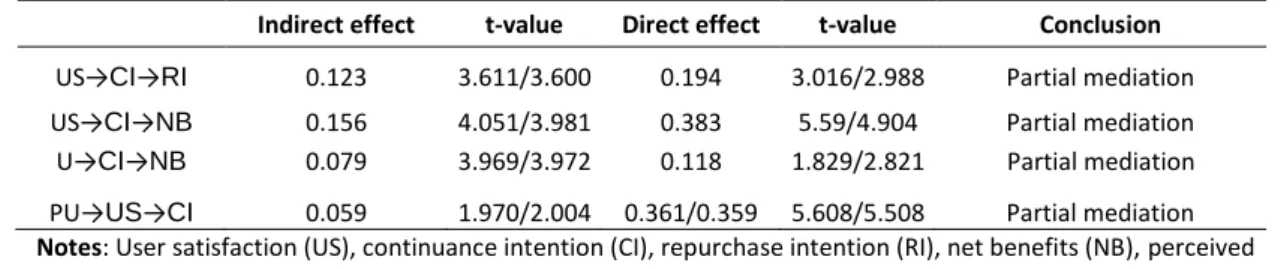
Additionally, we tested the mediation effect based on the approach of Preacher & Hayes (2008) which is defined in two steps that should be fulfilled to confirm the existence of a mediator. First, bootstrap the total effect; it is fundamental that direct and indirect impacts are statistically important. Second and after these two standards were met, the bootstrapped could calculated to assess the statistical significance. Based on the findings presented in Table 6, the research model resulted in a mediation effect where continuance intention plays the role of partial mediator of user satisfaction on
repurchase intention, user satisfaction on net benefits, and use on net benefits. User satisfaction also presents a partial mediator of perceived usefulness on continuance intention.
Table 6 - Mediation effect
Indirect effect t-value Direct effect t-value Conclusion
US→CI→RI 0.123 3.611/3.600 0.194 3.016/2.988 Partial mediation
US→CI→NB 0.156 4.051/3.981 0.383 5.59/4.904 Partial mediation
U→CI→NB 0.079 3.969/3.972 0.118 1.829/2.821 Partial mediation
PU→US→CI 0.059 1.970/2.004 0.361/0.359 5.608/5.508 Partial mediation
Notes: User satisfaction (US), continuance intention (CI), repurchase intention (RI), net benefits (NB), perceived
usefulness (PU), and use (U).
6.3. Managerial contributions
The results of this study contribute to close a research gap and present valued implications for researchers. As connections through the internet rise, accomplishment will be principally reliant on gaining and preserving user trust and satisfaction (Christine Roy et al. 2001). The overall trust that a client has in the sharing economy rely on the trustworthiness of the vendors, consequently this will influence online user repurchase intention. Thus, companies required to grow and foster shopper trust by approaching its specific components (competence, benevolence, and integrity) therefore,
customers occupy in a transaction and generate long-term relationships (Oliveira et al. 2017). In this research, the effect of confirmation, system quality, information quality, and perceived
usefulness on user satisfaction are robust than service quality. The empirical findings demonstrate that it is not enough to shape a sharing economy system with a modern interface and accessible screens to increase customers’ satisfaction and continuance intention, rather sharing economy systems should offer more pertinent and useful information to accomplish user needs and desire (Ong et al. 2004). This implies that executives should progress a system that delivers a swift and rapid service with good user interface constancy for service quality. We suggest that sharing economy system designers should pay more importance to quality measure considerations.
20 Since perceived usefulness was among the significant antecedent of continuance intention, executives can rise users’ usage intent by enlightening their reliance about how the sharing economy scheme can boost their effectiveness and performance (Roca et al. 2006). This contribution will allow managers that are engaged in collaborative consumption services in various fields to reveal insights into the factors of user’s continuance intention.
Moreover, the results of this paper offer major insights for managers of sharing economy services, particularly relevant for customer retention. The research findings propose that the benefits provided by the sharing economy service are not a strong determinant to make the customer feel the need to repurchase. The basic assumption is that individuals are better off creating a digital trust profile in the long term, rather than seeking for short-term benefits that might result in bad digital trust scores that might have negative long-term effects (Möhlmann 2015). Thus, when customers preserve long-term contractual interactions with their sharing economy service providers, one can go with the conclusion that trust, continuance intention, and satisfaction would be likely to be worthy determinants of customer relationship promise (Hsu et al. 2015). The important role of trust might be used as a strategic competitive advantage in sharing economy service providers (Oliveira et al. 2017). Additionally, the manager will be able to guide relationships with users and conceive targeted
marketing plans in a strategic way as well as to maintain user repurchase intention thus increasing the retention rate.
6.4. Limitation and future research
The present study has some restrictions. First, the illustrative data was conducted in a European country, but most of the respondents are students based in Portugal. Second, the study purposes to assess the determinants of the repurchase intention at an individual level. Thus, it doesn’t have a complete and comprehensive overview of the entire industry. Although the results are statistically pertinent except for hypotheses H4 and H5, additional examinations with a larger local scope will raise the model’s descriptive competences. Furthermore, the goal of the study was to assess the sharing economy as a global concept, not based on specific products and services that the sharing economy provides. Therefore, the proposed model suggests a more profound study of the products or services of the sharing economy. Additionally, this research was steered using a short-term snapshot of users’ behavior. We suggest an additional research effort to assess the validity of the research model and its answers. Since a longitudinal study will permit the researcher to gain insights about how users and the relationships among variables amend over time.
21
7. Conclusion
It is important for online services to appreciate why buyers are eager to involve in repurchase experience. This research established and verified a model clarifying the determinants of repurchase intention based on the combination of Anol Bhattacherjee's (2001) theory with the Delone & Mclean (2003) model and Oliveira et al.'s (2017) Overall Trust concept. The results from this study suggest that overall trust, continuance intention, and satisfaction are considered major subjects in the sharing economy experience rather than the net benefits provided. Competence, integrity, and benevolence are the three important dimensions which explain overall trust that in turn have a straight outcome on the intention to repurchase a sharing economy service. Our findings recommend that IS practitioners should progress the features of the sharing economy system; mainly because based on the primary period of user’s perceptions concerning its perceived quality (information quality, system quality, and service quality), and when these insights are settled, they produce a sense of either approval or dissatisfaction. As a result, pleased customers will engage in the sharing economy usage intention. As verified by our data, continuance intention plays the role of partial mediator of user satisfaction on repurchase intention, user satisfaction on net benefits and use on net benefits. User satisfaction also presents also a partial mediator of perceived usefulness on continuance intention.
22
8. References
Ajzen, I. (1991). The theory of planned behavior. Organizational Behavior and Human Decision
Processes, 50(2), 179–211. doi:10.1016/0749-5978(91)90020-T
Austin, J., Dwyer, B., & Kohli, A. (2013). Factors affecting trust in market research relationships. Journal
of Marketing, 57, 81–101.
http://citeseerx.ist.psu.edu/viewdoc/download;jsessionid=7A642B0365EEB930DE5BCE0 B2A74CAAA?doi=10.1.1.640.597&rep=rep1&type=pdf. Accessed 15 December 2017
Bhattacherjee, A. (2001). Understanding information systems continuance. MIS Quarterly, 25(3), 351– 370. doi:10.2307/3250921
Bhattacherjee, A. (2001a). Understanding information systems continuance: An expectation confirmation model. MIS quarterly, 25(3), 351–370. doi:10.2307/3250921
Bhattacherjee, A. (2001b). An empirical analysis of the antecedents of electronic commerce service continuance. Decision Support Systems, 32(2), 201–214. doi:10.1016/S0167-9236(01)00111-7 Boshoff, C., & Leong, J. (1998). Empowerment, attribution and apologising as dimensions of service
recovery. International Journal of Service Industry Management, 9(1), 24–47. doi:10.1108/09564239810199932
Botsman, R., & Rogers, R. (2010). What’s mine is yours : The rise of collaborative consumption. Harper Business.
Carrillat, F. A., Jaramillo, F., & Mulki, J. P. (2009). Examining the impact of service quality: A meta-analysis of empirical evidence. The Journal of Marketing Theory and Practice, 17(2), 95–110. doi:10.2753/MTP1069-6679170201
Cazier, J. A., Shao, B. B. M., & Louis, R. D. St. (2007). Sharing information and building trust through value congruence. Information Systems Frontiers, 9(5), 515–529. doi:10.1007/s10796-007-9051-6
Chang, W.-L., Diaz, A. N., & Hung, P. C. K. (2015). Estimating trust value: A social network perspective.
Information Systems Frontiers, 17(6), 1381–1400. doi:10.1007/s10796-014-9519-0
Chen, J. V., Jubilado, R. J. M., Capistrano, E. P. S., & Yen, D. C. (2015). Factors affecting online tax filing – An application of the IS success model and trust theory. Computers in Human Behavior,
43, 251–262. doi:10.1016/J.CHB.2014.11.017
Chiu, C., Chang, C., Cheng, H., & Fang, Y. (2009). Determinants of customer repurchase intention in online shopping. Online Information Review, 33(4), 761–784.
https://doi.org/10.1108/14684520910985710. Accessed 14 May 2018
Chong, A. Y.-L., Chan, F. T. S., & Ooi, K.-B. (2012). Predicting consumer decisions to adopt mobile commerce: Cross country empirical examination between China and Malaysia. Decision Support
23
Systems, 53(1), 34–43. doi:10.1016/J.DSS.2011.12.001
Christine Roy, M., Dewit, O., & Aubert, B. A. (2001). The impact of interface usability on trust in web retailers. Internet Research, 11(5), 388–398. doi:10.1108/10662240110410165
Chumpitaz, R., & Paparoidamis, N. G. (2004). Service quality and marketing performance in
business‐to‐business markets: Exploring the mediating role of client satisfaction. Managing
Service Quality: An International Journal, 14(2/3), 235–248. doi:10.1108/09604520410528653
Cohen, A. D. (2014). Strategies in learning and using a second language.
https://books.google.fr/books?hl=fr&lr=&id=GE7JAwAAQBAJ&oi=fnd&pg=PP1&dq=Cohen+et+al. ,+2014&ots=-GPsyGCSwf&sig=O3YC-Z0Dwejom25WVjZ90ZNdGVY#v=onepage&q=Cohen et al.%2C 2014&f=false. Accessed 16 December 2017
Cohen, B., & Kietzmann, J. (2014). Ride on! Mobility business models for the sharing economy.
Organization & Environment, 27(3), 279–296. doi:10.1177/1086026614546199
Costa, C. J., Ferreira, E., Bento, F., & Aparicio, M. (2016). Enterprise resource planning adoption and satisfaction determinants. Computers in Human Behavior, 63, 659–671.
doi:10.1016/j.chb.2016.05.090
Delone, W. H., & Mclean, E. R. (2003). The DeLone and McLean model of information systems success.
Journal of Management Information Systems, 19(4), 9–30.
doi:10.1080/07421222.2003.11045748
Diamantopoulos A., & Winklhofer H. M. (2001). Index construction with formative indicators: An alternative to scale development. Journal of Marketing Research, 38(1), 269–277.
Dutta, P. K., & Sundaram, R. K. (1993). The tragedy of the commons? Economic Theory, 3, 413–426. http://content.ebscohost.com/ContentServer.asp?T=P&P=AN&K=4542590&S=R&D=bth& EbscoContent=dGJyMNXb4kSeprM40dvuOLCmr1CeprRSsa64TbGWxWXS&ContentCu
stomer=dGJyMOzprkiuq7NQub%2FRXcW%2FuYHx2%2BWB. Accessed 5 September 2018
Esposito Vinzi, V., Chin, W. W., Henseler, J., & Wang, H. (2010). Handbook of Partial Least Squares:
Concepts, methods and applications. (J. E. Gentle, W. K. Härdle, & Y. Mori, Eds.). Springer,
New York, NY.
https://s3.amazonaws.com/academia.edu.documents/31843979/Handbook_of_Partial_Least_Sq uares_Concepts__Methods_and_Applications.pdf?AWSAccessKeyId=AKIAIWOWYYGZ2Y53UL3A& Expires=1523453856&Signature=TYe7rBh7aQmXfwocOmJBJDbHRLo%3D&response-content-disposition=. Accessed 11 April 2018
Figueiredo, B., & Scaraboto, D. (2016). The systemic creation of value through circulation in collaborative consumer networks. Journal of Consumer Research, 43(4), 509–533. doi:10.1093/jcr/ucw038
24 and measurement error. Journal of Marketing Research, 18(1), 39. doi:10.2307/3151312
Hair, J. F., Ringle, C. M., & Sarstedt, M. (2013, March 14). Editorial - Partial Least Squares structural equation modeling: Rigorous applications, better results and higher acceptance.
https://papers.ssrn.com/soL3/papers.cfm?abstract_id=2233795. Accessed 10 May 2018 Hart, C., & Johnson, M. (1999). Growing the trust relationship. Articles and Chapters.
http://scholarship.sha.cornell.edu/articles/432. Accessed 15 December 2017
Henseler, J., Ringle, C. M., & Sarstedt, M. (2015). A new criterion for assessing discriminant validity in variance-based structural equation modeling. Journal of the Academy of Marketing Science,
43(1), 115–135. doi:10.1007/s11747-014-0403-8
Hirschman, A. O. (1970). Exit, voice, and loyalty : Responses to decline in firms, organizations, and
states. Harvard university press Cambridge.
Hong, S., Thong, J. Y. L., & Tam, K. Y. (2006). Understanding continued information technology usage behavior: A comparison of three models in the context of mobile internet. Decision Support
Systems, 42(3), 1819–1834. doi:10.1016/J.DSS.2006.03.009
Hsu, M.-H., Chang, C.-M., & Chuang, L.-W. (2015). Understanding the determinants of online repeat purchase intention and moderating role of habit: The case of online group-buying in Taiwan.
International Journal of Information Management, 35(1), 45–56.
doi:10.1016/J.IJINFOMGT.2014.09.002
Hussain, S., Guangju, W., Jafar, R. M. S., Ilyas, Z., Mustafa, G., & Jianzhou, Y. (2018). Consumers’ online information adoption behavior: Motives and antecedents of electronic word of mouth
communications. Computers in Human Behavior, 80, 22–32. doi:10.1016/j.chb.2017.09.019 Lamberton, C. P., & Rose, R. L. (2012). When is ours better than mine? A framework for understanding
and altering participation in commercial sharing systems. Journal of Marketing, 76(4), 109–125. doi:10.1509/jm.10.0368
Lee, Y., & Kwon, O. (2011). Intimacy, familiarity and continuance intention: An extended expectation– confirmation model in web-based services. Electronic Commerce Research and Applications,
10(3), 342–357. doi:10.1016/J.ELERAP.2010.11.005
Lee, Z. W. Y., Chan, T. K. H., Balaji, M. S., & Chong, A. Y.-L. (2018). Why people participate in the sharing economy: An empirical investigation of Uber. Internet Research, 28(3), 829–850.
doi:10.1108/IntR-01-2017-0037
Liao, C., Lin, H. N., Luo, M. M., & Chea, S. (2017). Factors influencing online shoppers’ repurchase intentions: The roles of satisfaction and regret. Information and Management, 54(5), 651–
668. doi:10.1016/j.im.2016.12.005
Mccole, P., Ramsey, E., & Williams, J. (2010). Trust considerations on attitudes towards online