Full Terms & Conditions of access and use can be found at
https://www.tandfonline.com/action/journalInformation?journalCode=ymhj20
ISSN: 1936-9816 (Print) 1936-9824 (Online) Journal homepage: https://www.tandfonline.com/loi/ymhj20
‘Collective wisdom’ at the National Archaeological
Museum in Portugal
Elisabete J. Santos Pereira, Maria Margaret Lopes & Maria de Fátima Nunes
To cite this article: Elisabete J. Santos Pereira, Maria Margaret Lopes & Maria de Fátima Nunes (2019) ‘Collective wisdom’ at the National Archaeological Museum in Portugal, Museum History Journal, 12:2, 171-191, DOI: 10.1080/19369816.2019.1731148To link to this article: https://doi.org/10.1080/19369816.2019.1731148
Published online: 27 Feb 2020.
Submit your article to this journal
Article views: 61
View related articles
‘Collective wisdom’ at the National Archaeological Museum in
Portugal
Elisabete J. Santos Pereiraa, Maria Margaret Lopesband Maria de Fátima Nunesc
a
Universidade Nova de Lisboa, Lisbon, Portugal;bUniversity of Brasilia, Brasilia, Brazil;cUniversidade de Évora, Évora, Portugal
ABSTRACT
The aim of this article is to highlight the scientific practices of a range of ‘invisible technicians’ in order to provide a more complete understanding of the history of the National Archaeological Museum, in Portugal. At the meeting point of people, objects and knowledge, the history of its collections reveals the existence of local contexts and hitherto unknown individuals who were part of global communication networks. Thus there is a need for reassessing what is currently seen as the dominant role of a small number of actors at the national level. In the process of the construction of collections of archaeological objects, we argue that the scientific practices of local landowners, information providers and the many private collectors should be taken into account and their knowledge assigned due importance.
KEYWORDS
National museums; archaeology; history of collections; history of museums; invisible actors; objects biography; collective wisdom
1. Introduction
The National Archaeological Museum of Portugal– Museu Nacional de Arqueologia – was established in 1893. Based in Lisbon, it was initially designated the Portuguese Ethnographic Museum, and was directed by José Leite de Vasconcelos Cardoso Pereira de Melo (1858– 1941), a physician, who had graduated from the University of Porto in 1886. Vasconcelos initially practiced medicine for a short time, later taking up the post of curator and professor of numismatics at the Biblioteca de Lisboa– Lisbon Library – in 1887. It was here that he developed an interest in the primitive religions of Portugal, established a network of corre-spondents and began collecting ethnographic and archaeological objects.1
An analysis of Vasconcelos’ collected correspondence, containing thousands of letters,2
enables a picture to be built up of this wide-ranging network for the circulation of knowl-edge.3Among the more than three thousand correspondents identified in the archives of the National Museum of Archaeology are individuals from Portugal and abroad, including prominent academics in thefield of archaeology, ethnology and philology. Among these correspondents, a number of previously unknown individuals were identified, who regu-larly corresponded and collaborated with the director of the Ethnological Museum over a period of several decades. Evidence of the contribution of these individuals, who played a significant role in the development of the Portuguese museological institution, also
© 2020 Informa UK Limited, trading as Taylor & Francis Group
CONTACT Elisabete J. Santos Pereira [email protected] https://doi.org/10.1080/19369816.2019.1731148
appears in news articles in local and national newspapers and the official publications of the museum, in which Vasconcelos expressed his gratitude, both personally and on behalf of the museum, for the information, objects and collections they provided. The majority of them belonged to an illustrious elite in towns, cities and rural areas all over the country, some of them located in remote areas far from main urban centres, and developed an interest in antiques and manifestations of regional identity, as part of the romantic movement which fostered the study of‘Terra’ (the country or ‘nation’) and ‘Homem Português’ (‘Por-tuguese Man’). They contributed to the development of local areas and regions through the conservation and study of local history and heritage. They had access to a range of Portu-guese periodicals that, from the mid-nineteenth century, began to disseminate news about archaeological discoveries, while reflecting a gradual trend towards the institutionalisation of the organisation of archaeology in Portugal.4These modes of cultural consumption were thus factors leading to the gradual development of interest in antiquities, the growth in the number of private collections and museums, and a significant degree of collaboration between individuals and the national museum from 1893.
This extensive network of collaborators enabled information to be sent from places all over the country to Vasconcelos in Lisbon about the location of archaeological structures, including drawings and photographs of objects and monuments, decals of coins and inscriptions, maps showing the location of structures and archaeological objects ranging in size from small to large. Such objects, sent by train or boat to Lisbon, were initially housed at the Academia de Ciências de Lisboa– Lisbon Academy of Science. One of its rooms served as temporary premises for the museum on its creation in 1893, which was gradually established in another room and cloister at the academy.5Largely due to the con-tribution of numerous local collectors, local landowners and information providers, the museum’s collections grew and were transferred to the southern wing of the Mosteiro dos Jerónimos (seeFigure 1)– the Jeronimos Monastery – in 1900, which however was
Figure 1.Mosteiro dos Jerónimos, a building located in Lisbon whose construction began in the 16th century and which has housed the National Archaeological Museum since 1900. © Photo Elisabete J. Santos Pereira.
itself soon overflowing, the need thus arising to ‘build a large annex to house the Neolithic, Foreign, Egyptian, Portuguese Ethnography, Comparative, and Overseas sections’.6
Influenced by the latest publications on museums and collecting, the authors of this article aim to highlight the essential role of the scientific practices of a range of actors for providing an understanding of the history of the institution which goes beyond narra-tives associated with nationalism and national identity.7The approach adopted is aimed at providing an understanding of the essential role that individuals, who have previously been afforded little attention by science historiographers, played in the creation of collec-tions which are today housed at national and regional museums.
2. A strategy for expanding collections: the director, the museum journal and the network
An essential means for the development of the collections of the Portuguese Ethnographic Museum was the review launched in 1895 entitled O Archeologo Português (The Portu-guese Archeologist).8 Vasconcelos produced this illustrated monthly, which was sold at an affordable subscription rate in order to encourage, as he stated, ‘the dissemination of archeological science in this country’ (see Figure 2). Vasconcelos needed to amass a great deal of empirical evidence in order to ensure the success of his scientific and museo-logical ambitions: to study and portray‘o homem português’ – ‘Portuguese Man’. It was essential to be able to enter the world of private collecting and establish contact with indi-viduals who possessed collections and an intimate knowledge of their local territory. For this reason, as he noted in thefirst issue of the review, the importance of ‘the exchange and dissemination of cultural information among the many individuals who, out of either scientific interest or curiosity, are concerned with finding out about antiquities in this country’, and he provided ‘a specialist publication by means of which the objects which they possess may become known to the public, through the publication of images and descriptions, and they may provide information about the archaeological sites and monu-ments which they have knowledge of.’9
In the review, the director of the Portuguese Ethnographic Museum aimed to bring together brief items of news, rather than publishing‘long scholarly articles’, in order to create an ‘excellent repository of items for a knowledge of Portuguese history.’10 In O Archeologo Português he issued a request for notes to be sent ‘on archaeology, along with… drawings or photographs, and the dimensions of objects.’ Collectors in particular were targeted:‘In this country, coin and antique collectors abound, some who are either avid or casual collectors, others out of necessity as scientists– all of whose purposes are meritorious, because it is always good for the spirit to engage with such things that foment it and raise it to a higher plane: The review would welcome a brief description of each collection, thereby bringing new knowledge into the public domain and providing the foundations for a full history of Portuguese numismatics and archaeology to be pro-duced one day.’11
Infinding out about the content of these individuals’ collections, he also planned to obtain some of the objects they held or even acquire their collections, claiming that they would have much wider exposure displayed as part of the collections of the national museum, along with the name of the donor and place of origin (seeFigure 3). In fact, gen-erous donations by collectors were recorded in the pages of O Archeologo Português, which
also encouraged readers to look for undiscovered archaeological structures and objects. To this end, he published educational articles on archaeology, provided bibliographical infor-mation that was aimed at‘acting as a guide for scholars’, and included a section entitled Figure 2. O Archeologo Português: Collecção Illustrada de Materiaes e Notícias – The Portuguese Archeologist: An Illustrated Collection of Materials and News– a review which has been published by this Museum since 1895. Courtesy: Fundação Arquivo Paes Teles.
Notícias Varias e Perguntas– ‘News and Questions’. In the Notícias Varias section there were news reproduced from Portuguese newspapers about archaeologicalfinds, appeals for heritage conservation and information on activities currently being carried out by museums, societies and institutes at home and abroad. In the Questions section precise information was requested regarding ruins and monuments and questions raised by sub-scribers were answered.
In a nationalist context, Vasconcelos transmitted his message by means of O Archeologo Português while embarking on numerous archaeological excursions at weekends, on bank holidays and during vacations: he would visit monuments and ruins, visit private museums, and strengthen ties with collectors and other interested local figures who gave him permission to carry out excavations on their property and donated objects to the museum.12 The results of these forays were later reported in national newspapers and science magazines, especially the museum journal which was edited by Vasconcelos himself.
The pieces published in O Archeologo Português enable a profile of the archaeological network established by Vasconcelos to be built up including a range of actors all over Por-tugal, the rest of Europe and in the colonies; as well as the historical context in which it operated. The essential information provided by O Archeologo Português is complemented by informal personal reports in correspondence, which may be cross-referenced with other archival documentation, including inventories in which the reconstruction of the life path of museum objects can be followed. Researchers such as Samuel Alberti have Figure 3.Museu Etnológico Português– Portuguese Ethnological Museum – in 1915. Photo Courtesy: Museu Nacional de Arqueologia, Photographic Archive.
argued that the life paths of museum objects may be characterised by different contexts and the frequentfluctuations in the worth assigned to them deriving from the context in which they were found, the moment of acquisition or recovery, and the circumstances of how they come to be displayed in a museum.13From the time when they arefirst ident-ified to the time when they are added to a collection, archaeological items are linked by association with other objects and the people who come into contact with them. It is during this stage that a heterogeneous network of individuals channels objects towards collections and museums and the exchanges that are undertaken and the different owners, negotiations and concessions that take place, may be identified.14
In order tofind the actors involved and understand how they operated, we positively need to establish and reflect on details which are sometimes found in ‘object habits’,15 and in other sources used in thefield of the history of disciplines, of institutions and char-acters shaped by a nationalist context. At the same time, understanding processes of knowledge construction requires a grasp of how the interests of the different players coincide and requires the levelling of the playingfield, in the sense that the contribution of no group of actors should be regarded as being more or less important than that of any other.16
By highlighting the role of individuals who have hitherto been afforded scant attention in thefield of the archaeological sciences, our vision coincides with that of Steven Shapin and his invisible technicians.17Shapin raised historians’ awareness of the important role played by technicians and other individuals involved in the construction and recording of scientific knowledge. This aspect of the construction of knowledge has subsequently received greater attention, with an emphasis on the array of actors that strove to develop science in different fields, and the lack of historical visibility of these individuals.
In keeping with this latest development in historiographical production, in our approach to archaeological practice we argue that it is the establishment and recognition of the status of the professional scientist that led to the development of the modern concept of amateur status.18 We consider that the development of archaeology should be viewed as a process which involves feedback loops rather than assuming it evolved in a linear pattern moving from amateur to professional status. Several research studies have already pointed to the idea that the concept of the amateur made sense, for example in mid-nineteenth-century England, in the face of the relatively minor contri-bution of those who styled themselves as professionals.19 In the present paper, we also offer support for the idea put forward by Samuel Alberti that stresses the importance of considering science as a co-operative, collective enterprise which operates cross-nation-ally. Objects, images and information are exchanged and disseminated, and the process of scientific validation requires the cooperation of a group of agents who intervene at different levels.20
Thus, History of Science studies blur the boundaries between the status of the amateur and the professional scientist, indicating that during the nineteenth and early twentieth centuries the emergence of professionals in main urban centres involved a strategy which devalued the role of a range of actors who came to be regarded as inferior partners, mere amateurs, and geographically remote from the main current of developments. We consider, as Morgan Meyer points out, that‘amateurs have less time, professionals have more time, to do science.’21
We also examine the idea put forward by Steven Shapin and Arnold Thackray in the History of Science journal:‘Historiographically, we have been accustomed to disregarding science as it percolates down from men of science to the generally literate. It has either been dismissed as non-science, scientism (hence, irrelevant or pernicious), misunderstood science (hence, erroneous), or popularised science (hence, trivial).’22 Other historians,
such as Jürgen Renn, have come to understand the history of science within the framework of the long-term global history of knowledge, in which local knowledge often provides the bedrock and the matrix for scientific knowledge.23 Thus in this paper, when we seek to
value the diverse nature of the actors involved in the production of scientific knowledge through the formation of archaeological collections, we adopt a consistent approach. This is also based on the significant role of what are termed the field sciences,24 which include archaeology and its complex social and cultural practices.
Consequently, this paper highlights the collective nature of the construction of scientific knowledge, focusing the spotlight on a range of actors who have hitherto inhabited the fringes of historiographical research, which has traditionally been focused on institutions and their founders or main protagonists.
3. The‘collective wisdom’ of the National Archaeological Museum
In the process of the construction of knowledge based on collections of archaeological objects, we would argue that the archaeological practices of property-owners, information providers and the many private collectors scattered throughout continental Portugal should be taken into account, and their role assigned due importance: these were individuals who were interested in archaeology and collected and identified archaeological objects and structures; several among of them followed scientific developments through the most pres-tigious international journals of the time, wrote articles and reports for periodicals, and col-laborated with institutions and other interested parties, providing information and logistical support forfieldwork, and donating their objects or archaeological collections to institutions and museums. Their names are linked to the world of contemporary museologists, archae-ologists and historians, and there are references to their practices in collection inventories, publications and reports, but due importance has not been assigned to the extent of their contribution to the process of the construction of archaeological collections and knowledge, and they continue to be referred to as mere amateurs or antiquarians.
The approach adopted does not regard it as important to define boundaries between ama-teurs and professionals and indeed avoids the use of these terms. We seek to emphasise the spirit of cooperation between the different actors involved in scientific work, who in some cases populated different social worlds but who had common interests and shared knowledge with each other. Without the local knowledge of these actors enabling the identification of built structures and objects in thefield, scientific knowledge would not have been able to develop. Archaeological collections were built up, and are still formed, on the basis of a com-bination of empirical knowledge, acquired through the process of prospecting in thefield, and academic knowledge that derives fromfieldwork and written sources of information.25 Exam-ining practices of scientific collecting enables the spotlight to be focused on a range of individ-uals who acquired knowledge in what was a collective grassroots enterprise of science practice which led to advancement that was greater in degree and more productive than that which as individuals they could have hoped to produce alone.26
In fact, the collections currently held by the Portuguese museum represent a reserve of the memory of practices of dozens of actors who only rarely appear in mainstream histor-iography focusing on the history of museum and the career of its director.27A close exam-ination of this‘quiet wisdom’ and its contribution enables us to see how José Leite de Vasconcelos, the director of the institution from the date of its creation in 1893 to his retirement in 1929, residing and fulfilling his role as museum director in Lisbon, took full advantage of the knowledge and practices of an array of local actors to portray the archaeological heritage of the territory as a whole in the museum’s collections.28
In this connection, the archaeological practices of Father José Rafael Rodrigues (1861– 1939) and Father José Isidro Brenha (1867–1942) in Vila Pouca de Aguiar, in northern Portugal, provide useful examples. In order to prevent the destruction of the dolmens that existed in the Serra de Alvão hills, Rodrigues and Brenha began archaeological explorations at these sites on 20 December 1894. The results of their work were published in the daily newspaper Commercio do Porto and the weekly newspaper A Vida Moderna, in which the megalithic monuments explored were described in terms of their dimensions, construction features and the remains found in the interior of these burial sites.29 Vascon-celos closely monitored this local information and the following year, 1895, included news about the dolmens in thefirst issue of the museum’s magazine, describing the work as: ‘the most amazing archaeological explorations carried out by… Father José Isidro Brenha, from Póvoa do Varzim, who lives in Chaves and works as a teacher at the Collegio de São Joaquim, and Father José Joaquim Rodrigues Costa, currently working as a priest in the parish of Soutello do Valle in Villa Pouca d’Aguiar’.30
The objects found as a result of these explorations (see for exampleFigure 4) were dis-played at the private museums of the two priests. Brenha owned what was known as the ‘Brenha Museum’ in Póvoa de Varzim,31 and Rodrigues had one called the ‘Raphael
Museum’ in Telões, in Vila Pouca de Aguiar.32 In addition to an Archaeology section,
the former included Ethnography, Numismatics, Mineralogy and Zoology sections,33 while the latter had similarly on display objects discovered during excavation work at the Alvão dolmens, as well as stuffed animals – including local fauna and birds – turtle shells, snake skins, a huge whale’s jawbone, fossils, rock samples, and minerals, and also precious metals arranged in small boxes and wrapped in cotton.34
The extremely rare archaeological objects collected in the Serra do Alvão hills gained renown among collectors of the time, and were internationally compared with thefinds made in Dumbuck in the United Kingdom in 1904 and the controversial finds in the French town of Glozel in 1924.35 Vasconcelos sought to acquire these uncommon and controversial items for the museum. Father Brenha turned down several offers made by the director of the Lisbon museum to purchase them but Father Rodrigues, who was experiencing financial difficulties, was more amenable to Vasconcelos’ entreaties and ended up selling him part of his collection.36 In correspondence between the two in December 1896, Rodrigues included a ‘Catalogue of Archaeological Objects held at the museum of Father Jose Raphael Rodrigues from Tellões and Soutello in Vila Pouca de Aguiar’, in which he describes 49 objects plus other miscellaneous items, under the heading‘Diverse Objects’ which he was offering for sale.37 The deal was done in 1897: Rodrigues sold his collection for 150,000 réis, as recorded in the subsequent correspon-dence describing items sent to the Lisbon museum, packed in three cases.38The knowl-edge produced by these two priests was thus preserved at the National Archaeological
Museum from 1897, where the objects they discovered constituted a scientific resource for researchers and the general public.
Information on the existence of objects, sites and private archaeological collections was dis-seminated at the local, national and international level, and sites and collections were visited by collectors from at home and abroad who competed for items. From the city of Covilhã in central Portugal, the ethnological museum counted on the offers and collaboration of collector António Franco and council official Alberto da Fonseca Oliveira. The former had a private museum that included‘paintings, porcelain from India, Portuguese earthenware, weapons, clothing, gentile objects, and notably an exquisite silver dinner service inset with old Portu-guese coins in such a way that they were preserved undamaged.’39In September 1916, on
the occasion of a visit from José Leite de Vasconcelos, Franco donated ‘a prehistoric fibrolite axe’ to the ethnological museum along with other more recent objects including ‘an old Portuguese belt plate, and another displaying a metal National Guard emblem, a well-preserved King João II ceitil coin, and 32 eighteenth- and nineteenth-century Portuguese copper coins, also in fine condition.’40Objects not falling under the heading of classical archaeology donated by Franco in 1916 were incorporated in the museum’s Portuguese Eth-nography section and enhanced the appreciation of popular culture.41It was also in 1916 that Alberto da Fonseca Oliveira, a Covilhã City Council official, started corresponding with the Lisbon museum, offering to donate objects and documents that he had found in his local Figure 4.Object bearing‘alphabetiforms’ found in the Serra do Alvão hills by Father José Isidro Brenha and Father José Rafael Rodrigues. Drawing published in the review Portugália: Materiais para o Estudo do Povo Português (1903, p. 801). Document in public domain.
region, receiving in return a degree of honour that was recognised locally as a result of contact with the director of the Lisbon museum:‘I enjoy a great deal of honour due to my dealings with you. I am very pleased to be able to be of service to you in this city, where I respectfully await your instructions.’42
Vasconcelos recorded Oliveira’s cooperation with the museum for posterity in the pages of O Archeologo Português. It was through his local influence that the Portuguese Ethnological Museum managed to incorporate in its collections a Roman epigraph found at Quinta do Corge in Covilhã (seeFigure 5); an article appeared describing it in a local newspaper, A Mocidade Portuguesa, on 5 December 1926. Oliveira managed to per-suade the owner of the estate, Arnaldo Teixeira Castel-Branco, to donate the object to the museum on condition that his generosity be officially recognised: ‘Mr Castel-Branco seeks to have his name associated with the item as donor.’43
Other collectors who contributed to the national collection resided in the city of Lisbon. Joaquim José Collaço collected books, shells and archaeological objects. Among the objects he owned that interested Vasconcelos was a ‘Salacia coin’ acquired in Lisbon in October 1893. He provided Vasconcelos with a decal of the object in 1894, enabling him to compare it with other coins found in Alcácer do Sal (Salacia)44and those in the collection of another Por-tuguese collector, Augusto Carlos Teixeira de Aragão (1823–1903), who also donated a number of objects to Vasconcelos and invited him to examine his archaeological collection, as well as his collection of rings, coins, paintings, antique furniture, clothing, arms and books.45
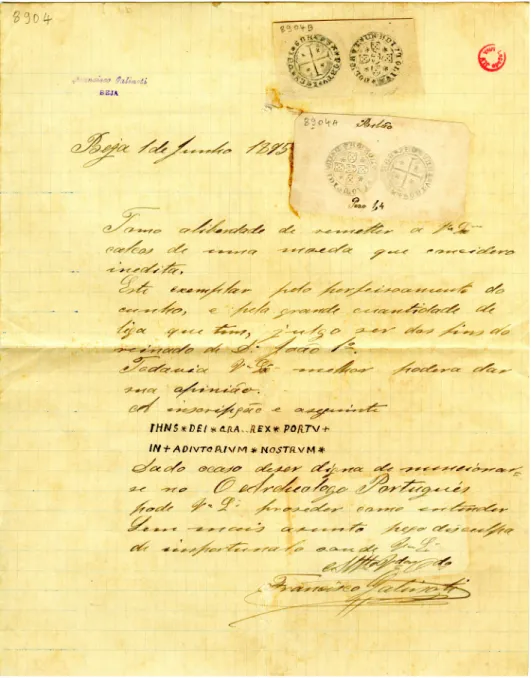
Vasconcelos was also in contact with many collectors who lived in southern Portugal. Francisco Galinoti, who lived in the city of Beja, was a local information provider (see for example his letter in Figure 6), as was Francisco Ignacio Mira. In 1895, the second year
Figure 5.Gravestone acquired by Alberto da Fonseca Oliveira for the Portuguese Ethnological Museum in 1927. Museu Nacional de Arqueologia, E 6957. Photo Courtesy: Museu Nacional de Arqueologia. DGPC/MNA– Paulo Alves.
of the museum’s existence, Mira received a visit from Vasconcelos in Beja, invited him to examine the objects in his collection and received a request to publish a descriptive note on it in O Archeologo Português. The two remained in contact until 1908, during which time Mira collaborated with Vasconcelos, sending a range of information to the Lisbon museum and contacting several localfigures in order to obtain information about archae-ological objects that Vasconcelos wanted either to learn about or incorporate into the
Figure 6.Letter and decals of an unissued coin: documents sent by Francisco Galinoti to José Leite de Vasconcelos on 1st June 1895. Museu Nacional de Arqueologia Library, Lisbon, Portugal, CoR JLV 1383/ 8904 AB. Photo Courtesy: Museu Nacional de Arqueologia.
museum collection.46 Not far from Beja, in the town of Serpa, Vasconcelos met another private collector, doctor José de la Feria y Ramos (1833–1896) in 1889, who had a collection of coins and other antiques as such as‘polished stone tools found in the local area; a bronze statuette of Cupid… , and a fragment of Roman lead piping.’ At the National Archaeological Museum there are several objects donated by La Feria y Ramos, among which a Roman altar dedicated to Mercury, an object that Vasconcelos later wrote about in O Archeologo Portu-guês,47and incorporated in his study Religiões da Lusitânia (Figure 7).48
Figure 7.This Roman altar was donated to José Leite de Vasconcelos by collector José de la Feria y Ramos in 1889; Museu Nacional de Arqueologia, Lisbon, Portugal, n. 18709. Photo Courtesy: Museu Nacional de Arqueologia. DGPC/ADF. José Pessoa.
Landowners all over Portugal also co-operated in the construction of knowledge deriv-ing from the archaeological objects discovered on their property or in the local area. The case of landowner António Paes da Silva Marques (1876–1950) provides a further example of the way in which information and knowledge were disseminated and objects were exchanged or changed hands, showing how peripheral areas and localfigures were cultu-rally isolated only in relative terms. The example highlights the existence of global com-munication networks linked to local contexts andfigures, and thus highlights the need, as already mentioned, for reassessing the supposed dominant role of a restricted number of actors at the national level in this process.49At the same time, it demonstrates, as Irina Podgorny pointed out, that the emergence of museums at the end of the nine-teenth century does not mean the end of the private collections and small cabinets, whose owners continued to collect objects.50
In order to achieve the main aim of this article, some historical details are required regarding this local landowner, who is described by Vasconcelos as an ‘illustrious person’ who loved the history of the local region, afforded him ‘courteous treatment’, and demonstrated a‘profound literary and cultural sensibility’, while possessing ‘a good library, containing many general works of ethnography (a science he is particularly fond of), encyclopaedias, and illustrative works.’51Born in Ervedal, António Paes obtained
his high school diploma in 1895, studied at the Escola Politécnica do Porto and the Escola Politécnica de Lisboa– Porto and Lisbon Polytechnic Schools – and served as the Admin-istrator of the municipality of Avis in 1901, 1904 and 1906. Like other landowners, infor-mation providers and collectors, Paes had an up-to-date library featuring the latest specialised literature published at home and abroad, which he purchased either in Portu-gal, on his travels abroad, or by placing orders with bookshops in Paris, for example.52In António Paes’ library there were works such as: L’Origine du Culte des Morts by Paul Mor-tillet; the first volume of Archeologie, by Joseph Déchelette; Révue Archeologique; and Révue d’Anthropologie; Manuel des Recherches Prehistoriques; as well as specialist period-ical publications such as L’Anthropologie, Revue Anthropologique, and L’Homme prehistorique.53
When he first met Vasconcelos in 1912, Paes was managing an olive oil mill and a number of farm estates. He was a correspondent for national newspapers such as Diário de Notícias and O Século, and the visit by the museum director and also professor at the Faculdade de Letras de Lisboa– the University of Lisbon Faculty of Letters54– to his local region was duly reported in O Século, under the title ‘Descoberta Arqueológica [Archaeological Discovery]; Ervedal do Alentejo (Avis).’55
As a connoisseur of the local territory who enjoyed privileged access to unique objects, Paes’ collaboration was of crucial importance for science: it was reported that ‘on an excur-sion that Dr. Leite de Vasconcelos embarked recently to the Alentejo at the invitation of Mr. António Paes… , many objects were collected that added to the value and prestige of the Museum… , among them a marble altar dedicated to the Lusitanian-Roman god Fon-tanus, and a piece of stone (fibrolite) which provides clues as to one of the methods employed by prehistoric man in the manufacture of tools: Dr. Leite de Vasconcelos says that, at least in the sphere of Portuguese archaeology, he knows of nothing quite like this object, which demonstrates its great scientific value.’56 The second object may be
seen inFigure 8. Vasconcelos planned to present a paper at the International Archaeology Congress57 to be held in Rome two months later in October 1912, and made several
moulds of the object from Ervedal for the purpose, taking them with him to the meeting.58 On his way to Rome, he exhibited the moulds in Toulouse, France, jointly with Émile Car-tailhac, author of Les Ages Prehistoriques d’Espagne et du Portugal (1886), director of the Saint-Raymond Museum, who supported the former’s theory as to the use of the piece in the fashioning of Neolithic tools. During the congress, Vasconcelos gave moulds of the object to the representatives of several European museums: those of Rome and Copenha-gen for example, and published his thesis in a paper entitled‘D’une manière de fabriquer les haches néolithiques’.59
His interpretation was called into question by Luigi Pigorini (1842–1925), director and founder of the Museo Nazionale Preistorico Etnografico de Roma (Rome Ethnographic Prehistoric Museum), but supported by others such as the director of the Copenhagen Museum, Valdemar Schmidt (1836–1925), the former presi-dent of the French Prehistoric Society, Leon Coutil (1856–1943), and the director of the Grenoble Museum, Hippolyte Müller (1865–1933).60
Reconstituting the path of this object, we acknowledge that it wasfirst identified in the possession of Mariana Queiroga Paes,61a member of António Paes’ family, in a small Por-tuguese town, and later it became part of the collection of the PorPor-tuguese Ethnological Museum, where it was endowed with the status of a scientific object, particularly through the production of moulds; then it was presented at an international congress and the moulds were displayed at a number of European museums. The life path it fol-lowed shows how the archaeological practices and knowledge of individuals who are unknown to historians, such as Antonio Paes, play an important role in setting in motion the process of knowledge production and the dissemination of knowledge at the international level. Indeed, Antonio Paes’ interest in archaeology and the invitation he subsequently extended to the director of the national museum to visit the municipality of Avis and scientifically examine several objects that he had previously identified even-tually led to the dissemination of an explanatory theory on how Neolithic objects were manufactured.
Paes, like other local landowners, welcomed the Lisbon museum director into his home for the duration of his twelve-day visit to the Alentejo region, provided logistical support for travel, research and excavation, and used his influence at the local level to facilitate the Figure 8.Fibrolite object founded in Ervedal (southern Portugal); at the request of António Paes, the owner of this object donated it to the Lisbon museum in 1912. This image, based on a photograph taken by Joaquim Fontes, was published in 1913 in O Archeologo Português (1913, p. 58). Document in public domain.
conduct of research, as well as donating a number of archaeological and ethnological objects to the Lisbon museum (seeFigure 9). At the same time, Vasconcelos endeavoured to publicly extol the names of Paes and his family members and acquaintances, while also mentioning the objects they had donated, and their interest in science and the advance-ment of knowledge:‘We are sincerely grateful to all those who have shown me such kind-ness during my stay and enabled me to achieve so much. Not only have many of the Figure 9.At the request of António Paes, the owner of this object donated it to the Lisbon museum in 1912. It is currently on display as part of the exhibition entitled Religiões da Lusitânia: Loquuntur saxa; Museu Nacional de Arqueologia, Lisbon, Portugal, n. E 6356. Photo Courtesy: Museu Nacional de Arqueologia. DGPC/ADF. José Pessoa.
Museum’s sections received a boost (for example, Ethnography, Prehistoric and Roman Archaeology, Numismatics), but a valuable contribution has also been made to the advancement of science’.62
The publication of congratulatory articles, not only in institutional reviews but also in general interest publications, was the strategy employed by the Ethnological Museum direc-tor to strengthen ties with these individuals who had scientific knowledge and influence at the local level. He kept up regular correspondence with them, and the public manifestation of his appreciation of their donations and generosity conferred prestige and recognition on them at the national and local level and ensured the growth of museum collections in the capital by means of the incorporation of regional collections. Vasconcelos worked together with these local actors to achieve his aims and ambitions. It was essential that the museum should provide recognition for local contexts– individuals’ small towns and villages – on the national and international stage. While localfigures such as António Paes received recog-nition of their interest in science, ordinary people in the regions and the local authorities in most cases assumed that their historical‘treasures’ being sent to Lisbon would lead to an increase in the prestige of the local region in question, whose importance and singular characteristics would be highlighted by the national museum.
The examples presented in this paper show how there was a‘collective wisdom’ associ-ated with museum collections.63 They were built on the basis of the combination of an extremely wide-ranging network of knowledge based on local people’s knowledge of the region and networks of influence and power at the local level.64 They thus involved the
participation of individuals practicing in a range of professions from a wide variety of types of academic background, who contributed to the process of the discovery and identification of objects and structures. We suggest that museum historians should con-sider the complexity of the legacies these institutions are endowed with and strive to understand and reflect on the multiplicity of traditions of scientific practice. The global knowledge that derives from museum collections is based on a vast fund of local knowledge.
4. Conclusion
Many of the archaeological objects currently housed in the National Archaeological Museum of Portugal found their way there because of the actions and knowledge of local figures, who were for the most part invisible in contemporary works dealing with museums, their history and their collections. In some cases, these actors were culturally informed, had an excellent knowledge of the local region, and were involved in farming and other activities associated with country life. For example, many property-owners col-lected objects, preserved them, disseminated information about them and donated the objects that they found on their estates to museums. Some local actors, such as doctors and priests, who built up private archaeological collections or collaborated in building public collections were engaged in professions involving frequent contact with ordinary local people. Their socio-economic and cultural status meant that they enjoyed the respect and trust of rural workers and landowners; by questioning the people they came into contact with and requesting information from them, these actors were able to locate antique objects and built structures in the field that were of value to collectors and those interested in antiquities. Rural workers and some property-owners became
increasingly cooperative with collectors when they realised that their knowledge was valued and they were sometimes rewarded for theirfinds or the information they pro-vided, with enhanced status orfinancial compensation.
The construction of historical knowledge was organised on the basis of information provided in written sources, the analysis of objects collected, and archaeological sites sur-veyed in places scattered all over the country; and technical documents in handwritten or printed form that circulated among the various stakeholders that were members of net-works at the local, regional, national and international level. Drawings and photographs, and also maps, of archaeological sites were shared and exchanged by network members, and sent to museums and other collectors, who recognised their singular features or drew parallels with items they possessed or knew about through visiting museological institutions or consulting paper museums.
Knowledge circulated multi-directionally. José Leite de Vasconcelos in Lisbon, received from places all over the country information about the appearance of antique objects and architectural remains, documentation about these objects and places– photographs, draw-ings, decals and maps – and collections of archaeological materials. The museum also shared information with collectors at home and abroad regarding the objects it received from all over the country, and produced documentation about them.
Knowledge and archaeological practices were disseminated by local and national news-papers and the exchange of correspondence by members of social and intellectual net-works who shared a common interest. Collectors allowed the members of their networks and other interested parties, based both at home and abroad, to find out about the objects in their private collections and disseminate information about them. They were photographed and drawn, and decals were produced and plaster moulds made, which were circulated among collectors at international science meetings, and were included in the comparative sections of the most important museums in the West. The private collections focused on in this paper highlight the knowledge of people with a range of professional backgrounds who drew on the resources at their disposal in the field in which they received academic training to record and preserve objects that could otherwise have been lost or destroyed. Collectors’ keenness for scientific learning led them to build up collections of items which often spanned a number of scientific fields.
At a time when there were very few actors who devoted their efforts full time to archae-ology and when the term amateur was meant to designate one who loves a given pursuit and had not yet taken on the pejorative meaning it later acquired with the emergence of the pro-fessional scientist in variousfields, to assign importance to such practices is to identify pro-cesses of the emergence and development of scientific culture. Adding such an approach to the array of scientific research methodologies enriches historiographical narratives and enables new and innovative museological approaches to the study of historical collections housed at museums to be adopted. Archaeological objects provide the basis for and illustrate the history of the territory, while they also document the‘collective wisdom’ of the individ-uals who collected, appreciated, sold, studied them, and built museums.
Notes
1. Carlos Fabião,‘Leite de Vasconcelos (1858–1941): um archeólogo português’, O Arqueólogo Português, 26 (2008), 100.
2. The archive of the National Archaeological Museum holds about 25,000 letters. These letters, received from more than 3000 individuals (3757, to be exact), are preserved in the archives of the National Museum together with photographs, maps, drawings and decals.
3. The present study constitutes a synthesis of the doctoral thesis defended by Elisabete J. Santos Pereira at the University of Évora in 2017 entitled:‘Actores, colecções e objectos: coleccio-nismo arqueológico e redes de circulação do conhecimento – Portugal, 1850-1930’ (Actors, collections and collectors’ items: archaeological collections and networks for the dis-semination of knowledge– Portugal, 1850–1930).
4. Evidence of this trend towards institutionalisation is associated with the prehistory research carried out by the Geological Commission of the Kingdom (in the 1850s), the government archaeological survey in the Algarve region (1877), and the founding of the Archaeological Museum of the Algarve (1880) in the year that Portugal hosted the 9th International Con-gress of Anthropology and Prehistoric Archaeology.
5. José Leite de Vasconcelos, Historia do Museu Etnologico Português (1893–1914) (Lisboa: Imprensa Nacional, 1915).
6. João L. Saavedra Machado,‘Subsídios para a História do Museu Etnológico Português Dr. José Leite de Vasconcelos’, O Arqueólogo Português, 5 (1964), 225.
7. Alice Stevenson, Scattered Finds: Archaeology, Egyptology and Museum (London, UCL Press, 2019), Mariana Françozo and Maria Patricia Ordoñez,‘Collecting Latin America in the Nine-teenth Century’, Museum History Journal, 12.1 (2019), 1–6. Miruna Achim, From Idols to Antiquity. Forging The National Museum of Mexico (University of Nebraska Press, 2017); Stefanie Gänger, Relics of the Past: The Collecting and Study of Pre-Columbian Antiquities in Peru and Chile, 1837–1911 (Oxford Studies in the History of Archaeology, 2014); Philip Kohl, Irina Podgorny and Stefanie Gänger, ed., Nature and Antiquities: The Making of Archaeology in the Americas (Tucson: The University of Arizona Press, 2014); Miruna Achim and Irina Podgorny, ed., Museos al detalle: colecciones, antigüedades e historia natural (Rosario: Prohistoria Ediciones, 2014); Sarah Byrne, Anne Clarke, Rodney Harrison and Robin Torrence, ed., Unpacking the Collection: Museums, Identity and Agency (Springer: One World Archaeology, 2011); Jim Bennett,‘Museums and the History of Science. Practitioner’s Postscript’. ISIS, 96–4 (2005), 602–609; Irina Podgorny and Maria Margaret Lopes, El desierto en una vitrina. Museos y historia natural (Prohistoria edi-ciones, 2008).
8. This review has continued to be published, with some gaps, up until the present day. All edi-tions of the review are available at http://www.patrimoniocultural.gov.pt/pt/recursos/o-arqueologo-portugues/o-arqueologo-portugues/, organised in five different series. The launch of the second series marked a change of direction in scientific terms, with the publi-cation of in-depth studies, in contrast with the brief news items and articles which character-ised the initial series, published from 1895 to 1938.
9. José Leite de Vasconcelos,‘Palavras Prévias’. O Archeologo Português, 1 (1895), 1–2. 10. Vasconcelos,‘Palavras Prévias’.
11. José Leite de Vasconcelos, ‘Aos coleccionadores portugueses’, O Archeologo Português, 3 (1897), 67–9. Vasconcelos himself would turn to this repository as a resource for the pro-duction of books and articles.
12. Following a period of political stability, beginning in 1851, Portugal’s ambitions in Africa were curtailed following the British Ultimatum in 1890 and the country experienced a severefinancial crisis in 1892. These developments provoked outrage in broad sections of society and aroused patriotic feelings. It is against this background that the Ethnological Museum was founded in 1893.
13. Samuel J. M. M. Alberti,‘Objects and the Museum’, Isis, 96.4 (2005), 559–71.
14. As with the research held at the Pitt Rivers Museum: Chris Gosden and Francis Larson, Knowing Things: Exploring the Collections at the Pitt Rivers Museum 1884-1945 (Oxford Uni-versity Press, 2007).
15. Alice Stevenson, Emma Libonati and John Baines,‘Introduction—Object Habits: Legacies of Fieldwork and the Museum’, Museum History Journal, 10.2 (2017), 113–26.
16. Susan Star and James Griesemer, ‘Institutional Ecology, “Translations” and Boundary Objects: Amateurs and Professionals in Berkeley’s Museum of Vertebrate Zoology, 1907-39’, Social Studies of Science, 19.3 (1989), 387–420.
17. Steven Shapin,‘The Invisible Technician’, American Scientist, 77.6 (1989), 554–63. 18. Brian Taylor, ‘Amateurs, Professionals and the Knowledge of Archaeology’, The British
Journal of Sociology, 46.3 (1995), 499–508.
19. Adrian Desmond,‘Redefining the Axis: “Professionals,” “Amateurs” and the Making of Mid-Victorian Biology, A Progress Report’, Journal of the History of Biology, 34 (2001), 3–50. 20. Samuel J. M. M. Alberti,‘Amateurs and Professionals in One County: Biology and Natural
History in Late Victorian Yorkshire’, Journal of the History of Biology, 34 (2001), 115–47. 21. Morgan Meyer,‘On the Boundaries and Partial Connections Between Amateurs and
Pro-fessionals’, Museum and Society, 6.1 (2008), 38–53.
22. Steven Shapin and Arnold Thackray, ‘Prosopography as a Research Tool in History of Science: The British Scientific Community, 1700-1900’, History of Science, 12 (1974), 1–28. 23. Jürgen Renn,‘From the History of Science to The History of Knowledge – and Back’,
Cen-taurus, 57 (2015), 37–53.
24. Robert E. Kohler, ‘History of Field Science: Trends and Perspectives’, in Knowing Global Environments: New Historical Perspectives on the Field Sciences (Rutgers University Press, 2011), pp. 212–40.
25. Robert E. Kohler,‘Finders, Keepers: Collecting Sciences and Collecting Practice’, History of Science, 45.4 (2007), 428–54.
26. Alan Briskin, Sheryl Erickson, John Ott and Tom Callanan, The Power of Collective Wisdom: And the Trap of Collective Folly (San Francisco: Berrett-Koehler Publishers, 2009).
27. Cf. thefield collectors of the Pitt Rivers Museum: Alison Petch, ‘Collecting Immortality: The field Collectors who contributed to the Pitt Rivers Museum, Oxford’, Journal of Museum Eth-nography, 16 (2004), 127–39. In Portugal, much attention was paid to José Leite de Vascon-celos’ intellectual and scientific career – closely linked to the history of the museum itself – through the holding of various colloquia, publications and other public honors.
28. It should be stressed that the actors whose role is highlighted below constitute a representa-tive sample of individuals who were involved in these archaeological practices, and that they were studied in greater depth as part of the doctoral thesis mentioned in Note 3. In the present article we have attempted to incorporate thefindings of that study by including indi-viduals from all over the country with a range of social and/or professional profiles who col-laborated to a greater or lesser degree with the director of the national museum.
29. José Rafael Rodrigues‘Dolmens ou Antas de Villa Pouca de Aguiar’, O Archeologo Português, 1 (1895), 36–7, 346–52; José Isidro Brenha, ‘Dolmens ou antas no concelho de Vila Pouca de Aguiar (Traz-os-Montes)’, Portugália: Materiais para o estudo do povo português, 1.4 (1903), 691; Elisabete J. Santos Pereira, Colecionismo Arqueológico e Redes de Conhecimento, Actores, colecções e Objectos– Portugal (1850-1930) (Caleidoscópio, Direcção-Geral do Património Cultural, 2018), pp. 139–54.
30. Pedro Augusto Ferreira,‘Archeologia Transmontana’, A Vida Moderna, 22 (1895). 31. Ricardo Severo,‘As necrópoles Dolménicas de Traz-os-Montes’, Portugália: Materiais para o
estudo do povo português, 1.4 (1903), 687–90.
32. José Isidro Brenha, ‘Dolmens ou antas … ’, p. 692; ‘Museu Raphael: abordagem prévia’. Unpublished text by João Ribeiro da Silva, former director of the Museum of Archeology and Numismatics of Vila Real. Kindly provided by the author in 2016.
33. Jorge Barbosa,‘Toponímia da Póvoa de Varzim’, Póvoa de Varzim Boletim Cultural, 13.1 (1974), 118.
34. Ibid.‘Museu Raphael: abordagem prévia’.
35. On Dumbuck comparison see‘Notes of the Month’, The Antiquary: A Magazine Devoted to the Study of the Past (London: Elliot Stock, 1904), Vol. XL, p. 1; on Glozel, see Mendes Corrêa, Glozel e Alvão (Porto: Imprensa Portuguesa, 1926); Salomon Reinach,‘Discoveries at Glozel, Allier’, The Antiquaries Journal, 7.1 (1927), 1–5.
37. Archive of the National Archaeological Museum, Letters sent by José Rafael Rodrigues, 3th Dec. 1896; 2944-20035; 11 Dez. 1896, 2944-20036+AB.
38. Archive of the National Archaeological Museum, Letters sent by José Rafael Rodrigues, 12th Jan. 1897, 2944/20037, 2944/20038.
39. José Leite de Vasconcelos,‘Pela Beira’, O Archeologo Português, 22, p. 327. 40. Vasconcelos,‘Pela Beira’, p. 328.
41. This section was divided into ten sub-sections:‘Food’, ‘House and Home’, ‘Eras and circum-stances of individual and family life’, ‘Different aspects of human development’, ‘Religion and magic (affective life)’, ‘Intellectual life’, ‘Industries and trades’, ‘Social life’, ‘Miscellaneous’ and‘Island Ethnography’; Vasconcelos, Historia do Museu Etnologico Português.
42. Archive of the National Archaeological Museum, Letters sent by Alberto da Fonseca Oliveira, 15th Sept. 1916, 2459 /16611.
43. Archive of the National Archaeological Museum, Letters sent by Alberto da Fonseca Oliveira, 21th Dec. 1926, 2459/24480A.
44. Archive of the National Archaeological Museum, Letters sent by Joaquim José Colaço, 17 [?] 1894, 848/5378.
45. Pereira, Colecionismo Arqueológico… , pp. 41–57.
46. Archive of the National Archaeological Museum, Letters sent by Francisco Ignácio Mira, 16th Dec. 1906, 2182/14685, 14686.
47. José Leite de Vasconcelos,‘Da Lusitânia à Bética’, O Archeologo Português, 5 (1899–1900), 225–49.
48. José Leite de Vasconcelos, Religiões da Lusitânia (Lisboa, Imprensa Nacional, 1913), Vol. III, p. 274.
49. Maria Margaret Lopes and Alda Lúcia Heizer,‘Bonpland, Saint-Hilaire e o Megatherium nas colecções de cartas de Dámaso António Larrañaga (1771-1848)’, in Colecionismo, práticas de campo e representações, ed. by Maria Margaret Lopes and Alda Lúcia Heizer (Campina Grande, EDUEPB, 2011), pp. 11–28.
50. Irina Podgorny, El Argentino Despertar de las Faunas y de las Gentes Prehistóricas: Coleccio-nistas, estudiosos, museos y universidad en la creación del patrimonio paleontológico y arqueo-lógico nacional (1875-1913) (Buenos Aires, Universidad de Buenos Aires/Libros del Rojas, 2002).
51. José Leite de Vasconcelos, Pelo Alentejo: Arqueologia e Etnografia, (Lisboa, O Archeologo Por-tuguês, 1912).
52. Archive of the National Archaeological Museum, Letters sent by António Paes, 1914-1916, 2538/17197.
53. Paul de Mortillet, Origine du culte des morts: les sépultures préhistoriques (Paris: J. Gamber, 1914); Joseph Déchelette, Manuel D’Archéologie Préhistorique Celtique et Gallo-Romaine (Paris: Librairie Alphonse Picard et Fils); Révue Archéologique (Paris: A. Leleux, Libraire-Editeur).
54. In 1913 the Ethnological Museum was attached to the Faculty of Letters of the University of Lisbon (Diário do Governo no. 196, 22 August 1913).
55. As politician, António Paes was aware of the need to value the archaeological discoveries made in his birthplace as a way to develop local self-esteem and promote the local identity. See O Século, 16 Aug. 1912, p. 3.
56. Diário de Notícias, 31 Aug. 1912, p. 1.
57. The history of the holding of International Classical Archaeology Congresses goes back to 1905, when thefirst such congress was held in Athens. Since then, congresses have been held almost without interruption everyfive years in various cities in Europe, the Mediterra-nean region and the USA.
58. José Leite de Vasconcelos,‘D´une manière de fabriquer les haches néolithiques’, O Archeo-logo Português, 18 (1913), 57–9.
59. Vasconcelos, 1913, pp. 57–9.
60. The thesis defended in Rome in 1912 is still validated by contemporary archaeologists, such as João Luís Cardoso, who personally confirmed it.
61. In the sample of individuals whose trajectory and collaborative intervention were studied, the number of women who are recorded as being responsible for the conservation of objects is very small; an example is Mariana Queiroga Paes; in some cases women managed the archae-ological collections of their deceased husbands. As managers of these collections, they feature in the set of documents analysed, mainly as donors or in some cases as vendors of objects or collections to private collectors or the national museum.
62. José Leite de Vasconcelos, Pelo Alentejo: Arqueologia e Etnografia (Lisboa, O Archeologo Por-tuguês, 1912), p. 7.
63. This idea is also being explored in the research project‘Collective Wisdom: Collecting in the Early Modern Academy’ led by Anne Marie Roos of the University of Lincoln.
64. Stevenson et al.,‘Introduction—object habits’, pp. 113–26.
Chris Gosden and Francis Larson, Knowing Things: Exploring the Collections at the Pitt Rivers Museum 1884-1945 (Oxford: Oxford University Press, 2007).
Acknowledgements
We acknowledge the assistance of the staff of the Museu Nacional de Arqueologia, Biblioteca Nacio-nal de Portugal and Fundação Arquivo Paes Teles, for facilitating access to published and archival sources. We are grateful to Michael Lewis for translating this paper from the original in Portuguese.
Disclosure statement
No potential conflict of interest was reported by the author(s). Funding
The authors are pleased to acknowledgefinancial support from Fundação para a Ciência e a Tec-nologia (UID/HIS/04209/2019).
Notes on contributors
Elisabete J. Santos Pereirais a pos-doctoral researcher at the Institute of Contemporary History, Uni-versidade Nova de Lisboa. She concluded her Ph.D. in History and Philosophy of Science, specialty in Museology, at the University of Évora (Portugal) in 2017. Her research focuses in the history of archaeological private collections which is the subject of her recent book granted by DGPC/Caleidos-cópio: Colecionismo Arqueológico e Redes de Conhecimento: Atores, Coleções e Objectos - 1850– 1930 (Archaeological Collections and Knowledge Networks: Actors, Collections and Objects).
Maria Margaret Lopes is an invited researcher at the Post-Graduate Programmes in Information Sciences at University of Brasília, Brazil and in History and Philosophy of Sciences, CEHFCI, Évora Uni-versity, Portugal. Her Ph.D. thesis on History of Science (University of São Paulo) focused on the History of Natural History Museums in Brazil. Professor and researcher with Habilitation at the Insti-tute of Geosciences, University of Campinas (1986–2009), she was the director of the Museum of Astronomy and Related Sciences (MAST/MCTI), Rio de Janeiro from 2011 to 2012. She teaches and researches on History of Sciences, History of collections, museum’s history in Brazil and Latin America.
Maria de Fátima Nunes is a Full Professor of History at the University of Évora; Integrated Researcher in Institute of Contemporary History (IHC) and coordinator of the Science Research Group: CEHFCi of the University of Évora. Develops research and teaching of 1st, 2nd, 3rd Cycles -in History of Culture and History of Scientific Culture, themes grounded in Modernity and Con-temporaneity (XVIII_XXI); has different publications in these areas, having guided several Master and Doctorate theses in these agendas, incorporating a comparative and international view.