Vegetative propagation of the endangered Azorean tree,
Picconia azorica
J
OSÉM
ARTINS,
O.
M
OREIRA,
L.
S
ILVA&
M.
M
OURAMartins, J., O. Moreira, L. Silva & M. Moura 2011. Vegetative propagation of the endangered Azorean tree, Picconia azorica. Arquipelago. Life and Marine Sci-ences 28:39-46.
Picconia azorica (Tutin) Knobl. (Oleaceae), commonly named “pau-branco”, is an
endan-gered tree endemic to the Azores. Vegetative propagation may be important for the preser-vation of this species, particularly in depauperate populations, with low seed set. The ob-jective of this study was to evaluate effective techniques for the vegetative propagation of
P. azorica by rooting of stem cuttings or by air layering. Rooting substrate, IBA
concentra-tion, and the portion of the area of the terminal leaf pair kept on stem cuttings, when tested in early spring (semi-hardwood cuttings) and autumn (hardwood cuttings) failed to produce any rooted cuttings. In contrast, air layering performed in the autumn on lateral branches of adult trees was successful. After 12 months, air layers treated with 5000 ppm of IBA in talc achieved 65% rooting, while those treated with 2500 ppm IBA or without growth regulator only attained 41 and 28% rooting, respectively. Our study indicates that P. azorica is rela-tively easy to propagate by air layering. This method could be used to restore natural popu-lations of P. azorica when seeds are not available or plant competition impairs natural re-generation.
Key words: air layering, endemic plants, Picconia azotica, rooting, stem cuttings, vegeta-tive propagation, Azores islands
José Martins (email: [email protected]), Orlanda Moreira, Luís Silva & Mónica Moura, CIBIO, Research Center in Biodiversity and Genetic Resources, Departamento de Biologia, Universidade dos Açores, Rua Mãe de Deus 58, Apartado 1422, 9501-801 Ponta Delgada, Portugal.
INTRODUCTION
Picconia azorica (Tutin) Knobl. (Oleaceae),
lo-cally named “pau-branco”, is an endangered spe-cies endemic to the Azores Archipelago, where it is found in all the islands except Graciosa (Car-doso et al. 2008; Silva et al. 2009; Silva et al. 2010). From our observations during extensive field work, P. azorica is an evergreen shrub or small tree (Fig. 1A) growing up to 8 m tall, with simple, lanceolate to ovate, opposite leaves with entire margins; it flowers from March to July producing small white flowers in axillary clusters (Fig. 1B); the fleshy fruits are dark blue drupes about 1.5 cm long (Fig. 1C). P. azorica is present in coastal and medium altitude forests, coastal
cliffs, ravines, lava flows, coastal scrubland
(Er-ica, Morella, mixed) and natural forests (Morella, Laurus) (Silva et al. 2009). P. azorica was
his-torically used in the Azores for furniture con-struction and religious statuary. Thus, overexploi-tation of the wood led to the species becoming almost extinct in some islands. It is a priority Azorean endemic species for conservation, listed as endangered (EN B1 + 2c) on the IUCN Red List 2004, and in Annex II of the EC Habitats Directive, namely due to habitat degradation, expansion of agricultural land, forestation, com-petition by alien species and isolation of popula-tions (Silva et al. 2009).
Recovery of P. azorica populations will de-mand active measures to propagate this species,
particularly in those islands were its populations are more depauperate (São Miguel, Faial, Ter-ceira and Corvo) (pers. comm.). Due to the scarceness of some populations and the low availability of seeds, the development of alterna-tive propagation methods is a priority. There is some urgency to develop measures for restoration of depleted natural populations, where invasive species are affecting natural regeneration, and to answer the growing demand of saplings by the nursery industry for application in reforestation projects.
In this context, the use of technically simple and inexpensive vegetative propagation methods such as rooting of cuttings and air layering will be of utmost importance. Air layering allows propa-gation to be performed in situ and is particularly advantageous from a conservation perspective as minimal damage is done to the mother plant if rooting fails, assuming that the area from which bark was peeled and branch tip is not lost. There are several advantages of this method, namely: rooting success is more ensured through layering, including clones which will not root easily; it is relatively simple to perform and with a small number of plants, it can produce a high number of layers with less skill, effort and equipment; larger
plants ready for planting can be produced in faster time. However, some disadvantages also exist: air layering might be laborious and therefore expen-sive; only a small number of layers can be pro-duced from a parent plant than when the same plant is used as source of cuttings; a wider area is needed to grow stock plants to be able to produce a greater number of layers; bigger layers need special care to establish them independently on the potting containers (Hartmann & Kester 1975; Browse 1992).
The synthetic growth regulator, IBA (indole-3-butyric acid), is usually the growth regulator of choice because it is very effective in the root promotion of a large number of plant species, including several Olive cultivars (Toogood 1999; Fabbri et al. 2004). Unlike other synthetic auxins, it is a strong root promoter, light- and temperature stable, resistant to microbial decomposition, and usually not toxic to hardwood and semi-hardwood cuttings over a wide concentration range. The addition of IBA was effective for promoting root-ing of O. europaea cuttroot-ings (Rugini et al. 1990; Wiesman & Lavee 1995; Pio et al. 2005) al-though rooting success varied considerably among different cultivars (Calado 2002; Fabbri et al. 2004).
Fig. 1. Picconia azorica general physiognomy: A) small tree in its natural habitat in July, fruiting period; B) small clusters of white flowers; C) clusters of ripe fruits.
This research aims to test stem cuttings and air layering as feasible and efficient methods for P.
azorica vegetative propagation. The VERONICA
project (Systematics, Population Genetics and Propagation of Vascular Priority Azorean En-demic Plants) allowed us to study the propagation of this species by seed, micropropagation, stem cuttings, and air layering. Positive results were obtained for seed propagation (Martins et al. in prep.), but not for micropropagation due to high contamination rates and high production costs (unpubl. data). In this communication we present new data obtained for propagation by rooting of air layers. Air layering and rooting of stem cut-tings have already been proved effective to propagate other endemic Azorean taxa (Moreira et al. 2009; Moura & Silva 2009), and several tree and shrub taxa (Browse 1992; Stoltz et al. 2005), including other Oleaceae species (Bartolucci & Dhakal 1999; Fabbri et al. 2004).
MATERIAL AND METHODS
PLANT MATERIAL
Plant material was obtained from mature seed-producing individuals, belonging to the single population in São Miguel Island, located at Lombo Gordo, Nordeste (from about 10 up to 200 m a.s.l.). The population was composed of 200 to 300 individuals with a height range of 1.9 to 7 m and a basal circumference of 20-65 cm. This area is covered by a coastal scrubland where P.
azo-rica dominates in certain areas, but is mixed with
other native and invasive woody species includ-ing Morella faya, Erica azorica, Pittosporum
undulatum, Arundo donax, Hedychium gardneri-anum and Phormium tenax.
STEM CUTTINGS
Semihardwood stems (i.e. with visible lignifica-tion at the base) were obtained in March 2008. Stems were surface cleaned with water and a few drops of a mild household detergent, and then cut into 10-15 cm long cuttings with 4-5 nodes each and the apical leaf pair retained (Oliveira et al. 2003; Fabbri et al. 2004). The basal cut was made just under a node. Cuttings were divided in three groups of treatments: i) with leaves pruned to 1/3
of their area, ii) with leaves totally removed and, iii) with leaves intact. All cuttings were immersed for 5 minutes in a 6% (w/v) solution of Benlate in water and allowed to air dry. Cuttings were then basally quick dipped up to 2.5 cm deep in differ-ent water solutions of IBA (as a potassium salt) at 0, 1000, 2000, 3000 and 4000 mgL-1. The cuttings were planted immediately after treatment, 4 cm deep, into one of two rooting media in polysty-rene trays composed of 216 square cells (each cell measured 5 cm square and 12 cm high). Two dif-ferent substrates were tested: a perlite and peat mixture (1:1), and a perlite and soil mixture (1:1). The soil (andosoil), collected at the natural habi-tat, was a clay loam with pumice of volcanic ori-gin and was left untreated to retain the native my-corrhizae. Whenever weeds appeared, they were manually removed. The total number of ments was 30 (two substrate types x 3 leaf treat-ments x 5 IBA concentrations), with three repli-cates per treatment and 30 cuttings per replicate for a total of 2700 stem cuttings (with a total of 90 cuttings per treatment). The experiment took place inside a glass ceiling nursery room with an average temperature of 19ºC, daytime relative humidity of about 70%, and the natural photope-riod occurring at Ponta Delgada between March and May 2008 (Fig. 2). The cuttings were kept moist and weekly sprayed with antifungal solu-tion (200 mgL-1 of Benlate, or 1.5 mL Previcur and 1 mL Derosal per litre). Survival, new leaf emergence, and rooting were evaluated after eight weeks. The same experiment was repeated be-tween September and November 2008 with hard-wood cuttings using three replicates per treatment and 12 cuttings per replicate.
AIR LAYERING
Three branches randomly located within the lower canopy of 30 trees were selected in early October 2008 for air layering (Fig. 3). On each branch, lateral twigs within 25-50 cm of the api-cal bud were removed and a 1-1.5 cm ring of bark was removed at ca. 40 cm from the branch apex (Browse 1992; Toogood 1999; Stoltz & Geneve 2005). The diameter of the branches where air layering was performed ranged from 6 to 10 mm. IBA was firstly diluted in pure alcohol and added to talc powder in order to attain concentrations of 2500 or 5000 ppm. Talc powder without IBA
addition was used as control. Talc powder was applied directly to the stem wounds with a brush. A stem segment with a length of about of 20 cm, basal to and including the layering site was co-vered with moist Sphagnum spp. where excess water had been squeezed out, wrapped in a black polyethylene sheet with about 1200 cm2 (40 x 30 cm), and ends tied with plastic braces. This type of material, maintains a dark, warm and humid
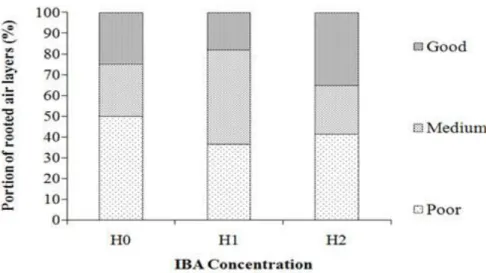
environment, while allowing gas exchange (Browse 1992). Rooting was evaluated after 12 months. Percentage of survival, callus formation and rooting were recorded for each treatment, and the degree of development (considering both root number and length) of the adventitious root sys-tem was visually estimated on a scale of 1 (poor: with few, short roots) to 3 (good: many, long roots).
Fig. 2. Propagation of Picconia azorica by stem cuttings. General appearance of the essays (left); example of new leaf development on some of the cuttings (right).
STATISTICAL ANALYSIS
The effect of IBA concentration on air layer sur-vival, callus formation and rooting was evaluated using contingency table analysis (Chi-Square test), followed by a multiple comparison test for proportions (Zar 1999). Calculations were per-formed using SPSS version 15 and Microsoft Of-fice Excel 2007.
RESULTS
STEM CUTTINGS
Development of new leaves was observed on ap-proximately 40% of the cuttings (Fig. 2). How-ever, no rooting was observed in any of the treat-ments of the experitreat-ments conducted on semi-hardwood cuttings in Spring or semi-hardwood cuttings in Autumn. Also, no callus formation was ob-served on any of the cuttings.
AIR LAYERING
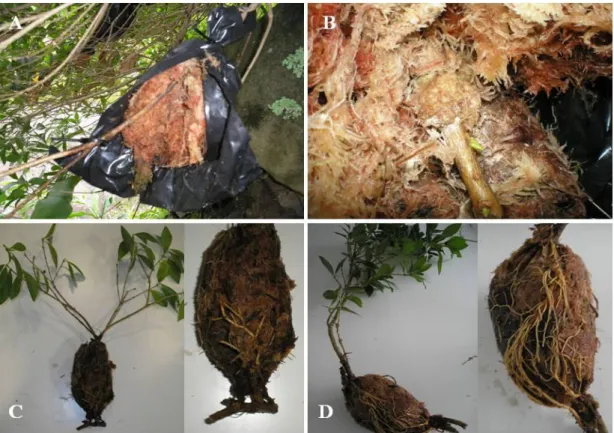
Percentage of air layer survival was not signifi-cantly different (=0.867; P=0.648) among dif-ferent IBA concentrations (Fig. 4), with values ranging from 76 to 81%. Percentage of rooting significantly increased with increasing IBA con-centrations (=7.2; P=0.027). After 12 months, 65% of the air layers treated with 5000 ppm IBA showed root development, a significantly larger proportion than the value of 28%, obtained with-out the addition of IBA (Figs. 4 and 5). An inter-mediate result (41%) was obtained with 2500 ppm IBA (Fig. 5). Visual estimation of the degree of development of the adventitious root system suggested a better development on air layers treated with IBA with the formation of many long roots, when compared with air layers without the addition of IBA (Figs. 3 and 6), although the dif-ferences were not significant (=0.718; P=0.949).
Fig. 3. Propagation of Picconia azorica by air layering: A) general appearance of an open air layer; B) example of callus formation; development of the adventitious root system without (C) and with (D) the addition of IBA.
DISCUSSION
In face of the obtained results, we hypothesise that the lack of rooting observed with P. azorica cuttings was eventually due to inadequate nursery conditions. According to Fabbri et al. (2004), O.
europaea requires heated rooting benches to
maintain temperature of the rooting medium above air temperatures, minimizing precocious bud-bursting. Stoltz et al. (2005) also found it crucial to keep the relative humidity near to 100%, as cuttings cannot take up enough water from the propagating medium to replace water lost through the leaves. Also, Isfendiyaroglu & Özeker (2008) successfully propagated an O.
eu-ropaea cultivar, very difficult to root, by stem
cuttings using heating rooting beds and air mist-ing. However, this might not explain why the cuttings without any leaves, used in the present study, failed to root. Also, another Azorean woody endemic species, Prunus azorica, has been
very successfully propagated by stem cuttings, using the same nursery conditions provided to the species targeted in the present study (Moreira et al. 2009). Furthermore, Picconia azorica is often found in dryer environments (coastal scrubland) than Prunus azorica (mesic to humid laurel for-est), so it was not anticipated that its stem cuttings would be more susceptible to drought than those from Prunus azorica. Other factors might thus explain the observed results. In this sense, it is known that other Oleaceae, namely some culti-vars of O. europaea, are difficult to root even with the appropriate nursery conditions (Matías et al. 1998; Calado 2002; Fabbri et al. 2004).
Regarding air layering, our findings showed that there was a clear beneficial effect of IBA in talc powder on the rooting percentage of P.
azo-rica air-layered branches. Similar findings when
using stem cuttings were obtained for other Oleaceae species (Rugini et al. 1990; Wiesman & Lavee 1995; Pio et al. 2005; Fabbri et al. 2004).
Fig. 4. Percentage of survival of P. azorica air layers after 12 months for three IBA treatments (H0, H1 and H2, respectively 0, 2500 and 5000 ppm in talc). Surviving air layers were further discriminated into three groups: with-out callus or root formation (“Survived”), with callus formation (“Callus”) and with root system developed (“Root”).
Although the use of air layering may be limited by the number of available branches in natural tree populations, it could effectively complement the application of other propagation methods (seed germination) to rapidly augment natural populations (in situ conservation). It could also be used to establish a field of mother plants (ex situ
conservation), by easily replicating a considerable portion of the individuals found in very depau-perate populations, avoiding the loss of local ge-netic diversity associated to the extinction of very small local populations, which are more suscepti-ble to environmental and demographic stochas-ticity.
Fig. 5. Effect of IBA concentration on rooting of P. azorica air layers after 12 months. Different letters indicate significant differences (=0.05; multiple comparison test for proportions applied after contingency table analysis).
Fig. 6. Effect of IBA concentration (H0, H1 and H2, respectively 0, 2500 and 5000 ppm in talc powder) on root development of P. azorica air layers after 12 months.
CONCLUDING REMARKS
In summary, P. azorica can be efficiently propa-gated in situ by conventional air layering during autumn, with the addition of 5000 ppm of IBA. Rooting can also be achieved without IBA but at lower percentages. Our study indicates that P.
azorica is a taxon amenable for vegetative
propa-gation by air layering and that this technique can be used to propagate trees in natural populations when seeds are not readily available. In the fu-ture, more research is needed using heated rooting beds under mist to possibly find effective ways of propagating P. azorica by stem cuttings.
ACKNOWLEDGEMENTS
The present study was part of the Project VE-RONICA, funded by Direcção Regional para a Ciência, Tecnologia e Comunicações, Azores. The manuscript was largely improved with sug-gestions from an anonymous reviewer.
REFERENCES
Bartolucci, P. & B.R. Dhakal 1999. Prospects for olive
growing in Nepal. Department of Agriculture, Fruit
Development Division Olive Production Development Project, TCP/NEP/6713 & Food and Agriculture Organization of the United Nations, 62 pp.
Browse, P.M. 1992. Plant propagation. 2nd ed. Mitchell Beazley Publishers Ltd. 192 pp.
Calado, M. 2002. Alternativa para cultivares de difícil enraizamento. Melhoramento 38: 193-204. [in Portuguese]
Cardoso, P., P.A.V. Borges, A.C. Costa, R.T. Cunha, R. Gabriel, A.F. Martins, L. Silva & 5 others. 2008. A perspectiva arquipelágica: Açores. Pp. 421-449 in: Martín, J.L., M.J. Arechavaleta, P.A.V. Borges & B. Faria (Eds). Top 100. Las cien especies
amenazadas prioritarias de gestión en la región europea biogeográfica de la Macaronesia.
Consejeria de Medio Ambiente y Ordenación Territorial, Gobierno de Canárias. [in Portuguese]. Dirr, M.A. & C.W. Heuser 1989. The reference manual
of woody plant propagation. Varsity Press, 239 pp.
Fabbri, A., G. Bartolini, M. Lambardi & S.G. Kailis 2004. Olive Propagation Manual. Landlinks Press, Collingwood. 141 pp.
Fagundo, M.C.A. & A.M. Isidoro 2004. Propagação
das espécies lenhosas endémicas dos Açores.
Direcção Regional dos Recursos Florestais, Nordeste. 47 pp. [in Portuguese]
Hartmann, H.T. & D.E. Kester 1975. Plant
Propagation: Principles and Practices. 3rd ed.
Englewood Cliffs, N.J., USA: Prentice Hall, Inc. pp. 455-476.
İsfendiyaroğlu, M. & E. Özeker 2008. Rooting of Olea
europaea „Domat‟ Cuttings by Auxin and Salicylic
Acid Treatments. Pakistan Journal of Botany 40(3): 1135-1141.
Martins, J., Moreira, O., Silva, L. & Moura, M. (in prep.). Seed germination of the Azorean endemic tree Picconia azorica.
Matías, C., A.A. Iriarte, A.G. González, G. Lessino & V.O. García 1998. Propagación de árboles selectos de olivo (Olea europea L.) con utilización racional
de energía. Producción y Agro Industrias, Congreso Regional de Ciencia y Tecnología. Universidad Nacional de Catamarca, 9 pp. [in Spanish]
Moreira, O., J. Martins, L. Silva & M. Moura 2009. Propagation of the endangered Azorean cherry
Prunus azorica using stem cuttings and air
layering. Arquipélago. Life and Marine Sciences 26: 09-14.
Moura, M. & L. Silva 2009. Vegetative propagation of the Azorean endemic shrub Viburnum treleasei Gand. Arquipélago. Life and Marine Sciences 26: 01-07.
Oliveira, A.F., M. Pasqual, N.N.J. Chalfun, M.A. Regina & C.R. Rincón 2003. Influência do número de nós em estacas semilenhosas de Oliveira (Olea
europaea L.) no enraizamento sob câmara de
nebulização. Ciênc. agrotec., Lavras 27 (2): 332-338. [in Portuguese]
Pio, R., D. Bastos, A. Berti, J. Filho, F. Filho, F. Entelmann, A. Alves & J. Neto 2005. Enraizamento de diferentes tipos de estacas de oliveira (Olea europaea L.) utilizando ácido indolbutírico. Ciência Agrotecnológica 29 (3): 562-567. [in Portuguese]
Rugini, E., V. Politi, C. Bignami, M. de Agazio & S. Grégo 1990. Effect of polyamine treatments on rooting cuttings of three olive cultivars. Acta
Horticulturae 286: 97-100.
Schäfer, H. 2005. Endemic vascular plants of the Azores: an updated list. Hoppea 66: 275-283. Silva, L., M. Martins, M. Moura & G.B. Maciel 2009.
Azorean vascular flora: priorities in conservation.
CCPA & Amigos dos Açores. 122 pp.
Silva, L., M. Moura, H. Schaefer, F. Rumsey & E.F. Dias 2010. List of Vascular Plants (Tracheobionta). Pp 117-163 in: Borges, P.A.V., A. Costa, R. Cunha, R. Gabriel, V. Gonçalves, A.F. Martins, I. Melo, M. Parente, P. Raposeiro, P. Rodrigues, R.S. Santos, L. Silva, P. Vieira & V. Vieira (eds.). A list
of the terrestrial and marine biota from the Azores.
Princípia, Cascais. 432 pp.
Stoltz, L.P., L. Mary & R. Geneve 2005. Propagating
plants in and around the home. HO-67. College of
Agriculture, University of Kentucky.
Toogood, A. 1999. Plant Propagation. American Horticultural Society. DK Publishing: New York. 320 pp.
Wiesman, Z. & S. Lavee 1995. Enhancement of IBA stimulatory effect on rooting of olive cultivar stem cuttings. Scientia Horticulturae 62 (3): 189-198. Zar, J.H. 1999. Biostatistical analysis. Fourth edition.
Prentice Hall, New Jersey.Barlow