© 2016 IBRACON © 2016 IBRACON
Evaluating the applicability of rheometry in steel iber
reinforced self-compacting concretes
Avaliação da aplicabilidade de reometria para concretos
autoadensáveis com ibra de aço
Abstract
Resumo
The use of self-compacting concrete in civil construction industry presents various advantages, since the material shows adequate workability during fresh state. When iber reinforcement is used, there are changes in its behavior that require attention. This study aimed to evaluate the applicability of rheological tests and the correlation between its results and those obtained with regular tests used to control SCCs. In that sense, diferent mixtures of SCC with diferent steel iber contents were produced in order to be analyzed in the experimental program described. Rotational rheology tests and slump low and L-box tests were performed. The results showed that slump low test did not present good correlations with rheological parameters. On the other hand, this test was able to point out the risk of segregation of the mixtures with higher iber contents. A good correlation was obtained between the L-box test results and rheological parameters. The L-box was also able to show loss in the passing ability of SCC related to the rise of plastic viscosity and yield stress. These tests also presented a good correlation with the rheological parameters when lower iber contents were used. Although the rheometry test was unable to evaluate these problems, this kind of test gave more objective and reliable data on variations in rheological parameters related to the increase of iber content, and proved to be a more reliable test to this kind of application, especially when applied together with the conventional tests.
Keywords: self-compacting concrete, steel ibers, l box, slump low, rheology.
O uso de concreto autoadensável na construção civil apresenta várias vantagens, desde que o material apresente trabalhabilidade adequada no estado fresco. Quando é utilizado o reforço com ibras, há alterações nas propriedades no estado fresco, que nem sempre são detectadas com a utilização de ensaios convencionais normalizados. Este estudo buscou avaliar o potencial de aplicação de ensaios reológicos e a relação com os ensaios comumente utilizados para aceitação de CAAs. Com essa inalidade, foram elaboradas misturas de CAA com ibras de aço em diferentes teores e realizaram-se ensaios de reometria rotacional, espalhamento e Caixa L. Os resultados mostraram que o ensaio de espalhamento não apresentou boa correlação com os parâmetros reológicos medidos, mas permitiu detectar o risco de segregação dos concretos com maior teor de ibras. O ensaio de caixa L obteve boa correlação com os valores obtidos no reômetro, demonstrando perda na habilidade passante em função do aumento da viscosidade plástica e tensão de escoamento, especialmente para baixos teores de ibras, mas apresentou bloqueio entre barras para grandes quantidades de ibras. O ensaio de reometria forneceu dados mais objetivos sobre variação nos parâmetros reológicos, apontando um comportamento pseudoplástico do concreto utilizado no trabalho. Ficou claro o aumento da viscosidade com o aumento do teor de ibras como uso da reometria, fornecendo informações coniáveis mesmo para maiores teores de ibras. Isto comprova que a reometria é um ensaio bastante adequado para este tipo de aplicação.
Palavras-chave: concreto autoadensável, ibras de aço, caixa l, espalhamento, reologia.
a Universidade de São Paulo, Departamento de Engenharia Civil, Escola Politécnica, São Paulo, SP, Brasil. Received: 10 Oct 2014 • Accepted: 03 Mar 2016 • Available Online: 21 Nov 2016
R. S. ALFERES FILHO a
F. K. MOTEZUKI a
R. C. O. ROMANO a
R. G. PILEGGI a
A. D. FIGUEIREDO a
1. Introduction
The use of self-compacting concrete (SCC) brings important changes to the concrete casting process, by changing its behavior in fresh state. Since SCC does not require the use of vibration, the casting process became easier even when there is dense rein-forcement or more complexes geometries [1].
Aydin [2] indicates that SCC increases the eiciency of iber reinforce-ment usage because it makes possible the usage of a higher iber volume in fresh concrete maintaining its workability through luidity improvement. This is a great advantage when a higher post-cracking strength is required for iber reinforced concrete (FRC), which could as-sure a reduction in steel bars or even their total replacement in some uses [3]. However, there are doubts about the ability of SCC to keep its workability conditions constant when iber content increases because the iber could change the consistency of cementitious materials [4, 5]. The inluence of iber in the cement paste has been studied by Martinie et al [5] who concluded that the increase in iber volume
leads to an increase in yield stress in pastes. The authors airm that the results can be extrapolated to situations involving concrete
and mortars. However, it is worth noting that ibers with distinct geometries afect the concrete in diferent ways. Previous study [6] demonstrates that, the higher the iber aspect ratio is, the higher is its impact in the workability of regular concrete.
Tests like L Box, Slump Flow and V Funnel are commonly used to assess this kind of suspension due to their easier use, although they only provide a single point result information about the fresh state characteristics of the concrete. Furthermore, the results obtained are not expressed in terms of physical parameters [7, 8], and there are previous studies that had pointed out that these tests are not ap-propriated to iber reinforced concrete [4]. On the other hand, there are other studies that have used these tests as a base for the analy-sis of iber reinforced self-compacting concrete (FRSCC) [4, 9-13]. The use of rotational rheometry permits to evaluate the character-istics of FRSCC in diferent shear stress conditions. That condition brings to the rheometer a higher capacity of evaluation, enabling its usage as physical criteria to comprehend the results obtained by the single point tests [14]. Thus, this experimental work was car-ried out aiming to evaluate the applicability of planetary rotational rheometry to evaluate the workability of steel iber reinforced
self-Figure 1 – Flowchart of the steps of the experimental study
971
IBRACON Structures and Materials Journal • 2016 • vol. 9 • nº 6
compacting concrete and correlate its results with those obtained by the conventional tests applied to SCC.
2. Experimental programme
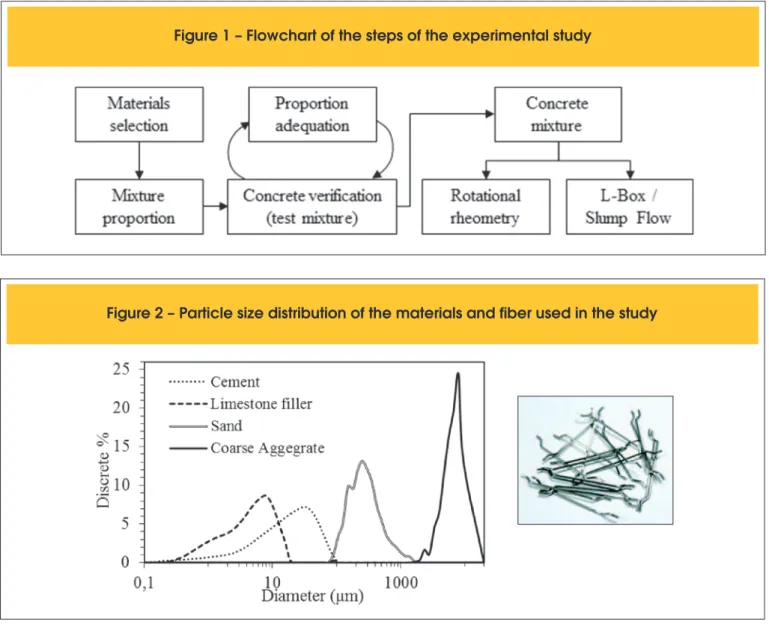
In order to achieve the objectives of this study, one type of steel iber was selected and its consumption was varied. This allowed the study to make clear the inluence of iber content in the rheo-logical behavior of the concrete. The maximum iber content used was 120 kg/m³. This research was then developed according to the scheme presented in Figure 1
The diferent mixtures produced for this study were made in a con-ventional mixer as detailed below. After mixing, the mixtures were submitted to conventional and rheological tests simultaneously. The simultaneous execution of the tests was adopted to ensure that the fresh concrete properties would not be inluenced by the loss of the efect of superplasticizer or cement early hydration. These tests are detailed in item 3.
2.1 Materials
The self-compacting concretes were made with crushed granite stone, sand, Portland Cement (Brazilian type CP II F 32, Votoran) and limestone iller (Proine 1, Provale) with particle size distribu-tion determined by dynamic image analysis in a Qicpic equipment (Sympatec) as shown in Figure 2.
Hooked ends steel ibers with 30 mm of length and aspect ratio of 47.6 (Figure 2) were used. Short ibers were used according to the traditional empirical recommendation for minimum iber length, which must be greater or equal to twice the maximum diameter of the coarse aggregate (Liber ≥ 2фmax of coarse aggregate), which was 9.5mm in this study. This recommendation aimed to make more eicient the post-crack strengthening of FRC [15].
A sodium polycarboylate based high performance superplasticizer (Grace ADVA 585) was used in all mixtures in a constant content by cement weight. This admixture is usually applied to ine par-ticles stabilization and as a mixing water reducer.
2.2 Concrete composition
The base of the composition of the concrete used in this study is shown in Table 1, and it was developed considering formulations available in the literature for the same type of concrete and with similar iber content [13, 16]. Therefore, no conventional mix de-sign method was used in this study.
Table 1 presents the speciic surface area (SSA) and the density of each raw material used is presented. The SSA was quantiied in a Belsorp Max equipment (Bel Japan) and the density of each material was determined in a He gas pycnometer (Quantachrome MVP 5DC).
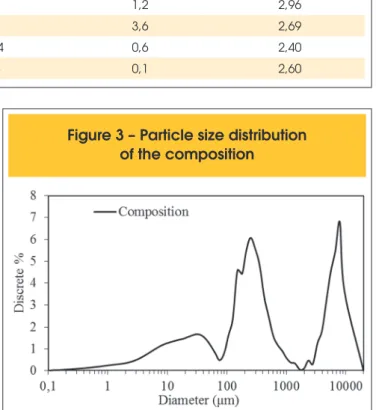
The resultant particle size distribution is show in Figure 3 and the water/cement ratio was 0.4, kept constant in all mixtures.
Table 2 provides the iber content values in terms of kilograms per cubic meter of concrete and by volume fraction used in the experiment. The values were chosen aiming to reach a range that
Table 1 – Material proportion of the designed concrete
Material Mixture proportion by cement weigth
Consumption (kg/m³)
SSA (m²/g)
Density (g/cm³)
Cement 1,0 522 1,2 2,96
Limestone filler 0,12 63 3,6 2,69
Sand 2,0 1044 0,6 2,40
Coarse aggregate 1,2 626 0,1 2,60
Figure 3 – Particle size distribution
of the composition
Table 2 – Fiber consumption in concrete mixtures
Mixture 1 2 3 4
Fiber content (kg/m³) 0 20 80 120
makes clearer the inluence of iber in the rheological behavior of FRSCC.
2.3 Concrete mixing process
The concrete mixing process was made in conventional concrete mixer with inclined axis, and a total capacity of 120 l. The mixing procedure adopted was the same for all mixtures to avoid any inlu-ence of intervening variables originated in this stage. The mixing
procedure followed the sequence below: 1. Moistening the mixer;
2. Coarse aggregate introduction;
3. Introduction of 50% of the water and the mixer was turned on for 1 minute;
4. Introduction of the ine aggregate and mixing for 1 minute; 5. Introduction of cement and iller, and mixing for 1 minute; 6. The remaining water and admixture was added;
7. The ibers were added gradually during the next 5 minutes of continuous mixing in order to avoid the formation of clumps. After the mixing was complete, samples were taken to be tested in L-box, Slump Flow and rotational rheometry tests, which were done at the same time, as described in item 2.
3. Test methods
3.1 L-Box
The L-Box test aims to assess the passing ability of self-com-pacting concrete, which is the capacity of lowing through narrow spaces between steel bars and maintaining homogeneity and the capacity of illing up the formwork without showing phase separa-tion or material blocking [17]. The three steel rebars with a diam-eter of 12 mm were kept in the tests with the intention of evaluating a particular condition of workability for hybrid reinforcement, that is the passing ability of FRSCC. This alternative reinforcement has been used in various applications [18-20] with the aim of optimizing the mechanical behavior of structural elements.
In the conduction of the L-Box test, the prismatic column was illed with FRSCC and, after 60 seconds, the loodgate was opened to start the concrete low. The clear side of the L-Box allows observ-ing the concrete lowobserv-ing as illustrated in Figure 4.
The result of this test is given by a relationship between the heights
Figure 4 – L-Box during the test
973
IBRACON Structures and Materials Journal • 2016 • vol. 9 • nº 6
of the concrete layer on both edges of the horizontal prism. The passing ability of the concrete is more eicient if the ratio value is closer to one. Values considered acceptable for self-compacting concrete should be in the range from 0.8 to 1 [17].
3.2 Slump low
The Slump Flow test has similarities with the Abrams slump test. This test is used to assess the concrete lowing capacity in uncon-ined situations under the action of their own weight [21].
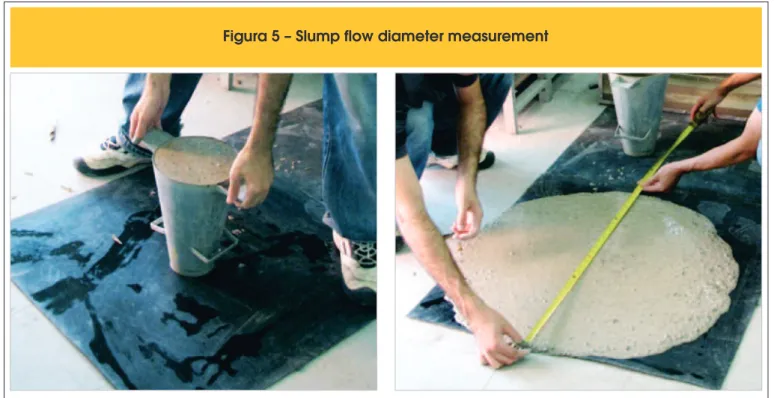
For this study, the cone was illed in the inverted position with the intention of making the initial low oriented and more restrictive. Al-though this difers from the position suggested by certain technical standards, there is an indication that there is little inluence related to the direction of the cone [22]. So, this set up was chosen in order to provide the most critical assessment condition for FRSCC. Two diameters measures are made in two mutually perpendicular axis after the remotion of the cone and spreading of the concrete, as shown in Figure [5]. There is no consensus in the technical litera-ture about the spreading limits. For this work, the values used as reference were taken from EFNARC [17], ranging 650-800 mm, similar to those adopted by Akcay and Tasdemir [23].
Although the Slump Test result is expressed only by the measured diameters, this method allows to visual assessment of segregation occurrence or water bleeding. However, this is a qualitative indica-tor and therefore not measurable as acceptance criteria [17], but it can help in assessing the suitability of the mixtures used.
3.3 Rotational rheometry
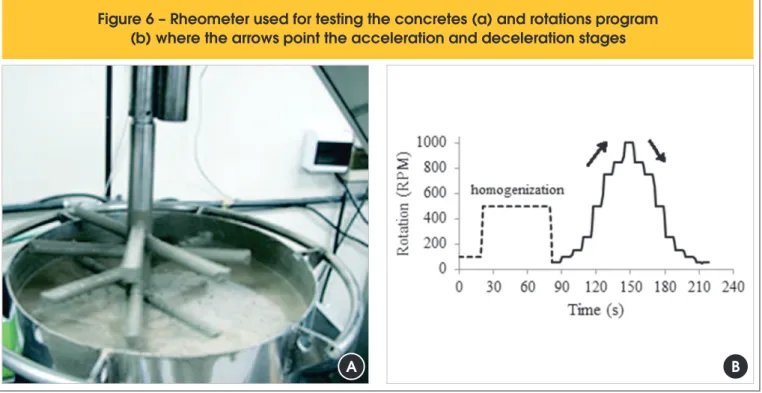
A planetarium rheometer built at Polytechnic School of University of São Paulo was used in the tests as shown in Figure 6a. The test consists in inducing shearing in a volume of approximately 18
liters of concrete inside a metal recipient with shearing elements adapted for testing the concrete. These shearing elements were especially designed aiming to decrease segregation.
The material was homogenized during the irst 80 seconds of the test in order to prevent materials segregation. That procedure was adopted since the mixing was done in the mixer and the concrete had to be subsequently moved into the equipment. Then a shear cycle was applied, varying the rotation speed from 50 to 1000 rpm and returning at 50 rpm. The speed was maintained for 7 seconds at each level, as illustrated in Figure 6b.
The results were compiled in a graph (for details see Fig 9) show-ing rotation versus the applied torque. The yield torque and plastic viscosity were obtained from the Bingham rheological model ap-plied in the rotation deceleration stage. This procedure was used aiming to guarantee the better dispersion of the particles after the imposition of the highest shear condition in the irst stage of the test. The parameters were then determined correlating the results with a linear trend line. So, slope was taken as a parameter for viscosity evaluation and the intersection with the ordinate axis as a parameter for yield stress evaluation.
4. Results and discussion
4.1 Single point tests (L Box and Slump Flow)
The results obtained from the L-box and Slump Flow tests, related to the iber content, are presented in Table 3. As reference criteria for these results, the values proposed by EFNARC [17] were adopted. In the L-Box test, the higher the iber content, the lower is the pro-portion between the vertical sections. So, the diference between the height at the beginning and in end of the horizontal prism is increased with the iber content. This shows that the ibers obstruct the mobility of the SCC. Only the concrete without iber and the
A
B
one with the lower content showed results within the limits recom-mended by EFNARC [17]. Therefore, only these concretes could be considered self-compacting by this criterion.
The iber consumption of 80 kg/m³ resulted in a ratio of 0.74 in the L-Box test, lower than the minimum recommended for appli-cation as self-compacting [17]. A partial blocking of the material at the metal rebars could be observed for FRSCC with this iber consumption (Figure 7a), which leaded to an heterogeneity of iber distribution in the fresh concrete.
For the iber consumption of 120 kg/m³ (Figure 7b), the impact of the rebars was even higher and there was no signiicant low during the test. Almost all the material was blocked behind the rebars, with a small amount of paste lowing through the horizontal section with negligible volume. Therefore, the result was quantiied as zero ratio. These results are important because they show that the test setup used in mixtures without iber or low iber content is not suitable for higher iber volumes, making it infeasible after a certain value. Similar results were obtained in the study of Dhonde, Mo and Hsu [24]. However, if the FRSCC is not intended for molding an ele-ment with hybrid reinforceele-ment, it would be interesting to remove the steel bars to better assess the material.
From the Slump Flow tests, diferently from observed in L-Box re-sults, all concrete mixtures would be considered within the recom-mended range for SCCs [17]. The results are similar with the
ob-tained in the research of Akcay and Tasdemir [23], which obob-tained Slump Flow diameters that did not show signiicant variation even in concretes with higher iber content. However, there was notable segregation in the concrete with higher iber content compared to the reference concrete, as seen in Figure [8]. There were clus-tering happening at the central portion of the sample during the Slump Flow. This fact occurs due to the interlocking of the ibers, which also acts as a barrier to the low of coarse aggregates. Thus, it was observed considerable phase separation. The ine materi-als, and part of the coarser, lowed through the border, similarly to the behavior that was observed by Grünewald and Walraven [25]. Although described in technical standards, the criteria that deines segregation during Slump Flow test is very subjective and relies on the judgment of those responsible for the interpretation of re-sults. This phenomenon was very clear in the case of concrete with iber content of 120 kg/m³, but this observation was not very pronounced in the other concretes. Thus, according to technical standard indications, the concrete with the higher iber content should not be considered self-compacting.
From these results, it is possible to point some limitations in Slump Flow test when higher amount of ibers are used. The irst one is the fact that the measurement can be afected by factors such as ibers interlocking, which is a phenomenon that is diicult to quan-tify although it can be easily observed. Furthermore, the measured
Table 3 – Results of the standard tests
Fiber content
(kg/m³) 0 (Ref) 20 80 120
Limits (EFNARC)
Min Max
L-Box (h2/h1) 1,0 1,0 0,74 0 0,8 1,0 Slump flow (mm) 785 795 775 780 650 800
A
B
975
IBRACON Structures and Materials Journal • 2016 • vol. 9 • nº 6
values were not signiicantly inluenced by the ibers, showing that the test is unable to assess the efect of the iber in the concrete mobility. Hence, the Slump Flow test is able to assess the poten-tial risk of segregation of the material acting as a qualitative test method for the evaluation of FRSCC.
Regardless of the test used so far, the single point tests evaluate the concrete only in a single stress situation, in which the mate-rial only lows due to the gravity efect, reducing their results to numbers that must be within in a range of values. Although they are widely used, these kind of methods do not allow the analysis of variation in the behavior of the fresh concrete under diferent shear conditions.
In addition, the results of Slump Flow and L-Box tests can be inlu-enced by factors such as the speed of execution [26]. This makes them highly dependent on the technical quality of the people in-volved, which does not happen with the rheometer test.
4.2 Rheometry tests
In rotational rheometry test it is possible to obtain more complete results than the obtained in previous tests. By applying diferent rotation speeds, it is possible to measure the material response at diferent in terms of shear torque as shown in Figure 9.
All concretes exhibit rheological behavior of pseudoplastic materi-als, and positive thixotropy proile (positive hysteresis area). The 20 kg/m³ iber consumption had no signiicant impact on the shear proile, but with volumes equal or higher than 80 kg/m³, the inlu-ence of the iber was very clear. The increment in shear torque was proportional to the increase in iber content due to the rise in the contact frequency between the particles and changes of the low lines.
A trend of growth of the plastic viscosity, directly proportional to the increased iber content, was observed and the results are shown in Figure [10]. Note that the plastic viscosity presented is not accord-ing to the international system of units. Therefore, as a relationship between the shear torque and rotation is deined in this kind of test. Kuder et al. [14] claim that it is possible to prevail the efect of structural break of the solid material when lower addition of iber. The mechanical interlocking efect is prevented when a critical amount is not reached. This information can be used to explain what happened during the Slump Flow test, where there was iber
A
B
Figure 8 – Slump flow of reference concrete
(a) and with fiber consumption of 120 kg/m³ (b)
interlocking inside the suspension. However, according to this test assesments, all concrete mixtures were similar and in accordance with the technical standards. Therefore, the combination of test methods, as the Slump Flow, L-Box and rheometer, provide more complete analysis of the material in order to obtain a more coher-ent and correct developmcoher-ent of the concrete mixture with adequate fresh state properties. This was especially clear in this experiment because the rheometer test was unable to point out the risk of segregation and problems with passing ability that other tests were able to demonstrate. Thus, there was no sign of segregation dur-ing the rheometer test because it acts like a mixer. Hence, for all the iber contents used, the rheometer test was able to assess with precise measurements the efects of its addition. This shows the eiciency of the equipment used that assures the homogeneity of
the iber reinforced concrete throughout the whole test. On one hand, it is efective when considering the mixing conditions of the material. On the other hand, the passing ability and the risk of seg-regation are not directly controled in the rheometer test.
4.3 Combined analysis of the results
The information obtained from the Slump Flow and L-Box test methods are very limited and speciic, measuring only one shear condition. Meanwhile, the rheometry data allows the clearly obser-vation of the rheological proile, the change in plastic viscosity and yield torque of the concrete due to the increased amount of ibers. This does not mean that irst tests cannot be used, but their results should be considered as a more qualitative and limited information to evaluate the concrete with ibers. Thus, the complementary use of diferent methodologies could provide a more comprehensive and eicient evaluation of the concrete behavior.
Correlations were made between the results from single point tests and from rotational rheometry test. It should be noted that the re-sult from L-Box with maximum iber content was removed from the analysis, since the coniguration used in the test proved to be im-proper to the level of ibers content.
In Figure 11, the correlation between Slump Flow and passing ability with yield torque obtained from the rotational rheometry is shown. And Figure 12 shows the correlation of the same variables with plastic viscosity.
The slump low had the lowest correlation coeicient when evaluat-ed in function of the parameters measurevaluat-ed by rotational rheometer. Meanwhile, the L-Box presented a more signiicant R² related to both the viscosity and the yield strength of the concrete mixtures. As previously studied by Damineli et al. [7] from analysis of the rheological proile measured in mixture from concrete plants, the Slump Flow of SCC has good correlation with yield stress and low with the plastic viscosity. In this study, the results were not simi-lar to those obtained by the authors [7] because the ibers acted
Figure 10 – Plastic viscosity and yield
toque related to fiber consumption
Figure 11 – Correlation between yield
977
IBRACON Structures and Materials Journal • 2016 • vol. 9 • nº 6
obstructing the free low of the mixture, creating barriers for the relative movement of the materials.
This is due to the test setup, since the Slump Flow measures only the free low of concrete, while the rheometer evaluates the ma-terial in conined situations, including interaction with the borders and with the shearing elements, which are characteristics closer to those observed in the L-Box test.
The loss of passing ability due to increasing iber content, mea-sured from the L-Box test, can be explained both by the increase in yield stress as the gain in the viscosity, assessed from rotational rheometry.
The rheometry, in turn, was more sensitive to short variations in the amount ibers, detecting changes even in the mixture with 20 kg/ m³, and did not present limitation for measurements at the highest iber amount (120 kg/m³). On the contrary, the L-Box test is limited to a critical amount of iber, as demonstrated in this study.
Parameters such as yield torque, hysteresis area and plastic vis-cosity could only be quantiied through rheometry, and were ac-curate for all ibers values used, showing good applicability to the rheological tests in FRSCC. However, due the fact that the rheom-eter keeps the concrete constantly in motion, there was no pos-sibility to evaluate the risk of segregation or the risk of blocking of the concrete by rebars.
5. Conclusions
The understanding of the inluence of the presence of ibers in SCC is of great importance to improve the use of this technology. The commonly used single point tests may show limitations and low relation with physical parameters. The rotational rheometry comes as an additional resource for this kind of research. This kind of test could measure various stress levels and bring the possibility of correlating the results with those obtained in single point tests in order to better understand the prevailing rheological parameters acting in these methods.
The result of the Slump Flow showed little variation related to iber content and classiied all the mixtures as SCC according to the standard. Therefore, there was no good correlation with the yield stress, nor with the plastic viscosity. However, the visual analysis of the spread concrete allowed observation of the occurrence of seg-regation in free low, which occurs in concrete with iber contents of 80 and 120 kg/m³.
Meanwhile, the L-Box test showed good correlation with rheologi-cal parameters and detected loss in passing ability of the concrete with increasing iber content, which could be related to the increase in plastic viscosity and yield stress. Furthermore, it was able to clearly demonstrate the diiculties of passing ability when the iber content was higher, which is not possible to assess through the use of rheometer. This clearly demonstrates that the combined use of the tests can provide a more comprehensive assessment of the suitability of the material. Furthermore, there is also the possibility of performing the L-Box test without the bars when there is no pre-diction of using hybrid reinforcement in the structures.
The result obtained through the rheometry allowed a more compre-hensive interpretation of the characteristics of the concrete making it possible to evaluate the basic parameters variation according to the iber content and the torque used. This enabled the concrete to be identiied as a pseudoplastic material with positive thixotropy. The test also quantiied the change in plastic viscosity and yield
torque provoked by the variation of the iber content. On the other hand, the rheometry could not give even a qualitative information about segregation and limitations of passing ability of FRSCC. In conclusion, it is possible to airm that, despite having limitations, the single point tests are able to provide additional information to assist the more precise analysis on the basic rheological proper-ties of the concrete given by the rheometry tests. Further, as the rheological test allow a better reading of the rheological param-eters regardless of iber content used, its results are essential for the precise assessment of FRSCC.
6. Acknowledgements
The authors acknowledge CAPES and FAPESP for the inancial support during the execution of this work.
7. References
[1] MEHTA, P. K.; MONTEIRO, P. J. M. Concrete: Microstruc-ture, properties and materials., New York, 2006, McGraw-Hill, 3 ed. 2006
[2] AYDIN, A. C. Self compactability of high volume hybrid iber reinforced concrete. Construction and Building Materials, v.21, n.6, 2007, p. 1149–1154.
[3] GRÜNEWALD, S. Performance-based design of self-com-pacting ibre reinforced concrete, 2004, 165p Tese (Douto-rado) - Delft University of Technology, Netherlands.
[4] EL-DIEB, A. S.; REDA TAHA, M. M. Flow characteristics and acceptance criteria of iber-reinforced self-compacted con-crete (FR-SCC). Construction and Building Materials, v.27, n.1, 2012, p. 585–596.
[5] MARTINIE, L.; ROSSI, P.; ROUSSEL, N. Rheology of iber reinforced cementitious materials: classiication and pre-diction. Cement and Concrete Research, v.40, n.2, 2010, p. 226–234.
[6] FIGUEIREDO, A. D; CECCATO, M. R. Workability Analysis of Steel Fiber Reinforced Concrete Using Slump and Ve-Be Test. Materials Research, p. 1, 2015.
[7] DAMINELI, B. L. et al. Análise do peril reológico de concre-tos dosados em central atraves de reometria aplicada em campo.IV Congreso Internacional de Tecnologia Del Hormi-gon. Mar del Plata. IV Congreso Internacional de Tecnologia Del Hormigon, 2010.
[8] ROUSSEL, N. Correlation between Yield Stress and Slump: Comparison between Numerical Simulations and Concrete Rheometers Results. Materials and Structures, 2007, p. 501–509.
[9] ABUKHASHABA, M. I.; MOSTAFA, M. A.; ADAM, I. A. Be-havior of self-compacting iber reinforced concrete contain-ing cement kiln dust. Alexandria Engineercontain-ing Journal, v.53, n.2, 2014, p. 341–354.
[10] MADANDOUST, R.; RANJBAR, M. M.; YASIN MOUSAVI, S. An investigation on the fresh properties of self-com-pacted lightweight concrete containing expanded polysty-rene. Construction and Building Materials, v.25, n.9, 2011, p. 3721–3731.
[12] NURUDDIN, M. F.; CHANG, K. Y.; MOHD AZMEE, N. Work-ability and compressive strength of ductile self-compacting concrete (DSCC) with various cement replacement materials. Construction and Building Materials, v.55, 2014, p. 153–157. [13] SAHMARAN, M.; YURTSEVEN, A.; OZGUR YAMAN, I. Work-ability of hybrid iber reinforced self-compacting concrete. Building and Environment, v.40, n.12, 2005, p. 1672–1677. [14] KUDER, K. G. et al. Rheology of iber-reinforced
cementi-tious materials. Cement and Concrete Research, v.37, n.2, 2007, p. 191–199.
[15] FIGUEIREDO, A. D. Concreto com ibras. In: Concreto: Ciên-cia e tecnologia. 2 ed. São Paulo, 2011, Instituto Brasileiro do Concreto (IBRACON). p. 1327–1365.
[16] FERRARA, L.; PRISCO, M.; LAMPERTI, M. G. L. Identiica-tion of the stress-crack opening behavior of HPFRCC : the role of low-induced iber orientation. 2010.
[17] EFNARC. The European Guidelines for Self-Compacting Concrete; speciication, production and use. [s.l: s.n.]. Avail-able in: www.efnarc.org/pdf/SCCGuidelinesMay2005.pdf. [18] FIGUEIREDO, A. D. ; ESCARIZ, R. C. . Drainage concrete
pipes with hybrid reinforcement. In: Second RILEM Interna-tional Conference on Strain Hardening Cementitous Com-posites, 2011, Rio de Janeiro. Strain Hardening Cementitous Composites (SHCC2-Rio). Babneux: RILEM Publications S.A.R.L., 2011. p. 391-398.
[19] DE LA FUENTE, A. et al. Experiences in Barcelona with the use of ibres in segmental linings. Tunnelling and Under-ground Space Technology, v.27, n.1, 2012, p. 60–71. [20] MAKITA, T.; BRÜHWILER, E. Tensile fatigue behaviour of
Ultra-High Performance Fibre Reinforced Concrete com-bined with steel rebars (R-UHPFRC). International Journal of Fatigue, v.59, 2014, p. 145–152.
[21] MELO, K. A. Contribuição à dosagem de concreto auto-ad-ensável com adição de fíler calcário. 2005, 183p Disserta-ção (Mestrado) – Universidade Federal de Santa Catarina, Florianópolis.
[22] FARES, G. Efect of slump cone orientation on the slump low time (T50) and stability of sustainable self-compacting concrete containing limestone iller. Construction and Build-ing Materials, v.77, 2015, p. 145–153.
[23] AKCAY, B.; TASDEMIR, M. A. Mechanical behaviour and ibre dispersion of hybrid steel ibre reinforced self-compact-ing concrete. Construction and Buildself-compact-ing Materials, v.28, n.1, 2012, p. 287–293.
[24] DHONDE, H.; MO, Y.; HSU, T. Passing Ability Tester for Self-Consolidating ConcreteJournal of ASTM International, 2006, p. 100330.
[25] GRÜNEWALD, S.; WALRAVEN, J. C. Parameter-study on the inluence of steel ibers and coarse aggregate content on the fresh properties of self-compacting concrete. Cement and Concrete Research, v.31, 2001, p. 1793–1798. [26] NGUYEN, T. L. H.; ROUSSEL, N.; COUSSOT, P. Correlation