INTRODUCTION
The sintering temperature is one of the most important processing variables in the manufacture of ceramic pieces. In fact, in some cases, it deines the inal product costs. Accurate measurement, prediction and predetermination of material properties are important for its posterior use, and undoubtedly the properties depends on both the
phase (crystalline and non crystalline) composition and microstructure of the inal ceramic material.
Ceramic clays are one of the most complicated ceramic systems because of the non simple relationship between the behavior of minerals during the ceramic processing and the transformations during heating. A major challenge is to predict the phase transformations in silicate ceramics, since non simple relationships occur between the structural
Firing transformations of an argentinean calcareous commercial clay
(Transformações de queima de uma argila de calcário comercial argentino)
M. F. Serra1,2, M .S. Conconi1,2,3, G. Suarez1,3, 4, E. F. Agietti1, 3, 4, N. M. Rendtorff1, 2, 31Centro de Tecnología de Recursos Minerales y Cerámica (CETMIC): (CIC-CONICET-CCT La Plata), Camino
Centenario y 506, C.C.49 (B1897ZCA) M.B. Gonnet, Buenos Aires, Argentina
2CIC-PBA, Buenos Aires, Argentina
3Facultad de Ciencias Exactas, Universidad Nacional de La Plata - UNLP, Argentina
4CONICET, Buenos Aires, Argentina
Abstract
Mineralogical transformations caused by iring are usually studied by XRD methods only semi-quantitatively. In this work the original mineral disappearance and the neo-mineralization were evaluated quantitatively. Furthermore an indirect non crystalline phase quantiication was performed under 1100 ºC was also carried out using the quartz content as internal standard. This study speciically discusses the behavior of an Argentinean white calcareous earthenware commercial when subjected to traditional ceramic iring, besides the technological importance of this particular material, it acts as a model for other clay based ceramic materials. Materials were subjected to thermal treatments between 700 ºC and 1100 ºC. A preliminary sintering characterization was carried out by contraction and porosity evolution. Simultaneous thermogravimetric and differential thermal analysis (TG-DTA) was carried out to elucidate the actual temperature at which the chemical changes occur. Finally, a quantitative analysis based on the Rietveld reinement of the X-ray diffraction patterns was performed to characterize the crystalline phases present in both the clay and in the materials obtained after different thermal treatments. The actual chemical reactions are proposed. The phases identiied after iring at traditional working temperature (1040 ºC) are quartz, plagioclase, and the Spinel type alumino-silicate, accompanied by the non-diffracting un-reacted metakaolin and some amount of amorphous glassy phase. At intermediate temperatures (900 ºC) the presence of gehlenite was also detected. The carbonates (calcite and dolomite) presence and decomposition were also evaluated and demonstrated to determine the sintering characteristics of this material.
Keywords: silicate ceramic processing, structure, X-ray diffraction.
Resumo
Transformações mineralógicas causadas por queima são estudadas pelo método semiquantitativo de difração de raios X. O desaparecimento do mineral original e o neomineral foram avaliados quantitativamente. Além disso, a quantiicação de fase não cristalina foi alcançada acima de 1000 ºC, sendo usado quartzo como padrão. Este estudo descreve um calcário branco argentino comercial, o qual é submetido a uma queima cerâmica tradicional, com base na sua importância tecnológica, ele atua como modelo para outras argilas com base cerâmica. Os materiais foram submetidos a tratamento térmico entre 700 ºC e 1000 ºC. Uma caracterização preliminar da sinterização foi avaliar a evolução da retração e da porosidade. Análise simultânea termogravimétrica e térmica diferencial foi realizada para determinar as temperaturas em que ocorrem mudanças químicas. Finalmente, foi feita uma analise quantitativa com base no reinamento Rietveld dos padrões de difração de raios X, para caracterizar as fases cristalinas na argila e nos materiais obtidos após os tratamentos térmicos. As reações químicas que ocorrem são propostas. As fases identiicadas após a queima na temperatura tradicional de trabalho (1040 ºC) são quartzo, plagioclásio, e o espinélio tipo aluminio-silicato, juntamente com metacaulim não detetado e algum teor de fase vítrea. Foi também determinada gehlenita em temperaturas intermediarias (900 ºC). A presença e a decomposição de carbonatos (calcita e dolomita) foram também avaliadas e demonstrada sua atuação nas características da sinterização.
characteristics of the ired products and the physical properties.
During ceramic process, once the crystalline structures of minerals exceed their stability limits, they are partially decomposed while simultaneously others are being formed. The destruction of the pre-existing structure does not occur instantaneously. Moreover these transformations determine the inal properties of the ceramic products [1-4]. Firing transformations of calcareous clays used in the manufacturing of ceramic tiles [5-8] were also studied.
Upon iring, the minerals in the clay bodies undergo chemical and structural modiications deeply transforming the original materials. The high temperature, low-pressure mineral transformations are mainly inluenced by the chemical and mineralogical compositions of the original clay, its grain-size distribution, the maximum heating temperature, heating rate, duration of iring and kiln redox atmosphere [9, 10]. Firing transformation inside traditional ceramic kilns was extensively reported in the literature, but usually this kind of evaluation is carried out qualitatively and not quantitatively. The presence of gehlenite and anorthite phases in ired clays which were originally composed of illite, Kaolinite, quartz and calcite was veriied [1]. The relationship between the mineralogical composition of the raw materials and the phase changes during sintering was also examined for other clay based ceramic materials [1-8, 11]. Several investigators have studied the mineralogical transformations in ired Ca-rich clays in comparison with Ca-poor clays [12-18]. The new phases typically reported are gehlenite, wollastonite and anorthite, formed from initial materials with about 50% SiO2, 15% Al2O3 and 10% CaO. The formation of gehlenite and calcic plagioclase in calcareous clays has been established. The presence of gehlenite and anorthite phases when iring clays which were originally composed of illite, kaolinite, quartz and calcite [1]. As shown there is a signiicant volume of literature on the disappearance and the neo-mineralization by iring in ceramic kilns. This study speciically discusses the behavior of an Argentinean white calcareous earthenware commercial when subjected to traditional ceramic iring, besides the technological importance of this particular material, it acts as a material model for other clay based ceramic materials.
Mineralogical transformations caused by iring are usually studied by XRD methods only semi-quantitatively [12-18]. In this work a quantitative analysis of the thermal evolution of crystalline and none (low) crystalline phases is carried out by means of the Rietveld method [19]. The method developed by H. Rietveld (1969) to reine crystalline structures using neutron diffraction data, extended its use to structural analysis, cell parameters measurement, phase transformations, quantitative analysis of mineral mixtures [20] and to determination of amorphous content by X-ray diffraction, between other uses [21]. Overcoming the complexity of these natural samples, this kind of analysis can also be applied to clay based materials with promising results [22]. This method its point-to-point the difference
between experimental intensities of the whole X-ray pattern and the calculated intensities, based on a certain model of crystalline structure, optic effects of diffraction, instrumental factors and other characteristics of the sample. The parameters included in the model are reined until the best least square it of the thousands proile points is obtained.
EXPERIMENTAL PROCEDURES Materials processing
A ceramic paste from commercial white earthenware (“Pasta blanca lisa” earthenware commercial formula Chilavert SA, Argentina) was studied. Prismatic specimens of 8 x 8 x 60 mm3 were elaborated by plastic forming and
dried to constant weight in an oven at 100 °C. They were then fired at different temperatures between 700 and 1100 °C with a heating (and cooling) rate of 10º C/min, and a 15 min of soaking time. The selected temperature range was chosen because the earthenware is usually fired at 980 ºC (Orton standard cone 06) in the first firing usually known as biscuit ire, and the second glazing iring is usually carried out in the 1020-1040 °C range (cone 05).
Chemical analysis of a dried clay sample (clay) and of a sampled ired at 1050 ºC (1050) is shown in Table I. In the same table, some properties of the unired materials are shown, this values are typical for these kind of materials used in the local ceramic industry.
As received dried clay
(wt.%)
Fired ceramic material (1040 ºC)
(wt.%)
SiO2 70.85 76.84
Al2O3 12.81 13.89
Fe2O3 0.61 0.66
TiO2 0.53 0.57
CaO 3.62 3.93
MgO 1.65 1.79
Na2O 0.15 0.16
K2O 2.00 2.17
LOI 7.80
Total 100 100
Properties
Table I - Chemical composition of dried calcareous clay (clay) and of a sampled ired at 1050 ºC (1050).
[Tabela I - Composição química de argila calcário seca e de uma amostra calcinada a 1050 ºC.]
Mass loss after drying (%) 19.8
Green density (g/cm3) 1.94
Green porosity (%) 28.3
Texture and thermal evolution of the calcareous commercial clay
Green density was evaluated by mercury immersion technique. Density and open porosity of sintered samples were determined by the water absorption method. Permanent linear contraction (C) in the mentioned temperature range was performed to preliminarily analyze the sintering behavior commercial clay.
The effect of heat treatment was also evaluated by thermogravimetric analysis and differential thermal analysis (DTA-TG) simultaneously carried out on a Netzsch 409C equipment. A complementary dilatometric analysis was performed for both, the green samples and the sintered (1040 ºC) material. This is the actual sintering temperature industrially used for this kind of earthenware. Prismatic specimens (8.0 x 8.0 x 50.0 mm3) were analyzed in air
atmosphere with a Netzsch 402 dilatometer. Both the heating and cooling rates were 5 ºC/min in all cases.
Identiication and quantiication of crystalline phases in the calcareous clay and in the ired materials were carried out by X-ray diffraction (XRD) (Philips 3020 with Cu-kα radiation, Ni ilter, at 40 kV-20 mA). The XRD patterns were analyzed with the program FullProf (version 4.90, July 2010) which is a multipurpose proile-itting program, including Rietveld reinement to perform phase quantiication.
Quartz grains do not reveal any appreciable morphological and chemical transformation until 1050 ºC. At this point, quartz grains show as a rule, microtextural evolution of albite and micas are irrespective of the clay composition. On the contrary, the transformation of calcite and the wider reaction layer around quartz are only produced within the Ca-rich clay [14]. For this reason in this study the quartz was employed as invariant internal standard.
When adding an internal standard to a sample, if any non crystalline phase is present, the internal standard content would be overestimated by the Rietveld analysis. The percentage of amorphous (glassy) phase in the sample can be estimated using the following equation [21]:
NC% = 100
-i-phases
Cix
WQ
CQ (A)
where NC% is the non crystalline content, WQ is the internal standard (quartz) weight%, CQ is the internal standard content evaluated by the Rietveld method and Ci is the i-phase content. For this reason to obtain the actual phase content of each present phase they should be corrected by the amorphous phase evaluated.
RESULTS AND DISCUSSION Starting crystalline phases
XRD was employed to determine and quantify the
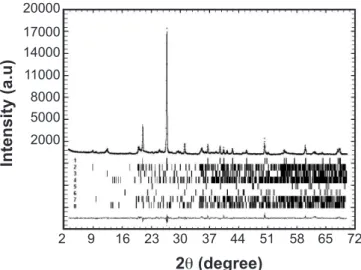
crystalline phases of the commercial clay. Particularly the Rietveld method was employed to quantify each phase. Fig. 1 shows the diffraction pattern of the as received (110 ºC dried) original sample for 2θ between 3o and 70o. The main
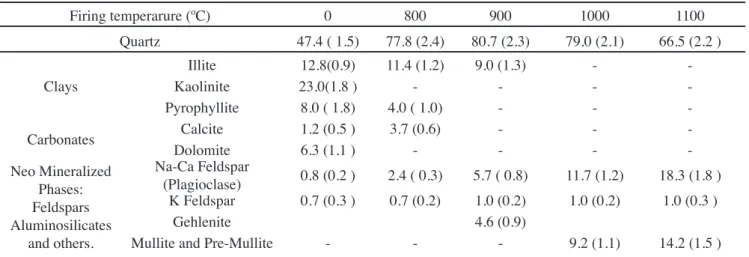
diffraction peaks are marked. Table II shows the actual content (weight basis) of each of the detected crystalline phases.
As expected for this the commercial calcareous material, quartz (Q) and clays (C) are the principal crystalline phases; the sum of Q and C is over 90%. The lux fraction of the original sample is composed principally of carbonates and traces of feldspars. Particularly dolomite (MgCa (CO3)2) and
calcite (CaCO3) are the principal luxing contributions, this fact gives the name to this particular commercial clay.
The clay fraction of the materials is composed mainly by
Figure 1: XRD-Rietveld pattern of the as received material. 1 Quartz, 2 Illite, 3 Kaolinite, 4 Plagioclase-Oligoclase (Ca-Na), 5 Calcite; 6 Dolomite, 7 Pyrophyllite, 8 Feldspar (K).
[Figura 1: Padrão DRX-Rietveld do material como recebido. 1 Quartzo, 2 Illita, 3 Caulinita, 4 Plagioclásio-Oligoclásio (Ca-Na), 5 Calcita, 6 Dolomita, 7 Piroilita, 8 Feldspato 8 (K).]
2q (degree)
In
te
ns
ity
(a
.u
)
20000 17000
8000 14000
5000 11000
2000
2 9 16 23 30 37 44 51 58 65 72
Crystalline
phase Content wt.% Type Content wt.%
Quartz 47.4 Quartz 47.4
Illite 12.8
Clays 43.8
Kaolinite 23.0
Pyrophyllite 8.0
Calcite 1.2 Carbonates 7.5
Dolomite 6.3
Na-Ca Feldspar
(Plagioclase) 0.8 Feldspars 1.5
K Feldspar 0.7
Table II - Crystalline composition of the as received material.
kaolinite (over the 50% of the clay). The complementary clays are illite and pyrophyllite. The low amount of Al2O3 (Table II) together with the detected presence of these complement clays and the other impurities suggest a moderately low refractoriness of this clay. Finally, the amount of iron (Fe) in the chemical composition together with the crystalline phase analysis suggests that the iring colour will not be completely white, In fact the iring samples presented a very light beige iring colour, however this commercial material is known as a white clay.
Textural properties
Porosity (P), water absorption (WA), density (D) and contraction (C) evolution with iring temperature were measured in order to evaluate the sinterability of the calcareous commercial clay. The results are shown in Fig. 2. Generally, these clays are biscuit ired at around 980 ºC and ired at 1040 ºC for the second glaze iring. This preliminary analysis corroborated that this is in fact a limiting temperature. The four properties remained stable up to 1040-1050 ºC and at 1100 ºC changed abruptly.
The under ired (700 ºC-900 ºC) materials presented an enlargement after the thermal treatment that decreased with the temperature. No size change was detected for the material ired at 1000 ºC and a not negligible 3% contraction was observed for the over ired material (1100 ºC). The enlargement is related to the clay decomposition that was evaluated in the following sections. Between 900 ºC and 1000 °C, the sintering process consists in the aggregation and compaction of particles. As this process is not complete, the ceramic bodies are quite porous. The reduction of water absorption is linked to the increase in the bending strength of the clay matrix and the thermal expansion of
the ceramic piece increases. As a irst glance P, WA and D remained stable up to 1000 ºC; a slight variation after 900 ºC could be detected, showing that before this temperature some mineralization started and were detected by DTA and XRD analysis. Results are shown in the following sections. Finally, it can be point out that the evaluated values of P, WA and D correspond to earthenware [23]. Another remarkable result is the observed stability of the properties in this wide temperature range which make them unsuitable for quality control parameters. Instead, a mechanical characterization is suggested.
Dilatometry
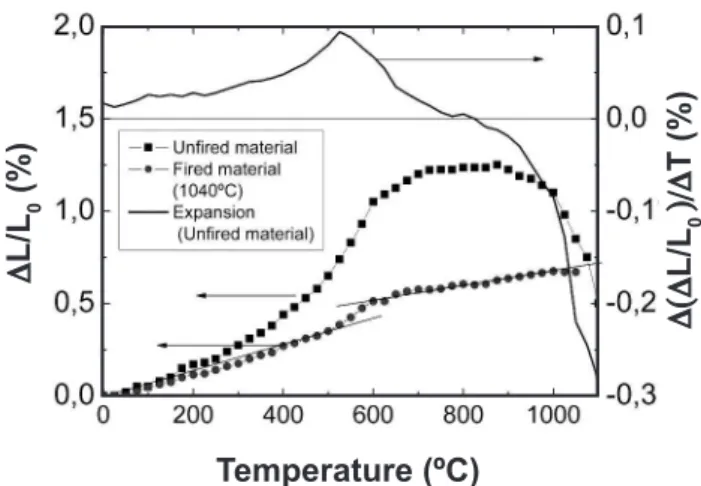
Fig. 3 shows the dilatometry of this material in green and sintered at 1040 °C (temperature usually used for the manufacture of earthenware). The expansion, assumed to be the derivative of the irst one, is shown in Fig. 3 as well.
For de unired clay, the expansion grows up to 550 ºC, from that temperature expansion decreases to 800 ºC then the graph presents a plateau until 900 °C temperature at which begins the contraction, This contraction becomes abrupt after 1050 ºC. This behaviour show that the maximum temperature is critical for the sintering of these materials. The sharp contraction at high temperatures illustrates the short maturity range. Hence this kind of clays cannot be used for dense stoneware. Dilatometry of the sintered material (Fig. 3) shows a discontinuity around 500-600 ºC. Two linear ranges can be easily observed below and over this temperature. This discontinuity corresponds to the α-β transformation of quartz [23]. The linear expansion coeficients can be calculated for both linear ranges (0-500 °C and 600-1040 °C). The expansion coeficients were calculated as the slope of the linear it by the method of least squares. Both itting presented good linear correlation (R2 ≥ 0.97 in both cases). The result showed a signiicant
difference in each temperature range (8.4 10-6 ºC-1 and
Figure 2: Porosity (P), water absorption (WA), sintered density (D) and linear contraction (C) as a function of the sintering temperature of the white calcareous earthenware.
[Figura 2: Porosidade (P), adsorção de água (WA), densidade do sinterizado (D) e retração linear (C) em função da temperatura de sinterização da cerâmica calcária branca.]
40 2,2 2
-2 -1 1
-3 0
-4 2,0
1,8
1,6
1,4 30
20
10
0 700
Sintering temperature (ºC)
Po
ro
si
ty
a
nd
w
ate
r a
bs
or
tio
n
(%
)
D
en
si
ty
(g
/c
m
3)
C
on
tr
ac
tio
n
(%
)
900
800 1000 1100
Figure 3: Dilatometry of the green and sintered (1040 ºC) calcareous clay.
[Figure 3: Dilatometria do compacto verde e sinterizado (1040 ºC) da argila calcária.]
Temperature (ºC)
D
L/
L0
(%
)
D
(D
L/
L 0
)/
D
T
(%
3.2 10-6 ºC-1, respectively). Finally, the actual expansion
coeficient from 25 ºC to 1000 °C was 6.8 10-6 ºC-1. This
is the last value that should be taken into account for the coupling of this body with the later glazes. Anyway, since it is a porous material (30%), this discontinuity hardly brings big problems with breakages. At high iring rates this could really become a problem.
Simultaneous thermogravimetric and differential thermal analysis (TG-DTA)
Fig. 4 shows the DTA/TG curve recorded from the powder of the calcareous commercial clay. A broad endothermic band centred at 538 ºC, due to clay dehydroxylation reaction that is overlapped with α-β quartz transformation of less energy involved, is the most important peak of the DTA analysis. The following equations illustrate this processes, while the irst one is irreversible, the second one is not, depending on the inal temperature achieved.
AL2O3.2SiO2.2H2O AL2O3.2SiO2.2H2O (B)
a - SiO2 b - SiO2 (C)
The mass loss associated to this endothermic peak is 3.1%. To consider that this mass loss is only due to the kaolinite decomposition is a good assumption; hence kaolinte content can be estimated in 22.3%. This peak is accompanied by four other peaks: A small endothermic peak at 100 ºC which is correlated with the surface adsorbed water, also a small exothermic peak is observed at 340 ºC, this peak evidenced the presence of illitic clays in the original formula [14]. Later, the carbonate decomposition is evident at 787 ºC, a small endothermic peak can be observed. Finally the pre-mullite spinel type phase formation at 980 ºC could be detected, the mullite is formed from this phase that is dificult to detect by XRD.
The exothermic peak at 980 °C has previously been assigned [24] to the transformation of the Al coordination from the pentahedral or tetrahedral form of the metakaolinite to the octahedral form. In this exothermic reaction, amorphous silica, the spinel-like phase, and nuclei of mullite are produced. This spinel like phase can dificultly be detected by XRD [24], only the three broad peaks can be detected at 37º, 46º, and 67º associated with a cubic phase. From this analysis it can be conclude that the studied formula corresponds to a kaolinitic-illitic clay with important alkaline earth metals (Ca and Mg) carbonates presence. Particularly for samples ired at 800 ºC, the carbonate decomposition (calcite and dolomite) is incomplete, Dolomite decompose irstly into a kind of calcite, which afterwards (twenty or forty degrees higher) decompose like the calcite already present in the starting formula [25, 26]. However a more accurate analysis was carried out by means of XRD diffraction and Rietveld reinement. This is shown in section 3.4. It is also important to point out that the mass loss of the ired (over 800 ºC) samples is of around 8 wt.%. This consists in the addition
Firing temperarure (ºC) 0 800 900 1000 1100
Quartz 47.4 ( 1.5) 77.8 (2.4) 80.7 (2.3) 79.0 (2.1) 66.5 (2.2 )
Clays KaoliniteIllite 23.0(1.8 )12.8(0.9) 11.4 (1.2)- 9.0 (1.3)- -- -
-Pyrophyllite 8.0 ( 1.8) 4.0 ( 1.0) - -
-Carbonates DolomiteCalcite 1.2 (0.5 )6.3 (1.1 ) 3.7 (0.6)- -- -- -
-Neo Mineralized Phases: Feldspars Aluminosilicates
and others.
Na-Ca Feldspar
(Plagioclase) 0.8 (0.2 ) 2.4 ( 0.3) 5.7 ( 0.8) 11.7 (1.2) 18.3 (1.8 )
K Feldspar 0.7 (0.3 ) 0.7 (0.2) 1.0 (0.2) 1.0 (0.2) 1.0 (0.3 )
Gehlenite 4.6 (0.9)
Mullite and Pre-Mullite - - - 9.2 (1.1) 14.2 (1.5 )
Table III - Crystalline phases of the green and ired earthenware evaluated by the Rietveld method.
[Tabela III - Fases cristalinas da cerâmica a verde e sinterizada avaliadas pelo método de Rietveld.]
Values in parenthesis represent estimated standard deviations in the last quoted place calculated by Fullprof
0
-2
-4
-6
-8
200 400 600 800 1000
-10
Temperature (ºC)
TG
(%
)
D
TA
(u
.a
.)
Figure 4: Thermal evolution of the white calcareous earthenware. Simultanous DTA-TG analysis.
of water and carbon dioxide liberation from the mineral decomposition during the iring processes. The actual crystalline phase evolution was evaluated and the results are shown in the following section. From this analysis is that the amount of carbonate is really lower than the calcareous rich clays evaluated recently [17] with lost more than 20% of mass after similar thermal treatments.
Evolution of crystalline phases
Fig. 5 shows the diffraction patterns the samples submitted to different thermal treatments and compared with the as received material. Table III shows the results of the XRD-Rietveld, identiication and quantiication. As mentioned three clay minerals were detected, the principal one is Kaolinite and is accompanied by illite and phyroilite, while the irst one decompose below 800 ºC the other two decomposes after 900 ºC treatments, the amount of Kaolinite evaluated by the Rietveld was equal to the one estimated from the TG analysis in section 3.3. As mentioned the carbonate decompositions occurs in two steps [26]. The following equations illustrated this processes:
CaMg(CO3)2(cryst) CaCO3(cryst) +
MgO(non-cryst) + CO2(gas) (D)
CaCO3(cryst) CaO(non-cryst) + CO2(gas) (E)
This is the reason why the amount of calcite after 800 ºC treatments is higher than the starting quantity. After 900 ºC treatments no carbonates are detected. No important amount of feldspars were detected in the original material, however, a gradual increment in the plagioclase content was detected
consequence of the thermal treatments. After 1100 ºC the amount of feldspar reaches almost 20% of the crystalline phases of the earthenware. Taking into account that below 1100 ºC quartz shows no important modiication [23] and that no quartz is formed from these starting phases as a consequence of the thermal treatment; hence, it can be used as internal standard for the estimation of the non-crystalline and glassy phase [21]. The metakaolin does not present important XRD manifestations [23]. For practical purpose, in this work, we assume that metakaolin belongs to the irst group.
Table IV shows the results of the non crystalline phase estimation carried out by the described methodology. Although in Table III the amount of quartz evaluated was 47.4 wt.% for the non crystalline estimation WQ was assumed to be 51.4%, because of the 8% mass loss consequence of the metakaolin formation and the carbonate decomposition observed and evaluated by TG analysis in section 3.3. the amount ok kaolinite evaluated by the two methods
(ATD-Firing temperature (ºC)
Non-crystalline phase %
NC% = 100 - Ci WQ
CQ x
0 0
800 33,9
900 35,7
1000 34,3
1100 22,7
Table IV - Non crystalline phase of the green and ired earthenware, using quartz (Q) as internal standard.
[Tabela IV - Fase não cristalina da cerâmica a verde e sinterizada, usando quartzo (Q) como padrão interno.]
10 18000
12000 16000
10000 14000
8000 6000 4000 2000
2q (degree)
In
te
ns
ity
(a
.u
.)
30 50
20 40 60 70
Figure 5: X-ray diffraction patterns of the green earthenware and ired at different temperatures. Q: Quartz, K: Kaolinite, I: Illite, D: Dolomite, C: Calcite, M: Mulllite, Pl: Plagioclase.
[Figura 5: Difratogramas de raios X da cerâmica a verde e sinterizada a diferentes temperaturas. Q: Quartzo, K: Caulinita, I: Ilita, D: Dolomita, C: Calcita, M: Mulllita, Pl: Plagioclásio.]
Figure 6: Thermal phase evolution of the white calcareous earthenware.
[Figura 6: Evolução térmica da cerâmica calcária branca.]
60
30 50
20 40
10
0
Firing temperature (ºC)
C
on
te
nt
(w
t.%
)
TG) and the XDR-Rietveld was equivalent.
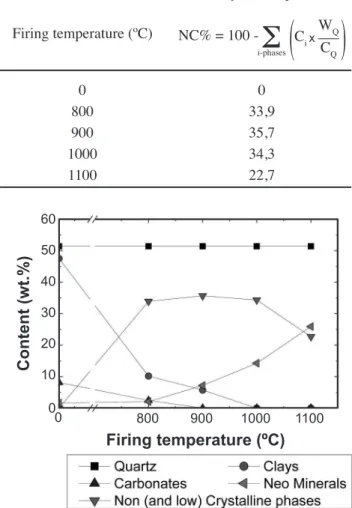
In Fig. 6 the amount of non-crystalline and glassy phase as a function of the temperature of the thermal treatment is plotted; in the same graph the different mineral types were grouped.
The calcareous earthenware is composed mostly of clay minerals (52%) and quartz (40%) accompanied by carbonates (calcite and dolomite) and some (less than 2%) feldspars (plagioclase and microcline). Generally the iring transformations include the decomposition of the clay minerals and the carbonates. The crystallinity of these products is low. Later, different crystalline phase neomineralize, as seen in the DTA-TG analysis (section 3.3) at 800 ºC the complete decomposition of the kaolinite is observed, however the remaining clay minerals decompose between this temperature and 900 °C. In samples treated at 900 ºC gehlenite (Ca2Al(AlSiO7) is detected (5%), but at higher temperatures this phase is not present, while the plagioclase (Na and Ca feldspar) content increases with temperature. The plagioclases detected are mainly “anorthe type” with high calcium content. This fact can be explained by the combination of the CaO released by carbonate decomposition with alumina and silica provided by clay decomposition to produce irst gehlenite and then plagioclase [14]. At higher temperatures (over 1150 ºC) this will decompose (melt) again. The amount of non crystalline phases at these intermediate temperatures is around 35% (800 ºC-900 ºC). From 1000 ºC on, some spinel type alumino-silicate crystallize (section3.3) from the metakaolinite, this phase is usually known as pre-mullite and also has low crystallinity and is not easily detected by XRD [23]. At higher temperature mullite (3Al2O3.2SiO2) crystallizes [23]. But these temperatures exceed the range usually used for these materials. As this type of calcareous earthenware is usually ired below 1100 ºC, in fact the most common iring temperatures are 1040 ºC and 1020 ºC, that correspond to the 05- and 06 Orthon standard cones [27], the expected phases to be present in the inal product are quartz, plagioclase, and the spinel type alumino-silicate, accompanied by the non diffracting un-reacted metakaolinite and some amount of amorphous glassy phase.
CONCLUSIONS
Firing transformation inside traditional ceramic kilns was extensively reported in the literature, but usually this kind of evaluation is carried out qualitatively and not quantitatively. This work intends to fulill this by applying the Rietveld reinement method. A preliminary sintering characterization was carried out by contraction and porosity evolution with the maximum temperature achieved during the processing. And conirmed the traditional iring treatments applied to this kind of materials (1040 ºC). Also some neomineralization was suggested by this macroscopic analysis. The thermal behavior characterization was also carried out to elucidate the actual temperature at which the chemical changes occur. From this analysis it can be
conclude that the studied formula corresponds to kaolinitic-illitic clay with important alkaline (Ca and Mg) carbonate presence. However, a more accurate crystalochemical evolution of the formula could be carried out by the XRD analysis. Finally a quantitative analysis based on the Rietveld reinement method of the X-ray diffraction patterns was carried out to characterize the presence of crystalline phases in the materials after different thermal treatments. Also with the non crystalline phases estimation. This was carried out by the internal standard method, assuming that quartz was unchanged during the iring below 1100 ºC. The Rietveld reining method showed to be a suitable tool for this analysis. The technological value of these results is clear; the actual chemical reactions are proposed. At intermediate temperatures (900 ºC) the presence of gehlenite was also detected. Furthermore, the carbonates (calcite and dolomite) presence and decomposition was also evaluated and established. Finally the expected phases at traditional working temperature (1040 ºC) are quartz, plagioclase, and the spinel type alumino-silicate, accompanied by the non diffracting un-reacted metakaolin and some amount of amorphous glassy phase. The presence of the pre-mullite phase, with aluminum with an octahedral coordination, was detected by ATD, and not detected by XRD, only indirectly by the proposed internal standard method.
REFERENCES
[1] F. González-García, V. Romero-Acosta, G. García-Ramos, M. González-Rodríguez, Firing transformations of mixtures of clays containing illite, Kaolinite and calcium carbonate used by ornamental tile industries, Appl. Clay Sci. 5, 4 (1990) 361-375.
[2] M. M. Jordán, A. Boix, C. De la Fuente, E. Ballbé, I. Queralt, T. Sanfeliu, Mineralogía y propiedades cerámicas de arcillas cretácicas wealdienses de Castellón, Bol. Soc. Esp. Mineralogía 17 (1994) 135-143.
[3] M. M. Jordán, A. Boix, T. Sanfeliu, C. De La Fuente,
Firing transformations of cretaceous clays used in the manufacturing of ceramic tiles, Appl. Clay Sci. 14, 4 (1999) 225-234.
[4] M. M. Jordán, A. Boix, T. Sanfeliu, C. De La Fuente,
The mineralogy of Cretaceous clays in Castellon and their application in the ceramic industry, Int. Ceram. J. 10 (1995) 25-29.
[5] M. M. Jordán, J. D. Martín-Martín, T. Sanfeliu, D. Gómez-Gras, C. de la Fuente, Mineralogy and iring transformations of Permo-Triassic clays used in the manufacturing of ceramic tile bodies, Appl. Clay Sci. 44, 1-2 (2009) 173-177.
[6] M. M. Jordan, M. A. Montero, S. Meseguer, T. Sanfeliu, Inluence of iring temperature and mineralogical composition on bending strength and porosity of ceramic tile bodies, Appl. Clay Sci. 42, 1-2 (2008) 266-271.
[8] M. M. Jordán, T. Sanfeliu, C. de la Fuente, E. Ballbé,
Ceramic interest Weald clays from Castellon, Third Euro-Ceramics 2 (1993) 947-952.
[9] M. Maggetti, “Phase analysis and its signiicance for technology and origin”, Archaeological Ceram. (1982) pp. 121-133.
[10] A. Moropoulou, A. Bakolas, K. Bisbikou, Thermal analysis as a method of characterizing ancient ceramic technologies, Thermochim. Acta 269-270 C (1995) 743-753. [11] V. Das Kshama, B. V. Mohan, M. Lalithambika, C. G. R. Nair, Sintering studies on plastic clays, Ceram. Int. 18, 6 (1992) 359-364.
[12] T. Peters, R. Iberg, Mineralogical changes during iring of calcium-rich brick clays, Am. Ceram. Soc. Bull. 57 (1978) 503-509.
[13] P. Duminuco, B. Messiga, M. P. Riccardi, Firing process of natural clays. Some microtextures and related phase compositions, Thermochim. Acta 321, 1-2 (1998) 185-190. [14] M. P. Riccardi, B. Messiga, P. Duminuco, An approach to the dynamics of clay iring, Appl. Clay Sci. 15, 3-4 (1999) 393-409.
[15] G. Cultrone, C. Rodriguez-Navarro, E. Sebastian, O. Cazalla, M. J. De La Torre, Carbonate and silicate phase reactions during ceramic iring, Eur. J. Mineralogy 13, 3 (2001) 621-634.
[16] K. Traoré, T. S. Kabré, P. Blanchart, Gehlenite and anorthite crystallisation from Kaolinite and calcite mix, Ceram. Int. 29, 4 (2003) 377-383.
[17] M. J. Trindade, M. I. Dias, J. Coroado, F. Rocha,
Mineralogical transformations of calcareous rich clays with iring: A comparative study between calcite and dolomite rich clays from Algarve, Portugal, Appl. Clay Sci. 42, 3-4 (2009) 345-355.
[18] F. Pardo, S. Meseguer, M. M. Jordán, T. Sanfeliu, I.
González, Firing transformations of Chilean clays for the manufacture of ceramic tile bodies, Appl. Clay Sci. 51, 1-2 (2011) 147-150.
[19] H. M. Rietveld, A proile reinement method for nuclear and magnetic structures, J. Appl. Crystallography 2 (1969) 65-71.
[20] D. L. Bish, J. E. Post, Quantitative mineralogical analysis using the Rietveld full-pattern itting method, Am. Mineralogist 78 (1993) 932-940.
[21] M. S. Conconi, N. M. Rendtorff, E. F. Aglietti,
Evaluation of Non Crystalline Phase in AZS Refractories by XRD Methods, New J. Glass Ceramics 1, 2 (2011) 21-25. [22] R. D. Bonetto, P. E. Zalba, M. S. Conconi, M. Manassero, The Rietveld method applied to quantitative phase analysis of minerals containing disordered structures, Rev. Geol. Chile 30, 1 (2003) 103-115.
[23] W. M. Carty, U. Senapati, Porcelain - Raw materials, processing, phase evolution, and mechanical behaviour, J. Am. Ceram. Soc. 81, 1 (1998) 3-20.
[24] J. Sanz, A. Madani, J. M. Serratosa, J. S. Moya, S. Aza, Aluminum-27 and Silicon-29 Magic-Angle Spinning Nuclear Magnetic Resonance Study of the Kaolinite-Mullite Transformation, J. Am. Ceram. Soc. 71, 10 (1988) C418-C421.
[25] G. Cultrone, C. Rodriguez-Navarro, E. Sebastian, O. Cazalla, M. J. De La Torre, Carbonate and silicate phase reactions during ceramic iring, Eur. J. Mineralogy 13, 3 (2001) 621-634.
[26] S. Gunasekaran, G. Anbalagan, Thermal decomposition of natural dolomite, Bull. Mater. Sci. 30, 4 (2007) 339-344. [27] H. Evele, R. Hayes, Using pyrometric cones to monitor iring of porcelain enamel ware: Plant and laboratory trials, Ceram. Eng. Sci. Proc. 18, 5 (1997) 81-91.