ABSTRACT: Composite propellant mainly consists of two parts, binder matrix (prepolymer, plasticizer, cross linker, antioxidant and curative etc.) and solid ingredients (oxidizer, metal fuel, burn rate modiier, combustion stabilizer etc.). Its processing involves several stages like ingredient preparation (grinding, 1.1 Hazard Division – 1.1 HD), mixing (1.1 HD), casting (1.1 HD), curing (1.3 HD) and extraction (1.3 HD). Each and every process is very hazardous. Removal of any of the mentioned step will be a great achievement for solid rocket motor processing. Mandrel is used to give proper grain geometry. But for metal mandrel, its extraction process (1.3 HD) is very dangerous. Proper safety precaution should be taken to perform the said operation. Also, for a metal mandrel, it is very dificult to develop intricate grain geometry due to extraction problem. This paper mainly deals with casting techniques of propellants (case bonded or cartridge loaded) with a chemically collapsible mandrel. This mandrel is collapsed in presence of suitable chemicals, hence extraction step (1.3 HD) becomes simpler. As the extraction process is very easy, intricate grain geometry can be developed in solid rocket motor. The mandrel is cheap, recycleable and relatively lightweight compared to the metal mandrel, thus handling becomes very easy. The mandrel material and the dissolution solvent have no effect on the propellant, which will be conirmed by evaluation of physicochemical as well as ballistic properties measurement.
KEYWORDS: Mandrel, Grain geometry, Composite propellant, Extraction, Mould.
Chemically Collapsible Mandrel for Solid
Rocket Motor Processing
Abhijit Dey1, Arvind Kumar1, Arun K Sikder1, Manoj Gupta1
INTRODUCTION
Conventional composite propellants comprise solid oxidizer (ammonium perchlorate, ammonium nitrate, potassium perchlorate etc.), metal fuel (aluminum powder, zirconium powder) and binders (hydroxyl/carboxyl terminated poly butadiene pre-polymer with isocyanate based curator), which also act as a fuel and contain high ratio of oxidizers.
An increased amount of the solid loading in the propellant composition results in an increase in the viscosity of slurry (a luid mixture of binder, oxidizer, metallic fuel etc.), which causes diiculty in the processing of propellant.
here are various methods of casting, but generally propellant slurry is cast by “vacuum gravity method” (top casting) (Davenas 1993; Krishnan et al. 1998), in an insulated motor cases or moulds. his technique is employed for casting large diameter rocket motors with large annular space or for slurries with low viscosities. Mandrel of required shape is positioned in the motor case or mould concentrically, and the slurry stored in feed hopper over casting chamber lows in the annular space (web) between mandrel and motor case under the inluence of pressure diferential (due to vacuum in casting chamber) and gravity. In “building block technique” (Krishnan et al. 1998), grain coniguration is divided into multiple blocks, and suitably conigured propellant blocks are separately cast and cured. hen, they are laid in the motor case and bonded using thin uncured propellant of the same composition. With the help of this technique, repairing and rework of larger built grain are also feasible. In bayonet casting method (Davenas 1993; Krishnan et al. 1998; Morgan and Dye 1989), bayonets are used to pump the slurry in the mould by air or nitrogen. he slurry will be de-aerated in the mixing phase itself and gradually pumped
1.Ministry of Defense – High Energy Materials Research Laboratory – Pune – India.
Author for correspondence: Abhijit Dey | EMR Division – HEMRL – Armament Post | Sutarwadi – Pune – 411021 – India | Email: [email protected]
into the mould. As the level rises in the mould, the bayonet is withdrawn automatically. An improvement of bayonet casting has been suggested in US patent no 4,836,961(Morgan and Dye 1989), in which the exit of bayonet consists of annular slit, which improves luidity and self leveling behavior of the propellant slurry and thus helps in deaeration. In centrifugal casting technique, the slurry is introduced under pressure into the motor, which is kept spinning. As the propellant falls at the centre of the motor, the centrifugal force pushes the propellant towards the wall, de-aerating it. his method is suitable for making cylindrical port geometry motors. It has limitation on the size of job that can be handled and the requirement of machine for its rotation. Barometric leg casting method is the combination of pressure and vacuum casting. he propellant slurry is fed by pressure from the can through a slit plate and falls into a de-aeration assembly. he propellant is collected in this zone and pressure rises, and, once it is beyond the atmospheric pressure, it lows through the automatic valve into the mould. Propellant casting in motor cases with low annular space and slurries of high viscosities has been described employing another technique in which slurry is pressurized into the casting moulds from the bottom. his technique is called pressure casting/die casting.
A new casting method have been suggested in US patent 6,101,948(A) (Knaresboro et al. 2000) for manufacturing solid rocket motor. In this method, a mandrel consisting of at least one collapsible solid slot former is positioned centrally along the axis of rocket motor and propellant slurry is cast around the mandrel and collapsible solid slot former. Now, ater curing of the solid propellant, the mandrel is removed, and the propellant and slot former is pressurized, causing the slot former to collapse as well as the easy removal from the cured propellant.
A novel construction of collapsible mandrel is described by Lembit et al. (2001). According to the invention, the outer wall comprises a plurality of sections with mating edge surfaces that diverge inwardly on odd-numbered sections and convergently on the alternating even-numbered sections of the mandrel wall, so that the odd-numbered set of sections may be retracted by a predetermined irst amount instead ofan even-numbered wall sections by a predetermined, lesser second amount. he collapsible mandrel is useful in a number of applications, such as the production of ilament wound containers. In a particular embodiment of the invention, the retractible sections make up the walls of a vertically-oriented cylindrical retractible mandrel which may be used for fabricating large-diameter chimney liners of ibre-reinforced plastic.
According to US patent 3,237,913, the collapsible mandrel (Sellers and Brunswick 1966) is adopted for use in forming the cavity coniguration in the solid propellant which is cast in large propulsion systems. As the propellant system increases, the weight of the mandrel will be necessarily increased in proportion to the size of the propulsion system. hus, it becomes necessary to provide a mandrel, so that such a mandrel can be easily removed ater propellant has cured without damage to the cavity coniguration in the propellant. Such a mandrel could be easily assembled under controlled conditions and disassembled as found to be necessary and easily shipped to any location for reassembly and reuse on repeated occasions.
A reusuable cylindrically shaped, pivotally collapsible, foam mandrel used for manufacture of hollow impregnated ibre tubes was described in US patent 3,988,103 (Hofmeister 1976). he mandrel includes a substantially rigid foam cylindrical member, an extractable member for aiding in collapsing the cylindrical member, such as groove. In one embodiment, a hinge member is employed to further aid in the pivotal collapsibility of the foam cylindrical member.
According to a special type of mandrel described in US patent 4,233,020 (Leo 1980), the mandrel has a cantilever-type mounting and includes a rotatable longitudinally slit tubular steel shell providing a molding surface on which thermosetting resin and glass iber reinforcing material may be deposited to form tank bodies or pipe. A row of pneumatic actuators mounted inside the shell and spaced axially thereof includes piston rods attached to the shell along the slit on one side thereof. Retraction of the piston rods collapses the shell, which is lexible over the greater portion of its periphery and supported in the lexible portion by a plurality of rows of pivotable turnbuckle connectors or support rods, for removal of a cured tank body or pipe.
A collapsible mandrel (Pistole et al. 1981) having a longitudinally slit tubular shell providing a molding surface for glass iber reinforced plastic pipe is provided with a removably mountable longitudinally slit sleeve as a molding surface for pipe of larger diameter.
rubber layers. he layers are cut into two parts, removed from the rigid mandrel, and rejoined by using reinforcing straps along the seam of the joined parts. he collapsible mandrel may be used to fabricate either ilament wound tanks or other collapsible mandrels, neither of which would have a seam or joint, since, ater constructing the tank or second mandrel on the irst inlated collapsible mandrel, the irst mandrel would be delated, collapsed and removed from the interior of the tank or second mandrel. his would leave a tank or second mandrel with continuous, unbroken layers forming the shell.
A propellant grain (Archer 2002) for a cylindrical casing has a cavity including an axially central opening with a combustion product exit port at one end. he grain bears a plurality of surfaces extending circumferentially about and disposed normally or helically to this opening so as to define, between these surfaces and axially toward the casing, alternating sections of propellant and sections of a groove or grooves in the propellant. he groove sections extend radially from the opening to a selectable distance to provide the grain with a large initial surface area while providing a high propellant volume.
Grain geometry is one of the important aspects in solid rocket propellant. Burning surface area depends on the grain geometry. As the grain geometry is getting more and more complex, it gives more and more burning surface area. But for scientists/technologists, the development of complex grain geometry in small motor is a challenge up to now. Extraction of metal mandrel is a 1.3 Hazard Division (HD) operation. Mechanically collapsible mandrel is already reported in the patents but extraction of this mandrel becomes a very hazardous operation. Hence, there arises a need for a suitable technique to develop complex grain geometry by casting such viscous propellant slurry directly within the lined motor case to have uniform web thickness.
he advantage of the present research is that it is a very simple method for casting propellant grain in a bonded case as well as cartridge loaded grain with complex design. Propellant slurry of high viscosity can be efectively cast. he
mandrel used for casting is less expensive and it is chemically collapsible, thus post-casting extraction process is removed. Ano- ther advantage is less manpower required for handling. Another advantage is that dissolved mandrel material can be reused to make a new mandrel.
EXPERIMENTAL SECTION
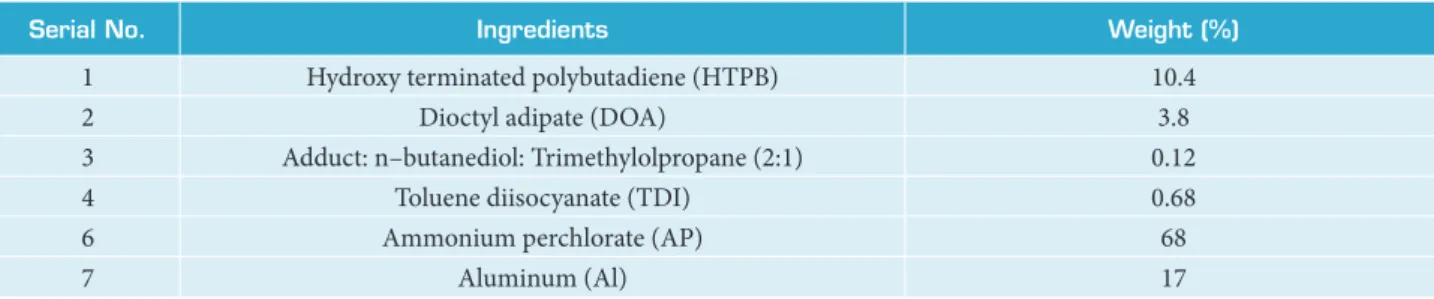
This technique is helpful for casting viscous propellant slurries (viscosity ranges from 2,000 to 20,000 P) by using chemi-cally collapsible mandrel. Composite propellant consists of two parts, i.e. binder and solid ingredient. he binder, which consists of hydroxy terminated polybutadiene (HTPB: OH value 40 – 50 mgg-1 moisture 0.15%, from Orion Chemicals), was cured with toluene diisocyanate (TDI: purity 99%, RI 1.565 – 1.567 at 30 °C; from Bayer). Dioctyl adipate (DOA: saponiication value 303 ± 3, moisture 0.5%, from Subhash Chemicals) was used as a plasticizer to increase the processability. The mixture (1 : 2) of trimethylol propane (OH value 1,220, moisture 0.5%; purchased from Celanese) and butane–1,4-diol (OH value 1,220, RI 1.444 ± 0.002 at 30 °C, moisture 0.5%, purchased from Biaf) was used as an adduct in the composition. Two diferent sizes of ammonium perchlorate were used in the propellant formulations. he irst one consisted of pure, research grade ammonium perchlorate (purity 99%, density 1.95, from Tamil Nadu Chlorates), with an average particle size of 300 µm. he other size of ammonium perchlorate was prepared by grinding ammonium perchlorate (> 99% pure) in a luid energy mill to an average particle size of 60 µm. Aluminum metal powder (from MEPCO) of an average particle size of 15 µm was used as a metal fuel. he detail formulation has given in Table 1. he propellant is processed by mixing the ingredient in vertical planetary mixer. he propellant formulations were mixed in 10 kg batches using a vertical planetary mixer of 15 L capacity. During mixing, vacuum (2 – 3 Torr) was applied at 55 °C, in order to remove air bubbles
Serial No. Ingredients Weight (%)
1 Hydroxy terminated polybutadiene (HTPB) 10.4
2 Dioctyl adipate (DOA) 3.8
3 Adduct: n–butanediol: Trimethylolpropane (2:1) 0.12
4 Toluene diisocyanate (TDI) 0.68
6 Ammonium perchlorate (AP) 68
7 Aluminum (Al) 17
from the formulation prior to casting. he propellant mixture was cast under vacuum by slurry cast techniques. he propellant was cured at 60 °C for 10 – 12 days in a water-jacketed oven.
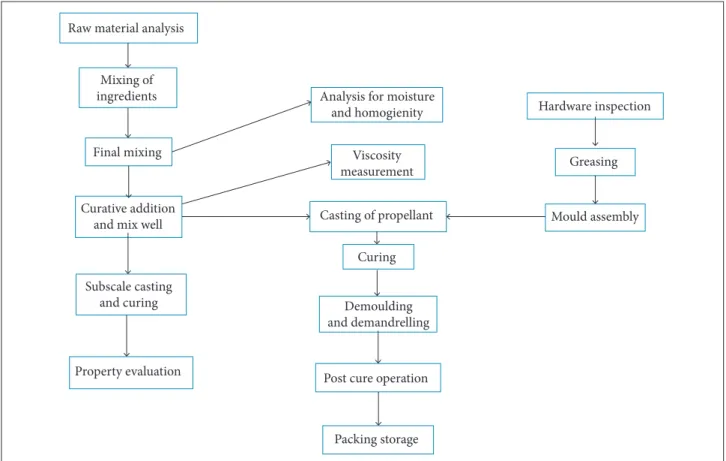
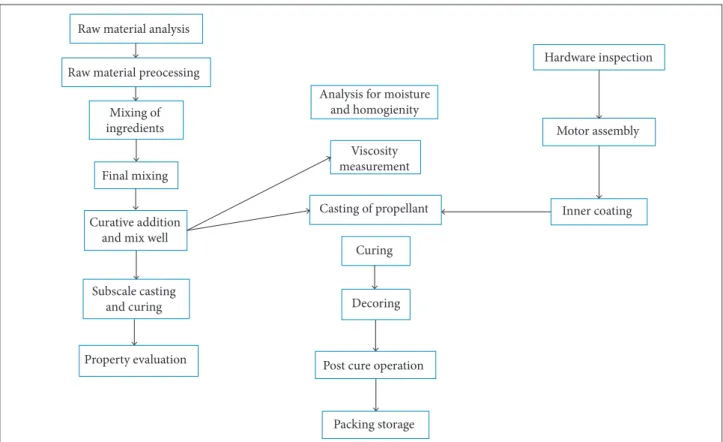
The propellant formulations were subjected to various performance tests. he detailed low chart for processing bonded case and cartridge loaded grain is presented in Figs. 1 and 2.
In the present research, a chemically collapsible mandrel was designed and made up indigenously by styrofoam material with a metal core. Metal core is used to give proper load support and ofset the bouncy force generated during propellant casting. he mandrel is speciically designed according to the requirement of casting. To avoid the reaction between mandrel material, propellant and dissolution liquid, coating with wax material has been carried out over the mandrel. his coating is removed very easily ater curing.
BRIEf DESCRIpTION Of ThE pROCESS
It is understood that, while the study has been described in conjunction with preferred speciic embodiments thereof, Figs. 3-7 intend to illustrate and not limit the scope of the study. Other aspects, advantages and modiications within the scope
of the study will be apparent to those skilled in the art to which the study pertains, following casting arrangements and process.
Vacuum Casting Chamber
It is a pressure vessel designed to withstand full vacuum. he purpose of this chamber is to deaerate the slurry during casting. An absolute pressure of 4 – 6 mmHg is maintained in the chamber throughout the deaerating process.
Propellant Feeder
It is basically a feeding hopper made up of stainless steel. At the bottom of the hopper, a ball valve is itted to control the low of the propellant.
Base Plate
It is a specially designed bottom plate to it the base of the motor and held the mandrel from one end.
Mandrel
he mandrel is speciically designed according to the requirement of casting. In the present study, the mandrel is basically made up
Raw material analysis
Analysis for moisture and homogienity
Viscosity measurement
Casting of propellant
Curing
Demoulding and demandrelling
Post cure operation
Packing storage Mixing of
ingredients
Final mixing
Hardware inspection
Greasing
Mould assembly Curative addition
and mix well
Subscale casting and curing
Property evaluation
Raw material analysis
Raw material preocessing
Analysis for moisture and homogienity
Viscosity measurement
Casting of propellant
Curing
Decoring
Post cure operation
Packing storage Mixing of
ingredients
Final mixing
Hardware inspection
Motor assembly
Inner coating Curative addition
and mix well
Subscale casting and curing
Property evaluation
Metal core
Styrofoam sheet
Hollow part
Propellant
Metal core Mould
Base plate Specific
material sheet
( a) ( b) ( c)
Figure 2. Process low chart for cartridge loaded grain. of indigenously made styrofoam material with a metal core. A wax coating is also applied over the assembly to protect the styrofoam from propellant ingredient during the curing. A metal core is used to give load support. his mandrel is itted in place of an actual metal mandrel. Fig. 3(a) shows a collapsible mandrel with metal core and styrofoam sheet. Fig. 3(b) shows a propellant grain ater curing. he hollow part is created by the mandrel. Fig. 3(c) depicts the complete casting mould with a specially designed mandrel. Figures 4-6 exhibit the pictorial representation of the mandrel (Fig. 4), its cross-sectional view (Fig. 5) and the casting mould with collapsible mandrel ater casting (Fig. 6).
Preparation of Propellant Slurry
Propellant slurry is prepared by mixing powder ingredients in pre-polymer resin. Ater the completion of the mixing cycle, homogeneity and slurry moisture of the mixed sample are checked. Later on a curative is added ater ensuring the readiness of the casting assembly. he composition must meet ballistic and mechanical properties. he viscosity of the slurry is generally between 5,000 to 8,000 P and built-up viscosity ater 3 hours may reach up to 12,000 P. From the mixer, the propellant slurry is unloaded into a slurry hopper for further operations.
Figure 3. (a) Collapsible mandrel, (b) Propellant grain and (c) Casting mould with mandrel.
Casting Process
Vacuum is applied in the vacuum casting chamber through oil ring vacuum pump till the absolute pressure inside the chamber reaches 3 – 4 mmHg. his pressure inside the casting chamber is maintained throughout the deaeration process.
Propellant slurry is fed into the feed hopper, which is placed over the vacuum casting chamber through feed valve. hen, the feed valve below the slurry hopper is slowly opened to allow the propellant slurry to flow inside the motor. The flow of slurry inside the motor is maintained at a rate of approximately 400 – 600 g/min. Slurry through the valve falls directly inside the motor, which allows large slurry surface area for deaeration. Slurry level in the motor kept inside the casting chamber is monitored through the viewing port. When the required amount of propellant lows inside the motor, the feed valve is closed and the motor along with the mandrel and the slurry mix is kept under vacuum for 30 min. hen, the vacuum is released and the lid of the vacuum casting chamber is removed.
Propellant Curing and Post-Cure Operations
Ater casting, the motor is kept in a curing oven at appropriate temperature and for the required period for curing the propellant. When the propellant curing is completed, the oven is switched of and the motor is slowly allowed to cool down to the ambient temperature. Two types of casting mould were assembled: one with regular mandrel and other with chemically collapsible mandrel to compare propellant physicochemical properties and ballistic properties. Extraction of regular mandrel was carried out by regular practice. But, in case of chemically collapsible mandrel, the propellant containing casting mould was placed vertically and a dissolution solvent (ketonic solvent) was applied over the material. When the chemical solution touches the material, it dissolves entirely and the metal core is removed easily. Other casting accessories are removed and the excess of propellant is trimmed of. Figure 7 represents the cross-sectional view of the casting assembly with mandrel.
ChARACTERIzATION
All the physicochemical and ballistic properties have been evaluated for comparison. Strand burning rates of the propellants were determined in the pressure range of 5 – 9 MPa by employing an Acoustic Emission Technique (Christensen 1978). he methodology involved combustion of the strand (ignited by means of a nichrome wire) with dimensions of 100 mm x 6 mm x 6 mm in the nitrogen pressurized steel bomb. he acoustic signal generated and the perturbations caused by the propellant delagration were transmitted through the water medium to a piezoelectric transducer (200 kHz) in conjunction with an oscilloscope. he burning rates were computed from the time they were recorded for the trial conducted at each
Metal core
Casting langes
Propellant Sheet of specific material
Figure 5. Cross-sectional view of collapsible mandrel with metal core.
Figure 6. Casting mould with collapsible mandrel after casting.
pressure for each sample. he standard deviation was of the order of 0.2%.
Calorimetric values were obtained using a bomb calorimeter (Parr instruments, Germany). he density of the propellants was determined by a Metler density kit. Toluene was used as a solvent.
determined using dumbbell shaped specimen as per speciication ASTM-D-638.
RESULTS
During this operation, no increase in temperature was observed. It became very easy to remove the metal core. he outer diameter and the inner one were measured, and no deformation was found. here were various sample pieces like dumbbells and density pieces. Strends and 2 kg of ballistic evaluation motor (BEM) were cut from the grain. No change in ballistic and physical properties was observed. he detail results are given next.
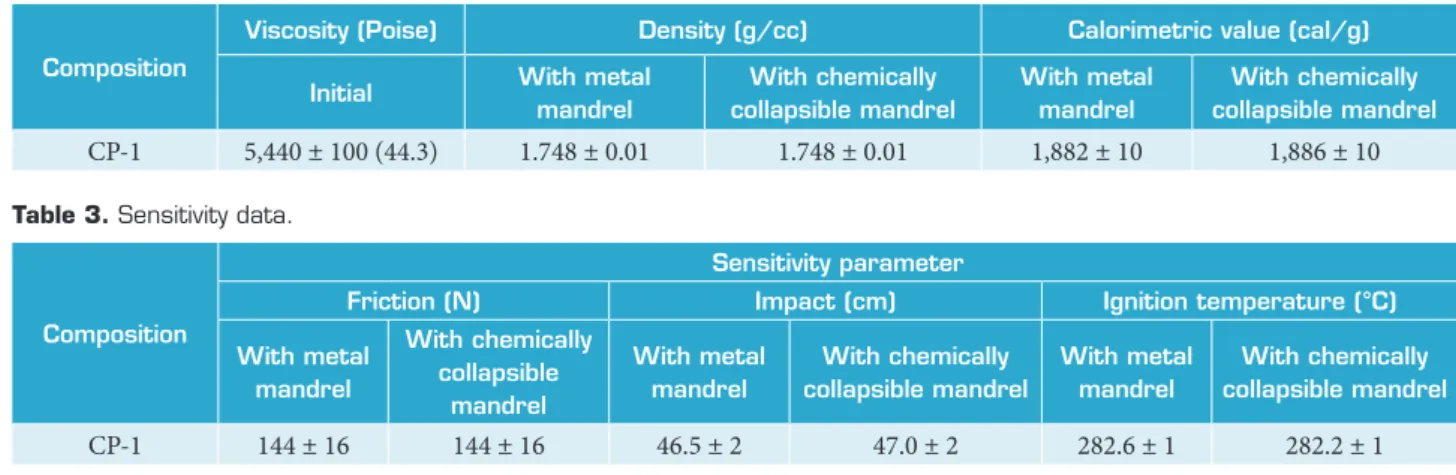
Table 2 shows the data of viscosity, density and calorimetric value with standard deviation which have been prepared with a metal mandrel and a chemically collapsible one. he experimental results show marginal variation.
According to Table 3, friction, impact and ignition temperature data with standard deviation have been highlighted. The experimental data were found to be an acceptable range in both experiments.
Mechanical properties data were highlighted in Table 4. According to this table, the mechanical properties also showed consistent results for both grains. Experimental results showed that propellant mechanical properties are not afected by the dissolution solvent, which was used for mandrel dissolution. Tables 5 and 6 represent thermal and ballistic analyses results with standard deviation. No change in the properties was observed. We also conclude that chemically collapsible mandrel material and its dissolution solvent do not afect the propellant’s thermal and ballistic properties. Specially, burn rate data for both propellant grains found an excellent match.
Composition
Sensitivity parameter
friction (N) Impact (cm) Ignition temperature (°C)
With metal mandrel
With chemically collapsible
mandrel
With metal mandrel
With chemically collapsible mandrel
With metal mandrel
With chemically collapsible mandrel
CP-1 144 ± 16 144 ± 16 46.5 ± 2 47.0 ± 2 282.6 ± 1 282.2 ± 1
Table 2. Physicochemical properties of propellant composition.
Composition
Viscosity (poise) Density (g/cc) Calorimetric value (cal/g)
Initial With metal
mandrel
With chemically collapsible mandrel
With metal mandrel
With chemically collapsible mandrel
CP-1 5,440 ± 100 (44.3) 1.748 ± 0.01 1.748 ± 0.01 1,882 ± 10 1,886 ± 10
Table 3. Sensitivity data.
he sensitivity to impact the stimuli of the propellant compositions was determined with a fall hammer apparatus (2 kg drop weight) using the Bruceton Staircase method (Brooks 1987), and the results were given in terms of the statistically obtained 50% probability of explosion (H50). he friction sensitivity was measured on a Julius Peter apparatus by incrementally increasing the load from 0.2 to 36 kg, until there was ignition/explosion in 5 consecutive test samples.
he ignition temperatures were measured by a Julius Peters apparatus. he sample was heated uniformly at a constant rate (5 °C/min) in a Woods metal bath, until it exploded or ignited at the ignition temperature.
hermal analysis of the propellant was carried out on the STA (Q-600,USA), Perkin Elmer Pyris Diamond DSC, at the heating rate of 20 °C/min under N2 atmosphere (sample mass of ~ 10 mg). Gaseous decomposition products were analyzed by Bruker make equinox 55 hyphenated with TG.
Mechanical properties were obtained with Instron (Model TIC-1185, UK). he operating instrumental parameters were always maintained constant – gauge length: 25 mm; cross-head speed: 50 mm/min. he stress and strain properties were
(1)
Density = x
weight of the sample weight of the sample in solvent
CONCLUSIONS
It was concluded that all the important properties of propellants like viscosity, density, calorimetric value, friction, impact, ignition temperature, mechanical properties, thermal analysis and ballistic properties show marginal variation, which can be acceptable for our study. Several major advantages like removal of hazardous operation such as extraction (1.3 HD), development of critical grain, room temperature, cost efective operation
Composition
Mechanical properties
Tensile strenght (maximun) (kgf/cm2) % elongation E-Modulus (kgf/cm2)
With metal mandrel
With chemically collapsible
mandrel
With metal mandrel
With chemically collapsible
mandrel
With metal mandrel
With chemically collapsible mandrel
CP-1 10.5 ± 2 10.7 ± 2 43.7 ± 10 42.5 ± 10 44.6 ± 5 42.0 ± 5
Composition
DSC @ 10 °C/min DTA @ 20 °C/min TGA@ 20 °C/min
peak temperature
(°C)
Δh (J/g)
Activation energy (kJ/M)
Tinitial (°C)
Tmax (°C)
Tinal (°C)
Temperature (°C)
Weight loss (%)
CP-1 400.7 ± 5 -1,671.4 ± 10 279.7 ± 10 242.9 ± 2 300.33 ± 2 371.0 ± 2 249.4 (± 5) –
416.1 ( ±5) 62.9 ± 10 Table 4. Mechanical properties data.
Table 5. Thermal analysis results of propellant composition.
Composition
Ballistic properties
Burn rate (mm/s) n value,
5 – 10 Mpa
a value
5 – 10 Mpa
5 Mpa 7 Mpa 10 Mpa
CP-1 6.68 ± 0.5 7.91 ± 0.5 9.47 ± 0.5 0.5 ± 0.1 0.931 ± 0.1
Table 6. Ballistic properties of propellant composition.
and less manpower involvement create the importance of this casting methodology.
ACKNOWLEDGEMENTS
he authors are thankful to Shri B. Bhattacharya, Director of High Energy Materials Research Laboratory, for valuable suggestions, constant encouragement and permission to publish this study.
REFERENCES
Archer HI, inventor; Propellant grain coniguration. 2002 Aug 13. US 6,431,072 B1.
Brooks JC, inventor; Method fabricating a collapsible mandrel structure to be used in manufacturing reinforced hollow tanks. 1987 Aug 04. US 4,684,423.
Christiansen WN (1978) In: Proceedings of the 14th Joint Propulsion Conference on Ferrocene, American Institute of Aeronautics and Astronautics/Society of Automotive Engineers; Las Vegas, USA.
Davenas A (1993) Solid rocket propulsion technology. New York: Pergamon Press.
Hoffmeister AC, inventor; Collapsible mandrel for making iber tubes. 1976 Oct 26. US 3,988,103.
Knaresboro DL, Goodson FR, Inman FS, inventors; Method of manufacturing solid rocket motors. 2000 Aug 15. US 6101948 (A).
Krishnan S, Chakravarthy SR, Athithan SK (1998) Propellant and explosives technology. New Delhi (India): Allied Publishers.
Lembit S, inventor; Collapsible mandrel. 2001 Aug 24. CA 2299487 A1.
Leo OA, inventor; Collapsible mandrel. 1980 Nov 11. US 4,233,020.
Morgan RE, Dye CB, inventors; Methods of and apparatus for casting solid propellant rocket motors. 1989 Jun 06. US 4,836,961(A).
Pistole RG, Stoll WA, Leo OA, inventors; Sleeve for changing diameter of collapsible mandrel. 1981 Jul 14. US 4,278,490.