Original Article
Artigo Original
Nayara Freitas Fernandes1 Elisabete Honda Yamaguti1 Marina Morettin1 Orozimbo Alves Costa1
Descritores
Perda Auditiva Percepção da Fala Criança Avaliação Audição Keywords
Child Evaluation Speech Perception Hearing Hearing Loss
Correspondence address:
Nayara Freitas Fernandes
Centro de Pesquisas Audiológicas da Sessão de Implante Coclear do Hospital de Reabilitação de Anomalias Craniofaciais (HRAC/USP)
Rua Silvio Marchione, 3-20, Vila Universitária, Bauru (SP), Brasil, CEP: 17012-900.
E-mail: [email protected]
Received: 11/01/2014
Accepted: 05/02/2015
Study carried out at the Audiological Research Center, Craniofacial Anomalies Rehabilitation Hospital, Universidade de São Paulo – USP – Bauru (SP), Brazil.
(1) School of Dentistry of Bauru, Universidade de São Paulo – USP – Bauru (SP), Brazil.
Financial support: Fundação de Amparo à Pesquisa do Estado de São Paulo – FAPESP.
Conlict of interests: nothing to declare.
Speech perception in users of hearing aid
with auditory neuropathy spectrum disorder
Percepção de fala em deicientes auditivos pré‑linguais com
desordem do espectro da neuropatia auditiva usuários de
aparelho auditivo de ampliicação sonora
ABSTRACT
Purpose: To analyze speech perception in children with pre-lingual hearing loss with auditory neuropathy spectrum disorder users of bilateral hearing aid. Methods: This is a descriptive and exploratory study carried out at the Research Center Audiological (HRAC/USP). The study included four children aged between 8 years and 3 months and 12 years and 2 months. Lists of monosyllabic words, two syllables, nonsense words and sentences, the Infant Toddler–Meaningful Auditory Integration Scale (IT–MAIS) and the Meaningful Use of Speech Scale (MUSS), hearing, and language categories were used. All lists were applied in acoustic booth, with speakers, in free ield, in silence. Results: The results showed an average 69.5% for the list of monosyllabic words, 87.75% for the list of two-syllable words, 89.92% for the list of nonsense syllables, and 92.5% for the list of sentences. Conclusion: The therapeutic process that includes the use of bilateral hearing aid was extremely satisfactory, since it allowed the maximum development of auditory skills.
RESUMO
Objetivo: Analisar a percepção de fala em crianças portadoras de deiciência auditiva pré-lingual com desordem do espectro da neuropatia auditiva (DENA) usuárias de aparelho de ampliicação sonora individual (AASI) bilateral. Métodos: Trata-se de um estudo descritivo e exploratório realizado no Centro de Pesquisas Audiológicas da Sessão de Implante Coclear do Hospital de Reabilitação de Anomalias Craniofaciais (HRAC/USP). Foram avaliadas 4 crianças com idade variando entre 8 anos e 3 meses e 12 anos e 2 meses. Foram utilizados: listas de palavras monossílabas, dissílabas, palavras sem sentido e sentenças, Escala de Integração Auditiva Signiicativa para Crianças Pequenas (IT-MAIS) e Questionário de Avaliação da Linguagem Oral (MUSS), categorias de linguagem e audição. Todas as listas foram aplicadas em cabine acústica, à viva-voz, em campo livre, no silêncio.
Resultados: Os resultados apresentaram média de 69,5% para a lista de palavras monossílabas, 87,75% para a lista de palavras dissílabas, 89,92% para a lista de sílabas sem sentido e 92,5% para a lista de sentenças.
INTRODUCTION
Hearing and communication skills are distinct features of the human existence, considered the greatest contributors for the well-being of any individual. However, the auditory sensory deprivation affects the development of the hearing function and the oral language, and may result in emotional, educational, social, and cultural implications(1).
The auditory neuropathy spectrum disorder (ANSD) is a dysfunction of the synapses of inner hair cells and/or auditory nerve. The individual with ANSD presents the functioning of the outer hair cells, however, the function of the vestibular-cochlear nerve is altered(2). Clinical characteristics include from auditory thresholds within normality to severe and/or profound bilateral hearing loss(2-4). It is important to highlight that the ANSD may be observed in individuals of all ages(5) and that there are many possibilities for the exact location of the alteration, the ANSD may be caused by failure of inner hair cells and/or the synaptic junction between these cells and the ibers of the VIII cranial pair, and/or the ibers of the VIII cranial pair themselves, and/ or in the biochemical basis and release of neurotransmitters, or even a combination of the structures mentioned(2).
The causes of this alteration may be associated to family history, the permanence in neonatal intensive care unit, hyper-bilirubinemia, premature birth and neo and perinatal asphyxia, or even syndromes, such as, the Charcot-Marie-Tooth syndrome, Friedreich’s ataxia, and the Mohr–Tranebjærg syndrome. Thus, it is important to consider that an early and accurate diagnosis is essential for these patients(2,3).
In the infant population, clinical characteristics of ANSD may determine additional dificulties for the development of hearing abilities. This way, the hearing habilitation and reha-bilitation of children with ANSD are a challenge, because, in this population the neural function alteration may or may not lead to impairment of hearing perception; in the cases when these dificulties are diagnosed, its biopsychosocial develop-ment may be affected.
Due to this complexity of the ANSD condition, differ-ent treatmdiffer-ent options have been considered and indicated. When an intervention by means of hearing aids is needed, the resources extend from the use of an individual hearing aid (IHA) to frequency-modulated system (FM system) and cochlear implant (CI).
As for the use of the IHA by this population, when indi-cated as a rehabilitation strategy, it stimulates the residual hear-ing and may improve the hearhear-ing thresholds(6). Some authors reported that the IHA may contribute to a better hearing detec-tion of the sounds(3,6); however, there may not necessarily be an improvement in auditory discrimination(7).
In a study(8) with children with ANSD users of IHA, the authors found a signiicant improvement in the hearing condi-tion, both for the results of the tests of speech perception car-ried out in silent and for the audiometric evaluation in free ield with research of the functional gain among children with ANSD. Another study(9) showed that children with ANSD users of IHA were able to reach global speech comparable to the results of speech perception of children with ANSD users of CI.
This way, what is noticed with the survey of the studies carried out with the population of children with ANSD users of IHA is that the results related to the hearing performance and the beneits by means of use of this device are widely vari-able. Besides, there are few scientiic evidences related to the evaluation of speech recognition of children with ANSD users of IHA. Thus, this research had the objective of analyzing the speech perception of children with pre-lingual hearing impair-ment with ANSD users of bilateral IHA.
METHODS
It is a descriptive and exploratory study carried out in the Audiological Research Center of the Cochlear Implant Department of the Craniofacial Anomalies Rehabilitation Hospital (HRAC/USP), in the city of Bauru (SP), Brazil.
The project was approved by the Audiological Research Ethics Committee of the Cochlear Implant Department of the HRAC/USP, process No. 199/2011. All subjects who took part in this study singed the informed consent.
For the sample, some inclusion criteria were adopted: • children aged under 18 years old, diagnosed with ANSD,
veriied by the absence or partial presence of answers in the research of the brainstem evoked auditory potential (BEAP), presence of otoacoustic emissions mentioned are identiied in the irst evaluation performed and/or cochlear microphonic presence and absence of acoustic relexes; • slight-to-moderate degree of hearing loss;
• users of bilateral IHA.
Subjects who did not take the speech perception test and subjects who did not agree in taking part in this research were excluded from the study.
This way, the present study consisted of a sample of four children users of IHA, enrolled at the Audiological Research Center of the Cochlear Implant Department of the HRAC/USP. The age of the sample varied between 8 years and 3 months old and 12 years and 2 months old, and the time of use of the IHA varied between 5 years and 8 months and 9 years and 3 months. All participants used the IHA daily for, at least, 9 hours.
In Chart 1, there is the characterization of the participants regarding gender, risk factors, age of the audiological interven-tion, time of use of the IHA, and age of evaluation.
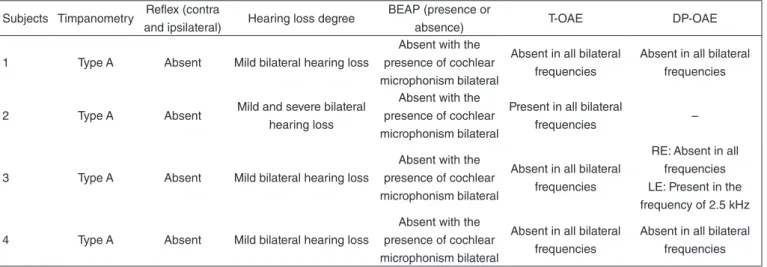
The Chart 2 follows the description of the cases related to the information of the audiological tests.
The procedures for the evaluation of speech perception were as follows: list of recognition of monosyllabic and disyl-labic words; list of recognition of nonsense syllables; and list of recognition of sentences (10). All lists were applied in a free-ield system of acoustic booth, in silent condition.
of the tone audiometric thresholds in free ield with hearing aid devices was also performed.
Previously, the evaluator clariied the possible doubts of the participants, without interfering at all in their responses. It is noteworthy that all participants carried out the evaluation of the speech perception without the aid of lip reading and with the use of the bilateral IHA.
The results were expressed in percentage of correct answers, which varied from 0% to 100%. The higher the score obtained in the test, the better the performance was considered.
RESULTS
The individual results obtained in the application of the speech perception test are represented in Table 1.
Table 2 shows the data of children with ANSD users of IHA obtained in the use of the speech perception test, related to the fol-lowing aspects: mean, standard deviation, maximum, and minimum.
It was observed that, in relation to the evaluation of par-ents as for the hearing development of the child, evaluated by the IT-MAIS questionnaire, before the intervention the results varied from 0 to 2.5%. After the use of the IHA, the results varied from 60 (1 year of use of the IHA) to 100% (3 years of use of the IHA). As for the MUSS questionnaire, the results before the intervention varied from 0 to 1.5%; after the use of the IHA, the results varied from 40 (1 year of use of the IHA) to 100% (3 years of use of the IHA).
All children in this study presented the recognition of words in an open set, compatible with the hearing category 6(14), and are luent in oral language, presenting the development of language skills according to the category 5(13). It is important to highlight that all children in this study were enrolled in speech language and audiology therapy that focus only on their school dificulties. The tonal audiometric thresholds in free ield, presented by the participants of this study with the use of hearing aids, may be observed in Table 3.
Chart 1. Characterization of the sample
Subjects Gender Risk factor Age of audiological intervention Time of use of the IHA Age at the evaluation 1 Male Hyperbilirubinemia 2 years and 3 months 7 years and 10 months 10 years and 1 month 2 Male Prematurity/meningitis 6 months 8 years and 6 months 9 years 3 Male Prematurity/hyperbilirubinemia 2 years and 7 months 5 years and 8 months 8 years and 3 months 4 Male Prematurity/permanence in the ICU 2 years and 11 months 9 years and 3 months 12 years and 2 months Caption: IHA = individual hearing aid, ICU = intensive care unit
Chart 2. Description of the audiological findings of the sample
Subjects Timpanometry Reflex (contra
and ipsilateral) Hearing loss degree
BEAP (presence or
absence) T-OAE DP-OAE
1 Type A Absent Mild bilateral hearing loss
Absent with the presence of cochlear microphonism bilateral
Absent in all bilateral frequencies
Absent in all bilateral frequencies
2 Type A Absent Mild and severe bilateral hearing loss
Absent with the presence of cochlear microphonism bilateral
Present in all bilateral
frequencies –
3 Type A Absent Mild bilateral hearing loss
Absent with the presence of cochlear microphonism bilateral
Absent in all bilateral frequencies
RE: Absent in all frequencies LE: Present in the frequency of 2.5 kHz
4 Type A Absent Mild bilateral hearing loss
Absent with the presence of cochlear microphonism bilateral
Absent in all bilateral frequencies
Absent in all bilateral frequencies
Caption: BEAP = brainstem evoked auditory potential; T-OAE = transient otoacoustic emissions; DP-OAE = distortion product otoacoustic emissions; RE = right ear; LE = left ear
Table 1. Individual values obtained in the use of speech perception test of children with auditory neuropathy spectrum disorder users of bilateral hearing aid
Speech perception test Case study (n=4)
Subjects Monosyllables Disyllables Nonsense syllables Sentences
% % % %
1 70.00 76.00 60.00 72.00
2 80.00 88.00 84.00 99.00
3 92.00 96.00 73.00 98.00
DISCUSSION
The indings of this study allowed the observation of indi-viduals with ANSD users of bilateral IHA, participants of this study presented high performance rates in the tests of speech perception performed.
When veriied in the literatures what the authors reported about the indication of IH for the habilitation and rehabilitation among ANSD cases, it is possible to notice that there are different posi-tions of scholars regarding this indication; that is, some reported that the development of hearing abilities by means of use of the IHA among children with ANSD is not reached out properly and effectively and, therefore, the indication of CI is the best option for treatment of these cases. However, other scholars reported that the development of hearing skills being possible, exclusively by means of use of the IHA among children with ANSD.
According to Hood(5), some adult individuals with ANSD reported little or even no beneit with the use of IHA. Other authors also reported that the use of IHA among subjects with ANSD did not report improvement in the performance(15). However, studies(16,8) reported that the use of IHA among sub-jects with ANSD improved speech recognition in up to 30%. In this study, the results showed that all children presented satisfactory results with the use of IHA, considering that the values presented estimated average of 69.5% for the list of monosyllabic words, 87.75% for the list of disyllabic words, 89.92% for the list of nonsense syllables, and 92.5% for the list of sentences. These results showed that the children evaluated are able to aurally recognize words and sentences in an open context, which means without having previous knowledge of what they are listening to.
Besides, it was possible to observe the hearing ability dur-ing the evaluation of speech perception, through the instruction of the test given to participants and by reaching category 6 of hearing and category 5 of language. It may also be observed that parents reported good hearing performance, demonstrating
the result of 100% regarding the IT–MAIS and MUSS ques-tionnaires, after 3 years of use of the IHA.
In one study(17), the results demonstrated that there was no statistically signiicant difference between children with ANSD users of CI, of bilateral IHA, and of IC+IHA. The authors concluded that children with DENA may receive the beneit by means of use of the IHA and present development of their hearing abilities similarly to children with ANSD users of CI.
According to Marino et al.(18), the beneit observed through evaluation tests in free ield, of the tests of speech perception or in self-evaluation of the user, obtained from the use of IHA among individuals with ANSD should be considered positive, so that new strategies may be used to improve the speech com-prehension and the communication of this individuals.
It is important to highlight that a limitation was found in this study, once that it was not possible to obtain the information about the exact location of the ANSD in the participants, this reinforces the need of investigating the kind of ANSD in this kind of pop-ulation to help future studies. However, it is valid to consider that three participants did not have the presence of transient-otoacoustic emissions (T-OAEs), indicating that in addition to the neural damage observed by means of the absence of BEAP, there is also sensory alteration, which justiies the use of sound ampliication (Chart 2). These information are conirmed by the etiology data described, once that the participants presented risk factors for sensory and neural alterations, suggesting that, in this study, the dysfunction is not only a synaptic or neural alteration.
The investigation of the exact location of the alteration in cases of ANSD may also help, especially, in the indication of resources used in auditory rehabilitation, once that, in the cases in which the alteration is sensory only, it is expected that the individuals have a good evolution of the hearing abilities by the use of IHA; in the cases in which the dysfunction would be sensory and neural the responses of the individuals with the use of IHA or of CI would be unpredictable, but with the use of CI, in this situation, the results would depend on the capacity of the auditory nervous system on dealing with electric stimuli from the device, whether satisfactory or not. Thus, it is important to consider that the accurate diagnosis of the alteration is essential in the population with ANSD.
As for the data regarding age in the audiological intervention, some authors reported that the diagnosis of hearing loss and of the ANSD should be made within the irst years of life, once that during this period there is a maturation of the hearing system, important for the good hearing and language development(19). Thus, the results of this study are compatible with the literature. Table 2. Results obtained in the use of the speech perception test among children with auditory neuropathy users of hearing aid
Speech perception test Case study (n=4)
Monosyllables Disyllables Nonsense syllables Sentences
% % % %
Mean 69.50 87.80 89.90 92.50
Standard deviation 11.50 8.90 11.40 13.50
Minimum 70.00 76.00 60.00 72.00
Maximum 96.00 94.00 84.00 100.00
Table 3. Tonal thresholds in free field with hearing aid of the evaluated subjects
Individuals Frequencies
This way, it was possible to observe that the hearing rehabil-itation by use of the IHA, in these cases, allowed improvement in the detection of sounds, auditory discrimination, auditory recognition, and improvement in the percentage of speech per-ception tests. The children participating in this study reached complex levels of hearing abilities for the conclusion of the evaluation of speech perception in an open set. This result may be attributed to a series of factors, such as the permeability of the therapeutic process, the time of sensory deprivation, the use of IHA and the speech language, and audiology therapy. These aspects contributed and inluenced the performance of auditory skills of these children.
This way, the results of the evaluation of speech percep-tion among children with ANSD users of the IHA may help health professionals to reorganize the intervention process, to improve the quality of life of the user.
CONCLUSION
The hearing performance of the participants in this research, whose therapeutic process included the IHA, was extremely satisfactory, once that is allowed the maximum development of the hearing skills.
*NFF was responsible for the elaboration of the research and chronogram, literature review, collection and analysis of the data, writing of the article, submission, and procedures of the article; EHY was responsible for the elaboration of the research, collection, and analysis of the data; MM was responsible for the chronogram, analysis, and writing of the data; OAC was responsible for the correction of the writing of the article and approval of the inal version.
REFERENCES
1. Northern JL, Downs MP. Audição na Infância. 5ª ed. Rio de Janeiro: Guanabara. Koogan; 2005.
2. Starr A, Picton TW, Sininger Y, Hood LJ, Berlin CI. Auditory neuropathy. Brain. 1996;119:741-53.
3. Doyle KJ, Sininger Y, Starr A. Auditory neuropathy in childhood. Laryngoscope. 1998;108(9):1374-7.
4. Spinelli M, Fávero-Breurl ML, Silva CMS. Neuropatia Auditiva: aspectos clínicos, diagnósticos e terapêuticos. Rev Bras Otorrinolaringol. 2001;67:863-7.
5. Hood LJ. Auditory neuropathy: what is it and what can we do about it? Hear J. 1998;51:10-7.
6. Silva RCL, Araújo SG. Os resultados do implante coclear em crianças portadoras de Neuropatia Auditiva: revisão de literatura. Rev Soc Bras Fonoaudio. 2007;12(3):252-7.
7. Hood LJ. Auditory Neuropathy Dys-synchrony new insigths. Hearing Journal. 2002; 55(2):10-20.
8. Dell’Aringa AHB, Esteves MCBN, Dell’Aringa AR, Arruda GV. Resultados da adaptação do aparelho de ampliicação sonora individual em um paciente portador de neuropatia auditiva. Arq Int Otorrinolaringol. 2009;13:107-10. 9. Pelosi S, Wanna G, Hayes C, Sunderhaus L, Haynes DS, Bennett ML,
et al. Cochlear implantation versus hearing ampliication in patients with auditory neuropathy spectrum disorder. Otolaryngol Head Neck Surg. 2013;148(5):815-21.
10. Lacerda AP. Audiologia Clínica. Rio de Janeiro: Guanabara Koogan; 1976. 11. Castiquini EAT, Bevilacqua MC. Escala de Integração Auditiva Signiicativa:
Procedimento Adaptado para a Avaliação da Percepção da Fala. Rev Soc Bras Fonoaudiol. 2000;6:51-60.
12. Nascimento LT. Uma proposta de avaliação da linguagem oral (Monograia). Bauru: Hospital de Pesquisa e Reabilitação de Lesões Lábio-Palatais; 1997. 13. Bevilacqua MC, Tech EA. Elaboração de um procedimento de avaliação de percepção de fala em crianças deficientes auditivas profundas a partir de cinco anos de idade. In: Marchesan IQ, Zorzi JM, Gomes ICD, organizadores. Tópicos em Fonoaudiologia. São Paulo: Editora Lovise; 1996. p.24-32.
14. Geers AE. Techniques of assessing auditory speech perception and lipreading enhancement in young deaf children. Volta R. 1994;96:85-96. 15. Mesquita Neto OMS, Redondo MC, Carlos RC, Figueiredo MS, Lopes
Filho OC. Neuropatia auditiva: aspectos relevantes na investigação clínica. Rev Bras Otorrinolaringol. 2001;67(5):636-42.
16. Madden C, Rutter M, Hilbert L, Greinwald Junior JH, Choo DI. Clinical and audiological features in auditory neuropathy. Arch Otolaryngol Head Neck Surg. 2002;128:1026-30.
17. Rance G, Barker EJ. Speech perception in children with auditory neuropathy/ dyssynchrony managed with either hearing Aids or cochlear implants. Otol Neurotol. 2008;29(2):179-82.
18. Marino MV, Mantello EB, Reis ACMB, Valadão MN, Anastasio ART. Reabilitação no espectro da neuropatia auditiva: estudo de caso. Medicina (Ribeirão Preto). 2013;46(1):36-46.