Maternal depression and child development: Evidence from
São Paulo’s Western Region Cohort Study
ALEXANDRA BRENTANI1*, GÜNTHER FINK2
1PhD, Department of Pediatrics, Faculdade de Medicina, Universidade de São Paulo, São Paulo, SP, Brazil 2PhD, Department of International Health Economics, Harvard School of Public Health, Cambridge, MA, USA
S
UMMARYStudy conducted at Department of Pediatrics, Faculdade de Medicina, Universidade de São Paulo (FMUSP), São Paulo, SP, Brazil
Article received: 6/29/2016
Accepted for publication: 7/26/2016
*Correspondence:
Departamento de Pediatria Address: Av. Dr. Arnaldo, 455 São Paulo, SP – Brazil Postal code: 01246-903 [email protected]
http://dx.doi.org/10.1590/1806-9282.62.06.524
Financial support: The project was funded by Secretaria Estadual da Saúde do Estado de São Paulo (SESSP)
Introduction: While a growing body of evidence has investigated the relation-ship between maternal mental health and child development, evidence on chil-dren’s early life outcomes remains mixed. We analyze the empirical relationship between maternal depression and children’s development at age one using data from the São Paulo Western Region Cohort project.
Method: Seven hundred and ninety-eight (798) mother-child dyads living in the Butantã-Jaguaré’ region of São Paulo were assessed through a home visit between January and March 2015. Maternal mental health was assessed using the Edin-burgh Postnatal Depression Scale (EPDS). Mothers were classiied as “possibly depressed” if their EPDS score was between 10 and 13 and as “likely depressed” if their EPDS score was > 13. The child outcomes analyzed were height, weight, and overall development as assessed by the Ages and Stages Questionnaire (ASQ). Height and weight were age-normalized using WHO growth standards. Stunting was deined as height-for-age z-score (HAZ) < -2. Obesity was deined as body mass index z-score (BMIZ) > 2. Adjusted and unadjusted linear regression models were used to assess the associations between Edinburgh scores and child outcomes.
Results: No association was found between maternal depression variables and children’s height, weight, stunting, and obesity. Positive associations were found between possible depression and ASQ (delta = 0.33; 95CI 0.11-0.54; p-value<0.01); no associations were found between likely depression and any of the outcomes analyzed.
Conclusion: The results from this study suggest that symptoms of maternal depression are not associated with delays in child development in the study set-ting analyzed. Further research will be needed to understand this lack of asso-ciation: while it is possible that caregivers’ mental health did not affect caregiv-ing behavior, it is possible that the effect of maternal depression can vary according to timing, persistence, and intensity. It is also possible that the EPDS instrument may fail to identify mothers with clinical depression, or that chil-dren with depressed mothers get increased support from other family members or public early childhood focused programs.
Keywords: maternal depression, linear growth, child development, child obesity.
INTRODUCTION
Healthy child development has been becoming increas-ingly postulated as instrumental for reducing economic and health inequities over the life course.1 As
highlight-ed by the recent Lancet series, mental health has become one of the greatest challenges for global well-being,2 with
depression as the most common and debilitating
condi-tion,3 particularly among women of childbearing age.4
De-pression rates appear particularly high in low and middle-income countries, particularly among women in extreme poverty;5 depression rates in these settings are generally 2
to 3 times higher than those observed in industrial coun-tries.6 Among low income Brazilian women the prevalence
during the irst 6 months after delivery, 43% of the wom-en experiwom-ence at least one episode of depression.7
Distress in pregnancy and during the child’s irst year does not only affect mothers, but is also likely to sig-niicantly impact fetal and child development.1 Existing
evidence suggests that mothers with depressive symp-toms are less sensitive and responsive in their daily in-teractions with their children, are more negative, and use physical punishment.8 Both theoretical and empirical
work suggest that maternal depression may be particu-lar harmful in early life because children heavily depend on their primary caregivers for care in infancy, and be-cause support and social interactions are particularly important due to this period’s high degree of develop-mental plasticity.3 In resource-poor settings, especially
in the context of low levels of social support, parenting dificulties are common, further increasing the risk of negative child outcomes.5
Observational studies have documented many par-enting dificulties associated with maternal depression, including increased hostility, fewer and more negative in-teractions, less responsiveness or less eficiently commu-nication.9 Postpartum depression similarly interferes with
many caregiver activities, including breastfeeding, sleep routines, immunization, and safety practices,10,11
severe-ly disrupting mother-child relationship.12
A growing literature has investigated the association between maternal psychological distress and infant out-comes.1,6 Poor maternal mental health has been linked to
preterm and low birth weight infant, as well as to poor growth outcomes during the irst year of life.4 In São
Pau-lo, psychiatric disorders among mothers living in favelas were associated with child underweight.13 Some studies
have also linked maternal depression and child short stat-ure. Maternal depressive symptoms have also been asso-ciated with a higher likelihood of overweight in a popu-lation of low-income Brazilian children between 6-24 months of age.14 Conceptually, it seems plausible that
dis-ruptions in the feeding behavior of depressed mothers could affect both sides of the growth distribution, lead-ing either to stuntlead-ing or obesity.15
A systematic review conducted in 2012 demonstrat-ed that 4 of 5 developmental domains in infants from birth to 1 year of age were adversely inluenced by mater-nal psychological distress (behavior, psychomotor, cog-nitive and social emotional delay).1 Another longitudinal
study comprising children of depressed mothers found a raised rate of insecure infant-attachment, impaired cog-nitive development, speciically in boys, and elevated rate of behavioral and emotional problems.16
Many studies, on the other hand, had found no evi-dences of associations between maternal depression and child development adverse outcomes, such as Santos et al.,6 Black et al.,17 Ertel et al.18 and Surkan et al.19 Grote et
al. concluded that maternal postnatal depression may not carry risk at least not in European population.15
The controversial indings presented can be a result of diversity in terms of samples, methods and measures.9
How-ever, due to the large proportion of depression rates among the population, and its possible consequences to child de-velopment, such theme demands further exploration.
The present study aims to understand the associa-tions between maternal depression and child develop-ment among a low-resource urban population in Brazil.
METHOD
Study setting
The study was conducted in the Butantã-Jaguaré (BJ) re-gion, which is located in the Western Region of São Pau-lo. The BJ region has an estimated population of 380,000. Infant mortality rates in the region vary between 4.4 deaths per 1,000 live births in Morumbi District and 10.3 deaths per 1,000 live births in Vila Sônia District.20,21
Study population
The study population comprised 798 mother-child dy-ads from the BJ region, assessed as part of the baseline survey conducted for an ongoing intervention trial (Clin-icalTrials.gov NCT02704000). All children in the study were born at the University Hospital (HU-USP), the main public general hospital of the region. The hospital cov-ers the large majority of all women enrolled in public na-tional health system (SUS), and about 40% of all births in the region.22 Nine hundred children born between
Sep-tember 2013 and March 2014 were randomly selected for the intervention trial among all hospital births by moth-ers living in the BJ region.
Data
Data was collected through home visits by trained inter-viewers between January and March 2015. A total of 900 interviews were conducted. A hundred of them were ex-cluded from this study because the primary caregiver of the child assessed was the child’s grandmother; two re-cords were excluded because the Edinburgh Scale was not administered, leaving a inal sample of 798 observations.
Exposure variables
us-ing the 10-item Edinburgh Postnatal Depression Scale (EPDS).23 The scale ranges between 0 and 30; following
standard scoring guidelines,23 we classiied mothers as
“pos-sibly depressed” if their score was between 10 and 13, and as “likely depressed” if their score was greater than 13.
Outcome variables
The primary outcome of interest was children’s develop-ment at 1 year of age. For physical developdevelop-ment, age- and gender-normalized height-for-age (HAZ), weight-for-age (WAZ) and body mass index (BMIZ) z-scores were com-puted using the WHO’s anthro software.24 Stunting was
deined as HAZ < -2; child obesity was deined as BMIZ > 2. Children’s age was adjusted for prematurity. Gesta-tional-length adjusted age was computed as the number of months between the time of the assessment and the child’s due date. Children’s overall development was as-sessed using the Brazilian version of the Ages and Stages Questionnaire (BR-ASQ).25
Statistical analysis and empirical strategy
To assess the associations between maternal depression and child development we estimate multivariate linear regression models. The basic model estimated can be de-scribed as follows:
yi = α + βpossibleDi + dlikelyDi + Xig + ei (1)
where
y
i is the child outcome of interest, possible D is an indicator for possible depression (EPDS score 10-13) and likely D is an indicator for likely depression (EPDS score > 13). X is a vector of maternal and child characteristics. As a irst step, we estimate unadjusted as well as adjust-ed models in the pooladjust-ed sample; we then estimate these models separately for male and female children, and show non-parametric estimates of the relationship between EPDS scores and child outcomes.All statistical analysis was performed using the Sta-ta 14 sSta-tatistical software package.26 Ethical clearance for
the intervention study was obtained from the University of São Paulo’s Institutional Review Board.
RESULTS
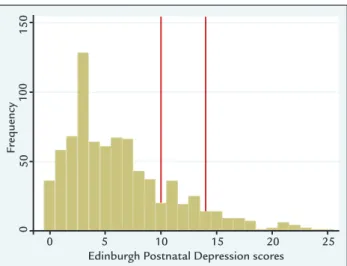
Figure 1 shows the empirical distribution of Edinburgh Postnatal Depression Scale (EPDS) scores. A total of 100 mothers (12.5%) were categorized as possibly depressed (EPDS score 10-13), and 70 mothers (8.8%) were classi-ied as likely depressed (EPDS score > 13).
Table 1 summarized sample characteristics by EPDS category. Average height-for-age z-score was -0.12, with
7.3% stunted. Average weight-for-age z-score was 0.44, with 18.0% of children falling in the obese category (BMI z-score > 2). Average age of children was 12.5 months at the time of the interview; 55% of children were female, and 1.3% referred to multiple births. Eight percent (8.3%) of children were born prematurely and 13% had teenage mothers. Most caregivers had secondary education; 16% had higher education; only 48.6% of caregivers were mar-ried at the time of the interview.
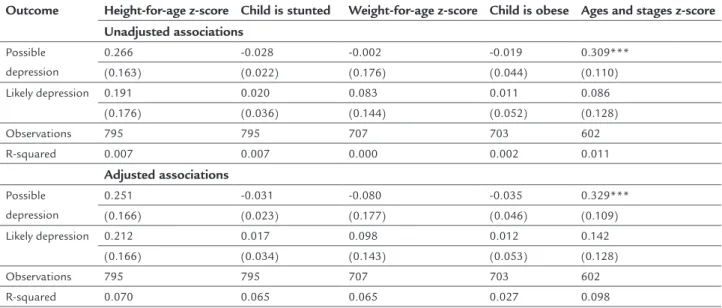
Table 2 shows the results of the multivariable regres-sion analysis. No associations were found between the two depression variables and physical growth variables, including stunting and obesity. For child development (Ages and Stages z-scores), slightly higher scores were found for mothers with possible (but not likely) depres-sion. On average, children of mothers in this group scored 0.33 standard deviations higher than children of moth-ers with EPDS scores < 10 (delta = 0.33, 95CI 0.11-0.54; p-value<0.01). No associations were found between like-ly depression and developmental outcomes.
Figure 2 shows polynomial smoothed relationships between our main outcome variables and EPDS scores separately for male and female children. Virtually all trend lines are nearly perfectly lat up to a score of about 15. Among mothers with an EPDS score of > 15, negative
trends were observed for all outcomes (including ASQ) for females; for males, trends seem opposite, with im-provements in ASQ, but also imim-provements in the prev-alence of under- and over nutrition. Due to the small sam-ple size in this bracket – only 44 women (5.5%) have a score > 15 – none of the observed subgroup differences were statistically signiicant.
Fr
equency
Edinburgh Postnatal Depression scores
0 5 10 15 20 25
0
50
100
150
TABLE 1 Sample characteristics by EPDS category.
No depression (EPDS < 10)
Possible depression (EPDS 10-13)
Likely depression (EPDS > 13)
Mean N SD Mean N SD Mean N SD
Height-for-age z-score -0.17 1.36 0.12 11 1.52 0.05 3 1.40
Child is stunted 0.08 48 0.04 4 0.09 6
Weight-for-age z-score 0.44 1.25 0.42 0.51 1.08
Child is obese 0.19 106 0.17 14 0.37 0.19 13
Ages and Stages z-score -0.05 1.02 0.25 0.90 0.02 0.86
Child age in months 12.45 1.87 12.57 1.71 12.45 1.91
Child is female 0.53 336 0.65 65 0.48 0.59 41 0.50
Child is a twin 0.01 8 0.00 0 0.00 0.03 2 0.17
Child was born small for gestational age 0.08 53 0.03 3 0.17 0.09 6 0.28 Child was born prematurely 0.08 53 0.09 9 0.29 0.06 4 0.23
Mother age < 20 0.13 79 0.17 17 0.38 0.11 8 0.32
Mother age 20-34 0.75 471 0.69 69 0.46 0.73 51 0.45
Mother age 35+ 0.13 80 0.14 14 0.35 0.16 11 0.37
Mother is primary caregiver 0.83 523 0.85 85 0.36 0.90 63 0.30
Caregiver primary education 0.29 182 0.33 33 0.47 0.49 34 0.50
Caregiver secondary education 0.45 282 0.41 41 0.49 0.37 26 0.49
Caregiver higher education 0.17 108 0.18 18 0.39 0.10 7 0.30
Caregiver married 0.50 318 0.43 43 0.50 0.40 28 0.49
Asset quintile 1 0.18 114 0.29 29 0.46 0.30 21 0.46
Asset quintile 2 0.27 167 0.26 26 0.44 0.21 15 0.41
Asset quintile 3 0.14 88 0.09 9 0.29 0.19 13 0.39
Asset quintile 4 0.20 125 0.24 24 0.43 0.20 14 0.40
Asset quintile 5 0.22 136 0.12 12 0.33 0.10 7 0.30
TABLE 2 Adjusted and unadjusted associations between depression scores and child developmental outcomes.
Outcome Height-for-age z-score Child is stunted Weight-for-age z-score Child is obese Ages and stages z-score Unadjusted associations
Possible depression
0.266 -0.028 -0.002 -0.019 0.309***
(0.163) (0.022) (0.176) (0.044) (0.110) Likely depression 0.191 0.020 0.083 0.011 0.086
(0.176) (0.036) (0.144) (0.052) (0.128)
Observations 795 795 707 703 602
R-squared 0.007 0.007 0.000 0.002 0.011
Adjusted associations
Possible depression
0.251 -0.031 -0.080 -0.035 0.329*** (0.166) (0.023) (0.177) (0.046) (0.109) Likely depression 0.212 0.017 0.098 0.012 0.142
(0.166) (0.034) (0.143) (0.053) (0.128)
Observations 795 795 707 703 602
R-squared 0.070 0.065 0.065 0.027 0.098
DISCUSSION
The results presented in this paper suggest that symp-toms of maternal depression (as measured by the Edin-burgh Postnatal Depression Scale) are not associated with child development in the Western Region of São Paulo. While we do not ind any associations at all for measures
of physical growth and child weight, intermediate EPDS scores actually seem to be positively associated with chil-dren’s overall development, while only very high EPDS scores appear to be associated with reductions in early childhood development scores, and only for girls.
The general lack of association between maternal de-pression scores and developmental outcomes is somewhat surprising; while there are studies with similar indings, the majority of the existing literature discussed in the in-troduction suggests negative associations between ma-ternal depression and children’s physical as well as over-all development. Several factors potentiover-ally contribute to the rather weak overall association observed: irst, chil-dren were on average only 12 months old when assessed, which makes it relatively dificult to assess cognitive and socio-emotional development of children. In terms of physical growth, most children in the area are doing rath-er well as evidenced by a stunting rate of only 7% – large
differences in this domain are thus relatively unlikely to occur. Conceptually, maternal mental health may also be-come more relevant once children bebe-come a little bit old-er and depend more on child-caregivold-er intold-eractions for stimulation and early learning, and as demonstrated in other studies, the effects of maternal depression during early life can become evident later in life. Second, and re-lated, access to health services is almost universal in the study area, so that children with early developmental prob-lems are likely to have received external support, reduc-ing the differentials between depressed and non-depressed mothers. Last, it is also possible that the relative short EPDS scale is not sensitive enough to clearly distinguish between clinically depressed and healthy mothers; the re-sulting measurement error will mechanically bias all of our coeficients towards zero. In addition to it, maternal depression was assessed only once, so our analysis cannot distinguish mothers with a persisting depression from the ones with acute episodes, or antenatal depression.
The presented study has several limitations: irst, as al-ready mentioned, it relies on the EPDS as primary mea-sure of maternal depression; while the EPDS has been wide-ly used as a screening tool, it is not a direct measure of clinical depression, and thus does not allow us to directly
FIGURE 2 Non-parametric trend estimates: Edinburgh Postnatal Depression Scale (EPDS) score, Ages and Stages Questionnaire (ASQ), stunting and obesity.
-.5 0 .5
1
-.5 0 .5
1
-1
.5
-1
-.5 0
.5
-.2
-.
1
0
.1
.2
-.2 -.
1
0
.
1
.2
.3
0
.2
.4
.6 .8
1
0 5 10 15 20 0 5 10 15 20 25
ASQ – Males ASQ – Females Stunting – Males Stunting – Females Obesity – Males Obesity – Females Edinburg Postnatal Depression Scale Score Edinburg Postnatal Depression Scale Score Edinburg Postnatal Depression Scale Score Edinburg Postnatal Depression Scale Score Edinburg Postnatal Depression Scale Score Edinburg Postnatal Depression Scale Score 0 5 10 15 20 25
0 5 10 15 20 25
0 5 10 15 20 25
compare healthy to clinically depressed mothers. Second, and along similar lines, the study did not conduct a direct assessment of children’s cognitive and socio-emotional de-velopment. While the ASQ tool used has been validated in Brazil, it relies on maternal self-reports, which may be bi-ased differentially across EPDS groupings. The same ob-viously does not apply to the anthropometric measures which were taken by study staff as part of the interviews. Last, as it is always the case for cross-sectional studies, we cannot rule out confounding bias. While we use a large set of covariates in our adjusted models, it is possible that omitted variables like maternal family background or ma-ternal social networks affect both mama-ternal health and child outcomes. In most cases, we would expect such omit-ted factors to improve maternal mental health as well as child well-being; if this was the case, the true associations between maternal mental health and child outcomes would be even more positive than the one reported here.
Despite these limitations, the study has several im-portant strengths: it is, to our knowledge, one of the very few studies assessing the relationship between maternal mental health and child development in a representative urban sample; the large amount of data collected as part of the larger study allows us to control for most environ-mental factors; the large number of child developenviron-mental measures collected allows us to conduct a multi-domain assessment rather than just focusing on nutritional or developmental outcomes.
CONCLUSION
Maternal depression is highly common among mothers in poor urban settings. According to our estimates, de-pression seems possible for 12.5% of mothers and likely for 8.8% of mothers. The results of this study suggest that depression symptoms are not generally associated with reductions in child development at age one. Negative as-sociations seem plausible for mothers with higher EPDS scores; our study was not powered to detect such differ-ences. Overall, the effect of maternal depression on child development appears to vary substantially depending on local context, and, as suggested by Claessens et al.,3 the
timing, persistence and intensity of depressive symptoms.
REFERENCES
1. Kingston D, Tough S, Whitield H. Prenatal and postpartum maternal psychological distress and infant development: a systematic review. Child Psychiatry Hum Dev. 2012; 43(5):683-714.
2. Prince M, Patel V, Saxena S, Maj M, Maselko J, Phillips MR, et al. No health without mental health. Lancet. 2007; 370(9590):859-77.
3. Claessens A, Engel M, Curran FC. The effects of maternal depression on child outcomes during the irst years of formal schooling. Early Child Res Q. 2015; 32(3rd Quarter):80-93.
4. Atif N, Lovell K, Rahman A. Maternal mental health: The missing “m” in the global maternal and child health agenda. Semin Perinatol. 2015; 39(5):345-52. 5. Parsons CE, Young KS, Rochat TJ, Kringelbach ML, Stein A. Postnatal depression and its effects on child development: a review of evidence from low- and middle-income countries. Br Med Bull. 2012; 101(1):57-79. 6. Santos IS, Matijasevich A, Domingues MR, Barros AJ, Barros FC.
Long-lasting maternal depression and child growth at 4 years of age: a cohort study. J Pediatr. 2010; 157(3):401-6.
7. Da-Silva VA, Moraes-Santos AR, Carvalho MS, Martins ML, Teixeira NA. Prenatal and postnatal depression among low income Brazilian women. Braz J Med Biol Res. 1998; 31(6):799-804.
8. McLearn K, Minkovitz C, Strobino DM, Marks E, Hou W. The timing of maternal depression symptoms and mother’s parenting practices with young children: implications for pediatric practice. Pediatrics. 2006; 118(1):e174-82.
9. Lovejoy MC, Graczyk PA, O’Hare E, Neuman G. Maternal depression and parenting behavior: a meta-analytic review. Clin Psychol Rev. 2000; 20(5):561-92.
10. Lefkovics E, Baji I, Rigó J. Impact of maternal depression on pregnancies and on early attachment. Infant Ment Health J. 2014; 35(4):354-65. 11. Stewart RC. Maternal depression and infant growth: a review of recent
evidence. Matern Child Nutr. 2007; 3(2):94-107.
12. Apter-Levi Y, Pratt M, Vakart A, Feldman M, Zagoory-Sharon O, Feldman R. Maternal depression across the irst years of life compromises child psychosocial adjustment; relations to child HPA-axis functioning. Psychoneuroendocrinology. 2016; 64:47-56.
13. de Miranda CT, Turecki G, Mari Jde J, Andreoli SB, Marcolim MA, Goihman S, et al. Mental health of the mothers of malnourished children. Int J Epidemiol. 1996; 25(1):128-33.
14. Surkan PJ, Kawachi I, Ryan LM, Berkman LF, Carvalho Vieira LM, Peterson KE. Maternal depressive symptoms, parenting self-eficacy, and child growth. Am J Public Health. 2008; 98(1):125-32.
15. Grote V, Vik T, von Kries R, Luque V, Socha J, Verduci E, et al.; European Childhood Obesity Trial Study Group. Maternal postnatal depression and child growth: a European cohort study. BMC Pediatr. 2010; 10:14. 16. Tomlinson M, Cooper PJ, Stein A, Swartz L, Molteno C. Post-partum
depression and infant growth in a South African peri-urban settlement. Child Care Health Dev. 2006; 32(1):81-6.
17. Black MM, Baqui AH, Zaman K, El Arifeen S, Black RE. Maternal depressive symptoms and infant growth in rural Bangladesh. Am J Clin Nutr. 2009; 89(3):951S-7S.
18. Ertel KA, Koenen KC, Rich-Edwards JW, Gillman MW. Maternal depressive symptoms not associated with reduced height in young children in a US prospective cohort study. PLoS One. 2010; 5(10):e13656.
19. Surkan PJ, Ryan LM, Carvalho Vieira LM, Berkman LF, Peterson KE. Maternal social and pyschological conditions and physical growth in low-income children in Piauí, Northeast Brazil. Soc Sci Med. 2007; 64(2):375-88. 20. Sistema de Informação Sobre Mortalidade (SIM) [Internet]. 2014 [cited
2014 April]. Available from: http://svs.aids.gov.br/cgiae/sim/.
21. Prefeitura do Município de São Paulo. Mortalidade Infantil no Municipio de São Paulo 2014.
22. Prefeitura de SP Saúde. Informações em saúde – Mãe Paulistana. 2012. 23. Cox JL, Holden JM, Sagovsky R. Detection of postnatal depression.
Development of the 10-item Edinburgh Postnatal Depression Scale. Br J Psychiatry. 1987; 150:782-6.
24. WHO. Anthro Software for assessing growth and development of the world’s children. Geneva: WHO; 2006.
25. Filgueiras A, Pires P, Maissonette S, Landeira-Fernandez J. Psychometric properties of the Brazilian-adapted version of the Ages and Stages Questionnaire in public child daycare centers. Early Hum Dev. 2013; 89(8):561-76. 26. StataCorp. Stata Statistical Software: Release 14. College Station: StataCorp