a This study was supported by São Paulo Research Foundation (FAPESP) (grant 2011/00543-9, FAPESP) and by the National Council for Scientific and Technological Development (CNPq). Study awarded Honorable Mention at the 20th International Symposium on Scientific Initiation of the University of São Paulo (SIICUSP).
b RN, University of São Paulo at Ribeirão Preto College of Nursing (EERP-USP). FAPESP Scientific Initiantion Grant Holder. Ribeirão Preto, São Paulo (SP), Brazil.
c Master’s degree candidate, Nursing Graduate Program in Fundamental Nursing, EERP-USP. Ribeirão Preto, SP, Brazil. d RN, EERP-USP. CNPq Scientific Initiation Grant Recipient. Ribeirão Preto, SP, Brazil.
e RN. Assistant Professor, EERP-USP. Ribeirão Preto, SP, Brazil.
f Biostatician. Research Associate Professor, School of Medicine, University of Washington, Seattle, ,USA. g MD, Associate Professor, Ribeirão Preto School of Medicine, University of São Paulo. Ribeirão Preto, SP, Brazil. h RN. Associate Professor, EERP-USP. Ribeirão Preto, SP, Brazil.
i RN. Professor,EERP-USP.. Ribeirão Preto, SP, Brazil.
j RN. PhD candidate, Interunit Doctoral Program in Nursing, EERP-USP. Ribeirão Preto, SP, Brazil.
PERCEIVED HEALTH STATUS AND PHARMACOLOGICAL ADHERENCE OF
PATIENTS WHO UNDERWENT PERCUTANEOUS CORONARY INTERVENTIONa
Mariana COELHOb, Eliana de Cássia Arantes COSTAc, Vitor César RICHTERd,
Carina Aparecida Marosti DESSOTTEe, Marcia Aparecida CIOLf, André SCHMIDTg,
Rosana Aparecida Spadoti DANTASh, Lídia Aparecida ROSSIi, Rejane Kiyomi FURUYAj
ABSTRACT
The objectives of this study were to evaluate the perceived health status and pharmacological adherence, and to verify the correlation between these measures in patients who underwent percutaneous coronary intervention, after hospital discharge. It was a cross-sectional study carried out from May 2011 to July 2012. The instruments used were: SF-36 and Measurement of Adherence to Treatment, with 101 patients, 54 (53.5%) of which were men; average age of 59.5±10.3; and 32 (32.7%) with previous cardiac treatment. All study participants were using antihypertensive drugs; the majority 99 (98%) used antiplatelet drugs; 98 (97%) used cholesterol reducers, and 59 (58.4%) used coronary vasodilators. The average number of drugs used was 6.8±2.1. Pharmacological adherence was observed in 98 (97%) patients. The participants presented best perceived health status in Social Functioning and Physical Functioning. Positive correlations of moderate magnitude were found between measurements of pharmacological adherence and Physical Functioning, General Health and Social Functioning. There was correlation between pharmacological adherence and perceived health status.
Descriptors: Quality of life, medication adherence, angioplasty, nursing.
RESUMO
Os objetivos foram avaliar o estado de saúde percebido e a adesão farmacológica, e verificar a correlação entre essas medidas em pacientes submetidos à intervenção coronária percutânea, após alta hospitalar. Trata-se de estudo transversal realizado no período de maio de 2011 a julho de 2012. Utilizaram-se os instrumentos SF-36 e Medida de Adesão aos Tratamentos, com 101 pacientes. Destes, 54 (53,5%) eram homens, a idade média era 59,5±10,3 e 32 (32,7%) haviam passado por tratamento cardíaco prévio. Todos utilizavam medicamentos anti-hipertensivos; 99 (98%) utilizavam antiagregantes plaquetários; 98 (97%), redutores de colesterol e 59 (58,4%), vasodilatadores coronarianos. A média do número de medicamentos utilizados foi 6,8±2,1. A adesão farmacológica foi verificada em 98 (97%) pacientes. Os participantes apresentaram melhor estado de saúde nos componentes “Aspectos sociais” e “Capacidade funcional”. Constataram-se correlações positivas e de moderada magnitude entre as medidas de adesão e “Capacidade funcional”, “Estado geral de saúde” e “Aspectos sociais”. Houve correlação entre adesão farmacológica e estado de saúde percebido.
Descritores: Qualidade de vida. Adesão à medicação. Angioplastia. Enfermagem.
INTRODUCTION
Cardiovascular diseases are the leading cause of death in both high-income and low-income coun-tries. In 2010, in Brazil, there were more than 326 thousand deaths from circulatory system diseases, corresponding to 28.7% of total deaths.(1-2)
Balloon angioplasty (percutaneous translu-minal coronary angioplasty), the implantation of intracoronary stents and other interventions that use catheters to treat coronary atherosclerosis make up an important group of technologies for the treatment of coronary artery disease (CAD), called Percutaneous Coronary Intervention (PCI).
(3-4) The therapeutic effect of the PCI is reduction
of the target stenosis with maintenance or rees-tablishment of blood flow in the coronary vessel. The use of coronary endoprostheses (stents) as a finished device for myocardial revascularization has increased consistently. In the beginning of 2000, in Brazil, coronary stents were incorporated onto the list of materials reimbursed by the public Unified Health System.(3) The stent is an orthesis meant
to increase the diameter of the obstructed vessel, and has benefits in comparison to balloon angio-plasty. Yet one limitation of the stent is the risk of intrastent stenosis. With the objective to prevent and treat late coronary restenosis (reduction of myointimal hyperplasia), drug-eluting stents were developed and are based on the principle of local drug administration, making possible the controlled release of drugs into the target stenosis.(3)
The success of a PCI is evaluated consider-ing angiographic success (reduction of the target stenosis to one with a diameter less than 30%, with maintenance or reestablishment of flow), and
absence of major clinical complications, such as death, acute myocardial infarction, and emergency coronary artery bypass graft (CABG) surgery.(3)
The intervention is not curative, and should be accompanied by other pharmacological and non-pharmacological therapeutic measures, aiming to control progression of the CAD with consequent improvement of quality of life and increased sur-vival of patients.(5-6)
Pharmacological adherence can be defined as the degree to which a patient uses drugs in accor-dance with times, frequency and dose prescribed in a therapeutic regimen.(7-8) In patients diagnosed
with acute coronary syndrome, six months after hospital discharge, the majority of participants (69.5%) reported medium or high pharmacological adherence. The primary reason for non-adherence was forgetfulness (23.2%).(5) There are many
vari-ables that can influence pharmacological adherence, including patient attributes (psychological, cultural and behavioral factors), therapeutic scheme (num-ber of drugs used), professional-patient relation-ship (patient’s trust in the physician), and access to the drugs (whether adequate or not).(5,8) The patient
is the primary focus in adherence to a therapy and his/her perception in regard to the importance of adherence and how much his/her health status influences correct use of the drugs.(8)
Evaluation of health-related quality of life (HRQOL) and perceived health status can be done through the use of instruments classified as generic or specific. The generic instruments can be applied in the general population, independent of illness or condition, and are concentrated on physical symp-toms, seeking to encompass all of the important health-related aspects of the individual. Specific
RESUMEN
Las finalidades fueran evaluar el estado de salud percibido y la adhesión farmacológica y, verificar la correlación entre esas medidas en pacientes sometidos a intervención coronaria percutánea, tras el alta. Estudio transversal, realizado en el periodo de mayo/2011 a julio/2012. Los instrumentos utilizados fueron: SF-36 y Medida de Adhesión a los Tratamientos, con 101 pacientes, 54 (53,5%) hombres; promedio de edad 59,5±10,3; con tratamiento cardiaco previo 32 (32,7%). Todos estaban usando medicación antihipertensiva, la mayoría utilizaba antiplaquetario, 99 (98%); reductores de colesterol, 98 (97%); y va-sodilatadores coronarios, 59 (58,4%). El número promedio de medicamentos utilizados fue 6,8±2,1. Se observó la adherencia farmacológica en 98 (97%) pacientes. Los participantes mostraron mejor estado de salud en los Aspectos Sociales y Capacidad Funcional. Fueron encontradas correlaciones positivas y moderadas entre la medida de adhesión farmacológica y Capacidad Funcional, Salud General y Aspectos Sociales. Hubo correlación entre adhesión farmacológica y estado de salud percibido.
Descriptores: Calidad de vida. Cumplimiento de la medicación. Angioplastia. Enfermería.
instruments are those directed toward a particular illness or condition.(9) Individuals with established
CAD present endangered HRQOL, which can be attributed to a group of factors that include the condition of the disease itself, physical limitations, depressive symptoms, and risk of death, which may intensify progression of the disease.(2,10)
Patients who underwent myocardial revascu-larization (PCI or CABG surgery) present better HRQOL six months after an acute coronary event when compared to the group of patients who were not revascularized. Improvement of HRQOL is related to improvement of physical functioning, reduction of symptoms and, consequently, better coexistence with the chronic illness, which requires efforts by the patient to retard its evolution.(11)
There is a scarcity of studies that evaluate the pharmacological adherence and perceived health status of patients who undergo PCI, despite the importance of these measures for controlling CAD. Thus, the objective of this study was to evaluate the perceived health status and pharmacological adherence of patients submitted to PCI, and to verify possible correlations between these two measures, in the period from two to six months after hospital discharge.
MATERIALS & METHODS
This cross-sectional study was performed in a teaching hospital in the interior of the state of São Paulo, Brazil, with patients who underwent PCI, in outpatient monitoring from two to six months after hospital discharge. The period chosen is justified by the fact that two months after the PCI, patients would already have returned to routine activities and previous employment.(3)
A convenience sample was established, con-sidering the period from May 2011 to July 2012 for data collection. In this period, the patients in outpatient monitoring who underwent PCI were invited to participate in the study. Inclusion criteria were: aged equal to or greater than 18 years, hav-ing outpatient return in the period from two to six months following the PCI, to have the capacity to communicate verbally and/or in writing, to dem-onstrate understanding of the free and informed consent form (FICF) and the questionnaires, and showing coherent responses that consider the ques-tions asked by the researcher. Exclusion criteria
were: presence of a motor dissability (for example, use of wheelchair), due to the influence of the dissability on the responses to questions about physical activities.
Data was collected during the outpatient re-turn, through an individual interview that lasted one hour, and through consultation of patient records in the charts. The following data were collected: date of birth, date of interview, data of PCI, sex, marital status, employment, education level, monthly family income, type of PCI, number of PCI locations, previous treatment of cardiac disease, presence of comorbidities (hypertension, diabetes, dyslipidemia and obesity), and type of prescribed drugs used by the patients.
For evaluation of the perceived health status, the validated Portuguese version of the Medical Outcomes Survey 36- Item Short Form (SF-36)
(12) was used. The SF-36 is made up of 36 items
grouped into eight components: Physical Func-tioning, Role-Physical, Bodily Pain, General Health, Vitality, Social Functioning, Role-Emo-tional, and Mental Health. Each component has a score from 0 to 100, in which 0 corresponds to the worst general health status and 100 cor-responds to the best health status. The values of the Cronbach’s alpha coefficient for the instrument SF-36, obtained in one recent Brazilian study done with patients with CAD, varied from 0.71 (General Health) to 0.97 (Role-Emotional), indicating good internal consistency.(2)
For this study, the suggestion of the authors of the MAT were followed, by using the converted dichotomous scale, transforming the mean of the values of the responses of each subject in the fol-lowing manner: values equal to or greater than 5 corresponded to adherents, and values less than 5 corresponded to non-adherents. In the study of the original validation scale, the MAT showed good internal consistency, with Cronbach’s alpha of 0.75 on the converted dichotomous scale. The response in the form of the Likert scale revealed greater sensibility and specificity to capture the various adherence behaviors.(13)
Data was entered into and analyzed using the software program Statistical Package for the Social Sciences (SPSS), version 20.0 for Windows. De-scriptive analyses and calculation of the Spearman correlation coefficient (rs) were done to evaluate the correlations between the measurements of the per-ceived health status (eight components of SF-36) and pharmacological adherence. The significance level was fixed at = 0.05.
For analysis of the level of linear correlation between the measurements, the classification pro-posed by Callegari-Jacques (2003)(14) was used, which
suggests that correlation values less than 0.30, even when statistically significant, do not present clinical significance (weak correlation); values between 0.30 and 0.59 indicate moderate correlation; values between 0.60 and 0.89 represent strong correlation; and 0.90 and higher represent very strong correlation.
The study was approved by the Research Eth-ics Committee of the Univertsity Hospital of the Ribeirão Preto School of Medicine (Process HCRP 7333/2010). The participants signed the FICF according to Resolution 196/96 of the National Health Council.
RESULTS
Of the 101 study participants, 54 (53.5%) were male. There was predominance of individuals who were married or in consensual union, (79, 78.3%). Seventy-eight participants (77.2%) were inactive, and the average age was 50.5±10.3 years. Table 1 shows the results of the sociodemographic and clinical description of the participants.
The mean family income was R$1,200.00. With the exception of one study participant who reported a monthly family income of R$40,000.00,
the others reported a monthly family income that varied from R$545.00 to R$4,500.00. The majority (n=83, 82.2%) did not complete primary education. Of the total number of study participants, 33 (32.7%) reported previous treatment for some type of heart disease (myocardial infarction, angina, arrhythmia, congestive heart failure and dyspnea). The mean number of drugs used by the study par-ticipants was 6.8 ± 2.1. All of the study parpar-ticipants used drugs for treatment of hypertension, and the majority (n=99, 98%) used antiplatelet drugs; 98 (97%) used cholesterol reducers; and 59 (58.4%) used coronary vasodilators.
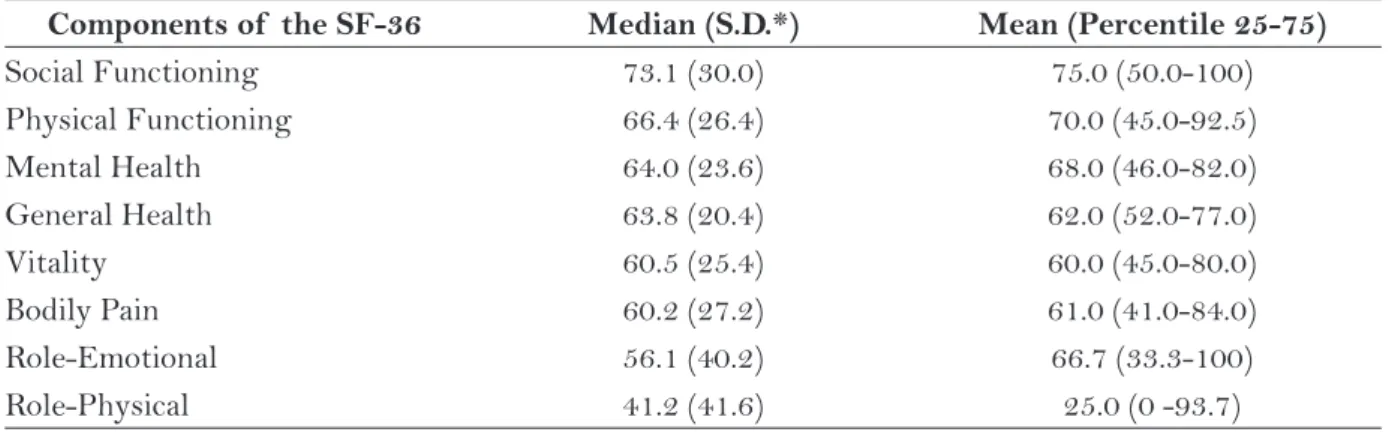
Table 2 presents the results obtained from the evaluation of patients’ perceived health status. The study participants reported better evaluations in the components Social Functioning and Physical Functioning. The components perceived by the par-ticipants as most compromised were Role-Physical, Role-Emotional, and Bodily Pain.
The results obtained from the evaluation of pharmacological adherence by the patients are presented in Table 3. The majority of participants responded “rarely” or “never” for the seven items from the MAT instrument.
The mean of the values of the responses to the seven items from the MAT instrument, which varies from 1 to 6, was 4 for three participants (3%), 5 for 26 participants (25.7%), and 6 for 72 participants (71.3%). In this way, considering the use of the converted dichotomous scale, 98 (97%) participants were classified as adherents (with mean of the values of the responses to the seven items equal to or greater than 5), and only three (3%) as non-adherents (with mean of the values of the responses to the seven items less than 5).
In the analysis of the correlations between the measurements of the perceived health status (components of the SF-36) and pharmacological adherence (MAT), positive correlations of moder-ate magnitude were verified between the measure-ments of adherence and the components Physical Functioning, General Health, and Social Function-ing. Although statistically significant, the other correlations were of weak magnitude (Table 4).
DISCUSSION
Sociodemographic and clinical characteristics (n=101) Sex
Male 54 (53.5)
Marital status
Married/consensual union 79 (78.3)
Employment situation
Inactive 78 (77.2)
Age (years)* 59.5 ±10.3
Presence of comorbidities
Hypertension 101 (100)
Dyslipidemia 85 (84.2)
Diabetes 39 (38.6)
Obesity 28 (27.7)
Previous treatment of heart disease
No 68 (67.3)
Number of locations of PCI
1 53 (52.5)
2 34 (33.7)
3 or more 14 (13.8)
Type of PCI
Stent 87 (86.1)
Stent and balloon 13 (12.9)
Balloon 1 (1.0)
Number of drugs* 6.8 ±2.1
Table 1 – Sociodemographic and clinical characteristics of the participants. Ribeirão Preto, SP, 2011-2012.
Data expressed in n (%).
* Variable expressed in mean and standard deviation.
Components of the SF-36 Median (S.D.*) Mean (Percentile 25-75)
Social Functioning 73.1 (30.0) 75.0 (50.0-100) Physical Functioning 66.4 (26.4) 70.0 (45.0-92.5) Mental Health 64.0 (23.6) 68.0 (46.0-82.0) General Health 63.8 (20.4) 62.0 (52.0-77.0)
Vitality 60.5 (25.4) 60.0 (45.0-80.0)
Bodily Pain 60.2 (27.2) 61.0 (41.0-84.0) Role-Emotional 56.1 (40.2) 66.7 (33.3-100) Role-Physical 41.2 (41.6) 25.0 (0 -93.7)
Table 2 – Study participants’ mean values for components of the SF-36 (n=101). Ribeirão Preto, SP, 2011-2012.
Items from the MAT Always (1)
Almost always
(2)
Frequently (3)
Sometimes (4)
Rarely (5)
Never (6)
1. Have you ever forgotten to
take the drugs for your illness? 2 (2.0) 3 (3.0) 1 (1.0) 6 (5.9) 40 (39.6) 49 (48.5) 2. Have you ever missed the
correct time to take the drugs for your illness?
6 (5.9) 8 (7.9) 2 (2.0) 4 (4.0) 34 (33.7) 47 (46.5)
3. Have you ever stopped taking the drugs for your illness because you felt better?
2 (2.0) 0 2 (2.0) 2 (2.0) 7 (6.9) 88 (87.1)
4. Have you ever stopped taking the drugs for your illness, on your own initiative, because you felt worse?
0 0 0 0 8 (7.9) 93 (92.1)
5. Have you ever taken more than one pill for your illness, on your own initiative, because you felt worse?
0 1 (1.0) 0 2 (2.0) 14 (13.8) 84 (83.2)
6. Have you ever interrupted therapy for your illness because your medicine(s) ran out?
0 2 (2.0) 0 2 (2.0) 23 (22.78 74 (73.2)
7. Have you ever stopped taking the drugs for your illness for some other reason that was not recommended by your physician?
0 0 0 2 (2.0) 4 (4.0) 95 (94.0)
Table 3 – Results of the instrument for Measurement of Adherence to Treatment (MAT) of the study participants (n=101). Ribeirão Preto, SP, 2011-2012.
Data expressed in n (%).
Components of the SF-36 Spearman Correlation p* value
General Health 0.35 < 0.001
Social Functioning 0.34 < 0.001
Physical Functioning 0.34 < 0.001
Mental Health 0.27 0.005
Role-Emotional 0.27 0.006
Vitality 0.26 0.008
Bodily Pain 0.23 0.02
Role-Physical 0.22 0.03
Table 4 – Correlation between the measurements of the components of SF-36 and pharmacological adher-ence, evaluated by the Measurement of Adherence to Treatments (MAT). Ribeirão Preto, SP, 2011-2012.
of patients who underwent PCI, and to verify the possible correlations between these two measures, in the period from two to seven months following hospital discharge. In the evaluation of the perceived health status through the SF-36, the components with the best evaluations were Social Functioning, and Physical Functioning. In regard to pharmacolog-ical adherence evaluated by the MAT, the majority of the participants were classified as adherents (97%). The correlations between the measurements of the perceived health status and pharmacological adher-ence were statistically significant and of moderate magnitude for the components Physical Functioning, General Health and Social Functioning.
The description of the study participants in regard to the predominance of inactive men who are married or in consensual union is similar to other studies with patients with CAD or who have undergone cardiac catheterization.(15-16)
The presence of various comorbidities consid-ered to be risk factors for cardiovascular diseases, such as hypertension, diabetes, dyslipidemia, and obesity, demand pharmacological adherence for the control of the diseases.(15)
In this study, we found the daily mean of 6.8 ±2.1 drugs, and 98 (97%) patients adhered to the drug therapy. In other studies, the daily mean of drugs used was higher than 5.0. The majority of patients stated that they adhere to the pharmaco-logical treatment.(15, 17)
The seven questions of the MAT instruments refer to the different situations that may lead the patient to non-adherence. All of the questions were predominately responded to with the option “never.” Similar results were found in another study,(18) which
implies that it is possible that the participants respond-ed with what they thought was the correct answer in order to satisfy the researcher, or were afraid that members of his/her health team would have access to the responses, and be informed about his/her in-adequate use of the drugs. Further, it is possible that the study participants really used the drugs correctly. The patient’s perception of the CAD as a grave illness with high mortality may be one of the factors related to the high pharmacological adherence of this population. In one meta-analysis, the authors found that patients who perceive their illness as grave have greater adherence to treatment when they believe in the possibility of improve-ment, than patients who consider their illness to be
less serious. However, those with worse perception of their health status have an 11% greater risk of not adhering to treatment.(19)
In regard to perceived health status, as found in this study, the best evaluations on the compo-nents Social Functioning and Physical Functioning were observed in a study that evaluated the patients three months after the PCI. However, the compo-nent Bodily Pain, one of those perceived as most compromised for the participants in our study, was what obtained the best evaluation.(4)
The component Role-Physical was perceived as the most compromised in our study, corroborat-ing what was found in one national study(10) and
another international study.(4) This component is
related to the consequences of physical health, such as reduced quantity of time dedicated to work or other activities, carrying out less tasks than the person would like, and limitations and difficulties performing activities. The perception of this com-ponent as the most compromised is possibly related to the fear of a new cardiovascular event,(17) with
consequent reduction and limitation of activities, including work.
In our study, the correlations between health status and pharmacological adherence were positive, and of weak and moderate magnitude. In another study, patients submitted to PCI re-lated pharmacological adherence to the perceived benefits and to the fear of complications resulting from non-adherence, such as angina and myocardial infarction,(17) which explains the positive correlation
between these two variables. However, one study that evaluated the association between the perceived health status and adherence to the treatment of African-Americans with serious and uncontrolled hypertension found a significant association be-tween better perceived physical health (values in the Physical Component Summary of the SF-36) and non-adherence to treatment.(20) In regard to the
components of the SF-36, participants with high values in Physical Functioning were also more dis-posed to non-adherence, while those that presented high values for Mental Health tended toward a be-havior of adherence. These associations may be due to the socioeconomic aspects and beliefs about the disease and treatment.(20) For example, the belief
CONCLUSION
The participants in this study showed a better perceived health status in the components Social Functioning and Physical Functioning, and worse perceived health status in the components Role-Physical, Role-Emotional, and Bodily Pain. The ma-jority of the participants were considered adherents to pharmacological therapy, despite the large number of drugs used. There were positive correlations of moderate magnitude between the measurement of adherence and the components Physical Function-ing, General Health, and Social Functioning.
Thus, it is important to orient patients about the relationship between pharmacological adher-ence and improvement of the perceived health status. That is, to emphasize that the correct use of the drugs will lead to reduced symptoms of CAD, and to emphasize that the continuous use of the drugs is important for secondary prevention, including when the patient is feeling well, without any clinical manifestation of the CAD.
The fact that this study is cross-sectional is a limitation, as it does not evaluate perceptions about the health status and adherence to treatment in different moments of the trajectory of the chronic condition and life of the individual. The quantita-tive evaluation of adherence by a single instrument does not supply responses to the questions put forth in this study, and other investigations with mixed approaches (quantitative and qualitative) are neces-sary. Mixed approaches can make possible a better understanding of the perceived health status and pharmacological adherence.
Other studies can be done to evaluate phar-macological adherence with different techniques, for example, counting of drugs, monitoring of prescription renewal and evaluation of biological markers. These evaluations can be compared to the patients’ self-reports on pharmacological adher-ence. Further, we highlight the need for studies that detail the correlation between perceived health status and adherence to treatment.
REFERENCES
1 Ministério da Saúde (BR), Departamento de Infor-mática do SUS. Sistema de informação sobre morta-lidade [Internet]. Brasília (DF); 2012 [citado 2012 Ago 21]. Disponível em: http://tabnet.datasus.gov. br/cgi/tabcgi.exe?sim/cnv/obt10uf.def
2 Dessotte CAM, Dantas RAS, Schmidt A, Rossi LA. Qualidade de vida relacionada à saúde de sujeitos internados, decorrente da primeira síndrome corona-riana aguda. Rev Latinoam Enferm [Internet]. 2011 [citado 2013 Jan 10];19(5):[8 telas]. Disponível em: www.scielo.br/pdf/rlae/v19n5/pt_07.pdf
3 Mattos LA, Lemos Neto PA, Rassi A Jr, Marin-Neto JA, Sousa AGMR, Devito FS, et al. Diretrizes da Sociedade Brasileira de Cardiologia - intervenção co-ronária percutânea e métodos adjuntos diagnósticos em cardiologia intervencionista (II Edição - 2008). Arq Bras Cardiol. 2008;91(6 supl.1):1-58.
4 Wong MS, Chair SY. Changes in health-related quality of life following percutaneous coronary intervention: a longitudinal study. Int J Nurs Stud. 2007;44(8):1334-42.
5 Kassab Y, Hassan Y, Abd Aziz N, Ismail O, Abdulra-zzaq H. Patients’ adherence to secondary prevention pharmacotherapy after acute coronary syndromes. Int J Clin Pharm. 2013;35(2):275-80.
6 Smith SC Jr, Benjamin EJ, Bonow RO, Braun LT, Creager MA, Franklin BA, et al. AHA/ACCF Se-condary prevention and risk reduction therapy for patients with coronary and other atherosclerotic vascular disease: 2011 update: a guideline from the American Heart Association and American College of Cardiology Foundation. Circulation. 2011;124(22):2458-73.
7 Cramer JA, Roy A, Burrell A, Fairchild CJ, Fuldeore MJ, Ollendorf DA, et al. Medication compliance and persistence: terminology and definitions. Value Health. 2008;11(1):44-7.
8 Mourão-Junior CA, Souza AB. Adesão ao uso de medicamentos: algumas considerações. Estud Inter-discip Psicol. 2010;1(1):96-106.
9 Fayers PM, Machin D. Quality of life. Assessment, analyses and interpretation. 2nd ed. Chichester: John Wiley & Sons; 2007.
10 Moriel G, Roscani MG, Matsubara LS, Cerqueira AT, Matsubara BB. Qualidade de vida em pacientes com doença ateroclerótica coronariana grave e estável. Arq Bras Cardiol. 2010;95(6):691-7.
12 Ciconelli RM, Ferraz MB, Santos W, Meinão I, Quaresma MR. Tradução para a língua portuguesa e validação do questionário genérico de avaliação de qualidade de vida SF-36 (Brasil SF-36). Rev Bras Reumatol. 1999;39(3):143-50.
13 Delgado AB, Lima ML. Contributo para validação concorrente de uma medida de adesão aos tratamen-tos. Psic., Saúde & Doenças. 2001;2(2):81-100.
14 Callegari-Jacques SM. Bioestatística: princípios e aplicações. Porto Alegre: Artmed; 2003.
15 Gama GGG, Queiroz TL, Guimaraes AC, Mussi FC. Dificuldades de indivíduos com doença arterial coro-nária para seguir tratamento medicamentoso. Acta Paul Enferm. 2010;23(4):533-9.
16 Feijó MKEF, Lutkmeier R, Á vila CW, Rabelo ER. Fatores de risco para doença arterial coronariana em pacientes admitidos em unidade de hemodinâmica. Rev Gaú cha Enferm. 2009;30(4):641-7.
17 Rushworth GF, Cunningham S, Mort A, Rudd I, Les-lie SJ. Patient-specific factors relating to medication adherence in a post-percutaneous coronary interven-tion cohort. Int J Pharm Pract. 2012;20(4):226-37.
18 Carvalho ARS. Qualidade de vida relacionada à saúde e adesão ao tratamento de indivíduos em uso de an-ticoagulação oral: avaliação dos seis primeiros meses de tratamento [tese]. Ribeirão Preto (SP): Escola de Enfermagem de Ribeirão Preto, Universidade de São Paulo; 2010.
19 Dimatteo MR, Haskard KB, Williams SL. Health beliefs, disease severity, and patient adherence: a meta-analysis. Med Care. 2007;45(6):521-8.
20 Konerman M, Weeks KR, Shands JR, Tilburt JC, Dy S, Bone LR, et al. Short Form (SF-36) Health Survey measures are associated with decreased adhe-rence among urban African Americans with severe, poorly controlled hypertension. J Clin Hypertens. 2011;13(5):385-90.
Author’s address / Endereço do autor / Dirección del autor
Lidia Aparecida Rossi
Departamento de Enfermagem Geral e Especializa-da, Escola de Enfermagem de Ribeirão Preto, USP Avenida Bandeirantes, 3900
14040-902 Ribeirão Preto, SP E-mail: [email protected]