Childhood and education:
new studies and old dilemmas of
educational researchI
Eloísa Acires Candal RochaII Márcia Buss-SimãoII
Abstract
This paper’s object of analysis is the academic production on the theme of education and childhood in the programs of graduate education in southern Brazil from 2007 to 2011. It aims to seek evidence of the dialogues of this production with education in childcare centers, pre-schools and schools. For the analysis, we have discussed some old dilemmas of educational research, particularly those involving the relationship between theory and practice since an evaluative perspective of the contribution of graduate education for primary and secondary education in Brazil requires examining the relationships between research and pedagogical practices in education systems. Without intending to establish a state of the art of the said period, we sought to identify the perspectives and analytical underpinnings of this body of research, which reveals the strengthening of possible dialogues between graduate education and educação básica (basic education)III, from the opening of science to disciplinary and theoretical collaboration toward consolidating a science of education whose focus is the educational processes involving small children, considering their social and cultural concreteness. The analyses indicate the need to be alert to the risks of superficialization and generalization in which the interest in knowing the children and their childhood demands another step from the educational research conducted contemporaneously: the reevaluation of its specificity.
Keywords
Education — Childhood — Educational research — Southern Region.
I-This paper originated from work commissioned by WG07 Education and Infancy, presented at the 9th Seminary ANPED SUL, held from July 29 to Auguts 1, 2012, in Caxias do Sul.
II- Universidade Federal de Santa Catarina, Florianópolis, SC, Brazil.
Contact: [email protected]; [email protected]
Infância e educação:
novos estudos e velhos dilemas da
pesquisa educacional
IEloísa Acires Candal RochaII Márcia Buss-SimãoII
Resumo
Este artigo toma como objeto de análise a produção acadêmica relacionada ao tema educação e infância, no âmbito dos programas de pós-graduação em Educação da Região Sul do Brasil, nos últimos cinco anos (2007-2011). Tem o objetivo de buscar indicativos das interlocuções dessa produção com a educação nas creches, pré-escolas e escolas. Para o desenvolvimento da análise, retomaram-se alguns velhos dilemas da pesquisa educacional, em especial aqueles que envolvem a relação entre teoria e prática uma vez que uma perspectiva avaliativa da contribuição da pós-graduação para a educação básica brasileira exige um olhar sobre as relações da pesquisa com as práticas pedagógicas nos sistemas educativos. Sem a pretensão de realizar um estado da arte do referido período, buscou-se identificar as perspectivas e bases analíticas desse conjunto de investigações, o qual revela um fortalecimento dos diálogos possíveis entre pós-graduação e educação básica, a partir da abertura científica para colaborações disciplinares e teóricas na direção de consolidar uma ciência da educação cujo foco são os processos educativos que envolvem as crianças pequenas, considerando sua concretude social e cultural. As análises indicam a necessidade de estar alerta para os riscos de superficializações e generalizações que o interesse em conhecer as crianças e sua infância coloca para a pesquisa educacional realizada contemporaneamente outro passo: a reavaliação de sua especificidade.
Palavras-chave
Educação — Infância — Pesquisa educacional — Região Sul. I- O presente texto originou-se de um trabalho
encomendado pelo GT07 Educação e Infância, apresentado no IX Seminário ANPED SUL, realizado de 29 de julho a 1 de agosto de 2012, em Caxias do Sul.
II- Universidade Federal de Santa Catarina, Florianópolis, SC, Brasil.
We have prepared this article on the basis of analysis of the academic production within the graduate programs in education in southern Brazil. Our objective is to seek evidence of the dialogues of this research with education in childcare centers, pre-schools and schools, i.e., in educational spaces based on the relations between education and childhood.
For this analysis, we will resume some old dilemmas of educational research, in particular the issues surrounding the relationship between theory and practice in this type of research, since, in our view, a perspective of evaluation of the contribution of graduate studies for primary and secondary education in Brazil requires looking at the relations of research and pedagogical practices in education systems.
Although we shall analyze the master’s and doctoral research developed within graduate programs,1 we recognize that academic production in the area is not the only form of dialogue between these two levels of education, namely, educação básica (basic education)2 and higher education. This dialogue is present especially in the initial training of educators who later become part of education systems, working in continuing education and services such as those provided through the university extension education and projects of direct intervention of researchers in schools or education systems in the form of advising and consulting. However, these other aspects of dialogue keep a fundamental and essential relationship with research.
Anyway, the analysis of this dialogue of the graduate programs with basic education in Brazil requires considering the dilemmas intrinsically linked to the relation between theory and practice in the production of scientific knowledge and teaching practice in the educational contexts responsible for children from childcare centers through primary education.
1- In the Southern Region, most educational research is developed in graduate programs and may also be linked to foundations, institutes and non-governmental organizations (NGOs) outside universities.
2- Translator’s note: In Brazil, educação básica (basic education) comprises early childhood education, primary and secondary education.
Without intending to establish a state of the art of this period, the path chosen for this analysis was to seek the set of academic productions within the graduate programs in education in southern Brazil,3 from 2007 to 2011, related to the theme of education and childhood, and in particular to early childhood education, as it is the foundation of our trajectory of study, on which we will base a broader dialogue about childhood, children and the different dimensions involved in their education.
Research in education: some brief
remarks about its dilemmas and possible dialogues
Although concern about the relationship of research with educational reality is not new, it is far from being exhausted. It involves different dimensions of the same social process of education, namely: educational action itself; educational research and knowledge; and education policy.
In Brazil, in the last decade, this concern was taken up due to the growth of graduate programs and policies for assessing quality of education systems. To some extent, this motivation, coupled with the pursuit of educational outcomes, social pressure via the media immediacy and the urgency of the managers of education systems to meet the requirements of funding agencies and international bodies, has been configuring a demand that the research offers simplifying and watered down responses and applications to the problems of national education.
The national debate among researchers in the field of education has insisted on a critical stance, in the sense that the political commitment of the research should consider the complexity of educational processes. According
to Maria Malta Campos, in the article Para
que serve a pesquisa educacional (What is educational research for?),
[...] Research is a kind of human activity like any other, subject to the same constraints, influences and limitations of any field of endeavor. Universities and research centers are not out of society, but, on the contrary, they keep various relationships with it, which can be more or less visible, but are always complex and contradictory. Knowledge, theories, concepts, as well as versions of research results, circulate among actors located in different sectors, which reject or appropriate them in their own way, returning these modified concepts to researchers through observed actions, speeches collected and effects supposedly produced by their performance. (CAMPOS, 2009, p. 271)
Continuing her reflection, the author adds:
[...] These two spaces have different temporalities and, if it is true that the demands of the systems and pedagogical work are urgent and need quick answers, then critical thinking, careful analysis of empirical data and theoretical reflection are processes that require different conditions, not of time only, but also of a detachment from this everyday life, necessary to constitute it as an object of research. (CAMPOS, 2009, p. 271)
Gatti (2006, p. 36) also mentions “[...] porosity between what is produced in academic institutions and what goes on in the managements and actions in education systems.” For the author, the idealistic view of the relation between research, policies and educational actions “[...] is not consistent with the perspectives of the historical production of relations, be it as objects of culture, be it in political and social movements” (GATTI 2006, p. 34). In this sense, we can say that this relation is neither direct nor linear, and that research is not supposed to provide ready single answers to education systems or pedagogical practices.
Every dialogue, influence or change in this direction involves mobilizations of several orders of knowledge, as well as political, structural and social conditions, educational and professional processes, etc.
Since the creation in France of the so-called sciences of education, Gaston Mialaret (1980, p. 82) already recognized this challenge by stating that “[...] it should be noted that the relations of daily practice and the sciences of education are not established as easily as the practical ones and researchers would wish. “When looking at how relationships between practice and research are established, the author warns about the different perspectives of the study of educational situations, since macroscopic (historical, demographic, economic, etc) studies do not provide the educator with the same support as that of microscopic scale. For him, “[...] this is a distinction that could be made, where appropriate, between education sciences and pedagogical sciences, and these are nothing but a subset of those” (p. 82). As Campos (2009, p. 282) concludes,
it is true that the results of our research could be better publicized and more widely used in decisions about education policies and practices, it would be illusory to imagine that only this kind of knowledge is mobilized in education. Broader issues about values , ethics, alternative projects of nation, which profoundly affect education, are not solved with research results, but depend on much more complex social processes, which fall in the midst of history, with all its conflicts and contradictions.
Without wishing to extend the debate about the nature of education sciences, we have discussed these dilemmas of educational research to present an axis of reflection about the limits and possibilities of the dialogues with basic education, particularly in relation to early childhood education and the early years of primary education. In this case, having the education of children as object of research, we add to the complexity of our studies the dimension of childhood which goes beyond the limits of understanding educational practice as mere teaching, aiming at the mastery of knowledge and cognitive skills, even though those are central in the educational relationship in institutional settings.
The principle of the research on the education of children is education “[...] as an area of knowledge and professional area, an applied, interdisciplinary sector, and the knowledge it produces concerns issues of intentional intervention within socialization” (GATTI, 2006, p. 61). It also requires the appropriation of knowledge from other scientific areas that extend the analysis of educational relationships, support the construction of their forms of action or the basis for understanding educational situations without confusing them, as it is an area of direct action-intervention (GATTI, 2006).
Again, we find here an old dilemma in the area of education: the relationship with a number of scientific disciplines. Mialaret (1980, p. 70) also insisted on this diversity:
[...] Sciences of education range from history to planning, from physiological analysis to the philosophical analysis, from sociology to technology. This variety is the reason why one might put into question the unity of these sciences, their autonomy and specificity.
The author identifies in the practice and research in education an interdisciplinary and intradisciplinary character which, on the one hand, demands for the analysis of the educational relationship, demands collaboration between different disciplines (external pluridisciplinarity), and, on the other, internal pluridisciplinarity, to provide an explanation to the complexity of educational situations (MIALARET, 1980).
Having situated this old dilemma in the studies of education as well as their relationships with childhood, we identified – in earlier studies carried out at Núcleo de Estudos e Pesquisas da Educação na Pequena Infância (NUPEIN – Center for Research and Education in Early Childhood) – that since the eighties research on children, childhood and their education has been seeking ways to include structural and contextual dimensions that comprise the educational processes of students in this age group.
In the last twenty years, the consolidation of childhood studies has made disciplinary boundaries approach, and, as a result of this scientific and political movement, has reaffirmed the need for analyses that consider the complexity of the relations that involve children and their education.4
Childhood and education: recent
milestones of national research
The analyses of the trajectory of research in early childhood education that we have conducted allow highlighting that a significant advance in relation to disciplinary and theoretical dialogues has been consolidated – toward what we have called childhood pedagogy or, if you prefer, a science of education which focuses on the educational processes involving children – with the denial of analyses that take them as isolated individuals in a social and cultural abstraction.
This interdisciplinary effort becomes even more complex in that it puts us as educators in contact with areas whose history and theorizations may be unknown or unfamiliar, requiring theorizations within each field to be confronted.
Even though it is a strong trend also in global terms, the perspective of disciplinary collaboration for a more articulated comprehension of the social and cultural processes that determine childhood is still far from being hegemonic. It should be noted that this growth has been accompanied by intense conceptual changes in the area.
We cannot ignore that those scientific and theoretical fields, marked by the positive and objectivist tradition, have simultaneously with this movement an interest in classificatory evaluations of children in different social and educational contexts. They seek to assess and measure competencies required to fit society later or to respond to the evaluation
4 - See ROCHA et al. (2001).
requirements of funding agencies.5 Therefore, we reaffirm that the dialogue between research, education systems and pedagogical practices cannot be analyzed in a linear and immediate way. Both research (its theoretical and methodological options) and the guidelines of education systems (from orientations to actions) are guided primarily by political choices that give this dialogue a relation of confrontation of stances and perspectives which are more or less conservative or critical and emancipatory. The consolidation of childhood studies, however, keeps the challenge of dealing with the dichotomies of nature/culture, individual/social, body/ mind, action/structure and even teaching/ learning, requiring that we keep vigilance over the praxeological nature of the educational field. One of the central characteristics of recent national research is the surprising quantitative growth of studies about the education of children (in early childhood education, but not only), on the basis of sociological references, especially within the sociology of childhood. This intensification has been a result of the consolidation of this area in Europe, the strengthening of the international relations of graduate programs and the very science demand for greater disciplinary articulation for the study of education during childhood.
Silva, Luz and Faria Filho (2010), in the text in which they analyze the research groups in early childhood education in Brazil, had already found that it is possible to establish a relationship with the dates of graduate course completion of most of the researchers leading research groups in early childhood education. Such dates coincide with the increase in the dissemination of approaches with anthropological and sociological perspectives of childhood in Brazil. They also identified that
Similarly, we must draw attention to the relatively high incidence of groups located using the descriptor children’s culture. As mentioned before, there are 31 groups in the humanities, of which 25 (80.6%) are in the area of education, marking clearly that this is an increasingly discussed topic in Brazil, especially in the research groups in the field of education. (SILVA; LUZ; FARIA FILHO, 2010, p. 89)
As also noted by Rocha (2010) in prior analyses of this trajectory, the themes favored in research, according to the authors, are:
[...] Regarding the frequency with which they appear, they also mark the conceptual and methodological changes of the area since the 1990s, as they include topics related to history, culture and children’s culture, educational practices and play,
showing concern for the amplification of the analysis. Recent work (Rocha, 2008; Silva, 2008) has evidenced that the themes, which until the early 1990s focused on adults and institutions, have included reflections on the social action of children as concrete historical and cultural beings, reproducers and producers of culture. (SILVA; LUZ; FARIA FILHO, 2010, p. 90, emphasis of the authors)
This greater presence of social sciences/ anthropology areas, surpassing that of psychology, which has traditionally been more present in issues related to childhood education, alongside education (ROCHA, 2010), evidences the change in theoretical and methodological approaches that started to occur thereafter.
A more general analysis of the themes present in the contemporary national production reveals a large number of studies in the area of education which analyze dimensions associated with the diversity of gender, social class, ethnic and racial relations, and generation.
We can even assert that the quantitative and qualitative growth of research in childhood education and all the theoretical effort made in Brazil to deal with the complexity of the educational processes involving childhood, considering its cultural-historical nature, boosted alongside research on childhood in primary education.
In this sense, there are also theoretical approaches whose epistemological assumption is the knowledge of reality that articulates structural dimensions of objective determination and the constitution of social subjects – their social experience-action, which simultaneously produce a transforming dynamics.
The new questions that arise for researchers of childhood have to do with issues related to alterity and education, heteronomy, heterogeneity and cultural interrelationship between researchers and research subjects.
Research, childhood and education in the South (2007-2011)
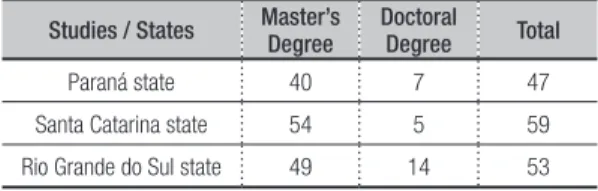
For the analysis of the research conducted in the graduate programs in southern Brazil from 2007 to 2011, we considered theses and dissertations available on the websites of the programs of Associação Nacional de Pós-Graduação e Pesquisa em Educação – Sul (Anped – National Association of Graduate Studies and Research in Education – South).6 The survey found a total of 169 studies (26 dissertations and 143 theses) across the three states that make up the region, as shown below.
Table 1 – Total number of theses and dissertations by state
Studies / States Master’s Degree
Doctoral
Degree Total
Paraná state 40 7 47
Santa Catarina state 54 5 59
Rio Grande do Sul state 49 14 53
Source: Survey conducted by the authors.
In the research groups identified here, there has been a growth and consolidation of the area of childhood education (initially triggered by research on early childhood education), and a reasonable establishment of the relationship between theory and practice in cross-disciplinary studies or collaboration studies.
Among the main research foci, we found an extension and deepening of the theoretical axes already indicated since the nineties7, as agreed on in the area of early childhood education, which led to the consolidation of what we call childhood pedagogy. Among the axes emphasized in that period, some stood out: childhood, its rights; social relations; language; play; mediation; the organization of space and time in the pedagogical practice of early childhood education; the relationship between education and care, and subsequently, children’s culture; participation; cultural diversity etc.
Compared to that earlier period, academic production related to education and childhood was much more restricted in quantity and limited in the underpinning theoretical framework and the methodological approaches used.8 This growth also reflects the consolidation of research groups regarding the theme of education and childhood and the emergence of lines of research in the graduate programs regarding such axis.
Following the strengthening in graduate programs, academic research started to give greater attention to theoretical deepening and to analysis of educational contexts from particular aspects of the pedagogical relationship. Theories of childhood and education are investigated and most studies are field research with direct interventions, ethnographic observations and records and a set of procedures that aim mainly to capture the voice, discourse or concepts of those involved in the educational relationship.
Studies on childhood and its constitution focus on small children, are dedicated to the theorization and analysis of the speeches
7- Please, see ROCHA (1999) and BRASIL (2001). 8- Please, see ROCHA (2010).
and meanings given by children to their own experience in different social and educational contexts, especially using contributions from sociology, philosophy and psychology.
Theoretical studies collate/compare reference authors and explore concepts and categories that may prove appropriate for understanding the determinations about childhood and the education of children. There was a significant recurrence in this direction, in which were found mainly doctoral dissertations about: the concept of childhood in academic production; childhood and subjectivity; being a child; childhood, experience and care; the rights and citizenship of children; body, sexuality, body beautification and generation; child sexualisation; gender; feeding of children and children and the media. This group focuses on philosophical, psychological and sociological underpinnings in dialogue with education, with emphasis on the conceptual appropriation of philosophy and the sociology of childhood. In the latter, as we have seen, we highlight the methodological orientation of the field studies with children.
We also see an expansion of the themes regarding the educational relationships in other social contexts, such as family and spaces outside the education system that introduce again theorizations about: maternal and paternal relations in the education of boys and girls; the rationale of education of family contexts with small children; socialization and care; childhood in poor urban settings; the perspectives of families regarding childcare; culture of indigenous children etc.
educational relations take (in the objective and subjective senses), since they are not restricted to the pedagogical and teaching processes as processes that are autonomous and independent of the political and social relation, mainly directed to anonymous and silenced subjects.
The category of studies that we started
defining as a pedagogical dimension can be
identified with what we said earlier about pedagogical research, i.e., the one whose nature, object and purpose are the educational processes and which uses as a basis for investigation the general and specific aspects that constitute them.
Among the studies on the theories of education, there are analyses on the production of recent Brazilian intellectuals on early childhood education, such as Paulo Freire, Dewey, Winnicott, precursors of kindergarten, and also educational conceptions of UNESCO. They also confront theories of language and of Brazilian Sign Language (LIBRAS), of ludicity and play, of learning and teaching to deepen assumptions that ground and give guidelines to the educational processes. In this set of studies, there is a basic concern with the pedagogical practice in early childhood education or in the early years of primary education, always associating conclusions with directions to teaching children, for initial and in-service training, for management and education policies directed at these stages of children’s education.
During this period, the perspectives of children are analyzed by capturing their voices and meanings in the study of: the social agency of babies and children’s cultures; ways of life in early childhood education and in the transition from this to school; the confrontation of children’s cultures and school cultures; children’s participation in pedagogical practice and even in the management of early childhood education; the relationship between peers in processes of inclusion, relations with television and the media, cultural production through music, leisure in the neighborhood; childhood in shelters; relations with nature
and the environment; narratives, expressed in drawings and body movement.
The term pedagogical practice is preferred by researchers to express the studies that analyze pedagogical actions targeting children, defined from: a curriculum guideline; a planning of the organization of space and time; the materials and the whole set of experiences in activities for children, with less presence of the studies that analyze curricula and assessment processes.9
The pedagogical practice or the teaching action was the most frequently analyzed dimension. The studies focus their attention on the numerous specific aspects involved both in early childhood education and in some cases in the early years and the transition from one level to another. The papers discuss: the pedagogical practice and the organization (dynamics of adult-child relationships, models and experiences); the presence and modes of expression and language (especially of music, drawing and, in one case, of sculpture and photography); cultural expression; the place of the imaginary and the media in the pedagogical practice; physical space; body and corporeality; space for movement and play; feeding practices; the language of babies in the pedagogical relationship and the use of toys; in such cases, always presenting directions for action.
Not only is the concern with practice more frequent but also has been expanding perspectives by associating with the theoretical contributions from education itself in dialogue with sociology and philosophy, with a prevalence of childhood studies and cultural studies, followed by the bases of psychology, language and arts. Accordingly, educational relations are also studied including dimensions previously little studied, such as child participation; childhood cultures or logics of children; social processes of transgressions and cultural production and reproduction in childhood in collective education.
Aspects related to the strictly pedagogical processes have also been analyzed in terms of the possibilities and limits of pedagogical documentation and records: portfolios, projects, school calendar and a virtual environment. The least studied topics, at least in this area of research, have been the concerns with specific learning such as initial arithmetics and operative learning; written language; music; study activities versus ludic activity. This group uses mainly educational spaces as a way to access a group of subjects/children and take them as an object of study, without establishing a relationship with the contextual dimensions and social and cultural belonging of the children.
The third category identified is that of the professionals and their education. It has studies on initial, continuing, in service and lato sensu education, introducing a deepening of theorizations on the establishment of teaching in early childhood, especially in the configurations that teaching takes in this scope of basic education. Here we find a strong question about: teaching in early childhood education regarding the theory-practice relationship, the professional specificity, and teacher metacognition; teacher subjectivity when acting as educators; symbolic mediation; the work of teachers and work history.
A variation of the professional title between its most generic form remains: professionals, and male or female educators. The most frequently mentioned term is professores (teachers) or docentes (teachers) in the female gender. Only two studies have included other professionals in the analysis of a democratic experiment of action of the pedagogical coordinator and of the work and performance of an assistant to the teacher.
Teacher education has a tradition of research in the area and maintains a clear question about the content and educational processes for the specificity of: children’s education or childhood pedagogy; teaching babies; intellectuals’ view of early childhood
education; theory-practice relationship; education models (technical-instrumental or emancipatory); relationship with the artistic-cultural training, and even about information technology, music, the female gender.
The number of studies on the understanding that female teachers have a wide variety of educational dimensions revealed a concern with the so-called conceptions; and also viewpoint, concept, discourse, speech, voice, social representation and perception. They analyze: the concepts of childhood and child development; the teaching of arts; body movement; and their own education; the quality of early childhood education; the ludic and aggressiveness. This emphasis requires a broader critical reflection on how one has understood the relations between discourse and actions, subjective and objective, and, ultimately, the very relationship between theory and practice in the knowledge about educational processes.
Finally, in a fourth dimension, the themes related to education policy and history allow attention to wider social determinants, traditional since the beginning of research in the area in Brazil, when researchers were also activists defending the rights of children and education. In the survey in question, we observed a predominance of research on regulations, and the enforcement of laws which resulted from these achievements. Those studies analyze processes of implementation of: special education, nine-year-long primary education, quality policies; municipal systems of education; regulation of early childhood education; municipal councils; local management; access, enrollment and waiting lists; participation of households, and funding of contracted child care centers.10
In conclusion, it is important to highlight how research perspectives have been consolidating knowledge about educational institutional contexts, particularly in early childhood education, linking such contexts to
the dimension of the broader issue of childhood and the political, historical and cultural questions that are involved in it and form it.
Final thoughts
A retrospective review of the history of research in the area of childhood and education, and particularly of early childhood education which we have often done, allows highlighting the strengthening of possible dialogues. Firstly, this progress has materialized thanks to the scientific opening to disciplinary and theoretical collaborations to the consolidation of a science of education that focuses on the educational processes that involve small children considering their social and cultural concreteness.
Undoubtedly there are still the challenges of overcoming classical dichotomies – as Alan Prout (2004) pointed out, when reconsidering the sociology of childhood. We recognize that recently we have seen growing possibilities of analysis of pedagogical practices by reintegrating children as a legitimate part of the educational relationship, but we have also seen the emphasis given (perhaps sometimes exaggerated) to children and their actions, at the risk of isolating them from the other relationships that define their own action. So much so that in many studies it is not yet possible to identify who the children are, girls and boys in the collective children, even when
such studies aim at knowing children’s cultures and productions.
In general, we can say that few studies manage to overcome the abstraction of social and cultural markers of class, ethnicity and gender of children, taking them sometimes only as a collective, rarely analyzing the educational relationship in a multireferential way, establishing a crossing of the positions of all the adults and children involved.
This difficulty to cross positions in the analysis of educational contexts could be the result of the effort to establish a disciplinary dialogue that leads us to fields outside that in which we have a basic trajectory: education. Possible dialogues require approaching paths of areas outside and appropriations of theoretical concepts until then unknown or unfamiliar, which is not only a complex task, but is also hindered by boundaries concerning theoretical choices within each area.
References
BRASIL. Educação infantil (1983-1996). Brasília: MEC/INEP/COMPED, 2001. Realização Universidade Federal de Santa Catarina/ CED/Nee0a6, 2001. (Estado do conhecimento, n. 2).
CAMPOS, Maria Malta. Para que serve a pesquisa em educação? Cadernos de Pesquisa, v. 39, n. 136, p. 269-283, 2009. Disponível em: <http://dx.doi.org/10.1590/S0100-15742009000100013>. Acesso em: 14 set. 2012.
GATTI, Bernardete Angelina. A pesquisa na pós-graduação e seus impactos na educação. Educação & Linguagem, v. 9, n. 14, p. 16-33, jul./dez. 2006.
MIALARET, Gaston. As ciências da educação. Lisboa: Moraes, 1980. (Coleção psicologia e pedagogia)
PROUT, Alan. Reconsiderar a nova sociologia da infância: para um estudo interdisciplinar das crianças. Ciclo de conferências em sociologia da infância 2003/2004. Departamento de Ciências Sociais Aplicadas. Universidade de Stirling, 2004.
ROCHA, Eloisa Acires C. A pesquisa em educação infantil no Brasil: trajetória recente das perspectivas de consolidação de uma pedagogia. Florianópolis: Núcleo de publicações, Centro de educação da Universidade Federal de Santa Catarina, 1999.
ROCHA, Eloisa Acires C. et al. Educação infantil (1983-1996). Brasília, DF: MEC/INEP/COMPED, 2001. (Estado do conhecimento, n. 2).
______. 30 anos da educação infantil na ANPED. In: SOUZA, Gizele (Org.). Educar na infância: perspectivas histórico-sociais. São Paulo: Contexto, 2010. p. 157-170, v. 1.
SILVA, Isabel de Oliveira e; LUZ, Iza Rodrigues da; FARIA FILHO, Luciano Mendes de. Grupos de pesquisa sobre infância, criança e educação infantil no Brasil: primeiras aproximações. Revista Brasileira de Educação, v. 15, n. 43, p. 84-98, jan./abr. 2010.
Received on Oct 18th, 2012
Approved on Feb 26th, 2013
Eloísa Acires Candal Rocha is a Professor at the Universidade Federal de Santa Catarina (UFSC), and the coordinator of
Núcleo de Estudos e Pesquisas da Educação na Pequena Infância (NUPEIN), Center for Research and Education in Early
Childhood).
Márcia Buss-Simão is a Professor at the Graduate Program in Education of the University of Southern Santa Catarina.
(Universidade do Sul de Santa Catarina - UNISUL). She holds a doctorate in Education from the University of Santa Catarina