Editorial
399 Rev Bras Hematol Hemoter. 2012;34(6):399-400
The journal in PubMed and the lessons of the SciELO/Fapesp seminar on journal performance
Milton Artur Ruiz
Editor-in-chief
Revista Brasileira de Hematologia e Hemoterapia
Submitted: 11/23/2012 Accepted: 11/24/2012
Corresponding author:
Milton Artur Ruiz
Rua Catarina Nucci Parise, 760, Jardim Vivendas 15090-470 São José do Rio Preto, SP, Brazil [email protected]
www.rbhh.org or www.scielo.br/rbhh DOI: 10.5581/1516-8484.20120105
The third seminar, coordinated by SciELO and Fapesp, on the evaluation of the performance of Brazilian journals took place in September in São Paulo.
With the editors of most of the Brazilian journals linked to SciELO and Fapesp attending, the contribution of these two institutions was demonstrated in the event, as was the promising
results observed since the irst meeting held three years ago. It was reported that there has been an increase in the number of journals published in English. In the SciELO database,
for example, the proportion increased from 33% to 66% over three years and the progress of
Brazil in the indexation of journals in the JCR/ISI/Thomson Reuters has been very expressive. The increase in Brazilian scientiic production with indexation of journals in the World of
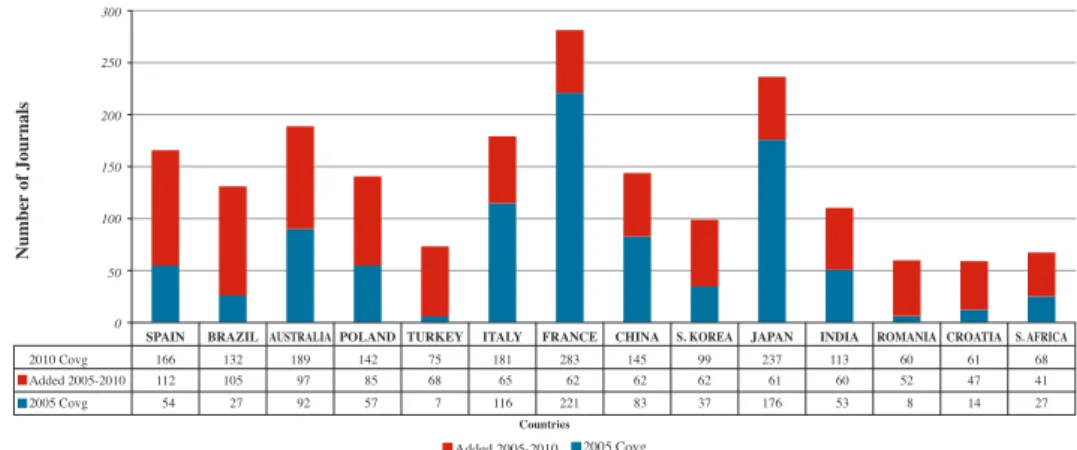
Science (WOS) of Thomson Reuters since 2005 is shown in Figures 1 & 2(1).
Figure 1 - 2005-2010: Countries that added over 40 titles to Web of Science
For the irst time in the area of health sciences, Brazilian journals have an Impact Factor (IF) higher than two and there is an increasing number of journals with IFs higher than one or
that are close to this value.
In the event, the Editor-in-Chief of the journal Frontiers in Ecology and the Environment, Sue Silver gave a speech on the theme “Scientiic journals: raising proiles, prospects and Impact Factors”.
Figure 2 - 2005-2010: Clinical medicine - countries with greatest increase in coverage Countries
Added 2005-2010 2005 Covg
0 50 100 150 200 250 300
2010 Covg Added 2005-2010 2005 Covg
166 112 54
SPAIN
132 105 27
BRAZIL
189 97 92
AUSTRALIA
142 85 57
POLAND
75 68 7
TURKEY
181 65 116
ITALY
283 62 221
FRANCE
237 61 176
JAPAN
145 62 83
CHINA
99 62 37
S. KOREA
61 47 14
CROATIA
68 41 27
S. AFRICA
113 60 53
INDIA
60 52 8
ROMANIA
Number
of Journals
2005-2010: COUNTRIES THAT ADDED OVER 40 TITLES DO WEB OF SCIENCE
Countries
0 10 20 30 40 50 60 70
Number
of Journals Cove
re
d
2010 Covg
Added 2005-2010
2005 Covg
AUSTRALIA
57
38
19 67
31
36
FRANCE
30
27
3
BRAZIL
50
25
25
ITALY
50
23
27
JAPAN
34
22
12
SPAIN
26
24
2
TURKEY
22
20
2
POLAND
18
15
3
S. KOREA
15
15
0
IRAN
400 Editorial
Rev Bras Hematol Hemoter. 2012;34(6):399-400
With her experience with the implantation of the journal The Lancet Oncology, Sue Silver listed the different measures that enabled her as editor of Frontiers in Ecology and the Environment to index
the journal in the WOS in 2003 and to attain an IF of 3.32 by 2005; the current IF is 9.113. This IF is very high for medical
journals. The magic formula to achieve this, as described by the Editor-in-Chief, is simply based on a professional organization of the journal, work and dedication at all levels of the editorial process and attaining a high-level of consultancy in the editorial, internal and marketing boards with the goal of deploying a judicious evaluation of the high-level
scientiic contributions that will be published. Sue Silver cited
strategies on how to attract good authors and thus good papers for publication in the Frontiers in Ecology and the Environment. With this, the articles started to be cited and as a result there
was an exponential increase in the IF as previously mentioned. This apparently trivial measure (that is dificult for some scientiic institutions to understand) put Frontiers in Ecology
and the Environment in second place of all journals in the area of environmental sciences worldwide. The Ecology Society of American that publishes the pleasant modern looking ‘Frontiers in Ecology and the Environment’ also publishes several other journals available both in print and on electronic media including with the use of new tools to access issues such as iPad.
Subsequently, in the SciELO/Fapesp meeting, several editors commented on their experiences and it became perfectly
clear that indexation by JCR/ISI/Thomson Reuters and obtaining an IF is the Holy Grail of publishing, of scientiic production and
of the evaluation of researchers, especially in Brazil(2). However,
several publications have shown that the IF is not a good
instrument to evaluate researchers and even the editor of Science has shown strong doubts in relation to this bibliometric index(2-5).
With all the hype mixed with the excessive patriotism of a large country and of an emerging country expressed in the event, the Revista Brasileira de Hematologia e Hemoterapia has learned and followed the strategies of specialty journals that are less favored by funding agencies and by CAPES(7). Even with the
dificulties of a scientiic journal that relies on its own inances, it
is necessary to learn from the lessons of this and previous events: to overcome barriers, organize the journal’s structure, to prepare a fearless and dedicated editorial staff, to expand the editorial board
with international members, to start to publish in English and after two years in Lilacs, ExtraMed Scopus and SciELO become
indexed in PubMed thereby giving deinitive and international
visibility to articles(8-11). We consider this moment in the history
of the journal to be an extremely special, but emblematic, one as achieving indexation in PubMed should just be considered another step in the evolution of the journal, a step that gives a greater degree of responsibility to the hematology and transfusion medicine community as a whole. We have an obligation to maintain the
scientiic journal and modernize it in order to adapt it for the culture
shock that has already arrived with developments in electronic media and new manners to access and divulge journals.
We are only at the start.
References
1. Testa J. The globalization of Web of Science 2005-2010. 2011 [cited 2012 Nov 23] Available from: http://wokinfo.com/media/pdf/globalwos-essay.pdf
2. Saha S, Saint S, Christakis DA. Impact factor: a valid measure of journal quality? J Med Libr Assoc. 2003;91(1):42-6.
3. Greenwood DC. Reliability of journal impact factor rankings. BMC Med Res Methodol. 2007;7:48.
4. Brown H. How impact factors changed medical publishing and science. BMJ. 2007;334(7593):561-4.
5. Ruiz MA, Greco OT, Braile DM. Journal Impact factor: this editorial academic and scientiic inluence. Rev Bras Cir Cardiovasc. 2009;24(3):273-8.
6. Pivetta M, Marques F. Ensinar ciência é preciso. Revista Pesquisa Fapesp. 2012;199: 28-33.
7. Ruiz MA. The Revista Brasileira de Hematologia e Hemoterapia now and discussion on the new classiication of Brazilian journals. Rev Bras Hematol Hemoter. 2011;33(5): 325-6.
8. Ruiz MA. The journal’s performance in 2011. Rev Bras Hematol Hemoter. 2011;33(6):399.
9. Ruiz MA. Countries emerging as major scientiic powers. Rev Bras Hematol Hemoter 2011;33(3):169-71.
10. Ruiz MA. Challenge of emerging countries: barriers to get published. Rev Bras Hematol Hemoter. 2012;34(2):71-2.
11. Ruiz MA. Challenge of emerging countries: a relatively positive view for the future. Rev Bras Hematol Hemoter. 2012;34(3):173-4.