Spanish adaptation and validation of the
supportive & palliative care indicators
tool – SPICT-ES™
Alfonso Alonso FachadoI, Noemí Sansó MartínezII, Marisa Martín RosellóIII, José Javier Ventosa
RialIV, Enric Benito OliverV, Rafael Gómez GarcíaIII, José Manuel Fernández GarcíaVI
I Servizo Gallego de Saúde. Subdirección General de Planificación y Programacion Asistencial. Santiago de Compostela, Galicia, España
II Universidad de las Islas Baleares. Facultad de Enfermería y Fisioterapia. Mallorca, Islas Baleares, España
III Fundación Cudeca. Málaga, Andalucía, España
IV Complejo Hospitalario Universitario de Ferrol. Servizo Galego de Saúde. Ferrol, Galicia, España
V Universidad Francisco de Vitoria. Madrid, España
VI Centro de Salud de Porto do Son. Servizo Gallego de Saúde. Porto do Son, Galicia, España
ABSTRACT
OBJECTIVE: To culturally adapt and validate the SPICTTM to Spanish, which is a brief and simple
tool to support a better identiication of chronic patients who have palliative care needs. METHODS: For this study, we designed a multicenter and national project between the centers
of Galicia, Balearic Islands, and Andalusia. For the process of translation and cross-cultural
adaptation of the SPICTTM to Spanish, we followed the steps proposed by Beaton et al. with
successive translations and subsequent consensus of experts using the debrieing methodology. After the content validation was completed, the psychometric properties were validated.
A prospective longitudinal study was designed with 188 patients from Galicia, the Balearic Islands,
and Andalusia. he internal consistency and reliability of the test and retest was analyzed for 10 days by the same researcher.
RESULTS: For more than 90% of the participants of the SPICT-ESTM, it seems simple to be illed
out, and they consider it written in an understandable language. he average time to apply the questionnaire without prior knowledge was 4 minutes and 45 seconds. To evaluate the internal consistency of the instrument, we used the Kuder-Richardson formula 20. Internal consistency is 0.71. he agreement index of the Kappa test is between 0.983 and 0.797 for the diferent items. CONCLUSIONS: In this study, we demonstrate the equivalence of content with the original. In addition, the validation of the psychometric properties establishes that the SPICT-ESTM
maintains adequate reliability and stability. If we add the satisfaction shown by the professionals and the ease of use, the SPICT-ESTM is an adequate tool for the identiication of palliative patients
with chronic diseases and palliative care needs.
DESCRIPTORS: Palliative Care Clinical Decision-Making. Decision Support Techniques. Surveys and Questionnaires, utilization. Translations. Validation Studies. Multicenter Study.
Correspondence: Alfonso Alonso Fachado
Subdirección general de Planificación y Programación Asistencial Dirección general de Asistencia Sanitaria Servicio Gallego de Salud Edificio Administrativo de San Lázaro, s/n
15707 Santiago de Compostela, A Coruña, España
E-mail: [email protected]
Received: Dec 5, 2016 Approved: Dec 21, 2016
How to cite: Alonso-Fachado A, Sansó-Martínez N, Martín-Roselló M, Ventosa-Rial J, Benito-Oliver E, Gómez-García R, et al. Spanish adaptation and validation of the supportive & palliative care indicators tool – SPICT-ES™. Rev Saude Publica. 2018;52:3.
Copyright: This is an open-access article distributed under the terms of the Creative Commons Attribution License, which permits unrestricted use, distribution, and reproduction in any medium, provided that the original author and source are credited.
INTRODUCTION
One of the diiculties faced by professionals working with chronic patients is the identiication of which patients have palliative care needs. To date, at the international level, there are
several questionnaires that have been designed to detect palliative patients, among them
the RADboud indicators for Palliative Care Needs, RADPAC1, or the Prognostic Indicator
Guide, GSF/PIG2. In Spain, the NECPAL CCOMS-ICO questionnaire was also prepared by Gómez-Batiste et al.3
he fundamental objective of palliative care in any sanitary or socio-sanitary service is to alleviate sufering and improve as much as possible the quality of life of patients who have a
chronic illness with a limited life prognosis4. In this sense, there are few objective identiication
criteria or validated tools to support physicians in the task of identifying a transition point to begin integrating palliative care5. For this reason, it is important to recognize the inlection
point from which the patient will beneit from a more intense palliative care. he diiculty is to determine the moment that will mark the inclusion of this person in a speciic palliative care. he establishment of this moment, marked by the separation between advanced chronic disease and palliative transition, has been deined by Boyd and Murray6. he importance of
identifying it is based on avoiding the so-called “prognostic paralysis” of the professional, which can delay a change of focus in the patient for a long time. Professionals should be aware of the possibility that a patient can beneit from supportive and palliative care, fundamental for the ofering of a better care at the end of his or her life6.
To this end, the University of Edinburgh Primary Palliative Care Research Group and the NHS Lothian (Edinburgh, Scotland) developed the SPICTTM in 20107, in order to create a guide that would identify and provide the necessary guidelines to carry out a plan of care
in patients with palliative care needs. In this project, we used the version of the SPICTTM
questionnaire from November 2013, accessible at the following electronic address: http://www.spict.org.uk/the-spict/spict-es/spict-es-download/.
his article describes the process of translation, adaptation to Spanish, and validation of
the psychometric properties of the SPICTTM, in order to establish the validity of content,
reliability, and stability of the scale that will allow us to conirm that it is equivalent to the original. he SPICTTM has 27 items with a yes/no dichotomous response and a inal
compartment in which the necessary plan of care is deined in case the patient is identiied as needing palliative care. he 27 items are grouped into two categories: the irst one with
general indicators of health deterioration, and the second one with clinical indicators of
advanced disease. he identiication of the patient with palliative needs is based on the
existence of at least two indicators of general health deterioration associated with an
indicator of advanced disease.
The SPICT-ESTM is a simple, one-page tool with indicators of health deterioration, usually
present in advanced diseases, and a language easily understandable for its completion. Data show that this tool identifies 48% of all those who will die within the next 12 months after completing the SPICT criteria. This questionnaire has a sensitivity of 70% and a specificity of 87%, according to a study with 1,546 patients aged over 70 years in a
health center8.
he purpose of this study was to translate, cross-culturally adapt to Spanish, and validate the Spanish version of the SPICT-ESTM in order to comply with the criteria of equivalence
with the original.
METHODS
Foundation (Fundación de Cuidados del Cáncer) of Malaga. he three organizations that participated have the necessary experience to carry out this project. he irst two are
responsible for coordinating the Plans and Strategies for Palliative Care in their Autonomous
Communities. he third one develops an important work as an institution that provides
comprehensive care to cancer patients and their families, from the creation of a complete
program of palliative care, information, training, and research in the Malaga area.
In order to carry out this study, we irst asked for the permissions needed from the authors of the original tool to adapt it to Spanish. At that time, a central committee of seven experts was set up to coordinate and review the documentation. hen, we followed the translation and back-translation method proposed by Beaton et al.9 For this, we established the following
steps (Figure):
1. Translation: the Spanish translation of the original version was carried out by three independent experts luent in English. he three translations sought to keep the
Figure. Scheme of the process of adaptation of the SPICT-ESTM.
Translation A Translation B Translation C
Consensus version 1 per expert group
(v1)
First pilot test
English back-translation A
English back-translation B
Pre-final version
Pre-final pilot test
Final version SPICT-ESTM
Consensus version 2 per expert group
equivalence of content with the original. Subsequently, a irst consensus version (v1) was created between the three versions with a documented report on the diferent discrepancies and how they were solved.
2. Administration of the irst version: this version was administered by a group of 22 professionals specialized in palliative care, establishing a proportional subsample between the three institutions in order to evaluate the diiculty of understanding the scale and the time required for the application. he results were analyzed by the central committee of experts to agree on a second version of the scale (v2).
3. Back-translation: the consensus version of the scale was translated into the
original language in order to prove the equivalence of the content of the items of the
scale with the original. Two back-translations were carried out by two independent
bilingual translators who did not know each other in order to create two independent
back-translations. One of the translators speaks Spanish as a native language and the other one English; both were unaware of the original questionnaire. he group of experts analyzed the back-translated versions along with the original to carry out a new consensus version (pre-inal version) to maintain the semantic, idiomatic, and concept equivalence with the original.
4. Pilot test of the final version: the final version was evaluated in a pre-test by a group of 30 health professionals to evaluate the comprehensibility of the
scale and to verify what the professional would estimate as the meaning of each
item and answer.
5. Presentation of the documentation to the authors of the original questionnaire in
order to prove that all steps were taken in the development of this adaptation of the SPICTTM to Spanish.
To evaluate the comprehensibility of the tool, we used the debrieing methodology with health and non-health professionals10,11 to identify the words or concepts that were diicult to be
interpreted, determine questions that cannot be answered with precision or that expose doubts in their answer, evaluate the sensitivity of the questions, and obtain suggestions for
the reviewing of the wording of the questions in the questionnaire.
Validation of the Psychometric Properties of the Scale
In a second phase, the psychometric properties of the Spanish version of the SPICT-ESTM
were evaluated, in order to know the internal consistency and stability of the tool. For this phase, and following the recommendation of Nunnally12, we determined that the minimum number of subjects required for the validation of the psychometric properties should be ive times greater than the number of items. In this case, 135 patients would be needed as the questionnaire has 27 items. We established 30% for non-responses, so the minimum number deined as deinitive was 176 patients.
Statistical Analysis
To carry out the statistical analysis necessary for the validation of the psychometric
properties of the questionnaire, the programs SPSS v.13 and EPIDAT were used. We used the Kuder-Richardson 20 to calculate internal consistency and the kappa test for the evaluation
of the stability of the tool or agreement in the same observer, using the test and retest
evaluation by the same researcher with a diference of ten days between them.
Ethical Aspects
RESULTS
Results of the Content Validity with the Original
During the procedure of adapting the tool to Spanish, the following detected discrepancies
needed a special agreement among researchers:
1. he item “lives in a nursing care home or NHS continuing care unit, or needs care to remain at home” was translated to “institutionalized or needs care to remain at home”,
as the network of hospitals of continuous care is scarce in Spain and, in addition, the
concept of institutionalization already includes all the patients that are part of the health system.
2. he item “choosing to eat and drink less; diiculty maintaining nutrition”was translated as “decreased intake, diiculty maintaining adequate nutrition”. In this case, the concept
of choice by a patient with dementia was debated by the group of experts, who inally opted for the concept of decreased intake. he concept of choice in a dependent patient did not have suicient consistency if he or she had some form of dementia.
Subsequent administration of the irst version was performed on a sample of 30 health
professionals, and the average time to complete the questionnaire was 4 minutes and
45 seconds the irst time it was applied by the professional.
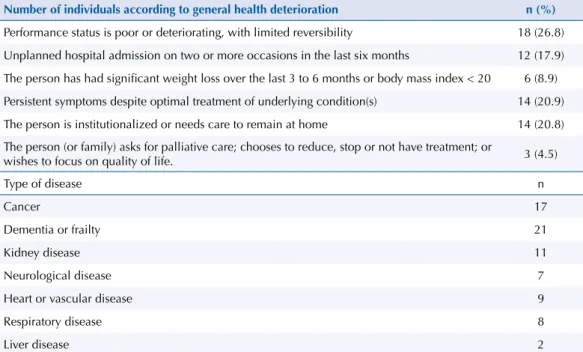
For 95.5% of the participants, the questionnaire was simple to complete, and 90% considered it written in an understandable language. he main results of the administration phase are in Table 1.
Result of the Validation of the Psychometric Properties
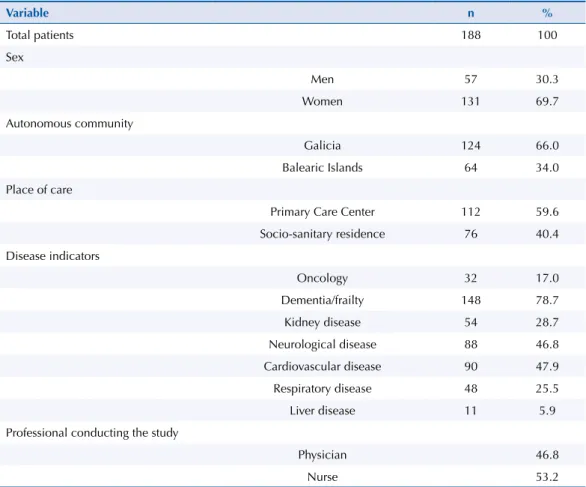
We obtained a inal sample of 188 individuals. Mean age is 82.71 years (SD = 8.85). he age range of the patients is between 52 years and 101 years. he test-retest interval is 10.6 days. he main descriptive results of the validation phase are in Table 2.
Internal Consistency Analysis
In order to evaluate the internal consistency of the instrument, we used the Kuder-Richardson formula 20 (KR-20), since it is the most appropriate test for the scale based on
Table 1. Results of the pilot phase.
Number of individuals according to general health deterioration n (%)
Performance status is poor or deteriorating, with limited reversibility 18 (26.8)
Unplanned hospital admission on two or more occasions in the last six months 12 (17.9)
The person has had significant weight loss over the last 3 to 6 months or body mass index < 20 6 (8.9)
Persistent symptoms despite optimal treatment of underlying condition(s) 14 (20.9)
The person is institutionalized or needs care to remain at home 14 (20.8)
The person (or family) asks for palliative care; chooses to reduce, stop or not have treatment; or
wishes to focus on quality of life. 3 (4.5)
Type of disease n
Cancer 17
Dementia or frailty 21
Kidney disease 11
Neurological disease 7
Heart or vascular disease 9
Respiratory disease 8
dichotomous indexes. he result obtained for internal consistency is 0.71. his value allows us to airm that it presents an adequate index of internal consistency since it is in the range between 0.70 and 0.90.
Analysis of the Stability of the Scale
To evaluate the stability of the scale, we used the index of agreement of the Kappa test, with
a test-retest analysis by the same observer. In the study design, we determined that it would be performed 10 days after the irst one. he intraclass correlation coeicient data is in the range between 0.983 and 0.797.
DISCUSSION
Before a questionnaire is applied to the general population, it must be validated in a sample
of patients. he validation process of a tool has its own methodology, which includes a standardized procedure to evaluate both its reliability and validity. One of the main conclusions of the systematic review published by Maas et al.5 is that, although several
tools to identify patients with palliative needs have been developed, none have been
validated or widely used in Europe. Further collaboration in the international development, implementation, and evaluation of these tools is recommended. his is one of the objectives of this study.
he Spanish version of the SPICT-ESTM
(http://www.spict.org.uk/the-spict/spict-es/spict-é-download/), created originally in English, was translated and adapted culturally to Spanish according to the methodological steps stipulated in the literature. It was evaluated according to experts and analyzed by groups of professionals, keeping the necessary semantic, idiomatic, cultural, and content equivalence with the original instrument. It presents an excellent acceptability by the professionals who used it, both the physicians and nursing staf of the
Table 2. Results of the validation phase of the psychometric properties of the scale.
Variable n %
Total patients 188 100
Sex
Men 57 30.3
Women 131 69.7
Autonomous community
Galicia 124 66.0
Balearic Islands 64 34.0
Place of care
Primary Care Center 112 59.6
Socio-sanitary residence 76 40.4
Disease indicators
Oncology 32 17.0
Dementia/frailty 148 78.7
Kidney disease 54 28.7
Neurological disease 88 46.8
Cardiovascular disease 90 47.9
Respiratory disease 48 25.5
Liver disease 11 5.9
Professional conducting the study
Physician 46.8
Palliative Care Units, as well as in the Primary Care Centers or Residential Centers where it was used. he questionnaire took 4 minutes to be completed the irst time it was used
without previous training, which allows us to assume that it will decrease according to
practice. A fundamental aspect of any measuring tool is, on the one hand, the deinition of
the patients that it wants to identify in the best possible way and, on the other hand, the
quick application and short time to be illed. In this sense, we demonstrated in this article that the SPICT-ESTM meets both requirements.
Until today, the only tool available for the Spanish population to identify patients with
palliative care needs is the NECPAL-CCOMS-ICO©. The most recent version of the
NECPAL-CCOMS-ICO© 3.0 from 2016 considered a reduction of the items in relation to the
original. In this sense, we estimate that both this tool and the SPICT-ESTM can be compatible,
and more studies are needed to identify at which point of the palliative transitions6 they
are. As for the SPICT-ESTM, it is a tool that presents an adequate content validity in relation
to the original, and according to the palliative care professionals who have adapted it to
Spanish, it correctly identiies patients with care needs with adequate reliability and validity.
One of the limitations of this study was to deine the time that must elapse from the test to the retest. In this case, we opted for 10 days. It may seem low, but we needed to adjust this time since the average stay of patients in palliative units is approximately eight days. hus, the initial suggestion was reduced from ifteen days to 10 days.
An important diference of the SPICT-ESTM in relation to other tools is the exclusion of
the surprise question from the questionnaire for the identiication of palliative patients. We consider that the surprise question implies the inclusion of subjective criteria that can alter the application of the questionnaire. he inclusion of objective criteria when deining the situation of palliative need is one of the important parts of this tool. Nevertheless, the surprise question and the SPICT-ESTM are not incompatible. he surprise question
is a general indicator, but it should not be used in isolation without a more extensive evaluation13, with the use of speciic questionnaires and with a greater degree of objectivity that allow greater reliability.
he association of the SPICT together with another tool to evaluate the complexity of the palliative patient, such as the IDC-PAL14 questionnaire, would ofer the best socio-sanitary
resource for each person who is in a situation of advanced disease with a limited life
expectancy. In addition to the obvious beneits for patients, it would be important to reduce the costs of health systems.
In this sense, several studies show that the application of unnecessary procedures to patients
with a terminal illness produce an unjustiied increase in health expenditure15. Bloom and
Kissick16 have found that the cost of hospital care in the last two weeks of life in patients with
palliative care needs was 10.5 times higher when compared to home care. his increase in
hospital costs was related to the application of diagnostic and therapeutic procedures that
were more technologically intensive, applied until the death of the patient. Similarly, Cheung et al.17, in a cohort study with 107,253 persons, have found that costs were 43% higher in cancer patients who received care according to an acute model compared to those who received
non-aggressive care. In order to solve these problems, more tools are needed to improve the ability to identify and diagnose palliative patients. he inal objective should be to improve
the capacity for intervention at the end of life at the community level in order to change the
current proile of care to a greater extra-hospital care of these patients18. We believe that the
SPICT-ESTM can be a useful tool for the quick identiication of these patients because of its
ease of use and reliability characteristics.
he SPICT-ESTM is a new tool to identify patients with palliative needs in the Spanish-speaking
population. It would be added to the NECPAL CCOMS-ICO© 3.0 for the same task. hese questionnaires are fundamental for the establishment of identiication criteria to be
anticipation or at a very late stage, which is the most frequent case, depriving patients of
the beneits of receiving quality palliative care. In the future, new studies should be carried out to identify the speciicity and sensitivity values of the tool more accurately in a larger sample. here is also the need to integrate it into the evaluation of the patient as an advanced chronic disease, with personalized evaluation plans for each patient.
REFERENCES
1. Thoonsen B, Engels Y, Rijswijk E, Verhagen S, van Weel C, Groot M, et al. Early identification of palliative care patients in general practice: development of RADboud indicators for PAlliative Care Needs (RADPAC). Br J Gen Pract. 2012;62(602):e625-31. https://doi.org/10.3399/bjgp12X654597
2. Gold Standards Framework. Welcome to the GSF Centre. Shrewsbury (UK); c2017 [cited 2016 Nov 12]. Available from: http://www.goldstandardsframework.org.uk/
3. Gómez-Batiste X, Martínez-Muñoz M, Blay C, Amblàs J, Vila L, Costa X. Identificación de personas con enfermedades crónicas avanzadas y necesidad de atención paliativa en servicios sanitarios y sociales: elaboración del instrumento NECPAL CCOMS-ICO©. Med Clin (Barc). 2013;140(6):241-5. https://doi.org/10.1016/j.medcli.2012.06.027
4. Ministerio de Sanidad y Consumo (ES). Estrategia en cuidados paliativos del Sistema Nacional de Salud. Madrid: Centro de Publicaciones del Ministerio de Sanidad y Consumo; 2007 [cited 2017 Jul 24]. Available from: http://www.aepcp.net/arc/estrategiaCuidadosPaliativos.pdf
5. Maas EAT, Murray SA, Engels Y, Campbell C. What tools are available to identify patients with palliative care needs in primary care: a systematic literature review and survey of European practice. BMJ Support Palliat Care. 2013;3(4):444-51. https//doi.org/10.1136/bmjspcare-2013-000527
6. Boyd K, Murray SA. Recognising and managing key transitions in end of life care. BMJ. 2010;341:c4863. doi: https://doi.org/10.1136/bmj.c4863
7. Highet G, Crawford D, Murray SA, Boyd K. Development and evaluation of the Supportive and Palliative Care Indicators Tool (SPICT): a mixed-methods study. BMJ Support PalliatCare. 2014;4(3):285-90. https://doi.org/10.1136/bmjspcare-2013-000488
8. Rhee J, Mitchell G, Senior H, Kong Teo C, Clayton J. Prediction of death in general practice: a cluster randomized controlled study [oral presentation]. The RACGP Conference for General Practice; Adelaida, Australia, 10 Oct 2014. Disponible en: http://racgpconference.com.au/wp-content/uploads/2014/11/Chronic-conditions-Prediction-of-death-in-gp-Dr-Joel-Rhee.pdf
9. Beaton DE, Bombardier C, Guillemin F, Ferraz MB. Guidelines for the process of cross-cultural adaptation of self-report measures. Spine. 2000;25(24):3186-91. https://doi.org/10.1097/00007632-200012150-00014
10. Hess J. The role of respondent debriefing questions in questionnaire development. In: Proceedings of the American Statistical Association, Section on Survey Research Methods; 1995 [cited 2016 Nov 12]. Available from: https://www.researchgate.net/ publication/238189777_THE_ROLE_OF_RESPONDENT_DEBRIEFING_QUESTIONS_IN_ QUESTIONNAIRE_DEVELOPMENT
11. Hughes KA. Comparing pretesting methods: cognitive interviews, respondent debriefing, and behavior coding. Washington (DC): US Bureau of the Census, Statistical Research Division; 2004 [cited 2017 Jul 24]. (Research Report Series. Survey Methodology #2004-02). Available from: https://www.census.gov/srd/papers/pdf/rsm2004-02.pdf
12. Nunnally JC. Psychometric theory. 2 ed. New York: McGraw-Hill; 1978. (McGraw-Hill series in Psychology).
13. Murray SA, Boyd K. Using the ‘surprise question’ can identify people with advanced heart failure and COPD who would benefit from a palliative care approach. Palliat Med. 2011;25(4):382. https://doi.org/10.1177/0269216311401949
15. Gardiner C, Ward S, Gott M, Ingleton C. Economic impact of hospitalisations among patients in the last year of life: an observational study. Palliat Med.;2014;28(5):422-9. https://doi.org/10.1177/0269216313517284
16. Bloom BS, Kissick PD. Home and hospital cost of terminal illness. Med Care. 1980;18(5):560-4.
17. Cheung MC, Earle CC, Rangrej J, Ho TH, Liu N, Barbera L, et al. Impact of aggressive management and palliative care on cancer costs in the final month of life. Cancer. 2015;121(18):3307-15. https://10.1002/cncr.29485
18. Nuño-Solinis R, Herrera Molina E, Flores SL, Orueta Mendía JF, Cabrera-León A. Actividad asistencial y costes en los últimos 3 meses de vida de pacientes fallecidos con cáncer en Euskadi. Gaceta Sanit. 2016. https://doi.org/10.1016/j.gaceta.2016.06.005
Authors’ Contribution: Project and planning of the study: AAF, JJVR, JMFG. Recompilation, analysis, and
interpretation of the data: AAF, NSM, MMR, RGG. Preparation or review of the study: AAF, NSM, MMR, JJVR, EBO, RGG, JMFG. Approval of the inal version of the article: AAF, NSM, MMR, JJVR, EBO, RGG, JMFG. Public responsibility for the content of the article: AAF, NSM, MMR, JJVR, EBO, RGG, JMFG.