352 352
Busnello et al
Dropout of hypertension treatment
Arq Bras Cardiol 2001; 76: 352-4.
Hospital de Clínicas de Porto Alegre - UFRGS
Mailing address: Renné Gusmão Busnello – Av. Lavras, 341/303 – 90460-040 – Porto Alegre, RS, Brazil
English version by Stela Maris C. Gandour
Objective - To determine the characteristics associa-ted with the dropout of patients followed up in a Brazilian out patient clinic specializing in hypertension.
Methods - Planned prospective cohort study of pa-tients who were prescribed an antihypertensive treatment after an extensive initial evaluation. The following para-meters were analyzed: sex, age, educational level, dura-tion of disease, pressure level used for classifying the pa-tient, previous treatment, physical activity, smoking, alco-hol consumption, familial history of hypertension, and le-sion in a target organ.
Results – We studied 945 hypertensive patients, 533 (56%) of whom dropped out of the follow-up. The mean age was 52.3±12.9 years. The highest probabilities of dropout of the follow-up were associated with current smoking, relative risk of 1.46 (1.04-2.06); educational level equal to or below 5 years of schooling, relative risk of 1.52 (1.11-2.08); and hyper-tension duration below 5 years, relative risk of 1.78 (1.28-2.48). Age increase was associated with a higher probability of follow-up with a relative risk of 0.98 (0.97-0.99).
Conclusion – We identified a group at risk for drop-ping out the follow-up, which comprised patients with a lower educational level, a recent diagnosis of hypertension, and who were smokers. We think that measures assuring adherence to treatment should be directed to this group of patients.
Key words - systemic hypertension, dropout, treatment
Arq Bras Cardiol, volume 76 (nº 5), 352-4, 2001
Renné Gusmão Busnello, Raquel Melchior, Carlo Faccin, Daniela Vettori, Juliano Petter, Leila Beltrami Moreira, Flávio Danni Fuchs
Porto Alegre, RS - Brazil
Characteristics Associated with the Dropout of
Hypertensive Patients Followed Up in an Outpatient
Referral Clinic
Original Article
Systemic hypertension is an important risk factor for cardiovascular diseases 1-3, and it has a high prevalence in
the Brazilian adult population. In Porto Alegre, the capital of the State of Rio Grande do Sul in the Southern region of Brazil, approximately 13% of the adults have systemic hy-pertension 4.
Sustained elevated blood pressure levels are related to a higher incidence of morbid events, are mainly associated with atherosclerosis, and may manifest as ischemic heart sease, cerebral stroke, and renal and peripheral vascular di-seases 5,6. On the other hand, in several clinical trials 7-9, a
re-duction in fatal and nonfatal cardiovascular events has be-en associated with the medicambe-entous treatmbe-ent of hyper-tension, mainly with thiazide diuretics and beta-blockers.
In addition, observational studies have shown that most patients with a diagnosis of hypertension have poor adherence to treatment 10-14, even though we observe that,
in the clinical practice, some patients do not even return for regular medical visits. Fuchs et al 15 have reported a
dro-pout of the regular outpatient clinic follow-up of approxima-tely 45% in a cohort with hypertensive patients.
The objective of this study was to determine the cha-racteristics associated with the dropout of medical follow-up of patients treated for systemic hypertension, aiming to identify which patients could potentially benefit from the creation of a system of active follow-up.
Methods
Arq Bras Cardiol 2001; 76: 352-4.
Busnello et al Dropout of hypertension treatment
353 353
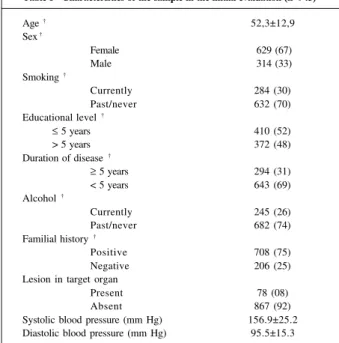
pressure were included in the study. The classifying blood pressure used for the diagnosis of hypertension was calcu-lated by the mean of 6 measurements obtained in 3 consecu-tive medical visits, following the technical recommendations established in the international consensus (Sixth Joint Na-tional Committee, 1997) 10. Characteristics of the sample are
shown in table I. Those patients who did not have at least 12 months of follow-up were excluded from the study, as were also a few cases of irregular follow-up with a late return to medical visit.
Dropout of medical follow-up was defined as the no-show to follow-up in a period from 12 to 24 months after the initial evaluation. The control group comprised patients who underwent regular follow-up.
The following variables were analyzed: sex, age (≤ or > 60 years), educational level (schooling ≤ or >5 years), dura-tion of disease (time since the first diagnosis of hypertension reported by the patient ≤ or > years), classifying blood pressure (mean of 6 measurements in 3 consecutive medical visits, during the initial evaluation), previous treatment (use of antihypertensive medication in the past or outpatient cli-nic follow-up already started, under medication), physical activity (regular physical exercise practice), smoking (cur-rent, in the past, or never), alcohol (independent from the amount consumed, current, in the past, or never), familial history of hypertension, and lesion in a target organ (reper-cussion of hypertension in organs, such as the brain, heart, kidneys, retina, and peripheral vessels).
In the statistical analysis, we used the chi-square test and the logistic regression model. We calculated the relative risk for dropping out of the treatment with the respective 95% confidence intervals. The significance established was 5%.
Results
Out of a total of 945 patients studied, 533 (56%) drop-ped out of follow-up and 412 (44%) remained in regular fol-low-up for a period of 12 to 24 months. The characteristics of the groups are shown in table II.
In the multivariate analysis carried out with 782 (82.7%) patients, out of all variables studied, 3 were associated in an independent way with a higher probability of dropout, as fol-lows: smoking, schooling <5 years, and hypertension diag-nosis for less than <5 years (table III).
Among current smokers, a dropout rate of 65.5% oc-curred, while among nonsmokers or ex-smokers the dropout rate was 52.5% (p=0.017). Patients with schooling <5 years
Table I - Characteristics of the sample in the initial evaluation (n=945)*
Age † 52,3±12,9
Sex †
Female 629 (67)
Male 314 (33)
Smoking †
Currently 284 (30)
Past/never 632 (70)
Educational level †
≤ 5 years 410 (52)
> 5 years 372 (48)
Duration of disease †
≥ 5 years 294 (31)
< 5 years 643 (69)
Alcohol †
Currently 245 (26)
Past/never 682 (74)
Familial history †
Positive 708 (75)
Negative 206 (25)
Lesion in target organ
Present 78 (08)
Absent 867 (92)
Systolic blood pressure (mm Hg) 156.9±25.2 Diastolic blood pressure (mm Hg) 95.5±15.3
* Data represented by n (%) and md±sd; † represents a characteristic in which loss of data occurred.
Table II - Characteristics of patients identified in the groups of dropout and follow-up
Dropout Follow-up P Adjusted*
(n=533) (n=412)
n (%) n (%)
Age †
<60 years 378 (59.1) 262 (40.9) 0.324 >60 years 138 (51.9) 128 (48.1)
Sex †
female 345 (54.8) 284 (45.2) 0.699 male 186 (59.2) 128 (40.8)
Smoking †
Current 186 (65.5) 98 (34.5) 0,017 Past/never 332 (52.5) 300 (47.5)
Educational level
≤5 years 235 (57.3) 175 (42.7) 0.025 >5 years 194 (52.2) 178 (47.8)
Duration of disease †
≥5 years 143 (48.6) 151 (51.4) 0.001 <5 years 387 (60.2) 256 (39.8)
Alcohol consumption †
Current 155 (63.3) 90 (36.7) 0.076 Past/never 368 (54.0) 314 (45.0)
Familial history†
Positive 407 (57.5) 301 (47.4) 0.187 Negative 110 (53.4) 96 (46.6)
Lesion in target organ
Present 41 (52.6) 37 (47.4) 0.742 Absent 492 (56.7) 375 (43.3)
Blood pressure
≥140/90mmHg 244 (55.3) 197 (44.7) 0.531 <140/90mmHg 263 (56.8) 200 (43.2)
* P adjusted for age, sex, smoking, educational level, duration of disease, alcohol consumption, familial history, lesion in target organ, and classifying blood pressure; † represents a characteristic, in which data loss occurred.
Table III - Risk ratio for dropping out of follow-up, significant variables in the multivariate analysis
Relative risk 95% Confidence interval
Age 0.98 0.97 – 0.99
Smoking 1.46 1.04 – 2.06
354 354
Busnello et al
Dropout of hypertension treatment
Arq Bras Cardiol 2001; 76: 352-4.
also had a higher risk of dropping out of the follow-up, as compared with those patients with a schooling rate >5 years (57.2% vs 52.2%, p=0.025). Hypertensive patients of less than 5 years dropped out of follow-up with a frequency hi-gher than that of those patients with a longer period of di-sease (60.2% vs 48.6%, p=0.001). The relative risk for drop-ping out of treatment associated with these characteristics was 1.46 (1.04-2.06) for active smoking, 1.78 (1.11-2.08) for a
low schooling rate (<5 years), and 1.98 (1.28-2.48) for the re-cent diagnosis of hypertension (<5 years). An increase in age (>60 years) represented a reduction in the risk of drop-ping out the follow-up with a relative risk of 0.98 (0.97-0.99) (table III).
The remaining characteristics were not significantly associated with the dropout of follow-up.
Discussion
The treatment of hypertension is always based on changes in lifestyle and may or may not be pharmacological. Regardless of he option, the continuous adherence of the patient to the recommended measures is paramount for ob-taining an adequate control of blood pressure.
In addition to the usual difficulties of the adherence to the medical treatment (financial difficulties, noxious effects of the medication, difficulties in accessing the health sys-tem, inadequacy of the medical-patient relation), additional characteristic factors of hypertension, such as the usual no-nexistence of symptoms in the first 15 to 20 years and the chronicity of the disease, exist.
The interface between efficacy and effectiveness is particularly critical in the treatment of systemic
hyperten-sion. Effectiveness, which is evaluated in the actual condi-tions of treatment, shows unsatisfactory levels of blood pressure control. Much more important than the medical ma-nagement, which sometimes is a little aggressive, the pa-tient’s adherence determines the success of treatment.
A high percentage of dropout of the ambulatory fol-low-up was identified in our cohort. In addition to several factors inherent to the disease that may explain this fact, we may also cite the great variety in geographical origin of the patients assisted, because at least 35% of them live in cities other than Porto Alegre.
Even though a loss of 163 patients occurred due to lack of information about certain characteristics, in the multi-variate analysis these patients were distributed in a similar manner between the groups of dropout and follow-up.
Smoking seemed to be associated with dropout of me-dical follow-up, and was also associated with a lower preo-ccupation with disease prevention and health promotion. In the same way, patients with a recent diagnosis of hyperten-sion did not properly undergo the medical follow-up, per-haps because most of them were previously healthy and asymptomatic. A lower educational level, indicating the so-cial and economical profile, was also related to a high fre-quency of dropout.
We believe that priority measures should be directed towards the risk group identified in this cohort comprising patients with a lower educational level, a recent diagnosis, and smokers, in order to guarantee adherence to treatment. Medical assistance closer to their dwellings, constitution of support groups, and an active search for those missing the visits may extend the benefit of interventions for controlling hypertension to a larger number of patients.
1. Stamler J, Stamler R, Neaton JD. Blood pressure, systolic and diastolic, and car-diovascular risk: US population data. Arch Intern Med1993; 153: 593-615. 2. Joint National Committee. The sisth report of the Join National Committee on
Pre-vention, detection, Evaluation and Treatment of High Blood Pressure. Arch Intern Med 1997; 157: 2413-45.
3. Chalmers J, et al. WHO-ISH Hypertension Guidelines Committee. 1999 World Health Organization - International Society of Hypertension Guidelines for the Management of Hypertension. J Hypertens 1999; 17: 151-85.
4. Fuchs FD, Moreira LB, Moraes RS, Bredemeier M, Cardozo SC. Prevalência de hi-pertensão e fatores associados na região urbana de Porto Alegre. Arq Bras Cardiol 1994; 63: 473-9.
5. Veterans Administration Cooperative Study Group on Antihypertensive Agents. Effects of treatment on morbidity in hypertension. Results in patients with diastolic blood pressure averaging 115 through 129mmHg. JAMA 1967; 202: 116-22.
6. Veterans Administration Cooperative Study Group on Antihypertensive Agents. Effects of treatment on morbidity in hypertension. II. Results in patients with diastolic blood pressures averaging 90 through 114mmHg. JAMA 1970; 213: 1143-52.
References
7. Neaton JD, Grimm Jr RH, Prineas RJ, et al. Treatment of Mild Hypertension Study: final results (TOHMS). JAMA1993; 70: 713-24.
8. Prospective Studies Collaboration. Cholesterol, diastolic blood pressure and stroke: 13000 strokes in 450.000 people in 45 prospective cohorts. Lancet 1995; 346; 1647-53.
9. Kaplan NM. Systemic hypertension: mechanisms and diagnosis. In: Braun-wald, E. Heart Disease: A Textbook of Cardiovascular Medicine. 5th ed.
Philadel-phia: WB Saunders Co., 1997; Cap. 26: 807.
10. Burt VL, Curtler JA, Higgins M, et al. Trends in the prevalence, awareness, treat-ment, and control of hypertension in the adults US population: data from the heal-th examination surveys, 1960 to 1991. Hypertension 1995; 26: 60-9. 11. Whelton PK. Epidemiology of hypertension. Lancet1994; 344: 101-6. 12. Tao S, Wu X, Duan X, et al. Hypertension prevalence and status of awareness,
treatment and control in China. Chin Med J1995; 108: 483-9.
13. Rudd P. Clinicians and patients with hypertension: unsettled issues about com-pliance. Am Heart J 1995; 130(Pt 1): 572-9.