1Full Professor, Instituto de Geociências, Universidade de São Paulo – USP, São Paulo (SP), Brazil. E-mail: [email protected] 2Senior Geologist, Brazilian Geological Survey, Recife (PE), Brazil. E-mail: [email protected]
3Emeritus Professor, Instituto Geociências, Universidade de Brasília – UNB, Brasília (DF), Brazil. E-mail: [email protected]
4Assistant Professor, Universidade Federal de Campina Grande – UFCG, Campina Grande (PB), Brazil. E-mail: [email protected]
*Corresponding author.
Manuscript ID: 20160004. Received in: 01/07/2016. Approved in: 10/24/2016. ABSTRACT: Magmatic arcs are an essential part of crust-forming events in planet Earth evolution. he aim of this work was to describe an early Ediacaran magmatic arc (ca. 635-580 Ma) exposed in the northernmost portion of the Transversal Zone, central subprovince of Borborema Pro-vince, northeast Brazil. Our research took advantage of several syntheses by diferent authors, including theses and dissertations, carried out on mag-matic rocks of the study area for the last 30 years. he ca. 750 km long and up to 140 km wide arc, trending ENE-WSW, is preserved to the south of the Patos Lineament, between 35º15’ and 42º30’W and 7º15’ and 8ºS. About 90 diferent stocks and batholiths of I-type granitic rocks were ma-pped along this orogenic zone, preferentially intruding low-grade schists of the Cryogenian-Ediacaran Piancó-Alto Brígida (SPAB) belt. hree igneous supersuites are recognized: a) epidote-bearing granodiorites and tonalites (“Conceição” type); b) high-K calc-alkaline granites (“Itaporanga” type); c) biotite granodiorites of trondhjemite ainity (“Serrita” type). A four-th group of peralkalic and shoshonitic rocks occurs to four-the soufour-th of four-the previous ones, relecting special tectonic conditions. NNE-SSW trending Paleoproterozoic fold belts, surrounding Archean nuclei, characterize the continental part of the northern lower plate. he oceanic fraction of this lower plate was recycled by subduction and scarce remnants of which may be seen either within the enclosing low-grade schists or as xenoliths within the arc intrusions. he upper continental plate presents WSW-ENE struc-tural trends and is composed of Neoproterozoic fold belts and Paleoprote-rozoic reworked basement inliers. Available data bear clear evidence of an Ediacaran magmatic arc built at the northern portion of the Transversal Zone in the Borborema Province, northeast Brazil.
KEYWORDS: Borborema Province; Transversal zone; Magmatic arc; Epi-dote-bearing granodiorites and tonalites; Continental boundary transform.
RESUMO: O objetivo deste trabalho é introduzir o conceito de um arco magmático eoediacarano (ca. 635–580 Ma) na porção norte da zona transversal, subprovíncia central da Província Borborema. Nossas pesquisas foram beneiciadas pela preexistência de sínteses de diferentes autores, incluindo teses e dissertações, sobre a zona transversal nos úl-timos 30 anos. O arco proposto está situado entre 35º15’W e 42º30’W (extensão ca. 750 km) e 7º15’S e 8ºS (largura de até 140 km), segundo trend geral NNE-SSW, ao sul do Lineamento Patos. Cerca de 90 stocks e batólitos graníticos tipo I foram reconhecidos e mapeados ao longo da zona acrescionária. Essas rochas intrudem preferencialmente xistos de médio e baixo grau da Faixa Orogênica Piancó-Alto Brígida (SPAB) do Criogeniano-Ediacarano. Três supersuítes ígneas são reconhecidas: a) granodioritos e tonalitos a epídoto (tipo Conceição); b) granitos calcioal-calinos de alto K (tipo Itaporanga); c) biotita granodioritos de ainidade trondhjemítica (tipo Serrita). O quarto grupo de rochas ígneas peral-calinas e shoshoníticas ocorre ao sul dos anteriores, reletindo especiais condições tectônicas locais. A parte continental da placa inferior (ao norte do Lineamento Patos) é caracterizada por faixas móveis paleoproterozo-icas, circunscrevendo alguns núcleos arqueanos. A fração oceânica dessa placa inferior foi completamente reciclada por subducção para o sul, em-bora escassos remanescentes sejam reconhecidos entre os xistos de baixo grau e como xenólitos das intrusões magmáticas. A parte continental da placa superior apresenta trend estrutural WSW-ENE e é composta de faixas orogênicas neoproterozoicas, com alguns remanescentes paleopro-terozoicos de embasamento retrabalhado.
PALAVRAS-CHAVE: Província Borborema; Zona transversal; Arco magmático; Granodioritos e tonalitos a epídoto; Transformante intracon-tinental de borda de placa.
A preserved early Ediacaran magmatic arc at
the northernmost portion of the Transversal
Zone central subprovince of the Borborema
Province, Northeastern South America
Arco magmático eoediacarano na porção setentrional da Zona
Transversal, sub-província central da Província Borborema,
nordeste da América do Sul
INTRODUCTION
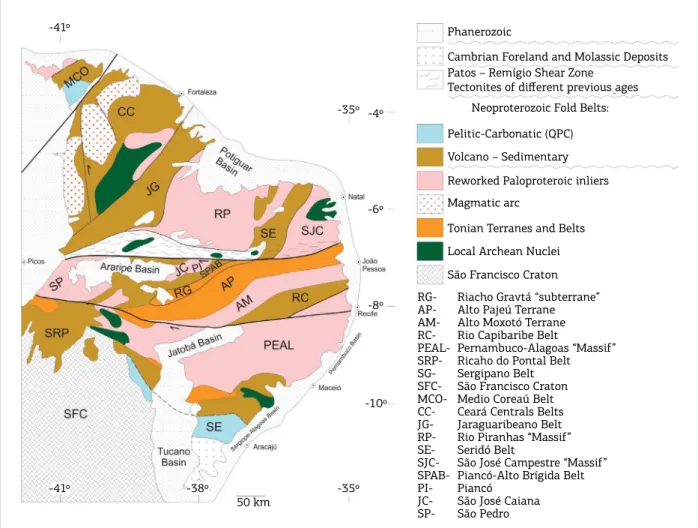
he Borborema Province, in northeastern South America, comprises a branching system of Neoproterozoic orogens (Fig. 1). hese orogens, before Pangea breakup, can be traced into Africa, between Ghana, in the north, and Cameroon, in the south. hus, the province lies between the West Africa-São Luis craton to the north, the Africa-São Francisco-Congo-Kasai-Angola craton to the south, and the Parnaíba block to the west, the latter concealed beneath Parnaíba Basin. At least in the former case of two cratonic domains, there is concrete evidence that were fractions of lithospheric plates, which developed via subduction-like processes within the inte-rior of the surrounding folded systems (Santos et al. 2009, Oliveira et al. 2010, among others), and thus participated in the formation of the fold belts. he fact that the province is bordered by large cratons does not obscure the equally
important participation of a few basement segments, perhaps even microcontinents and microplates, within the complex mosaic of the fold-system interior. Alternating basement inliers and fold belts is the characteristic feature of this branching system of Borborema Province (Santos & Brito Neves 1984, Santos et al. 1984).
he basement of the orogenic system is also branched, com-prising the Archean nuclei, surrounded by Paleoproterozoic mobile belts (mainly Rhyacian and Orosirian in age), and also early Neoproterozoic orogens related to the Tonian Cariris Velhos orogeny, all of which were thoroughly reworked in the late Neoproterozoic. Consequently, the diferent Neoproterozoic orogenic belts are separated by varied pre-Mesoproterozoic basement segments, which may also be exposed within the Neoproterozoic belts.
Referred to as massifs or terranes, these inliers may have acted in diferent ways in the Pre-orogenic history of the
RG- Riacho Gravtá “subterrane” AP- Alto Pajeú Terrane AM- Alto Moxotó Terrane RC- Rio Capibaribe Belt
PEAL- Pernambuco-Alagoas “Massif” SRP- Ricaho do Pontal Belt SG- Sergipano Belt SFC- São Francisco Craton MCO- Medio Coreaú Belt CC- Ceará Centrals Belts JG- Jaraguaribeano Belt RP- Rio Piranhas “Massif” SE- Seridó Belt
SJC- São José Campestre “Massif” SPAB- Piancó-Alto Brígida Belt PI- Piancó
JC- São José Caiana SP- São Pedro
Phanerozoic
Cambrian Foreland and Molassic Deposits Patos – Remígio Shear Zone
Tectonites of diferent previous ages
Neoproterozoic Fold Belts: Pelitic-Carbonatic (QPC) Volcano – Sedimentary Reworked Paloproteroic inliers Magmatic arc
Tonian Terranes and Belts Local Archean Nuclei São Francisco Craton
50 km -41º
-35º -4º
-6º
-8º
-10º
-35º
-41º -38º
branching system. As mentioned in the passage before, it is possible that some of the inliers behaved as microcontinents, or even as microplates, separating distinct parts of the oro-genic belts. On the other hand, some of the inliers are just the exposure of the basement of the orogenic pile. Future research relying on geophysical data and/or deep boreholes should be able to discriminate these possibilities.
he orogenic belts of the province fan out along struc-tural lines that strike perpendicular to the coast, from the NE-SW Médio Coreaú domain, northwestward, to NW-SE Sergipano Belt, southeastward (Fig. 1). he Neoproterozoic belts bear distinct characteristics in composition, evolution, and preservation from superposed exhumation processes. Some are well preserved orogenic belts, displaying substantial parts of their lithostratigraphic, collisional and/or accretion-ary records. Other ones are vestigial belts (“schist belts”), in the sense that very little of their original orogenic record is preserved. Recently, several features of accretionary orogenies
were recognized within the collisional domains related to the Neoproterozoic history of the province (Figs. 1 and 2), from NW Ceará (Fetter et al. 2003, Santos et al. 2009, 2015, Cordani et al. 2013, among others) to the SE of the prov-ince (Oliveira et al. 2010, among others). However, in the central part of the province, the record of arc magmatism is less obvious and has led to a long-lasting debate.
he E-W Patos and Pernambuco strike-slip lineaments, to the north and south, respectively, limit the central domain of the province; this is the so-called Transversal Zone, which separates rather diferent geologic-geotectonic domains. he northern Patos lineament (Archanjo et al. 2013) has particularly been recognized as a continental transform (Brito Neves et al. 2015a), dividing distinct lithospheric domains of the province, which difer in composition, age, structure and thickness, and are displaced laterally for more than 100 km.
In this work, we aimed to characterize the preserved accre-tionary belt exposed in the northern part of the Transversal
40° 38°
8° 36°
Phanerozoics Covers Neoproterozoic Fold Belts
(Cryogenian-Ediacaran) Rio Capibaribe (RC), Piancó, Alto-Brígida (PAB), Rio Salgado (RS), Seridó (SED) Tonian Fold Belts
(Cariris Velho) Alto Pajeú (TAP), Riacho Gravatá (RG)
“Terranes”/“Blocks” Pre-Mesoproterozoic, reworked
PEAL – Pernambuco-Alagoas TAM – Alto Moxotó
SJC – São José Campestre 1 – Piancó
2 – São José de Caiana 3 – Icaiçara
4 – Riacho São Pedro
São Francisco Craton
Granites
Late Orogenic
High-K and shoshonitic plutons
“Conceição type” “Itaporanga type”
Zone (the central subprovince) (Van Schmus et al. 2011). Abundant references are available on this particular area of the province, largely mapped at diferent scales and stud-ied through academic work, which brought about a wealth of petrologic, geochemical and isotopic data. Geophysical information (gravimetric, seismic, aeromagnetic, aerogam-maspectrometric, magnetotelluric) was integrated with our own data, leading to a model of an active continental margin, which was established and evolved during the late Neoproterozoic adjacent and to the south of the Patos con-tinental boundary transform.
The convergent plate interaction proposed here is recorded along a ca. 750 km long belt, from the coastal area of Jacaraú, Paraíba (~6º40’S, 35ºW) — northwest of João Pessoa, beneath Mesozoic sedimentary deposits —, to the Pernambuco-Piauí border (~8ºS, 42ºW) — south of Picos, Piauí, where it is covered by the Parnaíba Basin Paleozoic for-mations (Fig. 2). In the coastal Paraíba state (along meridian 45ºW), the northeastern largest portion of this accretion-ary orogenic zone is only ca. 20 km wide, reaching up to 140 km southwestward, close to longitude 39ºW. Evidence of the continuation of this accretionary belt in Africa has been recognized south of the Garoua lineament in Cameroon (Van Schmus et al. 2008, De Wit et al. 2008). herefore, the original linear accretionary zone may have been thou-sands of kilometers long, bearing important implications for West Gondwana formation.
PREVIOUS STUDIES
he irst references to the numerous granite intrusions in northeast Brazil, including reports on examples from the Transversal Zone, are from pioneering geologists — such as D. Guimarães, L. J. Moraes, W. Kegel, among oth-ers, in informal reports at the beginning of the last cen-tury. More detailed studies of granites and related rocks in Borborema Province, particularly in the Transversal Zone, were triggered by the work of Almeida et al. (1967), during an international symposium sponsored by United Nations Educational, Scientiic and Cultural Organization-Superintendência do Desenvolvimento do Nordeste (UNESCO-SUDENE), which included a ield trip to the region. his outstanding work discriminated the main granite types — Conceição, Itaporanga, Catingueira, Itapetim — exposed in Borborema Province, including genetic inferences and time relations, in spite of the lim-ited knowledge available at the time. he original concepts surrounding these granites were gradually improved by petrologic, geochemical and isotopic data in the following decades (Santos & Brito Neves 1984, Santos et al. 1984,
Sial & Ferreira 1985, Sial 1986, 1987), with many research-ers emulating Almeida et al. (1967) after that.
An important development in the study of the gran-ites in Brazil came about with the Núcleo de Estudos de Granitos (NEG), of the Universidade Federal de Pernambuco (UFPE), in 1984, followed by the Laboratório de Estudos Isotópicos (LABISE) in 1990 at the same university (Sial 1986, 1987, 1993, Ferreira & Sial 1993, Mariano & Sial 1993). Since then, NEG-LABISE has been conducting frontier research on the subject, sponsoring a number of theses and dissertations, scientiic meetings and ield trips, and publishing key scientiic papers and reviews.
In the 1980s, a wider range of work became available due to larger scale geologic maps (Companhia de Pesquisa de Recursos Minerais-Departamento Nacional de Produção Mineral — CPRM-DNPM), as well as the publication of research papers (Sial 1986, 1987) and reviews (Santos & Brito Neves 1984, Santos et al. 1984, Sial & Ferreira 1985). he irst International Symposium on Granites and Associated Mineralizations (ISGAM), in Salvador, took place in 1987, and many new scientiic contributions were added to the knowledge of the granites exposed in the Transversal Zone, including a memorable ield trip to their main exposures (Sial 1987).
From the 1990s on, several Master of Science (M.Sc.) dissertations and Doctor of Science (D.Sc.) theses (a large part from NEG-LABISE, UFPE) focused on specific granite intrusions, leading to knowledge improvement of these rocks. At the MAGMA workshop, sponsored by the Academia Brasileira de Ciências in 1993, several papers on granite magmatism were presented (Sial 1993, Ferreira & Sial 1993, Mariano & Sial 1993). Later on, several new contributions were presented during the II ISGAM (1997, Salvador), and another ield trip was led to the Transversal Zone (Sial et al. 1997). his was followed by the review of Santos & Medeiros (1999), proposing a system of granite suites and supersuites for the Transversal Zone (Figs. 1 and 2, Tab. 1).
Tectonic Zone and display distinct petrologic and isotopic features, in particular Paleoproterozoic Rb-Sr ages and Sm/ Nd TDM values (Brito Neves et al. 2005; recently reiterated by Archanjo et al. 2015).
Following subsequent reviews of the Borborema Province geology, encompassing the Transversal Zone granites (Delgado 2003, Ferreira et al. 2004), some new infor-mation became available (Sial et al. 2008, Ferreira 2010, Ferreira et al. 2014), including petrologic, geochemical, and isotopic evidences of south-directed subduction and the discrimination of possible remnants of ocean crust recorded as xenoliths in tonalite and granodiorite plutons of the Conceição type (Ferreira 2010, Ferreira et al. 2014). Sial and Ferreira (2015) published a recent and com-prehensive synthesis about magma associations in the Transversal Zone.
MAIN GEOLOGICAL FEATURES
he aim of this paper was to suggest that there is a pre-served Early Ediacaran (635-580 Ma) magmatic arc at the northernmost part of the Transversal Zone.
he proposed arc is exposed between 35º-42ºW (merid-ians) and 6º40’8 S, ca. 750 km long, up to 140 km wide, southward the Patos Lineament. It extends from de coastal area to the east — “Zona da Mata”, northeast of Paraíba state —, up to the Pernambuco-Piauí border — “Alto Sertão” — to the west, following a general ENE/WSW trend, more or less diagonally across the Transversal Zone.
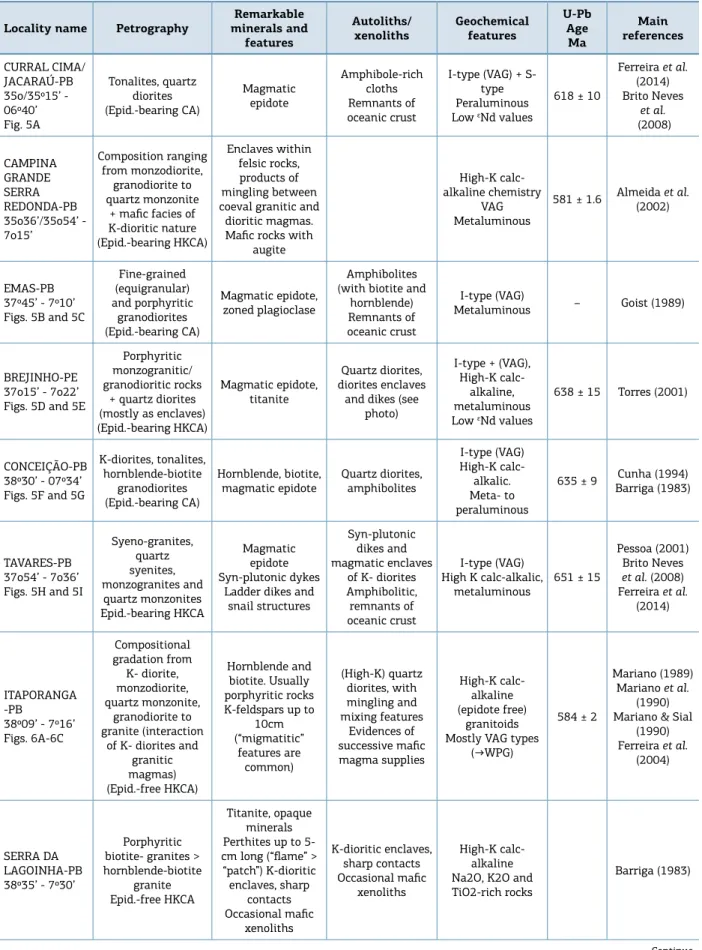
Based on geological ield observations, as well as on petrographic, petrological, geochemical and isotopic data compiled from many sources, about 90 diferent stocks and batholiths of I-type granitoids (“I” cordilleran, Pitcher 1983; “CAG”, Maniar and Piccoli 1989; Hca, Barbarin 1990; Chappell and White 2001) were recognized and mapped along the northern part of the Transversal Zone (Tab. 2).
hese rocks intruded preferentially into Cryogenian-Ediacaran low to medium grade schists of the Piancó-Alto Brígida (SPAB) system of orogens, and its basement, compris-ing older Neoproterozoic supracrustal belts — Cariris Velhos orogen, including the Alto Pajeú (TAP) and Riacho Gravatá (RG) terranes — and pre-Mesoproterozoic basement inliers, mostly Rhyacian and Orosirian in age (Figs. 1, 2 and 3). See syntheses and proposed maps of Santos et al. (2010) and Van Schmus et al. (2011).
THE PLUTONIC SUPERSUITES
Classical supersuites
hree supersuites of granitic rocks have long been recognized along the northern part of the Transversal Zone (Tab. 1). Most rock types are metaluminous to peraluminous (Ferreira et al. 2004), while a fourth type of peralkaline and ultrapotassic rocks is metaluminous. Magmatic epidote-bearing calc-alkaline, in part high-K calc-alkaline, granitoids (Conceição-type), form the most common stocks and batholiths in the northern part of the Transversal Zone. hey are usually metaluminous to slightly peraluminous, equigranular, medium to coarse-grained tonalite and granodiorite intrusions (Tab. 2, Figs. 2, 4 and 5). he plutons have a rather constant composition (quartz + feldspars + Ca-amphibole + biotite + epidote + apatite, Ferreira et al. 2004), generally fol-lowing the trends of I-type granitoids, according to the Chappell and White (2001) classiication.
A very typical feature is the presence of amphibole-rich cloths, which can be observed in rocks from the north-ern coastal area of Paraíba to the far west of Pnorth-ernambuco. Some of these amphibolitic portions, especially in the Curral de Cima, Emas and Tavares batholiths (Sial 1993, Ferreira 2010), support the hypothesis that they are altered sealoor basalts trapped as xenoliths. Rounded, elongated
Table 1. Main supersuites and suites of igneous rocks of the Transversal Zone, central subprovince of the Neoproterozoic Borborema Structural Province (Santos & Medeiros 1999).
Orogeny Supersuites Suites Examples
NEOPROTEROZOIC
Calc-alkalic High-K calc-alkalic Itaporanga, Lagoinha (Cryogenian-Ediacaran) Calc-alkalic Conceição, Emas
Brasiliano Cycle Trondhjemitic ainities Serrita, Salgueiro Peralkalic silica-oversaturated Catingueira, Moderna
Ultrapotassic/ Shoshonitic
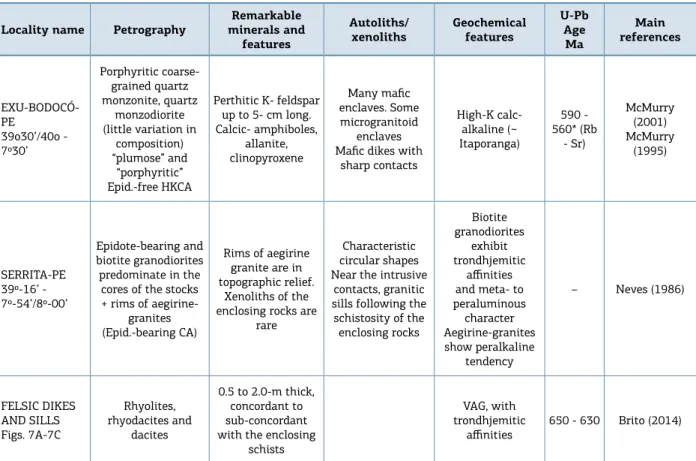
Table 2. Examples of the main granitic plutons of the Transversal Zone with their main characteristics, according to available academic theses, dissertations and other published papers.
Locality name Petrography
Remarkable minerals and features Autoliths/ xenoliths Geochemical features U-Pb Age Ma Main references CURRAL CIMA/ JACARAÚ-PB 35o/35º15’ - 06º40’ Fig. 5A Tonalites, quartz diorites (Epid.-bearing CA) Magmatic epidote Amphibole-rich cloths Remnants of oceanic crust
I-type (VAG) + S-type Peraluminous Low εNd values
618 ± 10
Ferreira et al.
(2014) Brito Neves et al. (2008) CAMPINA GRANDE SERRA REDONDA-PB 35o36’/35o54’ - 7o15’ Composition ranging from monzodiorite, granodiorite to quartz monzonite
+ maic facies of
K-dioritic nature (Epid.-bearing HKCA) Enclaves within felsic rocks, products of mingling between coeval granitic and
dioritic magmas.
Maic rocks with
augite
High-K calc-alkaline chemistry
VAG Metaluminous
581 ± 1.6 Almeida (2002)et al.
EMAS-PB 37º45’ - 7º10’ Figs. 5B and 5C
Fine-grained (equigranular) and porphyritic granodiorites (Epid.-bearing CA) Magmatic epidote, zoned plagioclase Amphibolites (with biotite and
hornblende) Remnants of oceanic crust
I-type (VAG)
Metaluminous – Goist (1989)
BREJINHO-PE 37o15’ - 7o22’ Figs. 5D and 5E
Porphyritic monzogranitic/ granodioritic rocks
+ quartz diorites (mostly as enclaves) (Epid.-bearing HKCA)
Magmatic epidote, titanite
Quartz diorites, diorites enclaves
and dikes (see photo)
I-type + (VAG), High-K calc-
alkaline, metaluminous Low εNd values
638 ± 15 Torres (2001)
CONCEIÇÃO-PB 38º30’ - 07º34’ Figs. 5F and 5G
K-diorites, tonalites, hornblende-biotite granodiorites (Epid.-bearing CA) Hornblende, biotite, magmatic epidote Quartz diorites, amphibolites I-type (VAG) High-K calc-alkalic. Meta- to peraluminous
635 ± 9 Barriga (1983)Cunha (1994)
TAVARES-PB 37o54’ - 7o36’ Figs. 5H and 5I
Syeno-granites, quartz syenites, monzogranites and quartz monzonites Epid.-bearing HKCA Magmatic epidote Syn-plutonic dykes
Ladder dikes and snail structures
Syn-plutonic dikes and magmatic enclaves
of K- diorites Amphibolitic,
remnants of oceanic crust
I-type (VAG) High K calc-alkalic,
metaluminous 651 ± 15
Pessoa (2001) Brito Neves
et al. (2008) Ferreira et al.
(2014)
ITAPORANGA -PB
38º09’ - 7º16’ Figs. 6A-6C Compositional gradation from K- diorite, monzodiorite, quartz monzonite, granodiorite to granite (interaction
of K- diorites and granitic magmas) (Epid.-free HKCA) Hornblende and biotite. Usually porphyritic rocks K-feldspars up to
10cm (“migmatitic” features are common) (High-K) quartz diorites, with mingling and mixing features Evidences of successive maic magma supplies High-K calc-alkaline (epidote free) granitoids Mostly VAG types
(→WPG)
584 ± 2
Mariano (1989) Mariano et al.
(1990) Mariano & Sial
(1990) Ferreira et al.
(2004)
SERRA DA LAGOINHA-PB 38º35’ - 7º30’
Porphyritic biotite- granites > hornblende-biotite
granite Epid.-free HKCA
Titanite, opaque minerals Perthites up to 5-
cm long (“lame” >
“patch”) K-dioritic enclaves, sharp contacts Occasional maic xenoliths K-dioritic enclaves, sharp contacts Occasional maic xenoliths High-K calc- alkaline Na2O, K2O and TiO2-rich rocks
Barriga (1983)
Scale ~1/2.500.000 50 km
Neoproterozoic Pericontinental Belts
(orogenic)
A+B = Médio Coreaú + Ceará Central SPAB = Piancó Alto Brigida Sg + Srp = Sergipano – Rio Preto
Plutons of magmatic arc Oceanic remmants
Neoproterozoic Intracontinental Belts
Rc = R. Capibaribe Sr = Seridó J = Jaguaribe
Pre-Cryogenian Blocks/Plates (Archean + Paleopoterozoic)
CSF = São Francisco G = PEAL
F = TAM + TAP E = R. São Pedro D = S. J. Campestre C = Rio Piranhas B = Central Ceará A = West Africa/São Luis
Figure 3. Tectonic sketch of the Borborema Province, trying to highlight the main known Neoproterozoic (Cryogenian-Ediacaran) accretionary orogenic developments: (A) the NNE-SSW trending Tamboril-Santa Quitéria, west of Ceará state; (B) north of the E-NE/W-SW trending Transversal Zone, object of this paper; (C) parallel to (and following) the northern margin of the São Francisco Craton. A probable former connection between (A) and (B) is suggested in this sketch.
Locality name Petrography
Remarkable minerals and
features
Autoliths/ xenoliths
Geochemical features
U-Pb Age Ma
Main references
EXU-BODOCÓ-PE
39o30’/40o - 7º30’
Porphyritic coarse- grained quartz monzonite, quartz
monzodiorite (little variation in
composition) “plumose” and
“porphyritic” Epid.-free HKCA
Perthitic K- feldspar up to 5- cm long. Calcic- amphiboles,
allanite, clinopyroxene
Many maic
enclaves. Some microgranitoid
enclaves
Maic dikes with
sharp contacts
High-K calc-alkaline (~ Itaporanga)
590 - 560* (Rb
- Sr)
McMurry (2001) McMurry
(1995)
SERRITA-PE 39º-16’ - 7º-54’/8º-00’
Epidote-bearing and biotite granodiorites predominate in the
cores of the stocks + rims of aegirine-
granites (Epid.-bearing CA)
Rims of aegirine granite are in topographic relief.
Xenoliths of the enclosing rocks are
rare
Characteristic circular shapes Near the intrusive
contacts, granitic sills following the schistosity of the enclosing rocks
Biotite granodiorites
exhibit trondhjemitic
ainities
and meta- to peraluminous
character Aegirine-granites show peralkaline
tendency
– Neves (1986)
FELSIC DIKES AND SILLS Figs. 7A-7C
Rhyolites, rhyodacites and
dacites
0.5 to 2.0-m thick, concordant to sub-concordant with the enclosing
schists
VAG, with trondhjemitic
ainities 650 - 630 Brito (2014)
HKCA: high K calc-alkalic magma association; CA: calc-alkalic magma association; Epid.-bearing CA: calc-alkalic magma association with epidote;
VAG: volcanic arc granite; WPG: within plate granites. (Sial & Ferreira 2015)
650-620 Ma
Rb 1000
100
10
1
1 10 100 1000
Y+Nb mEp-bearing HKCA
Ultrapotassic
Up dikes Trondh MHK syenites mEp-free SH mEp-free HKCA Peralkalic
VAG VAG
WPG
WPG
Syn-Colg Syn-Colg
mEp-bearing SH mEp-bearing CA
A
950-520 Ma
Rb 1000
100
10
1
1 10 100 1000
Y+Nb
B
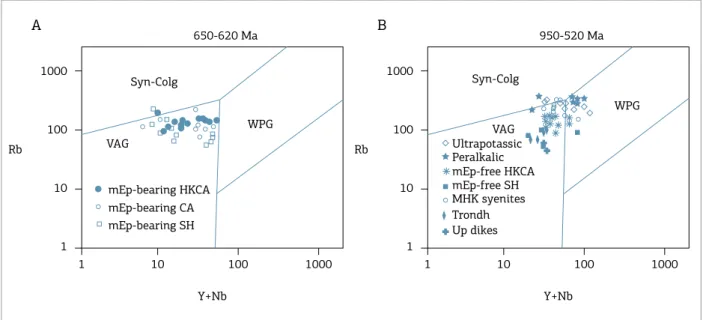
Figure 4. Granitoids and syenitoids of the Transversal Zone represented in Pearce et al. (1984) tectonic discriminant diagram (log Rb vs. log Y+Nb). Adapted from Ferreira et al. (2004). (A) 650-620 Ma group: mEp-bearing HKCA: magmatic epidote-bearing high-K calc alkalic; bearing CA: magmatic epidote bearing calc alkalic; mEp-bearing SH: magmatic epidote-mEp-bearing shoshonitic; (B) 590-540 Ma group: trondh.: trondhjemitic (mostly plotting in the VAG ield); mEp-free HKCA: magmatic epidote-free high-K calc alkalic; MHK syenites: maic high-K syenites; Ultrapotassic rocks; Up: ultrapotassic dikes; peralkalic dikes.
quartz diorite enclaves are ubiquitous, sometimes displaying a breccia-like pattern. In tectonic discrimination diagrams (e.g., Pearce et al. 1984), the epidote-bearing granites show a very clear position in the volcanic arc granites (VAG) ield of arc granitoids. his is also true for the rhyodacite and dacite dikes of trondhjemitic ainity that cut through the Salgueiro Group supracrustals in many outcrops (Brito 2014).
Isotopic data for these granodiorites and tonalites are still scarce. Generally, the TDM values vary from 1.3 to 1.8 Ga, and the Nd values vary from positive (one or two cases) to negative (from +2 to -10). Most of the U-Pb iso-topic determinations indicate Early Ediacaran ages (Tab. 2, Figs. 4, 5A-5I).
he Itaporanga-type plutons are heterogeneous in com-position, and broadly correspond to a high-K calc-alkaline series (Mariano 1989, Mariano et al. 1990). hey encom-pass compound batholiths, formed by dominant porphyritic granite (microcline-rich granite) to quartz monzonite types. hese rocks are, in many places, accompanied by early- to syn-plutonic, dominantly K-rich diorites, and by an interme-diate equigranular granite association (Mariano & Sial 1993, Santos & Medeiros 1999). he most usual feature, taken as basis for their recognition, is the porphyritic texture, characterized by large — up to 10-cm-long — K-feldspar megacrysts. he porphyritic assemblages display features of magma mixing with dioritic portions. hese apparent migmatitic features, rendered by magmas of contrasting
compositions, are rather common, and thought to be the product of successive pulses of maic magma supply, indi-cating coexistence and mixing of felsic and maic magmas (Mariano & Sial 1993). Migmatite-like, stromatic and agmatic structures are common, as well as pillow-like and irregular-shaped maic enclaves. he Itaporanga-type gran-ite was deined in the northern part of the Transversal Zone (Almeida et al. 1967), but has unfortunately been mistakenly applied to granites that outcrop in other tectonic domains of Borborema Province, based on apparently similar general features (Figs. 6A-6C).
Isotopic data for the Itaporanga-type granites are rather scarce. Generally, TDM model ages are between 1.6 and 2.5 Ga, and the Nd values are usually negative, from -8.0 to -16,5. Some of these granite intrusions crosscut the basement inliers of the low-grade schists belts (Sistema de Dobramentos Piancó-Alto Brígida – SPAB), and present strongly negative Nd values. For the typical locality, there is a previous U/Pb age of 584±2 Ma (TIMS, Brito Neves et al. 2003).
A
D
G
B
E
H
C
F
I
Figure 5. Photos of the main Conceição-type granodiorites and tonalites. (A) Curral de Cima granodiorite with diferent maic enclaves, at the easternmost part of the accretionary development. Locally, low-K metabasalts taken as probable remnants of oceanic crust occur (Brito Neves et al. 2008, Sial & Ferreira 2015); (B) Emas Batholith exhibiting maic/dioritic enclaves of K-dioritic composition containing amphibole-rich cloths. Some of the enclaves present characteristics of low-K metabasalts. Near Emas township; (C) K-dioritic enclaves surrounded by a coarse-grained granodioritic matrix. Between Emas and Olhos d’Água (Goist 1989; Tab. 2); (D) magma mixing in the Brejinho pluton, presenting E-W low strike with subvertical dip. Nicknamed “leopard skin”, it occurs in the Brejinho township; (E) Channel of pillow-like K-diorite in a more granodioritic matrix, 29 km SW of Brejinho (Torres 2001; Tab. 2); (F) Conceição granodiorite presenting small polygonal and sub-rounded K-dioritic enclaves, without structural orientation. Conceição township, typical locality; (G) large K-dioritic enclaves exhibiting centimeter-sized fragments and amphibole-rich cloths. Between Conceição and Ibiara (Barriga 1983, Cunha 1994; Tab. 2); (H) Tavares pluton of syenogranitic to monzogranitic composition with a great amount of large maic enclaves; (I) concentric magmatic (rhythmic) structure with an elliptical section. Felsic and maic bands (biotite rich) alternating almost regularly. The core is formed of K-feldspar megacrystals (photo from Pessoa, 2001).
trend (Neves 1986). Generation through garnet amphib-olite partial melting is compatible with the geochemical data recently obtained for the granodiorites. he contacts with the enclosing low-grade schists of the Cachoeirinha-Salgueiro Group are usually sharp. he granitic stocks may partially intrude the Paleoproterozoic basement inlier in the so-called Icaiçara terrane, located in west Pernambuco (Santos et al. 2010). here are some still unpublished U-Pb ages (verbal information, from Sial, A.N.), pointing out sim-ilar ages to that of Conceição type (ca. 630 Ma).
he peralkalic, silica saturated and shoshonitic plutons and dikes were emplaced along a straight contour line at the southern limit of the inferred main part of the magmatic arc, comprising the three groups of intrusions described before.
farthest intrusions from the subduction zone. Alternatively, they may represent magmatic activity recording the tran-sition of tectonic regimes, from a compressive, convergent and collisional setting to a post-collisional one, associated with the irst post-arc rupture. Still scarce U-Pb and Ar-Ar isotopic studies indicate ages between 600 and 590 Ma (Archanjo et al. 2015).
In addition to the plutonic rocks, the study area is char-acterized by many swarms of cm-m thick felsic dikes, gen-erally concordant to sub-concordant with black (Salgueiro Group) and green (Cachoeirinha Group) schists, and in part with the rocks of the Early Tonian RG Complex (Figs. 1, 2 and 7A–7C). hey comprise light-colored metarhyodacite, metadacite and meta-andesite, usually preserving their igne-ous texture. hey are mostly acid, peraluminigne-ous, calc-alka-line rocks, classiied as ferrous to magnesian, and calcic to alkaline (Brito 2014). heir geochemical signature points to subduction-related environments, independent from their Brasiliano or Cariris Velhos country rocks. he dike rocks are yet poorly studied, though it appears they are absent northward, in Rio Salgado Belt.
THE MAGMATIC ARC PROPOSAL
he geological and tectonic studies carried out in the study area led us to infer the presence of a magmatic arc, encompassing the main suites of plutonic rocks described before (Tabs. 1 and 2), namely the Conceição, Itaporanga, and Serrita types and rocks alike.
he continental part of the lower plate (to the north of the Patos Lineament) comprises the Central Ceará, Orós-Jaguaribe and Rio Grande do Norte domains, and is char-acterized by NNW-SSW trending Paleoproterozoic mobile belts, surrounding several Archean nuclei (Figs. 1 and 2). he former oceanic segment of this lower plate was com-pletely recycled in the mantle by southward B-subduction in Late Cryogenian-Early Ediacaran times. Scarce rem-nants of the former oceanic rocks are observed among the low-grade SPAB Belt, or even as preserved xenoliths within the Conceição-type tonalite and granodiorite intrusions (Ferreira 2010, Sial & Ferreira 2015). his is especially observed in the enclaves of the Curral de Cima, Emas and Tavares plutons (Tab. 2).
he Transversal Zone itself, south of the Patos Lineament, represents most of the former upper continental plate. It dis-plays a very complex tectonic framework of Neoproterozoic fold belts, including the Tonian Cariris Velhos RG and TAP Belts, plus two Cryogenian-Ediacaran belts: SPAB and Rio Capibaribe (RC). Additionally, this central subprovince exhibits several Paleoproterozoic (pre-Statherian) basement
A
B
C
Figure 6. Photos of the Itaporanga-type granites. (A) Local concentration of K-feldspar crystals and maic enclaves (K-dioritic composition). The general low orientation is locally not preserved; (B) K-diorite enclaves in the Itaporanga granite (main quarry, near Itaporanga township) and typical porphyritic granite, both following the igneous low (Mariano 1989, Mariano et al. 1990); (C) porphyritic (K-feldspar) granites predominate. Composition grading from K-diorite to granite. Weak low orientation of K-feldspar crystals.
inliers or terranes (Fig. 2). he Paleoproterozoic Alto Moxotó Terrane (TAM) — that includes some local Archean cores — is the southernmost basement of the Transversal Zone, and
apparently behaved as a backland domain. At the northern edge of this upper plate, rock units of the Rio Salgado Belt (RS) (Brito Neves & Campos Neto 2015) are preliminarily interpreted as the result of a former forearc basin.
he limit between these two inferred plates is presently marked by a boundary transform, the Patos Lineament plus the Malta Shear zone, an up to 20 km wide and 750 km long belt of tectonites, and the so-called Mataraca-Fronteiras kei-rogen, placed at the southern edge of the continental part of the lower plate (Brito Neves et al. 2015a). Many com-positional, structural, and chronological diferences exist between the northern segment (Fig. 1, Tab. 3), considered as the continental part of the lower plate, and the southern segment — the Transversal Zone — considered to have been the upper plate during the Cryogenian-Early Ediacaran sub-duction processes. Table 3 was organized so as to synthesize the main contrasting diferences (compositional, structural, tectonic, chronological, etc.) between these two segments of proposed Neoproterozoic plates.
Some geochemical and isotopic data
he amount of available petrographic, petrological, and geochemical data, despite being rather good, is still insuf-icient to further develop our magmatic-tectonic model. he preliminary isotopic data are not suicient to acknowl-edge all the controversies raised by the hypothesis proposed herein, of a Late Neoproterozoic magmatic arc developed in the northern part of the Transversal Zone. Nevertheless, the integrated data allow us to build a compatible model to the overall geological-tectonic scenario we deduce from ield relations.
It is well known that it is not possible to associate a geo-tectonic context with the characteristics of the produced arc magmatism in a simplistic way (Nédeléc & Bouchez 2011). he formation of hybrid granitoids with mixed isotopic signatures is recorded in all the cases of plate interactions involving subduction, due to diferent kinds of sources and to their participation in diferent proportions in arc magma generation. herefore, variation of granite types is a fact, as indicated by discriminant geochemical diagrams. Such dia-grams (Fig. 4) should be drawn having in mind that they are just a tool, and not the inal statement. hese diagrams should be seen with the necessary precautions.
Regarding the granite types, subsequent to the contributions of Santos & Medeiros (1999) (Tab. 1), Brito Neves et al. (2003) and Ferreira et al. (2004) (Fig. 4), this topic was recently enriched with the contribution by Ferreira et al. (2011) and Sial & Ferreira (2015), as part of the celebration of the NEG-LABISE 40th anniversary. hese authors have recognized the following group of magmatic associations for the Transversal Zone as a whole:
A
B
C
Table 3. Comparison between the lithospheric domains (plates) separated by the Patos Lineament.
Northern domain
(Lithospheric continental segment of the lower plate) Ceará Central + Orós-Jaguaribe + RG do Norte
Transversal zone domain
(Lithospheric continental segment of the upper plate) SPAB + RG + TAP + TAM (+ TRC)
Structural grain of older terranes and Brasiliano mobile belts:
NNE-SSW Structural grain of Paleoproterozoic terranes and Tonian and Brasiliano mobile belts: from E-W to ENE-WSW
Paleoproterozoic basement with Paleo-, Meso- and Neoarchean
nuclei Paleoproterozoic (Rhyacian > Orosirian > Siderian) basement with local Neoarchean inliers
Presence of an important terrane – Granja terrane – (Médio
Coreaú domain, NW of the province) composed of TTG
orthogneisses and kinzigites of Siderian age –
Presence of a belt composed of a Statherian volcano-sedimentary sequence plus anorogenic granites deformed
during Brasiliano events (Jaguaribeano Belt, Ceará state) Rare Statherian anorthosite magmatism
apparently missing Sparse Mesoproterozoic (Calymmian, Ectasian, Stenian) felsic magmatism during local extensional events
apparently missing Late Stenian to Early Tonian accretionary and collisional processes (Cariris Velhos Orogeny: 1.050-930 Ma); rare anorogenic intrusions
Intracontinental Neoproterozoic mobile belts deforming Statherian and Cryogenian-Ediacaran volcano-sedimentary sequences at ca. 600-580 Ma, followed by magmatism from 560 Ma onwards, including dikes and pegmatites
apparently missing
Important accretionary belt (NNE-SSW) in western Ceará
(Santa Quitéria arc, >300 km long), including arc plutonism and retroeclogites, probable continuation of the (Pan-African) Pharusian belt in the South-American continent
Neoproterozoic mobile belts recording subduction, accretion and collision; varied arc and collision plutonisms (635-580 Ma); rare late-orogenic events. The main arc extends for more than 750 km, from northeast of João Pessoa, to the east, up to
the Pernambuco-Piauí border, to the west
Important tectonic inheritance in Cambro- Ordovician basins; moderate to poor inheritance in Meso-Cenozoic sedimentary covers
Both Meso-Cenozoic interior and Atlantic marginal basins display important tectonic inheritance from the structural
trends of the subprovince
Shear zone characterized by melt-assisted intracrystalline dislocation (to the north of the Patos Lineament)
South border of the Patos Lineament marked by low- to medium-grade reactivation, dominated by solid state
movements
Several remnants of Cambro-Ordovician volcano- sedimentary basins, associated with anorogenic (granitic) intrusions
Only two or three sparse occurrences of Cambro- Ordovician volcano-sedimentary remnants; Cambro-Ordovician granites
unknown up to now
Important and varied metallogenetic provinces of diferent ages: magnesite, scheelite (W, Mo), Be- Ta, Li pegmatites, P-U,
Au, etc.
Modest and sparse mineral resources, mainly non- metallic deposits; some Fe-Ti±V±Cr±Cu occurrences
Crust and lithosphere thicknesses less than those of the Transversal Zone. Moho ca. 31.5 km deep
Crust and lithosphere relatively thicker than those of the Rio Grande do Norte terrane. Moho ca. 32-33 km deep; thickening from the Malta shear zone onwards (northern
limit of the keyrogen)
The most magnetic crust of the province; gravity and magnetic sources related to Archean nuclei and to volcano-sedimentary association (+ K- diorites) of the Mataraca-Fronteiras keirogen
Marked gravity zoning in alternating sigmoidal positive and
negative NE-SW belts, coinciding with magnetic zoning: dense
and magnetic rocks vs. less dense and magnetic rocks
Lower crust and lithospheric mantle afected by
Meso-Cenozoic pure and stretching events. Part of the continental margin was developed (Mid- Cretaceous) following transform displacements
Apparently the Transversal Zone behaved as a barrier against the propagation of the Meso- Cenozoic deformation
to the south
1. High-K calc-alkaline magma association;
■ Magmatic epidote-bearing high K calc-alkalic plutons (Epidote-bearing HKCA). his association includes a small part of the Conceição-type intrusions as Brejinho, Conceição das Creoulas and Tavares plutons, to which we add the Campina Grande and Serra Redonda plu-tons (Figs. 5A-5I);
■ Epidote-free high K-calc-alkalic plutons (Epi.-free HKCA). his association includes the main group of the so-cal-led Itaporanga type intrusions, like Itaporanga, Serra Lagoinha and Bodocó, to which we add the Princeza Isabel and Manaira plutons, among others (Fig. 6a-6C);
2. Magmatic epidote-bearing calc-alkalic and trondhjemitic plutons, which include the major part of the so-called Conceição-type intrusions and Serrita granite types, e.g., Conceição, Emas, Olhos d’Água, Angico Torto, Minador, Verdejante, Boa Ventura, São José do Bonim, Curral de Cima, Tabira, Riacho do Icó, and Serrita, Salgueiro West, Betânia, respectively (Tab. 2);
3. Ultrapotassic, peralkalic and shoshonitic plutons. Numerous fault-controlled monzonitic, syenitic and granitic intrusions of alkali, ultrapotassic to shoshoni-tic nature occur in the Transversal Zone. Most of these occurrences are located to the south and southwest of the idealized area of the proposed magmatic arc domain. Some of them (e.g., Teixeira, Palmeira, Salgueiro East) may still belong to the arc development, but it demands further investigations. According to Archanjo et al. (2015), most of these rocks record a tectonic regime transition, from a compressive phase related to plate convergence to a post-collision setting, dominated by extension and transcurrent movements. Usually these kinds of rocks are younger than 600 Ma (Archanjo et al. 2015). Hence, most rocks of this group may be associated (Fig. 4) to within-plate tectonic conditions (post-arc development). herefore, they will not be discussed any further.
Two age intervals were recognized for rocks of group 1a (epidote-bearing HKCA): he oldest one (650-620 Ma) pres-ents TDM ages between 2.1 and 1.01 Ga, and eNd(600) values between -3.0 and -16.6. he younger group (590-570 Ma) exhibits Paleoproterozoic TDM model ages (2.0-2.1 Ga), and eNd(600) values from -1.7 to -16.02. his means the possibility of important contribution (contamination) of older crustal material, of previous crustal residence, possibly related to the Paleoproterozoic basement inliers (Figs. 5A-5I).
Geochronological data for the rocks of group 1b (epi-dote-free HKCA) are scarce (590-580 Ma), and cannot be assumed as conclusive. Only in the case of the Itaporanga pluton, TDM age of 1.65 Ga and eNd(600) ≈ 9.0 are avail-able. Given the general geological conditions — such as
migmatitic-like features, basement xenoliths and nature of the basement —, the preliminary isotopic data suggest a large degree of crustal contamination of the original magma, as well as other petrological processes. Representative analy-ses of these plutons plot mostly in the VAG ield of Fig. 4, although some plot in the WPG ield (Figs. 6A-6C).
Rocks of group 2 (epidote-bearing, calc-alkalic and trondh-jemitic), including Conceição and Serrita intrusion-types, were dated 650-610 Ma (mostly U-Pb TIMS ages). TDM ages vary between 1.4 and 1.2 Ga, and the eNd(600) values are slightly negative, from -2.0 to -4.0, with just one known positive value up to now. Despite, the few (and not suicient) number of isotopic data, the indications are pointing out for arc mag-matic derivation for these rocks. his is also clear with the plot of their points in the diagram in Fig. 4 (in the VAG ield).
MAIN ARGUMENTS FOR THE
MAGMATIC ARC PROPOSITION
he proposition of a continental magmatic arc located in the north-northwest portion of the Transversal Zone is based on various arguments already listed, on observations of diferent authors within the last 30 years, and on our own geological and geophysical data, connecting well-established scientiic facts and some working hypotheses. To become sure about the previous existence of this arc, the present proposal implies additional research and detailed ield investigations.
his work will beneit from the critical debate, hopefully motivated by it. Several authors of dissertations and theses (Tab. 2) have highlighted the continental magmatic arc sig-nature of the granites in diferent geochemical diagrams. However, geotectonic models for the regional context are mostly lacking, although some magmatic arc schemes have been suggested (Cunha 1994, Ferreira 2010, Ferreira et al. 2014). Recent integration of previous ideas further lead to the model that the granitoids were product of a south-directed sub-duction zone (Brito Neves et al. 2005, Santos et al. 2014, Sial & Ferreira 2015, Brito Neves et al. 2015b, Brito Neves & Campos Neto 2016).
Taking into account the geological data discussed before (Tabs. 1 and 2, Figs. 2 and 3), as well as the geophysi-cal data available in the literature (Oliveira 2008, 2013, Santos et al. 2013, Castro et al. 2014, Daly et al. 2015, Lima et al. 2015, Padilha et al. 2016), the following argu-ments support the magmatic arc model:
evolution and chronology (Tab. 3). he Patos Lineament is now considered a former boundary transform;
2. Opposing gravity anomalies, positive northward and negative southward, as usually recorded in orogenic belts worldwide. he proposed thickening of the southern upper plate (Transversal Zone) is corroborated by deep seismic refraction proiles and magnetotelluric anoma-lies (Santos et al. 2013, 2014);
3. I-type cordilleran intrusions — sensu Chappel & White (2001) and similar classiications based on geochemical data (VAG, Pearce et al. 1984; CAG, Maniar & Piccoli 1989; Hca, Barbarin 1990; etc.) — are aligned following a 750 km long and 20-140 km wide ca. tectonic zone at the northern part of the Transversal Zone;
4. Probable remnants of oceanic lithosphere are preserved as xenoliths in granodiorite and tonalite intrusions, as indicated by petrologic, geochemical and isotopic data (Ferreira 2010, Ferreira et al. 2014, among others), particularly within the Curral de Cima, Emas and Tavares plutons. Ophiolite remnants are preserved in the greenschists of Cachoeirinha Group, near Bodocó, Pernambuco, though these occurrences still need addi-tional investigation;
5. Preservation of collisional and A-type granites south of the alignment and in back arc compressive zones (Guimarães et al. 2004, Brito Neves et al. 2008, Hollanda et al. 2010, Van Schmus et al. 2011, Lages & Marinho 2012). he post-arc development of granitic intrusions is you-nger than 540 Ma;
6. In spite of the small amount of data, it is possible to point out coherent geochronological intervals of intru-sions: 650-620 Ma (granodiorite, tonalite), 590-570 Ma (porphyritic granite, syenite and shoshonitic granite);
7. Intrusions are preferably emplaced within the Cryogenian-Ediacaran systems (SPAB) in the north and within the Tonian systems (TAP and RG) in the south, and do not reach the Paleoproterozoic and Archean rocks of TAM, farther south;
8. A forearc basin between the arc and the Patos boundary transform is represented by the RS Fold Belt, compri-sing distal meta-rhythmites and slates to the north, and proximal (meta)wackes and feldspathic (meta)arenites to the south (Brito Neves & Campos Neto 2016);
9. At the eastern side of the arc domain (eastward of the meridian 37ºW), the structures of the basement of the arc (both supracrustal belts and high-grade terranes) display important thrust faults verging to the north-northwest (afecting the granites of the arc themselves). To the west-ern side of the arc (Fig. 8A, westward of the meridian 38º) centrifugal structural vergence, typical of cordille-ran arcs, may be observed, comprising: a) compressive
domain with essentially north-directed vergence; b) the south-directed thrusts, verging away from the arc, form-ing a compressive back-arc zone (Figs. 8A and 8B);
10. Nd values are positive (ca. +2.0) to slightly negative (-1.0 to -7.0). TDM model ages range between 1.0 and 1.5 Ga, revealing the participation of Tonian and older basement rocks. Occasional older TDM values indi-cate unexposed pre-Mesoproterozoic inliers within the upper plate basement, as recorded along the syenitoid line (Sial 1986) or Teixeira-Terra Nova tectonic zone (Brito Neves et al. 2005);
11. In discriminant geochemical diagrams (Pearce et al. 1984, Pearce 1996, Maniar & Piccoli 1989), most of these rocks plot in the magmatic arc ield (VAG, CAG, Tab. 2), according to the majority of the authors working with these rocks; the epidote-bearing HKCA, epidote-bearing CA and epidote-bearing shoshonitic (SH) samples plot in the VAG ield (Fig. 4A); even epidote-free HKCA (Itaporanga type) plot in the same VAG ield (Fig. 4B). he same is true for the felsic dike swarms crosscutting the Salgueiro and Cachoeirinha groups (Figs. 7A-7C);
12. According to recent Gondwana reconstitutions (Pankhurst et al. 2008), it is possible to follow the outlined geological and tectonic patterns into Africa. De Wit et al. (2008) proposed the continuation of the Patos Lineament as the Garoua lineament to the south of Chad Lake and to the south of Libya, as an important suture zone. Van Schmus et al. (2008) refer to juvenile magmatism along the southern part of this lineament, in western Cameroon, southward the Benue trough. Figures 8A and 8B are the proposed schematic represen-tation of the present and previous (Cryogenian-Ediacaran times) general geologic and geotectonic conditions.
DISCUSSION OF THE RESULTS
OBTAINED AND THE NECESSARY
NEXT STEPS OF THE RESEARCH
and isotopic signatures, and bear some local evidence of oceanic crust basalt relics.
here are remarkable geological, geochemical, and geo-physical diferences between the inferred lower plate, the northern subprovince, and the upper plate, represented by the Transversal Zone, which interacted during the magmatic arc construction. he former plates are presently separated by an intracontinental plate boundary transform, namely the Patos Lineament.
However, there is still a great deal of research to be done, and many scientiic questions to be answered in order to pro-vide additional support for the magmatic arc hypothesis. First
and foremost, 1: 100,000-scale geological mapping should be continued, including updating of older editions. Geophysical surveys should grow in scale, as well as focus on the magmatic arc model. Petrological investigation and associated isotopic studies should be improved, including Lu-Hf isotopic deter-minations, consorted with U-Pb research. here are still many plutons and stocks to be better investigated. Special attention should be directed to the felsic calc-alkaline dikes and sills crosscutting the supracrustals of the Salgueiro-Cachoeirinha group of the Piancó Alto Brígida belt system. Due to their geochemical signatures (Brito 2014), they probably are related to subduction processes.
Figure 8. (A) General N-S geological section from the foreland (Rio Grande do Norte Terrane) to the back-arc domains (Alto Moxotó – TAM, and probably PEAL terranes), passing through diferent petrotectonic environments: keirogen, boundary transform (Patos Lineament), forearc basin (Rio Salgado Belt), Neoproterozoic belts pierced by the arc plutonism, and the back arc domains (TAM, PEAL); (B) proposed preliminary (hypothetical) drat of the plate-interaction events during Late Cryogenian-Early Edicaran times (Tab. 3), highlighting the geological and geophysical diferences between the two plate segments, presently exposed.
Foreland Keyrogen Forearc Arc Plutonism Back Arc Domains
RS SPAB RG TAP TAM PEAL
Phanerozoic sediments Pernambuco – Alagoas Superterrane (PEAL)
Alto Moxotó Terrane (TAM)
Foreland (Rio Grande do Norte Terrane) Rio Salgado Belt (RS)
Pianco-Alto Brígida System (PAB) Riacho Gravatá Complex (RG) Alto Pajeú Terrane (TAP)
A
B
LOWER PLATE UPPER PLATE
INTERNAL METAMORPHIC ZONE T + Sc BT
T + Sc = Trench + subduction complex BT = Boundary Transform
TAM = Alto Moxotó Terranes
Alternative models
Up to now, there has not been an alternative model for this series of Cryogenian-early Ediacaran stocks and batho-liths placed at the northern part of the Transversal Zone. Most of the authors mentioned in this paper (especially those mentioned in Tab. 2) have, in some way, indicated plate interactions as a driver for arc construction. hus, we here present an integration of local models, connecting them to the available geological, geochemical and geophysical data.
Nevertheless, there are some few authors who argue against a plate-tectonic accretionary process for the Meso and Neoproterozoic evolution of the Borborema Province (Neves & Alcantara 2010, Neves 2011) According to these researchers, the Borborema Province has behaved as an intracratonic setting since the late Paleoproterozoic. his means that all fold belts and granitic plutonism were the product of lithosphere extension without any formation of oceanic crust, followed by compression due to far-ield stresses. A synthesis of the main ideas of this group of research was recently published by Neves (2015).
According to our point of view (with all due respect), these authors did not present, up to now, the necessary
constraints, nor suicient arguments to deny all the facts pointing out to subduction processes.
hus, we hope that this contribution will lead to new investigations aimed at overcoming possible contradictions and disagreements and point the way forward for under-standing the evolution of Borborema Province.
ACKNOWLEDGMENTS
his work was possible thanks to the discussions with and invaluable help of many researchers, particularly Gorki Mariano, Valderez Pinto Ferreira, Alcides Nóbrega Sial, Ignez Pinho Guimarães, Ricardo José Ribeiro Pessoa, Vladimir Medeiros, Roberto Gusmão Oliveira and Maria de Fátima Lyra Brito. Financial support was provided by National Counsel of Technological and Scientiic Development (CNPq), through National Institute of Science and Technology (INCT) Estudos Tectônicos, and by Fundação de Amparo à Pesquisa do Estado de São Paulo (FAPESP) (Research Project 2013/09484-0). BBBN and RAF acknowledge CNPq research grants.
Almeida C.N., Guimarães I.P., Silva Filho A.F. 2002. Petrogênese de
rochas plutônicas félsicas e máicas na Província Borborema, NE do
Brasil: o c omplexo cálcio-alcalino de Alto-K de Campina Grande.
Revista Brasileira de Geociências, 32:205-216.
Almeida F.F.M., Leonardos Junior O.H., Valença J. 1967. Granitic Rocks of Northeast South America. In: International Symposium on Granites, Northeast Brazil Special Publication. Anais… IUGS/ UNESCO, Recife, 37p.
Archanjo C.J., Hollanda M.H.B.M., Vasconcelos P.M., Liu D. 2015. Geochonology (U-PB, AR/AR) and tectonic setting of the peralkaline-shoshonitic magmatism of the Teixeira-Terra Nova Domain (Central Borborema Province, NE Brazil) – PT.066. In: Hutton Symposium, 8., Florianópolis. CD-ROM.
Archanjo C.J., Viegas L.G., Freimann M., Hollanda M.H.B.M. 2013. O Lineamento Patos: estrutura e evolução. In: Simpósio de Geologia do
Nordeste, 25., Gravatá-Pernambuco. CD-ROM.
Barbarin B. 1990. Granitoids: main petrogenetic classiication in
relation to origin and tectonic setting. Geological Journal, 25:227-238.
Barriga V.M.F. 1983. Petrologia e geoquímica das rochas plutônicas de
Conceição-Itaporanga (PB). Dissertação de Mestrado, Centro de Ciências
Geofísicas e Geológicas, Universidade Federal do Pará, Belém, 146p
Brito M.F.L. 2014. Metavulcânicas ácidas do Complexo Salgueiro: caracterização e comparação com aquelas do Complexo Riacho Gravatá e Grupo Cachoeirinha, Zona Transversal, Província Borborema, NE Brasil. In: Congresso Brasileiro de Geologia, 47., Salvador. Anais... Salvador: SBG, p.121.
Brito Neves B.B. & Campos Neto M.C. 2016. A faixa de d obramentos do Rio Salgado, norte-noroeste da Zona Transversal – Província Borborema (PB-CE). Geologia USP Série Cientíica, 16 (3):3-17. doi: 10.11606/issn.2316-9095.
REFERENCES
Brito Neves B.B., Mantovani M.S.M., Moraes C.F., Sigolo J.B. 2008. As anomalias geológicas e geofísicas ao norte de Itapororoca (PB), folha Guarabira. Revista Brasileira de Geociências, 38(1):1-23.
Brito Neves B.B., Passarelli C.R., Basei M.A.S., Santos E.J. 2003. Idades U-Pb em zircão de alguns granitos clássicos da Província Borborema. Revista do Instituto de Geociências, 3:25-38.
Brito Neves B.B., Santos E.J., Fuck R.A. 2015a. Caracterização do Lineamento Patos como uma “boundary transform” intracontinental.
In: Simpósio Nacional de Estudos Tectônicos, 15., Vitória. Anais…
Vitória, Brazil. CD-ROM.
Brito Neves B.B., Santos E.J., Fuck R.A. 2015b. An Early Ediacaran magmatic arc at the northernmost part of the Transversal Zone – The Central Domain of the Borborema Province, Northeast of South America. In: Hutton Symposium, 8., Florianópolis. CD-ROM.
Brito Neves B.B., Santos E.J., Van Schmus W.R. 2000. Tectonic History of the Borborema Province. In: Cordani U.G., Milani E.J., Thomaz Filho A., Almeida D.A. (eds.). Tectonic Evolution of South
America. 31th Interntational Geological Congress, Rio de Janeiro,
p.151-182.
Brito Neves B.B., Van Schmus W.R., Kozuch M., Santos E.J., Petronilho L. 2005. A Zona Tectônica Teixeira Terra Nova – ZTTTN – fundamentos da geologia regional e isotópica. Revista do Instituto de Geociências, 5(1):57-80.
Castro D., Fuck R.A.D., Phillips J.D., Vidotti R.M., Bezerra F.H., Dantas E.L. 2014. Crustal structure beneath the Paleozoic Parnaíba Basin, revealed by airborne gravimetry and magnetic data, NE Brazil.
Tectophysics, 614:128-145.
Cordani U.G., Pimentel M.M., Araújo C.E.G., Fuck R.A. 2013.
The signiicance of the Transbrasiliano-Kandi corridor for the
amalgamation of West Gondwana. Brazilian Journal of Geology, 5
43(3):583-597. doi: 10.5327/Z2317-48892013000300012.
Cunha M.A.L. 1994. Petrologia, geoquimica e profundidade de
posicionamento dos stocks granodioríticos-tonalíticos de Boa
Ventura, Conceição e Pedra Branca, Paraíba, Nordeste do Brasil.
Dissertação de Mestrado, Universidade Federal de Pernambuco, Technological Center, 160p.
Daly M.C., Andrade V., Basrousse C.A., Costa R., McDowell K., Piggott N., Poole A.J. 2015. Brasiliano crustal structure and tectonic setting of the Parnaíba basin of NE Brazil: results of a deep seismic relection proile. Tectonics, 33:2102-2120. doi: 10.1002/2014TC003632.
Delgado I.M. (coord.). 2003. Geotectônica do Escudo Atlântico.
In: Bizzi L.A., Schobbenhaus C., Vidotti R.M., Gonçalves J.H. (eds.).
Geologia, Tectônica e Recursos Minerais do Brasil. Texto, Mapas &
SIG. Brasília, CPRM-Serviço Geológico do Brasil, p.227-334.
De Wit M.J., Stankiewicz I., Reeves C. 2008. Restoring Pan-African-Brasiliano connections: more Gondwana control, less trans-Atlantic corruption. In: Pankhurst R.J., Trouw R.A.J., Brito Neves B.B., D e Wit M.J. (eds.). West Gondwana: Pre-Cenozoic correlations across the South Atlantic region.The Geological Society of London, Special Publication, 294:399-422.
Ferreira V.P. 2010. Plutonismo saturado a supersaturado na Zona Transversal, porção leste da Província. Borborema; revisão
petrológica, geoquímica e isotópica. Full Professor thesis,
Universidade Federal de Pernambuco, Technological Center, 170p.
Ferreira V.P., Sial A.N. 1993. Mica-pyroxenite as probable source for ultrapotassic magmas in Northeastern Brazil: geochemistry and oxygen isotopes. In: Magma workshop – Magmatismo Granítico e Mineralizações Associadas, Academia Brasileira de Ciências, Rio de Janeiro. Resumos Expandidos, p.18-21.
Ferreira V.P., Sial A.N., Pimentel M.M., Moura C.A.V. 2004. Intermediate to acidic magmatism and crustal evolution in the Transversal Zone, Northeastern Brazil. In: Mantesso-Neto V., Bartorelli A., Carneiro C.D.R., Brito Neves B.B. (eds.). Geologia do
Continente Sul-Americano – Evolução da Obra de Fernando Flávio
Marques de Almeida. Beca, São Paulo, p.189-201.
Ferreira V.P., Sial A.N., Pimentel M.M., Armstrong R., Spicuzza M.J., Guimarães I.P., Silva Filho, A.F. 2011. Contrasting sources and P-T crystallization conditions of epidote-bearing granitic rocks, northeastern Brazil: O, Sr, and Nd isotopes. Lithos,
121:189-201.
Ferreira V.P., Valley J., Sial A.N., Pessoa R.J., Spicuzza M. 2014. Oceanic crust source-derived Tavares high- K Quartz Monozonite, Borborema Province, NE Brazil: geochemical and isotopic evidence.
In: Brazilian Geological Congress, 47., Salvador. Anais... Salvador: Núcleo Bahia da SBG, p.285.
Fetter A.H., Santos T.J.S., Van Schmus W.R.V., Hackspacher P.C., Brito Neves B.B., Arthaud M.H., Nogueira Neto J.A., Wernick E. 2003. Evidence for Neoproterozoic continental arc magmatism in the Santa Quitéria batholith of Ceará State, NW Borborema Province, NE Brazil: Implications for the assembly of West Gondwana.
Gondwana Research, 6(2):265-273.
Goist T.O. 1989. Petrology and geochemistry of the Emas pluton,
Northeastern Brazil. Master Dissertation, Universidade Federal de
Pernambuco, Technological Center, 157p.
Guimarães I.P., Silva Filho A.F., Almeida C.N., Van Schmus W.R., Melo S.C., Melo E.B. 2004. Brasiliano (Pan-African) granitic magmatism in the Pajeú-Paraiba belt, Northeast Brazil: an isotopic and geochronological approach. Precambrian Research,
135:23-53.
Hollanda M.H.B.M., Archanjo C.J., Souza L.C., Armstrong R.,
Vasconcelos P.M. 2010. Cambrian maic to felsic magmatism and
its connections with transcurrent shear zones of the Borborema Province (NE Brazil): implications for the late assembly of the West Gondwana. Precambrian Research, 178:1-4. doi: 10.1016/j. precamres.2009.12.004.
Lages G.A., Marinho M.S. 2012. Folha Boqueirão SB24Z-D-III Escala
1:100 000. Estado da Paraíba. Brasília. CPRM – Serviço Geológico do
Brasil. Disponível em: <http://geobank.cprm.gov.br/>.
Lima M.V.A.G., Berrocal J., Soares J.E.P., Fuck R.A. 2015. Deep seismic refraction experiment in Northeast Brazil: New constraints for Borborema Province evolution. Journal of South American Earth 14
Sciences, 58:335-349. doi: 10.1016/j.jsames.2014.10.007.
Maniar P.D., Piccoli P.M. 1989. Tectonic discrimination of granitoids.
Geological Society of America Bulletin, 101:635-643.
Mariano G. 1989. Magma mixing origin of P otassic C alk- alkaline pluton: the Itaporanga B atholith, state of Paraíba, Northeastern
Brazil. Master dissertation, University of Georgia, Athens, 180p.
Mariano G., Sial A.N. 1990. Coexistence and mixing of magmas in the late p recambrian Itaporanga Batholith, State of Paraíba, Northeastern Brazil. Revista Brasileira de Geociências, 20:101-110.
Mariano G., Sial A.N. 1993. High -K calc-alkalic vs. Shoshonitic granitic magmatism in northeastern Brazil. Anais da Academia Brasileira de Ciências, 65(supl):119-130.
Mariano G., Sial A.N., Herz N. 1990. Oxygen isotope geochemistry of a potassic porphyritic calc-alkaline composite pluton: the Itaporanga Batholith, state of Paraíba, Northeastern Brazil. Revista
Brasileira de Geociências, 20(1-4):159-164.
McMurry J. 1995. Mesonorm-based rock names for the Bodocó Pluton, Northeastern Brazil, and other metaluminous megacrystic rocks. Anais da Academia Brasileira de Ciências, 67:289-300.
McMurry J. 2001. Crystal accumulation and shearing in a Megacryst Quartz Monzonite: Bodocó Pluton, Northeastern Brazil. Journal of Petrology, 42(2):251-276.
Nédeléc A., Bouchez J.L. 2011. Petrologie des Granites. Vuibert, Societé Geologique de France, 237p.
Neves S.P. 1986. Petrologia e geoquímica dos stocks graníticos de Serrita, Pernambuco. Revista Brasileira de Geociências, 16(1):86-94.
Neves S.P. 2011. Atlantica revisited: new data and thoughts on the formation and evolution of a long-lived continent. International
Geology Review, 53(11-12):1377-1391. doi: http://dx.doi.org/10.108
0/00206814.2010.527676.
Neves S.P. 2015. Constraints from zircon geochronology on the tectonic evolution of the Borborema Province (NE brazil): widespread intracontinental Neoproterozoic reworking of a Paleoproterozoic accretionary orogen. Journal of South American
Earth Sciences,58:150-164.
Neves S.P. & Alcantara V.C. 2010. Geochemistry of orthogneisses and metasedimentary rocks across a proposed terrane boundary in the Central Domain of Borborema Province, NE Brazil: Geodynamic implications. Journal of South American Earth Sciences,29 (2):498-511. http://dx.doi.org/10.1016/j.jsames.2009.08.002.
Oliveira E.P., Windley B.F., Araújo M.N.C. 2010. The Neoproterozoic Sergipano orogenic belt, NE Brazil: a complete plate tectonic cycle in western Gondwana. Precambrian Research, 181(1-4):64-84. doi: 10.1016/j.precamres.2010.05.014.
Oliveira R.G. 2008. Arcabouço geofísico, isostasia e causas do magmatismo cenozóico da Província Borborema e de sua margem
continental (Nordeste do Brasil). PhD thesis, Centro de Ciências Exatas