Printed in Brazil - ©2006 Sociedade Brasileira de Química 0103 - 5053 $6.00+0.00
Short Report
* e-mail: [email protected]
Devulcanization of Styrenebutadiene (SBR) Waste Tire by Controlled Oxidation
Rachel R.V.A. Rios, Manuela Gontijo, Vany P. Ferraz, Rochel M. Lago and Maria Helena Araujo*
Departamento de Química, ICEx, Universidade Federal de Minas Gerais, Campus-Pampulha, 31270-901 Belo Horizonte-MG, Brazil
Neste trabalho é descrita a desvulcanização da borracha SBR (Styrene Butadiene Rubber) via oxidação controlada com ácido nítrico. Análises por IV, RMN de 1H e 13C, CHN, TG, GPC e experimentos de DTP-EM (Decomposição a Temperatura Programada –Espectrometria de Massas) sugerem que o ácido nítrico promove dois processos: (i) a desvulcanização por oxidação das pontes de enxofre e (ii) a oxidação da cadeia carbônica levando à formação de grupos –COOH e –NO2. Em condições mais drásticas de reação, a cadeia polimérica é fortemente oxidada e se fragmenta formando uma fração altamente oxigenada, de baixo peso molecular e solúvel em água.
This work describes the devulcanization of vulcanized SBR (Styrene Butadiene Rubber) based on controlled oxidation with nitric acid. IR, 1H and 13C-NMR, CHN elemental analyses, TG, GPC and TPD-MS (Temperature Programmed Decomposition-Mass Spectrometry) experiments suggest that nitric acid promotes two processes: (i) devulcanization by oxidation of the sulfide crosslinks and (ii) oxidation of the carbon framework leading to the formation of -COOH and -NO2 groups. Under aggressive conditions (HNO3, reflux) the polymer chain is strongly oxidized and fragmented to a highly oxygenated low molecular weight fraction, which is soluble in water.
Keywords: devulcanization, HNO3, oxidation
Introduction
The disposal and reuse of waste tires remain not only a serious environmental concern but also an economical issue. Several alternatives, such as direct uses of scrap tires, combustion to produce energy, pyrolysis to produce fuels, the use of crumbles to asphalt roads and devulcanization to recycle the polymer have been extensively investigated in the last decades. Different chemical, physical and biological processes for the devulcanization of vulcanized rubber have
been reported in the literature.1 For the chemical
devulcanization processes an extensive variety of agents such as: sulphides, e.g. diphenyl-disulphides, mercaptans, thiophenol, phosphorus compounds, e.g. triphenylphosphine and dibutylphosphite have been used.2-13 Also, some reducing
compounds have been studied for the devulcanization process, such as lithium aluminum hydride,14 phenyl
lithium,15 CuCl/Bu
3N,
16 alkaline metals (e.g. Nao) and FeCl
2/
hydrazine.17 On the other hand, oxidative processes for the
devulcanization have been scarcely investigated. One example is the use of CHCl3/O3/H2O2, which showed low efficiency and high cost.18
Nitric acid, HNO3, is a strong oxidizing agent which is well known to react with all types of sulfur groups,19
offering the possibility to devulcanize rubber by oxidizing the sulfide crosslinks. The corrosion effect of nitric acid on rubber surface has been observed in 1985 by scanning electron microscopy.20 Also HNO
3 and 30% H2O2 have
been used for the modification of the surface properties of rubber powder used as filler.21 However, the use of the
controlled oxidation with HNO3 to devulcanize vulcanized rubbers has not yet been studied.
In this work a detailed investigation of the reaction of SBR (Styrene butadiene Rubber) with concentrated nitric acid was carried out. This process is proposed as a novel devulcanization route which shows several advantages such as the use of an available and relatively low cost oxidant, the use of water as solvent, mild reaction conditions and high efficiency.
Experimental
Merck) and rubber (10 g) in a 100mL reflux system with oil bath at 110 oC. After the reaction the polymeric (PF polymeric
fraction) and the aqueous phases (WSF water soluble fraction) were separated by simple vacuum filtration using a sintered filter. The polymeric material was extensively washed with distilled water until the cleansing water had neutral pH (ca. 1 L) and dried under vacuum at 80 oC for 4 h.
The aqueous phase was evaporated and dried under vacuum at 80 oC. To determine the extractable fraction from the PF
(polymeric fraction) a 8 h Soxleht extraction was carried out to produce an extracted fraction (ExF) and an insoluble fraction (IF). Solubility tests were carried out by mixing 5 g of the ExF material with 2 mL solvent (THF, toluene, CH2Cl2, ethanol, acetonitrile, ethyl acetate) under low energy sonication for 1 h at 25 oC. After 12h equilibrium, 1 mL of
the solution was collected with a volumetric pipette, the solvent evaporated at 80 oC under vacuum and the solubilized
polymer measured by weight. IR spectra were obtained in a Perkin Elmer 283B Instrument in KBr or in solution. Elemental analyses were carried out in a Perkin Elmer PE2400 CHN. The GPC data was obtained in a Shimadzu LC-10AD equipped with a UV detector SPD-10AV at 254 nm and columns GPC805 and GPC804 with THF or DMF. NMR analyses were carried out with CDCl3 or D2O in a Brucker DRX200. TG analyzes were made in SHIMADZU TG 50 H equipment (10 oC min-1 and air 100 mL min-1).
TPD-MS (Temperature Programmed Decomposition Mass Spectrometer) analyses were performed by heating the sample at 5 oC min-1 in a He flow (30 mL min-1). A capillary
empty silica column near the sample was used to collect and continuously analyzing the decomposition products by a HP 5989A II mass spectrometer.
Results and Discussion
The oxidative devulcanization process of SBR was carried out with concentrated HNO3 under reflux for 0.5-10 h. From these treatments three fractions were obtained: (i) a polymeric material insoluble in water (PF), (ii) a water soluble (WSF) and (iii) a volatile fraction (VF) lost during the treatment (Scheme 1).
The mass balances for the PF, WSF and VF obtained after different treatments are shown in Table 1.
It can be observed that upon reflux with concentrated HNO3 for 1 h, 12% of the material is lost as VF, whereas 5% is transformed to a WSF and 83% remain as a solid polymeric fraction (PF). As the reflux time increases to 10h the PF fraction is reduced to 62%, strongly favoring formation of volatile compounds (25-28%).
Treatment with HNO3 strongly modified the physical aspect of the original vulcanized rubber producing in some cases oils and waxes. The solubility of the obtained PF was studied in different solvents such as THF, toluene, hexane, CCl4, ethanol and acetonitrile. Two different
fractions were obtained: (i) a soluble devulcanized
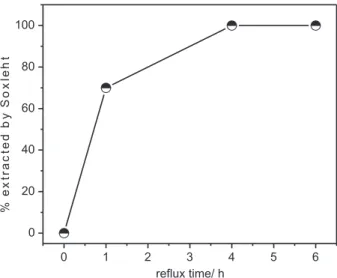
polymer (extracted by Soxleht, ExF) and (ii) an insoluble fraction (IF) in organic solvents. The %ExF obtained with THF are shown in Figure 1.
It can be observed that nearly no extraction by THF was observed for the original SBR not treated with HNO3. Upon
treatment with HNO3 for 1h under reflux, however
approximately 70% of the polymeric fraction is soluble in THF. This result clearly indicates a devulcanization process,
Table 1. Mass balances for the polymeric (PF), water soluble (WSF) and volatile (VF) fractions obtained by different treatments with HNO3
Treatment PF (wt%)a WSF (wt%)a VF (wt%)b
1 h/reflux 83 5 12
2 h/reflux 65 10 25
4 h/reflux 64 10 26
6 h/reflux 63 11 26
10 h/reflux 62 10 28
aobtained after drying all the materials at 80 oC under vacuum for 4 h; bestimated by weight loss, i.e. the difference VF=100-PF-WSF.
Figure 1. THF Soxleht extraction percentage of the PF obtained by re-flux with HNO3 after different periods of time.
breaking the sulfur crosslinks and producing free soluble polymer chains. The SBR treated under reflux with HNO3 for 4 and 6 h resulted in a material completely soluble in THF, suggesting complete devulcanization. Soxleht extraction using toluene and hexane showed similar results. The solubility of the extracted fractions was determined in different solvents and the results are shown in Figure 2.
It can be observed that the extracted fraction shows higher solubility in THF and that the solubility increases for longer reflux time. For less polar solvents, i.e. toluene, hexane and CCl4, the solubility tends to decrease. On the other hand, the material was almost insoluble in more polar solvents such as ethanol, acetonitrile and ethyl acetate.
In order to characterize the extracted polymeric fraction (ExF), CHN elemental analyses, IR, NMR, TG and GPC analyses were carried out. The elemental analyses results are displayed in Table 2.
It can be observed that the carbon content of ca. 85% for the original SBR decreased to ca. 78% after reflux for 10h. It is interesting to observe that the percentage of N
and others strongly increased upon reflux with HNO3
which could be related to oxidation and nitration reactions taking place during the devulcanization process.
Infrared spectroscopic analyses clearly show the presence of new absorptions after treatment with HNO3 (Figure 3).
The IR spectrum of the original SBR shows weak characteristic absorptions for C-H (ca. 3000, 1300-1480 cm-1) and CH
2 (1450-1475 cm
-1). On the other hand, the
spectra of the HNO3 treated samples show new absorption bands at 1650, 1550 cm-1 related to NO
2 groups and at ca.
1700-1770 cm-1, 1400, 1250 cm-1 and 3400 cm-1 likely
related to the presence of C=O, C-O and OH groups, suggesting the formation of carboxylic acid, COOH. It was clearly observed for longer treatment times with HNO3 that the intensity of NO2 and COOH bands also increased.
TPD/MS (Temperature Programmed Decomposition-Mass Spectrometry) experiments were carried out to identify possible functional groups present in the devulcanized material. Figure 4 clearly shows the signals at m/z 44 and 46 which are likely related to CO2 and NO2, respectively,
formed from the decomposition of -COOH and –NO2
groups in the material.
No m/z signal 64 or 80 related to SO2 or SO3 was detected, suggesting that probably most of the sulfur content was removed from the polymeric fraction.
Table 2. CHN elemental analysis for the extracted polymeric fractions (ExF)
Treatment C (%) H (%) N (%) others (%)
SBR original 85.4 9.5 0.3 4.8
2 h/ reflux 81.5 9.9 1.0 7.6
6 h/ reflux 79.6 9.1 1.8 9.5
10 h/ reflux 77.5 9.2 2.9 10.4
Figure 2. Solubility of the extracted fractions in different solvents.
Figure 3. IR spectra of the extracted fractions (ExF) of the SBR refluxed with HNO3 for 2 and 6h.
Analyses by 1H NMR showed the presence of signals
related to protons bound to aromatic rings (δ 7.0-8.0) and oxygen (δ 4.0-4.5). 13C NMR analysis showed the presence
of signals at δ 132.6, 130.9 and 128.8 related to the aromatic carbons, and δ 38.7 and 59.5 related to aliphatic carbons. New signals were also observed at δ 167.7 likely related to COOH carbons, and at δ 68.1, probably due to carbons bound to -NO2 groups.
Thermogravimetric analyses of the SBR sample and
the PF obtained by treatment with HNO3 for 4-6h and
10h under reflux are shown in Figure 5.
The original SBR showed a typical TG with two weight losses at 350-450 oC and 560-580 oC, the first one related
to the SBR polymer decomposition and the second one due to the carbon black oxidation.22 It can be observed
that as the SBR is treated with HNO3 the on set
decomposition temperatures are strongly decreased. The weight loss at lower temperature is related to thermal decomposition of –COOH and –NO2 groups,23 followed
by the decomposition of the polymeric fraction. Also, the weight loss due to the carbon black oxidation by air completely disappears after treatment of the SBR with HNO3. This result suggests that the carbon black in the rubber is strongly attacked under the reaction conditions. Literature work24 showed that carbon black can be easily
oxidized by concentrated nitric acid to produce water soluble polyaromatic compounds. Therefore, these results suggest that treatment of the SBR with HNO3 leads to the oxidation, not only of the polymeric material, but also of the carbon black, to produce a water soluble material. These water soluble compounds from the carbon black are removed during extensive washing of the PF.
GPC (Gel Permeation Chromatography) analyses of the extracted fraction (ExF) of the devulcanized SBR
showed chromatograms which are strongly dependent on the reflux time with HNO3 (Figure 6).
After refluxing with HNO3 for 1h, a broad GPC peak centered at shorter retention times is observed suggesting a wide molecular weight distribution around the average MW molecular weight of ca. 27700. It is also observed the presence of another peak centered near 21 min which is likely due to a polymeric fraction with small MW. For the samples obtained by treatment for 2, 4 and 10 h two
effects are observed: (i) a narrowing of the MW
distribution and (ii) a decrease in the average molecular weight to 23500, 16500, 6500 and 4500 Da, respectively. These results suggest that the reaction with HNO3 is not only oxidizing the sulfide crosslinks, leading to devulcanization, but is also cleaving the polymer carbon chains decreasing the MW.
The water soluble fraction (WSF) was obtained as a highly hygroscopic oil. The GPC analyses for all the obtained WSF showed similar peaks near 22 min corresponding to a small average molecular weight of ca. 1000-1500 Da.
The CHN elemental analyses for the WSF results, shown in Table 3, showed low carbon, hydrogen and nitrogen contents, suggesting the presence of large amounts of oxygen and other elements.
IR analyses (not shown) of the WSF showed very strong absorptions at 1600 and 1340 cm-1 (C-NO
2) and 3450 and
Table 3. CHN elemental analyses of the water soluble fractions
Treatment C (%) H (%) N (%) others (%)
2 h/reflux 16.0 1.2 1.9 80.9
1 h/reflux 17.9 3.2 0.6 78.3
10 h/reflux 19.9 2.3 0.5 77.3
Figure 5. Thermogravimetric analyses (in air atmosphere) of the original SBR and the PF obtained by reflux with HNO3 for 4-6 and 10h.
1750 cm-1 (COOH) indicating a high degree of nitration
and oxidation of the polymer. The TPD/MS experiments with the WSF showed strong signals with m/z 44 and 46 in the 100-300 oC temperature range, likely related to the
decomposition of the carboxylic (-COOH) and nitro groups (-NO2). The signal at m/z 64 was also detected in the temperature ranges of 200-350 and 450-550 oC, and is
related to SO2, likely formed by the decomposition of oxidized sulfur groups such as -SO3- and SO
4
2- (Figure 7).
This WSF is likely formed by compounds originated from two sources: (i) the severe oxidation of the SBR polymer to produce highly oxidized small MW polar molecules and (ii) water soluble polyaromatic compounds produced by the oxidation of the carbon black.
Reaction mechanism
It is well known that concentrated nitric acid is a strong
oxidizing agent and can oxidize disulfide bonds19
according to the process shown in Equation 1.
(1)
Under more aggressive conditions, the sulfonic group can be further oxidized and released to the aqueous solution as sulfate (Equation 2):
(2)
In fact, addition of a barium nitrate to the aqueous solution after treatment showed formation of a white precipitate (BaSO4), indicating the presence of sulfate. Therefore, one can consider that the devulcanization process takes place by oxidation of the sulfur crosslinks
with HNO3, producing free polymer chains. This
devulcanized polymer is soluble in different organic solvents. On the other hand, the concentrated nitric acid can also react with the polymer carbon backbone by two pathways: (i) nitration and (ii) oxidation. Nitration of styrene polymers with HNO3 is a well known process25, 26
and probably takes place at the aromatic ring according to equation 3:
(3)
These –NO2 groups have been clearly identified by IR spectroscopic analyses and TPD-MS experiments, which are in agreement with the increase in the N content observed in the elemental analyses. The polymer can also be oxidized by HNO3 to produce oxygenated groups such as –OH and –COOH, as detected by IR and NMR
spectroscopies and TPD-MS experiments. The HNO3
oxidation of carbonaceous materials is also well described in the literature.24 Although, the mechanism and the
location of these oxygenated groups are not clear, one can envisage that the oxidation might take place at different places in the carbon styrene butadiene polymer such as: the aromatic ring and at secondary or tertiary carbon of the main chain. In the case of oxidation at the aliphatic carbons the main polymeric chain will be broken, leading to the decrease of the polymer molecular weight. This effect was observed in the GPC measurements, which showed that the molecular weight decreases as the treatment with HNO3 was carried out at longer times. The polymer chain severe oxidation and fragmentation is responsible for the water soluble organic fraction. This fraction is probably composed of polar highly oxygenated molecules with average molecular weight lower than 1500 with a low carbon content of 16-20%. Some important issues which must be considered for the technical and economical viability of this process are: (i) the recycling of the remaining HNO3 after devulcanization, (ii) the treatment of the aqueous and gaseous effluents produced during the process and (iii) the unique properties of the devulcanized material.
The devulcanization process with HNO3 even under optimized conditions will produce an aqueous phase which is strongly acidic. Preliminary studies suggested that by simple distillation 5 to 10% of the initial nitric acid can be recovered from this aqueous phase. This aqueous phase contains a high concentration of organic matter, sulfate and different metals, especially zinc, which will demand treatment for suitable disposal. Also during the reaction significant amount of NO2 gas is formed as a by-product of the oxidation process and also from the decomposition
of HNO3, requiring a suitable treatment. Finally, an interesting point to consider is that the oxidative
devulcanization with HNO3 produces a devulcanized
polymer with unique characteristics. This polymeric material contains oxygenated functional groups in a wide range of concentrations which confere to the material completely novel and interesting properties. Although more detailed investigations are necessary, several potencial applications of this material can be envisage, such as special adhesives, fillers, production of polymer blends, etc.
Conclusions
This novel oxidative process shows great potential for the devulcanization of waste tires using solely HNO3, which is an available low cost oxidant. The reaction takes place initially by oxidation of the sulfur crosslinks.
However, two competitive reactions also occur, i.e.
nitration and oxidation to form -NO2 and -COOH groups. Under more aggressive conditions severe oxidation with fragmentation of the polymer chain to form water-soluble highly oxidized low molecular weight species also occurs.
Acknowledgments
The authors are grateful for financial support from FAPEMIG, PRPq-UFMG, SEBRAE-MCT, CNPq and Instituto Inovação.
References
1. Adhikari, B.; De, D.; Maiti, S.; Prog. Polym. Sci.2000, 25, 909.
2. Cotton, F.H.; Gibbons, P.A.; US pat.2,408,2961946. 3. Cotton, F.H.; Gibbons, P.A.; US pat. 2,471,8661949. 4. Cotton, F.H.; Gibbons, P.A.; US pat.2,469,529 1949. 5. Webb, F.J.; Cooks, W.S.; Albert, H.E.; Smith, G.E.P.; Ind. Eng.
Chem.1954, 46, 1711.
6. Tewksbury, L.B.; Howland, L.H.; Can. pat.215,952 1948. 7. Hunt, L.K.; Kovalak, R.R.; US pat.5,891,926A 1999. 8. Moore, C.G.; Trego, B.R.; J. Appl. Polym. Sci.1964, 8, 1957. 9. Moore, C.G.; Trego, B.R.; J. Appl. Polym. Sci.1961, 5, 299.
10. Saville, B.; Watson, A.A.; Rubber Chem. Technol. 1967, 40, 210.
11. Campbell, D.S.; Rubber Chem. Technol.1967, 40, 100. 12. Parks, C.R.; Chapman, D.K.; Cox, W.L.; Rubber Chem. Technol.
1970, 43, 572.
13. Onouchi, Y.; Inagaki, S.; Okamoto H.; Furukawa, Y., J. Am.
Chem. Soc., Div. Polym. Prep.1979, 20, 943.
14. Kawabata, N.; Yamashita, S.; Furukawa, Y.; Bull. Chem. Soc.
Jpn.1978, 51, 62; Kawabata, N.; Yamashita, S.; Furukawa, Y.; J. Appl. Polym. Sci.1977, 21, 2201.
15. Kawabata, N.; Yamashita, S.; Furukawa, Y.; J. Appl. Polym. Sci.1981,26, 1417; Kawabata, N.; Yamashita, S.; Furukawa, Y.; Nippon Gomu Kyokaishi1979, 52, 764.
16. Straube, G.; Straube, E.; Newmann, W.; Ruckalf, H.; Forkmann, R.; Loffler, M.; US pat.5,275,948 1994.
17. Kawabata, N.; Yamashita, S.; Akita, K.; Nippon Gomu Kyokaishi 1976, 49, 844; Kim, J.K.; Park, J.W.; J. Appl. Polym. Sci.1999, 72, 1453; Newman, W.; German pat.4,042,009 1992; Loffler, M.; Deutsche Kautschuk Tagung1994, 1.
18. Tsuchii, A.; Suzuki, T.; Takeda, K.; Appl. Environ. Microbiol. 1985, 50, 965.
19. Savige, S.; Maclaren, K.; Organic Sulfur Compounds, Vol. 2, Pergamon Press: New York, 1996, pp. 367; Capozzi, C.; Modena, S.; The Chemistry of the Thiol Group, Wiley: New York, 1974, pp. 785.
20. Akhtar, S.; Setua, D.K.; De, P.P.; De, S.K.; Polym. Degrad. Stab. 1985, 10, 299.
21. Yehia , A.A.; Mull, M.A.; Ismail, M.N.; Hefny, Y.A.; Abdel-Bary, E.M.; J. Appl. Polym. Sci. 2004, 93, 30.
22. Williams, P.T.; Besler, S.; Fuel1995, 74, 1277.
23. Rios, R.R.V.A.; Alves, D.E.; Dalmázio, I.; Bento, S.F.V.; Donnici, C.L.; Lago, R.M.; Mat. Res.2003, 6, 129; Lisovskii, A.; Semiat, R.; Aharoni, C.; Carbon1997, 35, 1639; Lisovskii, A.; Semiat, R.; Shter, G.E.; Aharoni, C.; Carbon1997, 35, 1645. 24. Kamegawa, K.; Nishikubo, K.; Kodama, M.; Adachi, Y.; Yoshida, H.; J. Colloid Interface Sci. 2003, 268, 58; Kamegawa, K.; Nishikubo, K.; Kodama, M.; Adachi, Y.; Yoshida, H.; Carbon2002, 40, 1447; Kamegawa, K.; Nishikubo, K.; Yoshida, H.; Carbon1998, 36, 433.
25. Philippides , A.; Budd, P.M.; Price, C.; Cuncliffe, A.V.; Polymer 1993, 34, 3509.
26. Karaivanova, M.S.; Georgiev, T.K.; Oxid. Commun.2003, 275.
Received: September 8, 2005