J. Braz. Chem. Soc., Vol. 13, No. 3, 389-391, 2002. Printed in Brazil - ©2002 Sociedade Brasileira de Química 0103 - 5053 $6.00+0.00
S
ho
rt
R
e
p
o
rt
* e-mail: [email protected]
A New
ent
-Clerodane Diterpene from
Hymenaea courbaril
var.
altissima
Raquel T. Nogueiraa, Rosana A. Giacominia, George J. Shepherdb and Paulo M. Imamura*a
a
Instituto de Química, Universidade Estadual de Campinas, CP 6154, 13083-970, Campinas - SP, Brazil b
Instituto de Biologia, Universidade Estadual de Campinas, CP 6109, 13083-970, Campinas - SP, Brazil
Da casca do tronco de Hymenaea courbaril var. altissima (Ducke) foi isolado um novo ent -clerodano na forma de éster metílico, após esterificação com diazometano, o (-)-(5R,8S,9S,10R)-clerod-3-en-15-oato de metila. Foram isolados também dois ent-labdanos conhecidos: o (-)-copalato de metila e (-)-eperuato de metila. Do extrato AcOEt do epicarpo foi isolado, após esterificação com diazometano, o (-)-zanzibarato de metila. As estruturas dos compostos foram elucidadas com base na análise de dados espectroscópicos.
A new ent-clerodane and two known ent-labdanes were isolated from the barks of Hymenaea courbaril var. altissima (Ducke). The new diterpene was identified, after esterification with diazomethane, as methyl (-)-(5R,8S,9S,10R)-clerod-3-en-15-oate and known diterpenes were identified as methyl (-)-copalate and methyl (-)-eperuate. From the EtOAc extract of seed pods a known methyl (-)-zanzibaratewas isolated. The structures of isolated compounds were elucidated based on spectroscopic studies.
Keywords: Hymenaea courbaril var. altissima, ent-clerodane, ent-labdane
Introduction
Hymenaea is a genus widely distributed from Central to South America and is known popularly as “jatobá”, “jataí ” or “jutaí ”.1 The wood is used for woodwork and
the resin extract is locally used as a remedy for many purposes.2 The chemical composition of the resin obtained
from some species of Hymenaea is already known in the literature3 and recently we reported the isolation of two
new ent-clerodane derivatives from the seed pods resin of
H. courbaril var. stilbocarpa.4 We now describe the
isolation of two known diterpenes (1, 2) and a novel ent -clerodane (3) from the ethyl acetate extract of H. courbaril
var. altissima (Ducke) barks, which grows mainly in a subtropical forest on the Atlantic Coast,5 and the isolation
of a known diterpene (9) from the ethyl acetate extract of its seed pods. Another five compounds (4-8) were also identified by GC/MS analyses.
Results and Discussion
The ethyl acetate extract of H. courbaril var. altissima
barks was esterified with diazomethane and submitted to a
combination of column chromatography (silica gel) and preparative TLC on SiO2/AgNO3 (5%, w/w), to afford a new diterpene, methyl (-)-(5R,8S,9S,10R)-clerod-3-en-15-oate (3), along with the known methyl (-)-copalate (1)6 and methyl
(-)-eperuate (2).7 Through GC/MS analysis of the methylated
extract, besides compounds 1-3, five known diterpenes were also identified by their retention indices and by co-injection with authentic samples as: methyl isoozate (4),4 methyl ozate
(5),4 methyl kovalenate (6),4 methyl (5S*,8S*,9S*,10R*
)-clero-3,13-dien-15-oate (7)4 and methyl (5R*,8S*,9S*,10R*
)-clero-3,13-dien-15-oate (8).4
The ethyl acetate extract of seed pods of H. courbaril var. altissima was esterified with diazomethane and submitted to a combination of column chromatography (silica gel), preparative TLC on SiO2/AgNO3 (5%, w/w) and RP-HPLC to give a known methyl (-)-zanzibarate (9).8
Through GC/MS analysis of the methylated extract, three known diterpenes: methyl isoozate (4), methyl ozate (5) and methyl kovalenate (6) were also identified by retention indices and by co-injection with authentic samples.4
Methyl (-)-(5R,8S,9S,10R)-clerod-3-en-15-oate (3) was obtained as colorless oil, [α]D20 – 54.0 (c 0.6, CHCl
3) and
HRMS data (m/z 320.27156) suggested the molecular formula C21H36O2. The 1H NMR spectrum of 3 showed two
390 Nogueira et al. J. Braz. Chem. Soc.
the methyl groups attached to a quaternary carbon and two signals at δ 0.90 (d, J 7.0 Hz, 3H) and 0.96 (d, J 6.6 Hz, 3H), corresponding to the methyl groups attached to a methine carbon. Signal for an additional methyl group, attached to a sp2 carbon at δ 1.59 (brd, J 1.5 Hz, 3H) coupled
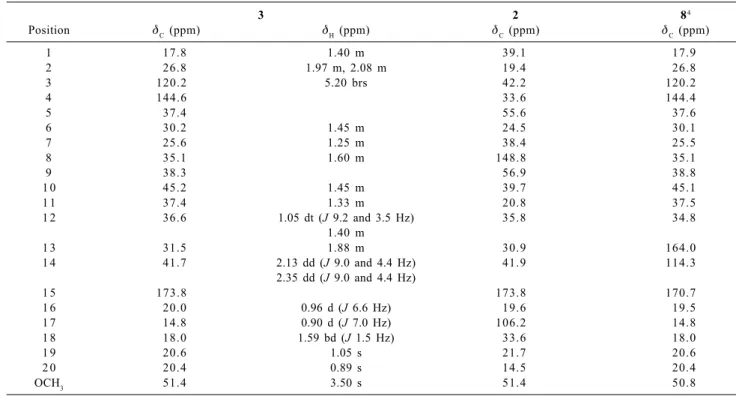
to a vinylic hydrogen at δ 5.20 (brs, 1H), was observed. The full 1H and 13C NMR signals assignment was based
on homonuclear and heteronuclear 2D experiments (COSY-90, HSQC) and by comparison with the 13C NMR spectral
data of the previously isolated compound 8,4 which showed
a good agreement for the chemical shifts of carbons belonging to the decalin moiety.
The 1H NMR spectrum also revealed signals for
methylene hydrogens (δ 2.13, dd, J 9.0 and 4.4 Hz; 2.35 dd, J 9.0 and 4.4 Hz) adjacent to a carbomethoxyl group and cross peaks in the COSY spectrum showing their coupling to a methinic hydrogen at δ 1.88 (m). This hydrogen was, in turn, connected to the methyl group at δ
0.96 and methylene hydrogens at δ 1.33 (m). The 13C NMR
data connectivity analyses and comparison of 13C NMR
data of the side chain of 3 with those of 2 were in good agreement. The chemical shift of carbon C-19, that appeared at δ 20.6, confirms the trans relationship for A/B ring.4 The assignments for all signals were fully confirmed
by HSQC and HMBC experiments.
Experimental
General
1H- and 13C-NMR spectra were recorded in CDCl 3
solution at 300 MHz and 75 MHz, respectively, with a Bruker AC 300/P spectrometer (internal standard TMS). IR spectra of neat samples were obtained on a Perkin-Elmer
1600 series FTIR. Mass spectra of purified compounds were obtained at 70 eV on an Hewlett-Packard 5990/5970 system equipped with a J&W Scientific DB-5 fused silica capillary column (30 m x 0.25 mm x 0.25 mm). High-resolution mass spectra (HRMS) were performed with a VG 7070E spectrometer by electron impact with beam energy of 70 eV. Optical rotations were measured with a Carl Zeiss photoelectric polarimeter.
Isolation
The seed pods and barks of Hymenaea courbaril var.
altissima (Ducke) were collected in March 1994 at Fazenda Santa Elisa (IAC- Campinas), São Paulo State, Brazil. A voucher specimen was deposited in the Herbarium of IB-UEC (# no. GS 01/03). Dry barks (360 g) were powdered and extracted with EtOAc (3L) for 5 days at room temperature. After filtration and evaporation of solvent at reduced pressure a crude extract (34 g) was obtained as an oily resin. A sample of resin (789 mg) was esterified with diazomethane and submitted successively for purification using silica gel column chromatography (CHCl3: MeOH 1% to 5%, v/v), prep TLC on SiO2/AgNO3 (5%, w/w) eluting with a mixture of different solvents and polarity (petroleum ether/EtOAc/CH2Cl2) to yield (-)-methyl copalate (1) {11 mg, [α]D20 –19.0 CHCl
3, c 0.7; lit., 6 [α]
D
20 –12.9}, methyl
eperuate (2) {15 mg, [α]D20 –24.0 CHCl
3, c 1.1; lit. 7, [α]
D 20
–26.0} and methyl (-)-(5R,8R,9R,10S) clerod-3-en-15-oate (3) {12 mg, [α]D20 –54.0 CHCl
3, c 0.6}. GC/MS analysis of
the barks methylated extract indicated: methyl isoozate (4) (3.7%), methyl ozate (5) (3.9%), methyl kovalenate (6) (3.2%), methyl (5S*,8S*,9S*,10R*
)-cleroda-3,13-dien-15-oate (7) (2.3%) and methyl (5R*,8S*,9S*,10R*
391 A New ent-Clerodane Diterpene from Hymenaea courbaril var. altissima
Vol. 13, No. 3, 2002
Dry seed pods (2.5 kg) were powdered and extracted with n-hexane (6L) for 5 days at room temperature. After filtration and evaporation of solvent at reduced pressure a crude extract (110 g) was obtained as an oily resin. A sample of resin (5 g) was submitted to acid and base extraction to furnish acidic fraction (3.3 g). Treatment with excess diazomethane gave esterified extract (3.4 g) which was submitted to successive purification by silica gel column chromatography (petroleum ether : EtOAc, 95:5, v/v) to yield (-)-methyl zanzibarate (6) as colorless crystals {150 mg, mp 132-134 oC, [α]
D
20 –37.5CHCl
3, c 2.0; lit., 8
[α]D –37.0, CHCl3, c 1.0}. GC/MS analysis of the esterified extract indicated the presence of methyl isoozate (4) (5.7%), methyl ozate (5) (46.5%) and methyl kovalenate (6) (10.5%).
Methyl (-)-(5R,8S,9S,10R)-clerod-3-en-15-oate (3)
Viscous oil, [α]D20 –54.0 (CHCl
3, c 0.6); HREIMS m/z:
320.27156 [M]+ (calcd 320.27153 for C
21H34O2); IR
νmax / cm
-1: 1741, 1458, 1436, 1381, 1162, 1096, 1012
(film); 1H NMR see Table 1; 13C NMR see Table 1.
Acknowledgements
This work was performed with financial support of FAPESP. RTN thanks CAPES and FAEP/UNICAMP for fellowships and RAG acknowledges FAPESP. We also
Table 1. 1H and 13C NMR spectral data of 3 (300 MHz, 75 MHz) and 13C NMR spectral data of 2 and 8 in CDCl
3 (75 MHz)
3 2 84
Position δC (ppm) δH (ppm) δC (ppm) δC (ppm)
1 17.8 1.40 m 39.1 17.9
2 26.8 1.97 m, 2.08 m 19.4 26.8
3 120.2 5.20 brs 42.2 120.2
4 144.6 33.6 144.4
5 37.4 55.6 37.6
6 30.2 1.45 m 24.5 30.1
7 25.6 1.25 m 38.4 25.5
8 35.1 1.60 m 148.8 35.1
9 38.3 56.9 38.8
1 0 45.2 1.45 m 39.7 45.1
1 1 37.4 1.33 m 20.8 37.5
1 2 36.6 1.05 dt (J 9.2 and 3.5 Hz) 35.8 34.8
1.40 m
1 3 31.5 1.88 m 30.9 164.0
1 4 41.7 2.13 dd (J 9.0 and 4.4 Hz) 41.9 114.3
2.35 dd (J 9.0 and 4.4 Hz)
1 5 173.8 173.8 170.7
1 6 20.0 0.96 d (J 6.6 Hz) 19.6 19.5
1 7 14.8 0.90 d (J 7.0 Hz) 106.2 14.8
1 8 18.0 1.59 bd (J 1.5 Hz) 33.6 18.0
1 9 20.6 1.05 s 21.7 20.6
2 0 20.4 0.89 s 14.5 20.4
OCH3 51.4 3.50 s 51.4 50.8
thank Dr. L.H.B. Baptistella and Dr. C.H. Collins for helpful discussion and suggestions.
References
1. Corrêa, M.P.; Dicionário de Plantas Úteis do Brasil, Ministério da Agricultura, IBDF, Imprensa Nacional: Rio de Janeiro, 1984, p. 593.
2. Neves, M.C.A.; Neves, P.C.A.; Zanini, J.C.; Medeiros, Y.S.; Yunes, R.A.; Calixto, J.B.; Phytother. Res.1993, 7, 356. 3. Bisby, F.A.; Buckingham, J.; Harborne, J.B.; Phytochemical
Dictionary of the Leguminosae. Plants and their Constituents, Chapman & Hall: London, 1994, Vol. 1, p. 357.
4. Nogueira, R.T.; Shepherd, G.J.; Laverde Jr., A.; Marsaioli, A.J.; Imamura, P.M.; Phytochemistry2001, 58, 1153. 5. Lee, Y.T.; Langenheim, J.H.; Systematics of the genus Hymenaea
L., Chemistry of California Press Ltd.: Los Angeles, 1975, Vol. 69.
6. Nunes, F.M.N.; Imamura, P.M.; J. Braz. Chem. Soc.1996, 7, 181.
7. Bevan, C.W.L.; Ekong, D.E.U.; Okogum, J.I.; J. Chem. Soc. C, 1968, 1067.
8. Hugel, G.; Ourisson, G.; Bull. Soc. Chim. Fr.1965, 2903.
Received: August 31, 2001 Published on the web: April 15, 2002