Low back pain in adolescent and associated factors: A
cross sectional study with schoolchildren
Mônica R. O. G. C. M. Silva1, Ana Fátima V. Badaró2, Marinel M. Dall’Agnol3
ABSTRACT | Objective: To determine the prevalence of low back pain nonspeciic and associated factors in schoolchildren. Method: This cross-sectional study investigated 343 adolescents, aged between 12 and 15 years, of both sexes of public
schools. The questionnaire included questions regarding sociodemographic characteristics, type of school transportation, body mass index and low back pain. The outcome was deined as discomfort localized below the costal margin and above the inferior gluteal folds in the last 12 months. Results: The prevalence of low back pain in the last year was
57% (n=195) among participants, with no signiicant difference between the sexes (OR 1.13, 95% CI 0.93 to 1.37). Advancing age and body mass index were associated with the presence of low back pain in the bivariate analysis. The
remaining seated at school in usual days was considered one of the main activities that trigger symptoms that lasted up
to seven days for the majority (80%) of adolescents. Conclusions: The high prevalence of low back pain presented,
indicating that it is a common condition among these adolescents. There was no difference between the sexes, but had inluence of age and body mass index. Our results point to the need for the development epidemiological studies of low back pain among children and adolescents.
Keywords: low back pain; prevalence; epidemiology; adolescent; rehabilitation.
HOW TO CITE THIS ARTICLE
Silva MROGCM, Badaró AFV, Dall’Agnol MM. Low back pain in adolescent and associated factors: A cross sectional study with schoolchildren. Braz J Phys Ther. 2014 Sept-Oct; 18(5):402-409. http://dx.doi.org/10.1590/bjpt-rbf.2014.0051
Introduction
Low back pain (LBP) or lumbago is characterized
by pain or discomfort in the lumbar region, below the costal margin and above the gluteal fold that may or may not irradiate to the thigh1. LBP is a sensory and
emotional experience that may be associated with
trauma. This condition is dificult to diagnose2, since many different factors (e.g. physiological, emotional
and cultural) are responsible for triggering pain
stimuli in individuals. Due to the complaints being subjective, it is challenging to characterize and to
describe this multidimensional experience, or to
quantify it in numbers or measurable data3.
The diagnostic of LBP, obtained through the
clinical history of the patient associated with a
physical examination, classifies LBP into three categories: 1) LBP potentially associated with a speciic cause in the spine, 2) LBP potentially associated with spinal stenosis, or 3) LBP with a nonspeciic cause1. The irst two diagnoses have deined etiology, since the pain has a speciic cause (i.e. congenital, neoplastic, inlammatory, infectious,
metabolic, traumatic, degenerative or functional) and this pain affects less than 15% of the adult, adolescent and childhood populations4. On the other hand, for the nonspeciic LBP, the causal agent is unknown5.
In Europe, the cumulative annual incidence of LBP symptoms in adolescents is 24%6, with
prevalence reaching more than half of these individuals7,8. It has become a common condition
among adolescents, similar to adults, and may
reach 70-80% of the population under 20 years of
age9. Several investigations on LBP in children and
adolescents have been conducted in other countries7-9,
but few studies have investigated the symptoms
within this age group in Brazil10-12. Furthermore,
there is a great difference between the prevalence
rates in Brazilian studies, ranging from 13% to 49%
in individuals between 11 and 19 years of age11,12.
The literature has shown that, when considering
the etiology of the nonspeciic LBP, the possible
risk factors include: age13,14, female gender13,14, race/ethnicity1, type of transportation used to go
1Centro de Ciências da Saúde (CCS), Universidade Federal de Santa Maria (UFSM), Santa Maria, RS, Brazil 2Departamento de Fisioterapia e Reabilitação, CCS, UFSM, Santa Maria, RS, Brazil
to school11, tight muscles15, accelerated growth in
height15,16, remaining seated for long hours17, child
work17,18, psychosocial barriers19 and body mass index (BMI)20. There are authors who also considered low
parental educational status, which is an indicator of socio economic status of the family, as a factor
that has been associated with LBP in children and
adolescents21.
Similar to what occurs among adults22, LBP
might affect the social lives of adolescents at school and during leisure23,24, as well as their economic
life, since the condition triggers costs for doctors
and treatments. Therefore, an investigation of the prevalence of LBP and its risk factors are important
for the development of preventive measures5 and effective interventions to improve the quality of life of these young people.
The present study had the objective of determining
the prevalence of LBP among adolescents in schools in southern Brazil, and its association with socio
demographic factors, types of school transportation
and BMI.
Method
This cross-sectional study evaluated students from the 6th to the 9th year of elementary education in public
schools, 12-15 years of age, that were living in the city
of Santa Maria, RS, Brazil. The Municipal Secretary of Education authorized the project and provided a
list of 45 elementary public schools in the urban area and the number of students per grade, by school and
by administrative region. A total of 5,471 students were enrolled in 2012.
The sample size a power calculation was made
using EpiInfo™ software version 6.04. The aim was
to have 80% power to observe a signiicant diference (alpha level) of 5%, with prevalence ratio of 1.3 and estimated dropout rate of 20%, we needed to include 328 adolescents in group.
The sampling was performed in multiple stages,
with stratiied cluster selection proportional to the
number of students enrolled in each of the six urban
administrative regions of the municipality. One
school per region was selected by simple random sampling, and all students of the target population
were invited to participate. When there was refusal of
the school to participate in the study, another school was drawn until the sample reached the number of
students required. One school refused to participate
in the study on the grounds that the data collection would delay the school schedule and a second school because of the existence of other health projects that
were already in development. Therefore two other schools were selected to make up the inal sample.
Exclusion criteria were students with alterations in the central nervous system (CNS) (e.g. cerebral palsy, paraplegia) and/or cognitive deicits, based
on the school records; students with musculoskeletal
problems (e.g. fractures in the upper limbs, lower
limbs, trunk or a prosthesis) and pregnancy, as these
conditions could interfere with the quality of the anthropometric data.
The project was approved by the Ethical Committee in Research from Universidade Federal de Santa Maria (UFSM), Santa Maria, RS, Brazil, under protocol number 7061/2012. The researcher
instructed the students about the informed consent
(IC), so that parents/or guardians could authorize their participation in the study. Likewise, the adolescents also signed a consent form.
Data collection was carried out between May and July 2012 during two visits: one for the application of the questionnaire and another for the measurement
of the body weight and height, both performed by
one of the researchers. The adolescents completed the questionnaire after the interviewer had read each question and its alternatives, had clariied any confusion and had emphasized that the answers were independently given. The interview took place in a room reserved by the school, with a group of 20 to 25 students, and lasted approximately 30 minutes for each student. The questions were pre-coded
and addressed socio demographic characteristics, and types of transportation used to go to school,
the presence of LBP and body positions that would trigger the pain. In addition, the measurements of
body weight and height were obtained to calculate
the BMI.
The socio demographic variables included age, gender, paid child work (yes or no), self-chosen
ethnic group (i.e., Caucasian, Black, Brown, Asian and Indigenous) and the highest level of education of the parent/guardian responsible for the adolescent (i.e., no education, incomplete or complete primary
education, incomplete or complete secondary education, incomplete or complete post-secondary
education).
The type of transportation used to go to school
was classiied as: on foot, by bicycle, by bus, by car or other. The responses were grouped into “passive
transportation” when the adolescent travelled by
car, motorcycle or bus; and “active transportation” when they travelled on foot or by bicycle. The type
of transportation, the colour of their skin and the
bivariate analysis, forming one of the many categories
presented in the tables to facilitate the tests.
The dependent variable, nonspeciic LBP, was
anatomically defined as any pain that occurred between the twelfth rib and the inferior gluteal fold without radiation to the lower limbs1,5. To increase the
accuracy of data collection, we added the following information, a minimum duration of 24 hours of
symptoms since onset, to avoid reports of LBP due to
fatigue, which can be resolved within a few hours19.
To measure this outcome we used the adapted version
of the Nordic Questionnaire (Standardized Nordic Questionnaire, originally created by Kuorinka25)
proposed by Sjolie26, for children and adolescents. The Brazilian Portuguese version was validated and showed an excellent intraclass correlation coeficient (0.70 to 0.99) and Cronbach’s alpha (0.795). The questionnaire showed the lower back region in a
drawing of the human body and investigated pain
through nine dichotomous answers (yes or no). The instrument evaluated LBP reports within the last year and its duration in days (i.e., one to seven days, eight to 30 days, more than 30 days - but not every day,
and every day) as well as the presence of trauma in
the lumbar spine (for exclusion criteria). In addition, it evaluated the respondent’s ability to recognize
whether or not the pain was triggered or enhanced
by certain body positions (i.e., seated in school,
seated at home, seated in a car, seated in situations other than those already listed, watching television, or physical work)14.
The BMI, obtained by dividing the body mass in kilograms by the square of the height in meters, was classiied as follows: excessively lean if less than 17 Kg/m2, normal if between 17 and 24.9 Kg/m2, overweight if between 25 and 29.9 Kg/m2 and obese if ≥30 Kg/m2. This classiication is considered the
most appropriate for children and adolescents27. The
overweight and obese categories were grouped into
the category “overweight” for analysis. Body mass
and height were recorded using an electronic digital scale (Soehnle brand) with a stadiometer consisting
of a metal rod scaled from zero to 2.30 meters and with intervals of one centimeter. These measurements were recorded using the techniques recommended by the World Organization of Health28.
The information was stored in a database in
EpiInfo 6.04, with double entry and data validation.
This was followed by descriptive and bivariate
analyses. The descriptive analysis showed the distributions of absolute and relative frequencies for categorical variables. For the continuous variables, mean and standard deviation were applied. For
analysis, the bivariate analysis with calculations of
Odds Ratio (OD) with the 95% conidence interval (CI), and the chi-square for nominal variables, were conducted. Associations with p≤0.05 were considered signiicant.
Results
This cross-sectional study assessed 355
adolescents attending public schools in 2012.
Sample loss from those who agreed to participate in the survey accounted for 3% of the total sample (n=12), and occurred due to the interruption of the interview process by a professor who had scheduled
other activities for the students. The inal sample
included 343 individuals, with a greater number of
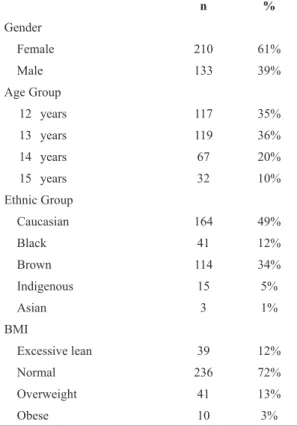
girls, caucasian or brown, normal BMI and with a mean age of 13 years (SD=0.96) (Table 1). Almost half of the parents interviewed had an educational level lower than elementary school education; most students walked to school, and the paid child labour
was observed in 13%. These characteristics are shown
in Table 2.
For the adolescents who reported back pain in the last year, the most reported activity and/or body
position that triggered or increased pain was seated in school followed by seated in another situation, seated at home, doing physical work, physical education
classes, watching TV and seated in the car, as shown
in Table 3.
The prevalence of LBP in the last year was 57% (n=195) among participants, 60% in girls (n=125) and 53% in boys (n=70), with no signiicant difference between the sexes (RP=1.13, 95% CI 0.93 to 1.37).
The vicariate analysis also showed a trend of
increased prevalence of LBP in older adolescents, with a statistically signiicant difference between 14 year old students compared to 12 year olds.
The BMI was associated with LBP and the prevalence was signiicantly lower among excessively lean students compared to normal individuals. There was no difference in LBP between obese compared with students having a normal weight. Their ethnic
group (Table 4), doing paid child labour, level of parental schooling and type of transportation to
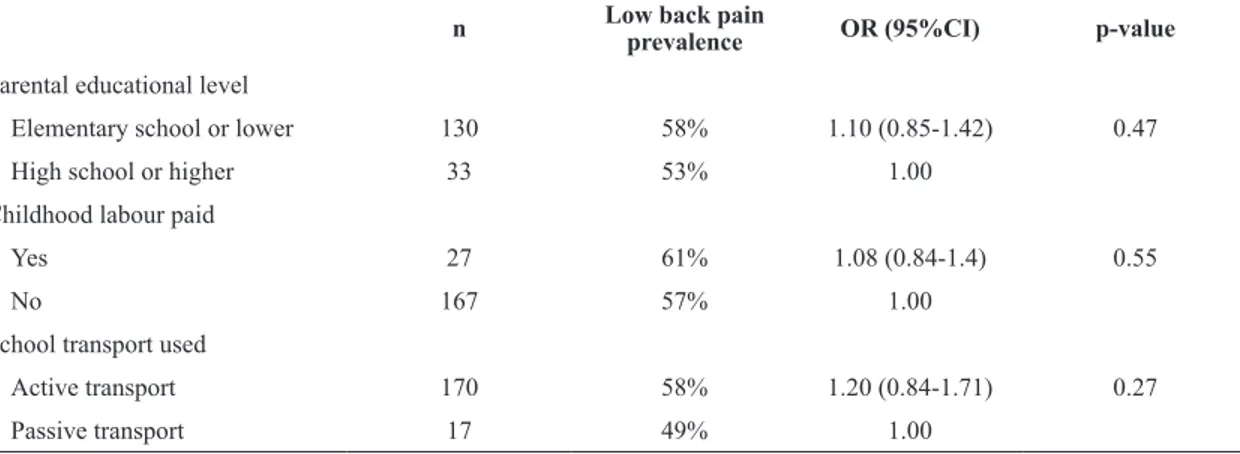
school were not associated with LBP (Table 5).
The symptoms of LBP lasted up to seven days for most students who reported pain (80%), but 7%
reported that pain was present every day and 5% of
Discussion
This study found that LBP was highly prevalent in students 12 to 15 years of age from public schools. In addition, the prevalence was similar among boys and girls. The cross-sectional design of this study
prevented inference of causality, however, the sample
size was suficient to detect relationships between the outcome and the variables studied. Being older was
associated with increased occurrence of low back
pain, however, this occurrence was less frequent among excessively lean adolescents (i.e., those with BMI <17Kg/m2).
Studies on the prevalence of LBP among Brazilian
adolescents are scarce10-12. Furthermore, the data
presented regarding the definition of LBP and
the types of instruments used to collect data are
conlicting. To minimize these issues, our study followed the standard deinition of LBP established by the European Guidelines for Prevention of Low
Back Pain (European Guidelines for Prevention
in Low Back Pain) by the group Cost Action B135. This research group was created by the European Commission to establish guidelines for the management of LBP. It consisted of invited researchers, experts in the ield of LBP, from nine countries. The instrument chosen to determine the
outcome was adapted to the population of interest and has been shown to have good reproducibility14.
Based on the criteria measured, this study observed a higher prevalence of LBP than the study of Vitta (19%) conducted in the southeast of Brazil10. The
findings were similar to international reports,
demonstrating that LBP is a common condition
among adolescents7,8,25, as well as among adults22.
Although measures were taken to ensure subject participation, some students refused to participate
in this investigation. This result is similar to
other studies conducted with adolescents using
questionnaires15,29,30. However, the observed high
prevalence suggests that the non-participants did not
affect the study’s outcome. It also suggests that the
outcome was not underestimated and the expected
random distribution of the non-respondents did occur. In addition, the two variables observed, age and BMI, were associated with non-speciic LBP.
Age showed a direct relationship with LBP, a fact
that has been supported by most studies16,18,19,24,29, and
according to some researchers, strongly associated with the growth spurt observed in adolescence15,16.
The peak of the growth spurt, which occurs earlier for girls (on average between the ages of 11 and 12 years) than for boys (commonly between the ages of Table 1. Sample distribution according to gender, age, ethnic group
and BMI of adolescents from the public schools in Santa Maria, RS, Brazil, 2012 (n=343).
n %
Gender
Female 210 61%
Male 133 39%
Age Group
12 years 117 35%
13 years 119 36%
14 years 67 20%
15 years 32 10%
Ethnic Group
Caucasian 164 49%
Black 41 12%
Brown 114 34%
Indigenous 15 5%
Asian 3 1%
BMI
Excessive lean 39 12%
Normal 236 72%
Overweight 41 13%
Obese 10 3%
Until 2% unrecognized answer and losses in the questionnaire; 4-5% unrecognized answer and losses in the questionnaire.
Table 2. Sample distribution according to parental educational level, childhood paid labour and school transportation used by
adolescents from public schools in Santa Maria, RS, Brazil, 2012 (n=343).
n %
Parental educational level
None 8 3%
Elementary school (incomplete) 124 43%
Elementary school (complete) 27 9%
High School (incomplete) 65 23%
High School (complete) 63 22%
Childhood paid labour
Yes 44 13%
No 297 87%
School transportation used
On foot 276 84%
Bus 24 7%
Other 14 4%
Car 11 3%
Bike 3 1%
Table 3. Activities or triggering positions that aggravated low
back pain in adolescents from public schools in Santa Maria, RS, Brazil, 2012 (n=195).
n %
Seated at school 131 70%
Seated in other situation 108 60%
Seated at home 102 57%
Heavy job 98 53%
Physical education classes 80 45%
Watching TV 60 33%
Seated in the car 30 17%
4-8% unrecognized answer and losses in the questionnaire.
Table 4. Bivariate analysis of the prevalence of low back pain according to gender, age, ethnic group and BMI of adolescents from public
schools in Santa Maria, RS, Brazil, 2012 (n=343).
n Low back pain
prevalence OR (95%CI) p-value
Gender
Female 125 60% 1.13 (0.93-1.37) 0.21
Male 70 53% 1.00
Age
12 years 59 51% 1.00
13 years 66 55% 1.09 (0.86-1.39) 0.48
14 years 44 67% 1.31 (1.02-1.68) 0.039
15 years 20 63% 1.23 (0.89-1.70) 0.24
Ethnic Group
Caucasian 93 43% 0.96 (0.83-1.21) 0.99
Other 97 43% 1.00
BMI
Excessive lean 15 39% 0.66 (0.43-0.99) 0.01
Normal 138 59% 1.00
Over weight or obese 34 67% 1.14 (0.91-1.42) 0.29 OR: odds ratio; CI: conidence interval; p-value <0.05.
Table 5. Bivariate analysis of the prevalence of low back pain, according to parental educational level, paid childhood labour, school
transportation used for adolescents from public schools in Santa Maria, RS, Brazil, 2012 (n=343).
n Low back pain
prevalence OR (95%CI) p-value
Parental educational level
Elementary school or lower 130 58% 1.10 (0.85-1.42) 0.47
High school or higher 33 53% 1.00
Childhood labour paid
Yes 27 61% 1.08 (0.84-1.4) 0.55
No 167 57% 1.00
School transport used
Active transport 170 58% 1.20 (0.84-1.71) 0.27
Passive transport 17 49% 1.00
OR: odds ratio; CI: conidence interval; p Value <0.05.
13 and 14)31, may be responsible for the decreased lexibility, especially of the quadriceps and hamstrings
muscles15 , that causes functional impairment of the lumbar muscles, and consequently pain.
In this study, LBP was commonly seen in the 14 year old group. It is possible that the small
number of 15 year old participants in the sample
(10%), compared with the 14 year old (20%), may have inluenced the results, despite the fact that LBP
has been shown to be prevalent among 15 year old
adolescents.
relationship of LBP and BMI were inconsistent with the indings of a previous study20,32,33, since
excess body weight was not correlated with LBP in
the present study, even with the slight increase as
compared to normal. Because most of the studies20,32,33
are generally focused on excess body weight, it
is necessary to evaluate the inluence of the
non-respondents, but it was not possible to carry out this
procedure, in the present study.
On the other hand, the low occurrence of LBP among excessively lean adolescents is of note. In this sample, a BMI<17 Kg/m2 appears to be a factor that decreases the occurrence LBP. However, this inding has not been emphasized by the literature reviewed,
because the focus of most of the studies20,32,33 have
generally involved the overweight group. According
to our results, it is important to consider that the
assessments based on BMI could be a complicating
factor due to the changes in body composition that occur during sexual maturation of the adolescent34.
In this study, the seated position during the usual
school day was one of the activities considered harmful to the lumbar region, both for those who
had LBP and those who did not. It is possible that
seated postures12,17 and school furniture7 might lead
to lumbar muscle dysfunction and predispose the individual to painful symptoms12,16,17. However, this conjecture was not assessed in the present study.
No association was found between LBP and
gender in this study, which it is consistent with some of the other studies6,29 in the literature. Nevertheless,
there is no consensus regarding this gender outcome, since there are authors who have found an association
between LBP and females7,8,10,17,19, and others
with males16,29. Furthermore, other variables
(ethnicity, type of school transport, education level of
responsibility and child work) were not signiicantly associated with LBP. However, the literature indicates
some of these variables as risk factors for the presence of painful symptoms in the lumbar region in schoolchildren11,13,18-20.
This study showed that there is evidence that problems in the lumbar spine in children and adolescents are common, but more epidemiological studies should be performed to assess the prevalence and incidence in other geographical regions of
Brazil, which may have cultural, social and climate differences from the one studied. In addition, other factors need to be investigated. For example: do the
symptoms persist over a number of years? do the majority of children with these problems receive appropriate treatment? do untreated disorders lead to
the occurrence of severe LBP in adulthood? do the
symptoms limit activities? what is the impact of this
severity on health services? Finally, how does this condition affect the quality of life of young people?
Conclusion
The knowledge of the prevalence and incidence
of LBP in a specific population, as well as the identiication of the risk factors, forms the basis
for the development of treatments and prevention programs and assists in the planning of health care
services directed to help children and adolescents. In the present study, LBP showed a high prevalence in
the 12 to 15 year old age group, indicating that it is a
common condition among adolescents. The majority
of the participants reported that the symptoms lasted for a week, were similar among boys and girls,
were signiicantly higher in older adolescents, and were lower among the excessively lean students. In addition, the seated position during school days was considered the main activity that triggered LBP symptoms.
References
1. Chou R, Qaseem A, Snow V, Casey D, Cross JRT, Shekelle P, et al. Diagnosis and treatment of low back pain: a joint clinical practice Guideline from the American College of Physicians and the American Pain Society. Ann Intern
Med. 2007;147(7):478-91. PMid:17909209. http://dx.doi.
org/10.7326/0003-4819-147-7-200710020-00006 2. International Association for the Study of Pain - IASP.
Psychological intervention for acute and chronic pain in children. Pain. 2006;14(4):1-4.
3. Silva JA, Ribeiro-Filho NP. A dor como um problema psicofísico. Rev Dor. 2011;12(2):138-51. Available from: http://www.scielo.br/scielo.php?script=sci_ arttext&pid=S1806-00132011000200011&lng=en. 4. Brazil A, Ximenes AC, Radu AS, Fernandes AR, Appel
C, Maçaneiro CH, et al. Diagnóstico e tratamento das lombalgias e lombociatalgias. Rev Bras Reumatol. 2004;44(6):419-25.
5. Burton AK, Balagué F, Cardon G, Eriksen HR, Henrotin Y, Lahad A, et al. Chapter 2. European guidelines for prevention in low back pain. Eur Spine J. 2006;15(2):136-68.
6. Jones GT, Watson KD, Silman AJ, Symmons DPM, Macfarlane GJ. Predictors of low back pain in British
schoolchildren: a population-based prospective cohort
study. Pediatrics. 2003;111(4 Pt 1):822-8. PMid:12671119. http://dx.doi.org/10.1542/peds.111.4.822
8. Kovacs FM, Gestoso M, Gil Del Real MT, López J, Mufraggi N, Méndez JI. Risk factors for non-speciic low
back pain in schoolchildren and their parents: a population
based study. Pain. 2003;103(3):259-68. http://dx.doi. org/10.1016/S0304-3959(02)00454-2
9. Jeffries LJ, Milanese SF, Grimmer-Somers KA. Epidemiology of adolescent spinal pain: a systematic overview of the research literature. Spine (Phila Pa 1976). 2007;32(23):2630-7. PMid:17978666. http://dx.doi. org/10.1097/BRS.0b013e318158d70b
10. De Vitta A, Martinez MG, Piza NT, Simeão SFAP, Ferreira NP. Prevalência e fatores associados à dor lombar em escolares. Cad. Saúde Pública. 2011;27(8):1520-8. http:// dx.doi.org/10.1590/S0102-311X2011000800007 11. Onofrio AC. Dor lombar aguda em adolescentes do ensino
médio de uma cidade do sul do Brasil: prevalência e fatores associados [dissertation]. Rio Grande do Sul: Universidade Federal de Pelotas; 2010.
12. Graup S, Santos SG, Moro ARP. Estudo descritivo das alterações posturais sagitais da coluna lombar em escolares da rede federal de ensino de Florianópolis. Rev Bras Ortop. 2010;45(5):453-9. http://dx.doi.org/10.1590/ S0102-36162010000500013
13. Watson KD, Papageorgiou AC, Jones GT, Taylor S, Symmons DP, Silman AJ, et al. Low back pain in
schoolchildren: the role of mechanical and psychosocial
factors. Arch Dis Child. 2003;88(1):12-7. PMid:12495949 PMCid:PMC1719294. http://dx.doi.org/10.1136/ adc.88.1.12
14. Vidal ARC. Dor lombar especíica em alunos adolescentes em função do gênero, idade e nível de atividade física [master’s thesis]. Porto: Universidade do Porto; 2009. 15. Feldman DE, Shier I, Rossignol M, Abenhaim L.
Risk factors for the development of low back pain in adolescence. Am J Epidemiol. 2001;154(1):30-6. PMid:11427402. http://dx.doi.org/10.1093/aje/154.1.30 16. Poussa MS, Heliövaara MM, Seitsamo JT, Könönen
MH, Hurmerinta KA, Nissinen MJ. Anthropometric
measurements and growth as predictors of low-back pain: a cohort study of children followed up from the
age of 11 a 22 years. Eur Spine J. 2005;14(6):595-8. PMid:15789230 PMCid:PMC3489232. http://dx.doi. org/10.1007/s00586-004-0872-4
17. Sjolie AN. Persistence and changes in nonspeciic low back pain among adolescents. Spine (Phila Pa 1976). 2004;29(21):2452-7. PMid:15507810. http://dx.doi. org/10.1097/01.brs.0000143666.58758.8b
18. Fassa AG, Facchini LA, Dall’Agnol MM, Christiani DC. Child labor and musculoskeletal disorders: the Pelotas (Brazil) epidemiological survey. Public Health Rep. 2005;120(6):665-73. PMid:16350337 PMCid:PMC1497777.
19. Jones GT, Macfarlane GJ. Predicting persistent low back pain in schoolchildren: a prospective cohort study. Arthritis Rheum. 2009;61(10):1359-66. PMid:19790124. http:// dx.doi.org/10.1002/art.24696
20. Shiri R, Karppinen J, Leino-Arjas P, Solovieva S, Viikari-Juntura E. The association between obesity and low back pain: a meta-analysis. Am J Epidemiol.
2010;171(2):135-54. PMid:20007994. http://dx.doi. org/10.1093/aje/kwp356
21. Hestbaek L, Korsholm L, Leboeuf-Yde C, Kyvik KO. Does socioeconomic status in adolescence predict low
back pain in adulthood? A repeated cross-sectional of
4,771 Danish adolescents. Eur Spine J. 2008;17(12):1727-34. PMid:18830719 PMCid:PMC2587673. http://dx.doi. org/10.1007/s00586-008-0796-5
22. Ferreira GD, Silva MC, Rombaldi AJ, Wrege ED, Siqueira FV, Hallal PC. Prevalence and associated factors of back pain in adults from southern Brazil: a population-based study. Rev Bras Fisioter. 2011;15(1):31-6. PMid:21390471. http://dx.doi.org/10.1590/S1413-35552011005000001 23. Skoffer B, Foldspang A. Physical activity and low-back
pain in schoolchildren. Eur Spine J. 2008;17(3):373-9. PMid:18180961 PMCid:PMC2270392. http://dx.doi. org/10.1007/s00586-007-0583-8
24. Prista A, Balangué F, Nordin M, Skovrom ML. Low back pain in mozambican adolescents. Eur Spine J. 2004;13(4):341-5. PMid:15034774 PMCid:PMC3468049. http://dx.doi.org/10.1007/s00586-004-0683-7
25. Kuorinka I, Jonsson B, Kilbom A, Vinterberg H, Biering-Sorensen F, Andersson G, et al. Standardised Nordic questionnaires for the analysis of musculoskeletal symptoms. Appl Ergon. 1987;18(3):233-7. http://dx.doi. org/10.1016/0003-6870(87)90010-X
26 Sjolie AN. Active or passive journeys and low back pain in adolescents. Eur Spine J. 2003;12(6):581-8. PMid:12928857 PMCid:PMC3467993. http://dx.doi. org/10.1007/s00586-003-0557-4
27. Cole TJ, Belizzi MC, Flegal KM, Dietz WH. Establishing a standard deinition for child overweight and obesity worldwide: international survey. BMJ. 2000;320:1240. PMid:10797032 PMCid:PMC27365. http://dx.doi. org/10.1136/bmj.320.7244.1240
28. World Health Organization - WHO. Physical status: the use and interpretation of anthropometry. Geneva: WHO; 1995. WHO Technical Report Series, 854.
29. Hestbaek L, Leboeuf-Yde C, Kyvik KO, Manniche C. The
course of low back pain from adolescence to adulthood:
eight-year follow-up of 9600 twins. Spine (Phila Pa 1976). 2006;31(4):468-72. PMid:16481960. http://dx.doi. org/10.1097/01.brs.0000199958.04073.d9
30. Mikkelsson LO, Nupponen H, Kaprio J, Kautiainen H, Mikkelsson M, Kujala UM. Adolescent lexibility,
endurance strength, and physical activity as predictors of adult tension neck, low back pain, and knee injury: a 25
year follow up study. Br J Sport Med. 2006;40(2):107-13. PMid:16431995 PMCid:PMC2492014. http://dx.doi. org/10.1136/bjsm.2004.017350
31. Instituto Brasileiro de Geograia e Estatística - IBGE. Pesquisa Nacional de Saúde do Escolar: PeNSE. Rio de Janeiro: Ministério da Saúde; 2009.
32. Auvinen JP, Tammelin TH, Taimela SP, Zitting PJ, Järvelin M, Taanila AM, et al. Is insuficient quantity and quality of
sleep a risk factor for neck, shoulder and low back pain?
A longitudinal study among adolescents. Eur Spine J. 2009;19(4):641-9. PMid:19936804 PMCid:PMC2899838. http://dx.doi.org/10.1007/s00586-009-1215-2
trunk muscle performance and low back pain in
male adolescents. Eur Spine J. 2010;19(4):624-32. PMid:19771455 PMCid:PMC2899830. http://dx.doi. org/10.1007/s00586-009-1168-5
34. Conde WL, Monteiro CA. Body mass index cut off points for evaluation of nutritional status in Brazilian children and adolescents. J Pediatr. 2006;82(4):266-72. http://dx.doi. org/10.2223/JPED.1502
Correspondence Ana Fátima Viero Badaró
Universidade Federal de Santa Maria Centro de Ciências da Saúde
Departamento de Fisioterapia e Reabilitação
Avenida Roraima, 1.000, prédio 26, Cidade Universitária, Camobi