The Brazilian version of STarT Back Screening Tool –
translation, cross-cultural adaptation and reliability*
Bruna Pilz1,2, Rodrigo A. Vasconcelos1,2, Freddy B. Marcondes1,3, Samuel S. Lodovichi4, Wilson Mello1, Débora B. Grossi2
ABSTRACT | Background: Psychosocial factors are not routinely identiied in physical therapy assessments, although
they can inluence the prognosis of patients with low back pain. The “STarT Back Screening Tool” (SBST) questionnaire aids in screening such patients for poor prognosis in the primary care setting and classiies them as high, medium, or low risk based on physical and psychosocial factors. Objectives: This study sought to translate and cross-culturally
adapt the SBST to the Brazilian Portuguese language and test the reliability of the Brazilian version. Method: The
irst stage of the study consisted of the translation, synthesis, and back-translation of the original version of the STSB, including revision by the Translation Group, pretest of the translated version, and assessment by an expert panel. The pre-inal Brazilian version was applied to 2 samples comprising 52 patients with low back pain; these patients were of both genders and older than 18 years of age. To assess the instrument’s reliability, an additional sample comprising 50 patients was subjected to 2 interviews, and the results were assessed using the quadratic weighted kappa value. The instrument’s internal consistency was assessed using Cronbach’s alpha (n=105), and the standard error of measurement was also calculated (n=50). Results: Translation and back-translation attained consensus, and only item 6 required
changes; the reformulated version was applied to an additional sample comprising 52 individuals who did not report any doubts related to this item. The reliability of the SBST-Brazil was 0.79 (95% conidence interval: 0.63-0.95), the internal consistency was 0.74 for the total score and 0.72 for the psychosocial subscale, and the standard error of measurement was 1.9%. Conclusion: The translated and cross-culturally adapted SBST-Brazil proved to be reliable for screening
patients according to their risk of poor prognosis and the presence of psychosocial factors.
Keywords: low back pain; questionnaire; STarT Back Screening Tool; rehabilitation; reliability.
HOW TO CITE THIS ARTICLE
Pilz B, Vasconcelos RA, Marcondes FB, Lodovichi SS, Mello WA, Grossi DB. The Brazilian version of STarT Back Screening Tool – translation, cross-cultural adaptation and reliability. Braz J Phys Ther. 2014 Sept-Oct; 18(5):453-461. http://dx.doi. org/10.1590/bjpt-rbf.2014.0028
Introduction
Low back pain is a major health problem worldwide, affecting mostly females and individuals aged 40-80 years. Approximately 11.9% of patients exhibit limitations due to low back pain for more than 1 day, and 23.2% of patients show limitations for more than 1 month1. Most patients with acute low back pain (90%) recover within 6 weeks, but symptoms remain in 2 to 7% of patients. These symptoms progress into chronic pain, which accounts for 75-85% of absenteeism in the workplace2. In addition, 53% of individuals with chronic low back pain from a speciic population exhibit signiicant psychological disorders3.
The emotional and behavioral impact of this pain favors the development of chronic conditions4-6, and some evidence shows that psychosocial factors, including the patient’s perception about the resolution of the symptoms of low back pain and their association with other diseases, dificulty in coping with the disease, lack of conidence, pain catastrophizing, and depressive symptoms, are predictive of dysfunction and interfere with the prognosis of low back pain7-12. Identiication in the primary care setting of patients exhibiting psychosocial factors liable to interfere with their prognosis2,7,8,13 contributes to establishing more speciic treatments and allows the patient to
1Núcleo de Estudos e Pesquisa, Instituto Wilson Mello, Campinas, SP, Brazil
2Programa de Pós-graduação em Reabilitação e Desempenho Funcional, Faculdade de Medicina de Ribeirão Preto (FMRP), Universidade de São
Paulo (USP), Ribeirão Preto, SP, Brazil
3Universidade Estadual de Campinas (UNICAMP), Campinas, SP, Brazil
4Centro Universitário da Fundação Educacional de Guaxupé (UNIFEG), Guaxupé, MG, Brazil
Received: 01/28/2014 Revised: 03/25/2014 Accepted: 03/31/2014
better understand the consequences of the signs and symptoms of low back pain13. These facts notwithstanding, the inluence of psychosocial factors is not fully understood and is poorly considered in the planning of treatment. For these reasons, the identiication of such factors still poses a challenge5,8.
Thus, the application of a questionnaire to assess psychosocial factors may enable the stratiication of individuals with low back pain and contribute to therapeutic decision-making.
Recently, Hill et al.14 formulated the “STarT Back Screening Tool” (SBST) questionnaire. Developed in English, the SBST classiies the risk of poor prognosis of low back pain patients with or without radiculopathy inluenced by physical and psychosocial factors. The SBST was shown to be able to predict future dysfunction in patients with low back pain in the primary care setting and exhibited acceptable test-retest reliability and internal consistency15.
Several studies have tested the effectiveness of the SBST12,13,15-17. Hill et al.18 found that patients stratiied and treated based on the SBST exhibited better performance on the Rolland-Morris Disability Questionnaire and consequently better quality of life, less use of healthcare services, and lower number of days off work compared to the control group, which was not stratiied.
However, there are few questionnaires available in Brazil to assess the risk of poor prognosis among patients with low back pain inluenced by physical and psychosocial factors. For this reason, the aims of the present study were to translate and cross-culturally adapt the SBST to the Brazilian Portuguese language and to analyze its psychometric properties of reliability through assessment of intra-rater reliability, internal consistency, and standard error of measurement to provide a reliable tool for screening individuals with low back pain. Such a tool will afford physical therapists with a differentiated approach and improve their clinical decision-making skills in both the clinical and research settings.
Method
Description of the SBST questionnaire The SBST questionnaire is comprised of 9 items. Of these, 4 are related to refererred leg pain, disability, and comorbid shoulder or neck pain, and 5 of the items make up a psychosocial subscale (items 5 to 9) that investigates bothersomeness, pain catastrophizing, fear, anxiety, and depression12,14,15,18. The SBST-Brazil includes the changes introduced
and the order of the items formulated by Fritz et al.12 and Hill et al.18, which the authors of the original instrument recommended to facilitate patient classiication.
Using the SBST in the study, patients were classiied as having a high risk of poor prognosis (high levels of psychosocial prognostic factors were present with or without the physical factors present); medium risk (physical and psychosocial factors were present, but not a high level of psychosocial factors); or low risk (few physical or psychosocial prognostic factors were present)12,18.
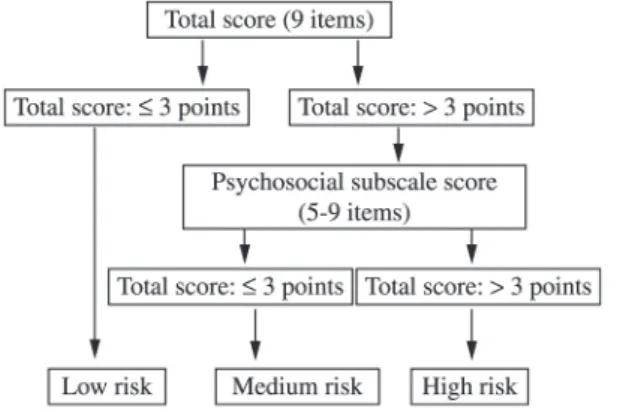
For the purposes of scoring and classiication, respondents were given answer options of “I agree” and “I disagree” for the irst 8 items, which were scored 1 and 0 points, respectively. Item 9 had 5 answer options, including “Not at all, Slightly, Moderately, Very much, and Extremely”; the irst 3 options were assigned 0 points, and the latter 2 were given 1 point each. Total scores from 0-3 corresponded to a low risk. For total scores greater than 3, classification was based on the psychosocial subscale score (items 5 to 9) as follows: scores ≤3 corresponded to medium risk and scores >3 corresponded to high risk12,14,18. Figure 1 depicts the SBST classiication system.
Translation and cross-cultural adaptation Cross-cultural adaptation of the SBST questionnaire was performed using the methods described by Beaton et al.19. Authorization for this process was requested from the author of the original version, Dr. Jonathan Hill, Keele University, United Kingdom. The present study was approved by the Research Ethics Committee of the Pontiical Catholic University of Campinas (Pontifícia Universidade Católica de Campinas - PUC-Campinas), Campinas, São Paulo, Brazil, under ruling no. 150.139.
The modified SBST version12,18 was used for cross-cultural adaptation, which was performed in the following 6 steps: (1) translation, (2) synthesis, (3) back-translation, (4) revision by the Translation Group, (5) pretest, and (6) assessment by an expert panel.
the investigators (second synthesis step), resulting in version T12.
In the third step, version T12 was back-translated into English by 2 different bilingual translators (BT1 and BT2) who had no knowledge about the original English version of the questionnaire; these translators were native English speakers residing in Brazil and luent in Brazilian Portuguese.
In the fourth step, all 5 versions (original, T1, T2, T12, BT1, and BT2) were revised by the Translation Group, which comprised one physical therapist, 2 orthopedic doctors, and all 4 translators. The Translation Group consolidated all 5 versions to produce a pre-inal version of the SBST questionnaire.
In the ifth step, 2 pretests were performed with the pre-inal version to eliminate any item not understood by more than 20% of the sample20. In the sixth step, all of the reports were submitted to the Committee for approval, after which they were sent to the author of the original version to approve the inal version.
A convenience sample was recruited at Wilson Mello Institute, Campinas, São Paulo, Brazil. This sample comprised individuals older than 18 years of age with low back pain, independent of the time elapsed since the onset of their back pain and with or without extension of pain to the lower limbs.
Individuals with severe clinical problems (e.g., cauda equina syndrome, fracture of the lumbar spine, malignancy, and cognitive, neurologic, or rheumatologic disorders), those subjected to lumbar spine surgery within the previous 6 months, pregnant women, and those who could not read or speak Brazilian Portuguese were excluded from the study. All patients who agreed to participate in this stage of the study and in the reliability assessment signed an informed consent form and provided demographic information, which is summarized in Table 1. The questionnaire was self-administered, and once the
patients answered the pre-inal version, they were each questioned by one of the investigators as to their understanding of each item to formulate suggestions for improvement.
Psychometric properties
Reliability
All of the properties corresponding to domain reliability were tested, including intra-rater reliability, internal consistency, and standard error of measurement21. Inter-rater reliability was not tested because the STBS is a self-administered questionnaire not subjected to any interference by examiners.
Intra-rater reliability
To assess the intra-rater reliability of the SBST-Brazil questionnaire, a different sample comprising 50 patients with unspecific low back pain was subjected to 2 interviews, as recommended by the Consensus-based Standards for the Selection of Health Measurement Instruments (COSMIN)21. The patients were recruited by means of convenience sampling at the physical therapy service of the Wilson Mello Institute, Campinas, São Paulo, Brazil.
The 2 interviews were conducted with an interval of 2 to 7 days, depending on the availability of the patients, and the SBST-Brazil questionnaire and a numerical rating scale (NRS) for pain22 were applied to all subjects. The NRS scale was used only as an exclusion tool. Only stable patients (i.e., those whose NRS scores exhibited variation of 2 points or less between both assessments) were considered for the study, because this value was considered as the minimal clinically important difference (MCID) for patients with chronic low back pain23. Patients with variations in the NRS score greater than 2 points and those who missed the second interview were excluded from the study.
Internal consistency
higher education) and risk stratiication based on the SBST (40% were classiied as low risk, 43% as medium risk, and 17% as high risk). Thus, a new sample (n=105) more homogeneous in regard to educational level (primary education: 24.7%; secondary education: 43.8%; complete higher education: 31.5%) and risk stratiication (low risk: 50%; medium risk: 26%; high risk: 24%) was recruited to test the internal consistency of the SBST-Brazil questionnaire.
Standard Error of Measurement (SEM)
The SEM was calculated based on data corresponding to the sample that participated in the irst interview for reliability analysis. The SEM does not represent actual changes in the questionnaire results but instead error in measurement24.
Statistical analysis
Intra-rater reliability was assessed using the quadratic weighted kappa coefficient with the corresponding 95% confidence interval (CI). Following the methods of Sim and Wright25, reliability values were classiied as poor (≤0), slight (0.01-0.2), fair (0.21-0.40), moderate (0.41-0.60), substantial (0.61-0.80), and almost perfect (0.81-1.0). Values equal to or higher than 0.70 were expected to be found for the reliability of the SBST, according to COSMIN recommendations21. Analysis was performed using the software SAS (version 9.2).
The data relative to internal consistency were tested using Cronbach’s alpha, with values within the 0.70-0.95 range considered acceptable24.
SEM was calculated according to the equation SEM95=1.96*SD*√(1 – Kappatest-retest) with the corresponding 95% CI26. Results equal to or lower than 5% were considered very good; 5.1 to 10% as good; 10.1 to 20% as questionable; and above 20.1% as poor27.
Results
The demographic characteristics of the patients involved in the various steps of the study are described in Table 1.
Cross-cultural adaptation
Initial cross-cultural adaptation of the SBST questionnaire to Brazilian Portuguese resulted in similar versions, with translations T1 and T2 exhibiting small differences. Table 2 shows how these differences were solved. As a result, the irst and second steps of the process were completed, resulting in version T12.
Analysis of the back-translations showed that versions BT1 and BT2 were quite similar and equivalent to the original version of the SBST questionnaire, thus indicating that version T12 was adequate to obtain the pre-inal version.
Table 1. Demographic characteristics and SBST-Brazil results of the subjects involved in the study at baseline.
Demographics variables Pre-inal version I (n=52)
Pre-inal version II
(n=52)
Intra-rater reliability
SEM (n=50)
Internal Consistency
(n=105)
Age (years), mean (SD) 48.87 (16.1) 50.1 (19.3) 48 (14.5) 47.8 (14.2) Gender, n (%)
Male 18 (34%) 24 (46%) 23 (46%) 55 (52%)
Female 34 (66%) 28 (54%) 27 (54%) 50 (48%)
BMI, mean (SD) 25.35 (3.6) 26.3 (4.5)
Education, n (%)
Primary education level 17 (32.6%) 16 (30.7%) 0 (0%) 26 (24.7%) High school level 33 (63.4%) 31 (59.6%) 15 (30%) 46 (43.8%)
University level 2 (4%) 5 (9.7%) 35 (70%) 33(31.5%)
NRS, mean (SD) 5.6 (1.9) 5.5 (2.2)
SBST- Brazil, mean (SD) 2.64 (2.16) 4.1 (2.2)
Low risk, n (%) 26 (52%) 53 (50%)
Medium risk, n (%) 17 (34%) 28 (26%)
High risk, n (%) 7 (14%) 24 (24%)
The irst pretest indicated that only item 6 of the questionnaire required changes, as the statement “Tenho ficado preocupado por muito tempo [Worrying thoughts have been going through my mind a lot of the time]” was not understood by more than 20% of the participants20. Following revision by the Translation Group and complying with a suggestion made by the author of the SBST, the text of item 6 was changed to “Tenho icado preocupado por muito tempo por causa da minha dor nas costas [Worrying thoughts have been going through my mind a lot of the time due to the pain in my back]”. Following this change, the patients did not report any doubts on the second pretest, and thus the inal Brazilian Portuguese version of the SBST was established, which is presented in Appendix 1.
Reliability
The intra-rater reliability was considered to be substantial25 according to the reference values selected, as the result was greater than 0.70, which is the established minimum21.
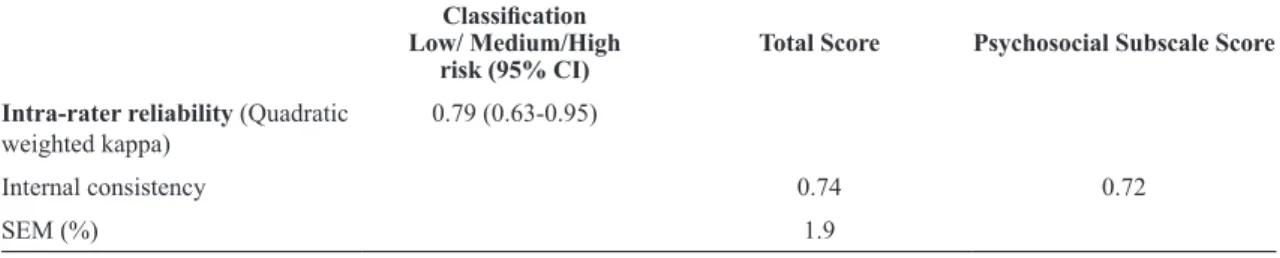
The internal consistency values of the SBST-Brazil questionnaire were also acceptable (total score: 0.74; psychosocial subscale: 0.72), and the SEM was rated very good. These results are described in Table 3.
Discussion
Reliable application of foreign questionnaires to the Brazilian population demands their systematic and judicious cross-cultural adaptation to the Brazilian Portuguese language. Cross-cultural adaptation of specific questionnaires is not simple, as not only language-related but also cultural differences between countries should be taken into consideration for the validity and reliability of instruments to be preserved19,26. For these reasons, the cross-cultural adaptation of the SBST questionnaire was performed with utmost care relative to the semantic, idiomatic, and conceptual equivalence, while preserving the original concepts28. Only item 6 posed doubts to the patients, and changes in its text were suggested by the original author of the SBST to conserve its intention. As a result, the new text was approved by the expert panel, and retest using a different sample showed that this item no longer posed doubts regarding its meaning.
The SBST-Brazil is the irst Brazilian questionnaire designed to screen and classify patients with low back pain as to their risk of poor prognosis relative to physical therapy due to psychosocial factors. Although the original version of the SBST was translated to other languages, including Spanish, French, Danish, Arabic, Dutch, German, Italian,
Table 2. SBST- Brazil questionnaire translation process modiication.
ITEM Original Version T 1 T 2 T 12
3 I have only walked short
distances
Evito andar longas
distâncias
Eu somente andei curtas
distâncias
Eu evito andar longas
distâncias
4 I have dressed more
slowly than usual Demora para eu me vestir Tenho me vestido mais lentamente que o habitual Tenho me vestido mais devagar 5 It´s really not safe for a
person with a condition like mine to be physically active
A atividade física é perigosa para as pessoas com a minha doença
Não é realmente seguro para uma pessoa com uma condição como a minha para ser isicamente ativo
A atividade física não é realmente segura para uma pessoa com um problema como o meu 6 Worrying thoughts have
been going through my mind often
Fico preocupado
frequentemente Pensamentos preocupantes têm passando na minha mente
Tenho icado preocupado por muito tempo
Table 3. Intra-rater reliability (n=50), internal consistency (n=105) and SEM (n=50) results for the SBST-Brazil questionnaire.
Classiication
Low/ Medium/High
risk (95% CI) Total Score Psychosocial Subscale Score Intra-rater reliability (Quadratic
weighted kappa) 0.79 (0.63-0.95)
Internal consistency 0.74 0.72
SEM (%) 1.9
Polish, Norwegian, Mandarin, Japanese, Swedish, Turkish, Urdu, Welsh, and Yoruba29, no adaptation to Brazilian Portuguese was available.
In our analysis, the quadratic weighted kappa value was 0.79 (95% CI: 0.63-0.95), which indicates that the intra-rater reliability of the SBST-Brazil was acceptable relative to the classiication result and close to the value of the original version14, which are 0.73 (95% CI: 0.57-0.84) for the total score and 0.76 (95% CI: 0.52-0.89) for the psychosocial subscale.
The internal consistency results were greater than 0.70 (total score: 0.74; psychosocial subscale: 0.72) and these values are similar to those corresponding to the SBST original14 (total score: 0.79; psychosocial subscale: 0.74), French30 (psychosocial subscale: 0.74), and Iranian31 (total score: 0.82; psychosocial subscale: 0.79) versions, all of which are recommended for use in clinical and research settings. To date, only internal consistency values for the latter 2 versions have been reported, and the samples used in those versions did not comprise as broad a scope of clinical conditions as that in the present study. Indeed, the Brazilian version of the SBST achieved acceptable values using a sample comprising patients with a broad scope of clinical conditions, including unspeciic low back pain and postoperative low back pain, with or without arthrodesis, spondylolisthesis, foraminal stenosis, and degenerative central canal stenosis, and thus was representative of the real-world physical therapy setting. Despite the wide variety of clinical conditions, the sample used in the present study exhibited homogeneous distribution as to the patients’ educational level and risk stratiication. In comparison, the sample used in the pilot study previously conducted to test the internal consistency of the SBST-Brazil included a low percentage of patients with low educational levels and those classiied as high risk, and the resulting internal consistency was less than 0.70 (total score: 0.59; psychosocial subscale: 0.51). However, this sample achieved greater representativeness after the variables risk level and educational level were more homogeneously distributed. As a result, the inal SBST-Brazil demonstrated satisfactory internal consistency for use in patients with various clinical low back pain conditions.
In regard to the internal consistency of the SBST-Brazil, it is worth noting that this instrument focuses on the assessment of psychosocial aspects related to coping that can be strongly inluenced by the psychosocial proile of the sample. Therefore, future studies will also be able to establish whether the internal consistency values of the SBST-Brazil
remain acceptable in individuals corresponding to the same clinical, diagnostic, or sociocultural strata.
The SEM calculated for the SBST-Brazil was classiied as very good27. This result also indicates that the actual score of any individual may vary 1.9% above or below the score attained in the applied questionnaire, which is not indicative of any real change in the patient’s clinical condition but merely relects an error in measurement.
The reliability domain exhibited satisfactory results that were quite similar to those corresponding to the original version of the questionnaire, indicating that the SBST-Brazil is reliable for application to the Brazilian population.
Use of the SBST can lead to signiicant differences in the standard treatment provided to different groups of individuals with low back pain in the primary care setting18. Patients classiied as high risk using this instrument exhibit unfavorable prognosis due to the presence of psychosocial factors, and may not have access to specif treatment what includes physical and psychosocial components based on cognitive and behavioral principles, and thus could not exhibit satisfactory outcomes. Although the prognosis of patients classiied as medium risk is less unfavorable compared to those classiied as high risk, these subjects also require physical therapy, mainly because of their physical symptoms. The prognosis of individuals classiied as low risk is good, and they may beneit from advice and explanation about their symptoms, reassurance, education about their daily and work activities, with no need for physical therapy on a steady basis. The abovementioned features show that the SBST allows physical therapists to deine more accurately the best approach to treatment for each individual patient.
Upon comparing subjective decision-making by clinical experts to the SBST’s allocation to risk subgroups, Hill et al.17 found that the agreement between the group assessed by clinicians and the group assessed using the SBST was poor. In addition, the results of the latter group were better than those of the former, which is indicative of the dificulties clinicians encounterin identifying individuals at high risk of poor prognosis. The SBST aids in the identiication of individuals who require special care and thus represents an important adjuvant to clinical assessment.
the SBST for screening patients with low back pain notwithstanding, other questionnaires should be used during clinical follow up, such as the Fear-Avoidance Beliefs Questionnaire (FABQ) or the shortened version of the Tampa Scale for Kinesiophobia (TKS-11)15.
The SBST can contribute to the initial screening of individuals with low back pain to improve their treatment, as well as to the performance of clinical studies of individuals with low back pain. In addition, based on the present study, other psychometric properties of the SBST may also be assessed.
Conclusion
The translation and cross-cultural adaptation of the SBST to the Brazilian Portuguese language was performed in a satisfactory manner. The resulting SBST-Brazil version proved to be reliable for use in Brazil, thus contributing to the treatment of individuals with low back pain in the primary care setting by screening them for a risk of poor prognosis and taking psychosocial factors into account.
References
1. HoyD, BainC, WilliamsG, MarchL, Brooks P, Blyth
F, et al. A systematic review of the global prevalence of
low back pain.Arthritis Rheum. 2012;64(6):2028-37. http:// dx.doi.org/10.1002/art.34347. PMid:22231424
2. van TulderM, BeckerA, BekkeringT, BreenA, del RealMT, HutchinsonA, et al. Chapter 3. European guidelines for the
management of acute nonspecific low back pain in primary care.Eur Spine J. 2006;15(S2, Suppl 2):S169-91. http:// dx.doi.org/10.1007/s00586-006-1071-2. PMid:16550447 3. ApeldoornAT, BosselaarH, OsteloRW, Blom-LubertiT, van
der PloegT, FritzJM, et al. Identification of patients with
chronic low back pain who might benefit from additional psychological assessment.Clin J Pain. 2012;28(1):23-31. http://dx.doi.org/10.1097/AJP.0b013e31822019d0. PMid:21677570
4. NicholasMK. Depression in people with pain: There is still work to do. Commentary on ‘Understanding the link between depression and pain’.Scandinavian Journal of Pain. 2011;2(2):45-6. http://dx.doi.org/10.1016/j. sjpain.2011.02.003.
5. LintonSJ, ShawWS. Impact of psychological factors in the experience of pain.Phys Ther. 2011;91(5):700-11. http:// dx.doi.org/10.2522/ptj.20100330. PMid:21451097 6. NicholasMK. Mental disorders in people with chronic pain:
an international perspective. Pain. 2007;129(3):231-2. http://
dx.doi.org/10.1016/j.pain.2007.03.011. PMid:17451878 7. AiraksinenO, BroxJI, CedraschiC, HildebrandtJ,
Klaber-MoffettJ, KovacsF, et al. Chapter 4. European guidelines
for the management of chronic nonspecific low back pain.
Eur Spine J. 2006;15(S2, Suppl 2):S192-300. http://dx.doi. org/10.1007/s00586-006-1072-1. PMid:16550448 8. NicholasMK, LintonSJ, WatsonPJ, MainCJ, and the
“Decade of the Flags” Working Group. Early identification and management of psychological risk factors (“yellow flags”) in patients with low back pain: a reappraisal. Phys Ther. 2011;91(5):737-53. http://dx.doi.org/10.2522/ ptj.20100224. PMid:21451099
9. Pincus T, BurtonAK, VogelS, FieldAP. A systematic
review of psychological factors as predictors of chronicity/ disability in prospective cohorts of low back pain. Spine (Phila Pa 1976). 2002;27(5):E109-20. http://dx.doi. org/10.1097/00007632-200203010-00017. PMid:11880847 10. HillJC, FritzJM. Psychosocial influences on low back
pain, disability, and response to treatment. Phys Ther. 2011;91(5):712-21. http://dx.doi.org/10.2522/ptj.20100280. PMid:21451093
11. Foster NE, Thomas E, Bishop A, Dunn KM, Main CJ. Distinctiveness of psychological obstacles to recovery in low back pain patients in primary care.
Pain. 2010;148(3):398-406. http://dx.doi.org/10.1016/j.
pain.2009.11.002. PMid:20022697
12. FritzJM, BeneciukJM, GeorgeSZ. Relationship between categorization with the STarT Back Screening Tool and prognosis for people receiving physical therapy for low back pain.Phys Ther. 2011;91(5):722-32. http://dx.doi. org/10.2522/ptj.20100109. PMid:21451094
13. MainCJ, SowdenG, HillJC, WatsonPJ, HayEM. Integrating physical and psychological approaches to treatment in low back pain: the development and content of the STarT Back trial’s ‘high-risk’ intervention (StarT Back; ISRCTN 37113406).Physiotherapy. 2012;98(2):110-6. http://dx.doi. org/10.1016/j.physio.2011.03.003. PMid:22507360 14. HillJC, DunnKM, LewisM, MullisR, MainCJ, Foster
NE, et al. A primary care back pain screening tool:
identifying patient subgroups for initial treatment.Arthritis Rheum. 2008;59(5):632-41. http://dx.doi.org/10.1002/ art.23563. PMid:18438893
15. BeneciukJM, BishopMD, FritzJM, RobinsonME, Asal NR, NisenzonAN, et al. The STarT back screening tool
and individual psychological measures: evaluation of prognostic capabilities for low back pain clinical outcomes in outpatient physical therapy settings. Phys Ther. 2013;93(3):321-33. http://dx.doi.org/10.2522/ptj.20120207. PMid:23125279
16. WidemanTH, HillJC, MainCJ, LewisM, SullivanMJL, Hay EM. Comparing the responsiveness of a brief, multidimensional risk screening tool for back pain to its unidimensional reference standards: the whole is greater than the sum of its parts. Pain. 2012;153(11):2182-91. http://
dx.doi.org/10.1016/j.pain.2012.06.010. PMid:22800410 17. HillJC, VohoraK, DunnKM, MainCJ, HayEM. Comparing
the STarT back screening tool’s subgroup allocation of individual patients with that of independent clinical experts. Clin J Pain. 2010;26(9):783-7. http://dx.doi. org/10.1097/AJP.0b013e3181f18aac. PMid:20842014 18. HillJC, WhitehurstDGT, LewisM, BryanS, DunnKM,
FosterNE, et al. Comparison of stratified primary care
2011;378(9802):1560-71. http://dx.doi.org/10.1016/S0140-6736(11)60937-9. PMid:21963002
19. Beaton DE, BombardierC, GuilleminF, FerrazMB. Guidelines for the process of cross-cultural adaptation of self-report measures. Spine (Phila Pa 1976). 2000;25(24):3186-91. http://dx.doi.org/10.1097/00007632-200012150-00014. PMid:11124735
20. Nusbaum L, Natour J, Ferraz MB, Goldenberg J. Translation, adaptation and validation of the Roland-Morris questionnaire—Brazil Roland-Roland-Morris.Braz J Med Biol Res. 2001;34(2):203-10. http://dx.doi.org/10.1590/ S0100-879X2001000200007. PMid:11175495
21. MokkinkLB, TerweeCB, PatrickDL, AlonsoJ, StratfordPW,
KnolDL, et al. The COSMIN study reached international
consensus on taxonomy, terminology, and definitions of measurement properties for health-related patient-reported outcomes.J Clin Epidemiol. 2010;63(7):737-45. http:// dx.doi.org/10.1016/j.jclinepi.2010.02.006. PMid:20494804 22. SalaffiF, Sarzi-Puttini P, CiapettiA, AtzeniF. Clinimetric
evaluations of patients with chronic widespread pain.Best Pract Res Clin Rheumatol. 2011;25(2):249-70. http://dx.doi. org/10.1016/j.berh.2011.01.004. PMid:22094200
23. LauridsenHH, HartvigsenJ, MannicheC, KorsholmL, Grunnet-NilssonN. Responsiveness and minimal clinically important difference for pain and disability instruments in low back pain patients.BMC Musculoskelet Disord. 2006;7(1):82. http://dx.doi.org/10.1186/1471-2474-7-82. PMid:17064410
24. Terwee CB, Bot SDM, de Boer MR, van der Windt DA, KnolDL, DekkerJ, et al. Quality criteria were
proposed for measurement properties of health status questionnaires.J Clin Epidemiol. 2007;60(1):34-42. http:// dx.doi.org/10.1016/j.jclinepi.2006.03.012. PMid:17161752 25. SimJ, WrightCC. The kappa statistic in reliability studies:
use, interpretation, and sample size requirements. Phys
Ther. 2005;85(3):257-68. PMid:15733050.
26. BeatonDE. Understanding the relevance of measured change through studies of responsiveness. Spine.
2000;25(24):3192-9. http://dx.doi.org/10.1097/00007632-200012150-00015. PMid:11124736
27. MagalhãesMO, CostaLO, FerreiraML, MachadoLA. Clinimetric testing of two instruments that measure attitudes and beliefs of health care providers about chronic low back pain.. Rev Bras Fisioter.2011;15(3):249-56. http://dx.doi.org/10.1590/S1413-35552011000300012. PMid:21829990
28. MarcondesFB, VasconcelosRA, MarchettoA, Andrade ALL, Zoppi FilhoA, EtchebehereM. Tradução e adaptação cultural do Rowe Score para a língua portuguesa.Acta Ortop Bras.2012;20(6):346-50. http://dx.doi.org/10.1590/ S1413-78522012000600007. PMid:24453630
29. Keele.ac.uk. North Staffordshire: The STarT Back Screening tool website [Internet]. 2013 [cited 2014 March 27]. Available from: http://www.keele.ac.uk/sbst/ translatedversions/.
30. BruyèreO, DemoulinM, BeaudartC, HillJC, MaquetD, GenevayS, et al. Validity and reliability of the French
Version of the STarT back screening tool for patients with low back pain.Spine (Phila Pa 1976). 2014;39(2):E123-8. http://dx.doi.org/10.1097/BRS.0000000000000062. PMid:24108286
31. Azimi P, ShahzadiS, AzhariS, MontazeriA. A validation
study of the Iranian version of STarT Back Screening Tool (SBST) in lumbar central canal stenosis patients. J Orthop Sci. 2014;19(2):213-7. http://dx.doi.org/10.1007/ s00776-013-0506-y. PMid:24343300
Correspondence Bruna Pilz
Instituto Wilson Mello, Fisioterapia
Rua José Rocha Bonim, 214, Ed. Chicago, 1° andar, Condomínio Praça Capital, Santa Genebra
Appendix 1. STarT Back Screening Tool- Brasil (SBST-Brasil).
Pensando nas duas últimas semanas, assinale sua resposta para as seguintes perguntas:
Discordo (0) Concordo (1)
1. A minha dor nas costas se espalhou pelas pernas nas duas últimas semanas ( ) ( ) 2. Eu tive dor no ombro e/ou na nuca pelo menos uma vez nas últimas duas semanas ( ) ( ) 3. Eu evito andar longas distâncias por causa da minha dor nas costas ( ) ( ) 4. Nas duas últimas semanas, tenho me vestido mais devagar por causa da minha dor nas costas ( ) ( ) 5. A atividade física não é realmente segura para uma pessoa com um problema como o meu ( ) ( ) 6. Tenho icado preocupado por muito tempo por causa da minha dor nas costas ( ) ( ) 7. Eu sinto que minha dor nas costas é terrível e que nunca vai melhorar ( ) ( ) 8. Em geral, eu não tenho gostado de todas as coisas como eu costumava gostar ( ) ( ) 9. Em geral, quanto a sua dor nas costas te incomodou nas duas ultimas semanas ( ) Nada (0) ( ) Pouco (0) ( ) Moderado (0) ( ) Muito(1) ( ) Extremamente(1)