Braz. J. of Develop., Curitiba, v. 6, n. 7, p. 46062-46073, jul. 2020. ISSN 2525-8761
Impact of physical activity on stress levels in medical students
Impacto da atividade física nos níveis de estresse em estudantes médicos
DOI:10.34117/bjdv6n7-292
Recebimento dos originais: 03/06/2020 Aceitação para publicação: 13/07/2020
Odil Garrido Campos de Andrade
Residente de Clínica Médica do Hospital Universitário de Brasília, Médico graduado pelo Centro Universitário de Brasília
Instituição: Hospital Universitário de Brasília
Endereço: Setor de Grandes Áreas Norte 605 - Asa Norte, Brasília - DF, Brasil E-mail: [email protected]
Lethícia de Castro Pereira
Médica graduado pelo Centro Universitário de Brasília Instituição: Centro Universitário de Brasília
Endereço: 707/907 - Campus Universitário, SEPN - Asa Norte, Brasília - DF,Brasil E-mail: [email protected]
Gabriela Resende Vieira de Sousa
Médica Endocrinologista. Doutora em Ciências pelo Hospital das Clínicas da Faculdade de Medicina da Universidade de São Paulo- FMUSP. Docente da Faculdade de Medicina do
Centro Universitário de Brasília Instituição: Centro Universitário de Brasília
Endereço: 707/907 - Campus Universitário, SEPN - Asa Norte, Brasília - DF,Brasil; E-mail: [email protected]
ABSTRACT
Background: To identify the prevalence of stress, overweight, and obesity and to assess the impact
of physical activity on sleep patterns, stress levels, and suicidal thoughts in medical students.
Methods: This cross-sectional study evaluated medical students from the Federal District. An online
questionnaire collected data regarding physical activity, sleep, and suicidal ideation. Stress was assessed using the Lipp Adult Stress Symptom Inventory, which was used to classify the students into one of the following phases: alert, resistance, near-exhaustion, and exhaustion. The classification of overweight and obesity was based on body mass index.
Results: A total of 404 students were included; the prevalence of stress was 71.3%. The prevalence
of overweight and obesity in the sample was 20% and 5%, respectively, and 36% and 6% in men, and 12% and 4% in women, respectively. Physical activity was significantly relevant in protecting against stress (p=0.001) and suicidal ideation (p=0.014), in addition to improving sleep patterns (p=0.019).
Conclusion: The prevalence of overweight, obesity, and stress was higher than the general population
average. Physical activity played a key role in reducing stress levels, protecting against suicidal thoughts, and improving sleep.
Braz. J. of Develop., Curitiba, v. 6, n. 7, p. 46062-46073, jul. 2020. ISSN 2525-8761
RESUMO
Objetivo: Identificar a prevalência de estresse, sobrepeso e obesidade. Avaliar o impacto da atividade
física no padrão de sono, níveis de estresse e pensamentos suicidas.
Métodos: Estudo de coorte transversal, realizado em estudantes de medicina do Distrito Federal. Foi
aplicado questionário online que coletou dados referentes à atividade física, sono e ideação suicida. O estresse foi avaliado através do Inventário de Sintomas de Stress para Adulto de Lipp, que classifica os estudantes em fase: alerta, resistência, quase-exaustão e exaustão. A classificação de sobrepeso e obesidade foi a partir do índice massa corporal.
Resultados: 404 estudantes foram incluídos. A prevalência de estresse é de 71,3%. A prevalência de
sobrepeso e obesidade da amostra é de 20% e 5%, respectivamente, nos homens 36% e 6% e nas mulheres 12% e 4%. A realização de atividade física mostrou-se significativa na proteção contra o estresse (p:0,001) e ideação suicida (p:0,014), além de melhorar o padrão de sono (p:0,019).
Conclusão: A prevalência de sobrepeso e obesidade está superior à média geral, assim como a
prevalência de estresse. A atividade física mostrou papel fundamental na redução dos níveis de estresse, na proteção contra pensamentos suicidas e no padrão de sono.
Palavras-chaves: Estresse, obesidade, sobrepeso, estudantes de medicina, atividade física. 1 INTRODUCTION
Stress is a response to any situation that threatens the well-being of an individual and occurs when the demands exceed the adaptive capacity of the body, resulting in biological and psychological changes. Initially, stress is an alert factor, created for the resolution of a stressor factor; however, chronic stress can become pathological and lead to anxiety, sleep disorders, addiction, and changes in weight1–3.
Medical students are exposed to several stressors, from situations related to the training itself to the social and academic environment―factors which may compromise academic performance and health1,4,5.
Overweight and obesity are marked by excess body fat resulting from an imbalance between caloric intake and energy expenditure, which can be influenced by behaviors triggered by crises6,7.
Previous studies evaluating stress levels, overweight, and obesity in medical students have reported a significant increase in these comorbidities compared with the general population. The prevalence of stress in students of Fayoum University (Faiyum, Egypt) was 62.4%, and demonstrated a significant association with overweight1. Another study performed at the Menoufiya University (Xibin El Kom, Egito) reported a prevalence of stress of 78.4%4. A cohort study conducted at Sir Salimullah Medical College (Dhaka, Bangladesh) found that 20.5% of students were overweight and 4.5% were obese8.
Considering that physical activity can contribute positively to stress management and sleep improvement9,10, the objective of the present study was to analyze the prevalence of stress,
Braz. J. of Develop., Curitiba, v. 6, n. 7, p. 46062-46073, jul. 2020. ISSN 2525-8761
overweight, and obesity among a group of medical students, and to assess the impact of physical activity on stress, sleep patterns, and suicidal thoughts.
2 METHODS
The present study was a cross-sectional investigation that evaluated medical students from the Federal District (FD). Data collection was performed through an online questionnaire created by the authors, which was administered from August 23 to October 4, 2018. Each student completed the questionnaire once. Respondents were required to be > 18 years of age and be regularly enrolled in a medical graduate course in a public or private institution. Non-FD medical students were excluded from the study.
The questionnaire collected the following data: age; sex; weight; height; academic semester; college; duration of weekly physical activity in minutes; hours of sleep per night; factors considered as stressors; presence of suicidal ideation; presence of plans to commit suicide; and the Lipp Adult Stress Symptom Inventory (LASSI).
Stress was evaluated using the LASSI, which has three frames (F), with symptoms referring to the phases of stress and divided as follows: symptoms in the past 24 h (F1); symptoms in the past week (F2); and symptoms in the past month (F3). Diagnosis was based on the sum of the symptoms of each inventory frame. When exceeding the limit number in a specific phase, the occurrence of stress was characterized as follows: F1 > 6 symptoms, alarm phase; F2 > 3, resistance phase; F2 > 9 , near exhaustion phase; and F3 > 8, exhaustion phase11.
The alert phase is marked by positive reactions, in which the body prepares to act in front of the stressful situation, driven by adrenaline, leaving the individual motivated and alert. In the resistance phase, there is a cumulative effect of stress, resulting in a breakdown of balance, in addition to decreasing yield, making the organism more vulnerable, which can lead to compromise of physical and mental health. The near-exhaustion phase begins when the body exceeds the limit of control and physical and mental resistance are broken; consequently, situations such as working, laughing, and making decisions become difficult. The exhaustion phase describes general imbalance, and the individual has difficulty with the basic activities of daily life, thus exhibiting functional and social impairment12.
Classification of body mass index (BMI) was according to the recommendations of the World Health Organization (WHO): underweight < 18.5 kg/m², healthy between 18.5 kg/m² and 24.9 kg/m², overweight between 25 and 29.9 kg/m², and obese > 30 kg/m² 6.
For sample calculation, the five medical schools in the FD were considered. There were 2590 students enrolled at the time of the study; thus, considering the variables present in the study and
Braz. J. of Develop., Curitiba, v. 6, n. 7, p. 46062-46073, jul. 2020. ISSN 2525-8761
using the sample calculation formula: n=N.Z2.p.(1-p) / Z2.p.(1-p) + e2.N-1 (n: calculated sample, N: population, Z: normal variable, p: actual probability of the event, e: sample error), with 95% confidence level, at least 335 medical students were required to respond the questionnaire for adequate reliability.
The independent T-test was used to compare two variables and one-way ANOVA with Bonferroni Post-Hoc test for subgroup evaluation. The data were analyzed using SPSS version 20 (IBM Corporation, Armonk, NY, USA).
3 RESULTS
A total of 419 students responded to the questionnaire, of whom 404 were included. Fifteen students were excluded for the following reasons: 13 were enrolled in colleges outside the FD; 1 was not enrolled in medical school; and 1 did not complete entire questionnaire.
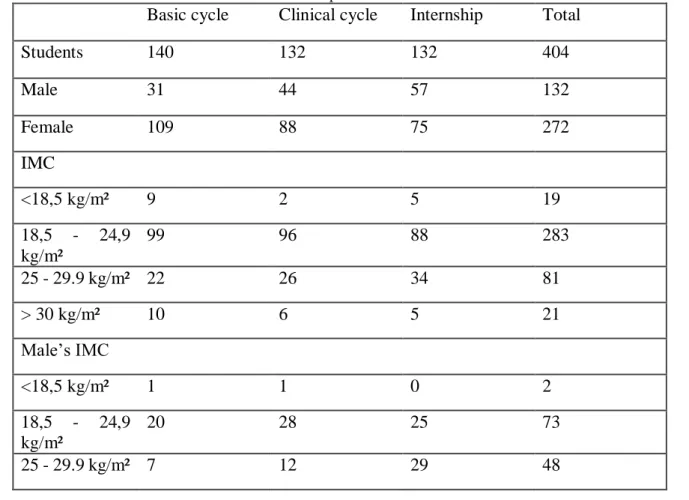
Students were classified according to academic cycle: basic (first to fourth semester), clinical (fifth to eighth semester) and internship (ninth to twelfth semester). The groups were compared with regard to BMI, stress rating, average duration of physical activity per week, average hours of sleep per night, suicidal thoughts, and plans to commit suicide (Table 1).
Table 1 – Sample characteristics
Basic cycle Clinical cycle Internship Total
Students 140 132 132 404 Male 31 44 57 132 Female 109 88 75 272 IMC <18,5 kg/m² 9 2 5 19 18,5 - 24,9 kg/m² 99 96 88 283 25 - 29.9 kg/m² 22 26 34 81 > 30 kg/m² 10 6 5 21 Male’s IMC <18,5 kg/m² 1 1 0 2 18,5 - 24,9 kg/m² 20 28 25 73 25 - 29.9 kg/m² 7 12 29 48
Braz. J. of Develop., Curitiba, v. 6, n. 7, p. 46062-46073, jul. 2020. ISSN 2525-8761 > 30 kg/m² 3 3 3 9 Female’s IMC <18,5 kg/m² 9 3 5 17 18,5 - 24,9 kg/m² 79 68 63 210 25 - 29.9 kg/m² 14 14 5 33 > 30 kg/m² 7 3 2 12 LASSI No stress 32 35 49 116 Alarm 2 0 1 3 Resistance 58 59 42 159 Near-Exhaustion 8 7 2 17 Exhaustion 40 31 38 109 Male’s LASSI No stress 15 16 29 60 Alarm 1 0 1 2 Resistance 10 19 17 46 Near-Exhaustion 0 1 0 1 Exhaustion 31 8 10 23 Female’s LASSI No stress 17 19 20 56 Alarm 1 0 0 1 Resistance 48 40 25 113 Near-Exhaustion 8 6 2 16 Exhaustion 10 35 28 86 Average physical activity per week Total 145 minutes/week 155 minutes/week 140 minutes/week 147 minutes/week
Braz. J. of Develop., Curitiba, v. 6, n. 7, p. 46062-46073, jul. 2020. ISSN 2525-8761 Male 180 minutes/week 171 minutes/week 168 minutes/week 166 minutes/week Female 135 minutes/week 147 minutes/week 119 minutes/week 137 minutes/week Average hours of sleep/night
Total 6 hours and 36 minutes 6 hours and 33 minutes 6 hours and 35 minutes 6 hours and 35 minutes
Male 6 hours and 38 minutes 6 hours and 32 minutes 6 hours and 39 minutes 6 hours and 37 minutes
Female 6 hours and 36 minutes 6 hours and 34 minutes 6 hours and 32 minutes 6 hours and 34 minutes Suicidal thoughts Total 27 25 38 90 Male 5 5 19 29 Female 22 20 19 61 Plans to commit suicide Total 10 4 12 26 Male 0 0 1 1 Female 10 4 11 25
Sex distribution among the entire study sample was approximately 2 females for each male. The highest proportion of females was in the basic cycle, with a ratio of 3.5 females to 1 male.
BMI
Among the sample, 70% of the students exhibited normal BMI values, 4% were underweight, 20% were classified as overweight, and 5% as obese.
According to sex, 43% of males exhibited excess weight, 36% of whom were overweight and 6% were obese. Of the females, 16% exhibited excess weight, 12% of whom were overweight and 4% were obese.
Stress
According to the LASSI classification, 71.3% of the students were in some stage of stress. The BMI of students in some stress categories was not statistically different from those who were classified with no stress.
The main stressors highlighted by the students included: courses requiring long hours (80%); charge for good grades (78%); lack of time for studies (67%), physical activity (65%), leisure (65%), and adequate nutrition (56%); and recurrent tests (48%).
Braz. J. of Develop., Curitiba, v. 6, n. 7, p. 46062-46073, jul. 2020. ISSN 2525-8761
Physical activity
According to the WHO recommendations for regular physical activity6, 49.2% of the students did not engage in physical activity on a regular basis. Among the factors cited as the greatest cause for lack of physical activity were lack of time (32%) and lack of disposition (34.4%).
Students who were rated to be in some stage of stress engaged in less physical activity per week (mean 136 min) compared with those who were classified as no stress (mean 174 min) (p=0.003).
Furthermore, there were differences in the time devoted to physical activity among the students classified in each stress phase (p=0.001) (Figure 1). The group classified with exhaustion engaged in 126 min per week of physical activity, with a mean difference of 48 min compared with the no-stress group (p=0.023); the group classified with near exhaustion engaged in a mean of 67 min, with a difference of 107 min (p=0.005).
Figure 1 - Mean time of physical activity per week by students classified by phase of stress
Sleep
The average number of hours sleep per night among the sample was 6 h 35 min, with 42% sleeping < 6 h per day. Male students who slept > 6 h per night exhibited a higher BMI than students sleeping 6 h to 8 h per night (p=0.027), with a mean BMI of 25.78 kg/m2 and 24.16 kg/m2, respectively, and with a Pearson coefficient of -0,21, reflecting the inverse correlation between BMI and sleep duration. In females, there was no statistical relationship between sleep duration and BMI. Furthermore, students who slept < 6 h per night engaged in less physical activity per week (mean 130 min) compared with those sleeping 6 to 8 h per night, averaging 159 min (p=0.019).
Braz. J. of Develop., Curitiba, v. 6, n. 7, p. 46062-46073, jul. 2020. ISSN 2525-8761
Students who were classified with some stage of stress slept fewer hours per night (6 h 30 min) compared with those classified with no stress (6 h 45 min) (p<0.0001).
There was a difference in sleep duration per night among students classified at each stage of stress (p<0.0001). The group classified with exhaustion, slept 6 h and 23 min, with difference of 21 min, compared to the no stress group (p<0.0001). Students in the resistance phase slept 6 h 37 min, and the group classified with exhaustion slept 6 h 23 min (p=0.003).
Figure 2 – Average sleep time per night of students classified by phase of stress
Suicidal thoughts
Among the sample of students, 22.2% experienced suicidal thoughts, with an equal percentage distribution between the sexes. Of these students, 28.8% had already made plans for how to complete the act, with the majority (96%) being female.
Students who did not experience suicidal thoughts had lower BMIs than those who did (22.96 kg/m2 and 24.08 kg/m2, respectively; p=0.037). When separated according to sex, the mean BMI of females who had suicidal thought(s) was 23.50 kg/m² and 22.13 kg/m² in those who did not (p=0.04). The average BMI of males who had previous thought(s) of suicide was 25.30 kg/m², and 24.67 kg/m² among those who did not (p=0.413).
Furthermore, female students who did not think about suicide engaged in more physical activity per week (mean 147 min) and had a longer sleep duration per night (6 hours 38 min) compared with those who thought about suicide (mean 105 min of physical activity and 6 h 25 min of sleep, p=0.014 and p=0.021, respectively).
Braz. J. of Develop., Curitiba, v. 6, n. 7, p. 46062-46073, jul. 2020. ISSN 2525-8761
4 DISCUSSION
In Brazil, 54.4% of physicians in active registries are male; however, considering the age group up to 29 years, 57.4% are female, reflecting the change in demographic distribution since 2009 with the entry of females in greater and increasing proportions13,14. This phenomenon was also evident in the FD population, given that the proportion of females to males in internship is 1.3:1 and, in the 4-year period, compared with the basic cycle, the ratio is currently 3.5:1.
Demographic changes, therefore, are directly linked to the main pathologies that affect medical students given that sex is an important risk factor, especially in psychiatric disorders15.
Overweight and obesity have been growing health problems affecting the entire population since the turn of the 20th century. Historically, the percentage of overweight has been higher in males than in females16. In our study, 43% of males and 16% of females exhibited excess weight. Among
medical students, who are more susceptible to weight gain both due to stressful situations and sedentary lifestyles2,17,18 excess weight was exhibited by 49.2% of FD medical students.
The primary influencers in weight gain are personal behaviors, such as sedentary lifestyles, irregular physical activity, hypercaloric diets, and poor sleep quality. These influencers act synergistically in weight gain, in addition to contributing to stress levels 6,16.
Maintaining regular physical activity (> 150 min/week) affords benefits beyond the balance of daily energy expenditure. It improves sleep patterns by facilitating sleep onset, increasing slow waves, and decreasing the duration of rapid eye movement in sleep10,19. As observed in this particular population of medical students, those who engaged in ≥ 159 min of physical activity per week exhibited better sleep patterns (p=0.019).
Another benefit of maintaining regular physical activity is the control and decrease of stress levels, which may be explained by the greater release of monoamines and endorphins, substances that promote a sensation of euphoria, reducing anxiety, tension and anger9,20,21. As shown, individuals classified with no stress or in the alarm phase engaged in more physical activity than those who were in the more advanced phases of stress, demonstrating the protective effect of physical activity on stress (p= 0.001).
In addition to physical activity, students with better sleep patterns exhibited lower stress levels (p=0.003). During sleep, the body goes into an anabolic state in an attempt to reconstitute what was lost during the day, in addition to trying to achieve homeostasis. Thus, individuals with better sleep patterns tend to have better mental control. However, the reverse can also occur because one of the main factors that hinders the onset of sleep and its maintenance are high levels of stress16,22.
Excess weight is another obstacle to the onset and maintenance of sleep because it facilitates sleep apnea, which in turn promotes micro-arousal in the individual and, consequently, results in
Braz. J. of Develop., Curitiba, v. 6, n. 7, p. 46062-46073, jul. 2020. ISSN 2525-8761
poorer sleep quality. However, a cyclical relationship is created because, during sleep, there is increased production of anorectic hormones, such as leptin; however, individuals with poor sleep patterns, aside from decreasing leptin levels, exhibit increased levels of ghrelin, which is an orexigen that facilitates weight gain and leads to worsening sleep duration and quality19,22–24. In this study, male students who slept < 6 h had a mean BMI of 25.78 kg/m2, demonstrating the association between overweight and poor sleep quality (p=0.027).
Regarding suicidal ideation, previous studies have shown that medical students are an at-risk population, with a prevalence of 11.1%, being justified by the high levels of stress, anxiety, and depression17,25. However, in the current sample, the prevalence of suicidal ideation was twice that
rate (22.2%), and 28.8% of these students had already made plans on how to commit the act.
Among the factors related to suicidal ideation, it was found that BMI, lower levels of weekly physical activity, and fewer hours of sleep per night in students who already had suicidal ideation17,25.
5 CONCLUSION
The prevalence of overweight, obesity, and stress in a sample of medical students in the FD was higher than the general average. Demonstrating the need for interventions in the coordination of the medical courses of the FD with measures to reduce the rate of overweight and obesity, in addition to reducing the stress level of students, aiming at reducing the risks.
As highlighted, physical activity plays a key role in mitigating stress by improving sleep quality and being protective against suicidal thoughts. Therefore, encouraging regular engagement in physical activity and the incorporation of physical exercise in the curriculum can be beneficial to students. On-campus accessibility to psychologists and psychiatrists is another beneficial measure that could be made available.
Assessing the health of medical students should be a continuous exercise, especially in relation to mental health, because demands and stressors change over time, which necessitates surveillance of unfavorable factors that could lead to negative outcomes such as suicide.
ACKNOWLEDGMENT
We thank the team of the Postgraduate and Research Adviser of the University Center of Brasilia for all the encouragement and support.
Braz. J. of Develop., Curitiba, v. 6, n. 7, p. 46062-46073, jul. 2020. ISSN 2525-8761
REFERENCES
1. Abdel Wahed WY, Hassan SK. Prevalence and associated factors of stress, anxiety and depression among medical Fayoum University students. Alexandria J. Med. 2017;53(1):77–84. 2. Haidar SA, Vries NK de, Karavetian M, El-Rassi R. Stress, Anxiety, and Weight Gain among University and College Students: A Systematic Review. J. Acad. Nutr. Diet. 2018;118(2):261–274. 3. Candido FJ, Souza R, Stumpf MA, Fernandes LG, Veiga R, Santin M, et al. The use of drugs and medical students: a literature review. Rev. Assoc. Med. Bras. 2018 May;64(5):462–468.
4. Abdallah AR, Gabr HM. Depression , anxiety and stress among first year medical students in an Egyptian public university. Int Res J. Med. Scince. 2014;2(1):11–19.
5. Moutinho ILD, Maddalena N de CP, Roland RK, Lucchetti ALG, Tibiriçá SHC, Ezequiel O da S, et al. Depression, stress and anxiety in medical students: A cross-sectional comparison between students from different semesters. Rev. Assoc. Med. Bras. 2017 Jan;63(1):21–28.
6. ABESO. Diretrizes Brasileiras de Obesidade. 4° ed. São Paulo, SP: Associação Brasileira para o Estudo da Obesidade e da Síndrome Metabólica; 2016.
7. Ashwell M, Gunn P, Gibson S. Waist-to-height ratio is a better screening tool than waist circumference and BMI for adult cardiometabolic risk factors: systematic review and meta-analysis. Obes. Rev. 2012 Mar;13(3):275–286.
8. Akhter H, Jahan N, Mahmud F Sultana N, Ferdous T AH. Study of Body Mass Index (BMI) on Medical Students. 2014;5(1):472–475.
9. Valk ES van der, Savas M, Rossum EFC van. Stress and Obesity: Are There More Susceptible Individuals? Curr. Obes. Rep. 2018 Jun;7(2):193-203.
10. Ropke LM, Souza AG, Bertoz AP de M, Adriazola MM, Ortolan EVP, Martins RH, et al. Efeito da atividade física na qualidade do sono e qualidade de vida: revisão sistematizada. Arch. Heal. Investig. 2018 Jan 29;6(12).
11. Lipp MEN. Manual do Inventário de Sintomas de Stress para adultos de Lipp (ISSL). Casa do Psicólogo; 2005.
12. Barbosa MR, Santos FU dos, Barbosa MR. Sources of stress patient with diagnosis of breast malignant neoplasia. Rev. Bras. Ter. Cogn. 2012;8(1):10–18.
13. Scheffer MC, Cassenote AJF. A feminização da medicina no Brasil. Rev. Bioética 2013 Aug;21(2):268–277.
14. Scheffer M, Cassenote A, Guilloux AGA, Biancarelli A, Miotto BA, Mainardi. GM. Demografia Médica no Brasil 2018. São Paulo, SP: FMUSP, CFM, Cremesp; 2018.
15. SILVEIRA MM da, PORTUGUEZ MW, SILVEIRA MM da, PORTUGUEZ MW. Analysis of life quality and prevalence of cognitive impairment, anxiety, and depressive symptoms in older adults. Estud. Psicol. 2017;34(2):261–268.
16. Hruby A, Hu FB. The Epidemiology of Obesity: A Big Picture. Pharmacoeconomics 2015 Jul 4;33(7):673–689.
17. Barbosa RR, Martins MCG, Carmo FPT do, Jacques T de M, Serpa RG, Calil O de A, et al. Study on Lifestyles and Stress Levels in Medicine Student TT - Estudo sobre Estilos de Vida e Níveis de Estresse em Estudantes de Medicina. Int. j. Cardiovasc. sci. 2015;28(4):313–319.
18. Tiwari R, Jain V, Rajput A, Bhagwat a, Goyal M, Tiwari S. A study to assess prevalence of obesity among medical students of G.R. medical college, Gwalior, M. P., India. Int. J. Res. Med. Sci. 2014;2(4):1412.
Braz. J. of Develop., Curitiba, v. 6, n. 7, p. 46062-46073, jul. 2020. ISSN 2525-8761
19. Maria P, Evagelia S. Obesity disease. Heal. Sci. J. 2009;3(3):132–138.
20. Campos AC, Fogaça M V., Aguiar DC, Guimarães FS. Animal models of anxiety disorders and stress. Rev. Bras. Psiquiatr. 2013;35(SUPPL.2):101–111.
21. Saravanan C, Wilks R, Saravanan C, Wilks R. Medical Students’ Experience of and Reaction to Stress: The Role of Depression and Anxiety. Sci. World J. 2014;2014:1–8.
22. Saunders TJ, Gray CE, Poitras VJ, Chaput J-P, Janssen I, Katzmarzyk PT, et al. Combinations of physical activity, sedentary behaviour and sleep: relationships with health indicators in school-aged children and youth. Appl. Physiol. Nutr. Metab. 2016 Jun;41(6 (Suppl. 3)):S283–S293.
23. Chaput J-P, Després J-P, Bouchard C, Tremblay A. The association between sleep duration and weight gain in adults: a 6-year prospective study from the Quebec Family Study. Sleep 2008 Apr;31(4):517–23.
24. Chaput J-P, Pérusse L, Després J-P, Tremblay A, Bouchard C. Findings from the Quebec Family Study on the Etiology of Obesity: Genetics and Environmental Highlights. Curr. Obes. Rep. 2014 Mar 4;3(1):54–66.
25. Rotenstein LS, Ramos MA, Torre M, Segal JB, Peluso MJ, Guille C, et al. Prevalence of Depression, Depressive Symptoms, and Suicidal Ideation Among Medical Students. JAMA 2016 Dec 6;316(21):2214.