www.ccarevista.ufc.br ISSN 1806-6690
Tetrazolium test for the viability of gherkin seeds
1Teste de tetrazólio para avaliação da viabilidade de sementes de maxixe
Emanoela Pereira de Paiva2*, Salvador Barros Torres2, João Paulo Nobre de Almeida2, Francisco Vanies da Silva Sá3
and Renata Ramayane Torquato Oliveira2
ABSTRACT - The tetrazolium test is a quick and effective method for evaluating viability in seeds. The aim of this study was to determine a methodology for using the tetrazolium test, and its efficiency in verifying viability in seeds of the gherkin (Cucumis anguria L.). Consequently, five batches of gherkin seed were initially evaluated by the tests for germination, first
count and speed of germination. The batches were then subjected to treatments in order to adjust the methodology for the tetrazolium test, evaluating three concentrations of tetrazolium solution (0.100, 0.075 and 0.050%), kept in the dark for two, four and six hours, under temperatures of 35 °C and 40 °C, with four replications of 25 seeds per treatment. At the end of the staining period, the seeds were washed in running water, split lengthways between the cotyledons, and classified as viable and non-viable. Evaluation of viability in seeds of the gherkin by tetrazolium test is efficient when carried out at a concentration of 0.050%, either for six hours at 35 °C or four hours at 40 °C.
Key words:Cucumis anguria. Viability. Vigour. Quick test.
RESUMO - O teste de tetrazólio é um método rápido e eficaz para avaliar a viabilidade das sementes. Este trabalho teve como objetivo determinar a metodologia de execução do teste de tetrazólio e a sua eficiência para verificar a viabilidade em sementes de maxixe (Cucumis anguria L.). Para isso, cinco lotes de sementes de maxixe foram inicialmente avaliados pelo teste de
germinação, primeira contagem e velocidade de germinação. Posteriormente os lotes foram submetidos aos tratamentos para adequação da metodologia do teste de tetrazólio, sendo avaliadas três concentrações da solução de tetrazólio (0,100; 0,075 e 0,050%), mantidas no escuro, por duas, quatro e seis horas, sob temperaturas de 35 e 40 °C, com quatro repetições de 25 sementes para cada tratamento. Decorridos os períodos de coloração, as sementes foram lavadas em água corrente, seccionadas longitudinalmente entre os cotilédones e classificados em viáveis e não viáveis. A avaliação da viabilidade de sementes de maxixe pelo teste de tetrazólio é eficiente quando realizada sob concentração de 0,050% por seis horas a 35 °C ou quatro horas a 40 °C.
Palavras-chave:Cucumis anguria. Viabilidade. Vigor. Teste rápido.
DOI: 10.5935/1806-6690.20170013 *Autor para correspondência
1Recebido para publicação em 05/01/2016; aprovado em 10/04/2016
Pesquisa desenvolvida no Laboratório de Análise de Sementes da Universidade Federal Rural do Semi-Árido/UFERSA
2Departamento de Fitotecnia, Universidade Federal Rural do Semi-Árido, R. Francisco Mota, 572, Costa e Silva, Mossoró-RN, Brasil, 59.600-971,
[email protected], [email protected], [email protected], [email protected]
3Centro Tecnologia e Recursos Naturais, Universidade Federal de Campina Grande, Rua Aprígio Veloso, 882, Bairro Universitário, Campina
INTRODUCTION
Gherkin (Cucumis anguria L.) belongs to the
Cucurbitaceae family, which produces fleshy fruits used in cookery, especially in the North and Northeast regions of Brazil. The gherkin crop is considered as secondary, due to its low yield and for having great genetic variability of the cultivated material, which leads to nonuniformity in fruit production and, consequently, production of seeds
with low physiological quality (MEDEIROSet al., 2010;
OLIVEIRAet al., 2014).
The physiological quality of the seed determines its viability and vigor, which are evaluated through laboratory analyses that express this potential in a precise, rapid and efficient way. For this purpose, the germination test is the most used to verify the viability of seeds and its result represents the maximum potential of the seed lot obtained under favorable environmental conditions (BRASIL, 2009).
Although the germination test is widely used, it has limitations, especially regarding its duration, requiring the use of other faster tests, such as the tetrazolium test. This test has attracted the attention of researchers, because it allows to efficiently estimate viability and vigor of the seeds, besides favoring the identification of factors that
influence their quality (GUEDESet al., 2010;
MARCOS-FILHO, 2015).
Various factors interfere with the tetrazolium test, especially those related to the execution methodology, such as the preparation of seeds before coloration (GASPAR-OLIVEIRAet al., 2011). The effectiveness of this test in
the evaluation of seed vigor and viability depends on the application of appropriate methods for each species, such as the pre-conditioning and cut of the seeds, which are necessary for the penetration of the tetrazolium solution into the embryonic tissues (BRASIL, 2009; GUEDES
et al., 2010). However, despite the importance of the
pre-conditioning of the seeds, the concentration of the solution, coloration temperature and time of exposure of the seeds are fundamental steps for the adjustment of the methodology of the test to the seed of each species
(GASPAR-OLIVEIRAet al., 2011).
Temperature leads to significant gains in the execution time of the test; as it increases, there can be an increment in the speed of seed imbibition and,
consequently, in coloration (RODRIGUES et al., 2015).
Another aspect considered as important is the concentration of the tetrazolium solution, which may vary from 0.5 to 1.0% (BRASIL, 2009). However, recent studies with various species have indicated that the use of solution at 0.075% allows the development of ideal coloration in both vigorous and non-vigorous tissues (BHERING; DIAS;
BARROS, 2005; LIMA; PINTO; NOVEMBRE, 2010; NERY; CARVALHO; OLIVEIRA, 2007; NOGUEIRA; TORRES; FREITAS, 2014).
The period of seed immersion in the tetrazolium solution also influences the results, because the excessive contact time of embryonic tissues with the solution may lead to development of coloration even in dead tissues or a very intense pink color in living tissues, compromising the interpretation and possibly the efficiency of the test (COSTA; SANTOS, 2010; SANTOS; NOVEMBRE;
MARCOS-FILHO, 2007; SILVAet al., 2013).
Therefore, this study aimed to determine the methodology of execution of the tetrazolium test and its efficiency to evaluate the viability of gherkin seeds.
MATERIAL AND METHODS
The experiment was carried out at the Laboratory of Seed Analysis of the Department of Plant Sciences of the Federal Rural University of the Semi-arid Region (UFERSA), Mossoró - RN, Brazil, using five lots of gherkin seeds, variety ‘maxixe-do-norte’.
in running water and evaluated for uniformity, location and intensity of coloration of embryonic tissues, being classified into two categories: viable and non-viable (NERY; CARVALHO; OLIVEIRA, 2007).
Viable seeds were considered as those whose embryo showed uniform shiny pink color, tissue with normal aspect, firm, with embryonic axis and cotyledon node region colored and cotyledon with more than 50% of its surface colored (Figure 1A). Non-viable seeds were those with totally white or intense red color, soft tissues, characterizing dead tissue and seeds with the entire embryonic axis in an intense carmine red (Figure 1BC).
The statistical design used was completely randomized, in a 5 x 3 x 3 factorial scheme (seed lots x tetrazolium solution concentrations x periods of seed immersion in the solution), with four replicates. Two experiments were conducted; the first adopted the coloration temperature of 35 ºC and the second adopted the temperature of 40 ºC. The obtained results were subjected to analysis of variance and, in case of significance, Tukey test at 0.05 probability level
(p<0.05) was applied using the statistical program
SISVAR (FERREIRA, 2011) and, subsequently, Pearson’s correlation analysis (p<0.05).
RESULTS AND DISCUSSION
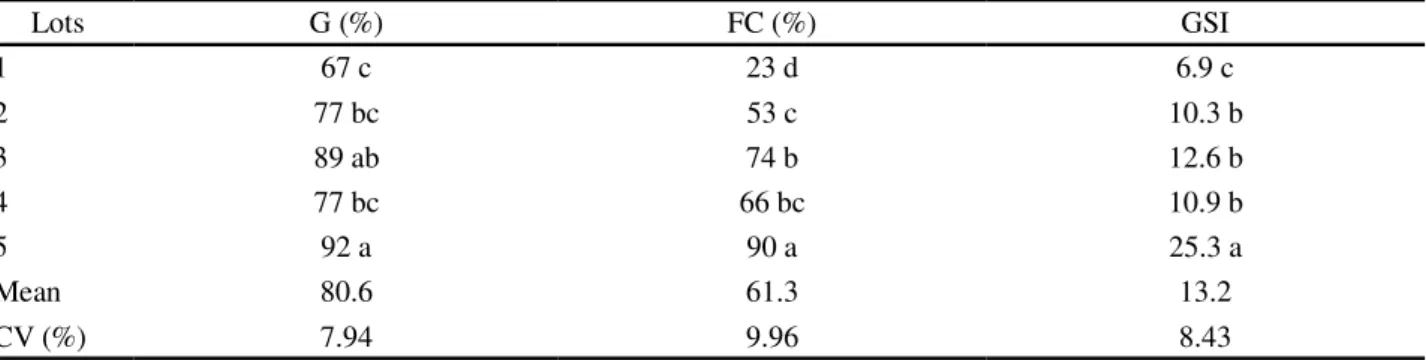
The results of germination, first count and germination speed index of the seeds allowed to infer that the physiological potential of lot 5 was superior to the others. For these analyzed variables, the lots 2, 3 and 4 did
Figure 1 - Illustration of gherkin seeds after tetrazolium test: viable (A), non-viable (B) and dead (C)
not differ statistically and were superior to lot 1, which showed the worst results (Table 1).
For the follow-up analysis of the factor Lots at temperature of 35 ºC, lot 5 was superior to the others, regardless of the evaluated concentrations and periods (Table 2). Lots 2 and 3 also obtained satisfactory results when exposed to the tetrazolium solution for 6 h, at the concentrations of 0.050 and 0.075%. In addition, it was observed that the seeds from lot 1 obtained the lowest percentages of viable seeds. The results found in the present study corroborate those of the germination test, in which lots 1 and 5 showed the lowest and highest vigor, respectively (Table 1).
According to the follow-up analysis of the concentration in the interaction Lots x Period, the immersion of the seeds in tetrazolium solution for the different concentrations during the period of 2 h was not adequate for the evaluation of the viability of gherkin seeds. The concentrations of 0.050 and 0.075% were the ones that best expressed the viability of the lots, when evaluated in the period of 6 h. The application of this methodology allowed the identification of the lots 5, 3 and 2 as those with higher percentage of viable seeds in comparison to the others, which is similar to the results of the germination test (Table 1).
For seeds of cucumber (Cucumis sativus L.), which
Lots G (%) FC (%) GSI
1 67 c 23 d 6.9 c
2 77 bc 53 c 10.3 b
3 89 ab 74 b 12.6 b
4 77 bc 66 bc 10.9 b
5 92 a 90 a 25.3 a
Mean 80.6 61.3 13.2
CV (%) 7.94 9.96 8.43
Equal letters in the column do not differ by Tukey test (p<0.05)
Table 1 - Germination (G), first count of germination (FC) and germination speed index (GSI) for the evaluation of the physiological potential of five lots of gherkin seeds
Lots 2 hours 4 hours 6 hours
0.050 0.075 0.100 0.050 0.075 0.100 0.050 0.075 0.100
1 36 abAy 29 bAx 24 aAx 40 bAxy 36 bAx 31 bAx 54 cAx 41 dABx 35 bCx
2 34 bAy 25 bAz 27 aAy 64 aAx 52 bBy 42 abBxy 73 abAx 71 bcAx 54 aBx
3 39 abAy 34 abAy 27 aAy 53 bAy 38 bAy 28 bAy 74 abBx 91 aAx 58 aCx
4 29 bAy 30 abAy 27 aAx 51 abAx 43 bAxy 39 abAx 57 bAx 57 cdAx 24 bBx
5 52 aAy 57 aABy 35 aBy 65 aABy 73 aBx 55 aBx 81 aAx 80 abAx 69 aAx
DMS1 17.57
DMS2 15.07
DMS3 15.07
Table 2 - Percentage of viable seeds of gherkin in the tetrazolium test for different combinations of immersion period and concentrations of the solution at temperature of 35 ºC
1Means followed by the same lowercase letter (a, b, c) in the column do not differ for the follow-up analysis of the factor Lots by Tukey test (p<0.05). 2Means followed by the same uppercase letter (A, B, C) in the row do not differ for the follow-up analysis of the factor Concentration by Tukey test
(p<0.05). 3Means followed by the same letter (x, y z) in the row (correlating the same temperature) do not differ for the follow-up analysis of the factor
Immersion period in the solution by Tukey test (p<0.05)
In the follow-up analysis of the exposure periods, the period of 6 h promoted higher number of viable seeds for all studied lots, regardless of the concentration used (Table 2). Hence, it can be inferred that, for the tetrazolium test at temperature of 35 ºC, it is necessary a longer period of immersion of the seeds in the solution to obtain the adequate coloration pattern, possibly because the utilized temperature does not stimulate higher respiratory activity of the living tissues of the seeds, which may be confirmed with the test at temperature of 40 ºC. As to the coloration pattern, the period of exposure of 6 h and concentration of 0.100% proved inadequate, since the embryos assumed an intense red color, which may lead to misinterpretation of the results, resulting in underestimation of the viability of the seed lot.
The low concentration of the tetrazolium salt in the solution, combined with the short period of exposure
of the seeds (2 h) at low temperature, was not sufficient to promote the coloration of the living tissues of the seed, especially in the region of the plumule, where the coloration is usually more intense, thus making it difficult the distinction between living and dead tissues, causing lower accuracy in the results of the test (SILVAet al.,
2013). Souzaet al. (2010) also reported difficulties in the
evaluation of essential structures of triticale seeds, using low concentrations and short periods of time.
Lots 2 hours 4 hours 6 hours
0.050 0.075 0.100 0.050 0.075 0.100 0.050 0.075 0.100
1 52 bcAy 47 bcAy 35 bcAx 58 bAy 59 bcAxy 34 cBx 80 abAy 78 abAx 52 bBx
2 61 abAx 61 abAx 65 aAx 65 abAx 77 abAx 65 aAx 60 bAx 76 abAx 74 abAx
3 34 cAz 29 cAy 22 cAy 67 abAy 43 cBy 37 bcBy 97 aAx 83 aABx 64 abBx
4 50 bcAy 54 abAy 54 abAx 67 abAy 70 abAxy 59 abAx 91 aAx 78 abABy 67 abBx
5 82 aAx 73 aAxy 67 aAxy 88 aAx 85 aAx 51 abcBy 58 bAy 58 bAy 78 aAx
DMS1 24.27
DMS2 20.82
DMS3 20.82
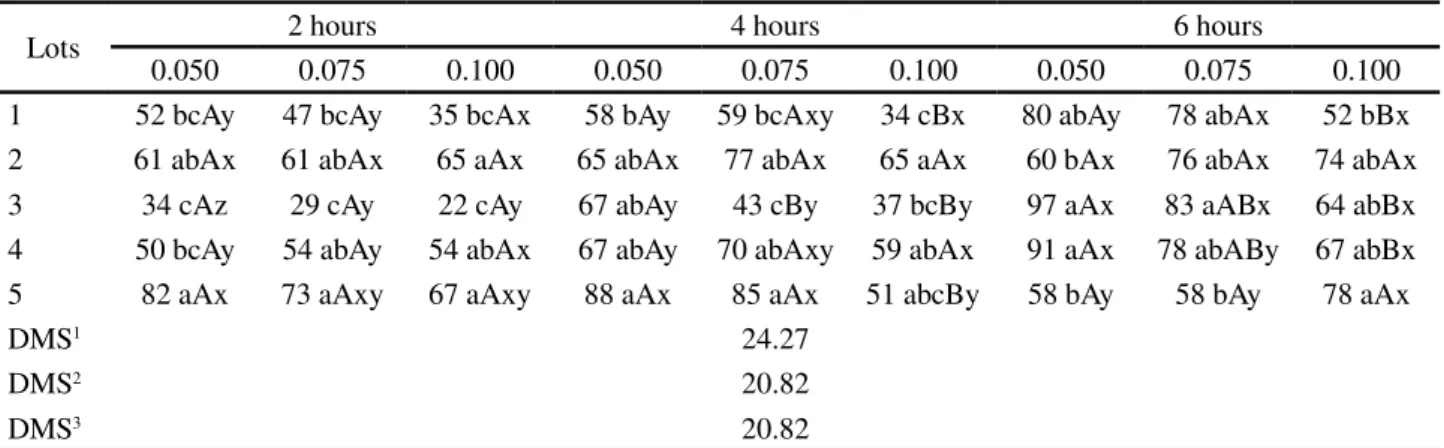
results obtained in the reference tests of physiological potential (Table 1), the tetrazolium test at temperature of 40 ºC (Table 3), conducted in the periods of 2 and 6 h, underestimated and overestimated, respectively, the viability of gherkin seeds, because these conditions led to the non-coloration of living embryos and coloration of dead embryos, respectively.
As to the follow-up analysis of the factor Concentration, there was no significant difference in the concentrations used for the period of 2 h. However, the concentrations of 0.050 and 0.075%, for the period of 6 h, underestimated the viability of the seed lots, except for lot 5, which was considered as non-viable due to the higher degree of coloration. However, the immersion of the seeds in solution with concentration of 0.050% for 4 h allowed adequate coloration and more precise identification of the viable seeds of the lots, a result similar to those obtained in the germination test (Table 1). Since the response of the tetrazolium test depends on the concentration and period of immersion of the seeds in the solution at adequate temperature, when the concentration of 0.050% was used, the viable tissues developed a little lighter pink color, not interfering with the interpretation of the test during the first 4 h of exposure. For Sarmentoet al. (2013), the
use of tetrazolium solution at 0.050% for 2 h, at 40 ºC, was efficient for the coloration of Brazilian guava seeds, corroborating the results observed in the present study, also denoting that the temperature of 40 ºC requires lower tetrazolium concentrations for the test.
The Rules for Seed Analysis recommend the use of tetrazolium solution at 1% under 30 ºC for 6 to 24 h for the coloration of embryos of seeds of species from the
Table 3 - Percentage of viable seeds of gherkin obtained through the tetrazolium test for different combinations of immersion period and concentrations of the solution at temperature of 40 ºC
1Means followed by the same lowercase letter (a, b, c) in the column do not differ for the follow-up analysis of the factor Lots by Tukey test (p<0.05). 2Means followed by the same uppercase letter (A, B, C) in the row do not differ for the follow-up analysis of the factor Concentration by Tukey test
(p<0.05). 3Means followed by the same letter (x, y z) in the column (correlating the same concentration) do not differ for the follow-up analysis of the
factor Exposure period by Tukey test (p<0.05)
genusCucumis for the evaluation of viability (BRASIL,
2009). Temperatures of 35 and 40 ºC were used in the present study in order to decrease the duration of the test; however, the use of higher temperatures did not allow the utilization of tetrazolium solution at 1% in the present study, for promoting intense colorations in the entire extension of the embryo, thus denoting the non-viability of the seeds. Different results were obtained by Deminics
et al. (2014), who observed that the concentration of
the tetrazolium solution at 1.0% for 150 min allowed to evaluate the viability of the lots of velvet bean seeds even at low temperatures, which can be related to some intrinsic characteristic of the species.
As to the period of immersion of the seeds in the solution at temperature of 40 ºC, the immersion for 2 h did not promote sufficient coloration for the identification of the viability of gherkin seeds, possibly due to the short time of exposure to the tetrazolium solution. On the other hand, the exposure of the seeds for 6 h promoted greater coloration and may induce the overestimation of the viability of the lots by the seed analyst, probably due to the intense coloration caused by the long time of exposure. Thus, the intermediate time of 4 h stood out as ideal, for expressing higher similarity between the vigor observed through the tetrazolium test and the vigor in the germination test, especially at the concentration of 0.050%, in which the lots 5, 2, 3 and 4 were considered as viable and lot 1 as non-viable (Tables 1 and 3). Coloration of wheat seeds through immersion (2 h, at 40 °C) in a tetrazolium solution at 0.075% was recommended for the identification and rejection of lots with lower viability
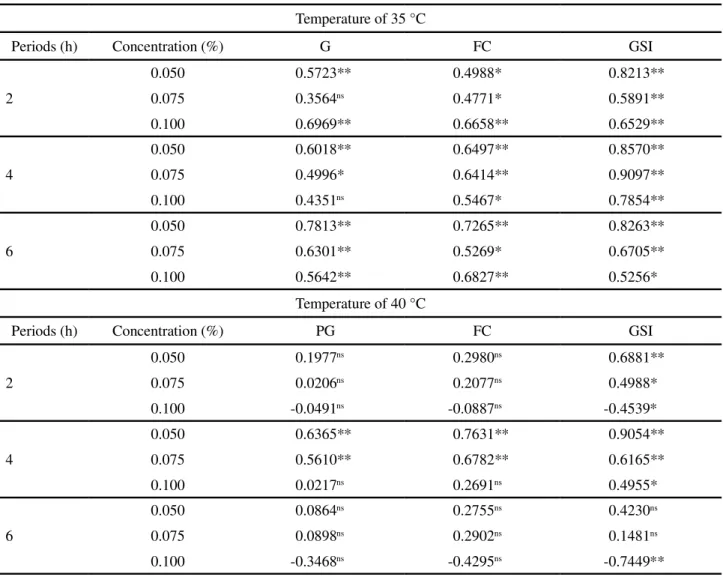
The highest values of Pearson’s correlation index were observed in the tetrazolium test at concentration of 0.050% for 6 h of exposure, at temperature of 35 ºC, and at concentration of 0.050% for 4 h at temperature of 40 ºC (Table 4).
The correlation analysis corroborates the obtained results, indicating that there is potential of use of the tetrazolium test for the identification of the viability of gherkin seeds. In addition, it is observed that the use of the temperature of 40 ºC reduced the duration of the tetrazolium test, possibly due to the increase in the speed of respiration of embryonic tissues, activity of the dehydrogenase enzymes involved in this process and the amount of formazan formed inside the cells, because
Table 4 - Pearson’s correlation between the tetrazolium test and the values of germination (G), first count of germination (FC) and
germination speed index (GSI) of gherkin seeds
NS, * and ** = not significant and significantat 1 and 5% (p<0.01 and p<0.05) probability, respectively Temperature of 35 °C
Periods (h) Concentration (%) G FC GSI
2
0.050 0.5723** 0.4988* 0.8213**
0.075 0.3564ns 0.4771* 0.5891**
0.100 0.6969** 0.6658** 0.6529**
4
0.050 0.6018** 0.6497** 0.8570**
0.075 0.4996* 0.6414** 0.9097**
0.100 0.4351ns 0.5467* 0.7854**
6
0.050 0.7813** 0.7265** 0.8263**
0.075 0.6301** 0.5269* 0.6705**
0.100 0.5642** 0.6827** 0.5256*
Temperature of 40 °C
Periods (h) Concentration (%) PG FC GSI
2
0.050 0.1977ns 0.2980ns 0.6881**
0.075 0.0206ns 0.2077ns 0.4988*
0.100 -0.0491ns -0.0887ns -0.4539*
4
0.050 0.6365** 0.7631** 0.9054**
0.075 0.5610** 0.6782** 0.6165**
0.100 0.0217ns 0.2691ns 0.4955*
6
0.050 0.0864ns 0.2755ns 0.4230ns
0.075 0.0898ns 0.2902ns 0.1481ns
0.100 -0.3468ns -0.4295ns -0.7449**
the increment in temperature accelerates the metabolic
reaction of the seeds (BRASIL, 2009; GUEDES et al.,
2010; RODRIGUESet al., 2015).
CONCLUSIONS
The evaluation of viability of gherkin seeds through the tetrazolium test is efficient when performed at concentration of 0.050% for 6 h at 35 ºC or for 4 h at 40 ºC.
REFERENCES
BHERING, M. C.; DIAS, D. C. F. S.; BARROS, D. I. Adequação da metodologia do teste de tetrazólio para avaliação da qualidade fisiológica de sementes de melancia. Revista Brasileira de Sementes, v. 27, n. 1, p. 176-182, 2005.
BRASIL. Ministério da Agricultura, Pecuária e Abastecimento.
Regras para análise de sementes. Ministério da Agricultura, Pecuária e Abastecimento. Secretaria de Defesa Agropecuária. Brasília: MAPA: ACS, 2009. 395 p.
CARVALHO, T. C.et al. Tetrazolium test adjustment for wheat
seeds. Journal of Seed Science, v. 35, n. 3, p. 361-367, 2013. COSTA, C. J.; SANTOS, C. P. Teste de tetrazólio em sementes de leucena. Revista Brasileira de Sementes, v. 32, n. 2, p.
066-072, 2010.
DEMINICS, B.et al. Tetrazolium test to evaluate Stizolobium aterrimumseeds quality.American Journal of Plant Sciences,
v. 5, n. 1, p. 148-152, 2014.
FERREIRA, D. F. Sisvar: a computer statistical analysis system.
Ciência e Agrotecnologia, v. 35, n. 6, p. 1039-1042, 2011.
GASPAR-OLIVEIRA, C. M. et al. Pré-condicionamento
das sementes de mamoneira para o teste de tetrazólio. Acta Scientiarum Agronomy, v. 33, n. 2, p. 303-311, 2011.
GUEDES, R. S.et al. Metodologia para teste de tetrazólio em sementes deAmburana cearensis(Allemao) A. C. Smith.Revista Brasileira de Plantas Medicinais, v. 12, n. 1, p. 120-126, 2010.
LIMA, L. B.; PINTO, T. L. F.; NOVEMBRE, A. D. L. C. Avaliação da viabilidade e do vigor de sementes de pepino pelo teste de tetrazólio.Revista Brasileira de Sementes, v. 32, n. 1 p. 060-068, 2010.
MAGUIRE, J. D. Speed of germination-aid selection and evaluation for seedling emergence and vigor.Crop Science, v. 2, n. 2, p. 176-177, 1962.
MARCOS-FILHO, J. Fisiologia de sementes de plantas cultivadas. 2. ed. Londrina: Abrates, 2015. 659 p.
MEDEIROS, M. A.et al. Maturação fisiológica de sementes
de maxixe (Cucumis anguria L.). Revista Brasileira de Sementes, v. 32, n. 3 p. 17-24, 2010.
NERY, M. C.; CARVALHO, M. L. M; OLIVEIRA, L. M. Teste de tetrazólio para avaliação da qualidade fisiológica de sementes de melancia. Semina: Ciências Agrárias, v. 28, n. 3,
p. 365-372, 2007.
NOGUEIRA, N. W.; TORRES, S. B.; FREITAS, R. M. O. Teste de tetrazólio em sementes de timbaúba. Semina: Ciências Agrárias, v. 35, n. 6, p. 2967-2976, 2014.
OLIVEIRA, F. A.et al.Produtividade do maxixeiro cultivado em
substrato e fertirrigado com soluções nutritivas.Horticultura Brasileira, v. 32, n. 4, p. 464-467, 2014.
RODRIGUES, A. P. M. S.et al. Teste de tetrazólio para avaliação da qualidade fisiológica de sementes deVigna unguiculata(L.)
Walp. Revista Ciência Agronômica, v. 46, n. 3, p. 638-644, 2015.
SANTOS, M. A. O.; NOVEMBRE, A. D. L. C.; MARCOS-FILHO, J. Tetrazolium test to assess viability and vigour of tomato seeds.Seed Science and Technology, v. 35, n 1, p. 213-223, 2007.
SARMENTO, M. B.et al. Teste de tetrazólio para avaliação
da qualidade fisiológica em sementes de goiabeira-serrana (Acca sellowiana O. Berg Burret). Revista Brasileira de Fruticultura, v. 35, n. 1, p. 270-276, 2013.
SILVA, R. C. et al. Adaptação do teste de tetrazólio para avaliação da viabilidade e do vigor de sementes de girassol.
Pesquisa Agropecuária Brasileira, v. 48, n. 1, p. 105-113,
2013.
SOUZA, C. R.et al. Tetrazolium test for evaluating triticale seed
viability.Revista Brasileira de Sementes, v. 32, n. 3, p.