Ni DengI, Lili XieII, Yongwei LiIII, Haishu LinIII, Renhui LuoIV
Oxymatrine alleviates periodontitis in rats by inhibiting
inflammatory factor
secretion and regulating MMPs/
TIMP protein expression
1Acta Cir Bras. 2018;33(11):945-953
Abstract
Purpose: To investigate the effect of oxymatrine on periodontitis in rats and related mechanism.
Methods: Ninety SD rats were divided into control, model, 10, 20 and 40 mg/kg oxymatrine and tinidazole groups. The periodontitis model was established in later 5 groups. The 10, 20 and 40 mg/kg oxymatrine groups were intragastrically administrated with 10, 20 and 40 mg/ kg oxymatrine, respectively. The tinidazole group was intragastrically administrated with 100 mg/kg tinidazole. The treatment duration was 4 weeks. The tooth mobility, gingival and plaque indexes, serum inflammatory factor levels and gingival tissue matrix metalloproteinases (MMPs) and tissue inhibitor of metalloproteinase (TIMP) protein levels were detected. Results: After treatment, compared with model group, in 40 mg/kg oxymatrine group the rat general conditions were obviously improved, the tooth mobility, gingival index and plaque index were significantly decreased (P<0.05), the serum tumor necrosis factor-α, interleukin-1β and prostaglandin E2 levels were significantly decreased (P<0.05), the 2 and MMP-9 protein levels were significantly decreased (P<0.05), and the TIMP-2 protein level was significantly increased (P<0.05).
Conclusions: Oxymatrine can alleviate the experimental periodontitis in rats. The mechanism may be related to its inhibiting inflammatory factor secretion and regulating MMPs/TIMP protein expression.
Key words: Periodontitis. Matrix Metalloproteinases. Rats.
DOI: http://dx.doi.org/10.1590/s0102-865020180110000001
IMS, Department of Stomatology, Hainan General Hospital, Haikou, China. Acquisition of data, critical revision, final
approval.
IIMS, Department of Stomatology, Hainan General Hospital, Haikou, China. Statistical analysis, critical revision, final
approval.
IIIMS, Department of Stomatology, Hainan General Hospital, Haikou, China. Design of the study, critical revision, final
approval.
IVMS, Department of Stomatology, Guangzhou Hospital of Integrated Traditional and Western Medicine, Guangzhou,
sedative, analgesic, antipyretic, hypothermic, cardiotonic, hypotensive and anti-arrhythmic
effects8-11. Various preparations of oxymatrine
have been widely used in clinical practice. However, there is no report on the effect of oxymatrine on periodontitis. In this study, the effects of oxymatrine on periodontitis in rats and the mechanisms related to inflammatory response and MMPs/TIMP expression were investigated. The objective was to provide an experimental basis for the clinical application of oxymatrine to treatment of periodontitis.
■
Methods
This study was performed in strict accordance with the recommendations in the Guide for the Care and Use of Laboratory Animals of the National Institutes of Health. The animal use protocol has been reviewed and approved by the Institutional Animal Care and Use Committee of Hainan General Hospital.
Establishment of periodontitis model
According to the reported method12
with some modifications, ninety SD rats (8 weeks age; 280±30g; male and female in half; Hainan Experimental Animal Center, Haikou, China) were randomly divided into 6 groups: control group, model group, 10, 20 and 40 mg/ kg oxymatrine groups and tinidazole group, 15 rats in each group. In later 5 groups, the periodontitis model was established. The rats were anaesthetized by intraperitoneal injection of 10% chloral hydrate with dose of 3 ml/kg. The neck of left maxillary first molar was ligated using 0.2 mm-diameter orthodontic wire. Then, the rats were daily fed with 50 ml 10% sugar water instead of drinking water. From the second day after ligation, the prednisolone acetate was injected into the four muscles of hind legs, with dose of 5 mg/kg. The injection
■
Introduction
Periodontitis is a chronic infectious disease occurring in the periodontal support tissue, which can cause the periodontal support tissue inflammation, periodontal pocket formation, progressive attachment loss and alveolar bone resorption, eventually
leading to the tooth loosening and extraction1.
Periodontitis is the primary cause of tooth loss in adults. The oral plaque is the main pathogenic factor of periodontitis. The plaque induces the early inflammation, and the host’s defense response to plaque bacteria further promotes the periodontal connective tissue
destruction and alveolar bone resorption2. The
key of successful prevention and treatment of periodontitis is to control bacteria and their products in periodontal tissues and gingival crevicular fluid, so as to maintain the microecological balance of periodontal local
environment3. The plaque is usually removed
using mechanical methods, but this can more or less cause the mechanical damage to tooth surface. At present, the antibiotics treatment is mostly used for treating periodontitis, and the short-term effect is obvious. However, the periodontitis is easy to recur, and many side effects are easy to produce. In addition, in recent years the resistance of pathogenic microorganisms to antibiotics has been increasing due to the misuse, and the efficacy of antibiotics treatment has been
declining4. It is reported that, the inflammatory
response and changes in expression of matrix metalloproteinases (MMPs) and tissue inhibitor of metalloproteinases (TIMPs) are involved in the occurrence and development
of periodontitis5-7. Oxymatrine is the main
component of alkaloids in medical plant
Sophora alopecuroides, Sophora flavescens
and Sophora japonica. The pharmacological
was performed once every two days, for 20 days. During the modeling period, no rat died.
Treatment method
After establishment of periodontitis model, the rats were fed normally for 1 week. Then, the ligature wire was removed. The rats in 10, 20 and 40 mg/kg oxymatrine groups were intragastrically administrated with oxymatrine (HPLC purity ≥ 98%; Chengdu Deruike Biotechnology Co., Ltd., Chengdu, China), with dose of 10, 20 and 40 mg/kg, respectively. The rats in tinidazole group were intragastrically administrated with 100 mg/kg tinidazole. The rats in control and model groups were intragastrically administrated with normal saline. The treatment was performed once per day, for 4 weeks. During the treatment, all rats were fed with standard feed and free
intake. The room temperature was 20-25°C.
The water drinking was forbidden for 2h after treatment, with free drinking in the rest time. The conditions of rats were observed during the experiment.
Measurement of tooth mobility
The tooth mobility before and after treatment was measured by scoring as follows: only lingual loosening, 1 point; buccal-lingual loosening and mesiodistal loosening, 2 points; buccal-lingual loosening, mesiodistal
loosening and vertical loosening, 3 points13.
Measurement of gingival index
Gingival index was measured by scoring as follows: 0 point: normal gingiva; 1 point: slightly edema of gingiva, without bleeding on probing; 2 points: slightly edema of gingiva, with bleeding on probing; 3 points: edema of gingiva, with spontaneous bleeding or ulcer formation. Four positions including proximal nipple, distal nipple, central nipple and palatal
surface of buccal surface of the experimental tooth were examined. The mean value of score of four positions was calculated as the gingival index.
Measurement of plaque index
A drop of plaque stain (2% erythrosine sodium) was applied to the experimental tooth. After 30s, the tooth was rinsed with water for 10s. The area and depth of purple-red on the teeth were observed. The plaque index was measured by scoring as follows: 0 point: no plaque; 1 point: there were scattered spots on the gingival margin of tooth neck; 2 points: there was continuous narrow-banded plaque on the tooth neck, with width no more than 1 mm; 3 points: the width of plaque was more than 1 mm, but the coverage area was less than 1/3 of tooth crown; 4 points: the coverage area of plaque was from 1/3 to 2/3 of tooth crown; 5 points: the coverage area of plaque was no less than 2/3 of tooth crown.
Determination of serum inflammatory factor levels
The rats were anesthetized with 5% chloral hydrate. Five milliliter of blood was taken from abdominal aorta. After centrifuging at 2000 r/min for 10 min, the supernatant was obtained. The serum levels of inflammatory factor tumor necrosis factor-α (TNF-α);
interleukin-1β (IL-1β) and prostaglandin E2
(PGE2) were determined by enzyme linked
immunosorbent assay. The process was according to the instructions of the kits.
Determination of matrix metalloproteinase and inhibitor of metalloproteinase levels in gingival tissue
determined using BCA protein quantitation kit. The expressions levels of MMP-2, MMP-9 and TIMP-2 protein in gingival tissue were detected using western blot assays. β-actin was used as the internal reference. The relative expression level of target protein was calculated by the ratio of integral optical density of target protein to β-actin. The experiment procedures were in accordance to the instructions of kits.
Statistical analysis
Statistical analysis was performed using SPSS 20.0 software (SPSS Inc., Chicago, IL, USA). The data were presented as mean±SD. The difference among different groups was analyzed using one-way analysis of variance with q test. P<0.05 was defined as statistically significant.
■
Results
General conditions of rats after treatment
After treatment, the spirit, activity, hair, food intake, stool, weight, periodontal tissues color and shape in control group were normal, with no obvious difference than before treatment. In model group, compared with before treatment, after treatment the spirit, activity, hair, food intake and stool were worsened, with decreased weight and obvious gingival gingival swelling and congestion. Compared with model group, the general conditions in other 4 groups were improved, especially in 40 mg/kg oxymatrine and tinidazole groups.
Change of tooth mobility
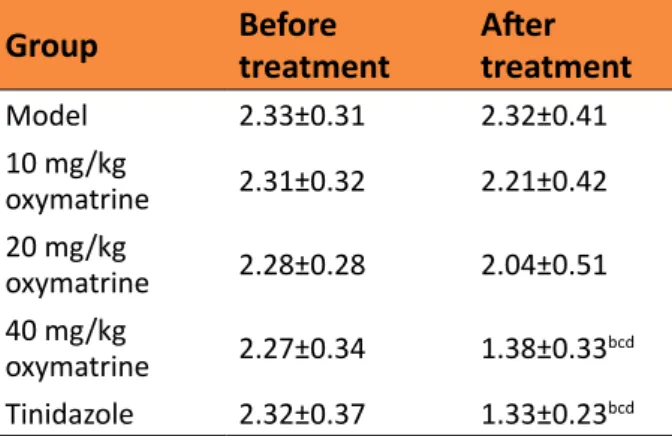
Before treatment, there was no significant difference of tooth mobility score among model, 10 mg/kg oxymatrine, 20 mg/ kg oxymatrine, 40 mg/kg oxymatrine and
tinidazole groups (P>0.05). After treatment, the tooth mobility score in model group was 2.32±0.41 points. The tooth mobility scores in 40 mg/kg oxymatrine and tinidazole groups were1.38±0.33 and 1.33±0.23 points, respectively, which were significantly lower than those in model group, respectively (P<0.05) (Table 1).
Table 1 - Change of tooth mobility score in
different groups (points).
Group Before
treatment
After treatment
Model 2.33±0.31 2.32±0.41
10 mg/kg
oxymatrine 2.31±0.32 2.21±0.42
20 mg/kg
oxymatrine 2.28±0.28 2.04±0.51
40 mg/kg
oxymatrine 2.27±0.34 1.38±0.33bcd
Tinidazole 2.32±0.37 1.33±0.23bcd
bP<0.05 compared with model group; cP<0.05 compared with
10 mg/kg oxymatrine group; dP<0.05 compared with 20 mg/kg
oxymatrine group.
Gingival index and plaque index after
treatment
Table 2 - Gingival index and plaque index after treatment in different groups (points).
Group Gingival index Plaque index
Control 1.54±0.36 2.55±0.45
Model 3.46±0.75a 4.22±0.72a
10 mg/kg oxymatrine 3.01±0.72a 4.45±0.82a
20 mg/kg oxymatrine 2.48±0.67a 3.54±0.72a
40 mg/kg oxymatrine 1.95±0.47bc 2.99±0.63bc
Tinidazole 1.67±0.61bcd 2.78±0.82bc
aP<0.05 compared with control group; bP<0.05 compared with model group; cP<0.05 compared with 10 mg/kg oxymatrine group;
dP<0.05 compared with 20 mg/kg oxymatrine group.
Serum TNF-α, IL-1β and PGE2 levels after
treatment
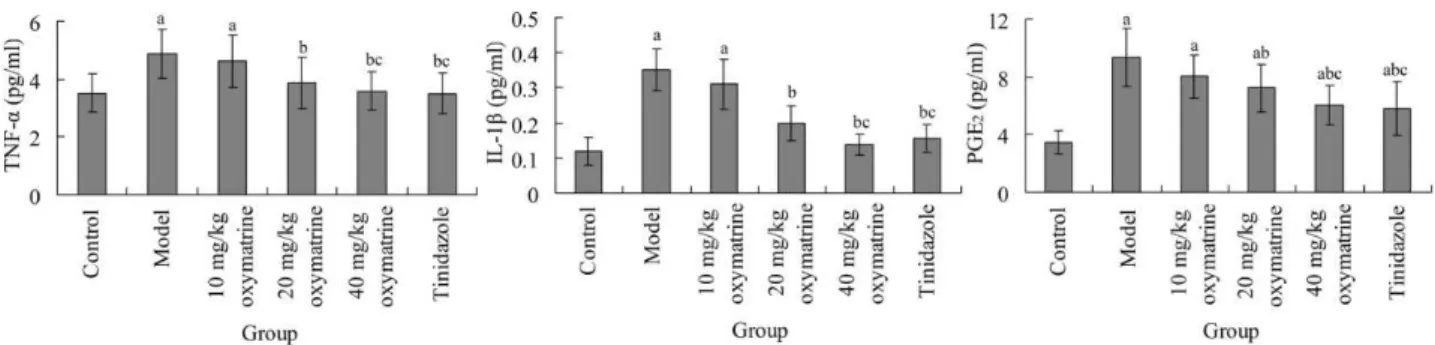
After treatment, the serum TNF-α,
IL-1β and PGE2 levels in model group were
4.88±0.84, 0.35±0.06 and 9.34±2.05 pg/ml, respectively, which were significantly higher than 3.52±0.67, 0.12±0.04 and 3.45±0.79 pg/ ml in control group, respectively (P < 0.05).
The serum TNF-α, IL-1β and PGE2 levels in 20
mg/kg oxymatrine, 40 mg/kg oxymatrine and tinidazole groups were 3.87±0.87, 0.20±0.05 and 7.21±1.65 pg/ml, 3.72±0.65, 0.15±0.03 and 6.02±1.37 pg/ml, and 3.64±0.72, 0.18±0.04 and 5.77±1.86 pg/ml, respectively. Each index in 20 mg/kg oxymatrine, 40 mg/kg oxymatrine and tinidazole groups was significantly lower than that in model group, respectively (P<0.05) (Figure 1).
Figure 1 - Serum TNF-α, IL-1β and PGE2 levels in different groups. aP<0.05 compared with control group;
bP<0.05 compared with model group; cP<0.05 compared with 10 mg/kg oxymatrine group. TNF-α, tumor necrosis factor-α; IL-1β, interleukin-1β; PGE2, prostaglandin E2.
Gingival tissue MMP-2, MMP-9 and TIMP-2 protein levels after treatment
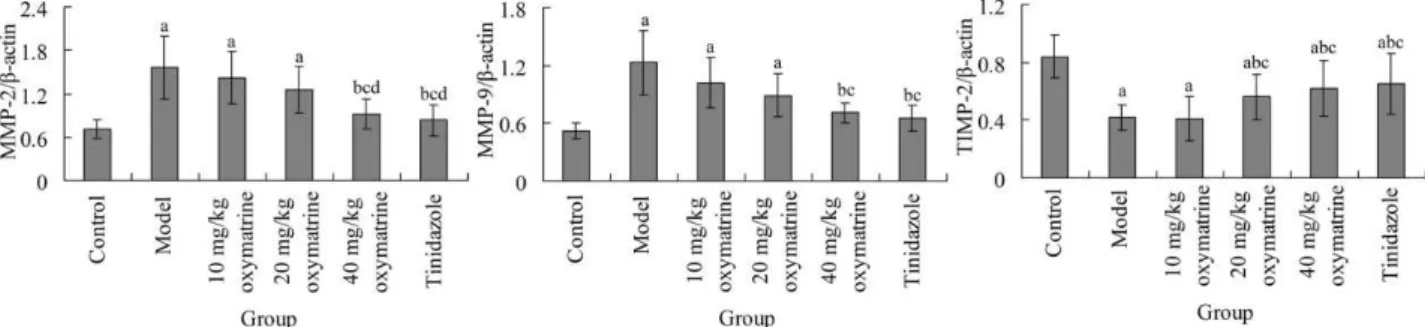
After treatment, the gingival tissue MMP-2 and MMP-9 protein levels in model group (MMP-2/β-actin, 1.56±0.46; MMP-9/β-actin, 1.23±0.33) were significantly higher than those in control group (MMP-2/β-actin,
0.71±0.13; MMP-9/β-actin, 0.52±0.09),
MMP-9/β-actin, 0.71±0.15) and tinidazole group (MMP-2/β-actin, 0.83±0.22; MMP-9/β-actin, 0.65±0.13) were significantly decreased, respectively (P<0.05), and the TIMP-2 protein
levesl in 40 mg/kg oxymatrine group (TIMP-2/β-actin, 0.62±0.19) and tinidazole group (TIMP-2/β-actin, 0.65±0.21) were significantly increased, respectively (P<0.05) (Figure 2).
Figure 2 - Gingival tissue MMP-2, MMP-9 and TIMP-2 protein levels after treatment in different groups.
aP<0.05 compared with control group; bP<0.05 compared with model group; cP<0.05 compared with 10 mg/
kg oxymatrine group. MMP-2, matrix metalloproteinase-2; MMP-9, matrix metalloproteinase-9; TIMP-2, tissue inhibitor of metalloproteinases-2.
■
Discussion
In this study, the effects of oxymatrine on periodontitis in rats were investigated. Result showed that, after treatment, the general conditions of rats in model group were obviously worse than those in control group. In addition, there was obvious tooth mobility in model group. The gingival index and plaque index in model group were significantly higher than those in control group, respectively. Compared with model group, in treatment groups the general conditions of rats were improved, the tooth mobility was significantly decreased, and the gingival index and plaque index were significantly decreased. This suggests that, the oxymatrine can alleviate the experimental periodontitis in rats.
Periodontitis is an inflammatory infectious disease of dental support tissue caused by gram-negative anaerobic bacteria, flagella, spirochetes and other microorganisms. Bacteria and their toxic products, such as bacterial endotoxins and enzymes, can directly damage the periodontal epithelium
and connective tissue14,15. At the same time,
the host defense cells are activated, thus releasing cytokines such as TNF-α and IL-1β. These cytokines activate the lymphocytes and act as many target cells. They mediate the inflammation that leads to the secondary
injury of peripheral tissue16,17. TNF-α plays an
important role in periodontal tissue destruction by stimulating collagenase-mediated tissue destruction, inducing osteoclast precursor cell proliferation and differentiation, and indirectly acting on mature osteoclasts to stimulate bone
resorption18. IL-1β is a multifunctional cytokine
and plays an active role in inflammation, immunity and bone metabolism. IL-1β can promote the bone resorption, and its level was significantly correlated with periodontal
attachment loss19. PGE
2 is a very important
inflammatory factor, and is also closely related
to periodontitis20. Results of this study showed
that, after treatment, the serum TNF-α, IL-1β
and PGE2 levels in model group were significantly
Compared with model group, the serum
TNF-α, IL-1β and PGE2 levels in 20 and 40
mg/kg oxymatrine groups were significantly decreased. This suggests that, oxymatrine can inhibit the secretion of inflammatory factors, thus alleviate the periodontitis.
MMPs are a family of proteolytic enzymes with similar structure and different functions. They can digest all the macromolecular substances outside the cells, and are the protease that mainly regulates the degradation of extracellular
matrix21,22. MMP-2 and MMP-9 are the main
proteolytic enzymes in MMPs family, and belong to the gelatinases. MMP-2 is mainly expressed by gingival epidermal cells and
periodontal ligament fibroblasts23.
MMP-9 is mainly produced by inflammatory cells infiltrating into periodontal tissues. The inflammatory cytokines can increase the
synthesis and secretion of MMP-924. MMP-2
and MMP-9 are important biological markers of periodontitis. Their over-expressions are closely related to the degree of gingival fibrous
matrix disintegration25. TIMPs are important
factors regulating the activation of MMPs. TIMPs can reduce the excessive degradation of extracellular matrix by inactivating the
activated MMPs26. TIMP-2 is an important
member of TIMPs family, and is related to the
development of periodontitis27. The regulation
of MMPs/TIMPs is a new strategy for treating periodontitis. In this study, after treatment, the gingival tissue MMP-2 and MMP-9 protein levels in model group were significantly higher than those in control group, and the TIMP-2 protein level in model group was significantly lower than that in control group. Compared with model group, in 40 mg/kg oxymatrine group the MMP-2 and MMP-9 protein levels were significantly decreased, and the TIMP-2 protein level was significantly increased. This indicates that, oxymatrine can down-regulate the expression of MMP-2 and MMP-9 proteins
and up-regulate the expression of TIMP-2 protein in periodontal tissues, which is related to its alleviation effect on periodontitis.
■
Conclusions
Oxymatrine can alleviate the
experimental periodontitis in rats. The mechanism may be related to its inhibition of inflammatory factor secretion and regulating MMPs/TIMP protein expressions. This study has provided an experimental basis for the clinical application of oxymatrine to treatment of periodontitis. This study still has some limitations. Firstly, the sample size of this study is relatively small. Secondly, the correlations among different indexes have not been investigated. Thirdly, there may be other mechanisms of oxymatrine alleviating periodontitis. These issues should be solved in next studies.
■
References
1 Sidhu RK. Association between acute myocardial infarction and periodontitis: a review of the literature. J Int Acad
Periodontol. 2016;18:23-33. PMID:
26764968.
2 Hajishengallis G. Periodontitis: from microbial immune subversion to systemic
inflammation. Nat Rev Immunol.
2015;15:30-44. doi: 10.1038/nri3785. 3 Hu Z, Zhang Y, Li Z, Yu Y, Kang W, Han Y, Geng
X, Ge S, Sun Y. Effect of Helicobacter pylori infection on chronic periodontitis by the change of microecology and inflammation.
Oncotarget. 2016;7:66700-12. doi:
10.18632/oncotarget.11449.
4 Ardila CM, Granada MI, Guzmán IC. Antibiotic resistance of subgingival species in chronic periodontitis patients. J Periodontal Res. 2010;45:557-63. doi: 10.1111/j.1600-0765.2010.01274.x.
10.1111/j.1467-789X.2008.00555.x.
6 Gonçalves PF, Huang H, McAninley S, Alfant B, Harrison P, Aukhil I, Walker C, Shaddox LM. Periodontal treatment reduces matrix metalloproteinase levels in localized aggressive periodontitis. J Periodontol. 2013;84:1801-8. doi: 10.1902/ jop.2013.130002.
7 Meschiari CA, Marcaccini AM, Santos Moura BC, Zuardi LR, Tanus-Santos JE, Gerlach RF. Salivary MMPs, TIMPs, and MPO levels in periodontal disease patients and controls. Clin Chim Acta. 2013;421:140-6. doi: 10.1016/j.cca.2013.03.008.
8 Wang YP, Zhao W, Xue R, Zhou ZX, Liu F, Han YX, Ren G, Peng ZG, Cen S, Chen HS, Li YH, Jiang JD. Oxymatrine inhibits hepatitis B infection with an advantage of overcoming drug-resistance. Antiviral Res. 2011;89:227-31. doi: 10.1016/j.antiviral.2011.01.005. 9 Liu Y, Xu Y, Ji W, Li X, Sun B, Gao Q, Su C.
Anti-tumor activities of matrine and oxymatrine: literature review. Tumour Biol. 2014;35:5111-9. doi: 10.1007/s13277-014-1680-z.
10 Yao N, Wang X. In vitro immunomodulatory activity of oxymatrine on Toll-like receptor 9 signal pathway in chronic hepatitis B. Am J Chin Med. 2014;42:1399-410. doi: 10.1142/ S0192415X14500888.
11 Cao YG, Jing S, Li L, Gao JQ, Shen ZY, Liu Y, Xing Y, Wu ML, Wang Y, Xu CQ, Sun HL. Antiarrhythmic effects and ionic mechanisms of oxymatrine from Sophora flavescens. Phytother Res. 2010;24:1844-9. doi: 10.1002/ptr.3206.
12 Di Paola R, Marzocco S, Mazzon E, Dattola F, Rotondo F, Britti D, De Majo M, Genovese T, Cuzzocrea S. Effect of aminoguanidine in ligature-induced periodontitis in rats. J Dent Res. 2004;83:343-8. doi: 10.1177/154405910408300414.
13 Kawarizadeh A, Bourauel C, Jäger A. Experimental and numerical determination of initial tooth mobility and material properties of the periodontal ligament in rat molar specimens. Eur J Orthod. 2003;25:569-78. PMID: 14700262.
14 Thiha K, Takeuchi Y, Umeda M, Huang Y, Ohnishi M, Ishikawa I. Identification of periodontopathic bacteria in gingival tissue of Japanese periodontitis patients. Oral Microbiol Immunol. 2007;22:201-7. doi:
10.1111/j.1399-302X.2007.00354.x.
15 Graves DT, Kang J, Andriankaja O, Wada K, Rossa C Jr. Animal models to study host-bacteria interactions involved in periodontitis. Front Oral Biol. 2012;15:117-32. doi: 10.1159/000329675.
16 Jiang ZL, Cui YQ, Gao R, Li Y, Fu ZC, Zhang B, Guan CC. Study of TNF-α, IL-1β and LPS levels in the gingival crevicular fluid of a rat model of diabetes mellitus and periodontitis. Dis Markers. 2013;34:295-304. doi: 10.3233/ DMA-130974.
17 Wytrykowska A, Prosba-Mackiewicz M, Nyka WM. IL-1β, TNF-α, and IL-6 levels in gingival fluid and serum of patients with ischemic stroke. J Oral Sci. 2016;58:509-13. doi: 10.2334/josnusd.16-0278.
18 Liao CH, Fei W, Shen ZH, Yin MP, Lu C. Expression and distribution of TNF-α and PGE2 of periodontal tissues in rat periodontitis model. Asian Pac J Trop Med. 2014;7:412-6. doi: 10.1016/S1995-7645(14)60067-5.
19 Oh H, Hirano J, Takai H, Ogata Y. Effects of initial periodontal therapy on interleukin-1β level in gingival crevicular fluid and clinical periodontal parameters. J Oral Sci. 2015;57:67-71. doi: 10.2334/josnusd.57.67. 20 Taxman DJ, Lei Y, Zhang S, Holley-Guthrie
E, Offenbacher S, Ting JP. ASC-dependent RIP2 kinase regulates reduced PGE2 production in chronic periodontitis. J Dent Res. 2012;91:877-82. doi: 10.1177/0022034512454541.
21 Shi J, Son MY, Yamada S, Szabova L, Kahan S, Chrysovergis K, Wolf L, Surmak A, Holmbeck K. Membrane-type MMPs enable extracellular matrix permissiveness and mesenchymal cell proliferation during embryogenesis. Dev Biol. 2008;313:196-209. doi: 10.1016/j.ydbio.2007.10.017.
22 Jabłońska-Trypuć A, Matejczyk M,
Rosochacki S. Matrix metalloproteinases (MMPs), the main extracellular matrix (ECM) enzymes in collagen degradation, as a target for anticancer drugs. J Enzyme Inhib Med Chem. 2016;31:177-83. doi: 10.3109/14756366.2016.1161620.
Morphol Embryol. 2015;56:77-83. PMID: 25826490.
24 Kumar MS, Vamsi G, Sripriya R, Sehgal PK. Expression of matrix metalloproteinases (MMP-8 and -9) in chronic periodontitis patients with and without diabetes mellitus. J Periodontol. 2006;77:1803-8. doi: 10.1902/ jop.2006.050293.
25 Chen D, Wang Q, Ma ZW, Chen FM, Chen Y, Xie GY, Wang QT, Wu ZF. MMP-2, MMP-9 and TIMP-2 gene polymorphisms in Chinese patients with generalized aggressive periodontitis. J Clin Periodontol.
2007;34:384-9. doi:
10.1111/j.1600-051X.2007.01071.x.
26 Arpino V, Brock M, Gill SE. The role of TIMPs in regulation of extracellular matrix proteolysis. Matrix Biology. Matrix Biol. 2015;44-46:247-54. doi: 10.1016/j. matbio.2015.03.005.
27 Oyarzún A, Arancibia R, Hidalgo R, Peñafiel C, Cáceres M, González MJ, Martínez J, Smith PC. Involvement of MT1-MMP and TIMP-2 in human periodontal disease. Oral Dis. 2010;16:388-95. doi: 10.1111/j.1601-0825.2009.01651.x.
Correspondence:
Yongwei Li
Department of Stomatology, Hainan General Hospital
19 Xiuhua Road Haikou 570311 China Phone: +86-898-68642645 [email protected]
Received: July 29, 2018 Review: Sept 25, 2018 Accepted: Oct 26, 2018
Conflict of interest: none Financial source: none
1Research performed at Central Laboratory,