A R T I G O O R I G I N A L
B A C K P A I N D U R I N G P R E G N A N C Y
:
A L O N G I T U D I N A L S T U D YC. Quaresma
*, C. Silva
**, M. Forjaz Secca
*,
***, J. Goyri O’Neill
*,
****, J. Branco
****,
******Cefitec, Departamento de Física, Faculdade de Ciências e Tecnologia, Universidade Nova de Lisboa, Monte de Caparica, Portugal
**Escola Superior de Saúde do Alcoitão, Portugal ***Ressonância Magnética – Caselas, Lisboa, Portugal ****Faculdade de Ciências Médicas, Universidade Nova de Lisboa”, Portugal
*****Maternidade Dr Alfredo da Costa, Lisboa, Portugal
whose body adapts to the general and local modi-fications that take place throughout this period1.
Back pain is a considerable problem in the ge-neral population2,and it is thought to be even more
common among pregnant women. Back pain is a common symptom in normal pregnant women and studies have reported that between 35 and 76%
of pregnant women experience back pain3.
Al-though many women experience back pain during pregnancy, it has not been considered an important health problem3.
A Swedish survey reports that 66% of women between the ages of 38 and 64 experience back pain4. Interestingly, the majority of these women re-ported that their first episode of back pain occur-red at a certain time during their pregnancy5,6. Se-veral other studies also indicate that women with severe pain during pregnancy are at extremely high risk for developing a new episode of severe pain during a subsequent pregnancy as well as later in life7-10.
Pregnancy is considered a normal physiological condition and the pregnant woman is expected to
go on with her life and work as usual11.However,
back pain in pregnancy is a significant problem gi-ven its significant negative impact on how women function and their well-being during pregnancy3,12.
Previous studies reported that back pain affects the pregnant woman’s daily activities. Mens et al.13
re-ported that more than 80% of pregnant women with back pain experience discomfort in daily ac-tivities and difficulties in housework, child-rearing
and job performance3. Many women report that
back pain not only compromises their ability to work during pregnancy but also interferes with ac-tivities of daily living14.
Not only does the problem persist well beyond pregnancy in a significant number of women, but many women with chronic back pain link its onset to pregnancy14.
In order to identify the causes of that pain in an attempt to develop effective intervention programs targeted at the different stages of pregnancy it is
im-Abstract
Objective: The goal of the present study was to eva-luate the prevalence of back pain during four dif-ferent periods of pregnancy and its action on each woman during this stage.
Methods: The sample comprises of a group of 49 pregnant women aged between 20 and 39 years. The presence of back pain symptoms and severity were evaluated at 12, 20, 32 and 37 weeks of gesta-tion in each woman, using one quesgesta-tion of the NIH Record Activity (ACTRE).
Results: The ANOVA for repeated measures was used to compare the four moments of evaluation (12 weeks, 20 weeks, 32 weeks and 37 weeks) in re-lation to back pain. A significant difference between the pain scores over the four moments were obser-ved, being that higher pain scores were noted at 12, 32 and 37 weeks of gestation. We also verified that at 12 weeks of gestation 71.4% of women had back pain, while at 20 weeks only 16.3% confirmed pain. At 32 weeks 91.7% of women reported pain and at 37 weeks, 98% reported the same.
Conclusion: We found that back pain is prevalent during pregnancy and its intensity varies throug-hout this period.
Keywords: Women; Pregnancy; Back pain
Introduction
Pregnancy is a state during which severe physiolo-gical changes occur in the muscle and skeletal sys-tem, physical and emotional life of the woman
C. Q U A R E S M A E C O L.
portant to bear in mind the above mentioned facts, as well as understand the action of back pain du-ring pregnancy in each woman. Thus, the aim of this study was to identify the prevalence of back pain in four different stages of pregnancy: 12, 20, 32 and 37 weeks of gestation.
Materials and Methods
This study is part of a broader project which seeks to identify both the biomechanical changes of the spine that occur throughout pregnancy and the factors correlated with these changes. The one as-pect that was discussed and accordingly presented as an independent study was the prevalence of back pain during pregnancy.
The study was approved by the Portuguese Ethics Committees of the Faculty of Medical Scien-ces of New University of Lisbon (“Comissão de
Éti-ca da Faculdade de Ciências MédiÉti-cas da Universi-dade Nova de Lisboa”), the Maternity Hospital Dr
Alfredo da Costa (“Maternidade Dr. Alfredo da Cos-ta”) and the Regional Health Administration of
Lis-bon and Vale do Tejo (“Administração Regional de Saúde de Lisboa e Vale do Tejo”).
All the data was collected between October 2008 and January 2010, and our sample comprises of pregnant women that were being followed at the obstetric services at the Health Institution Center of Sete Rios, in Lisbon, Portugal (“Centro de Saúde
de Sete Rios”).
Each subject was previously informed about the procedures and objectives of the study and signed an informed consent form. The NIH Activity Re-cord (ACTRE) for evaluating the existence or lack of back pain and the intensity of the same in preg-nant women during the four stages of pregnancy was used: 12, 20, 32 and 37 weeks of gestation in the same woman.
In this article, the questions of that instrument that address back pain were analyzed. They cover four possible answers, presented in a Likert scale, from which the subject must indicate the answer closer to her degree of concordance. The subjects evaluated the intensity of each symptom experien-ced during the moment of evaluation. Each res-ponse, which ranges from a minimum of 1 (wi-thout) a maximum of 4 (very), was added to the to-tal score.
The sample comprised of 49 pregnant women with no associated pathology. Their ages ranged from 20 to 39 years. Table I shows additional cha-racteristics of the sample: race; status and qualifi-cations.
Statistical Analysis
The statistical data was obtained through the use of the 17.0 version of the SPSS (Statistical Package for Social Sciences) program.
The ANOVA for repeated measures was used to compare the four moments in relation to back pain
Table I. Characteristics of the sample: race; status and qualifications
Min= 19 Max=40
Average = 30,61 Standard Deviation = 5,46
Freq. % Race Caucasian 43 87,8 Biracial 5 10,2 Status Married 40 81,6 Single 8 16,3 Divorced 1 2,0 Qualifications
1st stage of basic education (1st - 4th year) 1 2,0
3rd stage of basic education (7th - 9th year) 6 12,2
Secondary Education (10th - 12th year) 21 42,9
Higher Education 21 42,9
B A C K PA I N D U R I N G P R E G N A N C Y: A L O N G I T U D I N A L S T U D Y
(12 weeks, 20 weeks, 32 weeks and 37 weeks). The feasibility of this parametric test results from the presence of a normal distribution at different mo-ments of evaluation was obtained with the use of normality tests: Shapiro-Wilk and Kolmogorov--Smirnov test. It was also important to examine the observed power of the test in association with the ANOVA. The power represents the probability of correctly rejecting H0 (i.e. when H0 is false). Thus, the greater the observed power, the greater the degree of confidence in the conclusion obtai-ned. If the observed power of the test is low (less than 0.80) the results must be interpreted with cau-tion (Maroco 2003). ANOVA revealed a significant result at p ≤ 0.001 which indicates the existence of differences between the different periods, and the excellent power of the test (above 0.80). In order to identify the distinct moments, the Bonferroni test was used.
Results
The first analysis of the ANOVA revealed a signifi-cant result at p ≤ 0.001 which indicates the existen-ce of differenexisten-ces between the different periods, thus the power of the test was considered excellent (above 0.80).
Significant differences between the four stages of evaluation: 12. 20, 32 and 37 weeks of gestation, were observed. Table II shows that the standard deviation in the 1st moment of evaluation is 0.56, the 2nd moment is 0.46, whereas in the 3rd and 4th moments the standard deviation points are 0.47 and 0.48, respectively.
A significant decrease of the pain score (1.23)
was observed at 20 weeks of gestation and (1.81) at 12 weeks (Figure 1). This score tends to increase again at 32 weeks (2.12) and remain almost the same throughout the 3rd trimester of pregnancy.
During the four stages of data collection, it was possible to establish that the maximum and mini-mum scores of the following pain values varies in each period: 12 weeks 3.50 and 1.00, and 1.00 -3.00 20 weeks, 32 weeks - 3, 50, and 1.00, and 1.36 -3.56 37 weeks.
All women reported pain in the lumbar region and it was also ascertained that the pain score tends to increase later in the day.
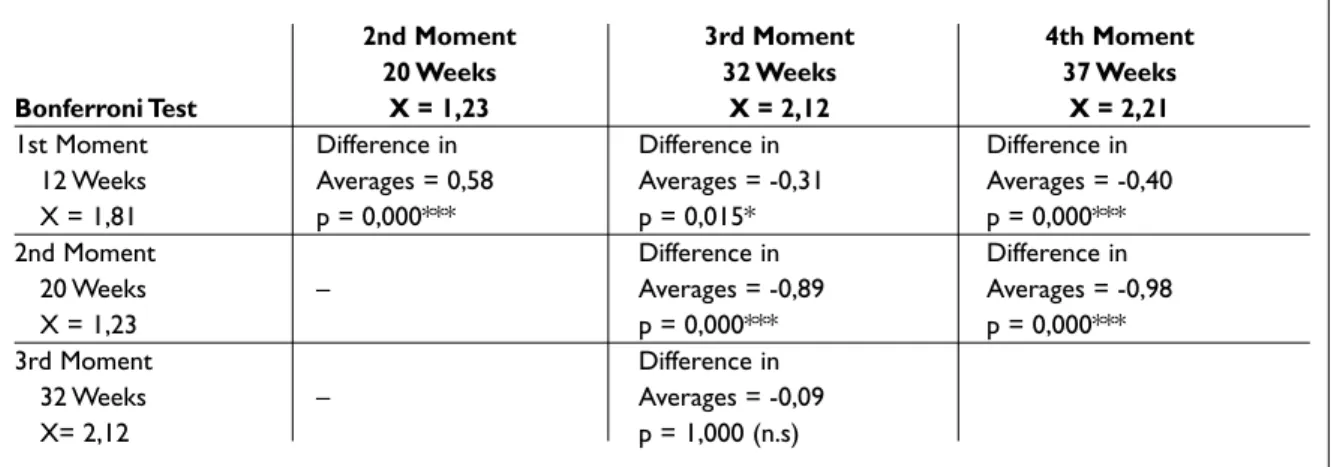
The Bonferroni test (Table III) was used in order to identify the different moments.
The Bonferroni test confirmed that there is a significant decrease in back pain during the first and second moments of evaluation (from 1.81 to 1.21, p ≤ 0.001), with a significant increase during the third moment (from 1.23 to 2.12, p ≤ 0.05), in-dicating a stabilization of the level of back pain Table II. ANOVA Repeated samples: comparison of 4 assessment moments regarding this variable
Standard ANOVA Observed
Back Pain Average Deviation N SAMPLE REPETIDAS Power*
Moment 1 12 weeks of gestation 1,81 ,56 49 Moment 2 20 weeks of gestation 1,23 ,46 49 F(3) = 55,343 1,00 Moment 3 32 weeks of gestation 2,12 ,47 49 p = 0,000 Moment 4 37 weeks of gestation 2,21 ,48 49
*Calculated for an alpha 0,05
0,5 0 2,5 2 1,5 1 37 weeks 32 weeks 20 weeks 12 weeks
Figure 1. Back Pain at the 12, 20, 32 and 37 weeks of gestation
C. Q U A R E S M A E C O L.
Table III. Bonferroni test (Post-Hoc ANOVA): multiple comparisons of the 4 time periods regarding the Back Pain variable
2nd Moment 3rd Moment 4th Moment
20 Weeks 32 Weeks 37 Weeks
Bonferroni Test X = 1,23 X = 2,12 X = 2,21
1st Moment Difference in Difference in Difference in
12 Weeks Averages = 0,58 Averages = -0,31 Averages = -0,40
X = 1,81 p = 0,000*** p = 0,015* p = 0,000***
2nd Moment Difference in Difference in
20 Weeks – Averages = -0,89 Averages = -0,98
X = 1,23 p = 0,000*** p = 0,000***
3rd Moment Difference in
32 Weeks – Averages = -0,09
X= 2,12 p = 1,000 (n.s)
(*significant p ≤ 0,05, *** significant p ≤ 0,001, n.s : not significant)
Table IV. The percentage of pregnant women that reported permanent back pain, those that reported the onset of back pain for the first time , those that ceased to have back pain and those that continued to have no pain
Differences Maintained Onset of Stopped having Remains without
Between ↓ Back Pain Back Pain back Pain Back pain
12 Weeks Vs 14,3% 2% 55,1% 28,6% 20 Weeks (7) (1) (27) (14) 20 Weeks Vs 16,7% 75% 0% 6,3% 32 Weeks (8) (36) (0) (4) 32 Weeks Vs 91,7% 6,3% 0% 2,1% 37 Weeks (44) (3) (0, ) (1)
from the 3rd to the 4th moment of assessment (from 2.12 to 2.21 ns). The pain is lower in the se-cond stage of evaluation (at 20 weeks) and signifi-cant differences were recorded in regards to all the other periods.
Subsequently, during the four moments of as-sessment it was possible to examine the percenta-ge of pregnant women that reported permanent back pain, those that reported the onset of back pain for the first time (in any of the four moments), those that ceased to have back pain and those that continued to have no pain (Table IV).
At 12 weeks of gestation 39 women (71.4%) re-ported having their first back pain while 16 women (28.6%) remained without pain.
In regards to the 20th week of gestation, only se-ven women (14.3%) reported back pain, 27 women (55.1%) ceased to have pain, 14 reported no pain
and only one woman reported having pain for the first time during her pregnancy.
At 32 weeks, 36 women (75%) reported having back pain, whilst 8 (16.7%) reported unremitting back pain and 4 women (6.3%) remained pain free and no longer felt any pain at this moment of the assessment.
At 37 weeks of gestation, 44 women (91.7%) ported having back pain. Three women (6.3%) re-ported their first signs of pain at this moment, whe-reas one woman (2.1%) did not refer to permanent pain, and actually showed no sings of this symptom during this period.
Observation of the collected data revealed that only 1 (2.1%) woman never had back pain during pregnancy, whereas 7 (14.3%) women reported ha-ving pain during every moment of the evaluation. 10 (20.4%) women reported pain only in the 3rd
B A C K PA I N D U R I N G P R E G N A N C Y: A L O N G I T U D I N A L S T U D Y
quarter.
We analyzed the prevalence of pain in only one of the moments of evaluation and noted that only two (4.1%) women suffered from this condition; referring to pain only at 37 weeks of gestation.
Data analysis revealed that the percentage of pregnant women with back pain varies greatly throughout pregnancy. We observed that at 12 we-eks of gestation 71.4% of women had back pain, whereas at 20 weeks only 16.3% reported pain. However, at 32 weeks 91.7% of women reported pain, and at 37 weeks, 98 % mentioned pain.
Discussion
The purpose of this longitudinal study was to iden-tify the levels of back pain during pregnancy. For that purpose the NIH Activity Record was applied to each woman in four differences moments of pregnancy: 12, 20, 32 and 37 weeks of gestation.
Several studies in different parts of the world have reported a high incidence of back pain during pregnancy, and it is predicted that approximately half of all pregnant women suffer from back pain at some point in their pregnancy – a large number of them severely enough to hinder their normal activities1.
Data analysis revealed that the prevalence of back pain varies significantly throughout preg-nancy and that this difference is more apparent during the 2nd (20 weeks) and 3rd trimesters (32 and 37 weeks). This result is contrary to the results obtained by Carvalho whose study did not esta-blish a significant relationship between trimes-ters15.
It was also possible to establish that at 12 weeks of gestation 71.4% of women had back pain, whe-reas at 20 weeks only 16.3% reported pain. At 32 weeks, 91.7% of women reported pain and at 37 weeks, 98% mentioned this symptom.
This data is not in accordance with studies that indicate a prevalence of 80% for back pain during pregnancy16 in view of the fact that our study indi-cates that over 90% of pregnant women suffer from back pain in the third trimester (32 and 37 weeks). Kilstrand et al. report a 20% increase of back
pain in pregnant women. These authors also state that this increase may result from the greater con-cern regarding the quality of life in the present day, especially concerning the welfare of pregnant wo-men. This factor has produced more detailed and
objective research on the diagnosis17.
Our results point to a greater prevalence of pain during the 1stand 3rdquarters. This result is con-trary to the results obtained by Sihvonen et al., who
ascertained that the highest incidence was not in those trimesters18.
We also verified that the higher incidence of back pain occurs during the third quarter which is contrary to the study by Martins and Silva16 who es-tablished that pain was more common in early pregnancy.
According to Orvieto et al., women in their last month of pregnancy reported higher incidences of back pain19.
This study is in agreement with others publis-hed in medical literature as it also concluded that musculoskeletal pain is frequent symptom during pregnancy20,21.
The results revealed a considerable decrease in the number of pregnant women who have back pain during the second stage of evaluation (20 we-eks of gestation). This finding is contrary to data that indicates a higher incidence of back pain between the 5th– 7thmonths of pregnancy. This fac-tor represents a common reason for sick leave10.
In contrast to the existing literature that indica-tes that back pain mainly occurs mainly during the first 5–7 months of pregnancy, we determined that back pain may be occur any time during preg-nancy.
Nearly 30% of the women with back reported that they had to discontinue at least one daily tivity because of back pain. For all other daily ac-tivities, they reported mild-to-severe degrees of difficulty because of back pain11.
This study revealed that back pain is not a sta-tionary aspect but rather a condition that under-goes alterations during gestation. It was also esta-blished that back pain decreases at 20 weeks of gestation and increase again during the 3rd tri-mester.
As the structure of society changes, back pain in pregnancy extends its negative impact across many areas of women’s daily lives, including work, household responsibilities, leisure activities, and sleep11.
This specific pain has an impact not only on the individual woman but also adversely affects those she cares for by limiting her daily activities, as well as adversely influencing her work productivity. We call upon researchers to contribute to the impro-vement of women’s health through research
focu-C. Q U A R E S M A E C O L.
sed on the prevention and treatment of lower back pain during pregnancy.
In conclusion, the data clearly indicates that back pain during pregnancy is a common problem that should not be ignored.
We consider it imperative that health professio-nals become familiar with the frequency and cha-racteristics of these complaints, because a greater awareness of this problem will help minimize its consequences on the one hand and, possibly redu-ce its prevalenredu-ce, on the other16. Thus, we suggest that further studies verify the effectiveness of dif-ferent treatments available in order to help solve or decrease its impact on the welfare of pregnant women and allow for their integration in more ho-mogeneous activities, domestic and professional16. Acknowledgments
C. Quaresma would like to acknowledge «Fundação Ciência e Tecnologia» (FCT) for the grant (SFRH/BD/ 44042/2008).
This research was supported in part by FCT project POC-TI/0068/2003.
Correspondence to
Claudia Quaresma
Cefitec, Departamento de Física, Faculdade de Ciências e Tecnologia, Universidade Nova de Lisboa, Monte de Caparica, Portugal Tel: +351 212948576 Fax: +351212948549 E-mail: [email protected]
References
1. Sant’ana P, Freire S, Alves A, Silva D. Caracterização da dor lombar em gestantes atendidas no Hospital Universitário de Brasília. Universitas: Ciências da Saúde, 2006;4: 37-48.
2. Walter BF. The prevalence of low back pain in Austra-lian adults. A systematic review of the literature from 1966-1998. Asia-Pac J Public Health 1999;11: 45-51. 3. Shim, Mi-Jung; Lee, Young-Sook, Oh, Hyun-Ei, Kim,
Jin-Sun. Effects of a Back-pain-reducing program du-ring pregnancy for Korean women: a non-equivalent control-group pretest-posttest study. International Journal of Nursing Studies 2007;44: 19-28.
4. Biering-Sorensen F. Low back trouble in a general po-pulation of 30-, 40-, 50-, and 60-year-old men and women: study design, representativeness, and basic results. Dan Med Bull 1982; 29: 289 – 299.
5. Svensson HO, Andersson GB, Hagstad A, Jansson PO. The relationship of low-back pain to pregnancy and gynecologic factors. Spine 1990; 15 :371–375. 6. Berg G, Hammar M, Moller-Nielsen J, Linden U,
Thorblad J. Low back pain during pregnancy. Obstet Gynecol 1988; 71: 71–75.
7. Ostgaard HC, Andersson GB. Previous back pain and risk of developing back pain in future pregnancy. Spi-ne 1991;16:432– 436.
8. Ostgaard HC, Zetherstrom G, Roose-Hansson E. Back pain in relation to pregnancy: a 6-year follow-up. Spi-ne1997; 22: 2945–2950.
9. Noren L, Ostgaard S, Johansson G, Ostgaard HC. Lumbar back and posterior pelvic pain during preg-nancy: a 3-year follow-up. Eur Spine J 2002; 11: 267–271.
10. Shu-Ming Wang , Peggy Dezinno, Inna Maranets et al. Low Back Pain During Pregnancy: Prevalence, Risk Factors, and Outcomes Obstetrics & Gynecology 2004:104; 65-70.
11. Olsson C, Nilson–Wikmar L. Health -related quality of life and physical ability among pregnant women with and without back pain in late pregnancy. Acta Obstet Gynecol Scand 2004; 83: 351-357.
12. Perkins J, Hammer R, Loubert P. Identification and management of pregnancy-related low back pain. Journal of Nurse-Midwifery 1998; 43: 331-340. 13. Mens JMA, Vleeming A, Stoeckart R, Stam HJ,
Sni-jders CJ. Understanding peripartum pelvic pain. Im-plications of a patient survey. Spine 1996; 21:1363–1370.
14. Cecin HA, Bichuetti JAN, Daguer MK, Pustrelo MN. Lombalgia e gravidez. Rev Bras Reumatol 1992;32:45--50.
15. Carvalho YBR, Caromano FA. Alterações morfofisio-lógicas relacionadas com lombalgia gestacional. Ar-quivos de Ciências da Saúde da Unipar 2001; 5: 267--272.
16. Martins R, Silva J. Prevalência de dores nas costas na gestação. Ver. Assoc. Med Bras 2005;51: 144-147. 17. Khilstrand M, Stenman B, Nilsson S, Axelsson O.
Wa-ter gymnastics reduced the intensity of back/low pain in pregnant women. Acta Obstet Gynecol Scan 1999;78:180-185.
18. Sihvonen T, Huttunen M, Makkanen A, Airaksinen O. Functional changes in back muscle activity correlate with pain intensity and prediction of low back pain during pregnancy. The Archives of Physical Medicine and Rehabilitation 1998; 79: 1210-1212.
19. Orvieto R, Achiron A, Bem-Rafael Z, Gelernter I, Achiron R. Low back pain of pregnancy. Acta Obste-tricia Et Gynecologica Scandinavica 1994; 73: 209-214.
20. Dumas GA, Reide JG, Wolfe LA, Griffin MP, McGrath MJ. Exercise, posture and back pain during preg-nancy: Part 2 Exercise and Back pain. Clinical Biome-chanics 1995; 10: 104-109.
21. Fast A, Shapiro D, Ducommun EJ, Friedmann LW, Bouklas T, Floman Y. Low-back pain in pregnancy. Spine 1987; 12: 368 -371.