1326
Rev. CEFAC. 2014 Jul-Ago; 16(4):1326-1339
PIAHO: A TOOL TO PREVENT BAD ORAL HABITS
OCCURRENCE (PROTOCOL OF APPROPRIATE
INCLUSION OF ORAL HABITS)
PIAHO: Una herramienta para la prevención de hábitos orales
deletéreos (Protocolo de Incorporación Apropiada de Hábitos Orales)
Pía Villanueva(1)
(1) Escuela de Fonoaudiología; Facultad de Medicina,
Univer-sidad de Chile; Depto. Del Niño y Ortopedia Dentomaxilar, Facultad de Odontología, Universidad de Chile; Instituto de Ciencias Biomédicas; Facultad de Medicina, Universidad de Chile. Programa de Doctorado en Psicología, Universi-dad de Granada.
Conlict of interest: non-existent
Therefore, it is a challenge for the OM specialist
to treat these patients in “in-formed” multidisciplinary
work teams to give a solution to the referred case. However, the real challenge of the Specialty is to
give a multidisciplinary solution to the presence
of the aforesaid disorders through PREVENTION procedures of the concomitant factors.
Among them are the early detection and
mainte-nance of the upper airways1 permeable, as well as the diet characteristics inluencing the persistence of
the child swallowing patterns 2.
The Orofacial myofunctional disorders include
swallowing, breathing, chewing and rest alterations
together with the presence of bad oral habits or harmful habits. Consequently, it is not surprising that the main objective of this article is the prevention of bad oral habits through the application of the Protocol of Appropriate Inclusion of Oral Habits.
METHODS
This descriptive study was approved by the
Ethics Committee of the School of Speech Therapy of the Universidad de Chile (04/2006).
INTRODUCTION
At present, in Chile there is no option for the
speech-language pathologists to study a
special-ization in Orofacial Myology. Therefore the appli -cants must study abroad and thus we can say that OM is a “developing” discipline in Chile, which is also the term used to describe the general economic
proile of our country.
The speech-language pathologists trained in
Orofacial Myology attend generally patients referred
by dentist, physicians and pre-school teachers. The
dental specialties with more referral cases to the
OM speech-language therapist are the orthodon-tists and the dento-maxillary orthopedists. The most
common referral causes are pathological signs in
the swallowing physiology, mainly associated with structural alterations.
ABSTRACT
Purpose: to present a tool to prevent bad oral habits ocurrance, this protocol is called PIAHO. Methods: comparing the diagnoses obtained by PeNaF subjective test with nasal resistance diagnoses obtained
by the objective test of rhinomanometry. It was explored the relationships between the incorporation of consistencies, tools and choice of positions during feeding and swallowing different types. Based
on both, the results obtained and published research in Chilean population; as in the international literature review. Results: a new strategy and guidelines for a early inclusion of consistencies and
feeding tools, also focus in a good nasal hygiene. Conclusion: to contribute to the prevention of
orofacial myofunctional disorders and avoiding oral bad habits occurrence.
KEYWORDS: Oral Medicine; Nasal Obstruction; Myofunctional Therapy; Speech Language and
signiicantly higher. So, we proved that the difference
between these children and those with normal occlusion + adult swallowing lied in the appropriate
inclusion of utensils, consistencies and postures during the feeding and also in the maintenance of
the nasal airways permeable, in other words, the
lacking of bad oral habits for these children2.
The assessment guidelines, the tests and proce-dures (treatment) are based on national evidence
developed in the last 15 years of clinic experience, teaching and research. The presentation of this protocol to the scientiic community intends to give a simple tool for the training of parents, teachers and health care professionals. For this, the same principle of diffusion to the community and the success of the plans for early intervention were applied. In the future, this will allow professionals,
parents and patients to be in-formed and thus it
will contribute to the oral health of our patients as well as to the decrease of the incidence of orofacial dysfunctions.
RESULTS
As this is an intervention protocol, it is intended
for the professionals who know the anatomo-physiological and evolutional basis required for its eficient and effective administration. In spite of this, many activities of the protocol can be carried out by the parents of the child, because of its simple nature
and recommended domestic materials.
Protocol of Appropriate Inclusion of Oral Habits (PIAHO)
This protocol consists basically of three items to
consider:
1. Preservation of hygiene and nasal permeability 2. Early detection of structural alteration in phono
-articulatory organs (OFA)
3. Early inclusion of consistencies, postures and food utensils
The Protocol of Appropriate Inclusion of Oral
Habits (PIAHO) was based on both a theoretical and
analytical revision of the international literature, using
Pubmed to obtain the records presented in periodic
publications, and on the results of researches
developed in our country. The databases, where
the national results were collected from, are listed
below.
Regarding the nasal permeability item, the
eficiency to detect the nasal obstruction through
the simple PeNaF clinical test was compared
with the results of the rhinomanometry1. For that, it is necessary to describe in detail the following descriptors: the result of the obstruction test is (+) if the patient cannot maintain 6 nasal cycles. Whereas, it is (-) if the patient is able to complete 6
nasal respiratory cycles.
For the item of early detection of the structural alteration in phonoarticulatory organs and for the item of early inclusion of consistencies, postures and food utensils, we used the evidence obtained in the last 5 years of research regarding the factors delaying the apparition of the adult swallowing. The 2008-2012 database of Prof. Villanueva was used, from the line of investigation: School of Speech Therapy, Universidad de Chile. “Evolution of the swallowing in Chilean children”. So, 180 cases of
children sorted in 3 groups: 2 to 4.11 years, 5 to 8.11
years and 9 to 12 years of age. They were sorted by age, gender and evolution state of the dentition. Then, a food routine survey was illed, including data of consistencies, postures and utensils used.
Finally, each child was clinically, extra and intra-orally assessed. For every procedure, the individuals and
their parents had to sign an informed consent2. These studies permitted to detect the presence
of a child swallowing pattern at a high rate in school
children aged between 5 and 8 years. The low
incidence of mature pattern –adult or typical – in
these children was associated with the presence
1
3
2
8
Vill
an
ue
va
P
R
e
v.
C
EF
AC
. 2
0
1
4
Ju
l-Ag
o
; 1
6
(4
):
1
3
2
6
-1
3
3
9
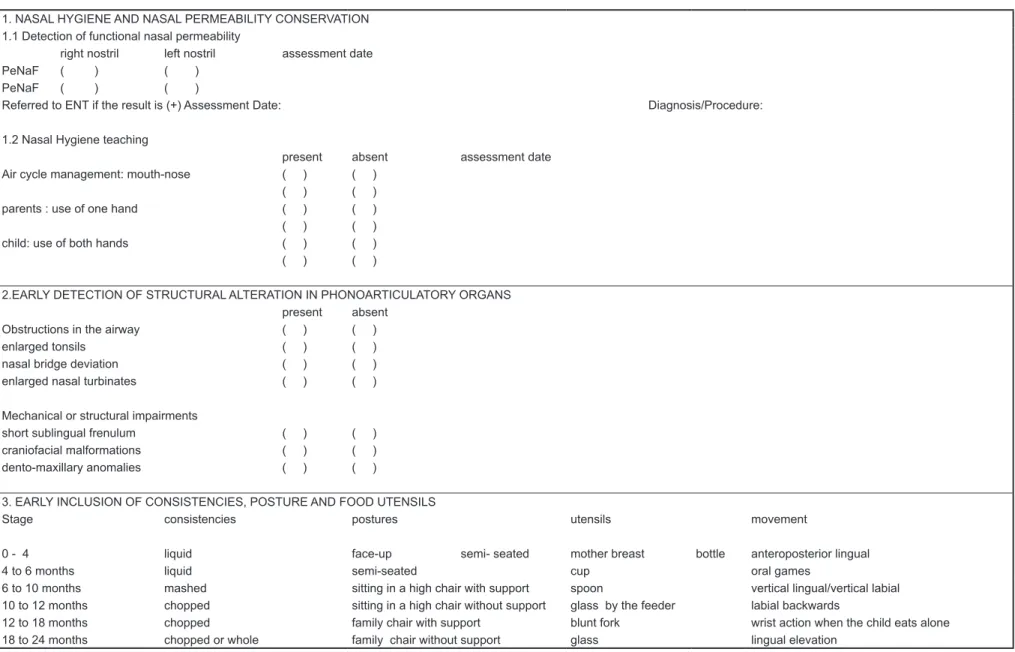
PROTOCOL OF ADEQUATE INCLUSION OF ORAL HABITS (PIAHO): Record Sheet
1. NASAL HYGIENE AND NASAL PERMEABILITY CONSERVATION 1.1 Detection of functional nasal permeability
right nostril left nostril assessment date PeNaF ( ) ( )
PeNaF ( ) ( )
Referred to ENT if the result is (+) Assessment Date: Diagnosis/Procedure:
1.2 Nasal Hygiene teaching
present absent assessment date Air cycle management: mouth-nose ( ) ( )
( ) ( )
parents : use of one hand ( ) ( ) ( ) ( )
child: use of both hands ( ) ( ) ( ) ( )
2.EARLY DETECTION OF STRUCTURAL ALTERATION IN PHONOARTICULATORY ORGANS
present absent Obstructions in the airway ( ) ( ) enlarged tonsils ( ) ( ) nasal bridge deviation ( ) ( ) enlarged nasal turbinates ( ) ( )
Mechanical or structural impairments
short sublingual frenulum ( ) ( )
craniofacial malformations ( ) ( ) dento-maxillary anomalies ( ) ( )
3. EARLY INCLUSION OF CONSISTENCIES, POSTURE AND FOOD UTENSILS
Stage consistencies postures utensils movement
0 - 4 liquid face-up semi- seated mother breast bottle anteroposterior lingual
4 to 6 months liquid semi-seated cup oral games
6 to 10 months mashed sitting in a high chair with support spoon vertical lingual/vertical labial 10 to 12 months chopped sitting in a high chair without support glass by the feeder labial backwards
12 to 18 months chopped family chair with support blunt fork wrist action when the child eats alone 18 to 24 months chopped or whole family chair without support glass lingual elevation
It is important to remember that at birth the child presents a small and retracted mandible,
an accumulation of fat in the cheeks that permit a
better sucking and their tongue takes up the entire
oral cavity. As a posterior limit, the veil of the palate
touches the epiglottis; the hyoid bone and the
larynx are high in the neck, which favors an eficient system of defense of the airway, considering that at this stage there is still a poor coordination of the
glottic closure during swallowing3,4.
For these reasons, the PIAHO protocol brings
up the two following items to fulill the objective of
hygiene preservation and nasal permeability.
1.1 Detection of functional nasal perme-ability: the professional must carry out the PeNaF test (Functional Nasal Permeability). This is a
semi-objective clinical exam, quick and easy to apply, which shows the functional nasal perme
-ability, independent for each nostril. Its results were
1. Preservation of hygiene and nasal permeability
The anatomo-functional characteristics of a full-term newborn include all the required elements for nasal breathing to be the least energy-consuming mechanism, even during breastfeeding (Figure 2).
Figure 2 – During breastfeeding, the minor keeps the nasal breathing
Figure 3 – Position of the examiner during PeNaF. The nostril is obstructed by the thumb of the examiner while the patient accomplishes 6 respiratory cycles through the other nostril compared with those obtained through the objective rhinomanometry exam, presenting a positive corre-lation and coincidence higher than 94%1.
For this test, the speech-language pathologist
obstructs gently with the thumb the right nostril of the subject, placed in postural position of the mandible
(Figure 3). Then the patient is asked to inhale and
exhale 6 times through the left nostril. After, the
same procedure is applied with the other nostril. The
result of the exam is negative (-) when the patient
keeps the nasal breathing during 6 inhalations and
positive (+) if the patient is not able to keep the nasal breathing during 6 inhalations and requires to
breathe orally to continue the inhalations.
The result of the PeNaF test is recorded in the
protocol and the speech-language pathologist
continues with the application of the PIAHO. If the
results obtained are positive, it is recommended
to repeat the test after 2 weeks during which the point 1.2 of the PIAHO, will be applied. If the result persists, the patient must be referred to an otorhi
-nolaryngologist to determine the cause of the nasal
obstruction.
It is important to note that the results of the
PeNaF are also related to the protocol’s item 2, as
many causes of obstruction can be detected when applying the assessment guideline of the phonoar -ticulatory organs.
1.2 Nasal Hygiene teaching: as described
before, many development skills (such as sphincter
control) and habits (such as teeth brushing) must be
1330
Villanueva PRev. CEFAC. 2014 Jul-Ago; 16(4):1326-1339
3. Early Inclusion of Consistencies, Postures and Food Utensils
In our country, the pediatrician generally
indicates to the mother the appropriate inclusion of food consistencies, once she visits the professional with her child for the “well-child check-ups”. As for the postures and utensils used for the food, they are normally chosen by the parents following intuition or family advices.
The inclusion of different consistencies and utensils in the food, as well as the recommended position for each stage, are based on
evolutionary-physiological principles experienced by the child. In
some cases, this permits the incorporation of new
tools, whereas in others, it stimulates the
devel-opment of a motor action, necessary for the step
towards the next stage. The swallowing stages are
well-known by the professionals of the ield, and
thus will not be approached here.
0 to 4 months
As previously described, the children are born
with a small mouth, completely illed by the tongue. The intraoral stability is given by the presence of fat cushions that permit a better grip to the nipple, guaranteeing an adequate extraction of the milk.
The lingual movements are only anteroposterior
and are made with the help of the mandible. This movement guarantees the irst physiological advance of the mandible, which in turn permits the condylar development and thus the enlargement of
the intraoral cavity.
Initially the child puts positive pressure with the
mandible and the anterior third of the tongue; and
then negative pressure with lingual backing and mandibular descent.
Considering that the minor is still totally dependent
of the mother, the recommended position to feed him/her must give the minor the required security sensation. The face-up position is recommended,
with the head slightly leaning up and sideward against the maternal breast, or semi-seated at an angle not higher than 45 degrees.
At this stage, the only recommended food utensil is the maternal breast. However, as a result of medical or parent decisions, the minor can be fed by the baby bottle. The chosen bottle must favor the correct position of the child’s head, it must allow the adequate quantity of milk according to the
development stage and it must have the appropriate
shape to be handled by the feeder.
4 to 6 months
Between 4 and 6 months old, the minors present
motor advances that lead to a change in their food.
They are able to hold the head, the larynx starts general knowledge. Nevertheless, the proper nasal
hygiene of the children by the parents at irst, and then by the children themselves since the age of 6,
is clearly a concept little known by the community.
For all of the above reasons, we propose the teaching of a correct nasal hygiene, according to the age of the child. For this, the bases of the nasal anatomy are outlined to the child and his/her parents, to inform that intranasal pressure must be produced by the permanent obstruction of one
nostril, to be able to blow strongly through the other nostril and then alternate.
For both parents and minors, it is necessary to
emphasize on the importance of a deep inhalation.
And, only because the nose is temporally and partially obstructed, this inhalation must be through the mouth.
In practice, we must make sure that the air cycle:
mouth – nose works properly !!! Therefore, some children with poor air control require some extra
activities to improve their coordination.
Finally the use of one hand, for the parents, and both hands at the same time, for the children, must be practiced. The use of both hands is always recommended in the irst stage.
2. Early Detection of Structural Alteration In Phonoarticulatory Organs (OFA)
This item of the protocol is centered on the assessment of the phonoarticulatory organs (OFA). Like every specialist in Orofacial Myology, who has a wide range of assessment guidelines, OFA
observation and anthropometric measures applied
to the orofacial study 5,6, I have included the OM assessment guideline, to give the general speech-therapists an improvable starting point, and to give the specialists a comparison point with their tools.
See igure 4: ile of assessment of Orofacial
Myology 7.
This item aims to determine the presence of
two concepts that must be detected precociously. The obstructions in the airway, possible to detect clinically; such as enlarged tonsils, nasal bridge deviation or enlarged nasal turbinates. And the mechanical or structural impairments interfering with the appropriate instauration of oral habits; such as short sublingual frenulum, craniofacial malforma -tions and dento-maxillary anomalies.
If one of the mentioned manifestations is detected, the patients must be timely referred to
the respective specialist, and continue with the next
item of the PIAHO, incorporating the indications of
UNIVERSIDAD DE CHILE FACULTY OF MEDICINE
SCHOOL OF SPEECH THERAPY VILLANUEVA P., GÓMEZ B. 2001
INTRA AND EXTRAORAL ASSESSMENT RECORD
PATIENT RECORD
NAME:
DATE OF BIRTH: AGE:
DATE: EXAMINER:
ANAMNESIS
Previous dental treatments NO___ YES___ Date______Cause______________
Tooth extraction or tooth loss NO___YES___Date____________Cause________________
Use of denture:
Upper Maxilla NO___ YES___
Partial prosthesis _____ Total prosthesis _____
Start____________Cause___________________________
Lower Maxilla NO___ YES ___
Partial prosthesis _____ Total prosthesis ______
Start__________Cause_____________________________
Patient experience with dentures: ___________________________________________________________________ ______________________________________________________________________________________________
Existence of dento-maxillary anomalies in the family NO___YES___Speciiy____________
Dental Hygiene Good____ Fair____ Bad ____
Other records:
______________________________________________________________________________________________ ______________________________________________________________________________________________ ______________________________________________________________________________________________
ANATOMO-FUNCTIONAL OROFACIAL ASSESSMENT:
Extraoral Exam
Facial width ________ Facial height________ % _________
Upper facial third _____ Middle facial third _____ Lower facial third _____
Facial type: Dolichofacial ____ Mesofacial ____ Brachiofacial ____
Swallow (trago), Subnasal, Chin _______________
Facial proile: Straight____ Convex ____ Concave ____
Nose:
Front:
Normal _____ Deviated right _____ Deviated left _____
Proile:
Normal _____ Shape ________________________
Inferior view:
1332
Villanueva PRev. CEFAC. 2014 Jul-Ago; 16(4):1326-1339
Permeability:
Nasal mirror test:___________________________________________
Rosenthal test: Right nostril _____ Left nostril _______
Upper lip:
Size:
Normal____ Long____ Short____ Cleft _____ Operated_____
Frenulum:
Normal____ Short____ Transixing _____
Functionality:
Functional____ Non functional____
Lower lip:
Size:
Normal____ Everted____
Intraoral Exam
Determine number of teeth in the mouth:_____________________
Absence of teeth NO___YES___ Specify_________________________
Maximum oral opening _______________
Occlusion and ADM (For each measurement specify if it is right or left).
· Intra-maxillary
o Upper Maxilla NO YES Specify
Agenesis ___ ___ _______________
Supernumerary ___ ___ _______________
Rotations ___ ___ _______________
Diastemas ___ ___ _______________
o Lower Maxilla NO YES Specify
Agenesis ___ ___ _______________
Supernumerary ___ ___ _______________
Rotations ___ ___ _______________
Diastemas ___ ___ _______________
· Intermaxillary
o Sagittal direction
Molar relationship:
Neutroclusion (D I)____ Distoclusion (D I)____ Mesioclusion (D I) ____
Incisor relationship:
Normal____ Aumentada (enlarged)____ Vis a Vis ____ Inverted____
o Vertical direction:
Normal____ Vis a Vis ____ Open____ Overbite ____
o Transversal direction:
Normal(D I) ____ Vis a Vis (D I) ____ Crossbite (D I) ____
· If the patient uses prosthesis, evaluate:
o Upper prosthesis : Retention YES______ NO______
Support YES ______ NO______
Indicate the covered zones _______________
- Lower prosthesis : Retention YES______ NO______
Tongue:
Size:
Normal____ Enlarged____
Frenulum:
Normal____ Short____
Hard palate:
Shape:
Normal____ High____ Cleft ___ Operated____
Soft palate:
Shape:
Normal____ Cleft ____ Operated____
Uvula:
Shape:
Normal____ Short____ Biid ____
Mobility in (/a/) phonation:
Appropriate ____ Reduced____ Without mobility____ Diverted____
Tonsils:
Normal____ Enlarged____ Absent____
EVALUATION OF NON-VERBAL FUNCTIONS:
Rest:
Lingual position:
Normal____ Low____ Interdental ____ Anterior thrust ____
Labial closure:
Present ____ Absent ____ With effort____
Breathing:
Type:
Diaphragmatic _____ High costal _____ Mixed _____
Mode:
Nasal _____ Oral _____ Mixed _____
Bad oral habits:
YES NO From To
Finger sucking Nail-biting Baby bottle
Paciier Lip sucking
Objects sucking Others
Swallowing:
Normal _____ Lip sucking _____
1334
Villanueva PRev. CEFAC. 2014 Jul-Ago; 16(4):1326-1339 Praxis execution:
Normal (N) Reduced (D) Without mobility (Sm)
Labial Praxis
Protrusion of both lips _____
Distension of both lips _____
Lip deviation to the right corner _____ Lip deviation to the left corner _____
Resonant labial retrusion _____
Lip vibration _____
Cheek swelling _____
Lingual Praxis
Lingual apex goes across upper dental arch _____ Lingual apex goes across lower dental arch _____ Lingual apex goes across the hard palate _____
Lingual attachment _____
Lingual click _____
Voiceless alveolar vibration _____ Voiceless lingual vibration between the lips _____
Extraoral lingual elevation _____
Extraoral lingual descent _____
Lateralization of the lingual apex to the right _____ Lateralization of the lingual apex to the left _____
Lingual apex pushes right cheek _____ Lingual apex pushes left cheek _____ Lingual apex under upper lip _____ Lingual apex under lower lip _____
SPEECH EVALUATION:
Articulation
Phonemes M P B F S T D N L R RR Ñ CH Y J K G
POINT OF
ARTICULATION
Bilabial
Labiodental Post Dent Inf.
Post Dent sup. Alveolar Palatal
Velar
Comp. Lab. Inf.
Interdental
Retrolex
Omite
OBSERVATIONS:
______________________________________________________________________________________________ ______________________________________________________________________________________________ ______________________________________________________________________________________________
SIGNATURE
UNIVERSIDAD DE CHILE FACULTY OF MEDICINE
SCHOOL OF SPEECH THERAPY VILLANUEVA P., GÓMEZ B. 2001
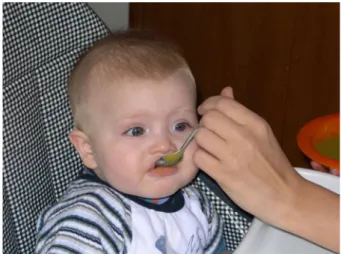
When the food is brought closer, the mandible is open for a prolonged period and the tongue is motionless. Ideally, the food must be given in a teaspoon, with a lat bowl at irst.
In the following months, the child acquires skills that facilitate the transition to the adult deglutition, as long as the consistency of the food and the incorpo
-ration of utensils, adapted to the age of the child, is done progressively. (Figure 5). At 7 months of age, the child is able to tear the food. At 9 months the upper lip can move downward to drag the food in the
spoon an when swallowing, the lips can close with
force 9,10. This labial movement is expressed clearly with the appearance of babbling and its character -istic bilabial sounds.
to descent with the consequent increase of risk of
aspiration. The mandible starts to grow downward
and forward. This, together with the disappearance of the fat cushions, generates more space for the
anteroposterior movement. They can start with the
buccal games of the lips and tongue that will favor their own intraoral perception, required for the devel
-opment of the feeding and speech mechanisms.
The minors are able to seize objects, so the
parents must consider changing the shape of the
baby bottle, in order to stimulate them to hold it.
Since they are 4 and half months old, the children can hold their baby bottle with both hands and after 5 months and a half the parents can help them
hold the bottle with one hand. The same principle
supports the inclusion of the use of cups with big
handles at this stage. The child can seize the cup with both hands but must exercise the hand-mouth
coordination as well as the handling of liquids. It is
recommended to incorporate the cup at this stage
for stimulation, using small quantities of liquid and keeping the baby bottle as the feeding tool.
As the minor is able to hold the head, the mouth
changes its orientation from a horizontal to a vertical plan. For this reason, some liquid spills may occur while the minor is fed in a semi-seated position that can reach 90 degrees for both in the feeder’s arms
and in a rocking chair.
The irst routines are developed at this stage and therefore it is necessary to remember that we must establish stable eating patterns, for example feeding the minor in a same, bright place with few distracting elements and ideally by the same feeder.
6 to 10 months
The 6-months stage is marked by the sitting position, which allows the pelvic stability to support the shoulder girdle and this, in turn the head and
neck. So, the orofacial region has a better motor
control. That is how the tongue begins to move up and down, which, together with a better lips control,
makes more eficient the nipple sucking and favors the appearance of phonemes8.
Due to the incipient pelvic control, it is suggested to change the position to sitting on a high chair,
with the support of cushions or towels around the
child. This is to give independence to the posture, based on an external or positional stability. This external support must be progressively retired until the postural or internal stability is obtained at 10 months, which permits to use a high chair without support.
At 6 months of age, it is recommended to incor
-porate the irst baby food. The physiological charac
-teristics of the minor favor this change. The dentition
appears, together with an excessive salivation.
Figure 5 – Since 6 months of age, the use of spoons with bowl depth is necessary, to stimulate the dragging movement of the upper lip
To assure the vertical movement of the upper
lip, the spoon must have the appropriate size in
the mouth of the infant and have a bowl depth, for the lip to drag the food. Besides, its shape, with a long handle, must facilitate the use by the feeder.
The bowl must resist the child’s bites, since the mandibular control at this stage is external and is
made through the seizure of objects.
Lateral lingual movements are observed.
Together with protrusive movements, they permit
a better handle of the food bolus in mouth. If the child already uses a cup, he/she can move the liquid laterally. The cup must favor an appropriate position of the head, have a small rim, resistant to the constant bites of the mandible, necessary for its
1336
Villanueva PRev. CEFAC. 2014 Jul-Ago; 16(4):1326-1339
This stage has to be considered as an
explo-ration stage and therefore the child must investigate by him/herself. The child usually plays with the food,
discovers the consistencies, temperature and tries
to help in his/her feeding with the hands. It is also
recommended to have a second spoon, lighter, with
a thicker plastic handle for the child to play eating. The former favors the hand-mouth coordination, necessary in the following stages to achieve the self-feeding by the child.
10 to 12 months
Between 10 and 12 months of age, the chewing
begins 10 because at this stage the minor must receive entire or partially ground food to help the development of the mastication. The smooth baby food must be replaced by lumpy purée, ideally not homogeneous. It is recommended to grind the soft
components (rice, potatoes, pasta), to blend the other components and to present both consistencies in one plate.
The minor sits independently from the feeder, in a high chair without support, as he/she has the required postural stability. The child can drink in a cup or glass, with occasional liquid loss as the
mandibular stability is still external.
The tongue presents anteroposterior and lateral movements which, together with the vertical and
diagonal movements of the mandible, permit the lateralization of the bolus in the mouth. It is recom
-mended to give entire food (cookies, bread), so that the child exercises vertical cutting movements of the
mandible.
It is possible to observe that the upper lip starts moving backwards at this stage when the spoon
leaves the mouth, allowing an eficient seal and avoiding the escape of food.
12 to 18 months
At 12 mouths of age, the minor starts walking, the irst words come out as well as the irst temporary molars. This assures the irst physiological lift and the consequent increase of the intraoral space. An occasional elevation of the tongue is observed.
Until 15 months, there is not enough neurological
maturation for the tip of the tongue to rise and to be placed in the anterior part of the palate. (Figure 6
and 7).
Figure 6 – Using a glass with small quantities of liquid since 6 months of age. The minor can hold the glass without help since one and half years of age.
The inclusion of minced food (except meat) favors the chewing, made with the help of the cheeks and the active participation of the corners of the mouth. The child can select the part of the bolus
ready to be swallowed and can continue to chew the remaining bolus.
The lingual protrusion can still be observed
inside the cup. This favors the stability, required for the swallowing of the liquid.
At 15 months of age the child can clean his/her
lower lip by dragging the upper incisors.
The cut of entire food (cookies for example) goes with backward movements of the head or the body.
The child continues with the exploration of food,
now throwing it to the ground, to the clothes or the
head, and facing also the reaction of the adults. The
child eats alone, using wrist movements sporadically.
18 to 24 months
If the child still uses the baby bottle, at 18 months he/she can grab and lift it and drink alone. He/She is very skillful at eating with the ingers and tries with other adult utensils (fork). It is recommended to let the child drink all the liquids in glass, cup or
narrow-mouthed bottles.
At 18 months of age, they can swallow with a soft closing of the lips and the tip of the tongue raised. This elevation of the lingual tip will not happen while the child is still fed with baby bottle, straw or sippy cups, which are placed at the tip of the tongue and prevent it from going up. The inclusion of the glass
(without accessories) must come early to guarantee
the accomplishment of the next stage. The child must be progressively included in the family routine, which means he/she must sit on an adult chair with booster or support. Even if the hours are different, at least one of the meals should be together with the family and its social routine.
2 years and more
At 24 months of age, most of the children change the protrusion for the elevation of the tongue, independently of the mandible, with a soft closing of the lips, preventing the leak of saliva or food 8,11,12. In this way, the labio-lingual position is established during swallowing, which together with the
labio-lingual position at rest favors the growth and devel
-opment of the craniofacial structures13.
With the eruption of the second molar, the
temporary dentition is complete and the second
physiological lift occurs, with the consequent increase of the intraoral space.
Provided that the appropriate utensils, consis-tencies and postures have been incorporated, the minor has an adult-like eating mechanism.
The opening of the mouth is in accordance with the proximity and seizure of the food. The mandibular
stability is given by the temporomandibular
articula-tions. So, the child is capable of holding a glass, cup
or bottle by gently using the lips without bites in its rim.
The tearing is made by the incisors or the canine
zone, without associated movements of head
or body. During the chewing, there are rotating mandibular movements and the child is able to move
the bolus from one side to the other. He/She can adjust the forces and the movements to the texture of the food, and clean the vestibules or look for rests of food out of the mouth with the tongue as well.
The minor shares the menu, the consistency, the
utensils and the routines with the family (Figure 8)
Figure 8 – The minor must share utensils and food with the family
DISCUSSION
Until one decade ago, it was frequent in our country to hear the question “what is
speech-language therapy?” At present, the dissemination
at the community level, together with the wonderful clinical achievement of our professionals, has not only incorporated this profession in the collective
consciousness but has also placed it among the
most demanded university careers of the students. Therefore, for more than ive years now, I have put in a lot of effort to change the pattern of “evalu
-ation and treatment of bad oral habits” by programs of “prevention and early stimulation of appropriate
oral habits”. In the “regulations of the prevention and interception of dento-maxillary anomalies” published
1338
Villanueva PRev. CEFAC. 2014 Jul-Ago; 16(4):1326-1339
breastfeeding for the irst 6 months, the correct
lingual position at rest, phonemes and swallowing14, are described as preventive patterns. Likewise, it has been proved that the longer the breastfeeding period, the smaller the presence of bad oral
habits 15.
For the previous reasons, we, health profes -sionals working with minors and their mothers must
promote themes that are not of common general knowledge, as the evolution of the feeding and the speech, and the appropriate inclusion of oral
habits. It has been proved that mothers with higher
schooling offer more commonly the feeding bottle than mothers with elementary schooling, for comfort and time reasons and affecting the good habits. The
same study shows that mothers working in the health
area do not present differences in the use of feeding
bottle when compared with mothers working in other areas16. Thus, the use of the Protocol of Appropriate Inclusion of Oral Habits intends to contribute to the prevention of organic, functional and sometimes
psycho-emotional alterations, associated with bad oral habits. The idea is to present it to the community
of speech-language therapists for its use in clinics,
schools, kindergartens and mothers associations.
Working on the “non-establishment” of bad oral habits is an unprecedented concept and therefore
this protocol is unpublished literature. However, it
requires a second stage for the validation of its use by the different groups of professionals, parents or
supervisors.
In the meantime, the eficiency of the treatment of the breathing, chewing and swallowing dysfunctions requires the systematic and coordinated approach of
the orthodontist and the speech therapist, specialist
in Orofacial Myology. Both specialists have a complete and professional training in evolutionary physiology and physiopathology of the related oral functions. Then, it is getting more necessary to know the work of the other professionals involved and to understand scientiically the most favorable interrelations for the rehabilitation of our patients.
CONCLUSIONS
This article presents the Protocol of Appropriate Inclusion of Oral Habits as a tool that contributes to the prevention of myofunctional alterations and that prevents the introduction of bad oral habits.
RESUMEN
Objetivo: presentar una herramienta de prevención de malos hábitos orales, llamado PIAHO. Métodos: se comparan los diagnósticos obtenidos de la prueba subjetiva PeNaF con los diagnósticos
de resistencia nasal obtenidos por la prueba objetiva de rinomanometria. Se estudian las relaciones
entre la incorporación de consistencias, herramientas y elección de posturas durante la
alimenta-ción y los diferentes tipos de deglualimenta-ción. Basados tanto en, los resultados obtenidos y publicados
de investigaciones realizadas en población chilena; como enla revisión de la literatura internacional. Resultados: una nueva estrategia y plan de acción para una oportuna incorporación de consistencias
y utensilios de alimentación, también enfocado en una correcta higiene nasal. Conclusión: Contribuir
a la prevención de alteraciones miofuncionales, y evitar la instauración de malos hábitos orales.
PALABRAS CLAVES: Medicina Oral; Obstrucción Nasal; Terapia Miofuncional, Fonoaudiología
REFERENCES
1. Villanueva P, Niño De Zepeda A, Lizana ML, Fernández MA, Palomino HM. Efectividad en la
Detección de la Permeabilidad Nasal Funcional: Presentación de un Método Clínico. Rev Chil Ortod. 2008:25;98-106.
2. Palomino HM, Maiza P, Martínez M, Fernández
MA, Lizana ML, Villanueva P. Anomalías
Dentomaxilares y Deglución en Niños Chilenos de 5 a 8.11 Años. XXII Reunion Anual de International
Association of Dental Research Sección Chile,
2009.
3. Morris S E y Klein M . Pre-Feeding Skills. Arizona: Therapy Skill Builders; 2000.
4. Villanueva P. Deglución atípica implicancia ortodóncicas. Rev.Chil Ortod. 2005;22:92-9.
5. Genaro KF, Berretin-Felix G, Redher MIBC,
Marchesan IQ. Avaliação Miofuncional Orofacial –
Protocolo MBGR. Rev CEFAC. 2009;11(2):237-55.
12. Peng Ch, Jost-Brinkmann PG, Yoshida N, Miethke R, Lin Ch. Differential diagnosis between infantile
and mature swallowing with ultrasonography. Eur J Orthod.2003;25:451-6.
13. Ravera MJ, Miralles R, Santander H, Villanueva P, Zúñiga C. Comparative study between children with and without cleft lip and palate. Part 2: Electromyographic analysis. Cleft Palate J.
2000;37:286-91.
14. Ministerio de Salud República de Chile. Normas
en la Prevención e Intercepción de Anomalías
Dentomaxilares. Santiago; División de Salud de las
Personas; 2010.
15. Pizzol K, Montanha S, Fazan E, Boeck E &
Rastelli A.. Prevalência dos hábitos de sucção não nutritiva e sua relação com a idade, gênero e tipo de aleitamento em pré-escolares da cidade de
Araraquara. Rev CEFAC. 2012;14(3):506-15. 16. Silverio K, Ferreira A, Johanns M, Wolf A, Furkim AM, Marques J. Relação de escolaridade, faixa etária e proissão de mães com a oferta de chupeta e mamadeira a seus ilhos. Rev. CEFAC. 2012;14(4): 610-5.
conduct according to speech language pathologist, odontologist and otorhinolaryngologist perspective. Rev CEFAC. 2008;10(3):343-51.
7. Villanueva P y Gómez B. Ficha de Evaluación en Motricidad Orofacial. Escuela de Fonoaudiología.
Facultad de Medicina. Universidad de Chile. 2001.
8. Kramer S. Swallowing in Children. In Jones B & Donner M. Normal and abnormal swallowing: imaging in diagnosis and therapy. New York: Springer-Verlag; 1991.
9. Aviv J. The normal swallow. In: Carrau R & Murry T. Comprehensive management of swallowing disorders. San Diego: Singular Publishing
Group.;1999.
10. Cunningham ET Jr, Donner MW, Jones B, Point
SW. Anatomical and Physiological Overview. In: Jones B & Donner M (Eds.). Normal and abnormal
swallowing: imaging in diagnosis and therapy. New
York: Springer-Verlag; 1991.
11. Arvedson J & Rogers B. Swallowing and feeding in the pediatric patient. In Perlman A & Schulze-Delrieu K. Deglutition and its disorders. San Diego: Singular Publishing Group;1997.
Received on: October 30, 2012 Accepted on: July 11, 2013
Mailing address:
Pía Villanueva
Independencia 1027
Independencia Santiago – Chile
CP: 8380453