173
Abstract
Al-Sn alloys are widely used in tribological applications. In this study, ther-mal, microstructural and microhardness (HV) analysis were carried out with an Al-5.5wt.%Sn alloy ingot produced by horizontal directional transient solidiication. The main parameters analyzed include the growth rate (VL) and cooling rate (TR). These thermal parameters play a key role in the microstructural formation. The den-dritic microstructure has been characterized by primary denden-dritic arm spacing (λ1) which was experimentally determined and correlated with VL, and TR. The behavior presented by the Al-5.5wt.%Sn alloy during solidiication was similar to that of other aluminum alloys, i.e., the dendritic network became coarser with decreasing cooling rates, indicating that the immiscibility between aluminum and tin does not have a signiicant effect on the relationship between primary dendritic arm spacing and the cooling rate. The dependence of the microhardness on VL, TR and λ1 was also ana-lyzed. It was found that for increasing values of TR, the values of HV decrease. On the other hand, the values of HV increase with increasing values of λ1.
Keywords: Horizontal directional solidiication, unsteady-state heat low, primary dendrite arm spacing, microhardness, Al-Sn Alloys.
Resumo
As ligas Al-Sn são amplamente utilizados em aplicações tribológicas. Nesse es-tudo, análises térmica, microestrutural e dureza (HV) foram realizadas ao longo de um lingote da liga Al-5,5%Sn, obtido por solidiicação direcional horizontal tran-sitória. Os principais parâmetros analisados incluem a velocidade de deslocamento da isoterma liquidus (VL) e a taxa de resfriamento (TR). Esses parâmetros térmicos desempenham um papel fundamental na formação da microestrutura. A microestru-tura dendrítica foi caracterizada através dos espaçamentos dentríticos primários (λ1),
os quais foram determinados, experimentalmente, e correlacionados com VL, e TR. O comportamento apresentado pela liga Al- 5,5% Sn, durante a solidiicação,é seme-lhante ao de outras ligas de alumínio, isto é, observa-se rede dendrítica mais grosseira com a diminuição da taxa de resfriamento, indicando que a imiscibilidade entre o
Metallurgy and materials
Metalurgia e materiais
Influence of thermal parameters
on the dendritic arm spacing
and the microhardness of
Al-5.5wt.%Sn alloy directionally
solidified
Influência dos parâmetros térmicos sobre
os espaçamentos dendríticos primários e na
microdureza da liga Al-5,5%Sn solidificada
direcionalmente
Angela de Jesus Vasconcelos
Undergraduate student of Materials Engineering Federal Institute of Education, Science and Technology of Pará -Belém
Pará, Brazil
Cibele Vieira Arão da Silva
Undergraduate student of MechanicalEngineering Federal University of Pará -Belém
Pará, Brazil
Antonio Luciano Seabra Moreira Professor of Faculty of Mechanical Engineering Federal University of Pará -Belém
Pará, Brazil [email protected]
Maria Adrina Paixão de Sousa da Silva Professor of Faculty of Mechanical Engineering, Federal University of Pará -Belém
Pará, Brazil [email protected]
Otávio Fernandes Lima da Rocha Professor of Federal Institute of Education, Science and Technology of Pará -Belém Pará, Brazil
174
Influence of thermal parameters on the dentritic arm spacing and the microhardness of Al-5,5wt%Sn alloy directionally solidified
1. Introduction
Alloys of the Al-Sn system are known to have good mechanical and tribological properties, making the alloys of this system suitable for applications requiring satisfactory wear resistance, for example automotive bearings (Yuan
et al., 2000). The metallographic struc-ture is characterized by a heterogeneous aluminum matrix with tin particles dis-persed throughout the matrix. This type of structure determines the tribological behavior of the alloy, with the unyielding matrix being responsible for mechanical strength while the particles of Sn act as a solid lubricant (Perrone et al., 2002). Due to the limited miscibility of Sn in Al, it is expected that the rapid solidiication conditions signiicantly affect the tribo-logical properties by the modiication of the microstructure (Cruz, 2008; Cruz et al., 2010).
When a metallic alloy is solidiied, the most frequently observed solid mor-phology is the dendritic microstructure
(Kaya et al., 2013), which is characterized by its microstructure parameters. Numer-ous solidiication studies (Okamoto and Kishitake, 1975; Rocha et al, 2003; Peres,
et al., 2005; Carvalho et al., 2013), all for Al-based alloys, have been reported with a view to characterizing the microstructure parameters, such as primary dendrite arm spacing (λ1) and secondary dendrite arm
spacing (λ2) as a function of VL and TR;
all destined for vertical upward directional solidiication. In this case the inluence of the convection is minimized when the solute is rejected for to the interdendritic regions, providing the formation of an interdendritic liquid denser than the global volume of liquid metal. When the process is carried out vertically downward, the system provides the melt convection that arises during the process. In the horizontal unidirectional solidiication, when the chill is placed on the side of the mold, convection in function of the composi-tion gradients in the liquid always occurs.
An interesting feature of the horizontal coniguration is the gradient of solute concentration and density in a vertical direction because solute-rich liquid pre-cipitates, whereas free solvent-crystals rise due to buoyancy force. Moreover, there will also be a vertical temperature gradient in the sample as soon as a thermosolutal convection roll emerges. In spite of these particular physical characteristics, only a few studies (Nogueira et al., 2012) have reported these important effects of melt convection and direction of growth on dendrite arm spacing for this particular case.
Realizing the inluence of structural parameters on the mechanical properties of the produced material, some researchers began studies that correlate the micro-structure and properties, such as in the 50s, when Hall and Petch (1951; 1953) proposed a relationship that relates the grain diameter versus the yield stress or hardness of the material,
H=H0+k×d(-1/2) and σ
e=σi+k×d
(-1/2) (1)
where H is the hardness of the ma-terial; σe is the yield stress, "d" is the
aver-age grain size; H0, σi and k are particular
constants obtained experimentally for the material. However, for some metallic systems, the dendrite arm spacing may have a more signiicant effect on the resulting mechanical properties of the material than the actual grain size.
The microhardness analysis is re-ported by Fan et al. (2010) as a relatively simple way to accomplish the complex task of predicting mechanical properties of alloys. In the case of Ti–Al alloys, Vickers microhardness (HV) is already used for quality control in the production of turbochargers, automotive valves and
compressor blades. Kaya et al. (2004) reported the effect of the lamellar spac-ing of Pb–Cd, Sn–Zn and Bi–Cd eutectic alloys on microhardness. In some recent studies with binary Al–Fe hypoeutectic alloys, Hall–Petch type relationships between hardness and the scale of the microstructure have been proposed for alloys solidiied under transient heat low conditions (Silva et al., 2012). It was shown that the hardness increases with the increase in alloy solute content and with the decrease in cell/dendritic spac-ing for any alloy examined. In recently published studies, Kaya et al. (2008; 2013) correlated the microstructural pa-rameters (λ1 and λ2) of aluminum based
alloys with hardness values, measured on the transverse and longitudinal sections of the cast product under steady-state solidification conditions. The results showed that the increasing of the den-dritic arm spacing promoted reduction of the tested hardness, i.e., the studies indicate that the structure reinement degree yields materials with higher hard-ness and therefore with greater wear resistance. Thus, the aim of the present work was to experimentally investigate the inluence of thermal parameters on the dendritic arm spacing and the mi-crohardness of the Al-5.5wt.%Sn alloy directionally solidiied in a horizontal solidiication device.
2. Experimental procedure
2.1 - Sample Preparation and Solidification
alumínio e estanho não tem um efeito signiicativo sobre o relação entre o espaçamento dendrítico primário e taxa de resfriamento. A dependência da microdureza em VL, TR e no λ1 foi também analisada. Veriicaram-se menores valores de HV para maiores TR.
Por outro lado, os valores HV aumentam com valores crescentes de λ1.
175
2.2 - Measurements of Growth Rate and Cooling Rate
Experimental cooling curves for the ive thermocouples inserted into the casting during solidiication of the alloy investigated in this study are shown in Figure 1. It is well known that the pri-mary dendritic arm spacing are depen-dent on solidiication thermal variables such as VL and TR, all of which vary with time and position during solidiication. In order to determine more accurate
values of these parameters, the results of experimental thermal analysis have been used to determine the displace-ment of the liquidus isotherm, i.e., the thermocouples readings have also been used to generate a plot of position from the metal/ mold interface as a function of time corresponding to the liquidus front passing by each thermocouple. A curve itting technique on such experimental
points has generated power functions of position as a function of time. The derivative of this function with respect to time has yielded values for VL. The TR proile was calculated by considering the thermal data recorded immediately after the passing of the liquidus front by each thermocouple. The method for measur-ing the tip coolmeasur-ing rate was used recently by Rocha et al. (2003).
2.3 - Metallographic Analysis
Selected transverse (perpendicular to the growth direction) sections of the directionally solidiied specimens at 10, 15, 20, 30, 40, 50, 60, 70, 80, 90 and 100 mm from the metal-mold interface were polished and etched with a solution
of 5%NaOH in water for micrograph examination. Image processing system Olympus BX51 and Image Tool (IT) software were used to measure primary arm spacing (about 20 independent read-ings for each selected position, with the
average taken to be the local spacing) and their distribution range. The method used for measuring the primary arm spacing on the transverse section was the triangle method utilized by Rocha
et al.(2003).
Figure 1
(a) Cooling curves showing the liquidus (TL) and solidus (TE) temperatures of the alloy studied and (b) Cooling curves recorded by five thermocouples inside the casting.
2.4 - Measurement of Microhardness
The mechanical properties of any solidiied materials are usually determined with hardness tests, tensile strength tests,
ductility tests, etc. Since true tensile strength testing of the solidiied alloys gave inconsistent results with wide scattering,
due to strong dependence on the solidiied sample surface quality, the mechanical properties were monitored by hardness Horizontal unidirectional
solidii-cation experiments were carried out with the Al-5.5wt.%Sn alloy in unsteady-state heat low conditions in order to simulate solidiication conditions typical of in-dustrial foundry processes. The casting assembly used in solidiication experi-ments was recently published (Nogueira
et al., 2012, Carvalho et al., 2013). It was designed in such a way that the heat was extracted only through the water-cooled system placed in the lateral mold wall, promoting horizontal directional solidi-ication. The carbon steel mold used had a wall thickness of 3 mm, a length of 110 mm, a height of 60 mm and a width of 80 mm. The lateral inner mold surfaces were covered with a layer of insulating alumina and the upper part of the mold
was closed with refractory material to prevent heat losses. The thermal contact condition at the metal/mold interface was also standardized with the heat extracting surface being polished.
The alloy was melted in situ and heated until a superheat of 10% above the liquidus temperature (TL) using an electrical furnace. Approaching the su-perheat temperature, the mold was taken from the heater and set immediately on a water cooled carbon steel chill. Water was circulated through this cooling jacket keeping the carbon steel plate dur-ing the solidiication at a constant tem-perature of about 250C and thus inducing
a longitudinal heat transfer from the mold. During the solidiication process, temperatures at different positions in the
alloy samples were measured and the data were acquired automatically. For the measurements, a set of ive ine type K thermocouples, arranged as shown in Figure 1, was used. The thermocouples were sheathed in 1.6 mm diameter steel tubes, and positioned at 5, 10, 15, 30, and 50 mm from the heat-extracting sur-face. The thermocouples were calibrated at the melting point of Al, exhibiting fluctuations of about 0.40C and 10C
176
Influence of thermal parameters on the dentritic arm spacing and the microhardness of Al-5,5wt%Sn alloy directionally solidified
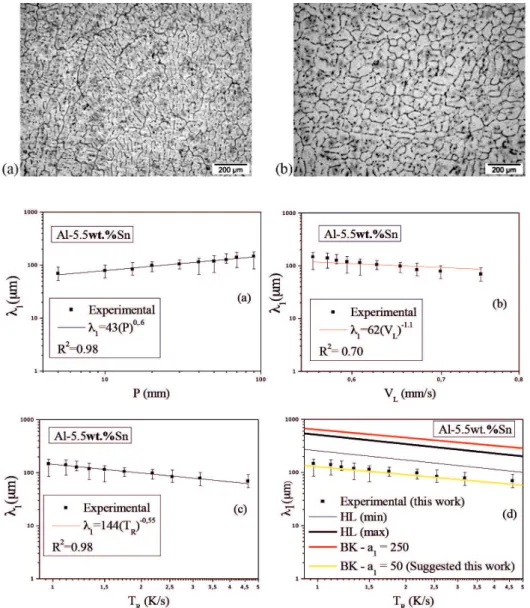
Figure 2 presents microstructures of a cross section of the samples at 10, and 60 mm from metal/mold interface, showing the primary dendrite arms. Figure 3(a) shows the average ex-perimental values of primary dendritic
spacing as a function of distance from the metal/mold interface obtained in this work. It is observed that dendrite arm spacing increases with the distance from the heat-extracting surface of the alloy investigated. It is noted that this
behavior is relected in correlation with the growth rate and cooling rate, i.e., primary spacing increases with decreas-ing thermal parameters, as shown in Figures 3 (b) and (c).
Figure 2 Solidification microstructure: (a) P = 5 mm, VL = 0.75 mm/s, TR = 6.6 0C/s
and λ1 = 65 µm; (b) P = 60 mm, VL = 0.60 mm/s, TR = 1.30 0C/s and λ1 = 119 µm;
Figure 3 (a) Primary dendrite arm spacing as a function of: (a) distance from metal-mold interface; (b) tip growth rate; (c) tip co-oling rate and (d) Comparison of experi-mental and theoretical primary dendrite arm spacing as a function of cooling rate. The R2 is the least-squares correlation
coefficient.
3. Results and discussion
Results from literature for Alumi-num based binary alloys: Al-Cu (Rocha et al,, 2003), Al-Si (Peres et al., 2005; Carvalho et al., 2013) and Al-Sn (Cruz
et al., 2010) alloys also indicate an
increase in spacing with decreasing VL and TR. Observed by Cruz et al. (2010), the Al-Sn is an immiscible binary alloy system, with an Al-rich dendritic matrix involving an Sn-rich eutectic mixture distributed along the interdendritic re-gions. For positions closer to the cooled
casting, i.e., at high values of the cooling rate, a more extensive distribution of the eutectic mixture is attained, which is consequently associated with the ine-ness of the interdendritic spacing. Notice that Figure 3(c) shows that power laws equal to -1.1 and –0.55 characterize the experimental variation of primary spacing with growth rate and cooling rate, respectively, i.e: λ1 = 62(VL
)-1.1 and λ1 = 144(TR)
0.55. This is in agreement
with observations reported by Rocha et
al (2003A),Peres et al(2005), Carvalho et al (2013) and Cruz et al.(2012) who stated that exponential relationships
λ1 = constant (TR)
−0.55 best generate the
experimental variation of primary den-dritic arms with cooling rate along the unsteady-state solidiication of Al–Cu, Al–Si and Al-Sn alloys, respectively.
Figure 3(d) shows the comparisons between the present experimental results of primary spacing with theoretical dictions furnished by unsteady-state pre-testing, which is one of the easiest and
most straightforward techniques (Kaya et al., 2013).Thus, microhardness measure-ments in this work were carried out using
a Shimadzu HMV-2 hardness measuring test device using a 50 g load and a dwell time of 10 s, according to the ASTM: E 384-11e1 and Kaya et al. (2008, 2013).
177
Properties Density Latent heat of fusion
Solute diffusivity
Gibbs– Thomson coefficient
Solidus
tempera-ture
Liquidus temperature
Partition coefficient
Liquidus slope
Symbol/units
ρS [kg/m3]
(solid) ρL
[kg/m3]
(liquid)
L [J/kg] D [m2/s] Γ [m.K] T
E [oC] TL [oC] kO
mL(K/wt
pct)
Al-5.5wt.%Sn 3011.6
2819.8 39.700.0 3 x 10⁻⁹ 9 x 10⁻⁸ 227 650 0.041 7.2 Table 1
Thermophysical properties of the Al 5.5wt.%Sn alloy used in the HL and BK models (Thermo-Calc).
Figure 4
Comparison between the results obtained in this work with those of Cruz (2008) and Okamoto-Kishitake.
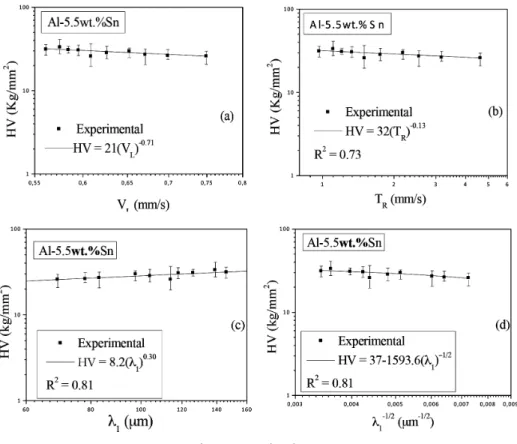
The dependence of the microhard-ness on the growth rate, cooling rate and the primary dendrite arm spacing for the investigated alloy is shown in Figures 5 (a), (b), (c) and (d), respec-tively. It can be seen from Figures 5 (a) e (b) that an increase in the growth rate and cooling rate leads to a decrease in the microhardness. The variation of the microhardness as a function of the dendritic spacing can be noted in Figures 5 (c) and (d), respectively. It
can be observed that an increase in the
λ1 values also increases the HV values.
This result is in accordance with the study of Cruz (2010), which observed that for the Al-Sn alloys, the wear volume decreases with increasing λ1.
According to the author the lower wear volume observed for coarser dendritic structures for the Al-Sn alloys seems to be associated with the larger Sn-rich interdendritic regions. He also assumed that the lubrication effect of the soft
Sn-rich areas seems to be improved for coarser microstructures. Variation of micro-indentation hardness with solidi-ication and microstructure parameters in the Al based alloys was investigated recently by Kaya et al. (2008, 2013). The exponent value of λ1 obtained in
this work (0.30) is between to the values of 0.28, 0.40, and 0.43, 0.35obtained by Kaya et al. (2008, 2013) for Al-based alloys (Al-Si, Al-Cu and Al-Ti alloys ), solidiied in an Bridgman system. dictive models: Hunt–Lu’s model (HL)
(1966) and Bouchard–Kirkaldy’s model (BK) (1997), with a calibration factor a1 = 250 for Al–Sn alloys, as suggested by these authors and a1 = 50, suggested this work. It is observed that the theoreti-cal values theoreti-calculated from both models overestimate the experimental values. On the other hand, for a1 = 50, a good approximation is observed between the experimental results and those calcu-lated by BK. Similarly, Cruz (2008) also noted that the experimental data did not it the model of Bouchard-Kirkaldy for primary growth. The author attributes
this behavior to the extensive range of solidiication of the Al-Sn system, and the large difference in density between the two components (virtually im-miscible), which signiicantly increases under heat extraction conditions in the vertical direction, which phenomenon can be attributed to results observed in this work. The predicted dendritic spac-ing calculated for unsteady solidiication by Hunt-Lu’s and Bouchard- Kirkaldy’s models are subjected to deviations caused mainly by the unaccounted dif-fusion relaxations and coring reductions for primary spacing. The thermophysical
properties of the Al-5.5wt.%Sn alloy, used to calculate the theoretical values of λ1 were obtained from Themo-Calc
178
Influence of thermal parameters on the dentritic arm spacing and the microhardness of Al-5,5wt%Sn alloy directionally solidified
4. Conclusions
The principal results of the present work can be summarized as follows:
(1) Experimental observations show that the values of λ1 decrease as the
VL and TR increase. Relations between
λ1 with the growth rate and cooling
rate were obtained by the following experimental laws: λ1 = 62(VL)
-1.1 and
λ1=144(TR) -0.55.
(2) The values of HV for direc-tionally solidiied Al-5.5wt%Sn alloy were measured. It was found that the values of microhardness increase with the decreasing of the values of VL as well as with the increasing of the values of the λ1. Microhardness has
shown to be signiicantly affected by the thermal parameters and by the scale of the primary dendrite arm spacing. Experimental laws have been deter-mined correlating HV with VL, TR and
λ1, giving as results: HV = 21(VL) -0.71,
HV = 32(TR)-0.13, HV = 8.2(λ 1)
0.30 and
HV = 37 – 1593(λ1 )-1/2.
5. Acknowledgements
The authors acknowledge the inan-cial support provided by IFPA (Federal
In-stitute of Education, Science and Technol-ogy of Pará), UFPA (Federal University of
Pará) and CNPq (The Brazilian Research Council), Brazil.
6. References
Figure 5 Variation of microhardness as a func-tion: (a) growth rate; (b) cooling rate; (c) primary dendrite arm spacing (λ1) and (c)
λ1-1/2.The R2 is the least-squares correlation
coefficient Okamoto-Kishitake (1975).
BOUCHARD, D., KIRKALDY, J. S. Prediction of dendrite arm spacings in unsteady and steady-state heat low of unidirectionally solidiied binary alloys. Metallurgi-cal and Materials Transactions B, v. 28B, p. 651-663, 1997.
CARVALHO, D. B., GUIMARÃES, E. C., MOREIRA. A. L., MOUTINHO, D. J., DIAS FILHO, J. M., ROCHA, O.L. Characterization of the Al-3wt.%Si alloy in unsteady-state horizontal directional solidiication. Materials Research. v. 16.n.4, p. 874-883, 2013.
CRUZ, K.A.S. Microestrutura de solidiicação, resistências mecânica e ao desgaste de ligas Al-Sn e Al-Si. Campinas, SP, 2008. 211 p. Tese de Doutorado em Engenharia Mecânica.
CRUZ, K.S, MEZA, E.S, FERNANDES, F.A.P, QUARESMA, J.M.V, CASTELET-TI, L. C, GARCIA, A. Dendritic arm spacing affecting mechanical properties and wear behavior of Al-Sn and Al-Si alloys directionally solidiied under unsteady--state conditions. Metallurgical and Materials Transactions A, v. 41, p. 972-984, 2010.
179
Received: 21 November 2013 - Accepted: 06 May 2014. de Mestrado).
FAN, J., LI, X., SU, Y., GUO, J., FU, H. Dependency of microhardness on solidiication processing parameters and microstructure characteristics in the directionally solidiied Ti–46Al–0.5W–0.5Si alloy. Journal of Alloys and Compounds, v. 504, p. 60-64, 2010.
HALL, H.O. The deformation and ageing of mild steel: III DISCUSSION OF
RE-SULTS. PROCEEDINGS OF THE PHYSICAL SOCIETY, 53.v. 64B, p. 747–753,
1951.
HUNT,J.D, LU,S.Z. Numerical modeling of cellular/dendritic array growth: spacing and structure predictions. Metallurgical Materials Transactions A, v. 27A. p. 611-23, 1966.
KAYA, H., GÜNDÜZ, M., ÇADIRLI, E., UZUN, O. Effect of growth rate and la-mellar spacing on microhardness in the directionally solidiiedPb–Cd, Sn–Zn and Bi–Cd eutectic alloys. Journal of Materials Science, v. 39, p. 6571–6576, 2004. KAYA, H., ÇADIRLI, E., BÖYÜK, U., MARASLI, N. Variation of microindentation
hardness with solidiication and microstructure parameters in the Al based alloys.
Applied Surface Science, v. 255, p. 3071–3078, 2008.
KAYA, H., ÇADIRLI, E., BÖYÜK, U., MARASLI, N. Inluence of growth rate on microstructure, microhardness, and electrical resistivity of directionally solidiied Al-7 wt% Ni hypo-eutectic alloy. Metals and Materials International, v. 19, p. 39-44, 2013.
NOGUEIRA, M.R., CARVALHO, D.B., MOREIRA, A.L., DIAS FILHO, J.M., ROCHA, O.L. Espaçamentos dendríticos primários da liga Sn-5%Pb solidiicada direcionalmente em um sistema horizontal. Revista Matéria, v. 17, n. 2, p. 1009-1023, 2012.
OKAMOTO, T., KISHITAKE, K. Dendritic structure in unidirectionally solidiied aluminum, tin, and zinc base binary alloys.Journal of Crystal Growth, v. 29, p. 137-146, 1975.
PERRONE, A., ZOCCO, A., de ROSE, H., ZIMMERMANN, R., BERSANI, M. Al-Sn thin ilms deposited by pulsed laser ablation. Materials Science and Engine-ering C, v. 22, p. 465-468, 2002.
PETCH, N.J. The cleavage strength of polycrystals. Journal of the Iron and Steel Ins-titute, v. 174, p. 25–28, 1953.
ROCHA, O.L., SIQUEIRA, C.A., GARCIA, A. Heat low parameters affecting den-drite spacings during unsteady-state solidiication of Sn-Pb and Al-Cu alloys. Me-tallurgical and Materials Transactions A, v.34A, p. 995-1006, 2003.
SILVA, B.L., GARCIA A., SPINELLI, J.E. The effects of microstructure and interme-tallic phases of directionally solidiied Al-Fe alloys on microhardness. Materials Letters, v. 89, p. 291–295, 2012.
YUAN, G.C., LI, Z.J., LOU, Y.X., ZHANG, X.M. Study on crystallization and mi-crostructure for New Series of Al-Sn-Si Alloys. Materials Science and Engineering