ISSN 0104-6632 Printed in Brazil
www.abeq.org.br/bjche
Vol. 34, No. 01, pp. 363 - 368, January - March, 2017 dx.doi.org/10.1590/0104-6632.20170341s20140241
*To whom correspondence should be addressed
Brazilian Journal
of Chemical
Engineering
SOLUBILITY OF 1-ADAMANTANAMINE
HYDROCHLORIDE IN SIX PURE SOLVENTS
BETWEEN 283.15 K AND 333.15 K
Yu-Jiao Tu
1,3,4, Zheng-Ming Yi
2*, Jing Liao
2and Shu-Heng Song
21Department of Chemical Science and Technology, Kunming University, Kunming, 650214, China. 2College of Chemical Engineering, Xiangtan University, Xiangtan, 411105, China.
Fax: +86 0731 58298330 E-mail: [email protected].
3Faculty of Environmental Science and Engineering, Kunming University of Science and Technology, Kunming, 650224, China.
4Faculty of Life Science and Technology, Kunming University of Science and Technology, Kunming, 650224, China.
(Submitted: December 21, 2014 ; Revised: November 2, 2015 ; Accepted: December 8, 2015)
Abstract - The solubility of 1-adamantanamine hydrochloride (1-AH) in ethanol, acetic acid,distilled water,
N-methylpyrrolidone (NMP), N,N-dimethylformamide (DMF) and dimethylacetamide (DMAC) between 283.15 K and 333.15 K was measured using a laser monitoring observation technique. Results of these measurements were correlated with the NRTL equation and a semi-empirical equation. For six solvents studied, the data are well fitted with the two equations, which can be used as a useful model in the production process of 1-AH.
Keywords: Solubility; 1-Adamantanamine hydrochloride; Modified Apelblat equation.
INTRODUCTION
Adamantanamine hydrochloride (abbreviated 1-AH CAS Registry No. 665-66-7, structural formula listed as Figure 1) (Schild and Sutton, 1965; Oxford and Schild, 1965), is a synthetic organic compound clinically used as an antiparkinsonism agent, as well as an antiviral drug (Davies et al., 1964; Van Voris et al., 1981; Bryson, 1982; Paci et al., 2001). Since 1-AH is highly soluble, relatively non-toxic and bio-logically stable (Schild and Sutton, 1965) it merited further extensive investigation.
As we know, the solubility of a drug is not only essential information in the drug discovery process, but also an important property in the recrystallization stage of solid drugs (Shayanfar et al., 2008; Nti-Gyabaah et al., 2008).
Figure 1: Structure of 1-Adamantanamine hydro-chloride.
com-pounds in different solvents played a crucial role in the determination of proper solvents and the devel-opment and operation of the crystallization process (Wu et al., 2010; Pankaj and Murthy, 2010).
Therefore, the solubility of 1-AH in different sol-vents directly affects the size of crystal formation, crystal habit, yield, and cost of production. Hence, it is necessary to know the solubility of 1-AH in pure and mixed solvents. However, it was found that there were few reported experimental solubility data of 1-AH.
In recent research, the dynamic method is used as a common approach in solubility measurement (Liu
et al., 2011), which incorporates laser techniques to monitor the dissolution process of the solid solute. Given the overwhelming advantages of the dynamic method (Jouyban-Guaramaleki et al., 2014; Qiao et al., 2014), it is also used in this research to measure the solubility of 1-AH in six pure organic solvents, including ethanol, acetic acid, distilled water, NMP, DMF and DMAC between 283.15 K and 333.15 K at atmospheric pressure. In addition, the experimental solubility results in pure solvents were correlated with the modified Apelblat equation and the NRTL equation, which proved good agreement with experi-mental data.
EXPERIMENTAL SECTION
Materials
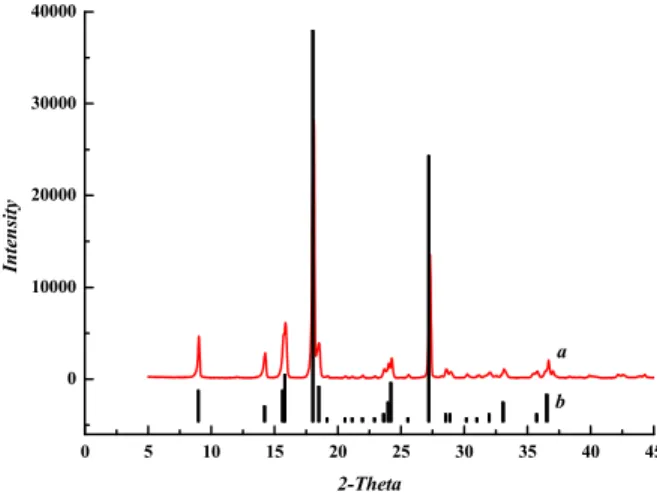
ADA-NH3Cl used during the solubility measure-ments had a mass purity of 0.998 and was purchased from China Langchem Inc. Its mass fraction purity was determined by HPLC and was purified through crystallization twice in distilled water before utiliza-tion. The X-ray diffraction (XRD) spectra of samples are shown in Figure 2. Other reagents were analyti-cal research grade reagents from Shanghai Chemianalyti-cal Reagent Co.
The solubility of 1-AH was determined by a laser monitoring dynamic method. The experimental in-strument and procedure were similar to those de-scribed in the previous literature14-18. A
predeter-mined excess mass of solvent (about 30 g) and a known mass of solute were added to a jacketed glass vessel (about 200 mL) with the laser light adjusted accordingly. The solution in the vessel was main-tained at a constant temperature by water circulating through the outer jacket from a thermostatic water bath (type MPG-10C, China). The temperature of the solution was determined by a mercury glass ther-mometer with an uncertainty of ± 0.05 K. The
pro-cess of dissolution was facilitated by continuously stirring at a desired temperature. At the beginning of the experiment, the intensity of the laser beam dropped due to a large number of undissolved 1-AH particles suspended in the solution. As the solid par-ticles dissolved, the intensity of the laser beam in-creased. When the solid particles dissolved com-pletely, the laser beam intensity reached a maximum level, and the solution in the vessel was clear. Then additional solid solute of known mass (about 1 mg to 3 mg) was added to the solution in the vessel.
0 5 10 15 20 25 30 35 40 45
0 10000 20000 30000 40000
Intensit
y
2-Theta
b a
Figure 2: XRD pattern of 1-Adamantanamine
hy-drochloride: a, samples; b, standard XRD pattern. Apparatus and Procedure.
This process was repeated several times until the maximum intensity of the laser beam started to de-cline after the last addition of solute. The time inter-val depended on the dissolution speed of 1-AH, usu-ally more than 60 min. When the intensity of the laser beam could no longer reach 90% of the maxi-mum, the mixture was considered to be in phase equilibrium. The total amount of the solute added to the vessel was recorded. Then the undissolved solute was separated and identified to be 1-AH by X-ray diffraction (XRD). Through all of the experiments in this work, polymorphic transformation was not found.
Brazilian Journal of Chemical Engineering Vol. 34, No. 01, pp. 363 - 368, January - March, 2017
THERMODYNAMIC MODELS
Modified Apelblat Equation
The Apelblat equation is the commonly used (Hefter and Tomkins, 2003; Wang et al., 2005; Li et al., 2010; Apelblat and Manzurola, 1997; Kondepudi and Prigogine, 2002) semi-empirical expression which is used to correlate experimental solubilities with calculated ones and to evaluate the influence of tem-perature on the mole fraction solubility of the solute.
According to the solid-liquid phase equilibrium theory, the relationship between solubility and tem-perature is generally modeled by (Apelblat and Man-zurola, 1997):
,1 ,1 ,1 ,1
1
,1
,1 ,1
1
ln 1 1
ln ln
f f pf f
f
pf f
H T C T
x
RT T R T
C T
R T
(1)where x1,1,Hf,1,Cpf,1,Tf,1,Rand T stand for the
mole fraction of the solute, activity coefficient, en-thalpy of fusion, difference in the solute heat capaci-ty between the solid and liquid at the melting tem-perature, melting temperature of the solute, gas con-stant, and equilibrium temperature in the saturated solution, respectively. The values of ∆Hf, ∆Cpf, Tf
were estimated by ASPEN PLUS software version 8.4 (∆Hf =-1.3673×10⁸ J/kmol, ∆Cpf=23.0446 kJ/(kmol·K),
Tf = 300 ℃).
Equation (2) can be written as
1
lnx A B ClnT T
(2)
where x1 is the mole fraction solubility of 1-AH, T stands for the absolute temperature (K), A、B and C
are the dimensionless parameters.
NRTL Model
In the binary system, the activity coefficient can be calculated by the following formula (Domanska and Marciniak, 2003):
2 2
2 21 21 12 12
1 2 2 2
1 21 2 2 12 1
ln x G G
x G x x G x
(3)
where,
12 exp( 12 12)
G
G21exp(
21 21) (4)12 22 12
g g RT
21 11
21
g g RT
(5)
where g12
g12g22
andg21
g21g11
are cross in-teraction energy parameters, independent of tempera-ture and composition. In addition, α12 is a constant that reflects the non-randomness of the mixture and its value generally varies between 0.20 and 0.47 (Wei and Pei, 2008). Different values of α12 were chosen to correlate the solubility data of 1-AH. It turns out that α12 = 0.30 is the most suitable value because of the smallest relative deviation for the measurement system.RESULTS AND DISCUSSION
The mean values were used to calculate the mole fraction solubility x1 based on
1 1 1
1 1 2 2
/
/ /
m M x
m M m M
(6)
where m1 and m2 are the mass of the solute and sol-vent respectively, M1 and M2 the molecular weight of the solute and solvent respectively. The solubility data of 1-AH in distilled water, acetic acid, ethanol, DMF, NMP and DMAC between 283.15 K and 333.15 K are listed in Table 1.
To evaluate the correlation results and select the most suitable model for 1-AH solubility in pure sol-vents, the relative deviation (RD %) and the average relative deviation (ARD %) were calculated. The relative deviation and the average relative deviation are defined as
exp 1, 1, exp 1, % cal i i i x x RD x
(7)
exp 1, 1, exp 1, 1 100 % | | cal N i i i i x x ARD
N x
(8)The parameters of the mentioned equations and the root mean square deviations (RMSD) are listed in Table 2. The RMSD is defined as (Douglas, 1997):
1,
Table 1: Mole fraction solubility (x1) of 1-adamantanamine hydrochloride in selected
solvents with the temperature range from 278.15 to 333.15 K and pressure p = 0.1 MPaa.
T (K) 100x1exp
100x1calc
T (K) 100x1exp
100x1calc
Apelblat NRTL Apelblat NRTL
DMAC
278.35 1.863 1.873 1.815 307.95 2.700 2.730 2.678
282.75 2.007 2.029 2.033 313.15 2.803 2.818 2.805
288.05 2.213 2.207 2.292 318.15 2.857 2.881 2.888
292.45 2.405 2.345 2.406 322.85 2.898 2.922 2.934
298.65 2.536 2.519 2.499 328.95 2.961 2.949 2.985
302.65 2.620 2.618 2.575 333.15 2.979 2.950 2.932
DMF
278.35 1.414 1.436 1.430 307.95 1.829 1.835 1.859
282.75 1.503 1.502 1.501 313.15 1.873 1.892 1.887
288.25 1.602 1.582 1.577 318.15 1.905 1.943 1.859
292.45 1.662 1.641 1.641 322.85 1.975 1.986 1.973
298.65 1.731 1.723 1.737 328.95 2.047 2.037 2.050
302.65 1.784 1.773 1.806 333.15 2.094 2.068 2.099
NMP
283.45 1.849 1.854 1.928 312.85 4.178 4.118 4.250
288.15 2.226 2.225 2.310 318.15 4.399 4.403 4.467
293.25 2.643 2.644 2.728 323.15 4.525 4.606 4.590
298.45 3.075 3.073 3.158 328.15 4.690 4.738 4.752
303.25 3.467 3.453 3.546 333.35 4.874 4.800 4.932
308.25 3.809 3.820 3.885 Acetic acid
293.35 1.132 1.125 1.138 318.15 2.999 2.943 3.003
298.05 1.377 1.353 1.386 323.25 3.601 3.573 3.596
303.35 1.606 1.664 1.617 328.15 4.339 4.299 4.327
308.15 1.978 2.005 1.990 333.15 5.097 5.184 5.081
313.25 2.456 2.440 2.465 Water
278.05 2.660 2.660 2.771 308.15 6.399 6.331 6.414
282.95 3.193 3.193 3.284 313.25 6.928 6.953 6.937
288.45 3.833 3.838 3.902 318.65 7.481 7.572 7.485
293.05 4.356 4.407 4.410 323.35 7.986 8.064 7.987
298.35 5.128 5.082 5.165 328.05 8.485 8.504 8.484
303.35 5.777 5.723 5.801 333.12 9.013 8.914 9.014
Ethanol
283.55 4.126 4.201 4.040 313.25 6.452 6.461 6.390
287.85 4.651 4.590 4.759 318.15 6.700 6.692 6.661
293.35 5.162 5.069 5.219 323.25 6.884 6.878 6.889
298.05 5.466 5.453 5.478 328.15 7.012 7.004 7.047
303.35 5.822 5.850 5.792 333.15 7.094 7.079 7.126
308.15 6.081 6.169 6.047
a The standard uncertainties u are u(T) = 0.1 K, u
r(p) = 0.05, ur(x) =0.03
Table 2: Parameters of Equation (2) for 1-adamantanamine hydrochloride in Different Solvents.
Solvent
Apelblat NRTL
A B C RMSD
%
Δg12 (J·mol−1) Δg21 (J·mol−1) RMSD
%
DMAC 187.88 -9324.5 -28.133 0.027 2725.3 14731.3 0.039
DMF 52.886 -3102.2 -8.1694 0.02 -3524.8 22243.5 0.02
NMP 437.00 -21630 -64.578 0.043 1626.3 11973.3 0.20
acetic acid -118.93 2139.7 18.859 0.048 -1061.8 3247.6 0.47
water 261.07 -13673 -38.297 0.058 1377.1 7453.6 1.61
Brazilian Journal of Chemical Engineering Vol. 34, No. 01, pp. 363 - 368, January - March, 2017 Table 3 lists the ARD % of different correlation
models. The average relative deviations of the two models are 0.86% (Apelblat) and 1.13% (NRTL). Therefore, the Apelblat model fits well with the ex-perimental solubility data of 1-AH in pure solvents.
Table 3: ARD% of different models in pure sol-vents.
Solvent Water DMF DMAC NMP Acetic acid
Ethanol
Apelblat 0.6750 0.8992 0.7742 0.6316 1.4729 0.7050 NRTL 0.9688 0.9081 1.3524 2.3161 0.4149 0.8532
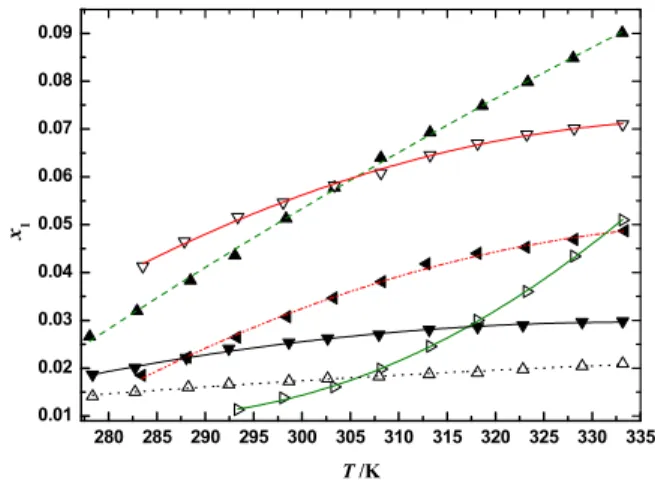
We can conclude from Figure 3 that: (1) Solubili-ty of 1-AH is the lowest in DMF and the highest in water when the temperature is higher than 310 K; this may be because of the intermolecular interaction between solvent and solute molecules. 1-AH is a salt and most salts can be dissolvent in water, especially in hot water. In addition, the structure of 1-AH is much more complicated and is harder to disperse in organic solvents. Hence, solvents which have com-plicated structures such as DMF show a lower solu-bility value than in water. (2) Solusolu-bility increases with temperature in all the selected solvents; (3) the solubility curves of 1-AH in NMP and ethanol show almost the same curvature, which may mean that both solubilities have the same sensitivity to temper-ature though their solubility values are different. The reason for this phenomenon needs to be studied further.
280 285 290 295 300 305 310 315 320 325 330 335 0.01
0.02 0.03 0.04 0.05 0.06 0.07 0.08 0.09
x1
T /K
Figure 3: Mole fraction solubility of 1-Adamantana-mine hydrochloride (x1) in different solvents between 278 K and 333 K: ◄, NMP; ▷ acetic acid; ▼, DMAC;
▲, water; △, DMF; ▽, ethanol.
The solid line solubility curve was calculated by the modified Apelblat equation.
CONCLUSIONS
The solubility of 1-adamantanamine hydrochlo-ride (1-AH) in ethanol, acetic acid, distilled water, N -methylpyrrolidone (NMP), N,N-dimethylformamide (DMF) and dimethylacetamide (DMAC) between 283.15 K and 333.15 K were measured using a laser monitoring observation technique. The solubilities in all selected solvents are functions of temperature and increase with the rise of temperature.
The modified Apelblat equation based on solid-liquid phase equilibrium principles and the NRTL equation were used to correlate the solubility data of 1-AH in these solvent systems. The RDs of the mod-ified Apelblat Equation among all of these values does not exceed 1.82%. The average relative devia-tion of the two models are 0.86% (Apelblat) and 1.13% (NRTL). Therefore, the modified Apelblat equation fits well with the experimental solubility data of 1-AH in pure solvents.
The solubility values calculated by the modified Apelblat equation and NRTL equation show good agreement with experimental values. Both the exper-imental solubility and correlation equation can be used as essential data in the purification process of 1-AH, as well as good support for further development of solubility models for 1-AH.
ACKNOWLEDGEMENT
We are grateful for the financial support of the National Natural Science Foundation of China (No. NNSFC 21306158), and General project of Hunan Provincial Education Department (grant no. 13C911).
REFERENCES
Apelblat, A. and Manzurola, E., Solubilities of L-aspartic, DL-L-aspartic, DL-glutamic, p-hydroxy-benzoic, o-anisic, p-anisic, and itaconic acids in water from T=278 K to T=345 K. J. Chem. Thermodyn. 29(12), 1527-1533 (1997).
Bryson, Y. J., The use of amantadine in children for prophylaxis and treatment of influenza A infec-tions. Pediatr. Infect. Dis., 1(1), 44-46 (1982). Davies, W. L., Grunert, R. R., Haff, R. F., McGahen,
Domanska, U. and Marciniak, A., Solubility of 1-alkyl-3-methylimidazolium hexafluoro -phosphate in hydrocarbons. J. Chem. Eng. Data, 48(3), 451-456 (2003).
Douglas, M., Design and Analysis of Experiments. John Wiley & Sons Inc., New York (1997). Fakhree, M. A. A., Acree, Jr. W. E. and Jouyban, A.,
Solubility of phenanthrene in ternary mixtures of C1−C4 alcohols at 298.2 K. Ind. Eng. Chem. Res., 49(13), 6238-6242 (2010).
Gandh P. J. and Murthy, Z. V., Solubility and crystal size of sirolimus in different organic solvents. J. Chem. Eng. Data, 55(11), 5050-5054 (2010). Hefter, G. T. and Tomkins, R. P. T., The Experimental
Determination of Solubilities. John Wiley, Chich-ester, England (2003).
Jouyban-Gharamaleki, V., Jouyban-Gharamaleki, K., Soleymani, J., Acree, Jr. W. E. and Jouyban, A., Solubility determination of tris(hydroxymethyl) aminomethane in water + methanol mixtures at various temperatures using a laser monitoring technique. J. Chem. Eng. Data, 59(7), 2305-2309 (2014).
Kondepudi, D. K. and Prigogine, I., Modern Ther-modynamics. John Wiley, Chichester, England (2002).
Li, Q. S., Tian, Y. M. and Wang, S., Solubility of chlorpheniramine maleate in ethanol, 1-propanol, 1-butanol, benzene, ethyl acetate, ethyl formate, and butyl acetate between 283 K and 333 K. J. Chem. Eng. Data, 52(6), 2163-2165 (2007). Li, Q. S., Yi, Z. M., Liu, W. Z. and Sun, X. F.,
Solu-bility of D(−)-p-hydroxyphenylglycine dane salt in binary methanol+isopropanol solvent mixtures. Korean J. Chem. Eng., 27(3), 936-938 (2010). Liu, B. S., Sun, H. S., Wang, J. K. and Yin, Q. S.,
Solubility of disodium 5′-guanylate heptahydrate in aqueous methanol mixtures. Food Chem., 128(1), 218-221 (2011).
Liu, J. Q., Chen, S. Y. and Ji, B. M., Solubility and thermodynamic functions of isatin in pure sol-vents. J. Chem. Eng. Data, 59(11), 3407-3414 (2014).
Nti-Gyabaah, J., Chmielowski, R., Chan, V. and Chiew, Y. C., Solubility of lovastatin in a family of six alcohols: Ethanol, propanol, butanol, 1-pentanol, 1-hexanol, and 1-octanol. Int. J. Pharm., 359(1-2), 111-117 (2008).
Oxford, J. S. and Schild, G. C., In vitro inhibition of rubella virus by 1-adamantanamine hydrochlo-ride. Archiv für die gesamte Virusforschung, 17(2), 313-329 (1965).
Paci, C., Thomas, A. and Onofrj, M., Amantadine for dyskinesia in patients affected by severe Parkin-son's disease. Neurol. Sci., 22(1), 75-76 (2001). Qian, C., Wang, Y. Y. and Chen, X. Z., Solubility of
1-fluoro-4-(methylsulfonyl)benzene in five pure organic solvents at temperatures from (288.40 to 331.50) K. J. Chem. Eng. Data, 59(4), 1254-1256 (2014).
Schild, G. C. and Sutton, R. N., Inhibition of influen-za viruses in vitro and in vivo by 1-adamantana-mine hydrochloride. Br. J. Exp. Pathol., 46(3), 263-273(1965).
Shayanfar, A., Soltanpour, S., Jabbaribar, F., Hamidi, A. A., Acree, W. E. and Jouyban, A., Solubility of anthracene in quaternary solvent mixtures of 2, 2, 4-trimethylpentane+ 2-propanone+ methanol+ al-cohols at 298.15 K. J. Chem. Eng. Data, 53(9), 2250-2253 (2008).
Song, J. X., Yan, Y., Yao, J., Chen, J. M. and Lu, T. B., Improving the solubility of lenalidomide via cocrystals. Crystal Growth & Design, 14(6), 3069-3077 (2014).
Teoh, W. H., Mammucari, R., Vieira de Melo, S. A. B. and Foster, N. R., Solubility and solubility modeling of polycyclic aromatic hydrocarbons in subcritical water. Ind. Eng. Chem. Res., 52(6), 5806-5814 (2013).
Van Voris, L. P., Betts, R. F., Hayden, F. G., Christ-mas, W. A. and Douglas, R. G. Jr., Successful treatment of naturally occurring influenza A/USSR/77 H1N1. J. Am. Med. Assoc., 245, 1128-1131 (1981).
Wang, S., Wang, J. K. and Yin, Q. X., Measurement and correlation of solubility of 7-aminocepha-losporanic acid in aqueous acetone mixtures. Ind. Eng. Chem. Res., 44(10), 3783-3787 (2005). Wei, D. and Pei, Y., Measurement and Correlation of
solubility of diphenyl carbonate in alkanols. Ind. Eng. Chem. Res., 47(22), 8953-8956 (2008). Wu, J. G., Ge, J., Zhang, Y. P., Yu, Y. and Zhang, X.