ISSN 0104-6632 Printed in Brazil
www.abeq.org.br/bjche
Vol. 25, No. 01, pp. 9 -17, January - March, 2008
Brazilian Journal
of Chemical
Engineering
MODELLING AND AUTOMATION OF THE
PROCESS OF PHOSPHATE ION REMOVAL
FROM WASTE WATERS
L. Lupa
1*, P. Negrea
1, A. Negrea
1, A. Iovi
1, L. Cocheci
1and G. Mosoarca
11
Politehnica University of Timişoara, School of Industrial Chemistry and Environmental Engineering Timişoara, Phone/Fax: 004 0256404192,
Victoriei Square No. 2, 30006, Timişoara, Romania, E-mail: [email protected]
(Received: April 25, 2006 ; Accepted: September 12, 2007)
Abstract - Phosphate removal from waste waters has become an environmental necessity, since these phosphates stimulate the growth of aquatic plants and planktons and contribute to the eutrophication process in general. The physicochemical methods of phosphate ion removal are the most effective and reliable. This paper presents studies on the process of phosphate ion removal from waste waters resulting from the fertiliser industry’s use of the method of co-precipitation with iron salts and with calcium hydroxide as the neutralizing agent. The optimal process conditions were established as those that allow achievement of a maximum degree of separation of the phosphate ions. The precipitate resulting from the co-precipitation process was analysed for chemical composition and establishment of thermal and structural stability, and the aim was also to establish in which form the phosphate ions in the formed precipitate can be found. Based on these considerations, the experimental data obtained in the process of phosphate ion removal from waste waters were analysed mathematically and the equations for the dependence of the degree of phosphate separation and residual concentration versus the main parameters of the process were formulated. In this paper an automated scheme for the phosphate ion removal from waste waters by co-precipitation is presented.
Keywords: Eutrophication; Phosphate removal; Fertilisers; Waste waters; Process modelling; Automation.
INTRODUCTION
The importance of purifying waste waters has increased at the international level, the main reason being the limit the flow need to impurities in waters and of ensure a quality suitable for all their uses. Phosphorus compounds are of great importance to some branches of the economy (Hodge and Popovici, 1994). From technological processes for obtaining these compounds as well as other processes in which they are used, waste waters with a phosphorus content, either inorganic (especially as phosphates) or organic, result. The residual waters released into effluents cause this pollution; phosphorus compounds stimulate the growth of aquatic
1997). From the production of phosphoric fertilisers waste waters containing phosphates are obtained. (Corbitt, 1990; Bower and Stensel, 1990).
The physicochemical methods of phosphate removal are the most effective and reliable (Lupu et al., 1986). Taking these considerations into account, studies were conducted to establish the optimal conditions for the process of phosphate ion removal from waste waters resulting from the manufacture of complex fertilizers by precipitation using as co-precipitation agents FeCl3 and FeSO4 and as neutralising agent calcium hydroxide. The precipitate resulting from the co-precipitation process was analysed for chemical composition and establishment of thermal and structural stability. Based on the studies, an automatic scheme for the process of phosphate ions removal from waste waters by co-precipitation is proposed.
EXPERIMENTAL
The waste waters of the fertiliser industry were analysed in accordance with Law no. 107/1996 (Official Monitor, 1997), which establishes the quality conditions of waste waters before they are evacuated in to the water sources. To remove the phosphate ions from the waste waters the Jar-Test methods were used. Water samples with a given content of phosphate ions were treated with an appropriate quantity of ferric chloride and ferrous sulphate (10 g Men+/l) and a well-determined quantity of neutraliser (a saturated solution of calcium hydroxide), under intense stirring (n=100-120 rot/min) for 2 minutes. Then the samples were stirred slowly (n=40 rot/min) for 10 minutes and left to rest for 30 minutes for decantation of the precipitate formed. To establish the optimal conditions for phosphate ion removal, the dependence of the degree of separation of P2O5versus different parameters (coagulant agent /
P2O5 mass ratio, the quantity of coagulant, pH and the nature of the precipitation agent) were studied. The pH mass reaction was measured with a DENVER 250 pH-meter and the residual content of phosphate ions was determined by the spectrophotometer method, using a UV-VIS JASCO-V-530 spectrophotometer (Lungu and Duda, 1999).
The precipitates formed during the co-precipitation process were separated under optimum conditions, dried at a temperature of 105ºC until they had a constant mass and then were dissolved with HCl for a complete leaching. The precipitates formed were analysed chemical composition and establishment of thermal and structural stability. Thermal-gravimetric and thermal-differential studies were carried out using a Perking Elmer TGA 7 thermo balance. To estimate the residual concentrations of P2O5 for the automation process, the dependence equations of the residual concentration of P2O5 versus pH for different types of coagulant agents were determined using as neutralising agent a saturated solution of calcium hydroxide. Based on the studies conducted, an automatic scheme for the process of phosphate ion removal from waste waters by co-precipitation is proposed.
RESULTS AND DISCUSSION
Waste Water Analysis
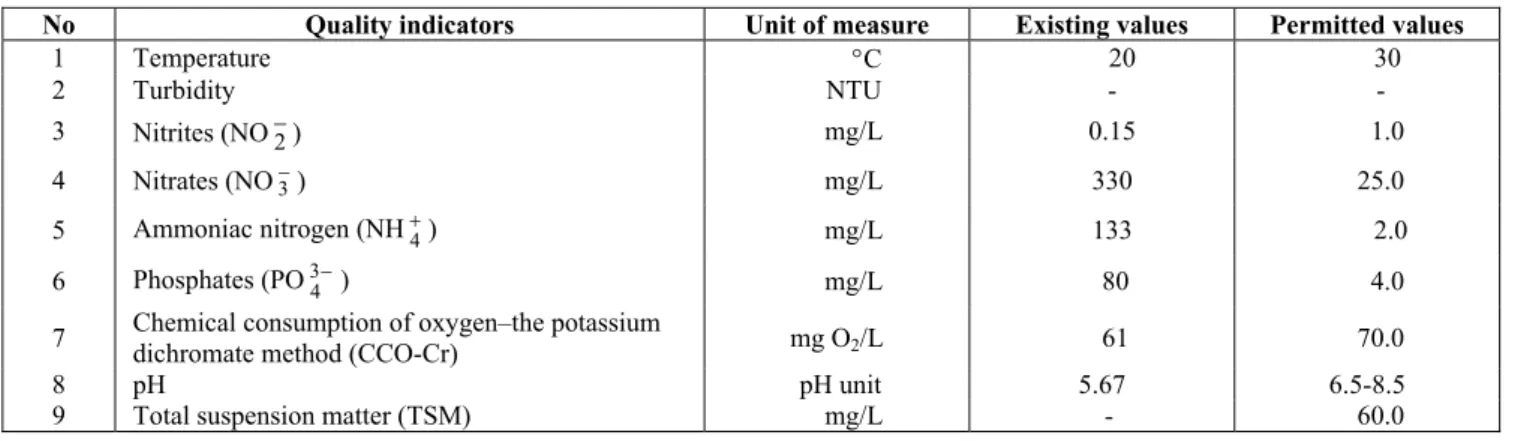
The experimental data on the composition of the waste waters of the fertiliser industry and the maximum of the parameters permitted by the legislation are presented in Table 1.
From the experimental data it can be observed that the water had a complex chemical composition with a high level of nitrogen and phosphor content that create conditions appropriate for eutrophication. In the current legislation the permissible limits for nitrogen and phosphate compounds are far too high.
Table 1: Composition of the industrial waste waters and the maximum permitted
No Quality indicators Unit of measure Existing values Permitted values
1 Temperature °C 20 30
2 Turbidity NTU - -
3 Nitrites (NO−2) mg/L 0.15 1.0
4 Nitrates (NO−3) mg/L 330 25.0
5 Ammoniac nitrogen (NH+4) mg/L 133 2.0
6 Phosphates (PO34−) mg/L 80 4.0
7 Chemical consumption of oxygen–the potassium
dichromate method (CCO-Cr) mg O2/L 61 70.0
Studies the Establishment of Optimal Conditions for Phosphate Ion Removal
a) The Influence of pH on the Degree of Separation
Ferric Chloride
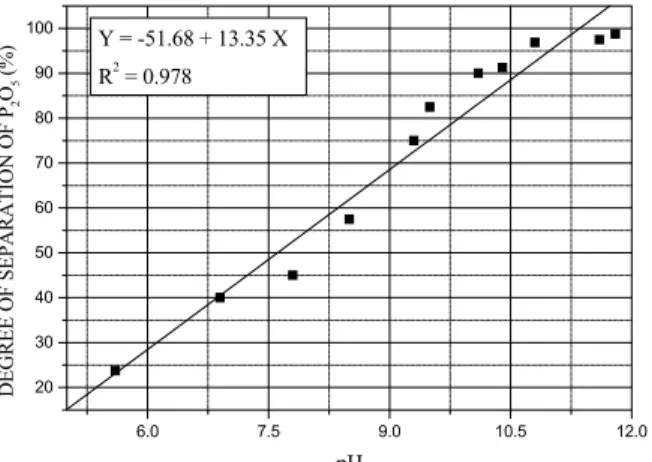
The experimental data on the dependence of the degree of separation of phosphate ions on pH at 25°C, using as neutralisation agent a saturated solution of calcium hydroxide and as co-precipitation agent solutions of ferric chloride of different concentrations, are presented in Figures 1-3. The experimental data show that degree of separation of
P2O5 increase with a pH. At pH~10, the degree of separation of P2O5 is ~10 %.
Ferrous Sulphate
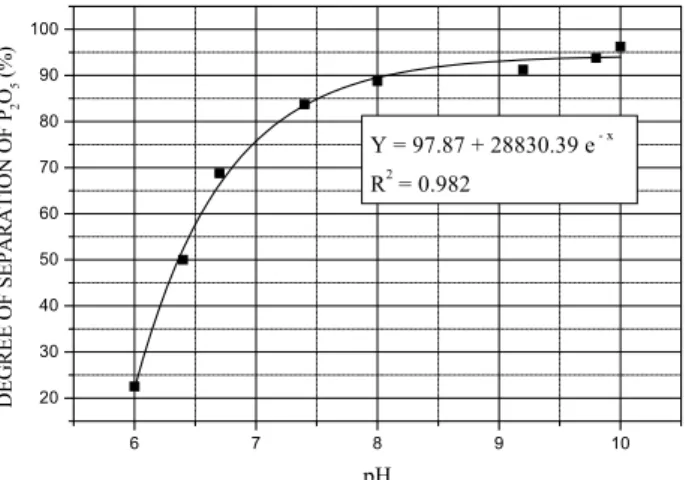
The experimental data the dependence of the degree of separation of the phosphate ions on pH at 25°C using as neutralisation agent a saturated solution of calcium hydroxide and as co-precipitation agent solutions of ferrous sulphate of different concentrations (Negrea, et al., 1998) are presented in Figures 4-6. From the experimental data can be observed that degree of separation of P2O5 increases with pH, achieving values over 90%.
2 4 6 8 10 12
50 60 70 80 90
100 Y = 40.04 + 5.04 X R2 = 0.993
D
E
G
R
E
E
O
F
S
E
P
A
R
A
T
IO
N
O
F
P2 O5
(%
)
pH
4 6 8 10 12
30 40 50 60 70 80 90 100
Y = -3.03 + 8.95 X R2 = 0.988
D
E
G
R
E
E
O
F
S
E
P
A
RA
T
IO
N
O
F
P2 O5
(%)
pH
Figure 1: The dependence of the degree of separation of P2O5 on pH at a 150 mg/L FeCl3 concentration
using as neutraliser Ca(OH)2.
Figure 2: The dependence of the degree of separation of P2O5 on pH at a 100 mg/L FeCl3 concentration
using as neutraliser Ca(OH)2.
6.0 7.5 9.0 10.5 12.0
20 30 40 50 60 70 80 90 100
Y = -51.68 + 13.35 X R2 = 0.978
D
E
G
R
E
E
O
F
S
E
P
A
RA
T
IO
N
O
F
P2 O5
(%
)
pH
Figure 3: The dependence of the degree of separation of P2O5 on pH at a 50 mg/L FeCl3 concentration
4 5 6 7 8 9 40
50 60 70 80 90
Y = 89.66 + 4598.94 e - x R2 = 0.977
D
E
G
RE
E
O
F
S
E
P
A
RA
T
IO
N
O
F
P2 O5
(%
)
pH
4 5 6 7 8 9 10
30 40 50 60 70 80 90 100
Y = 94.62 - 9692.84 e - x R2 = 0.991
D
E
G
RE
E
O
F
S
E
P
A
RA
T
IO
N
O
F
P2 O5
(%
)
pH
Figure 4: The dependence of the degree of separation of P2O5 on pH at a 150 mg/L FeSO4 concentration
using as on neutraliser Ca(OH)2.
Figure 5: The dependence of the degree of separation of P2O5 on pH at a 100 mg/L FeSO4 concentration
using as on neutraliser Ca(OH)2.
6 7 8 9 10
20 30 40 50 60 70 80 90 100
Y = 97.87 + 28830.39 e - x R2 = 0.982
D
E
G
R
E
E
O
F
S
E
P
A
RA
T
IO
N
O
F
P2 O5
(%
)
pH
Figure 6: The dependence of the degree of separation of P2O5 on pH at a 50 mg/L FeSO4 concentration,
using as on neutraliser Ca(OH)2.
b) The Influence of the Dose of Co-Precipitation Agent on the Degree of Separation
Ferric Chloride
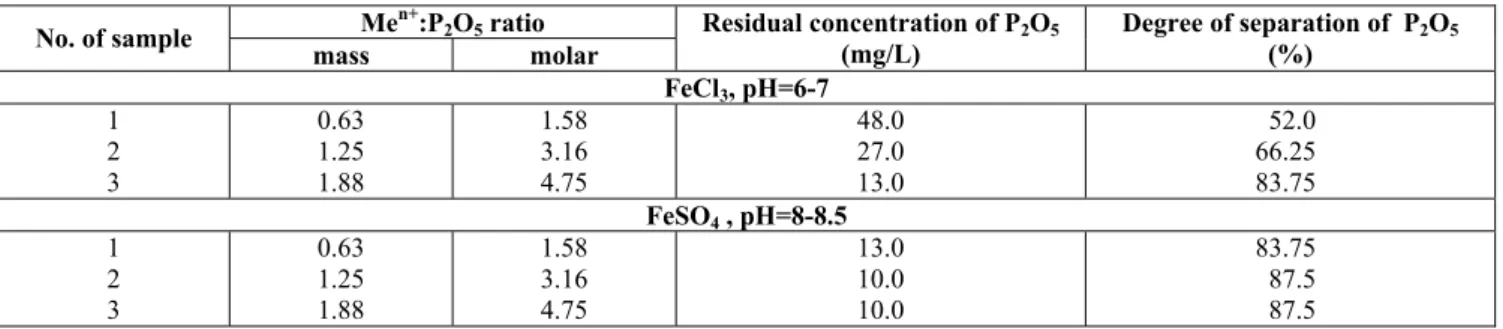
The experimental data on the dependence of the residual concentration of P2O5 on the degree of separation waste waters and the quantity of FeCl3 at 25°C using as neutralising agent a saturated solution of calcium hydroxide (Negrea, et al., 2000) is presented in Table 2. From the experimental data can be observed that the residual concentration of phosphate ions decreases with the increases in quantity of FeCl3. The degree of separation of P2O5
Ferrous Sulphate
c) The Influence of the Co-Precipitation Agent/P2O5
Mass Ratio on the Degree of Separation
Experimental data on the dependence of the degree of separation of phosphate ions on the residual concentration and the co-precipitation agent/P2O5 mass ratio at 25° using as neutralisation agent a solution of calcium hydroxide and as co-precipitation agent ferric chloride and ferrous sulphates shown in Table 4. From the experimental data can be observed that bigger degrees of separation of phosphate ions are obtained at a lower co-precipitation agent/P2O5 mass ratio when ferrous sulphate is used as co-precipitation agent than when ferric chlorides.
d) The Influence of the Nature of the Co-Precipitation Agent used on the Degree of Separation
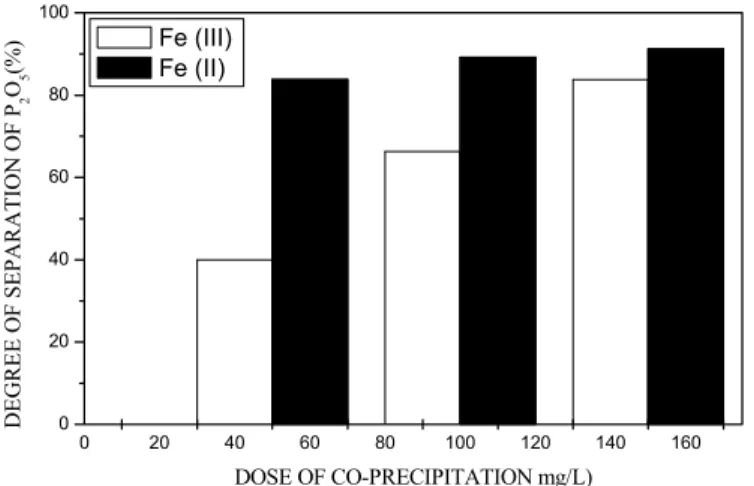
The experimental data on the dependence of the degree of separation of phosphate ions on the nature of the co-precipitation used are presented in Figure 7. From the experimental data it can be observed that the degree of separation of the phosphate ions depends on the nature of the co-precipitation agent used for the same neutralising agent, calcium hydroxide. The iron (III) ions provide the highest degree of separation of the phosphate ions for quantities larger than 100 mg/L.
Table 2: The dependence of the degree of separation of P2O5 on the residual concentration and the
quantity of FeCl3 at pH=8 and 25°C using as neutraliser Ca(OH2).
No. of sample
Quantity of co-precipitation agent [mg/L]
Residual concentration of P2O5
[mg/L]
Degree of separation of P2O5
[%] 1
2 3 4
0 50 100 150
80 48 27 13
0 40.00 66.25 83.75
Table 3: The dependence of the degreee of separation of P2O5 on the residual concentration and the
quantity of FeSO4 at pH=7 and 25°C using as neutraliser Ca(OH2).
No. of sample
Quantity of co-precipitation agent [mg/L]
Residual concentration of P2O5
[mg/L]
Degree of separation of P2O5
[%] 1.
2. 3. 4.
0 50 100 150
80 13 10 10
0 83.8 89.2 91.2
Table 4: The dependence of theresidual concentration of P2O5, on the degree of separation and the
co-precipitation agent/P2O5 mass ratio at 25°C
Men+:P2O5 ratio
No. of sample
mass molar
Residual concentration of P2O5
(mg/L)
Degree of separation of P2O5
(%) FeCl3, pH=6-7
1 2 3
0.63 1.25 1.88
1.58 3.16 4.75
48.0 27.0 13.0
52.0 66.25 83.75 FeSO4 , pH=8-8.5
1 2 3
0.63 1.25 1.88
1.58 3.16 4.75
13.0 10.0 10.0
0 20 40 60 80 100 120 140 160 0
20 40 60 80 100
D
E
G
RE
E
O
F
S
E
P
A
R
A
T
IO
N
O
F
P2 O5
(%
)
DOSE OF CO-PRECIPITATION mg/L) Fe (III)
Fe (II)
Figure 7: The dependence of the degreee of separation of P2O5 on the nature of co-precipitation agent used.
Characterisation of the Precipitate Formed During the Process of Separation of the Phosphate Ions
The chemical composition (% mass) of the precipitates separated from the waste waters under study is P2O5=19.7%; CaO=15.8% and Fe2O3=17.3%. This composition shows that the precipitates probably contain the following components: Ca5(PO4)3OH, FePO4 ·2.5H2O and FeOOH. To characterise the separated precipitates, thermal-gravimetric and thermal-differential studies were carried out.
The thermal-gravimetric and thermal-differential curves are alike for all the products obtained under the optimal conditions and they are presented in Figures 8 and 9. From these data it can be observed
that the process has two stages:
up to 200°C a larger loss of mass (~23%), determined by loss of physical and absorbed water takes place;
between 200 and 500°C, the period characterised by a slower speed of decomposition with a small loss (~7%), the crystallisation water and the basic components of the precipitate are eliminated.
Thermal-gravimetric and thermal-differential studies show that the precipitates formed in the process of water purification which contain P2O5 have a complex composition and they are probably formed from amorphous precipitates of hydroxyl apatite, ferric hydroxide and other basic phosphates. We must stress that hydroxyl apatite as a colloid has a large absorption capacity.
70 80 90 100
0 200 400 600 800
Temperature (°C)
M
as
s (
%
)
-0.7 -0.6 -0.5 -0.4 -0.3 -0.2 -0.1 0 0.1
d
m
%/
d
t,
%/
m
in
TG% DTG% St 5x10 0
70 80 90 100
0 200 400 600 800
Temperature (°C)
M
as
s (%
)
-0.7 -0.6 -0.5 -0.4 -0.3 -0.2 -0.1 0 0.1 0.2
dm
%/
dt
, %/
m
in
TG% DTG% St 5x100
Figure 8: TG and TDG curves for the product obtained from co-precipitation of waste water with an initial content of 80 mg/L P2O5 using as co-precipitation agent 150 mg/L Fe3+ and as neutraliser
Modelling of the Process of Phosphate Ion Separation
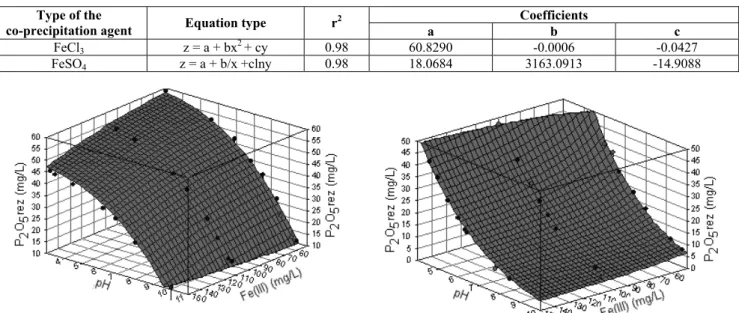
The experimental data for the mathematical equation for the dependence of the residual concentration of P2O5 (the equation term “z”) on the pH (the equation term “x”) and on the co-precipitation agent used (the equation term “y”) in the cases where ferric chloride and ferrous sulphate where used as co-precipitation agent and calcium hydroxides as neutralising agent are presented in Table 5 and Figures 10 and 11. The modelling of the process of phosphate ion removal (Negrea et al., 2002) shows a significant decrease in the residual concentration of P2O5 with pH and doses of the co-precipitation agent Fe (III) have a less visible influence. This dependence shows that the phosphate ions are eliminated, especially in the form of hydroxyl apatite, with the variation in pH being ensured by the Ca(OH)2. The co-precipitation agent ions precipitate in the form of hydroxides, the former acting rather as a coagulant for the colloidal hydroxyl apatite.
Automation of the Process of Phosphate Ion Separation
The proposed automated scheme, based on the studies of the process of removal of phosphate ions from waste waters resulting from the fertiliser industry by the co-precipitation method, (Perju et al.,
2001) is presented in Figure 12. As the raw water enters the reaction chamber, the following parameters are measured: pH with the A1T pH transducer, the initial concentration of P2O5with the
A2T transducer and the flow with the FT transducer. The responses of this transducer are measured by the central processing unit (computer) with the help of an analogue-digital converter (ADC). These responses are the input data for the program of the main response calculation with the soft being adjusted to the laboratory experimental data and turned for real installation versus the flow, pH and initial concentration of P2O5 in the raw water and of the assessed residual concentration of P2O5 in the treated water. The main responses from the digital-analogue converter are transmitted to the flow regulator for addition of the co-precipitation agent and calcium hydroxide solutions. From the reaction chamber the water enters the clarifying tank and after settling the water and sludge are treated. To reduce the volume of sludge, this is filtrated and forms a cake which contains specially calcium phosphates the water resulting from filtration is mixed with the treated water. The residual concentration of P2O5 in the treated water is determined by the A2T transducer and sent to the central processing unit by the analogue-digital converter. This response can be stored to watch the installationand can be used as a process feedback.
The treated water having a high pH (pH= 9 - 10) is neutralised with sulphuric acid to adjust the pH to 7. This neutralisation is realised in an automation curl which does not pass through the central processing unit; because of its simplicity, the curl is made with an A1T pH transducer and an A1C pH regulator. Also, an automation curl was proposed for the level of solution in the reaction chamber with the level LT transducer and the LC level regulator.
Table 5: Equation for the dependence of the residual concentration of P2O5 on pH and on the dose of
co-precipitation agent used with saturated Ca(OH)2 solution as neutraliser, for waste water with a P2O5
concentration of 80 mg/L.
Coefficients Type of the
co-precipitation agent Equation type r
2
a b c
FeCl3 z = a + bx
2
+ cy 0.98 60.8290 -0.0006 -0.0427
FeSO4 z = a + b/x +clny 0.98 18.0684 3163.0913 -14.9088
Figure 10: The dependence of the residual concentration of P2O5 on pH and the dose of FeCl3
Figure 12: The automated scheme of the process of phosphate ion removal from waste waters
A2T P2O5 concentration transducer (on line) A1T pH transducer
FT flow transducer LT level transducer ADC digital to analog converter DAC analog to digital converter LC liquor level regulator
CPU central processing unit (computer)
r1 reaction response: the flow value at the entrance of the treatment unit r2 reaction response: the pH at the entrance of the treatment unit
r3 reaction response: the P2O5 concentration at the entrance of the treatment unit r4 reaction response: the level in the blender
r5 reaction response: the P2O5 concentration at the exit of the treatment unit r6 reaction response: the pH at the exit of the treatment unit
c1 response used to control the co-precipitation solution flow as a function of P2O5 concentration
c2 response used to control the flow of Ca(OH)2 solution as a function of pH
c3 response used to control the exit flow of the blender as a function of level of solution blender
c4 response used to control the flow of H2SO4 solution as a function of pH of the water at the exit of the treatment unit in for this neutralisation.
CONCLUSIONS
The research made it possible to establish the optimal conditions for the process of phosphate ion removal from fertiliser industry waste waters by treating it with ferrous chloride and ferrous sulphate and neutralising it with calcium hydroxide, thus
of flocculation and hydroxide formation are responsible for phosphate ion removal by absorption of the phosphate ions. Based on the studies conducted, we believe that the two types of phenomena work simultaneously.
The research on the removal of P2O5 from waste water by co-precipitation methods shows that
The pH of the system is the control parameter;
Ca(OH)2, is the most efficient neutralising agent because it reacts with the phosphate ion, forming a precipitate that flocculates and clarifies more easily; it also acts as a coagulation adjuvant and is cheaper than NaOH;
Ferric salts have several advantages: the precipitates obtained are easy to clarify and ferric salts are cheap;
Under optimal conditions, a minimum residual concentration of P2O5 of 3 mg/L was obtained, which was within the permitted effluent discharge values.
The experimental data were processed mathematically, thus making it possible to establish the equations for the dependence of the degree of phosphate separation and the residual concentration on the pH and the dose of co-precipitation agent, so as to allow automation of the entire process. Based on the studies conducted, an automatic scheme for phosphate ion removal from waste waters by co-precipitation was proposed.
REFERENCES
***, Official Monitor of Romania, nr. 327/25.11
(1997).
Bowker, R. and Stensel, H., Phosphorus removal from waste water, Noyes Data Corp., New Jersey, 234 pp. (1990).
Burtică, G. Pode, R., Vlaicu, I., Pode, V., Negrea, A. and Micu, D., Technologies for treatment the residual effluents, Politehnica Publishing House, Timişoara, 96 pp. (2000).
Corbitt, R., Standard Handbook of Environmental Engineering, New York, McGraw-Hill, Inc. 5.76-5.93 pp. (1990).
Hammer, M., Water and Waste Water Technology, Wiley, New York, 167 pp. (1986).
Hodge, C. and Popovici, N., Pollution Control in Fertilizer Production, New York, 265 pp. (1994). Lungu E. and Duda L., Environmental pollution and
treatment technologies, Mirton Publishing House Timişoara, 10 pp. (1999).
Lupu I., Grigore, F. and Lupu, L., Instrumental analysis in metallurgy and machine construction, Technique Publishing House, Bucuresti, 345 pp. (1986).
Negrea, A., Geanta, M., Iovi, A., Negrea, P. and Cocheci, L., Mathematic models of the ion phosphates separation process from waste water, Bull. „Politehnica, Univ. Timişoara, 47(61), 1-2, 34-37 pp. (2002).
Negrea, A., Iovi, A. and Negrea, P., Studies regarding the phosphate ions removal from waters with aluminium sulphate, Timişene Academic Days, 22-24 May, 60-67pp. (1997).
Negrea, A., Negrea, P., Iovi, A., Radovet, R. and Iovi, C., Study concerning phosphates ions removal from water by using FeCl3, Chem. Bull. Politehnica, Univ. Timişoara, 43 (57), 3, 398-404 pp. (1998).
Negrea, A., Iovi, A., Negrea, P. and Iovi, C., Removal of phosphate ion by co-precipitation from wastewaters, International Symposium on Multi-Phase Flow and Transport Phenomena, Antalya, Turkey, 5-10 Nov., Begell House, Inc., New York, Wallingford (UK), 528-532 pp. (2000).
Negrea, A., Negrea, P. and Iovi, A., Studies concerning the separation processes of the phosphate ion from water, 3rd International Symposium Interdisciplinary Regional Research, (Hungary, Romania, Yugoslavia), Novi Sad, FR, Yugoslavia, 24-25 Sept., 885-888 pp. (1998). Perju, D., Şuta, M., Todincă, T. and Rusnac C., Pneumatic
automation equipment of low pressure, Politehnica Publishing House, Timişoara 156 pp. (2001).
Roques H., Fondements theoretiques du traitement chimique des eaux, vol. II, Ed. Technique et Documentation-Lavoisier, II rue Lavoisier-F 75384 Paris, Cedex 08, 40 pp. (1990).