Rev Saúde Pública 2005;39(1) www.fsp.usp.br/rsp
Trends in avoidable causes of infant mortality
in Belo Horizonte, Brazil, 1984 to 1998
Antônio Prates Caldeiraa, Elisabeth Françab, Ignez H elena O liva Perpétuoc and Eugênio M arcos Andrade Goulartd
aDepartamento de Saúde da Mulher e da Criança. Faculdade de Medicina. Universidade Estadual de
Montes Claros. Montes Claros, MG, Brasil. bDepartamento de Medicina Social e Preventiva. Faculdade de
Medicina da Universidade Federal de Minas Gerais (UFMG). Belo Horizonte, MG, Brasil. cDepartamento
de Demografia. Centro de Demografia e Planejamento Regional. UFMG. Belo Horizonte, MG, Brasil.
dDepartamento de Pediatria. Faculdade de Medicina. UFMG. Belo Horizonte, MG, Brasil
Based on the PhD dissertation in Pediatrics presented to the School of Medicine of the Federal University of Minas Gerais [Faculdade de Medicina da Universidade Federal de Minas Gerais], in 2002.
Received on 10/07/2003. Approved on 4/16/2004.
Correspondence to: Antonio Prates Caldeira
Rua Dr. Walter Ferreira Barreto, 225 B. Ibituruna 39401-347 Montes Claros, MG, Brasil E-mail: [email protected]
Keywords
Infant mortality. Postneonatal mortality. Death certificates. Medical records. Information systems. Mortality rate.
Abstract
Objective
To analyze the infant mortality trend in a metropolitan area, from 1984 to 1998. The main focus was on avoidable causes of neonatal and post-neonatal mortality.
Methods
Sources of data were the Sistema de Informações em Mortalidade do Ministério da Saúde (SIM-MS) [Mortality Information System of the Ministry of Health] and Fundação Instituto Brasileiro de Geografia e Estatística (IBGE) [Brazilian Institute of Geography and Statistics Foundation] (official live birth and death records) for the metropolitan region of Belo Horizonte, in the State of Minas Gerais. A simple linear regression model was used to evaluate time-trends of mortality rates. Statistical significance of the inclination of the regression curves was considered for the p<0.05 level.
Results
During the 15 year period in question, the infant mortality rate declined from 48.5 to 22.1/1,000 live births. However, the most accentuated decrease was observed during the last four years of the study period. The post-neonatal group was greatly responsible for this decline both in the capital and in the other districts within the metropolitan region of Belo Horizonte.
Conclusions
Although a significant decrease in the infant mortality rate has been observed, particularly in the post-neonatal mortality, it is still larger than the rates found in developed countries. Deaths due to perinatal morbidities as well as the group of causes represented by diarrhea-pneumonia-malnutrition still present an important potential for reduction. The authors discuss the role of the health services in improving the rates of these avoidable causes of infant mortality.
INTRODUCTION
The rate of infant mortality (IMR) represents one of the most commonly employed indicators utilized in the analysis of a country’s health situation. It is di-vided into two periods, classically: the neonatal pe-riod, which estimates the risk of death in the first 27 days of life and the post-neonatal period, which esti-mates the risk of death from the 28th day of life to the end of the first year of life. Whereas neonatal mortality is intrinsically related to health conditions during
preg-nancy and birth, as well as the physical integrity of the child itself, post-neonatal mortality is more closely associated to socio-economic and environmental con-ditions, with a predominance of the infectious causes.
Rev Saúde Pública 2005;39(1) www.fsp.usp.br/rsp Avoidable causes of infant mortality
Caldeira AP et al
M ETH O D S
The area being studied was the metropolitan re-gion of Belo Horizonte (MRBH) and the time frame for this analysis was restricted to the period from 1984 to 1998. The region was constituted by 18 districts or municipalities in 1984. These were: Belo Horizonte, Betim, Brumadinho, Caeté, Contagem, Esmeraldas, Ibirité, Igarapé, Lagoa Santa, Mateus Leme, Nova Lima, Pedro Leopoldo, Raposos, Ribeirão das Neves, Rio Acima, Sabará, Santa Luzia and Vespasiano. In 1993, there were two more mu-nicipalities (Juatuba e São José da Lapa) and in 1997, another three were added on: Mário Campos, São Joaquim de Bicas e Sarzedo. This increase in the number of districts did not impede a temporal analysis, for the new municipalities included were the result of the process of municipalization which led to the dismemberment of some of the districts in existence at the beginning of the study period. It is presumed that available data concerning the MRBH is of better quality than data concerning districts outside the metropolitan area, for the proportion of deaths due to ill-defined causes is lower and sub registration is negligible. The number of deaths was obtained from the Subsistema de Informações de Mortalidade do Ministério da Saúde (SIM/MS) [Subsystem of Information on Mortality of the Min-istry of Health] and the number of live births was obtained from the Estatísticas do Registro Civil da Fundação Instituto Brasileiro de Geografia e Estatística (IBGE). [Statistics of the Civil Registry of the Foundation of the Brazilian Institute of Ge-ography and Statistics]. Although the Ministry of Health has its own registry of live births, the Sistema de Informações de Nascidos Vivos (SINASC/MS) [Data System of Live Births], it has only recently been implanted, and thus it is not feasible to utilize it for a larger temporal series. It is acknowledged that data referring to the Civil Registry does not correspond to the real number of live births, for a significant portion of live births is only registered later on, years after the date of birth.6,7 In order to minimize the effect of sub-registration, the Giraldelli & Wong,7 method was employed. The point of de-parture of the latter is a preliminary analysis of the proportion of late birth registries per cohort and per period. The initial proposal was to verify if there was a similarity in the behavior of late registries when these were considered in two distinct man-ners: a series of births registered late in a specific year “x” (transversal series or “period”) and another series of births that occurred in the specific year “x” and that were registered in the following years(cohort). The proportion of births registered late in the period x represents the relation between the conditions, infant mortality in general – neonatal and
post-neonatal – has presented a tendency to decrease in the last few decades, in Brazil and throughout the world.1 There are, however, differentiated decreases in the rates of infant mortality among the diverse Bra-zilian regions and even among regions of a single State. This fact could be the result of differentiated policies of infant health care.17
Some causes of death in the neonatal period are considered to be reducible given adequate assistance is provided during pregnancy and birth, and still other causes are considered evitable by means of early di-agnosis and intervention.4,10,12 In the post-neonatal period, the principal causes of death are also consid-ered evitable and intervention is thought to be easy for they are more related to precarious basic sanitary conditions and access to health care.5,20 In the devel-oped countries, the post-neonatal component is not very significant, but in Brazil, despite accelerated decline in the past few years, there are still elevated levels of mortality that are unacceptable ethically.18 This fact is particularly important when one consid-ers that low effectiveness of infant health services represents one of the determinants of post-natal mor-tality due to acknowledgedly evitable causes.2
The purpose of establishing criteria for classifying diseases and infant deaths as evitable or not, according to present medical and scientific knowledge, is to keep a track of certain causes of death that may be signifi-cantly reduced by means of measures that are almost always simple and low cost.12,15 Knowledge concerning the behavior of clusters of evitable causes, both in the neonatal and in the post-natal period, makes it possible to undertake a more thorough analysis of the situation, propitiating greater comprehension of the dynamic proc-ess that has characterized infant mortality in the past few years and provides relevant subsidiary information for planning efficient interventions.
!
Rev Saúde Pública 2005;39(1) www.fsp.usp.br/rsp
Avoidable causes of infant mortality Caldeira AP et al
births that occurred in the year x-a (being a the number of years between birth and its registration) that were registered in the year x and those that were born and registered in the year x. The proportion of late registers in a specific cohort x represents the rela-tion between those born and registered in the year x+a and those born and registered in the year x. When the method was applied and both analyses were compared, it is pos-sible to verify if the two series are compat-ible, thus making it possible to utilize the transversal series to estimate sub registra-tion. If this similarity exists, a first approxi-mation to the sub registration correction for a calendar year x, would be the sum of the quotients of those born in the year x-a and
registered in the year x and the total of live births that occurred and were registered in the same year. In order to obtain more stable correction factors, the method proposes to make two successive adjust-ments: initially the proportion of late birth registers is described by means of a logarithmic model based on time and then the parameters of this model are adjusted by the logistic function, being then uti-lized to estimate the cumulative proportions of late registers.
Four major groups of causes of mortality were con-sidered, according to the Ninth and Tenth Revision of the International Classification of Diseases (the ICD-9 was utilized for the years 1984 to 1995 and the ICD-10 for the years 1996 to 1998). These groups of causes were : “certain conditions originating in the perinatal period” (ICD-9 codes 760-779 and ICD-10 codes P00-P96), “congenital malformations, deformations and chromosomal abnormalities” (ICD-9 codes 740-759 and ICD-10 codes Q00-Q99) and “diarrhea-pneumo-nia-malnutrition” (ICD-9 codes 001-009, 480-486, 260-269 and ICD-10 codes A00-A09, J12-J18, E40-E46). The remaining codes were classified in the category “other causes”. Perinatal conditions represent the prin-cipal group of evitable causes among the neonatal deaths being due, in the majority of cases, to fetal mal-nutrition, prematurity, hypoxia, perinatal asphyxia, as well as respiratory and cardiovascular conditions that occur in the perinatal period. The diarrhea-pneumo-nia-malnutrition cluster represents the principal com-ponent of causes in which intervention is possible among the post-neonatal deaths (among these are in-cluded intestinal infectious diseases, nutritional defi-ciencies, particularly protein-energy malnutrition, and the pneumonias).
The Epi Info and SAS (Statistical Analyses System) programs were utilized for processing and analyzing
data. Tendency curves were adjusted utilizing linear regression in order to estimate the inclination of the infant curves and their components. The value p<0,05 was considered as the level of significance for beta.
RESU LTS
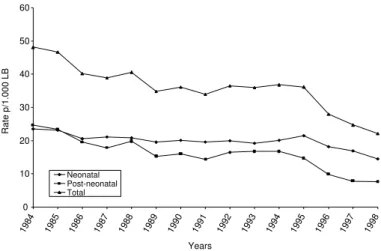
Table 1 presents the number of deaths in each year, the number of live births and the correction factor utilized to obtain the best estimate for the rate of infant mortality for both the capital and the remain-ing districts within the metropolitan region. It is note-worthy that the infant mortality coefficient decreased significantly in the MRBH in the study period, hav-ing gone from 48.5 per thousand live births to 22.1 per thousand live births, corresponding to a decrease of approximately 54% (beta =-0.56;p<0.0001).
Figure 1 presents the evolution of neonatal and post-neonatal mortality and makes it possible to ob-serve that there was a greater decrease in the post-neonatal mortality. From the third year of the series under study (1986) onwards the neonatal component was larger than the post-neonatal component and this tendency was maintained in the following years.
The decreases observed during the fifteen years analyzed were of approximately 38% for the neonatal mortality (beta =-1.60; p=0.0003) and 69% for the post-neonatal mortality (beta =-0.82; p<0.0001). An average decrease of 2.5% per year in the neonatal mortality and of 4.6% in the post-neonatal mortality could be inferred. However, a regular decrease was not observed in the curves throughout the years un-der study. It is possible to note more accentuated de-creases in the first and last years of the series studied and a stable behavior during the largest part of the period analyzed. From 1986 to 1995 no decrease was observed in the infant mortality nor in its neonatal or
Figure 1 - Infant mortality: neonatal and post-natal components for the Metropolitan Region of Belo Horizonte, MG, 1984-1998.
0 10 20 30 40 50 60
1984 1985 1986 1987 1988 1989 1990 1991 1992 1993 1994 1995 1996 1997 1998 Years
Rate p/1.000 LB
" Rev Saúde Pública 2005;39(1) www.fsp.usp.br/rsp Avoidable causes of infant mortality
Caldeira AP et al
post-neonatal components in the municipali-ties within the MRBH (within this period the linear regression analyses presents values that are not significant for beta).
As to the evolution of the major groups of causes of infant mortality in Belo Horizonte and the rest of the metropolitan region sur-rounding it, it was verified that the greatest variation occurred in mortality due to con-ditions originating in the perinatal period and the diarrhea-pneumonia-malnutrition cluster (see Table 2). The rate of mortality due to congenital anomalies was relatively stable throughout the period, whereas
mor-tality attributed to “other causes” presented Figure 2of causes, Belo Horizonte, MG, 1984-1998. - Infant neonatal and post-neonatal mortality and main groups 0
5 10 15 20 25
1984 1985 1986 1987 1988 1989 1990 1991 1992 1993 1994 1995 1996 1997 1998 Years
Rate per 1.000 LB
Post-neonatal Perinatal Conditions Diarrhea-Pneumonia-Malnutrition Neonatal
Table 1 - Evolution of the total number of infant deaths, of the number of live births registered (with the respective correction factor) and rate of infant mortality, Metropolitan Region of Belo Horizonte, MG, 1984-1998.
Year Total number Number of Correction Rim
of infant live births factor for the (per 1.000 lb)
deaths regi stered/year number of lb*
1984
Capital 2,310 45,640 12.3 45.1
Regi on 1,411 23,634 10.0 54.3
1985
Capital 2,143 44,032 13.6 42.8
Regi on 1,365 22,708 11.1 54.1
1986
Capital 2,043 46,277 13.4 38.9
Regi on 1,119 23,442 11.9 42.6
1987
Capital 1,994 47,766 11.3 37.5
Regi on 1,100 24,006 9.4 41.8
1988
Capital 2,041 46,396 11.0 39.6
Regi on 1,196 25,791 9.4 42.3
1989
Capital 1,799 43,763 11.9 36.7
Regi on 1,044 29,864 9.4 31.9
1990
Capital 1,638 40,461 10.3 36.7
Regi on 1,129 29,304 9.0 35.3
1991
Capital 1,439 39,052 10.3 33.4
Regi on 1,120 29,580 9.2 34.7
1992
Capital 1,501 38,305 11.9 35.0
Regi on 1,273 29,890 10.8 38.4
1993
Capital 1,541 39,341 12.9 34.7
Regi on 1,345 32,058 11.7 37.6
1994
Capital 1,710 39,591 11.5 38.7
Regi on 1,203 31,481 11.0 34.4
1995
Capital 1,344 31,230 14.1 37.7
Regi on 1,257 32,138 12.8 34.7
1996
Capital 1,162 37,623 12.5 27.4
Regi on 1,109 34,356 12.9 28.6
1997
Capital 1,025 38,335 14.3 23.4
Regi on 1,040 34,959 13.6 26.2
1998
Capital 844 35,805 16.5 20.2
Regi on 985 35,260 16.1 24.1
Sources: Sistema de Informações sobre Mortalidade do Ministério da Saúde e Instituto Brasileiro de Geografia e Estatística (IBGE) [Information System on Mortality of the Ministry of Health and Brazilian Institute of Geography and Statistics] *Correction Factor obtained by the Giraldelli-Wong Method
Rim: Rate of infant mortality lb: Live births
#
Rev Saúde Pública 2005;39(1) www.fsp.usp.br/rsp
Avoidable causes of infant mortality Caldeira AP et al
irregular behavior, with a more notable de-crease only in the last few years.
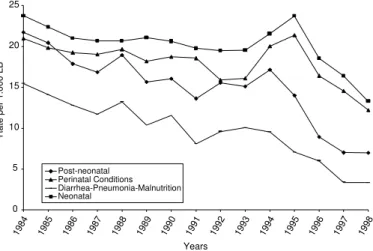
Figure 2 presents the evolution of infant mortality in the municipality of Belo Horizonte alone, distinguishing the neonatal and post-neonatal components. The most conspicuous clusters of causes in each com-ponent are also presented. It may be observed that the cluster of perinatal conditions and diarrhea-pneumonia-malnutrition were the major determinants of neonatal and post-neonatal death, respectively. Figure 3 presents the same curves, but in reference to the metropolitan region surrounding, but not including Belo Horizonte.
Three distinct moments in the evolution
of post-neonatal mortality stand out in Figures 2 and 3. A frankly declining tendency is observed between
1984 and 1991, despite the ascending peak in the year 1988. From 1991 onwards the post-neonatal
mor-Figure 3 - Infant neonatal and post-neonatal mortality and main groups of causes in the Metropolitan Region surrounding Belo Horizonte, MG, 1984-1998.
0 5 10 15 20 25 30
1984 1985 1986 1987 1988 1989 1990 1991 1992 1993 1994 1995 1996 1997 1998 Years
Rate per 1.000 LB
Diarrhea-Pneumonia-Malnutrition Perinatal Conditions Noenatal Post-neonatal
Table 2 - Evolution of the main groups of causes of infant mortality, Metropolitan Region of Belo Horizonte, MG, 1984-1998.
Year Causes
Congenital Perinatal D PM O thers
Rate* * % Rate* * % Rate* * % Rate* * %
1984
Capital 3.5 7.7 21.0 46.1 15.4 33.9 5.6 12.4
Regi on 3.0 5.5 23.2 42.8 22.2 40.9 5.9 10.8
1985
Capital 3.6 8.5 19.8 46.3 14.1 32.9 5.3 12.3
Regi on 3.2 6.0 23.3 43.0 20.5 37.9 7.0 13.0
1986
Capital 2.8 7.1 19.3 49.5 12.8 32.9 4.1 10.5
Regi on 3.5 8.2 17.9 42.1 15.7 36.9 5.5 12.8
1987
Capital 2.8 7.4 19.1 50.8 11.7 31.2 4.0 10.6
Regi on 3.4 8.1 19.6 46.8 14.4 34.5 4.4 10.6
1988
Capital 3.1 7.9 19.7 49.6 13.2 33.4 3.6 9.1
Regi on 3.1 7.3 20.0 47.2 14.8 35.0 4.4 10.5
1989
Capital 3.1 8.5 18.2 49.5 10.3 28.2 5.1 13.8
Regi on 2.5 7.8 16.2 50.7 10.7 33.4 2.6 8.1
1990
Capital 2.6 7.1 18.7 51.1 11.6 31.5 3.8 10.3
Regi on 2.8 7.8 18.5 52.3 10.7 30.4 3.4 9.5
1991
Capital 3.2 9.7 18.6 55.6 8.1 24.2 3.5 10.6
Regi on 2.9 8.3 18.8 54.1 9.2 26.6 3.8 10.9
1992
Capital 3.6 10.3 15.9 45.4 9.6 27.4 5.9 16.8
Regi on 3.0 7.8 17.1 44.5 11.8 30.7 6.5 17.0
1993
Capital 2.8 8.2 16.1 46.4 10.1 29.1 5.7 16.3
Regi on 2.4 6.3 15.9 42.3 12.3 32.8 7.0 18.6
1994
Capital 2.9 7.4 20.0 51.7 9.5 24.6 6.3 16.3
Regi on 1.9 5.5 18.0 52.4 9.7 28.1 4.8 14.0
1995
Capital 4.1 10.9 21.4 56.7 7.1 18.7 5.2 13.8
Regi on 2.9 8.5 17.6 50.7 9.5 27.4 4.7 13.5
1996
Capital 2.8 10.3 16.4 59.8 6.0 21.9 2.2 7.9
Regi on 2.9 10.0 15.9 55.5 7.8 27.4 2.0 7.1
1997
Capital 3.0 12.8 14.6 62.2 3.4 14.4 2.5 10.6
Regi on 3.2 12.2 15.3 58.3 5.1 19.4 2.6 10.0
1998
Capital 1.9 9.6 12.2 60.4 3.3 16.5 2.8 13.5
Regi on 2.1 8.6 14.3 59.6 4.5 18.6 3.2 13.2
$ Rev Saúde Pública 2005;39(1) www.fsp.usp.br/rsp Avoidable causes of infant mortality
Caldeira AP et al
tality presented increasing rates both in the capital and in the metropolitan region surrounding it. This elevation presented its greatest peak in 1993 in the metropolitan region surrounding Belo Horizonte and, in 1994 in Belo Horizonte itself. The third moment presents an accentuated decline in the post-neonatal mortality in both regions.
As to the neonatal mortality, Figures 2 and 3 indi-cate very distinct behaviors. In Belo Horizonte, neonatal mortality remained practically stable from 1986 to 1993. It then presented rising rates until 1995 and afterwards there was an accentuated decline. As to the metropolitan region surrounding Belo Horizonte, neonatal mortality initially presented a tendency to decrease, but became irregular for the greater part of the period under study and sometimes presented lower rates than the capital. At the end of the study period, the accentuated decline verified in the capital was not observed in the metropolitan re-gion surrounding it.
D ISCU SSIO N
One of the major problems in the construction of trustworthy estimates of infant mortality rates is the availability of confidential data concerning death reg-isters and live births. The imprecision of data may dis-tort the rates obtained with obvious setbacks for future inferences. Although both birth and death registers are compulsory in Brazil, they are sub notified.16
The sub registration of infant deaths tends to be smaller in the large urban centers, where “clandes-tine cemeteries” are less likely to be found. It is as-sumed that this limitation is of little importance, par-ticularly in this region, for sub registration of deaths is considered of small significance.21 Thus, it is pre-sumed that the number of deaths recorded in the Subsistema de Informações sobre Mortalidade do Ministério da Saúde (SIM-MS) [Subsystem of Infor-mation on Mortality of the Ministry of Health] for the MRBH, during the study period, is very close to reality or that there is a small and negligible rate of sub notification.
As to the number of live births, the late registry of births may lead to a bias in the estimates of the rates of infant mortality. There are several methods that attempt to bypass this difficulty, according to different assump-tions and methodologies.13 Probably, at least in the region under consideration, different methodologies would lead to similar results, since the proportion of sub registrations beyond a delay of eight years is neg-ligible. A previous study that evaluated birth statistics in the municipality of Belo Horizonte indicated that
the rates of infant mortality, calculated by means of two distinct methods, did not present significant dif-ferences.13 Therefore, it may be admitted that the mag-nitude of the bias in the correction of sub registration of live births is of little importance, implying in varia-tions of the estimated rates that are not significant. This study presents an approximation of the evolution of the real rates of infant mortality for one of the large metropolitan areas in the Southeastern region of Bra-zil. In consonance with what occurs throughout most parts of the country, infant mortality is presenting a tendency to decline in the MRBH. The post-neonatal component presented the greatest decline during the study period and its reduction, was, therefore, respon-sible, in large part, for the decline in infant mortality in the region. A similar phenomenon has been observed in other regions.18 However, despite the significant decreases in the rates of post-neonatal mortality, it still represents an important public health problem in the capital as well as in the metropolitan region surround-ing it. In recent years, the estimated rates are consid-ered elevated in relation to those observed in devel-oped countries. In fact, the rates observed are more elevated than rates of infant mortality, in general, in various countries.1 Even within Latin America, some countries have rates significantly lower than those observed in this study. In Cuba, post-natal infant mor-tality was not greater than 6.5 per thousand live births in 1980 and had decreased to 3.9 per thousand live births in 1989.14 In Chile, post-neonatal mortality de-creased from 50.5 per thousand live births, in 1970 to 6.6 per thousand live births in 199219 and to 4.3 per thousand live births in 1998.9
The elevated participation of deaths in the “diarrhea-pneumonia-malnutrition” cluster is notorious. The eco-nomic model has certainly contributed towards the persistence of social inequities and is partially respon-sible for maintaining the sequence of events that cul-minates in infant mortality for apparently banal causes. This however, does not nullify the co-responsibility of the health services that, not being capable of interven-ing in the incidence of morbidity, should assume a commitment to provide early and effective assistance. In principle, diarrheic diseases and pneumonia are pathologies that are easy to handle and that do not require high cost technology. In the majority of cases, complications may be avoided by close surveillance, identifying situations or children that suffer greater risk for a more effective intervention. According to Taucher & Jofré19 (1997), the decrease in deaths due to diarrheic and respiratory diseases in Chile was due to a set of factors that include early access to health serv-ices and high quality medical care.
%
Rev Saúde Pública 2005;39(1) www.fsp.usp.br/rsp
Avoidable causes of infant mortality Caldeira AP et al
decline was also observed, particularly in the more recent years of the study period and mainly in the municipality of Belo Horizonte. However, this behavior was irregular, with inclinations varying a great deal throughout the years. This behavior has been observed by other authors that attribute these varied inclinations to the lack of quality of obstetric services.3 In fact, the evitability of neonatal deaths is more closely associated to the technical conditions of prenatal care and care during birth than to the ex-istence of intensive therapy’s sophisticated technol-ogy.10,12 The elevated proportion of deaths due to peri-natal conditions constitutes an indicator of alarm. Causes associated to the early interruption of preg-nancy or to restrictions in uterine growth are frequently associated to deficiencies in prenatal care. Obstetrics traumas, hypoxia or asphyxia at birth are also warn-ing signals of inadequate care at birth.10
On the other hand, it cannot be denied that the struc-ture of causes has presented progress throughout the years included in this study. In the capital, the par-ticipation of the cluster of causes “diarrhea-pneumo-nia-malnutrition” in infant mortality in general de-creased from approximately 34% in 1984 to 16.5% in 1998, a decrease, therefore, of the order of 50%. As to the metropolitan area surrounding Belo Horizonte, the reduction was equally significant, approximately 55%. This decline in the post-natal mortality is par-ticularly important in the metropolitan area surround-ing Belo Horizonte, because it tends to decrease the distance between the rates in the two areas of the Metropolitan region– Belo Horizonte itself and the metropolitan region surrounding it. A similar phe-nomenon was observed in a previous study in the metropolitan region of Rio de Janeiro.11
Certainly the process of municipalization of health services makes it possible to develop different ap-proaches for different municipalities. A more efficient intervention depends upon the priority given to the quality of assistance and greater equity in access to care. It is not very likely that the metropolitan region surrounding Belo Horizonte is representative of the rest of the State. The proximity to propedeutic and therapeutic resources, the greater demographic den-sity of health professionals, the number of outpatient and hospital establishments has, surely played an important role in the decline of infant mortality in the entire MRBH, which probably does not happen in the rest of the State. This data, however is difficult to measure, for the vital statistics for the majority of districts within the State are very precarious.
The behavior of the rates of infant mortality makes it possible to infer that new developments are neces-sary. Post-natal and neonatal mortality due to perina-tal causes, such as prematurity, hypoxia and obstet-rics traumas, represent a reserve in which it is possi-ble to obtain further reductions in mortality during the first year of life in the future. In this sense, the participation of the health services is fundamental. However, the need for a continual and efficacious social policy geared towards the improvement of sani-tary conditions, maternal education and access to goods and services in general, including opportune, high quality medical care should not be neglected.
Throughout the historical series discussed in this paper, Brazil passed through important transforma-tions. In relation to public health policies, the imple-mentation of the Brazilian Unified Health System (SUS), in 1988, must be emphasized. This represented a new paradigm for health care in Brazil, in terms of policy, technology and ideology as well. As to child health, immunization programs, programs for the con-trol of diarrheic diseases and oral rehydration therapy, for the surveillance of growth and development, as well as programs for food supplementation were aug-mented. As to prenatal care and care in childbirth, advances were not as significant. As to care for the sick child, bottlenecks sill exist within the health system. The network of hospital assistance is predomi-nantly private and maintains contracts with the pub-lic services. Frequently the care provided is not linked to the public network in general, implying in a rup-ture with the concept of integral health care, which is of fundamental importance in infant health care.
& Rev Saúde Pública 2005;39(1) www.fsp.usp.br/rsp Avoidable causes of infant mortality
Caldeira AP et al
REFEREN CES
1. Ahmad OB, Lopez AD, Inoue M. The decline in child mortality: a reappraisal. Bull WHO 2000;78:1175-91.
2. Caldeira AP, França E, Goulart EMA. Mortalidade infantil pós-neonatal e qualidade da assistência médica: um estudo caso-controle. J Pediatr 2001;77:461-8.
3. Campos TP, Carvalho MS, Barcellos CC. Mortalidade infantil no Rio de Janeiro, Brasil: áreas de risco e trajetória dos pacientes até os serviços de saúde. Rev Panam Salud Publica 2000;8:164-70.
4. Carvalho, ML. Mortalidade neonatal e aspectos da qualidade da atenção à saúde na região metropolita-na do Rio de Janeiro [dissertação de mestrado]. Rio de Janeiro: Escola Nacional de Saúde Pública da Fundação Oswaldo Cruz; 1993.
5. França E, Souza JM, Guimarães MDC, Goulart EMA, Colosimo E, Antunes CMF. Associação entre fatores socioeconômicos e mortalidade infantil por diarréia, pneumonia e desnutrição em região metropolitana do Sudeste do Brasil: um estudo caso-controle. Cad Saúde Pública 2001;17:1437-47.
6. Frias LAM. Um modelo para estimar o sub-registro de nascimentos. Bol Demográfico 1982;13:11-32.
7. Giraldelli BW, Wong LR. O comportamento do registro atrasado de nascimentos (RAN) no Estado de São Paulo: uma tentativa de correção do sub-registro. Inf Demográfico 1984;13:53-135.
8. Hartz ZMA, Champagne F, Leal MC,
Contandriopoulos AP. Mortalidade infantil “ evitável” em duas cidades do Nordeste do Brasil: indicador de qualidade do sistema local de saúde. Rev Saúde Pública 1996;30:310-8.
9. Kaempffer Ramirez AM, Medina Lois E. Análisis de la mortalidad infantil y factores condicionantes: Chile 1998. Rev Chil Pediatr 2000;71:405-12.
10. Lanski S, França E, Leal MC. Mortalidade perinatal e evitabilidade: revisão da literatura. Rev Saúde Pública 2002;36:759-72.
11. Leal MC, Szwarcwald CL. Evolução da mortalidade neonatal no Estado do Rio de Janeiro, Brasil, de 1979 a 1993. I- Análise por grupo etário segundo região de residência. Rev Saúde Pública 1996;30:403-12.
12. O rtiz LP. U tilização das causas evitáveis na mortalidade infantil como instrumento de avaliação das ações de saúde. In: 9º Encontro Nacional de Estudos Populacionais 1996; Anais. Belo Horizonte: ABEP; 1996.
13. Perpétuo IHO, França E. Avaliação das estatísticas de nascimentos em Belo Horizonte, 1974-1994. In: 9º Encontro Nacional de Estudos Populacionais. Belo Horizonte; 1996. p. 219-35.
14. Riverón Corteguera RL. Estratégias para reducir la mortalidad infantil, Cuba 1959-1999. Rev Cubana Pediatr 2000;72:147-64.
15. Saad PM. Mortalidade infantil por causas no Estado de São Paulo (Brasil), em 1983: análise sob a perspec-tiva de causas múltiplas de morte. Rev Saúde Pública 1986;20:481-8.
16. Szwarcwald CL, Leal MC, Andrade CLT, Souza Jr PRB. Estimação da mortalidade infantil no Brasil: o que dizem as informações sobre óbitos e nascimentos do Ministério da Saúde? Cad Saúde Pública
2002;18:1725-36.
17. Szwarwald CL, Leal MC, Jourdan AMF. Mortalidade infantil: o custo perverso do desenvolvimento brasilei-ro. In: Leal MC, Sabroza PC, Rodriguez RH, Buss PM. organizadores. Saúde, ambiente e desenvolvimento: processos e consequências sobre as condições de vida. v. 2. São Paulo: Hucitec: 1992. p. 251-78.
18. Simões CC. Brasil: estimativas da mortalidade infantil por microrregiões e municípios. Brasília (DF): Ministério da Saúde; 1999.
19. Taucher E, Jofré I. Mortalidad infantil em Chile: el gran descenso. Rev Med Chile 1997;125:1225-35.
20. Victora CG, Bryce J, Fontaine O, Monasch R. Reducing deaths from diarrhoea through oral rehydration therapy. Bull WHO 2000;78:1246-55.
21. Viegas JMS, Dolabela RF. Estudo qualitativo das estatísticas de nascimentos e óbitos: o sub-registro em Minas Gerais e região metropolitana de Belo Horizonte: resultados definitivos do censo demográfi-co de 1980. Indic Conjunt Belo Horizonte