1037
SNEŽANA JOVIČIĆ1, SMILJKA ŠIMIĆ1 and A. VUJIĆ1*
1Department of Biology and Ecology, Faculty of Science, University of Novi Sad, 21000 Novi Sad, Serbia 2 Department of Geography, Tourism and Hotel Management, Faculty of Science, University of Novi Sad,
21000 Novi Sad, Serbia
Abstract - Seven species of the genus Pipiza, collected throughout the southern and western Balkans, were used for the analysis of habitat preferences and potential geographical distribution on the Balkan Peninsula. he analyzed species show a wide and uneven distribution across the delineated geographical-biogeographical regions. he highest number of species noted is from two regions – the Dinaric mountain chain and the Pannonian and subpannonian regions (seven and six). Land cover patch analysis revealed that forests dominate the landscape surroundings of the analyzed species. “Presence-only models” developed by Maxent support the understanding of the distribution and ecology of each analyzed species. he low probability values of current potential distribution correspond to large non-forested and fragmented forest areas, where, on the other hand, relatively high probabilities overlap with areas of deciduous forests across the peninsula. Results conirm species preference to forest landscapes and emphasize the need for local scale analysis. he studies are of impor-tance in developing regional monitoring schemes and conservation strategies.
Key words: Hoverlies, Pipiza, land cover, Balkan, Maxent, distribution, modeling.
INTRODUCTION
he monophyletic tribe Pipizini (Diptera, Syrphidae) comprises 6 genera with approximately 63 species in Europe. he genus Pipiza is in a broader sense con-ined to the Holarctic region, whereas in the Palae-artic, according to the catalogue of Palaearctic Dip-tera (Peck, 1988), 17 species are present. As for the European species belonging to the genus Pipiza, a re-cent taxonomic revision listed by Vujić et al. (2013) reveals 12 European species; Pipiza accola Violovitsh, 1985; Pipiza austriaca Meigen, 1822; Pipiza carbon-aria Meigen, 1822; Pipiza fasciata Meigen, 1822;
Pipiza festiva Meigen, 1822; Pipiza laurusi Vujić & Stahls 2013; Pipiza luteibarba Vujić, Radenković &
groups: long-tongued bee, short-tongued bee, other Hymenoptera, Diptera, Coleoptera, Lepidoptera, Hemiptera, Neuroptera and birds (Robertson, 1928). Except for a few groups thoroughly investigated in some parts of Europe (e.g. United Kingdom, Hol-land; Biesmeijer, 2006), the extended knowledge of pollinators, especially non-Apis pollinators, remains deicient (Potts et al., 2011), mainly in the context of their ecology and distribution. According to NRC (2006), environmental changes such as habitat frag-mentation and habitat loss inluence the functional diversity of pollinators and animal-pollinated plants but interactive efects are not yet fully understood (Schweiger et al., 2011).
he recent revision of the genus Pipiza and re-solved taxonomic issues by Vujić et al. (2013) high-lighted the fact that the ecology of species of the ge-nus Pipiza and factors that shaped their distribution are mainly unstudied and scant. Based on this study, 10 species are present on the Balkan Peninsula. he Balkan region is characterized by diverse and com-plex geographic and bio-geographical structure as a result of its turbulent geological history, variety of morphological and climatic features (Cvijić, 1904; Stanković, 1960; Savić, 2008). Bioregions, for the Balkans as a whole, are characterized by broad, land-scape-scale natural features and environmental proc-esses capturing the large-scale geographical patterns across the peninsula (Matvejev 1976; Savić, 2008). he remarkable richness of biodiversity is illustrated by the endemic and relict hoverly fauna (Šimić et al., 1999). Two species of the genus Pipiza from the Balkan Peninsula, P. luteibarba and the newly dis-covered species P. laurusi, are endemic, distributed in fragile and endangered ecosystems, and because of this, P. luteibarba is regarded as a candidate for the European Red List (Speight, M., pers. comm.).
In recent years, modeling methods using the data on species occurrence and environmental covariates, have been proliferating, greatly facilitating the un-derstanding, as well as prediction of the geographic distribution of species (Vargas et al., 2004; Elith et al., 2006). he results from studies taking the modeling approach are deemed to be of high importance and
ind a wide application, for example in conservation planning, monitoring schemes, biodiversity assess-ments, habitat management, restoration, prediction of the efects of environmental changes on species and ecosystems etc. Predictive modeling of a species geographic distributions with Maxent (Philips et al., 2006) that requires “presence-only” species occur-rence data and environmental data to estimate the potential distribution, i.e. prediction of relative suit-ability (Philips et al., 2006), has been used for a wide range of studies: species richness, estimation of the extent of occurrence, quality of protection of rare species, invasive species, climate change efects on species distribution, endemism hotspots (see Fran-klin, 2010).
he aim of this paper is to present occurrence data of species of the genus Pipiza; to describe land-scape-based habitat preference on the CORINE land cover patches, and to determine the potential distri-bution with SDM techniques. Such information is of great importance for future regional monitoring schemes and conservation strategy.
MATERIALS AND METHODS
Study area
he sampling localities spread across the western and southern Balkan area, with focus on mountain forests, forest edges and streams (Table 1). Species distribution across biogeographical regions was test-ed with a Chi square test (Statsot 10).
Data source
he material used in this study was collected over the course of more than 15 years of investigations (1985-2000) of the genus Pipiza hoverlies on the Balkan Peninsula. he collection is deposited at the Depart-ment of Biology and Ecology, Faculty of Natural Sci-ences, University of Novi Sad (Serbia). Sampling was done through several visits following the seasonal timescale of the species (spring and summer) and us-ing the standard method (census) for collectus-ing and preparation of hoverlies. According to data availa-bility presented in Table 2,7 out of 12 European spe-cies of the genus Pipiza were used in this study; 2 out of 12 European Pipiza species are not present on the Balkan Peninsula (P. accola and P. lugubris).
Land cover patch classiication
he classiication of land cover patches was based on the Corine Land Cover (CLC 2000), made in the scale of 1: 100,000 and with a minimal mapping area of 25 ha. he standard CLC nomenclature includes 44 land cover classes, grouped in a three-level hier-archy. A circle 2 km in radius was delineated around each occurrence point, taken to be the full range of the individual specimen and longest dispersal move (according to experts’ ield experience). For the es-timation of each land-use type portion within the delineated circles, all land cover classes were used for the calculation of class area – equals the sum of the areas of all land cover patches (units of equal ha); total area – equals the area of all land cover patches
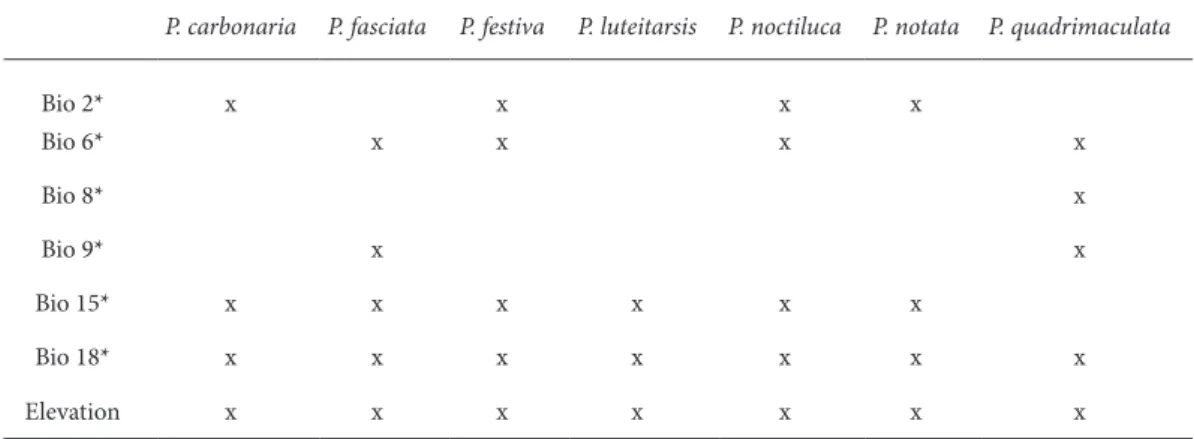
on species occurrence with environmental vari-ables to create a model of species’ ecological niche requirements (Franklin et al., 2010), and projecting the model into geographic space presents the species’ potential distribution (Philips et al., 2006). he mod-eling sotware MAXENT calculates the range of spe-cies in order to ind the spespe-cies distribution of maxi-mum entropy – closest to the uniform (Philips et al., 2006; Philips and Dudik, 2008). Calibration (train-ing) data was generated by random selection of 75% occurrence records and 25% for testing. he chosen Maxent default settings were: (maximum number of iterations = 500, convergence threshold = 10−5, regularization multiplier = 1.0, maximum number of background points = 10000). Cross-validation repli-cates were done for each species. All data points were entered into the Geographic Information System DIVA-GIS 5.2 (Hijmans et al., 2005). Based on the species preferences, by using Worldclim variables, 2.5 arc-minutes resolution (Hijmans et al., 2005) and elevation, the area of species distributions were modeled and projected on the Balkan Peninsula. Covariates were irst tested for muticolinearity with VIF (various inlation factors) analysis in R package. Selected covariates for SDM analysis are shown in Table 3.
around every occurrence point and then merged to one polygon. his polygon served for background data sampling because it represents geographical and environmental space with the same bias as the oc-currence data (Philips et al., 2009). he AUC values ranges from 0.5 (randomness) to 1 (perfect discrimi-nation). he spatial analysis yielded seven maps (one for each species) presenting the potential species dis-tribution on the Balkan Peninsula.
RESULTS
Data distribution
he number of species is unevenly distributed (Chi-Square = 6, 25; p = 0, 28) across the geographical-bi-ogeographical regions on the southern and western Balkan Peninsula, with the highest diversity on the Dinaric mountain chain, and Pannonian and sub-pannonian regions (Fig. 1).
Land cover patch analysis
Results of land cover patch analysis are summarized for seven analyzed species of the genus Pipiza in Fig. 2.
Pipiza carbonaria. Landscape around the oc-currence points is strongly dominated by deciduous forests, (covering 98% of the analyzed surrounding surface) and transitional woodland-shrub that cov-ers slightly more than 1%.
Pipiza fasciata. Deciduous forests are the domi-nant land cover type in the surrounding of the occur-rence points, covering 83%, followed by coniferous forests (8%), transitional woodland-shrub (5%) and mixed forests (2%).
Pipiza festiva. Deciduous forests cover the largest part of the area surrounding the occurrence points (85%). Open and semi-open patches of land cover, non-irrigated arable land, discontinuous urban fab-ric and complex cultivation pattern are also well rep-resented (9%, 5% and 1 %, respectively).
Pipiza luteitarsis. he surrounding area of the occurrence points is dominated by deciduous forests (70%), with a signiicant presence of coniferous and mixed forests (17% and 4 %, respectively), along with transitional woodland-shrub (6%).
Fig. 1. Sample distribution of Pipiza species throughout the
geograph-ical-biogeographical regions of Balkan deined by Matvejev (1969):
PP - Panonian and subpanonian region, SA - Eastern Alpes, CS - Car-pathians, DO – North and South Dinaric mountains, SR - Stara planina
(Balkan range) Rilo-Rhodopes-Moesian hilly areas, AE - Mediterranean (Adriatic and Aegean).
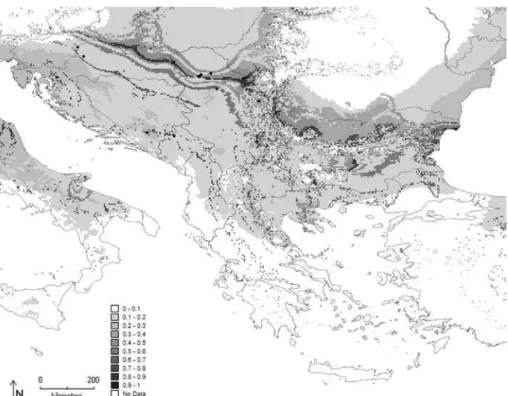
Fig. 3. Maximum entropy model developed for P. carbonaria on the Balkan Peninsula. Diferent shades of gray represent the percentage of the probability of occurrence.
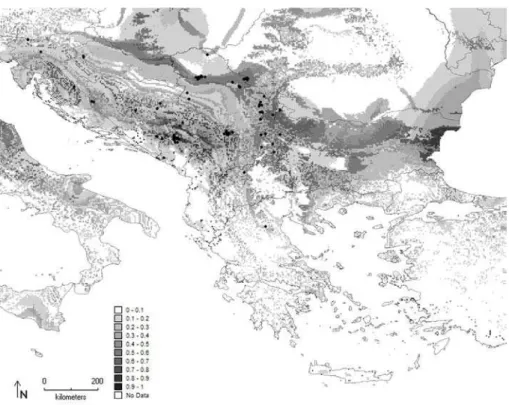
Fig. 5. Maximum entropy model developed for P. festiva on the Balkan Peninsula. Diferent shades of gray represent the percentage of the probability of occurrence.
Fig. 7. Maximum entropy model developed for P. noctiluca on the Balkan Peninsula. Diferent shades of gray represent the percentage of the probability of occurrence.
Pipiza noctiluca. he surroundings of the oc-currence points are highly dominated by deciduous forests (93%). Futhermore, another 13 types of land cover classes were present, showing a wide range of habitats within the landscape matrix occupied by this species.
Pipiza notata. Although area surrounding the occurrence points was dominated by deciduous for-est (46%), the percentage of other land cover types was also signiicant and slightly higher than in cases of other species. Natural grasslands, followed by co-niferous and mixed forests, transitional woodland-shrub, and a few types of mosaic cultivated landscape, covered a signiicant portion of the surrounding area (36%, 7%, 6%, 2% and 3 % respectively).
Pipiza quadrimaculata. he occurrence points in the surrounding area are dominated by deciduous forests (54%), followed by mixed forests (23%). Per-centage of area under transitional woodland-shrub
(10%), natural grassland (7%), coniferous forests (4%) and pastures (1%) is also signiicant.
Distribution modeling
he most important variable for Pipiza species was elevation (alt), and the jackknife tests showed that eliminating it from the analyses dramatically lowers the predictive power of the models. Temperature and precipitation variables followed by their importance for each species of the genus Pipiza, respectivly, in slightly diferent combinations. he remaining cli-matic variables were only marginally important and removing them did not severly afect the models’ pre-formance. he contribution of covariates used for the analysis of distribution of each species is presented in Table 4.
Training AUC was 0.920 for P. quadrimaculata; 0.871 for P. notata; 0.847 for P. carbonaria; 0.820 for
P. luteitarsis; 0.808 for P. faciata;0.800 for P. festiva;
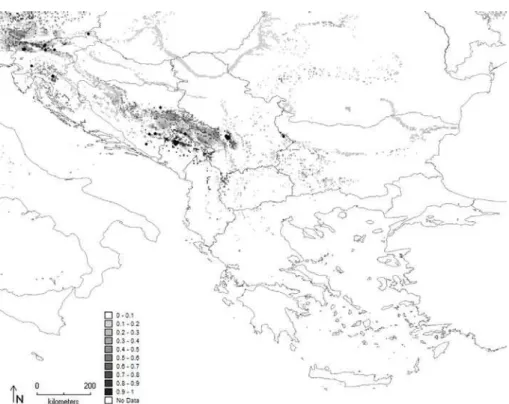
and 0.795 for P. noctiluca. he geographical distribu-tion of the Maxent-predicted suitability for the seven species in 2.5 arc minutes across the Balkan Penin-sula are described in more detail below and are pre-sented in Fig. 3-9.
Geographical distribution of species across the Balkan Peninsula : Pipiza carbonaria
he obtained distribution model projects the higest presence probabilities for borders of the Pannonian plain, Pannonian mountains, Carpathian foothills, Mt. Stara planina (Balkan range), and some small isolated patches of the Dinaric mountain chain. he
lowest presence probabilities are projected for most of the Pannonian plain, eastern parts of the Dinaric mountain chain, most of the FYR Macedonia, as well as the Mediterannean part of the Balkans (Fig. 3).
Pipiza fasciata
he highest presence probabilities are projected for the Pannonian mountains, the Danube and Drava river valleys, the eastern borders of the Pannonian plain, Carpathian foothills, mountains of southeast-ern Serbia, Mt. Stara planina (Balkan range), Strandža Mountain, and parts of the Dinaric mountain chain. he lowest presence probabilities are projected for P. fasciata Specimen: 10Localities: 5 Specimen: 6Localities: 3 Specimen: 7Localities: 3
P. festiva Specimen: 19Localities: 7 Specimen: 1Localities: 1 Specimen: 4Localities: 3
P. luteitarsis Localities:3 Specimen 7 Specimen: 18Localities: 2 Specimen: 6Localities:1
P. noctiluca Specimen l: 83Localities:9 Localities: 1 Specimen: 4 Specimen: 13Localities: 4 Specimen: 68Localities:13 Localities:6 Speci-men: 8 Specimen: 7Localities:3
P. notata Localities: 3
Specimen: 27
Localities:2 Specimen: 3
Localities:1 Specimen: 1
Localities:5 Specimen: 23
P. quadrimaculata Localities: 7
Specimen: 14
Localities:8 Specimen: 209
Localities:1 Speci-men:1
Total number of
specimens 168 21 38 335 15 10
Total number of
localities 14 8 7 22 6 3
Total number of
parts of the Pannonian plain, the Danube valley in the eastern part of the Djerdap gorge, the western part of the Dinaric mountain chain and the entire southern and Mediterannean Balkan region, show-ing the southern border of the species range (Fig. 4).
Pipiza festiva
he highest presence probabilities are projected for the Pannonian mountains, western Pannonian bor-ders, the Sava, Danube and Morava river valleys, smaller patches within the Dinaric mountain chain, the Carpathian foothills, the Rilo-Rhodopes, Mts. Strandža and Stara Planina (northern Balkan foot-hills). he lowest probabilities of presence are pro-jected for the Carpathian mountain chain, a large part of the Dinaric mountain chain, the highest parts of Rilo-Rhodopes and Mt. Stara planina (Balkan
range), as well as southern parts of the Mediteranean Balkan, showing the southern borders of the species range (Fig. 5).
Pipiza luteitarsis
he highest probabilities of presence are projected for the Pannonian mountains, parts of the Danube and Drava river valleys, hilly mountains in east-ern and central Serbia, parts of Mts. Stara planina (Balkan range), Rilo-Rhodopes, Strandža, Galičica, Kožuf and the Dinaric mountain chain. he lowest presence probabilities are projected for the whole Carpathian region, parts of the Pannonian plain and the whole Mediteranean and southern Balkan region (Fig. 6).
Pipiza noctiluca
he highest presence probabilities are projected for the Pannonian mounains, the Danube and Drava river valleys, hilly mountains of eastern Serbia, parts of the Rilo-Rhodopes, Mts. Stara planina (Balkan range), Strandža, Galičica, Kožuf and the Dinaric mountain chain. he lowest presence probabilities are projected for parts of the Pannonian plain, higher parts of the Carpathian and Rila-Rhodopes moun-tains, as well as a large part of the Mediterenean Bal-kan region (Fig. 7).
Table 2. Species modeled for the analysis
Speciment Number
P. carbonaria 47
P. fasciata 27
P. festiva 25
P. luteitarsis 31
P. noctiluca 172
P. notata 65
P. quadrimaculata 220
Table 3. Selected covariets for the SDM analysis
P. carbonaria P. fasciata P. festiva P. luteitarsis P. noctiluca P. notata P. quadrimaculata
Bio 2* x x x x
Bio 6* x x x x
Bio 8* x
Bio 9* x x
Bio 15* x x x x x x
Bio 18* x x x x x x x
Elevation x x x x x x x
P. noctiluca is the only species of the Pipiza genus found in a few diferent localities in the Mediteranean region of the Balkan Peninsula. Its potential distri-bution signiicantly spreads across the Mediteranean Balkan region compared to other species of Pipiza.
Pipiza notata
he highest probability presence is projected for the eastern border of the Pannonian plain, the Danube and Drava river valleys, the Carpathian foothills, parts of the Dinaric mountain chain, Mts. Stara plani-na (Balkan range), Rilo-Rhodopes and Strandža. he
lowest probabilities are projected for a large part of the Pannonian plain, the eastern Dinaric mountain chain and western borders of the Pannonian plain, Carpathians, a larger part of Bulgaria and most of the southern and Mediteranean Balkan region. he pro-jected distribution probably ilustrates the southern border of species range (Fig. 8).
Pipiza quadrimaculata
he highest presence probabilities are projected for the southern and southeastern Dinaric mountain chain, the Alpine region, a small part of Mt. Stara P. faciata alt bio 9 bio 6 bio 18 75.5 23.7 0.6 0.2 71.7 28.3 0 0 P. festiva alt bio 6 bio 18 93 0.6 0.2 88.5 0 0
P. luteitarsis bio 15alt 75.524.5 83.116.9
planina (Balkan range) and the Rilo-Rhodopes, Mt. Šar planina and the higest mountain areas of Greece and FYR Macedonia. he lowest presence probabili-ties are projected for a large part of the hilly regions, foothills and lowland area on the Balkan Peninsula (Fig. 9).
DISCUSSION
he presented results show that the Pipiza genus is widely and unevenly distributed throughout the southern and western Balkan region. For most spe-cies of the genus (except P. noctiluca), the Balkan Pe-ninsula represents the southern border of its range (Speight, 2012). Research localities include a number of ecological variations, characteristic for the Balkans (Adamović 1909; Matvejev, 1976; Stevanović and Stevanović, 1995; Stevanović et al., 1995), so most could be considered as a full environmental range (in terms of climate, topography and habitat types) of Pipiza species in southern and western Balkans.
he distribution of Pipiza species in the western and southern Balkans is mostly associated with the distribution of European, mainly deciduous, forests. he results conirm this to a great degree with most of the analyzed species occurring in the submedi-terranean zone of deciduous forests and mountain coniferous and mixed forests. Only one species (P. noctiluca) is widely distributed and common across the Mediterranean part of the researched area. High mountains with alpine ecosystems have a low diver-sity of the species, with only one species regularly present above the forest zone (P. quadrimaculata) (Speight, 2012). In contrast, six species were record-ed in the Pannonian and subpannonian mountains (Fruška gora and Vršačke planine), and four species in the lowland forests of the Pannonian biogeograph-ical region. he Pannonian mountains (Fruška gora and Vršačke planine) are covered by diverse forests, including oak, beech, hornbeam and lime commu-nities (e.g. Janković and Mišić, 1980; Sučević, 1962; Butorac, 1992), and, obviously, represent a suitable habitat for most Pipiza species, and could be consid-ered as the center of Pipiza species diversity. Fruška gora and Vršačke planine are also well-documented
centers of hoverly diversity in the Pannonian part of Serbia (Vujić and Glumac 1992, Vujić and Šimić 1994, Nedeljković et al., 2008, Nedeljković et al., 2009).
Land cover patch analysis revealed that forests dominate in the landscapes surrounding the occur-rence points of all analyzed species. Besides forests,
Pipiza species occupy on forest edges, bushes, near-water localities, orchards, gardens and plantations (Speight, 2012), important in the life cycle of hover-lies (breeding, feeding sites, sun basking, etc.).
Results show that species of the genus Pipiza
on the Balkan Peninsula generally depend on forest landscapes with natural grasslands, arable land, or-chards, streams, etc.
Pipiza carbonaria is a mainly forest and forest-edge species, with a preference for oak forests (Spei-ght, 2012), which is also presented in our analysis. Oak forests are widely distributed in the western and southern Balkans (e.g. Stevanović et al., 1995; Matve-jev, 1961).
Pipiza fasciata mostly occupies diverse for-ests dominated by oak, beech and spruce (Speight, 2012). he analysis revealed that in the western and southern Balkan region this species occurs mainly in decidious forests, similar to its representatives in the central and northern European range (Speight, 2012).
Pipiza festiva is generally a lowland- and lood-plain-forest species, also occupying mosaic land-scapes (Speight, 2012). he results conirm species preference for loodplain forests, as well as for other lowland forest types. he presence of open and semi-open land cover patches may be a consequence of the severe fragmentation of lowland forests in the west-ern and southwest-ern Balkans (Stevanović, 1995) or even illustrate a certain preference of the species to suit-able mosaic habitats.
row and with wide transition zones between them (Matvejev, 1961).
Pipiza noctiluca could be considered a typical de-ciduous forest species in the western and southern Balkan region. It occurs in a wide variety of habitats, from diverse forests to plantations of conifer and de-ciduous trees, orchards, gardens, hedges and water edges (Speight, 2012). Most of these habitats appear in the surrounding of the occurrence points, but in a somewhat smaller percentage than expected. his may be explained by the slightly diferent habitat preferences of the species in the western and south-ern Balkan region.
Field observations usually conirm that P. notata
and P. noctiluca oten occur at the same localities and, generally, in similar habitats. he results of this study, however, suggest greater diferences in habitat pref-erences of the two species in the western and south-ern Balkan region. In the case of this study, however, the land cover analysis showed that populations of
P. notata occupy a wider range of landscapes domi-nated by deciduous forests, and to a lesser extent the types of landscapes occupied by P. noctiluca. Hence, the results suggest a greater diference in the habitat preferences of the two species P. notata and P. noc-tiluca in the western and southern Balkan region.
Mountain coniferous and mixed forests, especial-ly moist beech and spruce forests are a typical habitat of the species P. quadrimaculata (Speight, 2012). he results conirm that in the western and southern Bal-kan region, P. quadrimaculata is also a typical moun-tain species occurring in various types of mounmoun-tain forests, as well as in other habitat types common for the mountain zone above the forest line. he rela-tively small percentage of coniferous forests and at the same tim much higher percentage of deciduous
areas without larger forest areas, as is the case in a large part of the Pannonian plain, as well as in se-verely fragmented deciduous forests. On the other hand, most specimens were collected on few well-researched areas, where all or all but one species were found: Fruška gora, Vršačke planine, Kopaonik and Durmitor. hese sites contain large, continuous, well-preserved and complex deciduous forest land-scapes (e.g. Mišić and Popović, 1954; Sučević, 1962; Janković and Mišić, 1980; Lakušić et al., 1984) and are legally protected as national parks or under other protected area categories.
he highest AUC values were obtained for P. quadrimaculata, the species with the highest number of occurrence points and quite speciic ecological preferences (e.g., altitudes), connoting high, reli-able predictive capacity gain (e.g .AUC > 0.75 is considered as acceptable). he lowest AUC value for
P. noctiluca was probably due to the highest spatial autocorrelation of sampling points, which was not resolved with the bias grid ile used. his can also be explained by the fact that the model calculation for generalists, occurring in a less restricted range of ecological conditions than specialists do, tends to provide less accuracy (Elith et al., 2006).
zones (Matvejev, 1976), revealed by the divergent forest types inhabited by diferent Pipiza species (Speight 2012). he existing correlation between the distribution of insect species and distribution of elevations with speciic forest types has already been shown in previous research (e.g Bosso et al., in press). Climatic covariates used for the analysis did not show any universal pattern of contribution to the models of potential distribution of diferent
Pipiza species (Table 5).
According to the potential distribution models, the deciduous forests of the subpannonian part of the Balkan Peninsula, as well as of the Carpathian foothills in the east of Serbia, should be inhabited by most of the Pipiza species. For these areas, the distri-bution models predict the presence with high prob-ability values. he original vegetation of these areas is primarily oak forest (Matvejev, 1976). he forested areas of subpannonian hills are conirmed as highly suitable habitats for genus Pipiza, and were previ-ously recognized as localities with a high diversity of the genus Cheilosia, which has similar habitat prefer-ences to the genus Pipiza (Vujić, 1996).
Although all of the species from the genus Pipiza
have been found in the Dinaric mountain chain, the current distribution model predicts moderately low probabilities of presence of most of the species in the larger part of this area (except for mountain species of P. quadrimaculata and widely distributed P. noc-tiluca). he low probabilities of presence were not expected because of the well-known fact that the Di-naric mountain chain is occupied by well-preserved temperate forests (www.worldwildlife.org/biomes). Additionally, many data on Pipiza species distribu-tion originate from the mountains of the Dinaric chain (e.g., Durmitor). Finally, the Dinaric moun-tain chain is known for its greatest species richness of Cheilosia (Vujić, 1996).
For most species (P. carbonaria, P. fasciata, P. festiva, P. luteitarsis, P. notata) the models showed high presence probabilities in small and very isolated patches in diferent parts of the Dinaric mountain chain, which could mean that Pipiza species occur
only in very speciic parts of the area with unique habitat features, such as canyons and valleys with warmer microclimates and with presence of forests typical for lower altitudes. In order to gain insight into the ecology and distribution of Pipiza species, the climatic and topographic variables necessary for the analysis at a regional scale would be missed at a local scale (Lomba et al., 2010). On the other hand, further detailed local scale research of hoverlies population viability should be focused on Dinaric mountain chain forests, especially on smaller patches with speciic environmental conditions.
It is clear that members of the Pipiza genus are typical forest-landscape species; nonetheless, their ecology is largely unexamined. More sophisticated analysis of habitats, plant communities and their spa-tial relations in ecosystems inhabited by the Pipiza
genus would be needed for a comprehensive under-standing of the ecological requirements of this group. Especially important in the research of the ecology of
Pipiza species is the information on the plant species they feed on. Pipiza species are typical pollinators of lowers (e.g. Stellaria sp.; Smyrnium perfoliatum), so that obtaining knowledge about their role in ecosys-tems as well as of their importance for a particular plant species is very desirable. Finally, taking into account the diversity of ecosystems and plant com-munities, the Balkan Peninsula could be a very im-portant area for future ecological research. Such in-formation could also be of importance in developing future regional monitoring schemes and conserva-tion strategies.
REFERENCES:
Adamović, L. (1909). Die Vegetationsverhältniss der
Balkan-länder. In: Die Vegetation der Erde (Eds. Engler, A. and Drude, O.), Leipzig, 11.
Biesmeijer, J.C., Roberts, S.P.M., Reemer, M., Ohlemüller, R., Es-wards, M., Peeters, T., Schafers, A.P., Potts, S.G., Kleukers,
R., homas, C.D., Settele, J. and W.E. Kunin (2006). Parallel
declines in pollinators and insect-pollinated plants in
Brit-ain and the Netherlands. Science313, 351-354.
Bosso, L., Robelo, H., Garonna, A.P., and D. Russo (In press).
Jour-Elith, J., Graham, C. H., Anderson, R. P., Dudík, M., Ferrier, S., Guisan, A., Hijmans, R. J., Huettmann, F., Leathwick, J. R., Lehmann, A., Li, J., Lohmann, L. G., Loiselle, B. A., Man-ion, G., Moritz, C., Nakamura, M., Nakazawa, Y., Over-ton, J. McC., Peterson, A. T., Phillips, S. J., Richardson, K. S., Scachetti-Pereira, R., Schapire, R. E., Soberón, J.,
Wil-liams, S., Wisz, M. S. and N. E. zimmermann (2006). Novel
methods improve prediction of species’ distributions from
occurrence data. Ecography29, 129-151.
Fenester, C.B., Armbruster, W.S., Wilson, P., Dudash, M.R. and
J.D. homson (2004). Polliation Syndromes and Floral
Specialization. Annu. Rev. Ecol. Evol. Syst.35, 375-403.
Franklin, J. (2010). Mapping Species Distributions – Spatial
In-ference and Prediction. Cambrige University Press.
Hijmans, R. J., Cameron, S. E., Parra, J. L., P. G. Jones and A. Jarvis
(2005). Very high resolution interpolated climate surfaces
for global land areas. international Journal of Climatology
25, 1965-1978.
http://worldwildlife.org/biomes (accessed on 30.12.2012).
http://www.eea.europa.eu/publications/COR0-landcover
(ac-cessed on 01.10.2012).
Hu, J., Hu, H., and z. Jiang (2010). he impacts of climate change
on the wintering distribution of an endangered migratory bird. Oecologia164, 555-565.
Huggett, R.J. (2004). Fundamentls of Biogeography (second
edi-tion). Routledge Taylor & Francis group, London and New York.
Janković, M.M. and V. Mišić (1980). Šumska vegetacija Fruške
gore. zbornik Matice srpske, Serija za prirodne nauke, Novi Sad. 19, 26-97.
Lakušić, R. (1984). Flora i ekosistemi planine Durmitora. In:
Nonveiller, G.(ed), Fauna Durmitora 1, CANU, Posebna
izdanja, knj. 18, Odelenje prirodnih nauka, knj. 11, 63-92.
Lomba A., Pellissier L., Randin C., Vicente J., Moreira F.,
Hon-rado J., and A. Guisan (2010). Overcoming the rare species
modelling paradox: test of a novel hierarchical framework
with an Iberian endemic plant. Biological Conservation
143 (11), 2647-2657.
Matvejev, D.S. (1961). Biogeograija Jugoslavije, Osnovni
prin-cipi. Biološki institut N. R. Srbije, Poseb. izdanja, knj. 9, Beograd.
Nedeljković, z., Vujić, A. and S. Šimić (2009). he fauna of hover
lies (Diptera: Syrphidae) of Vojvodina Province, Serbia.
Archives of Biological Sciences, Belgrade.
Nedeljković, z., Vujić, A., Šimić, S. and S Radenković (2008).
Stan-je i zaštita biodiverziteta osolikih muva (Diptera: Syrphi-dae) Vojvodine. zaštita prirode60 (1-2), 265-272.
Pearce, J. and S. Ferrier (2000). Evaluating the predictive
perfor-mance of habitat models developed using logistic regres-sion. Ecological Modeling 133, 225–245.
Peck, L.V. (1988). Syrphidae. In: Catalogue of Palaearctic Diptera
(Eds. Soos, A. and Papp, L.), Akadémia Kiadó, Budapest.
Phillips, S.J. and M. Dudik (2008). Modeling of species
distribu-tions with Maxent: new extensions and a comprehensive
evaluation. Ecography31, 161–175.
Phillips, S.J., Anderson, R.P. and R.E. Schapire (2006). Maximum
entropy modeling of species geographic distributions.
Ecological Modeling 190, 231-259.
Phillips, S.J., Dudık, M., Elith, J., Graham, C.H., Lehmann, A.,
Leathwick, J. and S.Ferrier (2009). Sample selection bias
and presence-only species distribution models:
implica-tions for background and pseudo-absence data. Ecological
Applications, 19, 181-197.
Potts, S .G., Biesmeijer, J.C., Kremen C., Neumann, P.,Schweiger,
O. and W.E. Kunin (2010). Global pollinators decline:
trends, impacts and drivers. Trends in Ecology and
Evolu-tion25, 345-353.
Potts, S.G., Biesmeijer, J. C., Bommarco, R., Felicioli, A., Fisher, M., Jokien, P., Kleijn, D., Klein, A., Kunin, W.E., Neumann, P., Penev, L.D., Petanidou, T., Rasmont, P., Roberts, S.P.M., Smith, H.G., Sørensen, P.B., Stefan-Dewenter, i., Vaissière B.E., Vilà, M., Vujić, A., Woyciechowski, M., zobel, M,
Settele, J. and O. Schweiger (2011). Developing European
conservation and mitigation tools for pollination services: approaches of the STEP (Status and Trends of European Pollinators) project. Journal of Apicultural Research50 (2), 152-164.
Robertson, C. (1928). Flowers and Insects. Lists of visitors of Four
Hundred and Fity-hree Flowers. Carlinville, IL: Charles
Robertson 221 pp.
Savić, i. R., (2008). Diversiication of the Balkan fauna: Its origin,
Ma-karov & R. N. Dimitrijević (Eds.): Advances in Arachnol-ogy and Developmental BiolArachnol-ogy: Papers dedicated to Prof. Dr. Božidar Ćurčić.; Inst. Zool., Belgrade; BAS, Soia; Fac. Life Sci., Vienna;SASA, Belgrade & UNESCO MAB
Ser-bia.Vienna — Belgrade — Soia, Monographs, 12, 57-78.
Schweiger, O, Heikkinen, R.K., Hickler, T., Klotz,S., Kudrna, O., Kuhn, i., Poyry, J. and J. Settele (2011). Increasing range mismatching of interaction speciaes under global change is related to their ecological characteristics. Global ecology
and Biogeography21, 88-99.
Speight, M.C.D. (2012). Species accounts of European Syrphidae
(Diptera), 2012. Syrph the Net, the database of Europe-an Syrphidae, vol. 69, 296pp., Syrph the Net publications, Dublin.
Stanković, S. (1960). he Balkan Lake Ohrid and Its Living
World. Dr. W. Junk, Den Haag.
Stevanović, B. (1995). Praktični značaj očuvanja diverziteta
biljnog sveta Jugoslavije. In: Biodiverzitet Jugoslavije sa pregledom vrsta od međunarodnog značaja (Eds. Stevanović, V. and Vasić, V.), Biološki fakultet i Ecolibri, Beograd.
Stevanović, V. and B. Stevanović (1995). Osnovni klimatski,
geološki i pedološki činioci diverziteta kopnenih eko-sistema Jugoslavije. In: Biodiverzitet Jugoslavije sa pregle-dom vrsta od međunarodnog značaja (Eds. Stevanović, V. and Vasić, V.), Biološki fakultet i Ecolibri, Beograd.
Stevanović, V., Jovanović, D. and D. Lakušić (1995). Diverzitet
vegetacije Jugoslavije. In: Biodiverzitet Jugoslavije sa pre-gledom vrsta od međunarodnog značaja (Eds. Stevanović, V. and Vasić, V.), Biološki fakultet i Ecolibri, Beograd.
Sučević, P. (1962): Šumske itocenoze Vršačkih planina. Rad
Vojvođanskih muzeja 11.
Šimić, S., Vujić, A., Radenkovic, S., Radišić, P., and V. Krpač
(1999). Endemic and relicts in the Balkan hoverly fauna.
8th ICZEGAR. he Hellenic zoological Society, Kavala.
Abstracts, 131.
Tellería, J.L, Santos, T, Refoyo, P., and J. Muñoz (2012). Use of ring
recoveries to predict habitat suitability in small passerines.
Diversity and Distributions 1-9.
Vargas, J.H., Consiglio, T., Jørgensen, P.M. and T.B. Croat (2004).
Modelling distribution patterns in a species-rich plant ge-nus, Anthurium (Araceae), in Ecuador. Diversity and
Dis-tributions10 (3), 211-216.
Vujić, A. (1996). Genus Cheilosia Meigen and related genera
(Diptera: Syrphidae) on Balkan peninsula. Matica Srpska, Novi Sad.
Vujić, A. and S.Glumac (1994). Fauna osolikih muva (Diptera:
Syrphidae) Fruške gore. Monograije fruške gore. Matica Srpska, Novi Sad.
Vujić, A. and S. Šimić (1994). Syrphidae (Insecta: Diptera)
Vršačkih planina. Monograije Vršačkih planina. Matica Srpska, Novi Sad.
Vujić, A., Ståhls, G., Ačanski, J., Bartsch, H., Bygebjerg, R. and A.
Stefanović (2013).Systematics of Pipizini and taxonomy of
European Pipiza Fallén: molecular and morphological
ev-idence (Diptera: Syrphidae). zoologica Scripta doi:10.111/