SOUSA WAT, FÉ LCM, MONTE LNC. Questionnaire assessment based on signs, symptoms and history in the prevention of colorectal cancer. J Coloproctol, 2011;31(4):339-345.
AbstrACt: Introduction: Colorectal cancer (CrC) is an important pathology characterized by tumors in colorectal segments. Colonoscopy is the gold standard of CrC detection, but it is very expensive. then, new methods are required for CrC screening to
reduce mortality and improve the cost-beneit ratio. Objective: Evaluate the eficacy of a questionnaire (QSSA) based on signs and symptoms of CRC. Methods: The QSSA was answered by 40 patients, before the colonoscopy procedure. The patients were divided into two groups: group I, with 20 patients showing positive result in the questionnaire, and group II, with 20 people showing negative
result in the questionnaire. Colonoscopy was considered positive when presenting neoplasm or its precursor. the result was
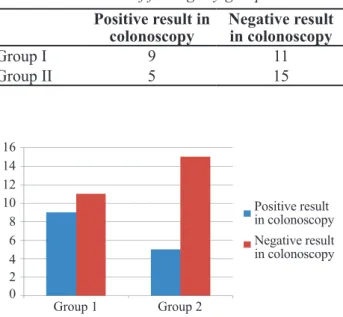
statisti-cally analyzed by Fischer’s exact test and sensitivity calculation. Results: The results showed 14 positive and 26 negative colonoscopies. Group I had 9 positive and 11 negative colonoscopies and Group II, 5 positive and 15 negative (p=0.20) colonoscopies. The question
-naire presented sensitivity of 64.2%. Conclusion: The use of this question-naire based on signs and symptoms of CCR alone was not
effective in CCr screening.
Keywords: colorectal cancer; questionnaire; mass screening; diagnosis; primary prevention.
Questionnaire assessment based on signs, symptoms and history in
the prevention of colorectal cancer
WALYSSON ALVES TOCANTINS DE SOUSA1, LEONARDO CARVALHO MOURA FÉ2, LORY NORONHA DE
CASTRO MONTE2
1Specialist in Coloproctology, Sociedade Brasileira de Coloproctologia; Master in Surgery; Professor of
Coloproctology at Faculdade Integral Diferencial (FACID) – Teresina (PI), Brazil. 2Academician, 5th year of Medical Sciences at FACID – Teresina (PI), Brazil.
Study carried out at the Faculdade Integral Diferencial – Teresina (PI), Brazil. Financing source: none.
Conlict of interest: nothing to declare.
Submitted on: 07/25/2011 Approved on: 09/06/2011
INtrODUCtION
Colorectal cancer (CRC) is a pathology charac-terized by tumors in the colorectal segments1. In ter-ms of incidence, colorectal cancer is the fourth most frequent cause of cancer in the world and the second cause in developed countries2-4.
In Brazil, the National Cancer Institute (INCA) estimated, in 2010, 14 new cases of CRC in each 100,000 men and 15 in each 100,000 women5.
In this scenario, prevention programs have been an attractive option to reduce the incidence and mortality of CRC6,7, despite the population re-sistance to participate, which can inluence their the program effectiveness6.
Colonoscopy is the gold standard of CRC detec-tion, accounting for the pathology decline8-10. Howe-ver, it involves high cost and long time to perform it in the public health system in Brazil, as well as the inhe-rent risks from the exam. Then, effective methods are required for CRC screening to reduce mortality and improve the cost-beneit ratio11,12.
Selvachandran et al., in two studies, de-monstrated that questionnaires based on signs and symptoms can be used as a CRC screening me-thod. Questionnaires were used in certain popula-tions and they observed that the patients with CRC diagnosis presented higher scores than the patients without this pathology15,16.
In Brazil, the possibility of incrementing the detection of colorectal cancer lesions with a ques-tionnaire based on signs, symptoms and history was raised after a pilot study that analyzed the re-sults of colonoscopy in patients submitted to FOBT and questionnaires of positive and negative results. The study demonstrated that most screened patients with positive results at colonoscopy were already symptomatic and/or already presented alterations at FOBT6.
Considering the increasing incidence of CRC in the country, the introduction of an effective ques-tionnaire based on signs, symptoms and history in the medical practice would help in the disease prevention. Then, the purpose of this study was to verify the effectiveness of a clinical questionnaire (QSSA) in CRC prediction, acting as an instrument of screening precursors of this neoplasm.
METHODS
The population analyzed in this study was from a private clinic in Teresina (PI), between March and August 2010.
The study included patients that would be submitted to colonoscopy and excluded those that had already been submitted to colonoscopy befo-re, under 50 years of age or with history of pelvic radiotherapy.
The patients signed an informed consent term be-fore they start their participation in the study.
The sample was constituted of 40 patients, to which a questionnaire based on signs, symptoms and history (QSSA) of colorectal cancer precur-sors was applied6 (Appendix 1). The QSSA was applied immediately before the previously sche-duled colonoscopy procedure was performed, with the intention of sorting the patients into two groups: group I, comprised of the 20 first patients with positive results in the QSSA, and group II,
comprised of the 20 first patients with negative results in the QSSA.
The QSSA was considered positive when the two following criteria were fulilled:
1. With family history of the disease, i.e., presence of at least one irst-degree family member with CRC or adenomas;
2. With symptoms:
a) Speciic symptoms – blood in stool and/or alteration to bowel habit, such as increased frequency, aspect change (ine stool) or loss of stool for more than three months (these two symptoms alone determined positive QSSA);
b) Non-speciic symptoms - abdominal pain in the hypogastrium, for more than three months, anemia without deined cause, we -akness, rectal pain and sensation of incom-plete evacuation (in cases of non-speciic symptoms, the QSSA was considered posi-tive when presenting association of at least two symptoms).
The colonoscopy procedures were performed by the same physician, with patients sedated with Midazolam at the dose of 1 to 5 mg. Olympus en-doscopic equipment were used in the procedures. All exams reached the cecum.
The study deined positive colonoscopy as that with neoplasm or precursors of CRC; otherwise, it was considered as negative colonoscopy.
A descriptive and inferential analysis was perfor-med through Fisher’s exact test, using Biostat 5.0 sof-tware to help in the analysis. The value of p<0.05 was considered statistically signiicant. In addition, sensi -tivity, speciicity, positive predictive value (PPV), ne -gative predictive value (NPV) and questionnaire accu-racy were calculated.
RESULTS
In total, 14 positive and 26 negative colonosco-pies were obtained. Group I presented 9 positive and 11 negative colonoscopies; while group II presented 5 positive and 15 negative colonoscopies (p=0.20) (Table 1, Chart 2)
The questionnaire sensitivity was 64.2%, speci-icity 57.7%, PPV 45.0%, NPV 75.0% and accuracy was 60.0% (Table 2).
DIsCUssION
CRC remains as an important cause of mor-bimortality worldwide3,4. In Brazil, the inciden-ce has increased each year5. Then, special attention has been dedicated to exams that diagnose CRC and its precursors.
With improvements made in colonoscopy, this technique has appeared as the main method of colo-rectal evaluation, more effective than the radiological exam, also due to its therapeutic options17. However, this exam is inconvenient, invasive and costly. These characteristics encourage the search for other scree-ning methods for such disease.
In Brazil, the best screening method would in-volve low cost, easy execution, high sensitivity and social acceptance11,12. As an exam that meets all the-se criteria is unavailable and bathe-sed on the existing resources, some methods have been discussed, es-pecially the fecal occult blood test (FOBT), which has shown to be a very attractive option, but without fulilling all these requirements, and questionnaire based on signs and symptoms and history. This ques-tionnaire, still not deeply studied, has shown to be effective when used with FOBT and has an educatio-nal character in terms of disclosing its most frequent signs, symptoms and history6.
Patients under 50 years of age, who constitute a population with greater risk for developing this neo-plasm, were excluded, in an attempt to have a more homogeneous sample. The same objective was inten-ded when using the other exclusion criteria. In addi-tion, no considerable predominance was observed be-tween the genders.
Regarding the sample selection, the utilization of patients already with an indication to colonoscopy is a study bias, or possibly, a biased sample. However, this is the easiest and most economic way to conduct studies that require more invasive/or costly exams. In addition, it should be noted that many asymptomatic patients are submitted to colonoscopy as a primary
Group 1 Group 2
Questionnaires
Gender
N
um
be
r of pa
ti ent s Male Female 14 12 10 8 6 4 2 0
Chart 1. Distribution of studied patients by gender.
Positive result in colonoscopy Negative result in colonoscopy 14 16 12 10 8 6 4 2 0
Group 1 Group 2
Chart 2. Distribution of colonoscopic indings by group.
Positive result in colonoscopy
Negative result in colonoscopy
Group I 9 11
Group II 5 15
Table 1. Distribution of indings by group.
sensitivity Speciicity PPV NPV Accuracy
QSSA + 64.2% 57.7% 45.0% 75.0% 60.0%
Table 2. Percentages of sensitivity, speciicity, positive predictive value, negative predictive value and accuracy.
REFERENCES
1. Jatobá MP, Candelária PAP, Klug WA, Fang CB, Capelhuchnik P. Pesquisa de sangue oculto nas fezes e achados colonoscópicos em 60 pacientes. J Coloproctol 2008;24(4):425-30.
2. Altenburg FL, Biondo-Simões MLP, Santiago A. Pesquisa de sangue oculto nas fezes e correlação com alterações nas colonoscopias. J Coloproctol 2007;27(3):304-9.
3. Duarte-Franco E, Franco EL. Epidemiologia e fatores de risco em câncer colorretal. In: Rossi, BM, Nakagawa WT, Ferreira FO, Aguiar Jr S, Lopes A. Câncer de cólon, reto e ânus. São Paulo: Lemar Tecmedd Editora; 2004. p. 3-21. 4. Andrade SMS, Pereira FL. Câncer colorretal sincrônico
- relato de caso e revisão de literatura. J Coloproctol 2007;27(1):69-79.
5. Brasil, Ministério da saúde. Instituto Nacional do Câncer.
Estimativa de 2010: incidência de câncer no Brasil. Rio de Janeiro: INCA, 2009.
6. Altenburg FL, Biondo-Simões MLP, Bahten LCV. A pesquisa de sangue oculto nas fezes associada a um questionário de sinais e sintomas na prevenção do câncer colo retal. J Coloproctol 2009;29(1):57-64.
7. Hewitson P, Glasziou P, Watson E, Towler B, Irwig L. Cochrane systematic review of colorectal cancer screening using the fecal occult blood test (hemoccult): an update. Am J Gastroenterol 2008;103(6):1541-9.
8. Nahas SC, Marques CFS, Araújo SA, Aisaka AA, Nahas CSR, Pinto RA, et al. Colonoscopia como método diagnóstico e terapêutico das moléstias do intestino grosso: análise de 2.567 exames. Arq Gastroenterol 2005;45(2):72-82.
9. Almeida MG, Baraviera AC, Malheiros APR, Cury
RM, Milman MHS, Gomes CAS, et al. Eicácia da videocolonoscopia com magniicação no diagnóstico
prevention of CRC. Then, patients with negative re-sults in the questionnaire were relatively frequent.
The statistical analysis did not show any signi-icant difference in the indings when comparing the groups. It should be noted that most adenomas, for their reduced size, are asymptomatic, and then, not detectable or presumed using tests based on signs and symptoms. Only the family history can be detected using a questionnaire, and for this reason, the effecti-veness of this strategy is questioned, especially when used alone in the prevention of CRC.
An effective screening test has to present high sen-sitivity, even with low speciicity. In this study, median values of sensitivity were obtained. The same occurred with the other diagnostic tests. It shows that, when used alone, the QSSA is not an effective screening method. Similar values were found by Altenburg et al.6.
Then, despite the fact of being an invasive and costly test, colonoscopy remains the method of choice for screening pre-neoplastic lesions, as the QSSA showed results of low significance when used alone to detect these lesions. However, the questionnaire should be further studied and impro-ved to help identify individuals with substantial risk for CRC. In addition, it can be used by the physician as a source of information and a way to disseminate the risk factors to the population un-dergoing colonoscopy.
CONCLUSION
The use of a questionnaire based on signs, symp-toms and history, when used alone, was not effective to screen neoplastic lesions.
RESUMO: Introdução: O câncer colorretal (CCr) é uma importante afecção caracterizada pela presença de tumores localizados no colón ou reto. A colonoscopia, padrão ouro na detecção do CCr, demanda alto custo. Assim, há necessidade de métodos de triagem
eicazes, visando um melhor custo beneicio na diminuição da mortalidade do CCR. Objetivo: Avaliar a efetividade de um questio
-nário de sinais, sintomas e antecedentes (QSSA) em predizer o CCR. Métodos: O QSSA foi aplicado a 40 pacientes, momentos antes da realização do exame colonoscópico, no intuito de compor dois grupos: grupo I formado pelos 20 primeiros que apresentassem o QSSA positivo, e grupo II formado pelos 20 primeiros com QSSA negativo. A colonoscopia positiva foi aquela com achado de neopla
-sia ou lesões precursoras do CCR. O resultado foi submetido à análise estatística através do Teste Exato de Fischer e do cálculo da sensibilidade, especiicidade, acurácia e valores preditivos positivos e negativos. Resultado: Observaram-se 14 colonoscopias positivas e 26 colonoscopias negativas, assim distribuídas: grupo I, 9 positivas e 11 negativas; grupo II, 5 positivas e 15 negativas (p=0,20). O questionário apresentou sensibilidade de 64,2%. Conclusão: A utilização de um questionário de sinais, sintomas e antecedentes usado isoladamente não mostrou eicácia no rastreamento de lesões neoplásicas.
diferencial dos pólipos neoplásicos e não-neoplásicos. J Coloproctol 2003;23(4):262-7.
10. Dias APTP, Gollner AM, Teixeira MTB. Neoplasias colorretais: aspectos epidemiológicos, endoscópicos e anatomopatológicos - estudo de série de casos. HU Revista 2009;35(4):305-14. 11. Perez RO, Proscurshim I, Julião GPS, Picolo M,
Gama-Rodrigues J, Habr-Gama A. Instalação e resultados preliminares de programa de rastreamento populacional de câncer colorretal em município brasileiro. ABCD, Arq Bras Cir Gig 2008;21(1):12-15.
12. Almeida FFN, Araújo SEA, Santos FPS, Franco CJCS, Santos VR, Nahas SC, et al. Colorectal. Câncer screening. Rev Hosp Clin 2000;55(1):35-42.
13. Kronborg O, Fenger C, Olsen J, Jorgensen OD, Sondergaard O. Randomised study of screening for colorectal cancer with faecal occult blood test. Lancet 1996;348(9040):1467-71. 14. Jorgensen OD, Kronborg O, Fenger C. A randomised
study screening for colorectal cancer using faecal occult blood testing: result after 13 years and seven biennial
screening rounds. Gut 2002;50(1):29-32.
15. Selvachandran SN, Hodder RJ, Ballal MS, Jones P, Cade D. Prediction of colorectal cancer by a patient consultation questionnaire and scoring system: a prospective study. Lancet 2002;360(9329):278-83.
16. Selvachandran SN, Maw A, Ballal MS. Use of a patients consultation and weighted numerical scoring system for the prediction of colorectal cancer and other colorectal pathology in symptomatic patients: a prospective cohort validation of a Welsh population. Colorectal Dis 2010;12(5):407-14. 17. Santos CHM, Cury MS, Saad FT. Principais achados de
colonoscopias realizadas em caráter de urgência e eletivas. J Coloproctol 2009;29(1):83-7.
Correspondence to:
Walysson Alves Tocantins de Sousa
Av Lindolfo Monteiro 2801, apto. 402, Hosto
CEP 64052-810 – Teresina (PI), Brazil
Provide your information below and answer the questions with (x) – front and back Name: __________________________________________________________ Age: ______________ Gender: _______________________________________ Address: _______________________________________________________ Telephone number: (__________) _________________________________ Height: ________ Weight (approx.): ________
1 - Have you ever noticed blood in stool? ( ) yes ( ) no
If your answer is yes, answer the questions below; otherwise, go to question 2. ( ) Bright red
( ) Dark blood
( ) Blood in the middle of stool ( ) Blood on paper, apart from stool ( ) Blood mixed with and apart from stool ( ) I can’t identify the type of bleeding
How often does bleeding occur?
( ) Every day ( ) Once a week ( ) Twice a week ( ) Once a month ( ) It has happened once or it rarely occurs
Bleeding started: ( ) One week ago or less ( ) One month ago
( ) Less than 3 months ago ( ) One year ago
Bleeding amount: ( ) Small amount ( ) Large amount
When bleeding occurs, do you feel anything in the anus? Itching, pain or increased volume (swelling or tumoration)?
( ) Yes ( ) No
2 - What’s your usual intestinal habit like? (How often do you evacuate?). ( ) Daily ( ) Three times a week
( ) More than once a day ( ) Less than once a week ( ) Twice a week
Your bowel is usually: ( ) Constipated (hard stool) ( ) Diarrhea
( ) Alternates between diarrhea and constipation
Has your intestinal habit changed lately? ( ) Yes ( ) No
If your answer is yes, how has it changed? ANSWER ONLY IF IT HAS CHANGED. ( ) It’s more frequent (I evacuate more often) ( ) Changed to diarrhea
( ) It’s constipated ( ) I’m losing stool
( ) It’s urgent ( ) Now I have ine stool
When did it change?
( ) More than 3 months ago ( ) Less than 3 months ago
3 - Do you see mucus (jelly-like substance) or pus in stool? ( ) Yes ( ) No
4 - Do you have frequent stomachache or abdominal discomfort? ( ) Yes ( ) No
If you feel abdominal pain, where is the pain exactly?
( ) In lower abdomen ( ) In upper abdomen
5 - Have you felt any pain, itching, burning or increase volume (tumoration) in the anus in the last months?
( ) Yes ( ) No
6 - Have you lost appetite in the last months? ( ) Yes ( ) No
7 - Have you been submitted to any blood test that showed anemia? ( ) Yes ( ) No
8 - Have you felt constant weakness (tiredness) in the last months? ( ) Yes ( ) No
9 - Do you have nauseas and/or vomiting? ( ) Yes ( ) No
10 - Have you even been submitted to exams such as colonoscopy? ( ) Yes ( ) No
11 - Have you ever had intestinal polyps? ( ) Yes ( ) No
12 - Regarding your close family members: parents, brothers/sister and grandparents:
Has any of them had cancer? ( ) Yes ( ) No
Where?
( ) Bowel ( ) Breast ( ) Stomach ( ) Ovary
Who had it?
( ) Parents ( ) Grandparents ( ) Brothers/Sisters ( ) Uncles/Aunts
13 - Do you: ( ) Smoke?
( ) Drink alcohol regularly?
( ) Eat fats and fried food very often? ( ) Eat greens and fruits very often?
14 - Have you ever had cancer? ( ) Yes ( ) No
Where?
( ) Prostate ( ) Breast ( ) Stomach ( ) Ovary ( ) Uterus