Case Report
397
SalleS VJa, Saba e, PiSSinin eR, aRguello eRF, Machado Filho hn. Complication related to colostomy oriice: intestinal evisceration. J Coloproctol, 2011;31(4):397-400.
AbstRACt: Intestinal evisceration at the site of a stoma is a rare event, with high morbimortality. Its clinical manifestation often occurs between the sixth and seventh days after surgery. the risk factors most frequently related to evisceration are: increased intra-abdominal pressure, digestive tract cancer surgery, emergency surgery and stomas in the surgical incision. the authors report the case of a male patient, aged 62, suffering from adenocarcinoma of the rectum with obstructive acute abdomen, who underwent loop transversotomy for decompression. On the fourth day after surgery, he had a bronchospasm crisis, with evisceration of ileum and colon through the colostomic hole. the association of some triggering factors, such as emergency surgery, colorectal malignant neoplasm, increased intra-abdominal pressure and technical failure of colostomy were decisive in the development of this rare peri-colostomy complication.
Keywords: dehiscence; evisceration; colostomy; wound closure techniques; complications.
Complication related to colostomy oriice: intestinal evisceration
ValdeMiR JoSé alegRe SalleS1, eduaRdo Saba2, endRigo RodRigueS PiSSinin3,
eduaRdo RubenS FRanciSco aRguello3, hugo nuneS Machado Filho3
1Assistant Professor; Doctor at the Universidade de Taubaté (UNITAU); Associate Member of Sociedade Brasileira
de Coloproctologia – São Paulo (SP); General Surgeon at the Hospital Regional do Vale do Paraíba – Taubaté (SP), Brazil. 2General Surgeon fo the Hospital Regional do Vale do Paraíba – Taubaté (SP); Assistant Professor at UNITAU –
Taubaté (SP), Brazil. 3General Surgeons at the Hospital Regional do Vale do Paraíba – Taubaté (SP), Brazil.
Study carried out at the Hospital Regional do Vale do Paraíba – Taubaté (SP), Brazil. Financing source: none.
Conlict of interest: nothing to declare.
Submitted on: 03/05/11 Approved on: 28/11/11
INtRODUCtION
complications at the colostomy site show variable incidence, with the most frequent of them occurring in
the immediate postoperative period, such as: necrosis, colocutaneous ixation dehiscence, retraction,
hemor-rhage, cellulitis and abscess1-4, with no difference if ap -pearing 30 days after the surgery, when complications
usually occur in approximately 39% of the cases5. Local factors that inluence the incidence of com-plications include: stoma topography, involvement of
rectus abdominis muscle, preoperative demarcation,
stoma diameter, transposition on intra- or extraperi-toneal plane with fascia ixation, aponeurotic closure,
emergency surgery and stoma type6, as well as higher
predominance associated with females and obesity7. due to the low frequency of this type of complica -tion, but associated with high morbidity, the authors decid -ed to report this case, discussing the factors pr-edisposing to intestinal evisceration and the adopted therapeutic option.
CAsE REPORt
A 62-year-old male patient was admitted to the
emergency sector of the hospital Regional do Vale do Paraíba with obstructive acute abdomen and was submitted to loop transversotomy for decompres -sion. he had middle rectum adenocarcinoma and was taking an oncologic neoadjuvant treatment. his comorbidity was chronic obstructive pulmonary dis -ease associated with systemic arterial hypertension, both under proper clinical control. on the fourth
post-operative day, with functional colostomy and
Complication related to colostomy oriice: intestinal evisceration Valdemir José Alegre Salles et al.
398 Journal of Coloproctology
October/December, 2011
Vol. 31 Nº 4
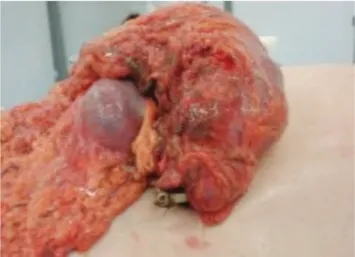
through the colostomic hole (Figure 1), although he
remained with the colocutaneous ixation tube in the
intestinal segment (Figure 2). he was then submit -ted to an urgency surgery, with surgical approach
through the colostomy site, and the
peritoneum-aponeurotic hole diameter was corrected, reducing it by using simple suturing, with separate stitches of unabsorbable wire (zero nylon©). In surgical
ex-ploration, microperfurations were observed in a re -stricted area of eviscerated colon, which determined the partial resection of transverse colon followed by
terminal colostomy and mucosa istula. The patient
presented satisfactory clinical progress and was dis -charged from the hospital, with scheduled elective rectosigmoidectomy.
DIsCUssION
intestinal evisceration at the site of a stoma is a rare event, with few reports in the literature of this complication8,9, which presents high morbimortality
and incidence between 2 and 3.5%10. general morbid
-ity associated with colostomy may vary between 20
and 30% and mortality, around 1%8.
acute dehiscence of surgical incision, also called evisceration, has incidence in adults ranging from 0.4
to 3.0%11 and it may present early clinical manifesta
-tion due to a number of factors, leading to ineffective healing12. Total evisceration occurs through complete
rupture of aponeurosis and, in partial evisceration, the involvement is restricted to skin and subcutaneous tis -sue13. its clinical manifestation often occurs between the sixth and seventh days after surgery14,15. The ap-proximate interval of 30 days is considered the most
critical, as in this period, the surgical wound tension is maintained mostly by the surgical synthesis material, which constitutes the main factor for proper healing maintenance16.
The risk factors most frequently related to evis-ceration are: anemia, increased intra-abdominal
pres-sure (due to ascites, cough, adynamic ileum, acute urine retention and vomiting), improper healing, di -gestive tract cancer surgery, emergency surgery, low vitamin or zinc level, malnutrition, diabetes mellitus, advanced age – over 65 years old, multiple organ fail
-ure, fever, digestive istulas, systemic arterial
hyper-tension, hypoproteinemia, jaundice, shock, surgical wound infection, peritonitis, drainage holes or stomas in the surgical incision, surgical reintervention, surgery duration over three hours, inadequate suture material, uremia, corticotherapy, chemotherapy and/or radio -therapy, mechanical ventilation and technical failure, among others10,14-18. To prevent evisceration, the sur-geon should correct the triggering factors and, in the surgery, use proper incisions, handle tissues carefully and perform the surgical incision closure following the tissue planes12,15,19,20.
When performing colostomy, some basic con
-cepts should be taken into account, such as: location,
which should be far from the surgical incision; prior de
-marcation; hole size, whose extension should be close to two to three ingers (around 5 cm); proper bowel
mobilization, free of tension and with good blood cir
-Figure 1. Voluminous intestinal evisceration through the colostomic site.
Complication related to colostomy oriice: intestinal evisceration Valdemir José Alegre Salles et al.
399 Journal of Coloproctology
October/December, 2011
Vol. 31 Nº 4
culation1. In cases of low-level bowel obstruction, the
colostomy approach through the abdominal cavity is usually performed in the right upper quadrant, far
from bony prominences, with the extension of trans-verse cutaneous incision extension of around 8 cm8. After deining the aponeurotic cutaneous hole
diam-eter, the muscle plane is accessed through a transrec -tal approach. after opening the peritoneal cavity, the
colon segment to be extruded is determined and, after colostomy is performed, the colon is ixed to the skin
at the mucocutaneous junction, which should be made with inabsorbable suture, such as prolene 3–0 or 4–0, our absorbable suture, such as catgut 2–020-22.
This case report involved some triggering factors, such as: urgency surgery, malignant colorectal neoplas-tic disease and increased intra-abdominal pressure, due
to the chronic obstructive pulmonary disease, factors associated with the technical failure to perform colos -tomy, as the hole diameter of stoma was larger than re
-quired for colon extrusion, due to the large transverse
colon distension observed in the episode of acute in -testinal obstruction. in the surgical approach for intesti
-nal evisceration, the surgical practice can be deined by exploratory laparotomy combined with the creation of
a new stoma or an intervention restricted to the colos -tomic site23. The method adopted in this study, with
re-section of the eviscerated loop and new colostomy per -formed through the prior colostomic hole, was based the patient’s clinical condition of severe respiratory failure for being less aggressive, as, in the opinion of
the surgical team, large exploratory laparotomy could
increase the patient’s morbimortality.
REsUmO: A evisceração intestinal desenvolvida no sítio de um estoma é um evento raro, tendo elevada morbimortalidade. sua manifestação clínica ocorre frequentemente entre o sexto e o sétimo dias de pós-operatório. Os fatores de risco mais frequente-mente relacionados à evisceração são: aumento da pressão intra-abdominal, câncer do aparelho digestório, cirurgia de urgência e estomias na incisão cirúrgica. Os autores relatam o caso de um paciente do sexo masculino, com 62 anos, portador de
adenocar-cinoma do reto médio com abdômen agudo obstrutivo, sendo submetido à transversostomia em alça, com inalidade descompres -siva. No quarto dia de pós-operatório com crise de broncoespasmo, apresentou evisceração do cólon e íleo pelo orifício abdominal colostômico. A associação de alguns fatores desencadeantes, como a cirurgia de urgência, a doença neoplásica colorretal maligna, o aumento da pressão intra-abdominal e a falha técnica na confecção da colostomia, foram determinantes para o desenvolvimento desta rara complicação pericolostômica.
Palavras-chave: deiscência; evisceração; colostomia; técnicas de fechamento de ferimentos; complicações.
REFERENCEs
1. hoffman MS, barton dPJ, gates J, Roberts WS, Fiorica JV, Finan Ma, et al. complications of colostomy performed on
gynecologic cancer patients. Gynecol Oncol 1992;44:231-4. 2. Londono-Schimmer EE, Leong APK, Phillips RKS. Life
table analysis of stomal complications following colostomy.
Dis Colon Rectum 1994;37:916-20.
3. Nour S, Beck J, Stringer MD. Colostomy complications: infants and children. Ann R Coll Surg Engl 1996;78:526-30. 4. Park JJ, Del Pino A, Orsay CP, Nelson RL, Pearl RK,
cintron JR, et al. Stoma complications. dis colon Rectum
1999;42:1575-80.
5. duchesne Jc, Wang YZ, Weintraub Sl, boyle M, hunt
JP. Stoma complications: a multivariate analysis. Am Surg 2002;68(11):961-6.
6. Szczepkowski M, Gil G, Kobus A. Parastomal hernia repair – Bielañski Hospital experience. Acta Chir Iugosl 2006;53(2):99-102.
7. Cottam J, Richards K, Hasted A, Blackman A. Results of a
nationwide prospective audit of stoma complications within
3 weeks of surgery. Colorectal Dis 2007;9(9):834-8.
8. hines JR, harris gd. colostomy and colostomy closure.
Surg Clin North Am 1977;57(6):1379-92.
9. Corsi PR, Lanterno G, Pereira CSB, Rasslan S. Evisceração Transcolostômica – Relato de Caso. J Coloproctol 1991;11(3):98-100.
10. Salvador A, Villalba F, Galindo P, Enguix MJ, Iglesias R,
Mir J, et al. la evisceración como complicación de la cirugía
abdominal. Cir Esp 2003;74(Suppl 1):86.
11. col c, Soran a, col M. can postoperative abdominal
wound dehis cence be predicted? Tokai J Exp Clin Med 1998;23:123-7.
12. Rodríguez-Hermosa JI, Codina-Cazador A, Ruiz B, Roig J,
gironès J, Pujadas M, et al. Factores de riesgo de dehiscencia aguda de la pared abdominal trás laparotomia en adultos. cir
Esp 2005;77(5):280-6.
Complication related to colostomy oriice: intestinal evisceration Valdemir José Alegre Salles et al.
400 Journal of Coloproctology
October/December, 2011
Vol. 31 Nº 4
14. Fagniez PL, Hay JM, Lacaine F, Thomsen C. Abdominal
midline in cision closure. a multicentric randomized prospective trial of 3135 patients, comparing continuous vs interrupted polyglycolic acid su tures. arch Surg
1985;120:1351-3.
15. Wissing J, Van Vroonhoven TJ, Schattenkerk ME, Veen HF, Ponsen RJ, Jeekel J. Fascia closure after midline laparotomy: results of a randomized trial. Br J Surg 1987;74:738-41. 16. Carter D. The surgeon as a risk factor. BMJ 2003;326:832-3. 17. Docobo-Durantez F, Sacristán-Pérez C, Flor-Civera B,
Liedó-Matoses S, Kreisler E, Biondo S. Estúdio clínico aleatorizado entre sutura de polidioxanona y de nylon en
el cierre de laparotomía en pacientes de riesgo. cir esp
2006;79(5):305-9.
18. Portilla F, Flikier b, espinosa e, utreta a, Rada R, Vega J, et al. estudo aleatorizado sobre la utilización de mallas reabsorbibles para la prevención de la evisceración en la
cirugía colorrectal. Cir Esp 2008;83(1):12-7.
19. Riou JP, Cohen JR, Johnson H Jr. Factors inluencing wound dehis cence. Am J Surg 1992;163:324-30.
20. Webster c, neumayer l, Smout R, horn S, daley J, henderson W, et al. Prognostic models of abdominal wound
dehiscence after lapa rotomy. J Surg Res 2003;109:130-7. 21. Bouillot JL, Aouad K. Traitement chirurgical des
complications des colostomies. In: Encyclopedie Médico-Chirurgicale. Techniques chirurgicales – Appareil digestif, 40-545, Paris: Techniques; 2002. 12p.
22. Keighley MRB. Estomas. In: Keighley MRB, Pemberton
Jh, Fazio VW, Parc R. atlas de cirurgia colorretal. Rio de
Janeiro: Revinter; 1999, p 61-91.
23. Gallot D. Traitement chirurgical des complications des colostomies. In: Encyclopedie Médico-Chirurgicale. Techniques chirurgicales – Appareil digestif, 40-545, Paris: Techniques; 1990. 10p.
Correspondence to:
Valdemir José alegre Salles