Article
Printed in Brazil - ©2008 Sociedade Brasileira de Química 0103 - 5053 $6.00+0.00
*e-mail: [email protected]
HPLC Determination of Oxadiazon in Commercial Pesticide Formulations
Guillermo Quintás, Sergio Armenta, Javier Moros, Salvador Garrigues,
Agustín Pastor and Miguel de la Guardia*
Department of Analytical Chemistry, University of Valencia, Edifici Jeroni Muñoz, 50th Dr. Moliner 46100
Burjassot, Valencia, Spain
Um procedimento simples, rápido e preciso de cromatografia líquida de alta eficiência (HPLC) foi desenvolvido para a determinação de oxadiazona em formulações concentradas de pesticidas emulsificáveis. 20 µL de amostra, diluída em acetronitrila, foram injetados em uma coluna Kromasil C18 (250 × 4,6 mm, 5 µm), usando acetonitrila:água (80:20) como fase móvel, numa velocidade de fluxo de 1 mL min-1. Oxadiazona foi determinada por medidas de absorbância a
292 nm. Obteve-se, usando-se o procedimento desenvolvido, um limite teórico de detecção de 0,02 µg mL-1, um limite de quantificação de 0,047 µg mL-1, correspondendo a 0,02 e 0,07% m/v
na amostra original e desvio padrão relativo de 0,08%, para três análises em replicata de amostras contendo 25% m/v de oxadiazona. A precisão do método foi evidenciada pelas porcentagens de recuperação de 98% a 99% para amostras contendo 0,015 a 0,085 mg de oxadiazona, assim como pela comparação entre os resultados encontrados pelo procedimento recomendado e pela espectrofotometria de infravermelho com transformada de Fourier (FTIR), para amostras reais de produtos formulados.
A simple, fast and precise high performance liquid chromatographic (HPLC) procedure has been developed for the determination of oxadiazon in emulsifiable concentrated pesticide formulations. 20 µL of diluted sample in acetonitrile were injected in a Kromasil C18 (250 × 4.6 mm, 5 µm) column, using acetonitrile:water (80:20) as mobile phase at 1 mL min-1 flow rate and oxadiazon
determined by absorbance measurement at 292 nm. A theoretical limit of detection of 0.02 µg mL-1,
a limit of quantification of 0.047 µg mL-1, corresponding to a 0.02 and 0.07% m/v in the original
sample, and a relative standard deviation of 0.08% for three replicate analysis of samples containing 25% m/v. Oxadiazon were achieved using the developed procedure. The accuracy of the whole method was evidenced by recovery percentages from 98% to 99% for samples spiked with 0.015 to 0.085 mg oxadiazon as well as by the good comparability between results found by the recommended procedure and by Fourier Transform Infrared (FTIR) spectrophotometry for actual samples of formulated products.
Keywords: oxadiazon, high performance liquid chromatography, UV-Vis detection, pesticide formulations
Introduction
O x a d i a z o n , 5 t e r t bu t y l 3 ( 2 , 4 d i c h l o r o 5 -isopropoxyphenyl)-1,3,4-oxadiazol-2(3H)-one, is a selective pre-emergence herbicide used for the control of annual grasses and many broadleaf weeds in turf and landscape ornamentals. The relatively low toxicity by ingestion and by dermal route of this herbicide is one of the reasons for its widespread use.1
Formulated products containing oxadiazon are presented as 25% (m/v) emulsifiable concentrates and are widely available in the market.2
Methods based on gas chromatography with flame ionization,3,4 electron capture,4 mass spectrometry5 and nitrogen–phosphorous4 detection, have been proposed for the determination of oxadiazon residues at trace levels after different clean-up and preconcentration steps, being used the aforementioned procedures in various types of matrices such as river and tap waters, foods and mussels.
techniques employed in the analysis and quality control of formulated pesticides, due to the high sensitivity and selectivity achieved.6 Despite of this fact, there are only two precedents in the literature about the use of HPLC-UV for the determination of oxadiazon. One of these was recently published in English about the determination of oxadiazon in water at trace level7 and a second one concerning 12% concentrated oxadiazon formulations,8 published in Chinese, is not available from the Analytical Abstract data base.
The objective of this work has been the development of a simple and fast HPLC-UV procedure which could be applied to the routine quality control analysis of formulated products containing oxadiazon as active ingredient.
Experimental
Apparatus and reagents
The HPLC system included an HP1050 chromatograph from Hewlett-Packard (Palo Alto, CA, USA) with a variable wavelength UV-Vis detector HP1050 and a Kromasil C18 (250 × 4.6 mm, 5 µm) analytical column from Scharlau (Barcelona, Spain). A Hewlett-Packard 8452-A diode array spectophotometer was employed for the measurement of the UV-Vis spectra.
A Nicolet Magna 750 FTIR spectrometer (Madison, WI, U.S.A.) with a temperature-stabilized DGTS detector, a long-lasting Ever-Glo source and a KBr beamsplitter, was employed for IR measurements, using a Specac microflow cell with ZnSe and CaF2 windows and 0.11 mm pathlength. The equipment employs the 2.1 version of the OMNIC software developed by Nicolet Corporation for the acquisition and processing of the FTIR absorbance data.
The effect of using increasing flow rates of the mobile phase from 0.5 to 2 mL min-1 provided a decrease of the retention time of oxadiazon from 41.8 to 10.4 min. On the other hand, it was observed an increase of the pressure from 55 bar to 230 bar. So, in order to ensure a compromise between the time of analysis and an appropriate pressure in the column, a flow rate of 1.00 mL min-1, which provides a retention time of 19.8 min and a pressure of 108 bar, was chosen.
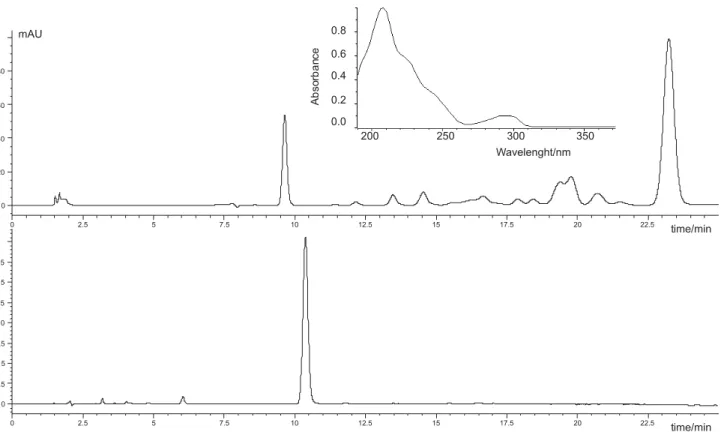
Chromatograms depicted in Figure 1 show that the use of 292 nm as detection wavelength permits to increase the percentage of acetonitrile in the mobile phase, thus reducing both, the total analysis time and the pressure of the system, which varies from 131 bar for 60% (v/v) CH3CN to 62 bar for 100% CH3CN on using a flow of 1 mL min-1.
The use of an 80% (v/v) acetonitrile provides a retention time for oxadiazon of 10.37 min, as compared with the 23 min found on using 70% (v/v).
Analytical features of the developed procedure
The regression line between peak area data and concentration of oxadiazon in µg mL-1 provided a slope of 8.977, ten times smaller than that found on using 208 nm and 70% (v/v) CH3CN but in both cases with a reduced
value of the intercept and an excellent linear regression coefficient (see Table 1).
The theoretical limits of detection (LOD) and quantification (LOQ) of HPLC determination of oxadiazon were calculated for the two wavelengths employed providing values of 0.02 and 0.07 µg mL-1, for 292 nm and 0.015 and 0.029 µg mL-1 for 208 nm. These values were determined from the standard deviation of 10 measurements of the peak area at a concentration level of 3.81 mg L-1 oxadiazon divided by the analytical sensitivity and multiplying by 3 or 10 for LOD and LOQ, respectively.
In order to determine the repeatability of the method, the relative standard deviation (RSD) was evaluated for six independent measurements of a sample, being found results from 0.08 to 0.17% as a function of the wavelength employed.
To test the accuracy of the proposed analytical method, recovery experiments were carried out by spiking a commercially available formulation with different quantities of oxadiazon and recovery percentages from 98 ± 1% to 99 ± 2% were found (see Table 2).
A typical standard addition line, obtained for a formulated pesticide, provided an equation of A = (2.089 ± 0.002) + (8.90 ± 0.03)Cad(µg mL-1) with a regression coefficient R2 = 0.9999 which provides a slope which
Figure 1. Chromatograms obtained for sample extracts using different conditions. Top: Detection wavelength, 208 nm; mobile phase composition, CH3CN:H2O (70:30) (v/v). Bottom: Detection wavelength, 292 nm; mobile phase composition, CH3CN:H2O (80:20) (v/v). Inset: UV spectrum of a 5 mg L-1oxadiazon solution in CH
is statistically comparable to that found by external calibration, at a probability level of 99%, being obtained an experimental value of the Student’s t of 2.53 which is lower than 2.583, the tabulated value, thus indicating that the HPLC determination of oxadiazon is free from matrix interferences.
Analysis of real samples
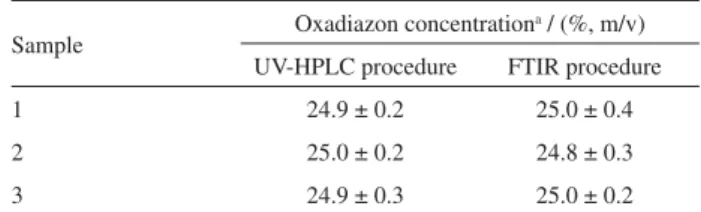
Three commercially available pesticide formulation products were analysed using the aforementioned procedure and an alternative method based on FTIR measurements.9 Results found by both procedures are in good agreement (see Table 3) thus evidencing that HPLC determination of oxadiazon provides a comparable accuracy to that obtained by FTIR.
Conclusions
The proposed HPLC method for the oxadiazon determination in formulated commercial pesticides is fast, due to the use of a simple sample pre-treatment and the 10.37 min retention time obtained in the selected conditions.
This method involves the use of reduced amount of solvents, 25 mL CH3CN to prepare each sample solution, being the sampling throughput of 5 samples per hour. The developed HPLC procedure is faster than previous methodologies based on the use of gas chromatography and does not require the use of chlorinated solvents as it is the case for FTIR determinations. Hence it can be easily and conveniently adopted for routine quality control analysis.
On comparing with the single precedent on the determination of oxadiazon in formulations by HPLC8 the RSD (0.28%), linear correlation (0.999) and average recovery (100.3%), are of the same order than those obtained by us (See Table 1). However, the determination at 292 nm instead of 220 nm improves the analytical selectivity of the procedure.
Acknowledgments
Authors acknowledge the financial support of the Ministerio de Educación y Ciencia (Project CTQ2005-05604, FEDER), Direcció General d’Investigació i Transferència Tecnològica de la Generalitat Valenciana (Project ACOMP/2007/131) and Universitat de València (Convocatòria d’Accions Especials, Project UV-AE-20070213). S. Armenta acknowledges the FPU grant of the Ministerio de Educación y Ciencia (Ref. AP2002-1874).
Table 2. Obtained recoveries (n=3) in the analysis of spiked formulated samples
mg added mg found % Recovery
15 14.85 ± 0.04 99 ± 2
57 55.86 ± 0.06 98 ± 1
85 83.3 ± 0.06 98 ± 1
Table 3. Determination of oxadiazon in actual samples by both, HPLC and the FTIR alternative procedure
Sample Oxadiazon concentration
a / (%, m/v)
UV-HPLC procedure FTIR procedure
1 24.9 ± 0.2 25.0 ± 0.4
2 25.0 ± 0.2 24.8 ± 0.3
3 24.9 ± 0.3 25.0 ± 0.2
aValues are the mean of three independent analysis ± the standard deviation.
References
1.Extension Toxicological Network (EXTOXNET), University
of California-Davis, Oregon State University, Michigan State University and the University of Idaho. http://ace.orst.edu/info/ extoxnet/pips/ghindex.html, 1996.
2. de Liñan, C.; Vademecum de Productos Fitosanitarios y
Nutricionales, Agrotécnica S. L.: Madrid, 2000.
3. Lin, Y. J.; Lin, C.; Yeh, K. J.; Lee, A.; Bull. Environ. Contam.
Toxicol. 2000,64, 780.
4. Boyd-Boland, A. A.; Pawliszyn, J. B.; J. Chromatogr., A1995,
704, 163.
5. Navalon, A.; Prieto, A.; Araujo, L.; Vilchez, J. L.;
Chromatographia2001,54, 377.
6.Collaborative International Pesticides Analytical Council
(CIPAC), http://www.cipac.org accessed in May 2007.
7. Papadopoulou-Mourkidou, E.; Patsias, J.; Koukourikou, A.;
Methods in Biotechnology2006,19 (Pesticide protocols),
435.
8. Li, C.; Hu, H.; Nongyao1998,37, 28.
9. Moros, J.; Quintás, G.; Armenta, S.; Garrigues, S.; de la Guardia
M.;Spectrosc. Lett.2007,14, 1.