Hot Flushes and Night Sweats in Midlife: Why do Some
Women Have Them and Others do Not?
Afrontamentos e Suores Noturnos na Meia-idade: Porque é que
Algumas Mulheres os Têm e Outras Não?
Filipa Pimenta
∗, João Maroco, Catarina Ramos & Isabel Leal
ISPA - Instituto Universitário de Ciências Psicológicas, Sociais e da Vida, Lisboa, Portugal
Abstract
This study investigated what predicts the occurrence of hot fl ushes (HF) and night sweats (NS). A community sample of 992 women (42-60 years) answered a questionnaire to collect socio-demogra-phic, health and menopause-related, as well as lifestyle information. Depressive mood and stress, as well as HF and NS (in terms of presence, frequency and intensity), were also assessed. Structural equation modelling was used to build a structural model to predict the occurrence of both vasomotor symptoms. Results: Stress predicted NS (β=.154; p =.006), whereas depressive mood was linked to the occurrence of HF’s (β=.149; p =.006). Being peri-menopausal and post-menopausal, among several other characteristics, were also signifi cant predictors of the occurrence of both HF and NS. This study supports a distinguished infl uence of stress and depressive mood in NS and HF respec-tively, probably due to the nature of psychological symptoms. Moreover, signifi cant associations between vasomotor symptoms and socio-demographic, health and menopause-related characteristics, and alcohol were confi rmed.
Keywords: Hot fl ushes, night sweats, stress, depressive mood, structural equation modelling.
Resumo
Este estudo investigou os preditores da ocorrência de afrontamentos (Af) e de suores noturnos (SN). Foi utilizada uma amostra comunitária de 992 mulheres (42-60 anos), que respondeu a um questionário para a recolha de informação sociodemográfi ca, de estado de saúde e menopausa, e sobre o estilo de vida. Os níveis de humor deprimido e estresse, tal como a ocorrência, frequência e intensidade dos Af e SN, foram avaliados. Modelos de equações estruturais foram utilizados para construir o modelo estrutural para predizer a ocorrência de ambos os sintomas vasomotores. Os resultados indicaram que estresse predisse os SN (β=0,154; p =0,006), enquanto o humor deprimido associou-se à ocorrência de Af (β=0,149; p =0,006). Estar na peri-menopausa ou na pós-menopausa, entre outras características, associou-se igualmente à ocorrência de Af e SN. Este estudo suporta uma infl uência diferenciada do estresse e do humor deprimido na ocorrência de SN e Af, respetivamente, provavelmente devido à natureza dos sintomas psicológicos. Adicionalmente confi rmou-se uma associação signifi cativa entre os sintomas vasomotores e características sociodemográfi cas, de saúde, de menopausa e consumo de álcool.
Palavras-chave: afrontamentos, suores noturnos, estresse, humor deprimido, modelos de equações estruturais.
* Mailing address: ISPA – Instituto Universitário de Ciên-cias Psicológicas, Sociais e da Vida, William James Center for Research, Rua Jardim do Tabaco, 34, Lisboa, Portugal 1149-041. E-mail: fi [email protected]
We kindly acknowledge the Portuguese Fundação para a Ciência e Tecnologia (FCT) for the PhD grant which allow this research (SFRH/BD/32359/2006). We also thank Raquel Oliveira for proof reading the manuscript. Many women, especially in western countries, experi-ence hot fl ushes during midlife (Stearns et al., 2002) and these tend to increase as women pass from one menopausal status to the following one (Hardy & Kuh, 2002). However, the prevalence of vasomotor symptoms does not have a
similar distribution between menopausal stages and even in a given stage, in the population of menopausal women (Melby, Lock, & Kaufert, 2005). In a longitudinal study (n = 2.229), the number of women who experience hot fl ushes (36%) is close to the number of women who do not experience hot fl ushes (29%), as a result of meno-pause experience (Gjelsvik, Rosvold, Straand, Dalen, & Hunskaar, 2011).
medical advice during the menopausal transition (vaginal dryness, decreased libido, joints pain, among others, can also precipitate the search for medical and pharmacologi-cal help; Albertazzi, 2007). Also, hot fl ushes are the most frequent symptoms that are associated with menopause, followed by mood swing, vaginal dryness, sleep problems, night sweats, and memory loss (Asadi, Jouyandeh, & Nayebzadeh, 2012).
It has been suggested that the origin of vasomotor symptomsis related with higher follicle stimulating hor-mone (Randolph et al., 2005) and lower estradiol (Blümel et al., 2004). And although these symptoms are likely to occur due to the decline in the estradiol levels, there is still some debate around their mechanisms (Archer et al., 2011; Dennerstein, Dudley, Hopper, Guthrie, & Burger, 2000; Stearns et al., 2002). While around 70% of women experience them, only 15-20% perceive them as problem-atic due to their particular consequences (such as social embarrassment, distress and physical discomfort; Hunter & Mann, 2010).
Different variables infl uence the emergence and/or se-verity of vasomotor symptoms. They include menopausal (Gold et al., 2000) and health status (Sievert, Obermeyer, & Price, 2006), the use of hormone therapy (Archer et al., 2011), alcohol intake (Kandiah & Amend, 2010), smok-ing (Gjelsvik et al., 2011), physical activity (Kandiah & Amend, 2010), education level (Gjelsvik et al., 2011), among other.
Psychological factors have also been studied in this fi eld. It has been observed a positive relationship between stress and hot fl ushes (Gannon, Hansel, & Goodwin, 1987; Shaw, 1997). Also, a stress reduction intervention can decrease these symptoms’ severity (Carmody, Crawford, & Churchill, 2006).
Depressed mood has also been associated with the presence of vasomotor symptoms (Bromberger et al., 2007; Freeman, Sammel, Lin, & Nelson, 2006; Hunter & Liao, 1995; Woods, Mariella, & Mitchell, 2002), and depres-sion is signifi cantly higher in peri- and post-menopausal women with hot fl ushes than in their counterparts without this vasomotor symptom (Thurston & Joffe, 2012). The relation between depression and vasomotor symptoms is bidirectional, according to some studies, that have also found that previous vasomotor symptoms in perimeno-pausal women were associated with an increased likelihood of depression (Joffe et al., 2002).
Similarly, anxiety is strongly linked to hot fl ushes, independently of the menopausal status, estradiol levels and smoking (Freeman et al., 2005). However, it is sug-gested that this association is due to the overlapping of anxiety’s somatic symptoms and the hot fl ushes’ physical manifestations, given that these vasomotor symptoms are connected with the somatic dimension of anxiety, but not with the affective one (Lermer et al., 2011).
Because hot fl ushes may persist in some women, even concomitantly with hormone therapy (Albertazzi, 2007), and because in a minority of women these may persist
until the late post-menopause (Huang et al., 2008), it is important to explore which factors are signifi cant predic-tors of the incidence of vasomotor symptoms. Therefore, the aim of this study is to build a structural model for hot fl ushes and night sweats’ occurrence, using a sample of pre-, peri- and post-menopausal women with and without vasomotor symptoms. Specifi cally, we will explore if psychological variables (namely, depressive mood, anxiety and stress), health and menopause-related factors, lifestyle and socio-demographic characteristics, can predict the presence of these two vasomotor symptoms. Moreover, it is also our objective to demonstrate if there are signifi cant differences between participants in different menopausal statuses, regarding hot fl ushes and night sweats’ severity, and frequency of anxiety, depressive mood and stress symptoms. Finally, we will analyze if women with vaso-motor symptoms differ signifi cantly from women without them in terms of psychological symptoms (anxiety, stress and depressive mood).
Method
Participants
A mainly community sample of 992 women in pre-, peri- and post-menopause, recruited in the city of Lisbon, was included in the present study. Ages ranged from 42 to 60 years old.
Procedure
This cross-sectional study encompasses a community sample, which was mainly recruited through schools and universities in the city of Lisbon. The inclusion criteria in this research were gender (female), literacy and age (between 42 and 60 years old). The American Psychologi-cal Association’s standards on the ethiPsychologi-cal treatment of participants were followed. A written informed consent form was delivered to all participants, explaining the aims of the study, emphasizing that the participation in this research was voluntary and that participants could interrupt their collaboration at any time, without any consequences.
Measures
regarding vasomotor symptoms, participants were divided in two different groups: the ones who had vasomotor symptoms and the ones who did not have these symptoms.
Depression, Anxiety and Stress. To evaluate stress, anxiety and depressive mood, a Portuguese adaptation of the Depression, Anxiety and Stress Scales (Lovibond & Lovibond, 1995; Pais-Ribeiro, Honrado, & Leal, 2004) was applied. Each subscale encompasses seven items which are evaluated in a 4-point Lykert-type scale, ranging from 1 (“did not apply to me”) to 4 (“it applied to me most of the time”). The instrument presented good psychometric properties.
Menopausal and Health-Related Variables. The menopausal status was defi ned according to the Stages of Reproductive Aging Workshop’s +10 criteria (Harlow et al., 2012). Women in pre-menopause presented an absence of changes in their menstrual cycle. Peri-menopausal par-ticipants would report variable cycle length (a difference of more than seven days, than usual) or had skipped two or more cycles, having an amenorrhea interval superior to sixty days. Post-menopausal women had at least a twelve-month period of amenorrhea.
Besides menopausal status, the use of hormone therapy, herbal/soy products or nothing to manage menopausal symptoms was also asserted. In addition, the search for medical help to manage these symptoms was also con-trolled.
Health status (both physical and psychological), as well as menopausal status, were self-reported. The participants were inquired about presence of a recent disease and of a psychological problem.
Lifestyle. Alcohol, hot beverages and coffee intake, smoking, physical exercise and body mass index (BMI) were assessed.
Lifestyle habits were explored in terms of presence/ab-sence, amount and/or frequency. Hence, physical exercise was measured in terms of times per week, and during how many minutes the participant exercised; a mean value of weekly frequency and duration was used in the multiva-riate model. Coffee intake, when present, was assessed in a four-option scale, ranging from “occasionally” to “more than fi ve per day”. Alcohol intake, when observed, was measured both in terms of frequency (“daily”, “every weekend” or “rarely”) and quantity (“until I feel drunk”, “moderately” or “less than a glass per occasion”); a mean value of both translates the alcohol consumption variable in the structural model. Finally, for current smokers, smoking was quantifi ed in a 6-point Likert-type scale that ranged from “less than 10 cigarettes per month”, until “more than 40 cigarettes per day”; this quantifi cation integrated the structural equation model to assert the infl uence of smoking on the occurrence of hot fl ushes and night sweats.
Socio-Demographic Characteristics. Socio-demo-graphic factors such as age, marital status, parity, profes-sional status, educational level and family annual income were explored.
Statistical Analysis
Missing values were imputated for variables, where its frequency was lower than 10% of the sample. This was done using the mean interpolation method.
The distribution of the studied variables was ex-plored with SPSS Statistics (v. 19, IBM SPSS Inc, Chicago, IL).
To explore if there were differences between the three menopausal statuses, regarding stress, anxiety and depressive symptoms’ frequency, as well as hot fl ushes and night sweats’ severity, a one-way ANOVA followed by post-hoc Tukey’s test was performed in order to identify the groups were means were statistically significant different from each other. Variances’ homogeneity was confi rmed and a Student t-test was implemented to evaluate the differences regarding stress, anxiety and depressive mood levels between participants with and without vasomotor symptoms (hot fl ushes and night sweats) using SPSS Statistics (v. 19, IBM SPSS Inc, Chicago, IL).
Multicollinearity between the independent variables was explored with the variance infl ation factor (VIF) given by SPSS Statistics (v. 19, IBM SPSS Inc, Chicago, IL). All variables should present a value below 5, indicating the absence of collinearity (Maroco, 2010; Weisberg, 1985). Because in the structural model anxiety evidenced a VIF above this value (that is, equal to 66), this variable was excluded from the structural model, since it showed multicollinearity with other independent variables.
To test the structural model for the occurrence of hot fl ushes and night sweats, a structural equation model was built relating the dependent variable (the two vasomotor symptoms in terms of presence/absence) with the twenty independent variables (namely, age, parity, marital and professional status, income, education, presence of a re-cent psychological problem or a disease, transition from pre- to peri-menopause and from peri- to post-menopause, use of hormone therapy or herbal/soy products to man-age menopause symptomatology, search for medical help to deal with menopause, alcohol and coffee intake, smoking, physical exercise, body mass index, stress and depressive mood). The model was evaluated with SPSS AMOS software (v. 18, IBM SPSS Inc, Chicago, IL). The quality of fi t of the structural model was given by chi-square statistics (X2/df), comparative
Results
After receiving the informed consent form and agreeing to participate in the research, a sample of 1,003 Portuguese
women completed all instruments adequately (45 were excluded due to insuffi cient information). Of these, 992 gave suffi cient information to be classifi ed in one of the three menopausal statuses and were included in the present study. Table 1 describes the participants.
Table 1
Characterization of the Participants in Relation to Socio-Demographic, Health and Menopause-Related and Lifestyle Variables
Pre-menopausal Peri-menopausal Post-menopausal
Characteristics n % n % n %
n 282 298 412
Age (M; SD) 45.7 (3.23) 47.6 (3.79) 53.9 (4.21)
Marital status
Married or in a relationship 202 71.9 218 73.2 277 67.4
Not married or in a relationship 79 28.1 80 26.8 134 32.6
Parity
0 21 7.6 22 7.5 42 10.4
1 83 30.0 97 33.1 104 25.9
2 123 44.4 136 46.4 186 46.3
3 36 13.0 32 10.9 49 12.2
>3 14 5.1 6 2.0 21 5.1
Education
Primary school 19 6.9 28 9.5 62 15.4
Middle school 51 18.5 68 23.1 98 24.4
High school 79 28.6 91 31.0 109 27.1
University degree or higher 127 46.0 107 36.4 133 33.0
Professional status
Active 259 92.5 262 89.7 317 78.7
Inactive 21 7.5 30 10.3 86 21.3
Family annual income
≤ 10.000 € 47 19.5 60 23.9 91 26.1
10.001 – 20.000 € 66 27.4 66 26.3 85 24.4
20.001 – 37.500 € 63 26.1 65 25.9 79 22.6
37.501 – 70.000 € 44 18.3 42 16.7 68 19.5
≥ 70.001 € 21 8.7 18 7.2 26 7.4
Recent disease
Yes 35 12.5 51 18.0 95 23.8
No 245 87.5 233 82.0 304 76.2
Recent psychological problem
Yes 33 12.0 43 14.8 76 18.9
Search for medical help to deal with menopause
Yes 35 13.5 136 46.7 257 71.6
No 224 86.5 155 53.3 102 28.4
HT, herbal/soy therapy or Nothing
HT 4 1.5 13 4.5 49 13.5
Herbal/soy therapy 0 0 16 5.5 48 13.3
Nothing 273 98.5 262 90.0 265 73.2
Hot fl ushes
Yes 31 11.6 102 36.8 206 55.1
No 237 88.4 175 63.2 168 44.9
Night sweats
Yes 57 21.0 115 40.9 200 51.7
No 214 79.0 166 59.1 182 48.3
Body mass index (kg/m2)
≤ 24,9 166 59.1 157 53.0 205 50.6
> 24,9 115 40.9 139 47.0 200 49.4
Physical activity
Yes 118 41.8 127 43.1 197 48.8
No 162 57.9 168 56.9 207 51.2
Smoking behavior
Current smoker 73 26.4 87 29.7 82 20.5
Current non-smoker 204 73.6 206 70.3 318 79.5
Alcohol consumption
Yes 137 49.1 157 53.0 192 47.2
No 142 50.9 139 47.0 215 52.8
Coffee consumption
Yes 242 86.4 266 89.6 344 84.3
No 38 13.6 31 10.4 64 15.7
Hot beverages intake
Daily 244 89.7 260 92.2 333 87.6
Occasionally or never 28 10.3 22 7.8 47 12.4
Note. HT = hormonal therapy.
The measurement model presented an acceptable fi t (X2/df=5.454; CFI=.955; GFI=.946; RMSEA=.070;
p<.001; CI 90%=].063;.077[) and the structural model had a good fi t (X2/df=3.423; CFI=.924; GFI=.941;
RM-SEA=.051; p=.248; CI 90%=].048;.055[). The structural model is shown in Figure 1.
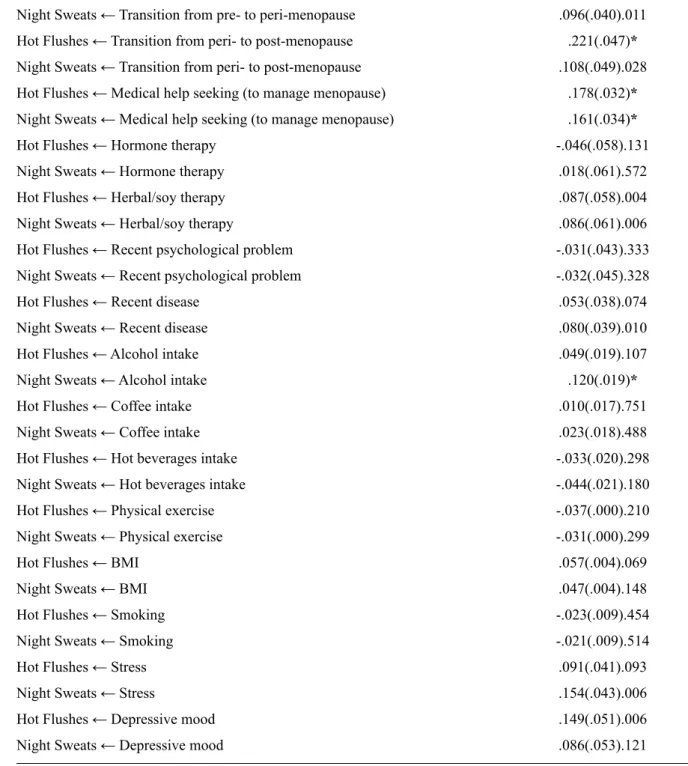
As shown, the assessed variables account for 20% and 25% of the occurrence of the night sweats and of the hot fl ushes’ variability, respectively.
Table 2
Structural Weights of Independent Variables (socio-demographics, health and menopause-related, lifestyle, stress and depressive mood) in Relation to the Dependent Variables (presence of vasomotor symptoms)
Trajectories β(SE)p
Hot Flushes ← Age .088(.004).030
Night Sweats ← Age .059(.004).158
Hot Flushes ← Marital status .111(.033)*
Night Sweats ← Marital status .118(.034)*
Hot Flushes ← N.º children -.075(.013).011
Night Sweats ← N.º children -.081(.014).008
Hot Flushes ← Professional status -.009(.044).776
Night Sweats ← Professional status -.019(.046).558
Hot Flushes ← Educational level .007(.010).844
Night Sweats ← Educational level .029(.010).442
Hot Flushes ← Household annual income .003(.015).940
Night Sweats ← Household annual income -.021(.016).575
Hot Flushes ← Transition from pre- to peri-menopause .143(.038)*
Night Sweats ← Transition from pre- to peri-menopause .096(.040).011
Hot Flushes ← Transition from peri- to post-menopause .221(.047)*
Night Sweats ← Transition from peri- to post-menopause .108(.049).028
Hot Flushes ← Medical help seeking (to manage menopause) .178(.032)*
Night Sweats ← Medical help seeking (to manage menopause) .161(.034)*
Hot Flushes ← Hormone therapy -.046(.058).131
Night Sweats ← Hormone therapy .018(.061).572
Hot Flushes ← Herbal/soy therapy .087(.058).004
Night Sweats ← Herbal/soy therapy .086(.061).006
Hot Flushes ← Recent psychological problem -.031(.043).333
Night Sweats ← Recent psychological problem -.032(.045).328
Hot Flushes ← Recent disease .053(.038).074
Night Sweats ← Recent disease .080(.039).010
Hot Flushes ← Alcohol intake .049(.019).107
Night Sweats ← Alcohol intake .120(.019)*
Hot Flushes ← Coffee intake .010(.017).751
Night Sweats ← Coffee intake .023(.018).488
Hot Flushes ← Hot beverages intake -.033(.020).298
Night Sweats ← Hot beverages intake -.044(.021).180
Hot Flushes ← Physical exercise -.037(.000).210
Night Sweats ← Physical exercise -.031(.000).299
Hot Flushes ← BMI .057(.004).069
Night Sweats ← BMI .047(.004).148
Hot Flushes ← Smoking -.023(.009).454
Night Sweats ← Smoking -.021(.009).514
Hot Flushes ← Stress .091(.041).093
Night Sweats ← Stress .154(.043).006
Hot Flushes ← Depressive mood .149(.051).006
Night Sweats ← Depressive mood .086(.053).121
Note. β=standardized estimates; SE=standard error. *p≤.001.
Table 3 evidences the mean levels of vasomotor symp-toms’ severity, and of stress, anxiety and depressive mood symptoms’ frequency, as well as, the differences between the three menopausal statuses.
To explore if there are signifi cant differences between women who have, and those who do not have, vasomotor symptoms in relation to depressive mood, anxiety and stress, the two groups were compared. The results are presented in the Table 4.
Discussion
of depressive mood, stress and anxiety. Therefore, given the results of the univariate analysis, the frequency of anxiety, depressive mood and stress symptoms is only statistically different when considering the presence of vasomotor symptoms (instead of taking into account the menopausal status) in peri- and post-menopausal women (although in the fi rst analysis – regarding the presence/ absence of vasomotor symptoms – pre-menopausal women are included, they are a small part of this sample; that is, 31 participants and 57 women in pre-menopause reported hot fl ushes and night sweats, respectively).
Although there is strong evidence that vasomotor symptoms are one of the few clinical manifestations strongly associated with the hormonal fl uctuation observed in the peri-menopause (Deecher & Dorries, 2007), these symptoms have been reported in some studies by pre-menopausal women (Freeman et al., 2005). In the present study this was observed: as mentioned before, 12% and 21% of women in pre-menopause reported hot fl ushes and night sweats, respectively.
It could be hypothesized that this translates a limitation on the assessment of the menopausal status - in this study a Table 3
Mean Scores for Vasomotor and Psychological Variables and Differences between the Three Menopausal Statuses
Variables
Pre-M(SD)
Peri-M(SD)
Post-M(SD)
one-way ANOVA MD(SE)p
Hot Flushes severity .2(.566) .8(1.197) 1.2(1.366) Pre- Peri- -.591(.097)*
Pre- Post- -1.056(.091)*
Peri- Post- -.464(.090)*
Night Sweats severity .3(.677) .8(1.204) 1.2(1.365) Pre- Peri- -.518(.098)*
Pre- Post- -.869(.092)*
Peri- Post- -.350(.090)*
Depressive mood 1.3(.478) 1.4(.535) 1.5(.644) Pre- Peri- -.081(.047).199
Pre- Post- -.173(.044)*
Peri- Post- -.091(.043).090
Stress 1.6(.500) 1.7(.559) 1.8(.606) Pre- Peri- -.133(.047).012
Pre- Post- -.168(.044)*
Peri- Post- -.035(.043).694
Anxiety 1.2(.307) 1.4(.467) 1.4(.545) Pre- Peri- -.150(.039)*
Pre- Post- -.228(.036)*
Peri- Post- -.078(.035).071
Note. MD=mean difference; SE=standard error. *p≤.001.
Table 4
Comparison of Women With and Without Hot Flushes (HF) and Night Sweats (NS) Regarding Levels of Stress, Anxiety and Depressive Mood
Psychol. Variables With HF M(SD)
Without HF M(SD)
t-student t(df)p
With NS M(SD)
Without NS M(SD)
t-student t(df)p
Anxiety 1.6(.577) 1.2(.332) -9.249(471.816)* 1.5(.556) 1.2(.336) -9.429(542.012)*
Stress 1.9(.577) 1.6(.517) -6.357(622.301)* 1.9(.602) 1.6(.504) -6.837(686.538)*
Depressive mood 1.6(.677) 1.3(.464) -6.851(528.208)* 1.6(.665) 1.3(.469) -6.246(603.198)*
self-report method based on STRAW+10 criteria (Harlow et al., 2012) was used - which could evidence that, although the menstrual period of these participants did not evidence alterations, minimal hormonal changes (not translated in manifest menstrual alterations) might promote these vaso-motor symptoms. Also, it can be thought that socio-cultural factors (such as the identifi cation with menopausal-peers), as well as the perception of age progressing towards an age interpreted as “menopausal”, might infl uence the interpretation of elevated body temperature (for reasons other than hormonal) as vasomotor symptoms. Despite these hypotheses, the assessment of the menopausal status through age and self-assessment of the menstrual history, as done in the present research, has been evidenced as a more accurate way of determining the menopausal status rather than using the presence of particular symptoms (such as vasomotor symptoms) or hormone levels given by laboratory tests (Bastian, Smith, & Nanda, 2003).
The structural model encompassing socio-demographic, health, menopause-related, lifestyle and psychological variables (stress and depressive mood), demonstrates that there are several factors that can predict the presence of vasomotor symptoms in midlife women. Age progression was a signifi cant variable in relation to the appearance of hot fl ushes. Also, being married (or in a relationship) and having less children (or no children) predicted the presence of both vasomotor symptoms. In other studies, being divorced was associated with bothersomeness of vasomotor symptoms (Avis, Crawford, & McKinlay, 1997) and parous women evidenced a higher frequency of vasomotor symptoms (Progetto Menopausa Italia Study Group, 2005).
Menopausal status (namely, being peri- and post-menopausal), as well as medical help sought to manage menopause, significantly predicted the occurrence of both hot fl ushes and night sweats. This is congruent with researches which evidence that the vasomotor symptoms result from the decrease in endogenous estrogens (Blümel et al., 2004; Randolph et al., 2005),and are the most com-mon reason to search for medical help search to deal with menopause (Albertazzi, 2007; Avis et al., 1997; Guthrie, Dennerstein, Taffe, & Donnelly, 2003; Whitcomb, White-man, Langenberg, Flaws, & Romani, 2007).
The use of herbal/soy products was signifi cantly as-sociated with both vasomotor symptoms. These results are consistent with other studies (Haimov-Kochman & Hochner-Celnikier, 2005; Thurston & Joffe, 2012). A review on herbal products’ effi cacy for the treatment of menopausal symptoms has concluded that there is no convincing evidence and that the data on these products is doubtful given the poor methodology used in studies that document benefi ts of the herbal therapies and safety concerns (namely, regarding the use of kava; Huntley & Ernest, 2003). Therefore, the use of natural products for the treatment of hot fl ushes and night sweats should receive further attention and be thoroughly researched. However,
it is reasonable to think that women without symptoms are less likely to use herbal/soy products. In addition, it can be hypothesized that some women with bothersome symptoms may have opted, or have been suggested to use natural products, in alternative to the hormonal therapy.
The physical health status (specifi cally, the presence of a recent disease) was also signifi cant in the prediction of night sweats. This outcome supports a previous study where a health status qualifi ed as excellent was linked to a decrease in night sweats, but not in hot fl ushes (Sievert et al., 2006).
Lifestyle factors can signifi cantly infl uence the degree of vasomotor symptoms’ reporting (Avis et al., 1997). In particular, daily alcohol consumption has been described as a habit that increases the probability of incidence and bothersomeness of night sweats (Sievert et al., 2006). In this study, only alcohol intake predicted one of the vasomo-tor symptoms. Therefore, higher alcohol intake was linked to the presence of night sweats. This emphasizes a conclu-sion drawn in prior researches which identify alcohol as a risk factor for vasomotor symptoms (Kandiah & Amend, 2010; Progetto Menopausa Italia Study Group, 2005; Shaw, 1997; Sievert et al., 2006). Smoking, coffee, physi-cal exercise and BMI were not signifi cant predictors of the occurrence of night sweats or hot fl ushes, in this sample. The different infl uences of the two psychological vari-ables in the vasomotor symptoms, namely stress predicting night sweats (but no hot fl ushes) and depressive mood predicting hot fl ushes (and not night sweats) might be re-lated with the nature of the psychological symptoms itself. Individuals with higher stress levels have been identifi ed as having lower sleep effi ciency, higher latency on the fi rst stage of sleep and increased arousal (Drake, Richardson, Roehrs, Scofi eld, & Roth, 2004). Another study has reported that vasomotor symptoms are associated with sleep disturbance and poor sleep continuity and quality (Kravitz et al., 2008). Since higher levels of stress predicted the occurrence of night sweats, this relation can be mediated by the sleep disturbance that results from higher levels of stress.
The variables assessed account for 20% and 25% of the occurrence of night sweats and hot fl ushes’ variability, re-spectively. Hence, variables, other than the included in this study, may have an impact in the emergence of vasomotor symptoms. For example, a structural model predicting the severity of both hot fl ushes and night sweats in a sample of symptomatic women (that is, who evidenced vasomotor symptoms in the previous month) showed that perceived control over vasomotor symptoms was the strongest and most signifi cant predictor of the symptoms’ severity; moreover, that structural model explained 67% and 72% of the variability of hot fl ushes and night sweats’ severity, respectively (Pimenta, Leal, Maroco, & Ramos, 2011). And although vasomotor symptoms are strongly associated with hormonal variations (Dennerstein et al., 2000) there might be other non-hormonal variables that account for the presence of vasomotor symptoms in midlife women.
The sample size (992 participants) was adequate for this type of statistical analysis given it was applied a rule of thumb of ten subjects per manifest variable, as is cur-rent practice in structural equation modelling (Kline, 2005; Maroco, 2010). Nevertheless, the fact that this research has a cross-sectional design, and that it uses a sample where a signifi cant part of the participants has a college degree, limits the generalization of these results.
In conclusion, this research shows that vasomotor symptoms’ occurrence might be predicted by several variables, namely, socio-demographic characteristics (age, marital status and parity), menopausal status, medical help-seeking (to manage menopause), use of herbal/soy therapies, health status, alcohol intake and psychological symptoms (depression and stress). Moreover, the differ-ent infl uences of the two psychological variables in the vasomotor symptoms, namely stress predicting night sweats (but no hot fl ushes) and depression predicting hot fl ushes (and not night sweats), might be related with the nature of the psychological symptoms itself. Additionally, it was concluded that participants with hot fl ushes and night sweats presented signifi cantly higher levels of stress, anxiety and depression.
References
Albertazzi, P. (2007). Non-estrogenic approaches for the treat-ment of climacteric symptoms. Climacteric, 10(Suppl. 2), 115-120. doi:10.1080/13697130701440980
Archer, D. F., Sturdee, D. W., Baber, R., de Villiers, T. J., Pines, A., Freedman, R. R., ...Warren, M. (2011). Menopausal hot
fl ushes and night sweats: Where are we now? Climacteric,
14(5), 515-528. doi:10.3109/13697137.2011.608596 Asadi, M., Jouyandeh, Z., & Nayebzadeh, F. (2012). Prevalence
of menopause symptoms among Iranian women. Journal of Family and Reproductive Health, 6(1), 1-3. Retrieved from http://jfrh.tums.ac.ir/index.php/jfrh/article/view/291 Avis, N. E., Crawford, S. L., & McKinlay, S. M. (1997).
Psy-chosocial, behavioral, and health factors related to menopause symptomatology. Women’s Health, 3(2), 103-120.
Bastian, L. A., Smith, C. M., & Nanda, K. (2003). Is this woman perimenopausal? JAMA, 289(7), 895-902. doi:10.1001/ jama.289.7.895
Blümel, J. E. M., Castelo-Branco, C., Cancelo, M. J., Córdova, A. T., Binfa, L. E., Bonilla, H. G., ...Sarrá, S. C. (2004). Relation between psychological complaints and vasomotor symptoms during climacteric. Maturitas, 49(3), 205-210. doi:10.1016/j. maturitas.2004.01.011
Bromberger, J. T., Matthews, K. A., Schott, L. L., Brockwell, S., Avis, N. E., Kravitz, H. M., …Randolph, J. F., Jr. (2007). Depressive symptoms during the menopausal transition: The Study of Women’s Health Across the Nation (SWAN). Jour-nal of Affective Disorders, 103(1-3), 267-272. doi:10.1016/j. jad.2007.01.034
Byrne, B. M. (2001). Structural equation modeling with AMOS: Basic concepts, applications, and programming. Mahwah, NJ: Lawrence Erlbaum.
Carmody, J., Crawford, S., & Churchill, L. (2006). A pi-lot study of mindfulness-based stress reduction for hot flashes. Menopause, 13(5), 760-769. doi:10.1097/01. gme.0000227402.98933.d0
Deecher, D. C., & Dorries, K. (2007). Understanding the pathophysiology of vasomotor symptoms (hot fl ushes and night sweats) that occur in perimenopause, menopause, and postmenopause life stages. Archives of Women’s Mental Health, 10(6), 247-257. doi:10.1007/s00737-007-0209-5 Dennerstein, L., Dudley, E., Hopper, J., Guthrie, J., & Burger,
H. A. (2000). A prospective population-based study of meno-pausal symptoms. Obstetrics & Gynecology, 96(3), 351-358. doi:10.1016/S0029-7844(00)00930-3
Drake, C., Richardson, G., Roehrs, T., Scofi eld, H., & Roth, T. (2004). Vulnerability to stress-related sleep disturbance and hyperarousal. Sleep, 27(2), 285-292.
Freeman, E., Sammel, M., Lin, H., Gracia, C., Kapoor, S., & Ferdousi, T. (2005). The role of anxiety and hormonal changes in menopausal hot flashes. Menopause, 12(3), 258-266. doi:10.1097/01.GME.0000142440.49698.B7
Freeman, E. W., Sammel, M. D., Lin, H., & Nelson, D. B. (2006). Associations of hormones and menopausal status with depressed mood in women with no history of depression. Ar-chives of General Psychiatry, 63(4), 375-382. doi:10.1001/ archpsyc.63.4.375
Gannon, L., Hansel, S., & Goodwin, J. (1987). Correlates of menopausal hot fl ashes. Journal of Behavioral Medicine,
10(3), 277-285. doi:10.1016/0378-5122(88)90172-7 Gjelsvik, B., Rosvold, E. O., Straand, J., Dalen, I., & Hunskaar,
S. (2011). Symptom prevalence during menopause and factors associated with symptoms and menopausal age. Results from the Norwegian Hordaland Women’s Cohort Study. Maturitas,
70(4), 383-390. doi:10.1016/j.maturitas.2011.09.011 Gold, E. B., Sternfeld, B., Kelsy, J. L., Brown, C., Mouton, C.,
Reame, N., …Stellato, R. (2000). Relation of demographic and lifestyle factors to symptoms in a multi-racial/ethnic population of women 40-55 years of age. American Journal of Epidemiology, 152(5), 463-473. doi:10.1093/aje/152.5.463 Guthrie, J. R., Dennerstein, L., Taffe, J. R., & Donnelly, V.
(2003). Health care-seeking for menopausal problems. Cli-macteric, 6(2),112-117. doi:10.1080/cmt.6.2.112.117 Haimov-Kochman, R., & Hochner-Celnikier, D. (2005). Hot
fl ashes revisited: Pharmacological and herbal options for hot
Hardy, R., & Kuh, D. (2002). Change in psychological and vasomotor symptom reporting during menopause. Social Science & Medicine, 55(11), 1975-1988. doi:10.1016/S0277-9536(01)00326-4
Harlow, S. D., Gass, M., Hall, J. E., Lobo, R., Maki, P., Rebar, R. W., ...de Villiers, T. J. (2012). Executive summary of the Stages of Reproductive Aging Workshop + 10: Addressing the unfi nished agenda of staging reproductive aging. Menopause, 19(4), 1-9. doi:10.1097/gme.0b013e31824d8f40
Huang, A. J., Grady, D., Jacoby, V. L., Blackwell, T. L., Bauer, D. C., & Sawaya, G. F. (2008). Persistent hot fl ushes in older postmenopausal women. Archives of Internal Medicine,
168(8), 840-846. doi:10.1001/archinte.168.8.840
Hunter, M. S., & Liao, K. L. (1995). A psychological analysis of menopausal hot fl ushes. British Journal of Clinical Psychol-ogy, 34(4), 589-599. doi:10.1111/j.2044-8260.1995.tb01493.x Hunter, M. S., & Mann, E. (2010). A cognitive model of
menopausal hot fl ushes and night sweats. Journal of Psy-chosomatic Research, 69(5), 491-501. doi:10.1016/j.jpsy-chores.2010.04.005
Huntley, A. L., & Ernst, E. (2003). A systematic review of herbal medicinal products for the treatment of menopausal symptoms. Menopause, 10(5), 465-476. doi:10.1097/01. GME.0000058147.24036.B0
Joffe, H., Hall, J. E., Soares, C. N., Hennen, J., Reilly, C. J., Carlson, K., & Cohen, L. S. (2002). Vasomotor symp-toms are associated with depression in perimenopausal women seeking primary care. Menopause, 9(6), 392-398. doi:10.1097/00042192-200211000-00003
Juang, K. D., Wang, S. J., Lu, S. R., Lee, S. J., & Fuh, J. L. (2005). Hot fl ushes are associated with psychological symptoms of anxiety and depression in peri- and post- but not premeno-pausal women. Maturitas, 52(2), 119-126. doi:10.1016/j.ma-turitas.2005.01.005
Kandiah, J., & Amend, V. (2010). An exploratory study on per-ceived relationship of alcohol, caffeine, and physical activity on hot fl ashes in menopausal women. Health, 2(9), 989-996. doi:10.4236/health.2010.29146
Kline, R. B. (2005). Principles and practices of structural equa-tion modelling (2nd ed). New York: The Guilford Press.
Kravitz, H. M., Zhao, X., Bromberger, J. T., Gold, E. B., Hall, M. H., Matthews, K. A., & Sowers, M. R. (2008). Sleep dis-turbance during the menopausal transition in a multi-ethnic community sample of women. Sleep, 31(7), 979-990. Lermer, M., Morra, A., Moineddin, R., Manson, J., Blake, J., &
Tierney, M. (2011). Somatic and affective anxiety symptoms and menopausal hot fl ashes. Menopause, 18(2), 129-132. doi:10.1097/gme.0b013e3181ec58f8
Lovibond, P. F., & Lovibond, S. H. (1995). The structure of negative emotional states: Comparison of the Depression Anxiety Stress Scales (DASS) with the Beck Depression and Anxiety Inventories. Behaviour Research and Therapy, 33(3), 335-343. doi:10.1016/0005-7967(94)00075-U
Maroco, J. (2010). Análise de equações estruturais: Fundamen-tos teóricos, software e aplicações. Pêro Pinheiro, Portugal: Report Number.
Melby, M. K., Lock, M., & Kaufert, P. (2005). Culture and symp-tom reporting at menopause. Human Reproduction Update,
11(5), 495-512. doi:10.1093/humupd/dmi018
Murray, G. (2007). Diurnal mood variation in depression: A signal of disturbed circadian function? Journal of Affective Disorders, 102(1), 47-53. doi:10.1016/j.jad.2006.12.001
National Institutes of Health. (2005). National Institutes of Health State-of-the-Science Conference statement: Manage-ment of menopause-related symptoms. Annals of Internal Medicine, 142(12, Pt. 1), 1003.
Pais-Ribeiro, J. L., Honrado, A., & Leal, I. (2004). Contribuição para o estudo da adaptação portuguesa das Escalas de Ansie-dade, Depressão, e Stress (EADS) de 21 Itens de Lovibond e Lovibond. Psicologia, Saúde & Doenças, 5(2), 229-239. Pimenta, F., Leal, I., Maroco, J., & Ramos, C. (2011). Perceived
control, lifestyle, health, socio-demographic factors and menopause: Impact on hot fl ashes and night sweats. Matu-ritas, 69(4), 338-342. doi:10.1016/j.maturitas.2011.05.005 Pimenta, F., Leal, I., Maroco, J., & Ramos, C. (2012). Menopause
Symptoms’ Severity Inventory (MSSI-38): Assessing symp-toms’ frequency and intensity. Climacteric, 15(2), 143-152. doi:10.3109/13697137.2011.590617
Progetto Menopausa Italia Study Group. (2005). Factors associ-ated with climacteric symptoms in women around menopause attending menopause clinics in Italy. Maturitas, 52(3), 181-189. doi:10.1016/j.maturitas.2005.01.008
Randolph, J. F., Jr., Sowers, M., Bondarenko, I., Gold, E. B., Greendale, G. A., Bromberger, J. T., …Matthews, K. A. (2005). The relationship of longitudinal change in reproduc-tive hormones and vasomotor symptoms during the meno-pausal transition. The Journal of Clinical Endocrinology and Metabolism, 90(11), 6106-6112. doi:10.1210/jc.2005-1374 Shaw, C. R. (1997). The perimenopausal hot fl ash: Epidemiology,
physiology, and treatment. The Nurse Practitioner, 22(3), 55-69.
Sievert, L. L., Obermeyer, C. M., & Price, K. (2006). Determi-nants of hot fl ashes and night sweats. Annals of Human Biol-ogy, 33(1), 4-16. doi:10.1080/03014460500421338
Stearns, V., Ullmer, L., Lopez, J. F., Smith, Y., Isaacs, C., & Hayes, D. F. (2002). Hot fl ushes. Lancet, 360, 1851-1861. doi:10.1016/S0140-6736(02)11774-0
Thurston, R. C., & Joffe, H. (2012). Vasomotor symptoms and menopause: Findings from the study of women’s health across the nation. Obstectrics & Gynecology Clinics of North America, 38(3), 489-501. doi:10.1016/j.ogc.2011.05.006 Weisberg, S. (1985). Applied linear regression (2nd ed). New
York: John, Wiley & Son.
Whitcomb, B. W., Whiteman, M. K., Langenberg, P., Flaws, J. A., & Romani, W. A. (2007). Physical activity and risk of hot
fl ashes among women in midlife. Journal of Women’s Health,
16(1), 124-133. doi:10.1089/jwh.2006.0046
Woods, N. F., Mariella, A., & Mitchell, E. S. (2002). Patterns of depressed mood across the menopausal transition: Ap-proaches to studying patterns in longitudinal data. Acta Obstetricia et Gynecologica Scandinavica, 81(7), 623-632. doi:10.1034/j.1600-0412.2002.810708.x