INTRODUCTION
Inlammatory Bowel Disease (IBD) is an immunological condi-tion that carries a signiicant morbidity as well as mortality(1). It has been classiied as Crohn’s Disease (CD) or Ulcerative Colitis (UC). Even though these entities share a common ground, they exhibit differences in terms of clinical presentation and therapeutic alternatives. During the last few years, there has been a signiicant development of scientiic evidence showing the beneit of biological therapy – mainly anti-TNF α agents – in both scenarios(7).
Nevertheless, approximately 30% of patients with moderate-to-severe disease, whether they are CD or UC patients, do not respond to anti-TNF α therapy (primary failure)(3) and a signiicant proportion of patients (13% to 25% per year of treatment) may develop resistance and hence loss of eficacy to this type of treat-ment (secondary failure)(27,33). This is why alternative therapeutic strategies are needed for these patients so that clinical conditions are improved and potentially serious complications can be avoided.
There is some evidence that show the eficacy of calcineurin inhibitors for the treatment of patients with severe UC(18). Due to the effect that these drugs exert on calcineurin, they can inhibit the transcription of the Interleukin-2 gene – among others – which is necessary for the activation of T lympochytes(2). As a consequence, although the quality of the available evidence is far from ideal, cy-closporine has been used in this clinical context; much less evidence is available in the CD scenario.
Efficacy of tacrolimus for induction of remission in
patients with moderate-to-severe ulcerative colitis:
a systematic review and meta-analysis
Juan
LASA
and Pablo
OLIVERA
Received 24/11/2016 Accepted 26/12/2016
ABSTRACT – Background – There is evidence that shows that calcineurin inhibitors may be useful for the treatment of severe ulcerative colitis. How-ever, evidence regarding the eficacy of tacrolimus for remission induction in this setting is scarce. Objective – To develop a systematic review on the existing evidence regarding the clinical eficacy of tacrolimus for the induction of remission in patients with moderate-to-severe ulcerative colitis. Methods – A literature search was undertaken from 1966 to August 2016 using MEDLINE, Embase, LILACS and the Cochrane Library. The fol-lowing MeSH terms were used: “Inlammatory Bowel Diseases” or “Ulcerative Colitis” and “Calcineurin Inhibitors” or “Tacrolimus” or “FK506”. Studies performed in adult ulcerative colitis patients that evaluated the clinical eficacy of tacrolimus for the induction of remission were considered for revision. A meta-analysis was performed with those included studies that were also placebo-controlled and randomized. Clinical response as well as clinical remission and mucosal healing were evaluated. Results – Overall, 755 references were identiied, from which 22 studies were inally included. Only two of them were randomized, placebo-controlled trials. A total of 172 patients were evaluated. A signiicantly lower risk of failure in clinical response was found for tacrolimus versus placebo [RR 0.58 (0.45-0.73)]; moreover, a lower risk of failure in the induction of remission was also found versus placebo [RR 0.91 (0.82-1)]. Conclusion – Tacrolimus seems to be a valid therapeutic alternative for the induction of remission in patients with moderate-to-severe ulcerative colitis.
HEADINGS – Inlammatory bowel diseases. Tacrolimus. Calcineurin inhibitors.
Disclosure of funding: no funding received
Gastroenterology Section, Internal Medicine Department. Centro de Educacion Medica e Investigaciones Clinicas Norberto Quirno (CEMIC). Buenos Aires, Argentina. Correspondence: Juan Lasa. Libertad, 984 (CP 1012). Buenos Aires, Argentina. E-mail: [email protected]
Bearing this in mind, a class-effect on moderate-to-severe UC could be inferred; consequently, the use of other calcineurin inhibi-tors such as tacrolimus has been proposed. Tacrolimus has the ad-vantages of oral administration, a well-known safety proile and the previous experience of use in other clinical settings(31). However, the evidence of the eficacy of its use in moderate-to-severe UC is scarce. As a consequence, we sought to carry out a systematic review of the available evidence on this matter, with a meta-analysis con-sidering randomized controlled trials.
METHODS
A literature search was carried out from 1966 to August 2016 using the following databases: MEDLINE, Embase, LILACS and The Cochrane Library. The search strategy included the following MeSH terms: “Inlammatory Bowel Disease” or “Ulcerative Co-litis” and “Calcineurin Inhibitors” or “Tacrolimus” or “FK-506”. Also, we reviewed the bibliographic references of the papers iden-tiied as potentially relevant. Additionally, we manually reviewed the abstracts of the Digestive Disease Week and United European Gastroenterology Week from 2010 to 2016.
meta-analysis performance, studies which fulilled the aforementioned criteria and were randomized controlled trials were included. PRISMA recommendations were followed for this purpose.
Authors’ indings were then compared. If there was disagree-ment regarding the inclusion of a study, this would be discussed until consensus was reached. If data duplication was suspected, the authors of the studies would be contacted to exclude this situation. The methodological quality of the included studies would be evaluated following the Evidence-Based Gastroenterology Sterring Group recommendations(29). In addition, Jadas score was estimated for each study.
Outcome measures were: clinical response, clinical remission after induction treatment and, if available, mucosal healing rate.
Meta-analysis was performed using REVMAN software (Review Manager Version 5.1. Copenhagen: The Nordic Cochrane Center, The Cochrane Collaboration, 2011). Heterogeneity was estimated by means of I2 test and chi square test. If no signiicant heterogeneity was found, a ixed-effect model would be used for meta-analysis; otherwise, a random-effect model would be preferred. Outcome measures were described as Relative Risks (RR) with their cor-responding 95% Conidence Interval (95%CI). Additionally, their corresponding Number Necessary to Treat (NNT) were calculated.
RESULTS
Overall, 755 potentially relevant citations were identiied; 48 of them were furtherly chosen for analysis. Figure 1 shows the low diagram which describes the reasons for citations exclusion. Finally, 22 studies(4-6,9-17,20-25,28,30,32,33) that fulilled eligibility criteria were included. Only two studies were randomized controlled trials(24,25) (Ogata 2006 and Ogata 2012); these were included for meta-analysis.
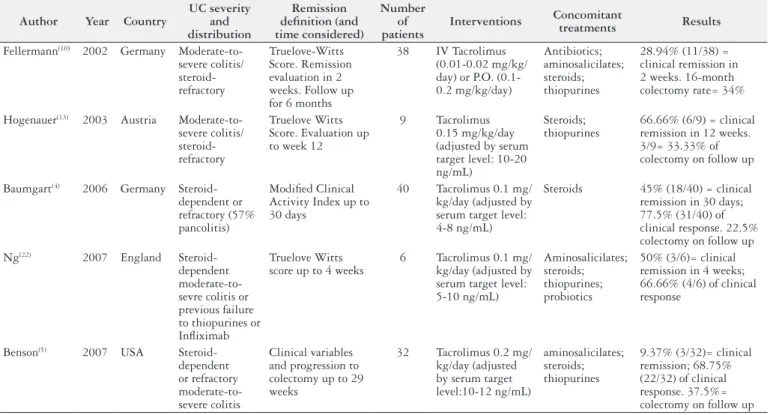
Table 1 describes the main features of the non-controlled studies that evaluated the eficacy of tacrolimus in patients with UC. The population included in these studies are rather similar – moderate-to-severe UC patients which are dependent or steroid-refractory– but certain discrepancy was found in the way that clinical response and clinical remission were deined: some studies used Truelove Witts criteria, whereas others used Lichtiger score. Some minor differences in terms of follow up time were also found. It is worth mentioning that only one of these studies(14) (Ikeya 2015) considered mucosal healing as an outcome. The tacrolimus dos-age was adjusted to obtain a serum level between 10 to 15 ng/ mL. Overall, 609 patients were included in non-controlled studies: in many of these cases, colectomy was delayed but not avoided.
TABLE 1. Characteristics of observational studies included in the systematic review
Author Year Country
UC severity and distribution
Remission deinition (and time considered)
Number of patients
Interventions Concomitant
treatments Results
Fellermann(10) 2002 Germany
Moderate-to-severe colitis/ steroid-refractory
Truelove-Witts Score. Remission evaluation in 2 weeks. Follow up for 6 months
38 IV Tacrolimus (0.01-0.02 mg/kg/ day) or P.O. (0.1-0.2 mg/kg/day)
Antibiotics; aminosalicilates; steroids; thiopurines
28.94% (11/38) = clinical remission in 2 weeks. 16-month colectomy rate= 34%
Hogenauer(13) 2003 Austria
Moderate-to-severe colitis/ steroid-refractory
Truelove Witts Score. Evaluation up to week 12
9 Tacrolimus 0.15 mg/kg/day (adjusted by serum target level: 10-20 ng/mL)
Steroids; thiopurines
66.66% (6/9) = clinical remission in 12 weeks. 3/9= 33.33% of colectomy on follow up
Baumgart(4) 2006 Germany
Steroid-dependent or refractory (57% pancolitis)
Modiied Clinical Activity Index up to 30 days
40 Tacrolimus 0.1 mg/ kg/day (adjusted by serum target level: 4-8 ng/mL)
Steroids 45% (18/40) = clinical remission in 30 days; 77.5% (31/40) of clinical response. 22.5% colectomy on follow up Ng(22) 2007 England
Steroid-dependent moderate-to-sevre colitis or previous failure to thiopurines or Inliximab
Truelove Witts score up to 4 weeks
6 Tacrolimus 0.1 mg/ kg/day (adjusted by serum target level: 5-10 ng/mL)
Aminosalicilates; steroids; thiopurines; probiotics
50% (3/6)= clinical remission in 4 weeks; 66.66% (4/6) of clinical response
Benson(5) 2007 USA
Steroid-dependent or refractory moderate-to-severe colitis
Clinical variables and progression to colectomy up to 29 weeks
32 Tacrolimus 0.2 mg/ kg/day (adjusted by serum target level:10-12 ng/mL)
aminosalicilates; steroids; thiopurines
9.37% (3/32)= clinical remission; 68.75% (22/32) of clinical response. 37.5%= colectomy on follow up Continue ➥
FIGURE 1. Flow-Chart showing the selection process of the studies included in the systematic review.
755 potentially relevant
citations identiied
48 papers selected for further analysis
Studies included in Systematic Review (n=22)
– 2 Randomized controlled
trials
– 22 Observational Studies
Studies excluded due to:
– Data duplication (n=2)
– Case Reports (n=7)
– Studies on pediatric
population (n=5)
Yamamoto(32) 2008 Japan Moderate-to-severe colitis refractory to other treatments (81.5% pancolitis) Truelove Witts
Score up to 30 days 27 Tacrolimus 0.1 mg/kg/day (adjusted by serum target level:10-15 ng/mL)
aminosalicilates; steroids; thiopurines
70.4% (19/27)= clinical remission in 30 days; 77.8% (21/27) of clinical response. 26.9%= colectomy on follow up
Thin(30) 2012 Australia
Moderate-to-severe colitis refractory to other treatments
Colitis Activity
Index up to 30 days 24 Tacrolimus 0.1 mg/kg/day (adjusted by serum target level:8-12 ng/mL)
aminosalicilates;
steroids 37.5% clinical remission (9/24); 58.3% (14/24) clinical response
Schmidt(28) 2013 Germany
Steroid-refractory Moderate-to-severe colitis
Lichtiger score up to 12 weeks; need for colectomy
130 Tacrolimus 0.1 mg/
kg/day aminosalicilates; steroids; thiopurines
72% (94/130) clinical remission; 14% (18/130)= colectomy on follow up
Inoue(15) 2013 Japan
Moderate-to-severe pancolitis without steroid treatment
Lichtiger score. Mayo score for mucosal healing up to 4 weeks.
11 Tacrolimus 0.1 mg/ kg/day (adjusted by serum target level:10-15 ng/mL)
aminosalicilates;
thiopurines 72.7% (8/11) clinical remission; 100% (11/11) clinical response
Miyoshi(21) 2013 Japan
Steroid-dependent or refractory moderate-to-severe colitis
Lichtiger score. Mayo score for mucosal healing up to 12 weeks.
51 Tacrolimus initial dose= 5 mg/day; then, oral Tacrolimus (adjusted by serum target level: 10-15 ng/mL)
aminosalicilates; steroids; thiopurines
39.2% (20/51)= clinical remission; 62.74% (32/51)= clinical response
Landy(17) 2013 England
Moderate-to-severe colitis refractory to other treatments
Truelove Witts Score up to 6 months
25 Tacrolimus 0.1 mg/ kg/day (adjusted by serum target level:5-10 ng/mL)
aminosalicilates; steroids; thiopurines
20% (5/25)= clinical remission; 24% (6/25)= clinical response
Boschetti(6) 2014 France
Moderate-to-severe colitis refractory to other treatments
UC-DAI at 4 and
12 weeks 30 Tacrolimus 0.1-0.2 mg/kg/day (adjusted by serum target level:10-15 ng/mL)
steroids;
thiopurines 47% (14/30)= clinical remission; 70% (21/30)= clinical response in 4 weeks
Hiraoka(11) 2015 Japan Colitis
moderada-severa cortico-dependiente/ refractaria
Lichtiger score up
to 2-3 weeks 47 Tacrolimus 0.05-0.15 mg/kg/day (adjusted by serum target level: 10-15 ng/mL)
aminosalicilates; steroids; thiopurines
87% (41/47) showed remission and/or clinical response
Ikeya(14) 2015 Japan
Moderate-to-severe colitis Colitis Activity Index. Mayo score for mucosal healing up to 12 weeks
44 Tacrolimus 0.1 mg/ kg/day (adjusted by serum target level:10-15 ng/mL)
aminosalicilates; steroids; thiopurines
86.4% (38/44)= clinical response; 65.9% (29/44)= clinical remission; 43.8% mucosal healing Kawakami(16) 2015 Japan
Steroid-dependent or refractory moderate-to-severe colitis
Lichtiger score up
to 4 weeks 49 Tacrolimus 0.1 mg/kg/day (adjusted by serum target level:10-15 ng/mL) aminosalicilates; steroids; thiopurines 89.6%= clinical response; 75.6%= clinical remission in 4 weeks
Minami(20) 2015 Japan
Moderate-to-severe colitis refractory to other treatments
Mayo score up to 8
weeks 22 Tacrolimus 0.1 mg/kg/day (adjusted by serum target level:10-15 ng/mL)
aminosalicilates; steroids; thiopurines
90.9% (20/22)= clinical response; 63.63% (14/22)= clinical remission in 8 weeks Hiraoka(12) 2015 Japan
Moderate-to-severe colitis refractory to other treatments
CAI 24 Tacrolimus 0.1 mg/
kg/day (adjusted by serum target level:10-15 ng/mL)
aminosalicilates; steroids; thiopurines
79% (19/24)= remission and/or response
Endo(9) 2016 Japan
Steroid-dependent or refractory moderate-to-severe colitis
CAI up to 8 weeks 47 Tacrolimus 0.1 mg/ kg/day (adjusted by serum target level:10-15 ng/mL) aminosalicilates; steroids; thiopurines 68.08% (32/47)= clinical response; 55.31% (26/47)= clinical remission. 14.89% (7/47)= colectomy on follow up Yamamoto(33) 2016 Japan
Steroid-dependent or refractory moderate-to-severe colitis
UC-DAI up to 12
weeks 50 Tacrolimus 0.1 mg/kg/day (adjusted by serum target level:10-15 ng/mL)
aminosalicilates; steroids; thiopurines
62% (31/50) = clinical response; 40% (20/50)= clinical remission
Nuki(23) 2016 Japan
Moderate-to-severe colitis UC-DAI up to 10 weeks 21 Tacrolimus 0.1 mg/kg/day (adjusted by serum target level:10-15 ng/mL)
aminosalicilates; steroids; thiopurines
Only two studies(24,25) (Ogata 2006 and Ogata 2012) were rando-mized controlled trials. The features of these trials are shown in Table 2. Overall, 127 UC patients were included for meta-analysis. Table 3 shows the methodological analysis of these two trials. As witnessed in Figure 2, tacrolimus signiicantly increased the risk of clinical response versus placebo [RR of clinical response
failure 0.58 (0.45-0.73)], with a NNT of 3. Figure 3 highlights the RR of failure of clinical remission versus placebo, which was 0.91 (0.82- 1), with a NNT of 10. Mucosal healing, as shown in Figure 4, was also signiicantly favoured by tacrolimus treatment [RR 0.59 (0.46-0.74)] with a NNT of 3. According to Egger test, a low risk of publication bias was found (P>0.5).
TABLE 2. Characteristics of randomized controlled trials included in meta-analysis
Author Year Country UC severity and
distribution
Remission deinition (and
time considered) Number of patients Interventions
Concomitant treatment
Ogata(25) 2006 Japan
(17 centers)
Moderate-to-severe left colitis or pancolitis
DAI Score <2 with every subitem <1. Clinical response: a decrease of at least 4 points in DAI. Evaluation in 2 weeks and then open follow up up to week 12. Mucosal healing evaluated
65 patients randomized; 60 patients inished study: 19 in Tacrolimus group (high-dosage), 21 in Tacrolimus low-dosage group and 20 in placebo group
0.05 mg/kg b.i.d. (adjusted to serum target levels of 5-10 ng/mL or 10-15 ng/ mL) versus placebo
Aminosalicilates and/or oral/IV steroids
Ogata(24) 2012 Japan
Moderate-to-severe, steroid-refractory left colitis or pancolitis
DAI Score <2 with every subitem <1. Clinical response: a decrease of at least 4 points in DAI. Evaluation in 2 weeks and then open follow up up to week 12. Mucosal healing evaluated
62 patients aleatorizados; 30 a rama placebo y 32 a rama tacrolimus
0.5-1 mg b.i.d. (adjusted to serum target levels of 10-15 ng/mL) versus placebo
Aminosalicilates and/or oral/IV steroids
UC: ulcerative colitis. DAI: disease activity index.
TABLE 3. Methodological analysis of randomized controlled trials included in meta-analysis
ID Study Concealed random
allocation
Blinding of patients and medical team
Similar interventions between groups
Complete follow up
Intention to
treat analysis Jadad score
Ogata 2006(25) Not clear Yes Yes Yes No 4
Ogata 2012(24) Yes Yes Yes Yes Yes 5
Tacrolimus Placedo Risk Ratio Risk Ratio Study or Subgroup Events Total Events Total Weight M-H, Random, 95% CI Year M-H, Random, 95% Cl
Ogata 2006 23 44 19 21 58.5% 0.58 [0.42, 0.79] 2006
Ogata 2012 16 32 26 30 41.5% 0.58 [0.42, 0.84] 2012
Total (95% Cl) 76 51 100,0% 0.58 [0.45, 0.73]
Total events 39 45
Heterogeneity: Tau2 = 0.00; Chi2 = 0.00, df = 1 (P=1.00); I2 = 0%
Test for overall effect: Z = 4.47 (P<0.00001) 0.01 0.1 1 10 100 Favours Tacrolimus Favours Placebo
FIGURE 2. Forest Plot showing meta-analysis on clinical response of tacrolimus versus placebo.
Tacrolimus Placedo Risk Ratio Risk Ratio Study or Subgroup Events Total Events Total Weight M-H, Random, 95% CI Year M-H, Random, 95% Cl
Ogata 2006 38 44 20 21 40.9% 0.91 [0.78, 1.06] 2006
Ogata 2012 29 32 30 30 59.1% 0.91 [0.80, 1.03] 2012
Total (95% Cl) 76 51 100.0% 0.91 [0.82, 1.00]
Total events 67 50
Heterogeneity: Tau2 = 0.00; Chi2 = 0.00, df = 1 (P=0.98); I2 = 0%
Test for overall effect: Z = 1.96 (P=0.05) 0.01 0.1 1 10 100 Favours Tacrolimus Favours Placebo
The most commonly reported severe adverse events were gastroenteritis and sepsis. When considering only the randomized controlled trials, there was not a signiicant increase in the risk of serious adverse events versus placebo [RR 3.38 (0.17-68.91)].
DISCUSSION
According to the results observed in our systematic review, tacrolimus therapy could be a valid alternative in the context of moderate-to-severe UC that have not responded to other treatments or who are regarded as cortico-dependent or refractory.
As mentioned before, evidence on the eficacy of calcineurin inhibitors derives mainly from the experience of cyclosporine as a rescue therapy in the setting of severe UC. In a pioneer study, Lichtiger et al.(18) showed that endovenous cyclosporine was useful to avoid colectomy in patients with severe UC lares after systemic steroid therapy failure. D’Haens et al.(8) concluded that cyclosporine is a valid alternative to intravenous steroids in severe lares. Ad-ditionally, controlled studies have shown that cyclosporine may be equivalent to Inliximab in this type of clinical scenario(18). Nevertheless, it should be reminded that cyclosporine has a non-neglectable adverse event proile and there is much less evidence apart from its parenteral use.
Tacrolimus is a well-known calcineurin inhibitor that is widely used as immunosupresant therapy in the context of transplant or even for the treatment of autoinmmune conditions(31). Tacrolimus has the advantage that it can be administered orally and that its serum concentration can be easily measured and adjusted to reach the adequate level in each case. The initial experience in UC patients was originated in referral centers from Japan, and then it was adopted by some centers in Europe. According to what is witnessed in uncontrolled studies, tacrolimus shows a high pro-portion of clinical response in the short-term, with a low NNT; however, when clinical remission is considered, such proportion is lower and more variable.
It is worth mentioning, according to what is observed from uncontrolled studies, the relatively high proportion of patients who would eventually require colectomy in spite of receiving tacroli-mus(4,5,10,13,28,32) (Fellermann 2002, Hogenauer 2003, Baumgart 2006, Benson 2007, Yamamoto 2008, Schmidt 2013). As a consequence, it
would seem like tacrolimus could delay the need for colectomy in a selected group of patients – those moderate-to-severe UC patients with prior failure to other therapeutic alternatives. It should also be mentioned that no study has considered tacrolimus therapy in patients with less severe disease.
There is a scarcity of high-quality trials to know the real impact of tacrolimus in the management of UC. As a matter of fact, as shown by this review, there has only been published two controlled trials(24,25) (Ogata 2006 and Ogata 2012), with a relatively low number of patients and a rather short follow up time. One strength of these two trials is that mucosal healing was included as an outcome, which is known to be a relevant prognostic factor and a therapeutic target, particularly when it comes to UC(26). It is also worth mentioning that all studies assessed the eficacy of oral tacrolimus for the continued treatment of UC patients.
Evidence on the eficacy of calcineurin inhibitors in the set-ting of CD is more scarce: there are only a few controlled trials, mainly on patients with perianal disease, and few cohort studies(19). Nevertheless, the relatively few alternatives in severe CD may turn tacrolimus into a valid therapeutic option, regardless of the few scientiic evidence available.
Some limitations should be mentioned. First of all, there were few studies included for meta-analysis, so the conclusions should be cautiously interpreted. We decided not to perform meta-analysis with observational uncontrolled studies, because this represents a high risk for relevant biases, which could in turn produce a distortion in the conclusions derived from higher-quality studies. Last but not least, it is worth mentioning that most observational studies were retrospective, with the logical limitations that this implicate.
In conclusion, tacrolimus seems to show in both uncontrolled studies as well as in placebo controlled trials, a signiicant eficacy to induce clinical response and remission in moderate-to-severe UC. However, more evidence is undoubtfully needed to fully estimate the magnitude of its beneit.
Authors’ contributions
Juan Lasa: bibliographic review, data analysis, statistical analy-sis, manuscript review. Pablo Olivera: bibliographic review, data analysis, manuscript elaboration.
Tacrolimus Placedo Risk Ratio Risk Ratio Study or Subgroup Events Total Events Total Weight M-H, Random, 95% CI Year M-H, Random, 95% Cl
Ogata 2006 21 44 19 21 49.6% 0.53 [0.38, 0.74] 2006
Ogata 2012 18 32 26 30 50.4% 0.65 [0.46, 0.91] 2012
Total (95% Cl) 76 51 100.0% 0.59 [0.46, 0.74]
Total events 39 45
Heterogeneity: Tau2 = 0.00; Chi2 = 0.73, df = 1 (P=0.39); I2 = 0%
Test for overall effect: Z = 4.39 (P<0.0001) 0.01 0.1 1 10 100 Favours Tacrolimus Favours Placebo
Lasa J, Olivera P. Eicácia do tacrolimus para indução de remissão em pacientes com colite ulcerosa moderada a grave: uma revisão sistemática e me-ta-análise. Arq Gastroenterol. 2017;54(2):167-72.
RESUMO – Contexto – Há evidências que mostram que os inibidores de calcineurina podem ser úteis para o tratamento da colite ulcerativa severa. No entanto, há poucos dados sobre a eicácia do tacrolimus para indução de remissão neste cenário. Objetivo – Desenvolver uma revisão sistemática sobre evidências existentes sobre a eicácia clínica do tacrolimus para a indução de remissão em pacientes com colite ulcerosa de moderada a grave. Métodos – Realizada pesquisa bibliográica de 1966 a agosto de 2016 usando MEDLINE, Embase, LILACS e Biblioteca Cochrane. Foram utilizados os seguintes termos MeSH: “doenças inlamatórias intestinais” ou “colite ulcerativa “ e “inibidores da calcineurina” ou “tacrolimo” ou “FK506”. Foram considerados para revisão estudos que avaliaram a eicácia clínica do tacrolimus para a indução de remissão em pacientes adultos com colite ulcerosa. Uma meta-análise foi realizada com esses estudos incluídos que também fossem controlados por placebo e randomizados. Avaliou-se a resposta clínica, bem como remissão clínica e a cicatrização da mucosa. Resultados – No total, 755 referências foram identiicadas, dos quais 22 estudos foram inalmente incluídos. Apenas dois deles eram experimentações randomizadas e, placebo-controlada. Um total de 172 pacientes foram avaliados. Veriicou-se um risco signiicativamente menor de falha na resposta clínica para tacrolimus versus placebo [RR 0.58 (0.45-0,73)]; Além disso, um menor risco de falha na indução da remissão também foi encontrado versus placebo [RR 0,91 (0,82-1)]. Conclusão – Tacrolimus parece ser uma alternativa terapêutica válida para a indução de remissão em pacientes com colite ulcerosa moderada a grave.
DESCRITORES – Doenças inlamatórias intestinais. Tacrolimo. Inibidores de calcineurina.
REFERENCES
1. Abraham C, Cho JC. Inlammatory bowel disease. N Engl J Med. 2009;361:2066-78. 2. Actis GC, Volpes R, Rizzetto M. Oral microemulsion cyclosporine to reduce
steroids rapidly in chronic active ulcerative colitis. European J Gastroenterol Hepatol. 1999;11:905-8
3. Allez M, Karmiris K, Louis E, et al. Report of the ECCO pathogenesis work-shop on anti-TNF therapy failures in inlammatory bowel diseases: Deinitions, frequency and pharmacological aspects. J Crohn’s Colitis. 2010;4:355-66. 4. Baumgart DC, Pintofl J, Sturm A, Wiedenmann B, Dignass AU. Tacrolimus is safe
and effective in patients with severe steroid-refractory or steroid-dependent inlam-matory bowel disease- a long-term follow up. Am J Gastroenterol. 2006;101:1048-56. 5. Benson A, Barrett T, Sparberg M, Buchman AL. Eficacy and safety of tacrolimus in refractory ulcerative colitis and crohn’s disease: a single center experience. Inlamm Bowel Dis. 2008;14:7-12.
6. Boschetti G, Nancey S, Moussata D, Stefanescu C, Roblin X, Chauvenet M, Stro-eymeyt K, Bouhnik Y, Flourie B. Tacrolimus induction followed by maintenance monotherapy is useful in selected patients with moderate-to-severe ulcerative colitis refractory to prior treatment. Dig Liv Dis. 2014;46:875-80.
7. Costa J, Magro F, Caldeira D, Alarcão J, Sousa R, Vaz-Carneiro A. Inliximab Reduces Hospitalizations and Surgery Interventions in Patients With Inlam-matory Bowel Disease: A Systematic Review and Meta-analysis. Inlamm Bowel Dis. 2013;19:2098-110.
8. D’Haens G, Lemmens L, Geboes K, Vandeputte L, Van Acker F, Mortelmans L, Peeters M, Vermeire S, Penninckx F, Nevens F, Hiele M, Rutgeerts P. Intrave-nous cyclosporine versus intraveIntrave-nous corticosteroids s single therapy for severe attacksof ulcerative colitis. Gastroenterology. 2001;120:1323-9.
9. Endo K, Onodera M, Shiga H, Kuroha M, Kimura T, Hiramoto K, Kakuta Y, Kinouch Y, Shimosegawa T. A comparison of short nd long-term therapeutic outcomes of inliximab – versus tacrolimus-based strategies for steroid-refractory ulcerative colitis. Gastroenterol Res Prac 2016;3162595.
10. Fellermann K, Tanko Z, Herrlinger KR, Witthoeft T, Homann N, Bruening A, Ludwig D, Stange EF. Response of refractory colitis to intravenous or oral tacrolimus (FK506). Inlamm Bowel Dis. 2002;8:317-24.
11. Hiraoka S, Kato J, Moritou Y, Takei D, Inokuchi T, Nakarai A, Takahasi S, Harada K, Okada H, Yamamoto K. The earliest trough concentrarionredicts the dose of tacrolimus required for remission induction therapy in ulcerative colitis patients. BMC Gastroenterol. 2015;15:53.
12. Hiraoka S, Inokuchi T, Takei D, Nakarai A, Sugihara Y, Morito Y, Takahashi S, Harada K, Okada H, Yamamoto K, Kato J. Tacrolimus therapy for outpatients with refractory ulcerative colitis. Gastroenterology. 2015;148:(Suppl 1):870-1. 13. Hogenauer H et al. Effect of oral tacrolimus (FK506) on steroid-refractory
moderate/severe ulcerative colitis. Aliment Pharmacol Ther. 2003;18:415-23. 14. Ikeya K, Sugimoto K, Kawasaki S, Iida T, Maruyama Y, Watanabe F, Hanai H.
Tacrolimus for remission inductionn ulcerative colitis: Mayo endoscopic subscore 0 and 1 predicts long-term prognosis. Dig Liv Dis. 2015; 47:365-71.
15. Inoue T, Murano M, Narabayashi K, Okada T, Nouda S, Ishida K, et al. The eficacy of oral tacrolimus in patients with moderate/severe ulcerative colitis not receiving concomitant corticosteroide therapy. Intern Med. 2013;52:15-20. 16. Kawakami K, Inoue T, Murano M, Narabayashi K, Nouda S, Ishida K, et al.
Effects of oral tacrolimus s a rapid induction therapy in ulcerative colitis. World J Gastroenterol. 2015;21:1880-6.
17. Landy J, Wahed M, Peake STC, Hussein M, Ng SC, Lindsay JO, Hart AL. Oral tacrolimus s maintenance therapy for refractory ulcerative colitis – an analysis of outcomes in two London tertiary centers. J Crohn Colitis. 2013;7:e516-e521
18. Lichtiger S, Present DH, Kornbluth A, Gelernt I, Bauer J, Galler G, Michelassi M, Hanauer S. Cyclosporine in severe ulcerative colitis refractory to steroid therapy. N Engl J Med. 1994;330:1841-5.
19. McSharry K, Dalzell AM, Leiper K, El-Matary W. Systematic review: the role of tacrolimus in the management of Crohn’s disease. Aliment Pharmacol Ther. 2011;34:1282-94.
20. Minami N, Yoshino T, Matsuura M, Koshikawa Y, Yamada S, Toyonaga T, Madian A, Honzawa Y, Nakase H. Tacrolimus or inliximab for severe ulcerative colitis: short-term and long-term data from a retrospective observational study. BMJ Open Gastro. 2015;2:e000021.
21. Miyoshi J, Matsuoka K, Inoue N, Hisamatsu T, Ichikawa R, Yajima T, Okamoto S, Naganuma M, Sato T, Kanai T, Ogata H, Iwao Y, Hibi T. Mucosal healing with oral tacrolimus is associated with medium-nd long-term prognosis in steroid-re-fractory/dependent ulcerative colitis patients. J Crohn Colitis. 2013;7:e609-e614. 22. Ng SC, Arebi N, Kamm MA. Medium-term results of oral tacrolimus treatmen-tin refractory inlammatory bowel disease. Inlamm Bowel Dis. 2007;3:129-34. 23. Nuki Y, Esaki M, Asano K, Maehata Y, Umeno J, Moriyama T, Nakamura S,
Matsumoto T, Kitazono T. Comparison of the therapeutic eficacy and safety between tacrolimus and inliximab for moderate-to severe ulcerative colitis: a single center experience. Scand J Gastroenterol 2016;51:700-5.
24. Ogata H, Kato J, Hirai F, Hida N, Matsui T, Matsumoto T, Koyanagi K, Hibi T. Double-blind, placebo controlled trial of oral tacrolimus (FK506) in the management og hospitalized patients with steroid-refractory ulcerative colitis. Inlamm Bowel Dis. 2012;18:803-8.
25. Ogata H, Matsui T, Nakamura M, Lida M, Takazoe M, Suzuki Y, Hibi T. A randomised dose inding study of oral tacrolimus (FK506) therapy in refractory ulcerative colitis. Gut. 2006;55:1255-62.
26. Pineton de Chambrun G, Peyrin-Biroulet L, Lémann M, Colombel JF. Clinical implications of mucosal healing for the management of IBD. Nat Rev Gastro-enterol Hepatol. 2010;7:15–29.
27. Roda G, Jharap B, Neeraj N, Colombel JF. Loss of Response to Anti-TNFs: Dei-nition, Epidemiology, and Management. Clin Transl Gastroenterol. 2016;7:e135. 28. Schmidt KJ, Herrlinger KR, Emmrich J, Barthel D, Koc H, Lehnert H, Stange EF, Fellermann K, Buning J. Short-term eficacy of tacrolimus in steroid-re-fractory ulcerative colitis – experience in 130 patients. Aliment Pharmacol Ther. 2013;37:129-136.
29. Schoenfeld P, Cook D, Hamilton F, Laine L, Morgan D, Peterson W. An ev-idence-based approach to gastroenterology therapy. Gastroenterology. 1998; 114:1318-25.
30. Thin LW, Murray K, Lawrance IC. Oral tacrolimus for the treatment of re-fractory inlammatory bowel diseasein the biologic era. Inlamm Bowel Dis. 2013;19:1490-8.
31. Webster A, Woodroffe RC, Taylor RS. Tacrolimus versus cyclosporin as primary immunosupresion for kidney transplants recipients. CDS Review. 2005;4:CD003961.
32. Yamamoto S, Nakase H, Mikami S, Inoue S, Yoshino T, Takeda Y, et al. Long-term effect of tacrolimus therapy in patients with refractory ulcerative colitis. Aliment Pharmacol Ther. 2008;28:589-97.