Short Report
S
J. Braz. Chem. Soc., Vol. 22, No. 3, 598-603, 2011. Printed in Brazil - ©2011 Sociedade Brasileira de Química 0103 - 5053 $6.00+0.00*e-mail: [email protected]
Synthesis of 3-Bromotetronamides via Amination of 3,4-Dibromofuran-2(5
H
)-one
Silvio Cunha,*,a,c Caio C. Oliveiraa,c and José R. Sabinob
aInstituto de Química and cInstituto Nacional de Ciência e Tecnologia - INCT em Energia e Ambiente, Universidade Federal da Bahia, Campus de Ondina, 40170-290 Salvador-BA, Brazil
bInstituto de Física, Universidade Federal de Goiás, CP 131, 74001-970 Goiânia-GO, Brazil
Este trabalho descreve a síntese de dez tetronamidas em bons rendimentos através da reação
da 4-dibromofuran-2(5H)-ona, obtida do furfural, com aminas primárias e secundárias. As aminas
aromáticas foram mais toleradas que as alifáticas e as heteroaromáticas. Foram determinadas as estruturas cristalinas de cinco derivados.
This work describes the direct synthesis of 3-bromotetronamides in good yields through the
reaction of 3,4-dibromofuran-2(5H)-one, obtained from furfural, with primary and secondary
amines. Aromatic amines were more tolerated than aliphatic and heteroaromatic ones. The X-ray structures of ive derivatives are described.
Keywords: enaminones, tetronamides, butenolides
Introduction
The synthesis of functionalized tetronamides is a theme of ongoing research activity, and this interest is due to the synthetic applications of such compounds, mainly in heterocyclic synthesis.1 A particular class of synthetically useful tetronamides are the 3-halo derivatives. However, most of the available protocols for the synthesis of 3-halotetronamides are based on the direct halogenation of a preformed enaminone, employing halogenation’s reagents such as ICl, NBS, Br2, I2, I(py)2BF4 and benzyl-trimetylammonium dichloroiodate (BTMA.ICl2).
2
Cyclic enaminones are especially attractive in the formation of bicyclic compounds.3 In this context, tetronamides have embedded in their structure the N−C=C−C=O enaminone moiety, and recently they have
emerged as a latent acyclic enaminone in the formal aza-[3+3] cycloaddition reaction.4 However, the synthesis of 3-halotetronamides unsubstituted at position 5 is scarcely described, being limited to the reaction of α-halotetronic
acid with an amine5 or by direct halogenation of tetranamides.6 Thus, practical synthetic approaches to this class of compound would be beneicial.
In our ongoing investigation on the chemistry of enaminones,7 we envisioned herein a direct route
to 3-bromotetronamides (4-amino-3-bromo-2(5H)
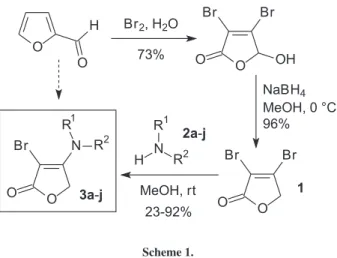
furanones), which are a special class of cyclic compound because they present both aspects mentioned above, i.e., the embedded enaminone moiety, and the bromide atom at the alpha position. Besides, this study represents an approach to 3-bromotetronamides from furfural, an attractive starting material obtained from renewable biomass. In this way, the furfural derivative of choice was the 3,4-dibromofuran-2(5H)-one 1, which is easily prepared in 70% overall yield by the reaction of furfural with bromine in water, affording mucobromic acid (commercially available also).8 This late was reduced affording 1 in 87-96% yield, Scheme 1, employing a recently described method by Bellina and Rossi.9 It should be pointed out that the reactions where 1 is employed as electrophile is scarcely described, being limited to palladium cross-coupling reactions,10 or only to morpholine as nucleophile and expensive base (Cs2CO3).
11
Results and Discussion
Cunha et al. 599 Vol. 22, No. 3, 2011
dibenzylamine, piperazine, cyclohexylamine and ethyl 3-aminocrotonate.
To test the possibility of a direct synthesis of 3-bromotetronamides, equimolar amounts of 1 and morpholine were reacted in diverse solvents and temperatures, but the starting material 1 was always detected by TLC. Employing 2 equiv. of morpholine in diethyl ether (24 h) or acetone (2.5 h) at room temperature complex mixture was formed, but in acetone at low temperature (0 °C) tetronamide 3a could be obtained in modest 35% yield. However, when the reaction was carried out in methanol at room temperature, excellent yield was obtained (Table 1, entry 1). With this optimal condition in hand, it was extended to a representative spectrum of aromatic amines, and yields were good to all
of them, but some ortho substituted ones (entries 6, 8 and 10). Mechanistically, formation of all 3-bromotetronamides 3a-f is a nucleophilic substitution by an addition-elimination pathway.
The use of 2 equiv. of amines can be a serious drawback when expensive or no commercial amines are necessary. To circumvent this limitation, one can imagine the use of one equiv. of a trivial weak base to act as HBr scavenger. Due to the decomposition of butenolide 1 in basic medium, we investigated its stability in methanolic solution of equimolar amounts of 1 and Et3N, Na2CO3 and NaHCO3. Compound 1 was completely decomposed after 4 h to the two irst bases, and after 24 h to the late. Because reaction of 1 and aromatic amines is a slow one, we choose NaHCO3 as additive.
Fortunately, the amount of amines 2 could be reduced to 1 equiv. and comparable yields of 3 were obtained when the reaction was carried out in the presence of 1 equiv. of NaHCO3 (entries 1, 3, 5, 7, Table 1). In general, anilines with para substituents afforded better yields and shorter reaction time than ortho substituted ones for both electron releasing and electron withdrawing groups (compare entries 3-8). Hence, a diversity of 3-bromotetronamides could be prepared, but the methodology presents some limitations, because no reaction was observed with 4-nitroaniline, diphenylaniline, 2,4-dichloroaniline and glycine, being furanone 1 quantitatively recovered.
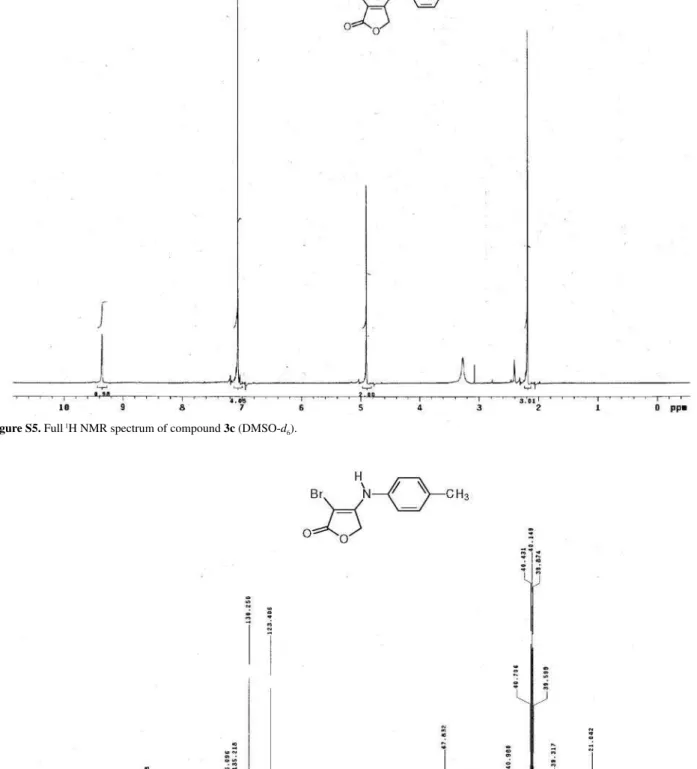
Curiously, in the 1H NMR spectrum of 3c, the signal of the aromatic hydrogens show up as a singlet integrated
Table 1. Isolated 3-bromotetronamide yields
entry Compound Amine 2 Yield / (%) time / h
R1 / R2 Condition A (and B)a
1 3a CH2CH2OCH2CH2 92 (65) 24 (88)
2 3b H / Ph 89 22
3 3c H / p-CH3Ph 80 (87) 14 (200)
4 3d H / o-CH3Ph 72 288
5 3e H / p-CH3OPh 82 (78) 5 (6)
6 3f H / o-CH3OPh 61 216
7 3g H / p-ClPh 78 (87) 73 (44)
8 3h H / o-ClPh 23 120
9 3i H / o-NH2Ph 75 14
10 3j H / α-naphthyl 57 168
aCondition A: 2 equiv. of 2; Condition B: 1 equiv. of 2 and 1 equiv. of NaHCO
Synthesis of 3-Bromotetronamides via Amination of 3,4-Dibromofuran-2(5H)-one J. Braz. Chem. Soc.
600
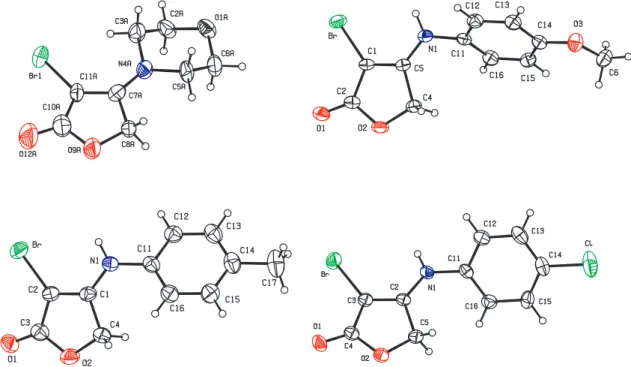
to four hydrogens, and not as the typical pair of doublets expected for para substituted aromatic rings. The structure of 3c was unambiguously conirmed by X-rays crystallography. Compounds 3a, 3e and 3g also afforded single-crystals whose X-rays structures are shown in Figure 1.
During the investigation on the reactivity of butenolide 1 with benzaldehyde in Knoevenagel condition, compound 3a and 5 were obtained, and the structure of the later
was corroborated by X-rays crystallography, as shown in Figure 2. Mechanistically, the formation of 3a follows the same addition-elimination pathway above mentioned, and the formation of 5 represents a three component reaction. In a control experiment, tetronamide 3a and benzaldehyde were left in the same Knoevenagel reaction condition, but the reagents were quantitatively recovered. Additionally, butenolide 1 and benzaldehyde were tentatively reacted in Knoevenagel condition with other no nucleophilic bases,
Figure 1. Ortep12 representations of 3a (top left), 3c (bottom left), 3e (top right), and 3g (bottom right). Displacement ellipsoids are drawn at the 30%
probability level and H atoms are shown as spheres of arbitrary radius.
Figure 2. Tricomponent reaction and Ortep12 representation of 5. Displacement ellipsoids are drawn at the 30% probability level and H atoms are shown
Cunha et al. 601 Vol. 22, No. 3, 2011
being the reagents recovered or the decomposition of 1 observed. These facts ruled out 3a as the intermediate in the formation of 5, suggesting a homoaldol reaction of 1 and 4 followed by an addition-elimination and a last step of water elimination to afford 5.
In contrast of the amines’ behavior with butenolide 1, which afforded tetronamides 3a-j in good yields, no reaction was observed with phenol. To gain more insight into the potential of 3-bromotetronamides 3a-j as building block, compound 3b was submitted to diverse intramolecular Mizoroki-Heck reaction conditions, but the substrate was
recovered unchanged. The unique observed transformation under these condition was the debromination of the butenolide ring when dioxane was employed as solvent with compounds 3b,e, affording the two known tetronamides 6a,b,13 which represents a palladium catalyzed dehalogenation without a formal hydride donor font, Scheme 2. A proposed mechanism of the palladium-catalyzed dehalogenation reaction is indicated in Figure 3, which was inspired in a previously described formal hydride-free donor one,14 where DMF was employed as solvent and act as a hydride source. Thus, the intermediate formed by the insertion of
Figure 3. Proposed mechanism of Pd-catalyzed dehalogenation.
Synthesis of 3-Bromotetronamides via Amination of 3,4-Dibromofuran-2(5H)-one J. Braz. Chem. Soc.
602
palladium (0) into the C-Br bond would react with dioxane in the presence of triethylamine to yield the specie that should suffer a beta-H elimination, followed by reductive elimination of Pd0 from the resulting hydridopalladium complex to give C-H, Figure 3.
In conclusion, we developed a practical synthesis of 3-bromotetronamides in good yields, describing for the first time that 3,4-dibromofuran-2(5H)-one 1 can be conveniently employed as electrophile in reactions with aromatic amines, amplifying the scope of such transformation.11 Efforts are underway on the application of these α-bromoenaminones in the synthesis of natural
and unnatural bioactive compounds.
Experimental
Melting points were determined on a Microquímica MQAPF 301 hot plate apparatus and are uncorrected. Infrared spectra were recorded as KBr discs on a FT-IR BOMEM MB100 instrument. NMR spectra were obtained for 1H at 300 MHz and for 13C at 75 MHz using a Varian Gemini 300 spectrometer. Chemical shifts are reported in ppm units downield from reference (internal TMS).
General synthetic condition A
To a solution of 1.0 mmol of 1 in 10 mL of CH3OH was added 2.0 mmol of amine 2. The solution was left at room temperature at the indicated time in Table 1. After this time, the solvent was evaporated and 20 mL of CHCl3 was added, extracted with water (3 × 5 mL), and the organic layer was dried over anhydrous Na2SO4, iltrated and the solvent evaporated. The crude residue was recrystallized from CHCl3/hexane affording a solid.
General synthetic condition B
To a solution of 1.0 mmol of 1 in 10 mL of CH3OH were added 1.0 mmol of NaHCO3 and 1.0 mmol of amine 2. The solution was left at room temperature at the indicated time in Table 1. After this time, the solvent was evaporated and 20 mL of CHCl3 was added, extracted with water (3 × 5 mL), and the organic layer was dried over anhydrous Na2SO4, iltrated and the solvent evaporated. The crude residue was recrystallized from CHCl3/hexane affording a solid.
Synthesis of 3a and 5
To a solution of 1 (0.613 g, 2.54 mmol) and benzaldehyde (0.531 g, 5 mmol) in 20 mL of methanol, was added 0.356 mL of morpholine (0.349 g, 4 mmol) under magnetic
stirring at room temperature. After 16 h the solvent was evaporated and the crude residue puriicated by column chromatography (hexane:ethyl acetate 4:1), affording 0.162 g (19% yield) of 5 as a yellow solid, and 0.210 g (34% yield) of yellow solid 3a after recrystallization in ethyl acetate.
Compound 3a
mp 128-129 °C; IR (KBr) νmax/cm-1: 1766, 1029, 990;
1H NMR (CDCl
3) d 3.63-3.66 (m, 4H), 3.78-3.81 (m, 5H), 4.71 (s, 2H); 13C NMR (CDCl
3) d 171.41, 159.26, 72.80, 67.52, 66.17, 47.10.
Compound 5
mp 149-154 °C; IR (KBr) νmax/cm-1: 2867, 1742, 1727, 1621, 1450; 1H NMR (CDCl
3) d 3.69-3.72 (t, 4H, J 9.3 Hz), 3.85-3.88 (t, 4H, J 9.3 Hz), 6.13 (s, 1H), 7.32-7.41 (m, 3H), 7.71-7.44 (m, 2H); 13C NMR (CDCl
3) d 50.85, 67.07, 85.33, 111.10, 128.80, 129.18, 130.54, 132.17, 157.11, 165.43.
Synthesis of 6a,b
A suspension of 3b,e (0.5 mmol), PdCl2(PPh3)2 (0.035 g, 0.05 mmol) and triethylamine (0.15 g, 1.5 mmol) in dry, degassed dioxane was reluxed until total substrate consume (15 and 68 h for 3b and 3e, respectively). The solvent was evaporated and the crude residue puriicated by column chromatography (ethyl acetate:hexane 7:3).
Compound 6a
Pale brown solid, mp 201-203 oC (lit.13 220-221 oC);
1H NMR (DMSO-D
6) d 4.92 (s, 2H), 5.30 (s, 1H), 7.05 (t, 1H, J 7 Hz); 7.19 (d, 2H, J 7 Hz), 7.38 (t, 2H, J 7 Hz), 9.68 (s, 1H).
Compound 6b
Pale brown solid; 1H NMR (CDCl
3) d 4.94 (s, 2H), 5.19 (s, 1H), 7.05 (d, 2H, J 10 Hz); 7.21 (d, 2H, J 10 Hz), 9.60 (s, 1H).
X-ray analysis
Cunha et al. 603 Vol. 22, No. 3, 2011
riding constraints to their parent atoms using ShelxL97.16 Reinement using Full-matrix least-squares on F2.
Supplementary Information
CCDC 767789 (compound 5), CCDC 767791 (3g), CCDC 767790 (3e), CCDC 643308 (3c) and CCDC 643307 (3a) contains the supplementary crystallographic data for this paper. It can be obtained free of charge via www.ccdc.cam.ac.uk/data_request/cif, or by emailing [email protected], or by contacting The Cambridge Crystallographic Data Centre, 12, Union Road, Cambridge CB2 1EZ, UK; fax: +44 1223 336033. Supplementary data is available free of charge at http://jbcs.sbq.org.br, as PDF ile.
Acknowledgments
We acknowledge the inancial support of Conselho Nacional de Desenvolvimento Cientíico e Tecnológico/ CNPq, Fundação de Amparo à Pesquisa do Estado da Bahia/FAPESB, and IFSC/USP and IF/UFF for the access to the KappaCCD. We also thank CNPQ for fellowship to C. C. O., and research fellowship to S. C.
References
1. Madec, D.; Mingoia, F.; Prestat, G.; Poli, G.; Synlett2008, 1475; Hehn, J. P.; Gamba-Sánchez, D.; Kemmler, M.; Fleck, M.; Basler, B.; Bach, T.; Synthesis2010, 2308; Calvo, L.; González-Ortega, A.; Navarro, R.; Pérez, M.; Sañudo, M. C.; Synthesis 2005, 3152; Fariña, F.; Martín, M. V.; Sánchez, F.; Maestro, M. C.; Martín, R.; Synthesis1983, 397; Pévet, I.; Meyer, C.; Cossy, J.; Synthesis2003, 663; Tanoury, G. J.; Chen, M.; Dong, Y.; Forslund, R. E.; Magdziak, D.; Org. Lett.2008, 10, 185. For a recent review see: Barbosa, L. C. A.; Teixeira, R. R.; Pinheiro, P. F.; Maltha; C. R. A.; Demuner, A. J.; Quim. Nova 2010, 33, 1163.
2. Kim, J. M.; Na, J. E.; Kim, J. N.; Tetrahedron Lett.2003, 44, 6317; Campos, P. J.; Arranz, J.; Rodriguez, M. A.; Tetrahedron Lett.1997, 38, 8397; Zhou, L.-H.; Yu, X.-Q.; Pu, L.; J. Org. Chem.2009, 74, 2013; Matsuo, K.; Ishida, S.; Takuno, Y.; Chem. Pharm. Bull.1994, 42, 1149.
3. Reviews: Lue, P.; Greenhill, J. V. In Advances in Heterocyclic Chemistry, Vol. 67; Katritzky, A. R., ed.; Academic Press: New York, 1997, p. 207; Kuckländer, V. In The Chemistry of Enamines, Part 1; Rappoport, Z., ed.; John Wiley & Sons: New York, 1994, p. 525; Elliott, M. C.; Wood, J. L.; Wordingham, S.
V.; Trends Heterocycl. Chem.2005, 10, 73; Cheng, Y.; Huang, Z. T.; Wang, M.-X.; Curr. Org. Chem. 2004, 8, 325; Ferraz, H. M. C.; Pereira, F. L. C.; Quim. Nova2004, 27, 89; Negri, G; Kascheres, C; Kascheres, A. J.; J. Heterocyclic. Chem.2004,
41, 461; Kascheres, C. M.; J. Braz. Chem. Soc.2003, 14, 945; Elassar, A.-Z. A.; El-Khair, A. A.; Tetrahedron2003, 59, 8463. 4. Sydorenko, N.; Hsung, R. P.; Vera, E. L.; Org. Lett.2006, 8,
2611; Sydorenko, N.; Hsung, R. P.; Darwish, O. S.; Hanh, J. M.; Liu, J.; J. Org. Chem. 2004, 69, 6732.
5. Kumler, W. D.; J. Am. Chem. Soc.1940, 62, 2560; Albers, H.; Mohler, W; Chem. Ber.1963, 96, 357.
6. Schlessinger, R. H.; Petus, T. R. R.; J. Org. Chem. 1994, 59, 3246; Schlessinger, R.; Bergstrom, C. P.; J. Org. Chem. 1995,
60, 16; Schlessinger, R.; Bergstrom, C. P.; Tetrahedron Lett.
1996, 37, 2133.
7. Cunha, S.; Damasceno, F; Ferrari, J.; Tetrahedron Lett. 2007,
48, 5795; Cunha, S.; Bastos, R. M.; Silva, P. O.; Costa, G. A. N.; Vencato, I., Lariucci, C.; Napolitano, H. B.; Oliveira, C. M. A.; Kato, L.; Silva, C. C.; Menezes, D.; Vannier-Santos, M. A.; Monatsh. Chem. 2007, 138, 111; Cunha S.; Silva, V. C.; Napolitano, H. B.; Lariucci, C.; Vencato, I.; J. Braz. Chem. Soc. 2003, 14, 107; Cunha, S.; Rodovalho, W.; Azevedo, N. R.; Mendonça, M. O.; Lariucci, C.; Vencato, I.; J. Braz Chem. Soc. 2002, 13, 629; Cunha, S.; Kascheres, A.; J. Braz. Chem. Soc. 2001, 12, 481.
8. Taylor, G. A.; Org. Synth. Coll.1963, 4, 688.
9. Bellina, F.; Rossi, R.; Synthesis 2007, 1887; Bellina, F.; Anselmi, C.; Viel, S.; Mannina, L.; Rossi, R.; Tetrahedron 2001, 57, 9997 10. Bellina, F.; Anselmi, C.; Viel, S.; Mannina, L.; Rossi, R.;
Tetrahedron 2003, 59, 9001; Bellina, F.; Anselmi, C.; Viel, S.; Mannina, L.; Rossi, R.; Tetrahedron Lett. 2001, 42, 3851; Bellina, F.; Rossi, R.; Synthesis 2002, 2729; Zhang. J.; Blazecka, P. G.; Belmont, D.; Davidson, J. G.; Org. Lett.2002, 4, 4559. 11. Ripka, A.; Shapiro, G.; Chesworth, R.; WO 2009158473, 2009. 12. Spek, A.L.; J. Appl. Crystallogr.2003, 36, 7.
13. Wu, J.; Zhang, L.; Gao, K.; Eur. J. Org. Chem. 2006, 5260. 14. Zawisza, A. M.; Muzart, J.; Tetrahedron Lett. 2007, 48, 6738;
Moon, J.;Lee, S; J. Organomet. Chem. 2009, 648, 473. 15. Harms, K.; Wocadlo, S.; XCAD4, University of Marburg:
Germany, 1995; Duisenberg, A. J. M.; Hooft, R. W. W., Schreurs, A. M. M.; Kroon, J.; J. Appl. Crystallogr. 2000,
33, 893; EvalCCD (1990-2000); Blessing, R. H.; J. Appl. Crystallogr. 1997, 30, 421.
16. Sheldrick, G. M.; Acta Crystalogr., A 2008, 64, 112.
Supplementary Information
J. Braz. Chem. Soc., Vol. 22, No. 3, S1-S11, 2011. Printed in Brazil - ©2011 Sociedade Brasileira de Química
0103 - 5053 $6.00+0.00
S
I
*e-mail: [email protected]
Synthesis of 3-Bromotetronamides via Amination of 3,4-Dibromofuran-2(5
H
)-one
Silvio Cunha,*,a,c Caio C. Oliveiraa,c and José R. Sabinob
aInstituto de Química and cInstituto Nacional de Ciência e Tecnologia - INCT em Energia e
Ambiente, Universidade Federal da Bahia, Campus de Ondina, 40170-290 Salvador-BA, Brazil
bInstituto de Física, Universidade Federal de Goiás, CP 131, 74001-970 Goiânia-GO, Brazil
General information
Melting points were determined on a Microquímica MQAPF 301 hot plate apparatus and are uncorrected. Infrared
spectra were recorded as KBr discs on a FT-IR BOMEM MB100 instrument. NMR spectra were obtained for 1H at
300 MHz and for 13C at 75 MHz using a Varian Gemini 300 spectrometer. Chemical shifts are reported in ppm units
downield from reference (internal TMS).
3a:yellow solid, mp 128-129 oC; IR (KBr)
ν
max/cm
-1: 2360, 1766, 1029, 990; 1H NMR
(CDCl3) d 3.63-3.66 (m, 4H), 3.78-3.81
(m, 5H), 4.71 (s, 2H); 13C NMR (CDCl 3) d
171.41, 159.26, 72.80, 67.52, 66.17, 47.10.
3b:yellow solid, mp 165-167 oC; IR (KBr)
ν
max/cm-1: 3204, 1745, 1637, 1179; 1H NMR
(DMSO-d6) 4.97 (s, 1H), 7.09 (t, J 7.2 Hz,
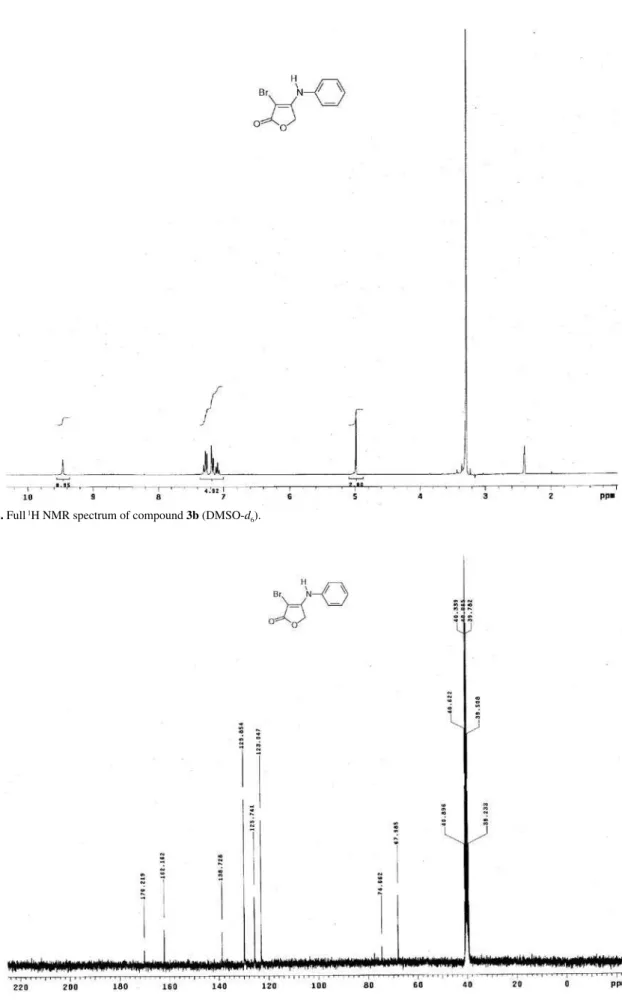
1H), 7.17 (d, J 7.2 Hz, 2H) 7.28 (t, J 7.2 Hz, 2H), 9.47 (s, 1H), 13C NMR (CDCl
3) d
170.22, 162.16, 138.73, 129.85, 125.74, 123.05, 74.66, 67.99.
3c:brown solid, mp 146-148 oC; IR (KBr)
νmax/cm-1: 3229, 3072, 1730, 1627, 1049;
1H NMR (DMSO-d
6) d 2.19 (s, 3H) 4.91 (s,
2H), 7.07 (s, 4H), 9.36 (s, 1H); 13C NMR
(DMSO-d6) d 170.23, 162.37, 136.10,
135.22, 130.25, 123.41, 73.98, 67.83, 21.04.
3d:brown solid, mp 166-167 oC; IR (KBr)
ν
max/cm
-1: 3227, 3042, 2933; 2836, 1713,
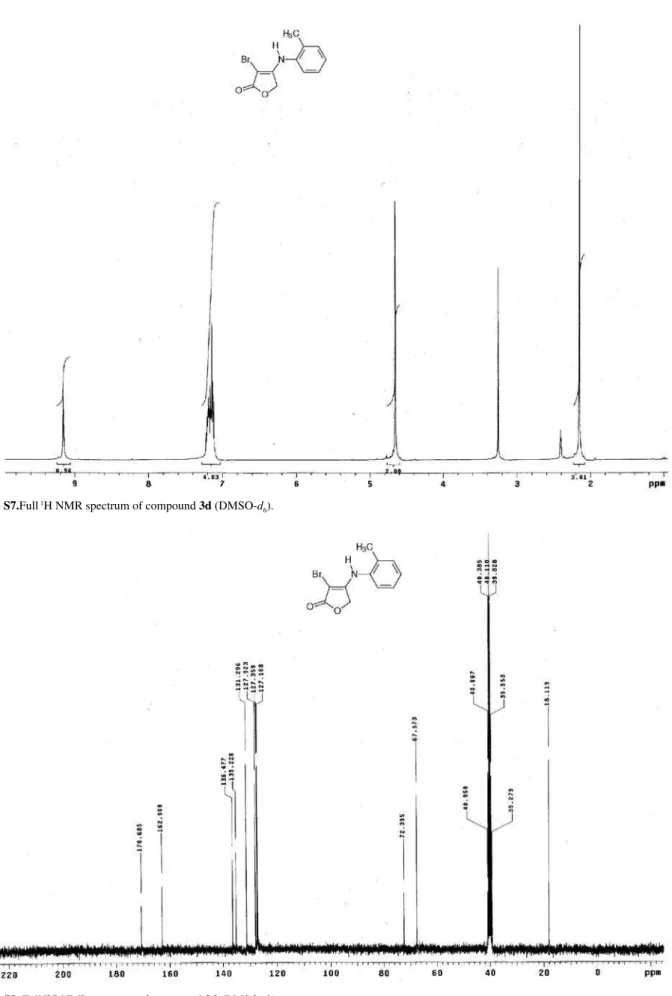
1611, 1036; 1H NMR (DMSO-d
6) d 2.15 (s,
3H) 4.65 (s, 2H), 7.11-7.22 (m, 4H), 9.16 (s, 1H); 13C NMR (DMSO-d
6) d 170.69, 162.91,
136.48, 135.23, 131.30, 127.92, 127.36, 127.17, 72.40, 67.57, 18.12.
3e:green solid, mp 135-138 oC; IR (KBr)
ν
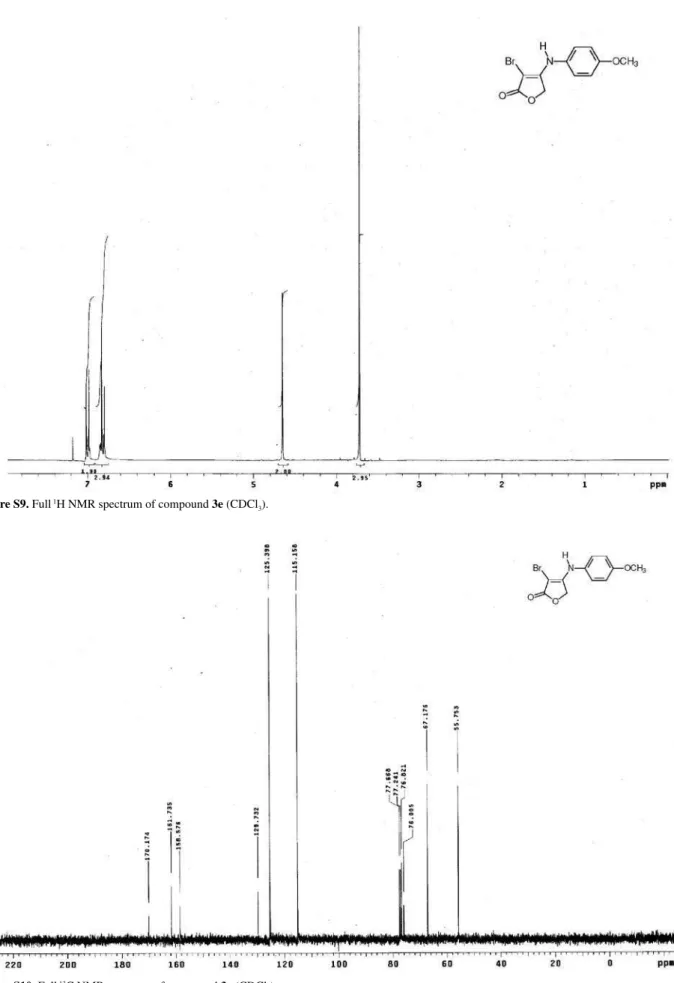
max/cm-1: 3175, 3067, 1723, 1631, 1025; 1H NMR (CDCl
3) d 3.72 (s, 3H) 4.65 (s, 2H),
6.82 (d, J 10 Hz 2H), 6.85 (sl, 1H), 7.00 (d,
J 10 Hz 2H); 13C NMR (CDCl
3) d 170.17,
161.74, 158.58, 129.73, 125.40, 115.16, 76.00, 67.18, 55.75.
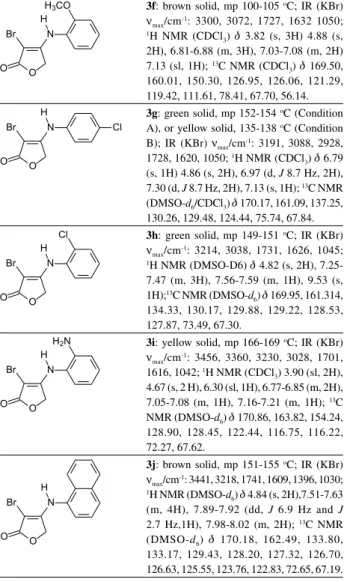
Table S1. Physical data for compounds 3a-j
3f:brown solid, mp 100-105 oC; IR (KBr)
ν
max/cm
-1: 3300, 3072, 1727, 1632 1050; 1H NMR (CDCl
3) d 3.82 (s, 3H) 4.88 (s,
2H), 6.81-6.88 (m,3H), 7.03-7.08 (m, 2H) 7.13 (sl, 1H); 13C NMR (CDCl
3) d 169.50,
160.01, 150.30, 126.95, 126.06, 121.29, 119.42, 111.61, 78.41, 67.70, 56.14.
3g:green solid, mp 152-154 oC (Condition
A), or yellow solid, 135-138 oC (Condition
B); IR (KBr) ν
max/cm
-1: 3191, 3088, 2928,
1728, 1620, 1050; 1H NMR (CDCl 3) d 6.79
(s, 1H) 4.86 (s, 2H), 6.97 (d, J 8.7 Hz,2H), 7.30 (d, J 8.7 Hz, 2H), 7.13 (s, 1H); 13C NMR
(DMSO-d6/CDCl3) d 170.17, 161.09, 137.25,
130.26, 129.48, 124.44, 75.74, 67.84.
3h:green solid, mp 149-151 oC; IR (KBr)
ν
max/cm-1: 3214, 3038, 1731, 1626, 1045; 1H NMR (DMSO-D6) d 4.82 (s, 2H),
7.25-7.47 (m, 3H), 7.56-7.59 (m, 1H), 9.53 (s, 1H);13C NMR (DMSO-d
6) d 169.95, 161.314,
134.33, 130.17, 129.88, 129.22, 128.53, 127.87, 73.49, 67.30.
3i:yellow solid, mp 166-169 oC; IR (KBr)
νmax/cm-1: 3456, 3360, 3230, 3028, 1701,
1616, 1042; 1H NMR (CDCl
3) 3.90 (sl, 2H),
4.67 (s, 2 H), 6.30 (sl, 1H), 6.77-6.85 (m, 2H), 7.05-7.08 (m, 1H), 7.16-7.21 (m, 1H); 13C
NMR (DMSO-d6) d 170.86, 163.82, 154.24,
128.90, 128.45, 122.44, 116.75, 116.22, 72.27, 67.62.
3j:brown solid, mp 151-155 oC; IR (KBr)
ν
max/cm
-1: 3441, 3218, 1741, 1609, 1396, 1030; 1H NMR (DMSO-d
6) d 4.84 (s, 2H),7.51-7.63
(m, 4H), 7.89-7.92 (dd, J 6.9 Hz and J
2.7 Hz,1H), 7.98-8.02 (m, 2H); 13C NMR
(DMSO-d6) d 170.18, 162.49, 133.80,
Synthesis of 3-Bromotetronamides via Amination of 3,4-Dibromofuran-2(5H)-one J. Braz. Chem. Soc. S2
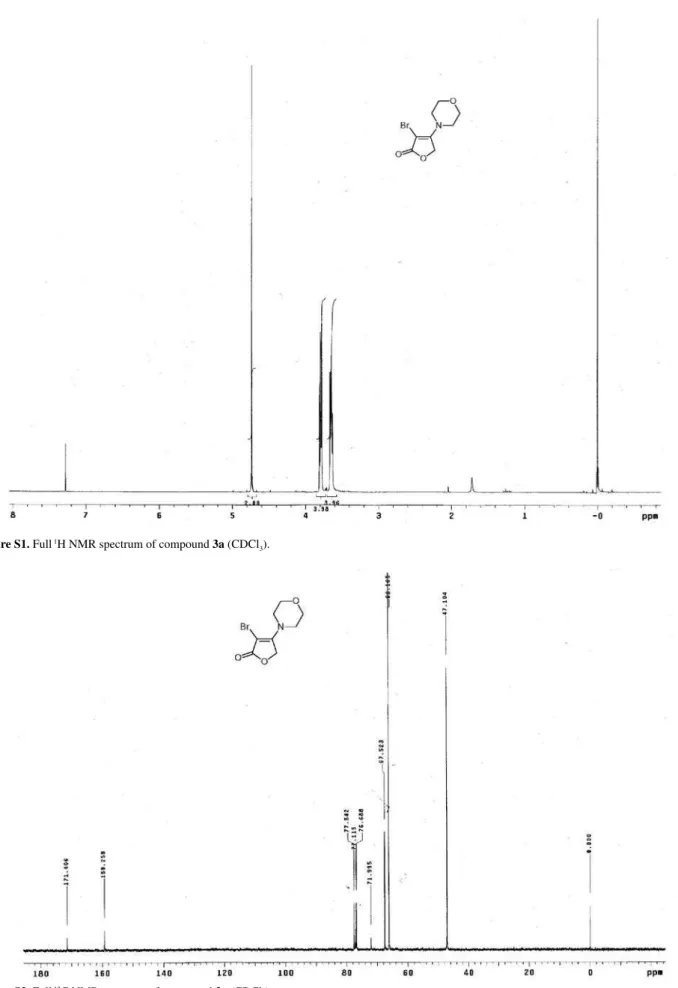
Figure S1. Full 1H NMR spectrum of compound 3a (CDCl 3).
Cunha et al. S3 Vol. 22, No. 3, 2011
Figure S3. Full 1H NMR spectrum of compound 3b (DMSO-d 6).
Synthesis of 3-Bromotetronamides via Amination of 3,4-Dibromofuran-2(5H)-one J. Braz. Chem. Soc. S4
Figure S5. Full 1H NMR spectrum of compound 3c (DMSO-d 6).
Cunha et al. S5 Vol. 22, No. 3, 2011
Figure S8. Full 13C NMR spectrum of compound 3d (DMSO-d 6).
Synthesis of 3-Bromotetronamides via Amination of 3,4-Dibromofuran-2(5H)-one J. Braz. Chem. Soc. S6
Figure S9. Full 1H NMR spectrum of compound 3e (CDCl 3).
Cunha et al. S7 Vol. 22, No. 3, 2011
Figure S12. Full 13C NMR spectrum of compound 3f (CDCl 3).
Synthesis of 3-Bromotetronamides via Amination of 3,4-Dibromofuran-2(5H)-one J. Braz. Chem. Soc. S8
Figure S13. Full 1H NMR spectrum of compound 3g (CDCl 3).
Figure S14. Full 13C NMR spectrum of compound 3g (CDCl
Cunha et al. S9 Vol. 22, No. 3, 2011
Figure S15. Full 1H NMR spectrum of compound 3h (CDCl 3).
Synthesis of 3-Bromotetronamides via Amination of 3,4-Dibromofuran-2(5H)-one J. Braz. Chem. Soc. S10
Figure S17. Full 1H NMR spectrum of compound 3i (CDCl 3).
Cunha et al. S11 Vol. 22, No. 3, 2011
Figure S19. Full 1H NMR spectrum of compound 3j (CDCl 3).