Article
J. Braz. Chem. Soc., Vol. 22, No. 3, 462-467, 2011. Printed in Brazil - ©2011 Sociedade Brasileira de Química 0103 - 5053 $6.00+0.00
A
*e-mail: [email protected]
Microwave-Assisted Passerini Reactions under Solvent-Free Conditions
Angélica de Fátima S. Barreto, Otilie E. Vercillo and Carlos Kleber Z. Andrade*
LaQMOS - Instituto de Química, Universidade de Brasília, CP 4478, 70910-970 Brasília-DF, Brazil
Diversas α-acilóxi carboxamidas foram facilmente obtidas combinando três componentes em uma única etapa: um ácido carboxílico, um aldeído e uma isonitrila (reação de Passerini), usando irradiação de micro-ondas em condições sem solvente. Os produtos foram obtidos em bons rendimentos (61-90%) e em tempos reacionais bastante curtos (≤ 5 min), usando duas diferentes temperaturas (60 e 120 °C). A 120 °C, os rendimentos foram mais altos e as reações mais rápidas (≤ 1 min). Vários dos produtos formados são multifuncionais, possibilitando sua aplicação em reações de Passerini consecutivas.
Various α-acyloxy carboxyamides were easily obtained combining three building blocks in one step: a carboxylic acid, an aldehyde and an isonitrile (Passerini reaction), using microwave irradiation under solvent-free conditions. The products were obtained in good yields (61-90%) and in short reaction times (≤ 5 min), using two different temperatures (60 and 120 °C). At 120 °C, the yields were higher and the reactions faster (≤ 1 min). Most of the obtained products are multifunctional allowing their application in consecutive Passerini reactions.
Keywords:α-acyloxy carboxyamides, Passerini reaction, microwave irradiation, solvent-free reactions
Introduction
Multicomponent reactions (MCRs) are referred to as one-pot processes, where three or more reactants combine to give a single product which incorporates essentially most of the atoms of the starting materials.1 MCRs constitute an especially attractive synthetic strategy since they offer greater possibilities for molecular diversity per step with a minimum of synthetic effort, time and formation of by-products.2
The development of atom-economic and synthetically effective methodologies is currently an important goal in organic synthesis3 and in this regard MCRs play a signiicant role.At the same time, the use of microwave energy to facilitate chemical reactions has become increasingly popular in organic synthesis.4 Microwave-assisted organic synthesis (MAOS) has been demonstrated to be eficient at increasing the rate of MCR reactions with signiicant improvements in reaction times and yields.5
Combining these two powerful tools is a particularly attractive methodology in modern organic synthesis.6 This combination allows for rapid production of molecular complexity and diversity from simple and readily accessible
bioactive molecules. Recently, literature has provided many examples of microwave-promoted multicomponent reaction protocols, for example, Ugi, Biginelli and Hantzsch reactions.6 Nevertheless, to the best of our knowledge, the Passerini three-component reaction had not yet been explored.This reaction,7 described in 1921, is a multicomponent reaction which provides α-acyloxy carboxyamides by combining three building blocks in one step: a carboxylic acid, an oxo-component (aldehyde or ketone) and an isonitrile.8
In continuation toour research on MCRs,9 we herein report the results of a systematic study of unprecedented microwave-assisted Passerini reactions under solvent-free conditions (Scheme 1).
Experimental
Barreto et al. 463 Vol. 22, No. 3, 2011
FTIR. 1H and 13C NMR spectra were recorded on a Varian Mercury Plus 300 spectrometer, operating at 300 MHz for 1H NMR and 75 MHz for 13C NMR. Chemical shifts (d ppm) in CDCl3 were reported downield from TMS (= 0) for 1H NMR. For 13C NMR, chemical shifts were reported in the scale relative to CDCl3 (77.00 ppm) as an internal reference. Column chromatography was performed on silica gel (Acros Organic 0.035-0.070 mm). High resolution mass spectra (electrospray ionization) were obtained using a Micro TOF Ic-Bruker Daltonics instrument. All compounds were analyzed by 1H NMR, 13C NMR, IR, melting points (for solid products) and high resolution mass spectra giving data consistent with those proposed.
General procedure for the Passerini reaction
A sealed 10 mL glass tube containing the carboxylic acid (1 equiv.), the aldehyde (1 equiv.) and the isonitrile (1 equiv.) was introduced in the cavity of a microwave reactor (CEM Co., Discover). The lask was irradiated (40 W) while stirring for the time and temperature speciied in Table 1. Puriication by column chromatography on silica gel eluted with 4:6 (4a-g) or 2:8 (4h-j) ethyl acetate-hexane gave the pure products.
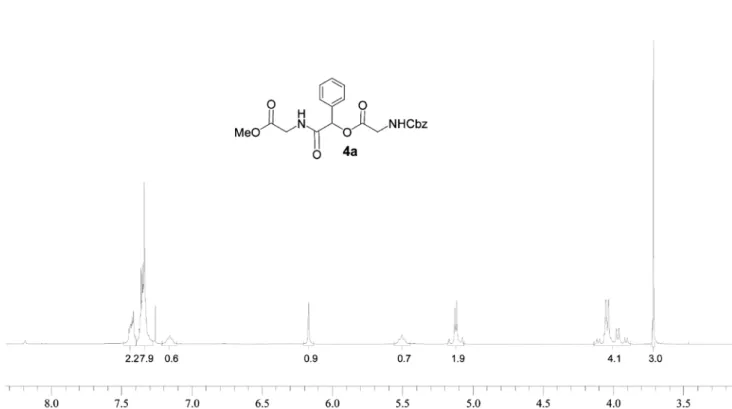
Compound 4a: Prepared following the general procedure using Cbz-glycine (0.042 g, 0.20 mmol), methyl isocyanoacetate (0.020 g, 0.20 mmol) and benzaldehyde (0.021 g, 0.20 mmol). Compound 4a was purified by column chromatography on silica gel eluted with 4:6 ethyl acetate-hexane (0.059 g, 71%); white solid; mp 117-118 °C; IR (ilm) νmax/cm−1 3376, 3294, 1750, 1681, 1513, 1205; 1H NMR (300 MHz, CDCl
3) d 7.45-7.41 (m, 2H), 7.37-7.32 (m, 8H), 7.16 (br t, J 5.5 Hz, 1H), 6.17 (s, 1H), 5.50 (br t, J 5.4 Hz, 1H), 5.14 (d, J 16.0 Hz, 1H), 5.10 (d, J 16.0 Hz, 1H), 4.11-4.02 (m, 3H), 3.94 (dd, J 5.4 and 18.1 Hz, 1H), 3.71 (s, 3H); 13C NMR (75 MHz, CDCl
3) d 169.9, 168.5, 168.3, 156.8, 135.9, 134.5, 129.3, 128.8, 128.5, 128.2, 128.0, 127.7, 76.0, 67.3, 52.3, 43.0, 40.9. ESI-HRMS [M+Na]+ Found: 437.1301. Calc. for C21H22N2O7Na: 437.1325.
Compound 4b: Prepared following the general procedure using Cbz-glycine (0.042 g, 0.20 mmol), methyl isocyanoacetate (0.020 g, 0.2 mmol) and isobutyraldehyde
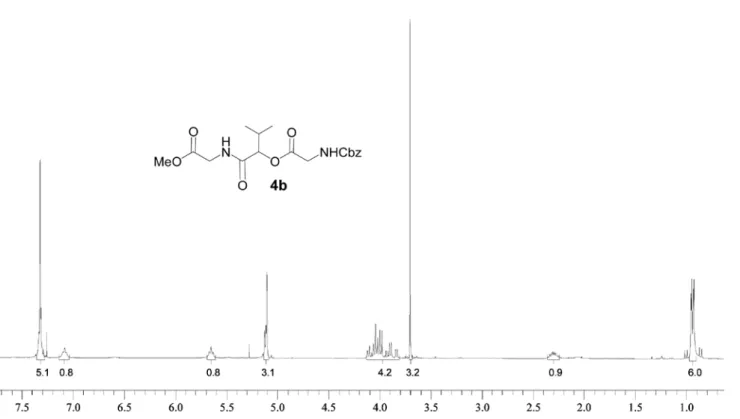
(0.014 g, 0.20 mmol). Compound 4b was puriied by column chromatography on silica gel eluted with 4:6 ethyl acetate-hexane (0.064 g, 84%); white solid; mp 77-78 ºC; IR (ilm) νmax/cm−1 3325, 3072, 3041, 2966, 1748, 1693, 1657, 1538, 1248;1H NMR (300 MHz, CDCl
3) d 7.32 (s, 5H), 7.08 (br t, J 5.5 Hz, 1H), 5.13-5.11 (m, 1H), 5.10 (s, 2H), 5.65 (br t, J 5.7 Hz, 1H), 4.12-3.92 (m, 3H), 3.87 (dd, J 5.5 and 18.0 Hz, 1H), 3.70 (s, 3H), 2.33-2.25 (m, 1H), 0.94 (d, J 6.8 Hz, 3H) 0.93 (d, J 6.8 Hz, 3H); 13C NMR (75 MHz, CDCl3) d 170.0, 169.5, 169.0, 157.1, 135.9, 128.5, 128.3, 128.0, 78.7, 67.3, 52.2, 43.0, 40.6, 30.4, 18.7, 16.4. ESI-HRMS [M+Na]+ Found: 403.1479. Calc. for C18H24N2O7Na: 403.1481.
Compound 4c: Prepared following the general procedure using Cbz-glycine (0.21 g, 1.00 mmol), methyl isocyanoacetate (0.10 g, 1.00 mmol) and p-nitrobenzaldehyde (0.15 g, 1.00 mmol). Compound
4c was puriied by column chromatography on silica gel eluted with 4:6 ethyl acetate-hexane (0.31 g, 68%); white solid; mp 143-144 ºC; IR (ilm) νmax/cm
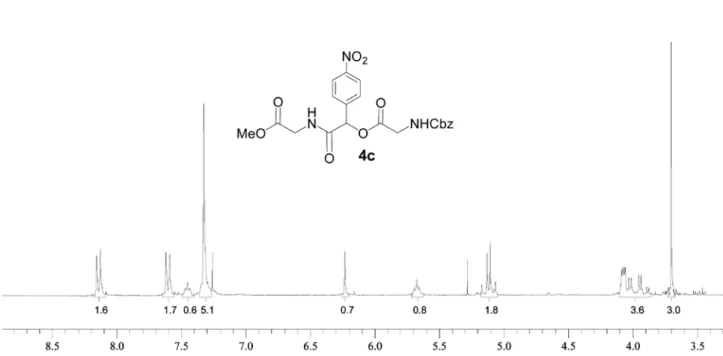
−1 3296, 3098, 3078, 1753, 1701, 1696, 1532, 1233;1H NMR (300 MHz, CDCl3) d 8.14 (d, J 8.7, 2H); 7.60 (d, J 8.7 Hz, 2H), 7.45 (br t, J 5.5 Hz, 1H), 7.38-7.25 (m, 5H), 6.23 (s, 1H), 5.67 (br t, J 6.1 Hz, 1H), 5.14 (d, J 19.4 Hz, 1H), 5.10 (d, J 19.4 Hz, 1H), 4.08-4.01 (m, 3H), 3.91 (dd, J 5.5 and 18.0 Hz, 1H), 3.70 (s, 3H); 13C NMR (75 MHz, CDCl3) d 169.7, 168.2, 167.3, 157.0, 148.1, 141.4, 135.8, 128.6, 128.3, 128.0, 123.8, 74.7, 67.4, 52.4, 43.0, 40.9. ESI-HRMS [M+Na]+ Found: 482.1171. Calc. for C21H21N3O9Na: 482.1176.
Compound 4d: Prepared following the general procedure using Cbz-glycine (0.21 g, 1.00 mmol), methyl isocyanoacetate (0.10 g, 1.00 mmol) and p-chlorobenzaldehyde (0.14 g, 1.00 mmol). Compound
4d was puriied by column chromatography on silica gel eluted with 4:6 ethyl acetate-hexane (0.27 g, 61%); white solid; mp 123-124 ºC; IR (ilm) νmax/cm
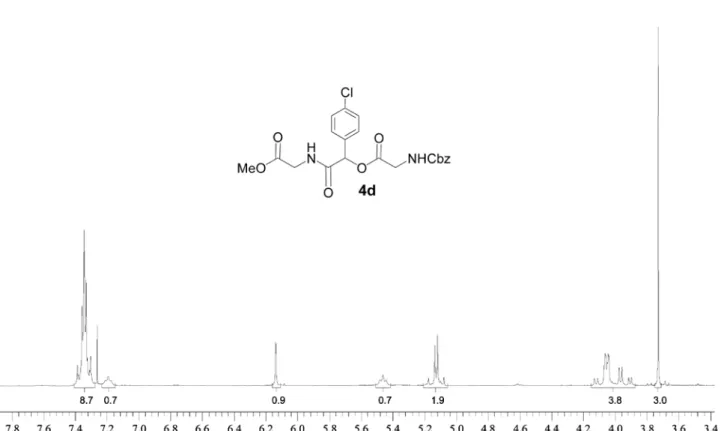
−1 3296, 3114, 3088, 2956, 1743, 1686, 1542, 1516, 1233;1H NMR (300 MHz, CDCl3) d 7.39-7.30 (m, 9H), 7.20 (br t, J 5.4 Hz, 1H), 6.14 (s, 1H), 5.46 (br t, J 5.8 Hz, 1H), 5.15 (d, J 17.2 Hz, 1H), 5.11 (d, J 17.2 Hz, 1H), 4.13-4.04 (m, 3H), 3.94 (dd, J 5.1 and 18.0 Hz, 1H), 3.73 (s,
Microwave-Assisted Passerini Reactions under Solvent-Free Conditions J. Braz. Chem. Soc.
464
3H); 13C NMR (75 MHz, CDCl
3) d 169.9, 168.6, 168.2, 157.0, 136.0, 135.3, 133.1, 129.1, 129.0, 128.6, 128.4, 128.1, 75.2, 67.3, 52.4, 43.0, 40.9. ESI-HRMS [M+Na]+ Found: 471.0937. Calc. for C21H21ClN2O7Na: 471.0935.
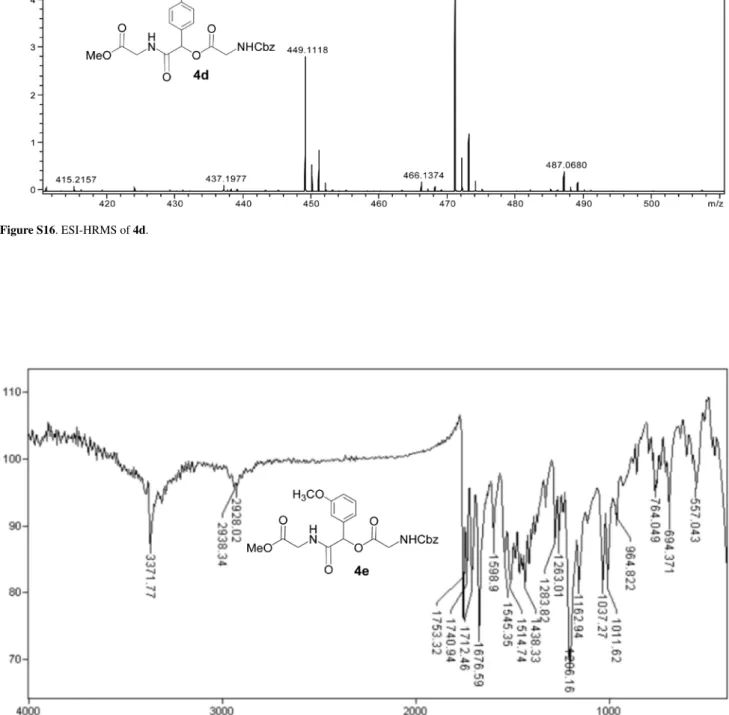
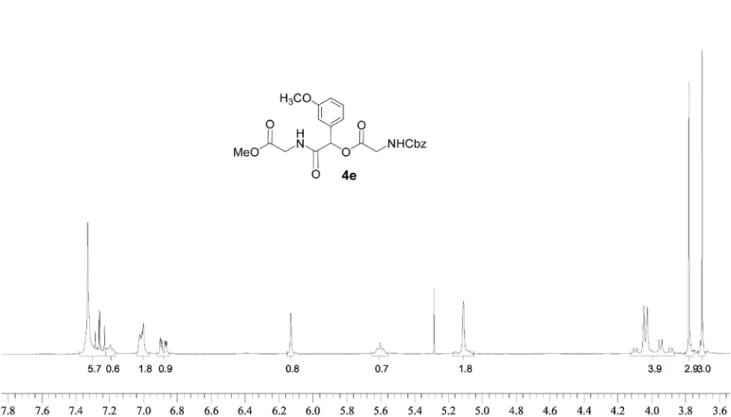
Compound 4e: Prepared following the general procedure using Cbz-glycine (0.084 g, 0.40 mmol), methyl isocyanoacetate (0.040 g, 0.40 mmol) and m-methoxybenzaldehyde (0.054 g, 0.40 mmol). Compound 4e was puriied by column chromatography on silica gel eluted with 4:6 ethyl acetate-hexane (0.15 g, 82%); white solid; mp 88 ºC; IR (ilm) νmax/cm
−1 3372, 2938, 2928, 1753, 1741, 1712, 1677, 1515, 1206;1H NMR (300 MHz, CDCl3) d 7.40-7.22 (m, 6H), 7.20 (t, J 5.7 Hz, 1H), 7.10-6.98 (m, 2H), 6.88 (ddd, J 8.3, 2.7 and 1.1 Hz, 1H), 6.13 (s, 1H), 5.60 (br t, J 6.0 Hz, 1H), 5.15-5.07 (m, 2H), 4.10-4.02 (m, 3H), 3.92 (dd, J 5.3 and 18.0 Hz, 1H), 3.78 (s, 3H), 3.70 (s, 3H); 13C NMR (75 MHz, CDCl
3)
d 169.8, 168.5, 168.3, 159.7, 156.8, 135.9, 129.8, 128.5, 128.2, 128.0, 119.8, 114.9, 113.1, 75.8, 67.2, 55.2, 52.3, 42.9, 40.8. EI-HRMS [M+Na]+ Found: 467.1428. Calc. for C22H24N2O8Na: 467.1430.
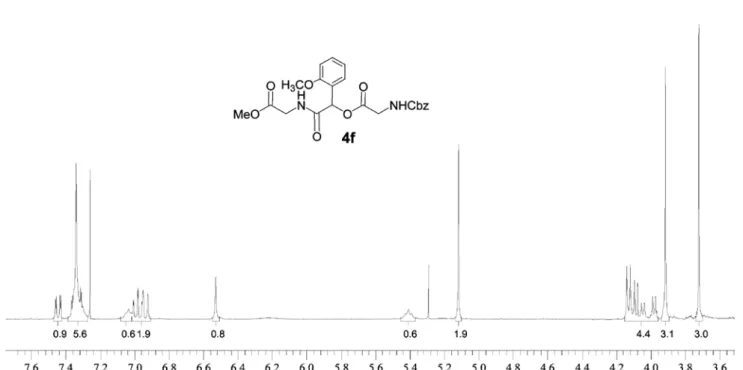
Compound 4f: Prepared following the general procedure using Cbz-glycine (0.084 g, 0.40 mmol), methyl isocyanoacetate (0.040 g, 0.40 mmol) and o-methoxybenzaldehyde (0.054 g, 0.40 mmol). Compound
4f was puriied by column chromatography on silica gel eluted with 4:6 ethyl acetate-hexane (0.140 g, 79%); colorless oil; IR (ilm) νmax/cm
−1 3345, 3072, 3031, 2954, 1748, 1676, 1537, 1214; 1H NMR (300 MHz, CDCl
3)
d 7.40-7.37 (m, 1H), 7.40-7.30 (m, 6H), 7.04 (br t, J 4.6 Hz, 1H), 6.99 (dd, J 1.0 and 7.5 Hz, 1H), 6.94 (d, J 8.3 Hz, 1H), 6.53 (s, 1H), 5.41 (t, J 5.7 Hz, 1H), 5.12 (s, 2H), 4.14-4.08 (m, 3H), 4.01 (dd, J 5.3 and 19.6 Hz, 1H), 3.92 (s, 3H), 3.72 (s, 3H); 13C NMR (75 MHz, CDCl
3)
d 169.9, 169.0, 161.0, 156.5, 136.1, 130.4, 128.5, 128.3, 128.2, 128.0, 122.9, 121.1, 110.9, 70.5, 67.1, 55.8, 52.4, 42.9, 41.1. ESI-HRMS [M+Na]+ Found: 467.1428. Calc. for C22H24N2O8Na: 467.1430.
Compound 4g: Prepared following the general procedure using Cbz-glycine (0.050 g, 0.24 mmol), methyl isocyanoacetate (0.024 g, 0.24 mmol) and o-methoxybenzaldehyde (0.034 g, 0.24 mmol). Compound
4g was puriied by column chromatography on silica gel eluted with 4:6 ethyl acetate-hexane (0.074 g, 69%); colorless oil; IR (ilm) νmax/cm
−1 3325, 3072, 2949, 1753, 1685, 1532, 1217, 1174;1H NMR (300 MHz, CDCl
3) d 7.52-7.49 (m, 1H), 7.40-7.37 (m, 1H), 7.32-7.23 (m, 8H), 6.57 (s, 1H), 5.60 (t, J 5.7 Hz, 1H), 5.12 (d, J 14.7 Hz, 1H),
5.08 (d, J 14.7 Hz, 1H), 4.10 (dd, J 5.7 and 18.0 Hz, 1H), 4.05-3.98 (m, 2H), 3.92 (dd, J 5.2 and 17.9 Hz, 1H), 3.71 (s, 3H); 13C NMR (75 MHz, CDCl
3) d 169.7, 168.6, 167.7, 156.8, 135.9, 133.9, 132.5, 130.5, 129.8, 128.4, 128.2, 127.9, 127.3, 72.8, 67.2, 52.3, 42.8, 40.9. ESI-HRMS [M+Na]+ Found: 471.0930. Calc. for C
21H21ClN2O7Na: 471.0935.
Compound 4h: Prepared following the general procedure using benzoic acid (0.030 g, 0.24 mmol), tert-butyl isocyanide (0.020 g, 0.24 mmol) and piperonal (0.036 g, 0.24 mmol). Compound 4h was puriied by column chromatography on silica gel eluted with 2:8 ethyl acetate-hexane (0.060 g, 71%); white solid; mp 131-132 ºC; IR (ilm) νmax/cm−1 3303, 3072, 2974, 2928, 1718, 1656, 1552, 1249;1H NMR (300 MHz, CDCl
3)
d 8.09-8.06 (m, 2H), 7.60-7.58 (m, 1H), 7.50 (t, J 8.4 Hz, 1H), 7.02-6.98 (m, 2H), 6.81 (d, J 8.4 Hz, 1H), 6.13 (s, 1H), 6.02 (br s, 1H), 5.97 (s, 2H), 1.38 (s, 9H); 13C NMR (75 MHz, CDCl3) d 167.3, 164.8, 147.9, 133.6, 129.7, 128.6, 121.7, 108.4, 107.8, 101.3, 75.8, 51.6, 28.6. ESI-HRMS [M+Na]+ Found: 378.1316. Calc. for C20H21NO5Na: 378.1317.
Compound 4i: Prepared following the general procedure using benzoic acid (0.029 g, 0.24 mmol), tert-butyl isocyanide (0.020 g, 0.24 mmol) and p-chlorobenzaldehyde (0.034 g, 0.24 mmol). Compound
4i was puriied by column chromatography on silica gel eluted with 2:8 ethyl acetate-hexane (0.056 g, 68%), white solid; mp 185-186 ºC; IR (ilm) νmax/cm−1 3284, 3088, 2973, 1727, 1600, 1492, 1260; 1H NMR (300 MHz, CDCl3) d 8.08 (dd, J 8.3 and 1.2 Hz, 2H), 7.65-7.59 (m, 1H), 7.51-7.46 (m, 4H), 7.38-7.34 (m, 2H), 6.19 (s,1H), 6.10 (br s, 1H), 1.37 (s, 9H); 13C NMR (75 MHz, CDCl
3)
d 166.9, 164.7, 133.7, 129.7, 128.9, 128.7, 75.2, 51.6, 28.6. ESI-HRMS [M+Na]+ Found: 368.1034. Calc. for C19H20ClNO3Na: 368.1029.
Compound 4j: Prepared following the general procedure using benzoic acid (0.061 g, 0.50 mmol), tert-butyl isocyanide (0.041 g, 0.50 mmol) and m-methoxybenzaldehyde (0.070 g, 0.50 mmol). Compound
4j was puriied by column chromatography on silica gel eluted with 2:8 ethyl acetate-hexane (0.123 g, 72%); white solid; mp 118-119 ºC; IR (ilm) νmax/cm
−1 3299, 3078, 2975, 1722, 1660, 1552, 1253;1H NMR (300 MHz, CDCl
3) d 8.09 (dd, J 8.5 and 1.5 Hz, 2H), 7.62-7.55 (m, 1H), 7.45 (t, J 7.6 Hz, 2H), 7.30 (t, J 7.9 Hz, 1H), 7.13-7.08 (m, 2H), 6.89 (ddd, J 8.2, 2.3 and 0.9 Hz, 1H), 6.20 (s, 1H), 6.10 (br s, 1H), 3.79 (s, 3H), 1.35 (s, 9H); 13C NMR (75 MHz, CDCl
Barreto et al. 465 Vol. 22, No. 3, 2011
Table 1. Microwave-assisted Passerini reactions
entry Reagents Product Temp. / time Yield (%)a
1 MeO NC O + O H + HO NHCbz O MeO H N O O NHCbz O O 4a
60 °C / 4 min 120 °C / 30 s
71 90 2 MeO NC O
+ + HO NHCbz
O O H MeO H N O O NHCbz O O 4b
60 °C / 3 min 120 °C / 30 s
84 84 3 MeO NC O
+ + HO NHCbz
O O
H
O2N MeO
H N O O NHCbz O O NO2 4c
60 °C / 5 min 120 °C / 1 min
68 70 4 MeO NC O + + HO NHCbz O O H Cl MeO H N O O NHCbz O O Cl 4d
60 °C / 4 min 120 °C / 1 min
61 64
5 MeO NC
O +
+ HO NHCbz O
O
H H3CO
MeO H N O O NHCbz O O H3CO
4e
60 °C / 3 min 120 °C / 30 s
82 86 6 MeO NC O + O H OCH3 HO
NHCbz O + MeO H N O O NHCbz O O H3CO
4f
60 °C / 3 min 120 °C / 30 s
79 81 7 MeO NC O
+ HO NHCbz
O + O H Cl MeO H N O O NHCbz O O Cl 4g
60 °C / 3 min 120 °C / 30 s
69 73 8 NC O OH + + O H O O H N O O O O O 4h
60 °C / 5 min 120 °C / 1 min
71 74 9 NC O H Cl O OH
+ + HN
O O
O Cl
4i
60 °C / 5 min 120 °C / 1 min
68 70 10 NC O OH + + O H
H3CO H
N O
O
H3CO
O 4j
60 °C / 3 min 120 °C / 1 min
72 76
Microwave-Assisted Passerini Reactions under Solvent-Free Conditions J. Braz. Chem. Soc.
466
d167.1, 159.6, 137.2, 133.4, 129.6, 129.1, 128.5, 119.5, 114.2, 113.0, 75.8, 55.1, 51.4, 28.5. ESI-HRMS [M+Na]+ Found: 364.1524. Calc. for C20H23NO4Na: 364.1525.
Results and Discussion
In the synthesis of α-acyloxy carboxyamides, aliphatic, aromatic and heteroaromatic aldehydes were reacted with equivalent amounts of isonitriles (methyl isocyanoacetate and tert-butyl isocyanide) and carboxylic acids (benzoic acid and Cbz-glycine). The three components were subjected to MW irradiation for the time speciied in Table 1. Aromatic aldehydes substituted with both electron withdrawing and electron donating groups could be used successfully. The temperature was initially set at 60 °C (40 W) and the reactions were completed within 3-5 min as monitored by TLC showing the disappearance of the starting materials. Due to the good results obtained with the initial potency of 40 W, it was kept constant and used in all experiments. The yields of the puriied products were generally very good and varied according to the substitution pattern of the aromatic aldehydes. Increasing the temperature to 120 °C, the yields were slightly better in all cases except for benzaldehyde (entry 1) in which the yield of the product was signiicantly improved. Reaction times in Table 1 correspond to the time at which the temperature was maintained at 60 or 120 °C. Furthermore, in all cases the increase of the temperature caused a decrease in the reaction time.
The results obtained in this study, especially in terms of reaction time (1 min or less at 120 °C), are remarkable as compared with our previous results on the Passerini reaction using ionic liquids (2-14 h)and PEG (0.5-6 h)as alternative solvents.9Compared to usual organic solvents,
such as CH2Cl2,the difference for similar reactions is even greater (completion usually above 18 h).10 Water has been demonstrated to accelerate these reactions but only in a limited extent (completion in 3-3.5 h).10 According to a recent report on Passerini reactions, the yields were usually better under solvent-free conditions compared to the same reactions using dichloromethane as solvent.11
For comparison, the reactions of entries 1 and 2 were also performed using acetonitrile as solvent at 60 °C (oil bath) allowed formation of the products after 3 h in moderate yields (65 and 64%, respectively) as compared to 90 and 84% for the MW-assisted, solvent-free method (Table 1). The choice for acetonitrile relies on the fact that the acid component Cbz-glycine is not soluble in solvents commonly used in Passerini reactions such as dichloromethane. These results prove the superiority of our methodology in effectively promoting Passerini reactions.
Spectral analysis of 4a-j supported the success of the MW-mediated triple one-pot condensation. The isolated products were characterized on the basis of their IR, 1H and 13C NMR spectroscopy and mass spectra.
The most important characteristic of the 1H NMR spectra is the presence of a singlet around d 6.00-6.50 ppm relative to the hydrogen of the stereogenic center (except for 4b
which gives a doublet at d 5.20 ppm). The 13C NMR spectra corroborated the analysis of the compounds, showing four peaks corresponding to the carbonyl groups (d 155-170 ppm) when Cbz-glycine and methyl isocyanoacetate were used. Accordingly, when benzoic acid and tert-butylisocyanide were used two peaks corresponding to the carbonyl groups were observed at d165-175 ppm.
Conclusions
A simple and eficient method was achieved for the preparation of α-acyloxy carboxyamides. Compounds 4a-g
are versatile multifunctional intermediates that can be further functionalized at the NCbz-moiety. For instance, 4a-g can be easily hydrolyzed to the respective acid components which could be used in a subsequent Passerini reaction opening the possibility for the study of consecutive Passerini reactions. This new methodology is already being developed in our research group. The simplicity of the reaction conditions, its eficacy and the excellent results obtained using two different temperatures, under solvent-free conditions, constitute an attractive contribution among the existing methodologies.
Supplementary Information
Supplementary data are available free of charge at http://jbcs.sbq.org.br, as PDF ile.
Acknowledgments
We thank the Instituto de Química, Universidade de Brasília, FINEP-CT INFRA No. 970/01, CAPES and CNPq for inancial support.
References
1. Ramon, D. J.; Yus, M.; Angew. Chem., Int. Ed. 2005, 44, 1602; Ugi, I.; Pure Appl. Chem. 2001, 73, 187; Hulme, C.; Gore, V.;
Curr. Med. Chem. 2003, 10, 51.
2. Trost, B. M.; Science, 1991, 254, 1471; Trost, B. M.; Angew. Chem., Int. Ed. Engl. 1995, 34, 259.
Barreto et al. 467 Vol. 22, No. 3, 2011
4. Varma, R. S.; Pure Appl. Chem. 2001, 73, 193; Varma, R. S.;
Indian J. Chem., Sec. B: Org. Chem. Incl. Med. Chem. 2006,
45,2305.
5. Kappe, C. O.; Chem. Soc. Rev. 2008, 37, 1127; Kappe, C. O.
Angew. Chem., Int. Ed. 2004, 43, 6250; Lidström, P.; Tierney, J.; Wathey, B.; Westman, J.; Tetrahedron2001, 57, 9225; Jiang, B.; Shi, F.; Tu, S. J.; Curr. Org. Chem.2010, 14, 357; Zhu, Y. G.; Zhai, C. W.; Hu, W. H.; Prog. Chem.2010, 22, 1380. 6. For a review on microwave-mediated multicomponent reactions,
see: Hügel, H. M.; Molecules2009, 14, 4936. 7. Passerini, M.; Gazz. Chim. Ital. 1921, 5, 126.
8. For reviews, see: Dömling, A.; Ugi, I.; Angew. Chem., Int. Ed.
2000, 39,3169; Zhu, J. P.; Eur. J. Org. Chem. 2003, 1133; Dömling, A.; Chem. Rev. 2006, 106, 17.
9. Andrade, C. K. Z.; Takada, S. C. S.; Suarez, P. A. Z.; Alves, M. B.; Synlett2006, 10, 1539; Vercillo, O. E.; Andrade, C. K. Z.; Wessjohann, L. A.; Org. Lett. 2008, 10, 205.
10. Pirrung, M. C., Sarma, K. D.; J. Am. Chem. Soc. 2004, 126, 444; Pirrung, M. C., Sarma, K. D.; Tetrahedron2005, 61, 11456. 11. Koszelewski, D., Szymanski, W., Krysiak, J., Ostaszewski, R.;
Synth. Commun. 2008, 38, 1120.
Submitted: July 28, 2010
Supplementary Information
J. Braz. Chem. Soc., Vol. 22, No. 3, S1-S21, 2011. Printed in Brazil - ©2011 Sociedade Brasileira de Química
0103 - 5053 $6.00+0.00
S
I
*e-mail: [email protected]
Microwave-Assisted Passerini Reactions under Solvent-Free Conditions
Angélica de Fátima S. Barreto, Otilie E. Vercillo and Carlos Kleber Z. Andrade*
LaQMOS - Instituto de Química, Universidade de Brasília, CP 4478, 70910-970 Brasília-DF, Brazil
Microwave-Assisted Passerini Reactions under Solvent-Free Conditions J. Braz. Chem. Soc. 2
Figure S2. 1H NMR (CDCl
3, 300 MHz) of 4a. Note: The number below each peak refers to the number of integration.
Figure S3. 13C NMR (CDCl
Barreto et al. 3 Vol. 22, No. 3, 2011
Figure S4. ESI-HRMS of 4a.
Microwave-Assisted Passerini Reactions under Solvent-Free Conditions J. Braz. Chem. Soc. 4
Figure S6. 1H NMR (CDCl
3, 300 MHz) of 4b. Note: The number below each peak refers to the number of integration.
Figure S7. 13C NMR (CDCl
Barreto et al. 5 Vol. 22, No. 3, 2011
Figure S8. ESI-HRMS of 4b.
Microwave-Assisted Passerini Reactions under Solvent-Free Conditions J. Braz. Chem. Soc. 6
Figure S10. 1H NMR (CDCl
3, 300 MHz) of 4c. Note: The number below each peak refers to the number of integration.
Figure S11. 13C NMR (CDCl
Barreto et al. 7 Vol. 22, No. 3, 2011
Figure S12. ESI-HRMS of 4c.
Microwave-Assisted Passerini Reactions under Solvent-Free Conditions J. Braz. Chem. Soc. 8
Figure S14. 1H NMR (CDCl
3, 300 MHz) of 4d. Note: The number below each peak refers to the number of integration.
Figure S15. 13C NMR (CDCl
Barreto et al. 9 Vol. 22, No. 3, 2011
Figure S16. ESI-HRMS of 4d.
Microwave-Assisted Passerini Reactions under Solvent-Free Conditions J. Braz. Chem. Soc. 10
Figure S18. 1H NMR (CDCl
3, 300 MHz) of 4e. Note: The number below each peak refers to the number of integration.
Figure S19. 13C NMR (CDCl
Barreto et al. 11 Vol. 22, No. 3, 2011
Figure S20. ESI-HRMS of 4e.
Microwave-Assisted Passerini Reactions under Solvent-Free Conditions J. Braz. Chem. Soc. 12
Figure S22. 1H NMR (CDCl
3, 300 MHz) of 4f. Note: The number below each peak refers to the number of integration.
Figure S23. 13C NMR (CDCl
Barreto et al. 13 Vol. 22, No. 3, 2011
Figure S24. ESI-HRMS of 4f.
Microwave-Assisted Passerini Reactions under Solvent-Free Conditions J. Braz. Chem. Soc. 14
Figure S26. 1H NMR (CDCl
3, 300 MHz) of 4g. Note: The number below each peak refers to the number of integration.
Figure S27. 13C NMR (CDCl
Barreto et al. 15 Vol. 22, No. 3, 2011
Figure S28. ESI-HRMS of 4g.
Microwave-Assisted Passerini Reactions under Solvent-Free Conditions J. Braz. Chem. Soc. 16
Figure S30. 1H NMR (CDCl
3, 300 MHz) of 4h. Note: The number below each peak refers to the number of integration.
Figure S31. 13C NMR (CDCl
Barreto et al. 17 Vol. 22, No. 3, 2011
Figure S32. ESI-HRMS of 4h.
Microwave-Assisted Passerini Reactions under Solvent-Free Conditions J. Braz. Chem. Soc. 18
Figure S34. 1H NMR (CDCl
3, 300 MHz) of 4i. Note: The number below each peak refers to the number of integration.
Figure S35. 13C NMR (CDCl
Barreto et al. 19 Vol. 22, No. 3, 2011
Figure S36. ESI-HRMS of 4i.
Microwave-Assisted Passerini Reactions under Solvent-Free Conditions J. Braz. Chem. Soc. 20
Figure S38. 1H NMR (CDCl
3, 300 MHz) of 4j. Note: The number below each peak refers to the number of integration.
Figure S39. 13C NMR (CDCl
Barreto et al. 21 Vol. 22, No. 3, 2011