The role of Research Ethics Committees
O papel dos comitês de ética em pesquisa
ABSTRACT
Research ethics committees are responsible for the ethical evaluation of research projects. Moreover, they must inform and educate their members and the community on their role in protecting the society. For some researchers, ethics committees are a target of criticism, although they are currently essential in the ield of medical research and publications. The present study uses a documental analysis to describe the functioning of the research ethics committee system by focusing on the National Research Ethics Committee, Sarah Network of Rehabilitation Hospitals.
Keywords: Ethics. Research. Ethics committees.
RESUMO
Os comitês de ética em pesquisa são responsáveis pela avaliação ética dos projetos de pes quisa; ademais, devem informar e educar seus membros e a comunidade quanto a sua função no controle social. Para alguns pesquisadores, os comitês de ética são alvo de muitas críticas; todavia, na atualidade, são imprescindíveis no campo das pesquisas e publicações médicas. Os autores descreveram por meio de análise documental o funcionamento do sistema de comitês de ética em pesquisa, da Comissão Nacional de Ética em Pesquisa e da Rede Sarah de Hospitais de Reabilitação.
Descritores: Ética. Pesquisa. Comissão de ética. Study conducted at the
Associação das Pioneiras Sociais – Rede Sarah de Hospitais de Reabilitação (Social Pioneers Association – Sarah Network of the Rehabilitation Hospitals), Brasília, DF, Brazil.
Submitted to SGP (Sistema de Gestão de Publicações/Manager Publications System) of RBCP (Revista Brasileira de Cirurgia Plástica/Brazilian Journal of Plastic Surgery).
Article received: August 11, 2011 Article accepted: January 10, 2012
1. Full Member of the Sociedade Brasileira de Cirurgia Plástica (Brazilian Society of Plastic Surgery) - SBCP, Research Ethics Committee Coordinator of the Associação das Pioneiras Sociais – Rede Sarah de Hospitais de Reabilitação (Social Pioneers Association – Sarah Network of Rehabilitation Hospitals), Bioethics Specialist and Master, President of the Regional DF for the biennium 2012-2013, Plastic Surgeon at Hospital Sarah Brasília (Sarah Brasília Hospital), Brasília, DF, Brazil.
2. Medical Doctor of the Força Aérea Brasileira (Brazilian Air Force), Brasília, DF, Brazil.
3. Senior Nurse at the Rede Sarah de Hospitais de Reabilitação (Sarah Network of Rehabilitation Hospitals), Specialist in the Surgical Center, Center of Material and Occupational Nursing, Brasília, DF, Brazil.
Kátia torres Batista1
rildo rinaldode andrade2
nilzete laurentino
Bezerra3
INTRODUCTION
The ethics of health care professionals should include all aspects of scientiic assistance, performing research, and scientiic publications1. The organization of committees for
ethics review in research began in the 1960s.
In Brazil, this system was created through a resolution adopted in 1988 by the Conselho Nacional de Saúde [National Council of Health (CNS)], a social control agency linked to the Ministry of Health. The system was later revised by Reso-lution 196/962, which deined the guidelines for the creation
and consolidation of the Brazilian organization for research ethics review, namely, the Institutional Review Board (IRB)/ Comissão Nacional de Ética em Pesquisa - National Re search Ethics Committee (IRB/CONEP) system. In addition to this resolution, the CNS put forth several complementary
resolutions addressing the regulation and accreditation of IRB, standard rules for special areas, foreign cooperation, human genetics and reproduction with native people, multi-center projects, and storage and use of biological material3.
According to Resolution 196/962, research is deined
publication of a scientiic paper is an ethical obligation, and is an important criterion for the evaluation of scientiic results. In a study by Sardenberg et al.5 performed in 1999, the norms
related to ethics in research studies published by 139 Brazi-lian scientiic journals were evaluated. It was observed that 79.1% studies did not reference ethical rules, 12% required prior approval of the Ethics Commission, and the remaining reports mentioned the Declaration of Helsinki, asked for consent, or did not have established norms. In that report, the Revista Brasileira de Cirurgia Plástica/Brazilian Journal of Plastic Surgery (BJPS) was included among those that did not require ethical references, probably because it implied that the study was performed according to norms, ru les, and ethical principles as recommended by the Brazilian laws. However, the ield of research and publications has become vast and diverse, and the editorial policies of the journals require cons-tant evidence of evaluation by ins ti tutional ethics committees. Currently, according to the po licy of BJPS6 and those of other
national journals, such as Arquivos Brasileiros de Cardio-logia (Brazilian Archives of Cardiology)7, the authors should
state that the research was approved by the Research Ethics Committee of their institution, in line with the Declaration of Helsinki6, reviewed in 2000, and follows the guidelines
of Resolution 196/962. Moreover, the authors are required to
submit the number of the protocol obtained after application in the site of the Plataforma Brasil (Brazil Platform): http:// www.cometica.ufpr.br/ORIENTACOES%20BASICAS%20 PLATAFORMA%20BRASIL.pdf.
Ethics committees are characterized by the multidisci-plinary training of their members, and evaluate the research at all stages of studies involving humans, from the design of a project until its inal report and publication.The activities of the ethics committees, the CONEP and CNS, in educating and supervising research studies ensures the preservation of human rights as a prerogative of all members of society. We should not ignore the fact that the existence of an ethics committee does not mean that the ethical principles of re -search have been achieved. The system requires speciic cri teria for evaluation and operational capacity.
The aim of this paper is to contextualize the role of IRBs and their importance in publication in scientiic journals.
IRB/CONEP SYSTEM
IRB is an institutional organization whose involvement must be internally regulated with regard to the analysis of re search protocols of an institution or as a co-participant. There are situations in which the IRB must exercise its func tion, for example by designation of the CONEP, for the analysis of a project led by a researcher who is linked to an institution that does not have a IRB. In multicenter studies, the IRBs of all the participant institutions must follow the research protocol6.
To create an IRB, an institution must apply for registra -tion and provide the CONEP with the following documents: an act of committee creation, including a description of the mission and general activities of the proposing institution; and data on the members, the institution, and the coordinator, which are the representatives of the civil society organized by the users. The instructions for the formation and functio-ning of an IRB are contained in the manual of the committee formulated by CONEP6, which can be downloaded from the
CNS website (Form)8. It is worth mentioning that institutional
involvement is a mandatory for the creation and functioning of an IRB, as the institution covers all the costs.
The organization of an IRB is an interdisciplinary pro -cess, and must comply with the norms of Resolution 196/962.
At the most, 50% of the members of the IRB should belong to the same professional category, and the participation of individuals that are not involved in research must also be ensured. In other words, it is not a committee of researchers, but rather a group of individuals representative of the society. The aim of IRBs is to analyze the aspects of biomedical research protocols that are related to research subjects, and the importance and relevance of the research. The protocols must also be evaluated according to the effort, resources, and time spent. The IRB is also responsible for monitoring the progress of research projects.
IRB FUNCTIONING
documents, the researcher must include a communication to the coordinator of the IRB explaining the reason for this omission. The project must be prepared using Microsoft Word and all the documentation must be scanned and sent in digital format on a CD or using the website of the CNS (Plata-forma Brasil)9. The cover page is the main document and it
gives the project legal validity, identiies the research project, the responsible researcher, the proposing institution, the principal investigator, the sponsor, and the co-participants8.
In cases in which the researcher or the proposing institution does not have an IRB, a request is sent to CONEP to obtain an IRB indication more suitable for the proposed project, or the project can also be directly sent to CONEP, which will assign the project to an IRB in the proximity of the resear-cher. The Informed Consent Form (ICF) is formulated for a voluntary decision by an independent and capable individual, made after a process of informed deliberation, and is aimed at obtaining approval for a speciic treatment or experimental protocol, with awareness of its nature, consequences, and Chart 1 –Documents required for the analysis
of the research project.
1. Speciic scientiic work form of the hospital or letter of consent
of the institution in which the research will be performed
2. Cover letter of the Ministry of Health – CONEP
3. 3 copies of the complete research project in Portuguese (res
-ponsible researcher, introduction, objectives, justiication,
budget, timeline, and references)
4. Data collection tools
5. Free and informed consent form
6. Researcher resume
Annex 1 – Free and informed consent form model.
• Title of the research: must be identical to that shown in the cover page.
• Investigators: This item should contain the names of the researchers and the entire team.
• Justiication of the objectives: The objectives of the research must be described clearly, leaving no room for doubt for the investigated subject, in a clear and objective language.
• Methodology: Briely “to explain to a subject”, in an accessible language, how data will be obtained (explain the type of procedure: questionnaires, interviews, conversations, recordings, videos, etc.). If recordings or ilms will be used, the destination of the tapes after the research must be disclosed.
• Risks and Discomforts: All possible risks or expected discomforts must be described. • Beneits: All the potential beneits of the research should be described clearly. • Rights of the Investigated Subject:
1. Guarantee of investigation and response to any question;
2. Freedom to leave the study at any time without any prejudice towards the subject of his/her treatment (if applicable); 3. Guarantee of privacy and conidentiality;
The items 4 and 5 are speciic to research involving surgical treatment, chemicals, new drugs, and other treatment modalities
that may cause physical damage to the subject.
4. Guarantee that any additional spending will be absorbed by the research project’s budget.
5. Guarantee that in case of any injury to the subject, all costs will be assumed by the investigators or by the responsible institution, as medical and hospital attendance.
• Doubts and Clariications: name and telephone of the responsible investigator and of the whole team.
Free and Informed Consent:
I, (subject or responsible for... ), having been informed of all the details mentioned above and aware of my rights, agree to participate in this research, and consent to the divulgation and publication in journals, magazines, conference presentations, workshops, and any scientiic events. I am initialing all the pages and signing this form, together with the investigator, in two copies of equal content, of which I shall keep one and the researcher will keep the other.
Location:
Date: ____/____/____ Signature:
be an academic or applied project, as long as it is included in the deinition of “research involving humans”.
risks10. There are special situations in which the ICF may be
dispensed (CNS Resolution no 196/96-IV.3.c); in these cases,
it must be replaced by a justiication explaining why it is not necessary or the reasons why it could not be obtained, and the IRB shall assess the relevance. All data collection instru-ments must be clearly described, because the objective of the ICF (Annex 1) is to ensure that the research subject has the right to refuse answering questions that may cause embar-rassment of any nature. It is important that the IRB is aware of the questionnaires used, as sometimes changes are required to make the research tools more ethically appropriate and less invasive for the individual’s privacy. Documents with a letterhead should not be used for data collection. The prin cipal investigator and participating researchers should submit their resumes in the Lattes Platform, attaching only the irst page containing the Lattes address. The resume must be updated at least 90 days prior to the date of valuation.
The members of the IRB prepare a report that includes the ethical and methodological faults, reactions, and adverse effects of the proposed research; assessment of risks and beneits; study inclusion and exclusion criteria; privacy and conidentiality of the research subjects; and the names of the IRB members. The members prepare the consolidated report, and designate the project as “approved”, “approved with re -commendations”, “pending,” or “not approved”.
The amendments represent any proposed changes made to the objectives and methodology of the initial project. After approval, the project must be directed to CONEP for revision of special thematic areas (Chart 2), or it can be withdrawn, if the investigator does not provide the requested answers to questions; canceled, when there is an interruption before the start of the study; suspended, when the interruption occurs during the course of the research; or terminated, when
inalized after completion of the steps proposed. Moreover, the investigator must submit the partial and inal research report. According to Freitas and Hossne1, the special thematic areas
were designated as such because they often bring to light impor-tant ethical dilemmas, which frequently lack consensus in the society and have major repercussions for the research subject. For this reason, after the evaluation of the project by the insti-tutional IRB, the inal assessment is performed by the CONEP. There are currently 628 IRBs registered in CONEP, and they must meet the criteria for registration and renewal, sub mit monthly reports, and evaluate at least 12 projects per year.
Several resolutions are available on the CONEP website concerning the regulations applicable to linked or proposed institutions, such as the electoral process and other delibera-tions related to research involving humans. To accommodate the growing demands and improve the system operating con ditions, IRB/CONEP created the Sistema Nacional de Informação sobre Ética em Pesquisa [National System of Information on Research Ethics (SISNEP)], which enabled the registration of research projects, although not all the IRBs were using it. In an attempt to broaden this system, in January 2012, the IRB/CONEP implemented the Plataforma Brasil9,
a uniied national registry for research involving humans. The CONEP is organizing training workshops for system implementation. The coordinators of the IRBs of Brasilia met on September 21 and 22, 2011 in the auditorium of the CNS of the Ministry of Health for the presentation of this system and for orientation on the operation of the system.
The CNS Resolution 196/962, which establishes the
guidelines and regulatory norms for research projects invol-ving humans, was released to the public on 10/11/2011. The rules of this Resolution have been in effect since 1996. It
Chart 2 – Special thematic areas.
1. Human genetics.
2. Human reproduction.
3. Drugs.
4. Medicines, vaccines, and new diagnostic tests (phases I, II, and III) or those not approved in the country (even in phase IV), or when the research is related to the use of modalities, indications, dosages, or other routes of administration different from those established, including their use in combinations.
5. Equipment, materials, and health care devices that are new or not approved for use in the country.
6. New procedures still not established in the literature.
7. Native populations.
8. Projects involving biosafety aspects.
9. Research coordinated abroad or with foreign participation and research involving the shipment of biological material abroad.
Table 1 –Composition of the Research Ethics Committee of the Association of Social Pioneers –
Sarah Network of Rehabilitation Hospitals.
Areas of expertise n
Medical doctor
Medical clinic 3
Surgery 3
Neurophysiology 1
Surgical pathology 1
Nurse 2
Sociologist 1
Professor 1
Psychologist 1
Statistician 1
Functional therapist 2
Members of the community 2
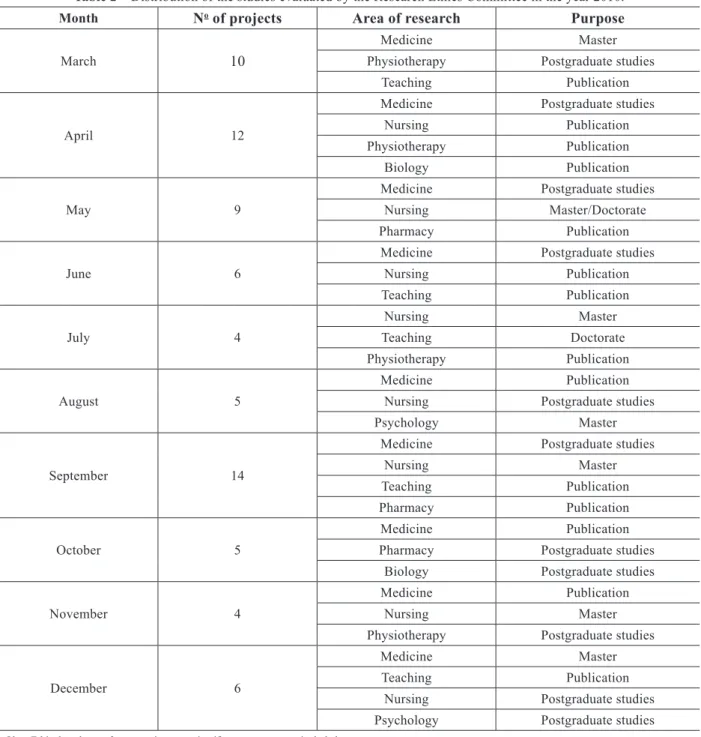
Table 2 – Distribution of the studies evaluated by the Research Ethics Committee in the year 2010.
Month No of projects Area of research Purpose
March 10
Medicine Master
Physiotherapy Postgraduate studies
Teaching Publication
April 12
Medicine Postgraduate studies
Nursing Publication
Physiotherapy Publication
Biology Publication
May 9
Medicine Postgraduate studies
Nursing Master/Doctorate
Pharmacy Publication
June 6
Medicine Postgraduate studies
Nursing Publication
Teaching Publication
July 4
Nursing Master
Teaching Doctorate
Physiotherapy Publication
August 5
Medicine Publication
Nursing Postgraduate studies
Psychology Master
September 14
Medicine Postgraduate studies
Nursing Master
Teaching Publication
Pharmacy Publication
October 5
Medicine Publication
Pharmacy Postgraduate studies
Biology Postgraduate studies
November 4
Medicine Publication
Nursing Master
Physiotherapy Postgraduate studies
December 6
Medicine Master
Teaching Publication
Nursing Postgraduate studies
Psychology Postgraduate studies
Obs.: Ethical analyses of presentations on scientiic events were not included. was a moment of great importance when the possibility of submitting suggestions became a reality.
CONEP FUNCTIONING
The CONEP is responsible for the coordination of the IRB networks of several types of institutions that to some extent work with human research, forming the System IRB/
CONEP8. It is a consultant agency of the Ministry of Health
issue and if further evaluation by the CONEP is necessitated, accor ding to IRB norms. In addition, notiication of adverse events should also be sent to the CONEP after consideration and im mediate measures taken by the researcher and others. The IRB must inform the CONEP in case of changes in its composition, the mandate of its members on the election of new members of the college or choose new coordinator, the speciic queries about ethics in research involving human subjects and suggestions for improvement and adequacy of the system and standards.
EXPERIENCE IN SARAH NETWORK OF REHABILITATION HOSPITALS
The IRB at Sarah Network of Rehabilitation Hospitals is a collegiate organ established according to the regulations and structure of Resolution 196/96 of the CNS/CONEP.
The IRB was established in 2001 with the main objective of promoting the application of principles on the basis of the ethics of human rights in all research involving humans. The decisions of the IRB are independent of special, institutional, or personal interests.
The collegiate is comprises 1 coordinator, 10 members, and 7 substitutes. It is committed to the fair representation of gender and occupation among its members (Tables 1 and 2). The IRB meets monthly to analyze proposals of research projects involving humans, with occasional meetings for conceptual discussion of ethics in research and the improvement of the identity of the IRB.
The research projects are presented for consideration by the IRB before the phase that involves subject participation, that is, before the data collection step. The performance of the analysis and preparation of the report occur within no more than 30 days.
The main problems presented by research projects are related to the ICF (language and lack of clariication of risks and beneits, among others), projects in English, nonin clusion of budget and schedule, imprecise deinition of sam ple and data collection instruments, and methodological errors (in the description of the technique).
FINAL CONSIDERATIONS
In the formation of an IRB, it is important to ensure that its members are not considered representatives of a group of interest, and avoid adherence to certain religious beliefs or corporate institutions. The IRB is not the place for negotiation of corporate interests; the objective should be to evaluate the impact of research on the welfare of the population.
Considerable effort has been made to implement pro -grams of orientation and training of CONEP members, the Executive Secretary, and institutional IRBs. The eficiency of the system can be valued for its protective role, considering several factors including the subjects, investigators, sponsors, and the government itself. However, the system has still been cri ticized as slow because of the numerous procedures and documents required.
Another aspect is related to the dificulty in the supervision and control of the projects authorized. In several countries, the abuse of research subjects has been reported. Fortunately, Brazil, as a result of the role played by the IRB/CONEP system, has been spared by the international press, which has exposed the lack of standards rules and structures of social control that led to the exploitation of vulnerable populations11.
We emphasize the essential role of IRBs in publicizing the ethical rules of research with humans, educating researchers, and establishing the correct way to design and carry out a re -search project12. However, despite these efforts, there are still
dificulties and priorities that need to be addressed, in particular with regard to deadlines and the procedure required for the approval of projects, which currently seem to be minimized with the creation of a computerized system called Plataforma Brasil.
REFERENCES
1. Freitas CBD, Hossne WS. O papel dos comitês de ética em pesquisa na proteção do ser humano. Rev Bioética. 2002;10(2):129-46.
2. Brasil. Conselho Nacional de Saúde, Ministério da Saúde. Diretrizes e normas regulamentadoras da pesquisa em seres humanos: Resolução 196,1996. Disponível em: conselho.saude.gov.br/resolucoes/reso_96. htm - 113k. Acesso em: 30/9/2011.
3. Brasil. Conselho Nacional de Saúde, Ministério da Saúde. Disponível em: conselho.saude.gov.br. Acessado em: 28/9/2011.
4. Pearn J. Publication: an ethical imperative. BMJ. 1995;310(6990):1313-5. 5. Sardenberg T, Müller SS, Pereira HR, Oliveira RA, Hossne WS. Análise dos aspectos éticos da pesquisa em seres humanos contidos nas instru-ções aos autores de 139 revistas cientíicas brasileiras. Rev Assoc Med Bras. 1999;45(4):295-302.
6. Revista da Sociedade Brasileira de Cirurgia Plástica. Normas aos au -tores. Disponível em: http://www.rbcp.org.br/conteudo.asp?pag=1. Acesso em: 20/9/2011.
7. Arquivos Brasileiros de Cardiologia. Normas aos autores. Disponível em: http://www.arquivosonline.com.br. Acesso em: 20/9/2011. 8. Brasil. Comissão Nacional de Ética em Pesquisa. Formulários.
Dispo-nível em: http://conselho.saude.gov.br/web_comissoes/conep/index. html. Acesso em: 28/9/2011.
9. Brasil. Comissão Nacional de Ética em Pesquisa. Plataforma Brasil. Dis-ponível em: www.saude.gov.br/plataformabrasil. Acesso em: 21/9/2011. 10. Saunders CM, Baum M, Houghton J. Consent, research and the doctor-pa tient relationship. In: Gillon R, ed. Principles of health care ethics. London: John Wiley & Sons; 1994. p. 457-70.
11. Brasil. Conselho Nacional de Saúde. Consulta pública da Resolução 196/96. Disponível em: http://portal.saude.gov.br/portal/saude/Gestor/ area.cfm?id_area=1253. Acesso em: 22/9/2011.
12. Muñoz DR. Problemas e soluções no desenvolvimento de um CEP. Cad Ética Pesquisa. 2005;15(5):9-11.
Correspondence to: Kátia Torres Batista
SMHS Quadra 301 – Bloco B – No 45 – 3o andar – Asa Sul – Brasília, DF, Brazil – IRB 70330-150