RESUmo
Os objeivos do estudo foram descrever a disposição sobre o Processo de Enferma -gem (PE) e a percepção de poder clínico dos proissionais de enfermagem; analisar associações entre aitudes relacionadas ao PE e variáveis selecionadas. Pariciparam 1.605 auxiliares de enfermagem e enfer -meiros (86,9% mulheres, idade média 44,12 anos; DP=9,55). O escore médio no instrumento Posições sobre o Processo de Enfermagem (PPE) foi 112,37 (DP=22,28) e no Power as Knowing Paricipaion in Change Tool - versão brasileira (PKPCT) foi 281,12 (DP= 38,72). Os escores nos instru -mentos foram mais altos para enfermeiros quando comparados aos auxiliares. Houve correlação posiiva moderada entre es -cores do PPE e PKPCT. Para os auxiliares houve associação entre os escores no PPE, sexo e pós-graduação; e entre percepção de poder e sexo. Para os enfermeiros hou -ve associação entre PKPCT e cargo de che -ia. Mais estudos devem ser desenvolvidos com vistas a ideniicar variáveis potencial -mente associadas ao uso do Processo de Enfermagem na práica clínica.
dEScRitoRES Processos de enfermagem Cuidados de enfermagem Aitude do pessoal de saúde Papel do proissional de enfermagem
Attitudes of nursing staff related
to the nursing process
*O
riginal
a
r
ticle
AbStRAct
The aims of the study were to describe nur -ses’ posiions on nursing process and their percepion of power; and to analyse asso -ciaions between posiions on nursing pro -cess, power percepion and selected varia -bles. One thousand six hundred and ive nurses (86.9% female, mean age=44.12 years, SD=9.55) paricipated in the study. Mean score on the Posiions on Nursing Process (PNP) tool was 112.37 (SD=22.28); and on the Power as Knowing Paricipaion in Change Tool – Brazilian Version (PKPCT) was 281.12 (SD=38.72). Baccalaureate nur -ses had staisically higher scores on PNP and PKPCT than auxiliary nurses. There was posiive and moderate correlaion between PNP and PKPCT scores. Auxilia -ry nurses’ scores on PNP were associated with sex and post-graduaion; auxiliary nurses’ scores on PKPCT were associated with sex. For baccalaureate nurses there was associaion between PKPCT and admi -nistraive posiion. More studies should be developed in order to idenify variables po -tenially associated with the use of nursing process in clinical pracice.
dEScRiPtoRS Nursing process Nursing care
Aitude of health personnel Nurse’s role
RESUmEn
Los objeivos del estudio fueron describir la disposición sobre el Proceso de Enfer -mería (PE) y la potencia clínica percibida del personal de enfermeira, y analizar las asociaciones entre las acitudes hacia el PE y variables seleccionadas. Pariciparon del studio 1605 auxiliares de enfermería y enfermeros (86,9% mujeres, edad media 44.12 años, DP = 9,55). La puntuación en el instrumento de la disposición sobre el Proceso de Enfermería (DPE) fue 112,37 (DP = 22,28) y en el Power as Knowing Paricipaion in Change Tool-version Brasi -leña (PKPCT) fue 281,12 (DP = 38,72). Las puntuaciones en los instrumentos fueron más altas para los enfermeros en compa -ración con los auxiliares de enfermería. Hubo correlación posiiva moderada entre las puntuaciones del DPE y PKPCT. Para los auxiliares de enfermería se encontró asociaciones entre las puntuaciones en el DPE y sexo, y postgrado, y entre el poder percibido y sexo. Para los enfermeros se encontró asociación entre PKPCT y cargo de gesión. Más estudios se desarrolló con el in de ideniicar las variables potencial -mente asociadas con el uso de proceso de enfermería en la prácica clínica.
dEScRiPtoRES Procesos de enfermería Atención de enfermería Acitud del personal de salud Rol de la enfermera
Erika de Souza Guedes1, Ruth natália teresa turrini2, Regina márcia cardoso de Sousa3,
Valéria troncoso baltar4, diná de Almeida Lopes monteiro da cruz5
Atitudes dos profissionAis de enfermAgem relAcionAdAs Ao processo de enfermAgem
lAs Actitudes del personAl de enfermeirA en relAciÓn com el proceso de enfermerÍA
*taken from the thesis “Atitudes do pessoal de enfermagem relacionadas ao processo de enfermagem”, university of são paulo school of nursing, 2012.
1rn. m.sc. in sciences, university of são paulo school of nursing. são paulo, sp, Brazil. [email protected] 2rn, ph.d., professor, university of
são paulo school of nursing. são paulo, sp, Brazil. [email protected] 3rn. full professor, university of são paulo school of nursing. são paulo, sp, Brazil.
[email protected] 4statistician. ph.d. in Health. post-doctoral fellow at the university of são paulo school of public Health, sp, Brazil. [email protected] 5rn. full
intRodUction
The nursing process (NP) has been the target of dis -cussion and research as a nursing care instrument to be taught, used (in clinical pracice and nursing manage -ment) and assessed(1-3). Nevertheless, litle is known about
the variables that are potenially associated with the use of the NP in health services. Advancing in knowledge on this process involves the exploraion and analysis of vari -ables related not only to the usage characterisics of the NP at insituions, but also to the characterisics of the in -situional and nursing professionals’ environment.
This paper reports on a study about the posiions of baccalaureate and auxiliary nurses towards the NP, which is part of a broader study at outpaient clinics and hospi -tals in São Paulo State, Brazil. In the broader study, three subprojects are ariculated: one of them is to describe how the NP is used at outpaient clinics and hospital; the other to analyze the characterisics of the NP associated with service variables; and the third to study the char -acterisics of the NP associated with the variables of the baccalaureate and auxiliary nurses at the
services.
Posiions play an important role in the applicaion of concepts, as they contribute to moivate the accomplishment of related behaviors(4). For professionals with more
favorable posiions towards the NP, it will probably be easier to get involved in the changes required for its implantaion and implementaion, while those with more negaive posiions will probably experience more diiculies. In this study, perceived power was assumed as a posiion in the sense that it refers to the person’s willing
-ness towards a role – the clinical role – which is presumed in his/her funcion.
Nursing Care Systemizaion (NCS) and the Nursing Process (NP) were treated as synonyms, and the deini -ion adopted is that the NP is an instrument that provides systemized guidance to develop a style of thinking that di -rects the clinical judgments needed for nursing care(5). The
NP establishes that care be based on the paient’s assess -ment, which provides the data to idenify the diagnoses, which direct the deiniion of outcomes to be reached. Together, diagnoses and outcomes represent the bases to select the most appropriate intervenions for the paient’s speciic situaion. Ater performing the intervenions, the achievement of the outcomes should be assessed, return -ing to the previous phases if the outcomes have not been reached or if new diagnoses have been ideniied.
In the adopted perspecive, the NP is an instrument to guide nurses’ clinical decisions and, as such, refers to the intellectual and cogniive processes of nursing pracice. In Brazil, however, by law(6), nursing documents at health
services should be structured according to the nursing process. In that context, one can admit that the NP con -cept also involves its documentaion.
Thus, the study objecives were: to describe baccalau -reate and auxiliary nurses’ posiions on the nursing pro -cess (determinaion about the NP and perceived clinical power); and to analyze the associaions between posi -ions on the NP and the selected variables.
mEtHod
This descripive and exploratory study with a cross-secional design was developed at the hospitals and out -paient clinics under the direct administraion of the São Paulo State Health Secretary (SES/SP) Health Service Coor -dinaion Department (CSS), Brazil. Out of 43 eligible and invited clinics and hospitals, eight insituions did not take part: two large hospitals received all contacts and did not respond about their paricipaion, which characterized re -fusal, according to the adopted criteria; at three insitu -ions, negoiaions to schedule data collecion extended beyond the feasible deadline to conclude the study and were thus excluded; the same was true for three other insituions that served as pilot test areas, resuling in impor -tant modiicaions in the collecion instru -ments and procedures. Thus, 35 insituions were part of the research.
The study received approval from the Ethics Commitee at the University of São Paulo School of Nursing under protocol 856/2009 and all paricipants signed the In -formed Consent Term.
Data collecion
One of the authors (ESG) collected the data between January and October 2011, with the help of research as -sistants, who were baccalaureate nurses trained especial -ly for this task.
Based on the experience obtained during the pilot test, the researchers decided to apply the quesionnaires at the workplace, so as to be able to provide clariicaions about the instruments and guarantee their completeness.
Paricipants
The subject paricipated in the study by convenience. All baccalaureate and auxiliary nurses formally employed at the SES/SP, acive at the 35 insituions and working at sectors involving paients (as the study focuses on posi -ions related to the NP, this means that, where there are no paients, there is no recommendaion to apply the NP).
The sample size was calculated based on the data sur -veyed in the pilot test. To esimate the mean posiions on for professionals
with more favorable positions towards
the np, it will probably be easier to get involved in the changes required for its implantation and
the nursing process score (instrument described further ahead) at each hospital with a one-unit error, standard deviaion of 1.3, 5% signiicance and 95% power, a sam -ple of 24 subjects per insituion would be necessary. To prevent possible losses, a sample size of 30 baccalaureate nurses and 30 auxiliary nurses was deined per insituion. In those cases when the total nursing staf was smaller, all baccalaureate and auxiliary nurses were invited to parici -pate in the study.
Out of 1,711 eligible professionals, the following were not included in the study: 31 baccalaureate and 68 aux -iliary nurses because they refused; and 7 due to the lack of funcional ideniicaion at the State Health Secretary. Thus, the data of 1,605 paricipants were analyzed: 973 auxiliary nurses (60.6%) and 632 baccalaureate nurses (39.4%). The paricipants were ailiated with 15 general hospitals, 10 psychiatric hospitals, 5 outpaient clinics, 2 maternity hospitals, 2 specialized hospitals and 1 pediatric hospital. Some subjects did not answer all quesionnaire items. The researchers decided not to use staisical tech -niques to complete missing answers so that, in the results secion, the total sample changes with the variable.
Instruments
The following instruments and procedures were used: • Posiions on Nursing Diagnosis – quesionnaire originally developed to assess nurses’ posiions towards the nursing diagnosis concept(7), was adapted to measure posiions
on the NP. The adaptaion made for the sake of this study was to replace the nursing diagnosis by the nursing pro -cess concept, changing the quesionnaire’s name to Po -siions on the Nursing Process (PNP). In this instrument, which uses the semanic diferenial to measure posiions, the respondent was asked to indicate how (s)he felt to -wards the NP concept, using the same 20 pairs of adjec -ives used in the original instrument. A 7-point scale was used to separate each pair of adjecives. To esimate the validity of the adaptaion, a general asserion was includ -ed about the extent to which the respondent’s posiion on the nursing process concept was favorable. This modiied instrument was used in a Brazilian project that involved nursing managers at public health insituions(8). In this
study, the adapted scale maintained the factor structure of the scale for nursing diagnoses, with a reliability level close to what was observed in the original scale(7,9) and
reported in the study by Leite(8). Considering the total
sample, Cronbach’s alpha coeicient for the 20-item in -strument equaled 0.954, against 0.957 in the auxiliary and 0.950 in the baccalaureate nurse sample, indicaing good internal consistency.
• Power as Knowing Paricipaion in Change Tool – Bra -zilian version (PKPCT) – to measure the perceived clinical power. Power is deined as intenional paricipaion in the change(10). In this 52-item quesionnaire, respondents
are asked to score how they feel towards their aware
-ness of their clinical role, their choices, their freedom to act intenionally and their involvement in the creaion of changes, which are operaional power indicators. For each subscale, 13 adjecive pairs with opposite mean -ings are presented. Seven equally distant points separate each pair. The thirteenth adjecive pair of each subscale is the inverted repeiion of one adjecive pair to test the reliability of the answers and is not included in the total score(10). Conirmatory factor analysis was used to check
the instrument’s validity, which ideniied 4 irst-level fac -tors and one more general second-level factor. The reli -ability of the 48 items checked using Cronbach’s alpha was 0.964 for the total sample, for the auxiliary nurses and for the baccalaureate nurses.
• Knowledge on Nursing Care Systemizaion (NCS) – par
-icipants chose between ‘none’, ‘litle’, ‘moderate’ or ‘a lot’ to indicate how much they knew about the ‘NCS in general’ and each of its phases. Knowledge on the NP was assessed using 5 items with good reliability in the sample (n=1,526; Cronbach’s alpha = 0.883). This vari -able was analyzed by adding up the scores on the 5 items and, the higher the score, the greater the knowledge on the NP.
• Level of contact with Nursing Care Systemizaion (NCS) – to esimate the paricipants’ level of contact with the NCS in the last 3 years, reading on the topic, paricipaing in classes or courses on the theme and in speciic events, use in clinical pracice and research aciviies were con -sidered. For each of the 5 items, the response scale was ‘nothing’, ‘litle’, ‘moderate’ and ‘a lot’. The level of con -tact with the NP was assessed through 5 items with good reliability in the sample (n=1,543; Cronbach’s alpha = 0.822). This variable was analyzed by adding up the scores on the 5 items and, the higher the score, the more intense was the contact with the NP.
Data analysis
Each subject’s answers were registered in an electron -ic database. Sphinx®, Mplus 6.12® and PASW Staisics 18® were used. Descripive and inferenial staisics were used to analyze the data. Non-parametric tests were applied to analyze the associaion between the posiions, perceived power and selected variables, considering that the PNP and PKPCT scores are ordinal scales. For all tests, signii -cance was set at 0.05.
RESULtS
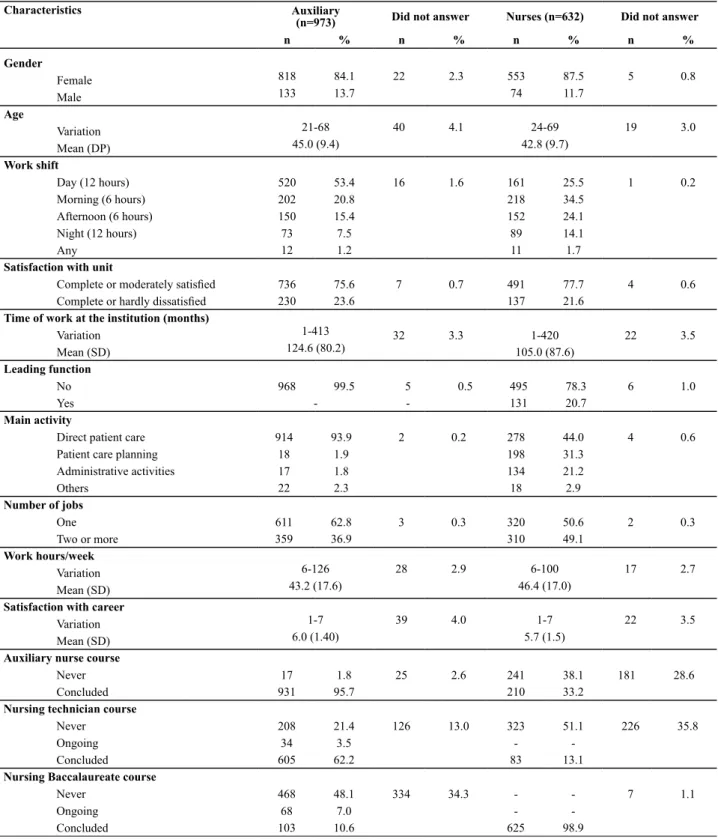
taking a specializaion degree, 15 a Master’s and 4 a Ph.D. program; 33% informed they had concluded the auxiliary nurse program, 13.1% the nursing technician program.
Based on this result, it is supposed that at least 33% of the baccalaureate nurses may have occupied other funcions in nursing (Table 1).
Table 1 – Sample characteristics - São Paulo, 2011
Characteristics Auxiliary
(n=973) Did not answer Nurses (n=632) Did not answer
n % n % n % n %
Gender
Female 818 84.1 22 2.3 553 87.5 5 0.8
Male 133 13.7 74 11.7
Age
Variation 21-68 40 4.1 24-69 19 3.0
Mean (DP) 45.0 (9.4) 42.8 (9.7)
Work shift
Day (12 hours) 520 53.4 16 1.6 161 25.5 1 0.2
Morning (6 hours) 202 20.8 218 34.5
Afternoon (6 hours) 150 15.4 152 24.1
Night (12 hours) 73 7.5 89 14.1
Any 12 1.2 11 1.7
Satisfaction with unit
Complete or moderately satisied 736 75.6 7 0.7 491 77.7 4 0.6
Complete or hardly dissatisied 230 23.6 137 21.6
Time of work at the institution (months)
Variation 1-413 32 3.3 1-420 22 3.5
Mean (SD) 124.6 (80.2) 105.0 (87.6)
Leading function
No 968 99.5 5 0.5 495 78.3 6 1.0
Yes - - 131 20.7
Main activity
Direct patient care 914 93.9 2 0.2 278 44.0 4 0.6
Patient care planning 18 1.9 198 31.3
Administrative activities 17 1.8 134 21.2
Others 22 2.3 18 2.9
Number of jobs
One 611 62.8 3 0.3 320 50.6 2 0.3
Two or more 359 36.9 310 49.1
Work hours/week
Variation 6-126 28 2.9 6-100 17 2.7
Mean (SD) 43.2 (17.6) 46.4 (17.0)
Satisfaction with career
Variation 1-7 39 4.0 1-7 22 3.5
Mean (SD) 6.0 (1.40) 5.7 (1.5)
Auxiliary nurse course
Never 17 1.8 25 2.6 241 38.1 181 28.6
Concluded 931 95.7 210 33.2
Nursing technician course
Never 208 21.4 126 13.0 323 51.1 226 35.8
Ongoing 34 3.5 -
-Concluded 605 62.2 83 13.1
Nursing Baccalaureate course
Never 468 48.1 334 34.3 - - 7 1.1
Ongoing 68 7.0 -
-Concluded 103 10.6 625 98.9
The mean score on the 5 quesions about knowledge on the NP equaled 2.8 (SD=0.66) for the auxiliary nurse sample and 3.2 (SD=0.47) for the baccalaureate nurse sample; for the 5 quesions about contact with NCS, this score corresponded to 2.1 (SD=0.72) for the auxiliary nurses and 2.6 (SD=0.57) for the nurses. This score ranged from 1 to 4, with higher scores indicaing greater contact.
The baccalaureate and auxiliary nurses’ posiions on the NP were assessed with the help of the PNP. Instru -ment scores could range from 20 to 140 and, the higher the score, the more favorable the posiion towards the NP. The total PNP score ranged between the scale minimum and maximum. For the total sample (n=1,489), the mean score was 112.4; for the auxiliary nurses (n=889) 111.0 and for the baccalaureate nurses (n=600) 114.3. The item with a mean score ≤4.5 used the adjecives rouine/cre -aive. This result was observed in the total sample, in the auxiliary nurse and in the baccalaureate nurse group. The following pairs showed mean scores ≥5.5: meaningless/ meaningful, no worthless/valuable, negaive/posiive, dumb/intelligent, hindering/helpful, invalid/valid, insig -niicant/signiicant, irrelevant/relevant, unrewarding/re -warding, inconvenient/convenient, unacceptable/accept -able, bad/good and unimportant/important. These results were observed in the three groups of respondents.
The baccalaureate and auxiliary nurses’ perceived clini -cal power was veriied with the help of the PKPCT. The item scores can be added up for each subscale (possible range from 12 to 84 points) and for the total scale (possible range from 48 to 336 points)(10). The higher the score, the greater
the perceived power. Total PKPCT scores ranged from 105 to 336 for the total sample and for the baccalaureate nurs -es. For the auxiliary nurses, the total score ranged from 155 to 336. The total mean scores equaled 285.1 for the bac -calaureate nurses (n=550), 278.3 for the auxiliary nurses (n=782), and 281.1 for the total sample (n=1,332). Neither the total sample nor the baccalaureate nurses showed any item with mean scores below 4.5. For the auxiliary nurses, the item person following/leading showed mean scores be -low 4.5 on all subscales. In the auxiliary nurses’ responses, mean scores for most items were higher than 5.5, except for 10 items. In the baccalaureate nurses’ responses, mean scores were lower than 4.5 for only 2 items.
Iniially, the relaions between posiions on NP and perceived power on the one hand and professional cat -egory on the other were tested using the Mann-Whitney test. The baccalaureate nurses’ posiions were signii -cantly more favorable than those of the auxiliary nurses (p=0.024). The baccalaureate nurses’ perceived clinical power was staisically higher when compared with the auxiliary nurses (p=0.004). In view of these results, the re -maining associaion analyses were developed separately for baccalaureate nurses and auxiliary nurses. A moderate posiive correlaion was found, according to Spearman’s correlaion coeicient, between PNP and PKPCT scores, for auxiliary nurses (r=0.480; p<0.001) as well as for bac -calaureate nurses (r=0.460; p<0.001).
Table 2 summarizes the main results of the associaion tests between PNP and PKPCT scores and the selected variables.
Table 2 – Main results of association tests between PNP and PKPCT scores and selected variables - São Paulo, 2011
Auxiliary Nurse
Variables (20 items)PNP (48 items)PKPCT (20 items)PNP (48 items)PKPCT
Sex F>M
p=0.018
F>M p=0.020
F=M p=0.660
F=M p=0.570
Age r=0.100
p=0.003
r=0.109 p=0.003
r=0.060 p=0.146
r=0.115 p=0.008
Time since graduation r=0.087
p=0.016
r=0.067 p=0.084
r=-0.051 p=0.227
r=0.038 p=0.380
Degree Yes>No
p=0.011
Yes = No p=0.231
Yes = No p=0.420
Yes = No p=0.375
Leading function - - Yes = No
p=0.290
Yes > No p=0.010
Main activity Care =
planning = administrative
p=0.305
Care = planning = administrative
p=0.079
Care = planning = administrative
p=0.125
Care = planning = administrative
p=0.294
Satisfaction with workplace
r=0.242 p=0.000
r=0.129 p=0.000
r=0.239 p=0.000
r=0.247 p=0.000
Satisfaction with career r=-0.247
p=0.000
r=-0.246 p=0.000
r=-0.236 p=0.000
r=-0.280 p=0.000
Knowledge on NCS r=0.202
p=0.000
r=0.173 p=0.000
r=0.156 p=0.000
r=0.120 p=0.005
Contact with NCS r=0.197
p=0.000
r=0.109 p=0.003
r=0.290 p=0.000
diScUSSion
The baccalaureate nurses (n=632) and auxiliary nurses’ (n=973) responses to the PNP and PKPCT quesionnaires provided data to characterize hospital and outpaient nursing staf’s posiions on the NP and nursing’s perceived clinical power. The mean posiion scores on the NP in this study seem to be higher than the results of another study that used the PNP(8) and the mean posiion scores towards
the nursing diagnosis(8-9,11), one phase of the PNP.
In this study, social desirability may have interfered in paricipants’ responses to the PNP. Data collecion took place almost 9 years ater the Project Weaving the NCS, developed in partnership between the CSS and other SES/SP eniies(12). This project was an iniiaive to mo
-bilize nurses in the São Paulo State hospital network on the use of the NP and the documentaion of its phases(12).
The Central NCS Commission of the CSS/SES/SP invested in meeings to plan and supervise the establishment and implementaion of the NP(12). In addiion, the NP is men
-ioned in nursing legislaion as something that enhances care quality(6). Based on these facts, it can be airmed
that, in the context, more favorable aitudes towards the NP were valued, so that a possible social desirability bias can reasonably be considered in the PNP results. The au -thors of another study(13) quesioned whether the nurses’
favorable opinion towards the implantaion of the nursing diagnoses resulted from relecions on and assessments of the work process, or whether they were merely repro -ducing something they learned as correct and desirable. Therefore, further research is need to further knowledge on the weight of social desirability in posiions on the NP.
The results showed that baccalaureate nurses’ posi -ion scores were signiicantly higher than those of auxil -iary nurses. Although this result was expected, it would be desirable if the enire nursing staf’s posiion towards the NP were similar.
The mean score on the PNP items was lower for the item rouine/creaive in the total sample (3.98), among auxiliary nurses (3.96) and among baccalaureate nurses (4.01). The same item also scored the lowest (4.33) in the phase ater the implementaion of the nursing diag -noses(9). In a study among nurses, the authors ideniied
that baccalaureate and auxiliary nurses hardly value the nurses’ orders and consider it as part of rouine(12).This
fact may be due to the view of the NP as a daily task, seen as a part of the work rouine, but which should not be mixed up with a product of mechanical work, without any relecion.
In most studies(8-9,11), the item easy/diicult in the PNP
as well as in the instrument that assesses posiions on the nursing diagnosis tended towards lower scores in compari -son with the scores for the other items. Perhaps the under -standing of the NP or one of its phases as diicult is due to the gap in nursing educaion about this theme. One study
showed that nursing technicians were unfamiliar with the phases of the NP, associated the NP with the nurses’ or -ders only, without menioning the other phases(14). In a
study that involved auxiliary nurses and nursing techni -cians (n=77), 93.5% of the subjects recognized the use of the NCS, but approximately 60% of the auxiliary nurses and nursing technicians believed the Nursing Council did not allow them to monitor the diferent NCS phases(3). The
paricipaion of auxiliary nurses and nursing technicians in the NP remains unclear(3). In their educaional programs,
auxiliary nurses and nursing technicians need further con -tact with the NP and clariicaions on each nursing team members’ tasks and responsibiliies(3). Baccalaureate nurs
-es need to acknowledge the interdependence of paient care aciviies; and know that, although they are respon -sible for decision making on the most adequate care, the nursing team should be involved in care planning(3).
Another important aspect that can interfere in posi -ions on the NP is that, frequently, it is treated as an end in itself or as the means to achieve high-quality nursing care. The NP cannot be understood as an end in itself or as a synonym that its mere applicaion will enhance care quality. Otherwise it will be desined to coninue as a form of control and a pracice nursing itself discredits(1).
As for the perceived clinical power; the total mean PKPCT score of the baccalaureate nurses in this study (285.06; SD=36.62) was higher than that in a Brazilian sample of Brazilian clinical nurses (273.6; SD=33.0)(15) and
closer to the scores of nurse managers in samples from the United States (USA)(16-17). What may have contributed
to the higher scores among nurses in this study is the fact that the sample included a considerable part of nurses in leading funcions (20.7%), as the perceived power was posiively associated with leading funcions (p=0.010).
The total mean PKPCT scores of the auxiliary nurses in this study (278.35; SD=39.93) were also higher than those of Brazilian clinical nurses(15). Like for the posiions on the
NP, the associaion test showed that the baccalaureate nurses’ perceived clinical power was signiicantly higher (p=0.004) than that of the auxiliaries.
In this research, the auxiliary nurses showed the low -est mean scores (<4.5) for the item person following/lead -ing on all subscales. In the history of nurs-ing, the hierarchy plays a central role and takes the form of a strict posiion among baccalaureate nurses, nursing technicians and auxiliary nurses, who at the same ime are subordinated to other health team members(2). In this context, it seems
that auxiliary nurses do not conceive the role of leaders. One study’s proposal(10) represents a change from the so
The lack of a cut-of point for PKPCT scores makes it diicult to determine whether the study paricipants’ scores were high, moderate or low. In another study(15),
the total mean PKPCT score before puing in pracice the nursing diagnosis classiicaion by NANDA-Internaion -al(18) in clinical pracice was 80% of the maximum score
(269/336), against 81.3% ater the implementaion. The baccalaureate nurses’ score in this study represents 84.8% of the maximum (285.0/336) and the auxiliary nurses’ score 82.8% (278.3/336). The trend towards high PKPCT scores arouses relecions on the instrument’s discrimina -ive ability. Social desirability when answering the instru -ment could jusify these indings(10).
The moderate and signiicant posiive correlaion be -tween the PNP and PKPCT scores for the auxiliary nurs -es (r=0.480; p<0.001) and for the baccalaureate nurs-es (r=0.460; p<0.001) arouses new quesions to enhance knowledge on the NP. Although the present study results support the hypothesis that people with high perceived clinical power have a more favorable posiion to the NP needs to be invesigated in further depth in other stud -ies. Although the social desirability efects on the measur -ing of both variables (PNP and PKPCT) are studied as well, studies are needed to explore the interacion of other variables in the relaion between PNP and PKPCT.
Among the associaions between the other variables and the PNP and PKPCT, staisically signiicant associa -ions should be highlighted, or at least moderate correla -ions(19). For the auxiliary nurses, a posiive relaion was
found between aitudes towards the NP and female sex and holding a graduate degree. The associaion between a graduate degree and PNP scores may be due to the fact that auxiliary nurses are in closer contact with the NP and its phases in the courses they take ater their iniial graduaion.
The nurse managers who paricipated in this study showed staisically higher PKPCT scores when compared with the auxiliary nurses’ scores, as previously observed in another study involving a sample of 182 nurse managers in the USA(17). The negaive correlaion between PNP and
PKPCT scores and saisfacion with the career, although insigniicant, was an intriguing result as, in a review on the PKPCT(20), a posiive associaion was reported between
perceived power and saisfacion with the career.
The main limitaion in this research was the conve -nience sample. Another limitaion was that not all ques -ionnaires were fully answered. Individuals who did not answer some items difered in some aspects from individ -uals who did: this group included more auxiliary nurses, less people with a graduate degree, with a higher mean age and greater saisfacion with their career. Posiions on the NP and perceived clinical power may have been alert -ed because of the missing responses.
concLUSion
The study results reported here permit airming that the posiions of the baccalaureate nurses and auxil -iary nurses acive in hospitals and outpaient clinics are favorable to the NP and that the baccalaureate nurses’ posiions are signiicantly more favorable than the auxil -iary nurses’ posiions. Posiion on the NP and perceived clinical power were signiicantly associated in the group of baccalaureate nurses and in the auxiliary nurses’ group.
The perceived clinical power in the study sample was similar to other studies and the baccalaureate nurses’ perceived clinical power was higher among baccalaureate nurses than among auxiliary nurses.
In the auxiliary group, women displayed more favor -able posiions on the NP and perceived power of the clinical role when compared to men. Auxiliary nurses with higher degrees showed higher PNP scores than other aux -iliary nurses. In the baccalaureate nurses’ group, profes -sionals in leading funcions revealed a higher perceived power of the clinical role than professionals who reported no leading funcion.
The intensity of the correlaions between posiions on the NP, perceived clinical power and other variables was insigniicant and associaion were not signiicant at 5%.
REfEREncES
1. Garcia TR, Nóbrega MML. Processo de Enfermagem: da teoria à práica assistencial e de pesquisa. Esc Anna Nery Rev En-ferm. 2009;13(1):188-93.
2. Pereira MJB, Fortuna CM, Mishima SM, Almeida MCP, Ma-tumoto S. A enfermagem no Brasil no contexto da força de trabalho em saúde: peril e legislação. Rev Bras Enferm. 2009;62(5):771-1.
3. Ramos LAR, Carvalho EC, Canini SRMS. Opinião de auxiliares e técnicos de enfermagem sobre a sistemaização da assistên-cia de enfermagem. Rev Eletr Enferm [Internet]. 2009 [citado 2011 dez. 05];11(1). Disponível em: htp://www.fen.ufg.br/ revista/v11/n1/v11n1a05.htm
5. Kenney JW. Relevance of theory-based nursing pracice. In: Chris-tensen PJ, Kenney JW, editors. Nursing process: applicaion of conceptual models. 4th ed. St. Louis: Mosby; 1995. p. 3-23.
6. Conselho Federal de Enfermagem (COFEN). Resolução COFEN n. 358/2009. Dispõe sobre a Sistemaização da Assistência de Enfermagem – SAE nas insituições de saúde brasileiras [In-ternet]. Brasília; 2009 [citado 2011 nov. 11]. Disponível em: htp://site.portalcofen.gov.br/node/4384
7. Lunney M, Krenz MA. An instrument to measure aitudes toward nursing diagnosis. In: Carroll-Johnson RM, Paquete M, editors. Classiicaion of Nursing Diagnoses. Proceedings of the Tenth Conference of North American Nursing Diagnosis Associaion. San Diego: Lippincot; 1992. p. 389-90.
8. Leite JEL. Viabilidade do processo de enfermagem no con-texto hospitalar: perspeciva gerencial [dissertação]. Natal: Departamento de Enfermagem, Universidade Federal do Rio Grande do Norte; 2011.
9. Cruz DALM, Kitazulo RC, Pimenta CAM, Lima AFC, Gaidzinski RR. Aitudes frente ao diagnósico de enfermagem durante a implementação de classiicação de diagnósicos. Ciênc Cui-dado Saúde. 2006;5(3):281-8.
10. Barret EAM. A measure of power as knowing paricipaion in change. In: Diloria C, Strickland O, editors. Measurement of nursing outcomes. 2ª ed. New York: Springer Publishing; 2003. p. 21-37.
11. Cruz DALM, Hayashi APM, Oliva APV, Corrêa CG. Adaptação e validação do instrumento “Posiions on nursing diagnosis” para a língua portuguesa. Rev Bras Enferm. 2006;59(2):163-7.
12. Bersusa AAS. Qualiicando para a assistência de enferma-gem: projeto “Tecendo a SAE em São Paulo”. Bol Inst Saúde. 2009;(48):61-6.
13. Elizalde AC, Almeida MA. Percepções de enfermeiras de um hospital universitário sobre a implantação dos diagnósicos de enfermagem. Rev Gaúcha Enferm. 2006;27(4):564-74.
14. Cruz AMP, Almeida MA. Competencies in the educaion of Nursing Technicians to implement the Nursing Care System-aizaion. Rev Esc Enferm USP [Internet]. 2010 [cited 2011 Dez 11];44(4):921-7. Available from: htp://www.scielo.br/ pdf/reeusp/v44n4/en_09.pdf
15. Cruz DALM, Pimenta CAM, Pedrosa MFV, Lima AFC, Gaidz-insk RR. Nurses’ percepion of power regarding their clinical role. Rev Lat Am Enferm. 2009;17(2):234-9.
16. Caroselli C. Power and feminism: a nursing science perspec-ive. Nurs Sci Q. 1995;8(3):115-9.
17. Moulton PJ. An invesigaion of the relaionship of power and empathy in nurse execuives [thesis]. New York: New York University; 1994.
18. North American Nursing Diagnosis Associaion Internaional (NANDA). Nursing diagnosis: classiicaion and deiniions 2009-2011. Ames: Blackwell; 2008.
19. Fox L. Estaísica para ciências humanas. São Paulo: Pren-ice-Hall; 2004.
20. Kim TS. The theory of power as knowing paricipaion in change: a literature review update. Visions. 2009;16(1):19-39.