*e-mail: [email protected]
Presented at the International Symposium on High Temperature Corrosion in Energy Related Systems, Angra dos Reis - RJ, September 2002.
Rare Earth Oxide Coatings to Decrease High Temperature
Degradation of Chromia Forming Alloys
Stela Maria de Carvalho Fernandes, Lalgudi Venkataraman Ramanathan*
Instituto de Pesquisas Energéticas e Nucleares Travessa R-400, Cidade Universitária
O5422-970 São Paulo – SP, Brazil
Received: September 2, 2002; Revised: September 4, 2002
The addition of small quantities of reactive elements such as rare earths (RE) to chromia or alumina forming alloys improves the high temperature oxidation resistance. Traditionally, these elements are alloying additions or are added as oxides to form a dispersion. The alloys can also be coated with RE oxides. Several methods can be used to coat alloy substrates with RE oxides and the sol-gel process is considered to be quite efficient, as it generates the very small oxide particles. This paper presents the influence of surface coatings of Ce, La, Pr, and Y oxide gels on the oxida-tion behavior of an Fe-20Cr alloy at 1000 °C. The morphology of the rare earth (RE) oxide coat-ings varied with the nature of RE. The oxidation rate of RE oxide coated Fe-20Cr was signifi-cantly less than that of the uncoated alloy. The extent of influence the RE oxide coating exercised on the oxidation rate decreased in the following order: La, Ce, Pr, Y. The scale formed in the presence of RE oxide was very thin, fine grained and adherent chromia. A direct correlation be-tween rare earth ion radius and the extent of influence on chromia growth rate at 1000 °C was observed.
Keywords:oxidation, rare earth, coatings
1. Introduction
Metallic materials for use at high temperatures are usu-ally iron, nickel or cobalt based alloys. The surface oxide formed on these metals in oxidizing environments are not sufficiently protective above 550 °C, and are therefore al-loyed with Cr and Al to establish more protective oxide scales of chromia or alumina respectively. The scales, in order to be highly protective should be: (a) stoichiometric; (b) free of pores, cracks or other defects; (c) free of stress at operat-ing temperaturee and (d) resistant to spallation1. In practice, it is almost impossible to form such ideal scales. However, the addition of rare earth (RE) elements such as yttrium or cerium to these alloys, has been shown to improve the prop-erties of chromia and alumina scales. In the case of chromia scales, REs have been shown to: (a) improve scale adher-ence, especially under thermal cycling conditions; (b) re-duce the scale growth rate constant (for steady state growth) by a factor of up to 10 or more; (c) reduce the chromium content necessary in the alloy to form a continuous chromia scale, from 20-35% to 10-13%Cr; (d) change the scale
growth mechanism, from scale growth at the oxide/gas in-terface to scale growth at the metal/oxide inin-terface and (e) reduce the grain size of the scale2. Several mechanisms have been proposed to account for these beneficial effects of add-ing the reactive elements, and some of these have been veri-fied for specific alloys under specific conditions3,4.
hy-droxides ranging in size between 20 Å and 1 µm. Metallic substrates are coated with the sol using suitable methods, such as dipping, spin coating or electrophoresis. On drying (removing water from the colloidal units), the sol is trans-formed into a gel5.
The use of RE oxide coatings has the advantage of not affecting adversely the mechanical properties of the alloy and it has also the potential of being used on surfaces of metallic components exposed to high temperature oxidiz-ing environments. This paper presents the influence of sur-face coatings of La2O3, Pr2O3, Y2O3 and CeO2 applied by the sol-gel technique on the oxidation behavior of an Fe-20Cr alloy at 1000 °C. The mechanism by which the rare earth oxides affect the oxidation behavior is also presented.
2. Methods and materials
Sols of Y2O3, La2O3, CeO2, and Pr2O3 were prepared as aqueous dispersions of the respective oxides in nitric acid and a non-ionic surfactant. The solutions were heated to 80 °C under constant agitation for 1 h and the sol formed as sediment. Fe-20Cr specimens 1.0 cm × 1.0 cm × 0.5 cm were ground to 400 mesh, rinsed and dried. The RE oxide sols were sprayed onto specimens that were then heated to 150 °C to form a surface layer of RE oxide gel. The speci-mens were subsequently oxidized at 1000 °C for 40 h.
Scanning electron microscopic examination of the speci-men surfaces and cross-sections was carried out, both after coating with the RE oxide and after oxidation. Analysis of the surface scales using energy dispersive spectroscopy and x-ray diffraction was also carried out.
3. Results and discussion
The micrographs of the Fe-20Cr alloy specimens cov-ered with the different RE oxides and oxidized for 40 h at 1000 °C are shown in Fig. 1. The Pr2O3, La2O3 and CeO2 gels are uniformly distributed, where as that of Y2O3 is not. The morphology of the gels varied with the nature of the RE oxide. While the CeO2 gel consists of elongated crys-tals, those of the Pr2O3 gel consisted of finely linked crys-tals. Similar observations with respect to morphological variations have been reported by other authors, although not for Pr oxide10.
Isothermal oxidation measurements revealed weight in-creases that corresponds to chromia formation. The Pr2O3 and La2O3 on the oxidized specimens were still quite adher-ent and uniformly distributed unlike CeO2 and Y2O3. Chro-mium oxide in the form of Cr2O3 (as detected by XRD analy-sis) was found in the regions where CeO2 and Y2O3 had spalled off.
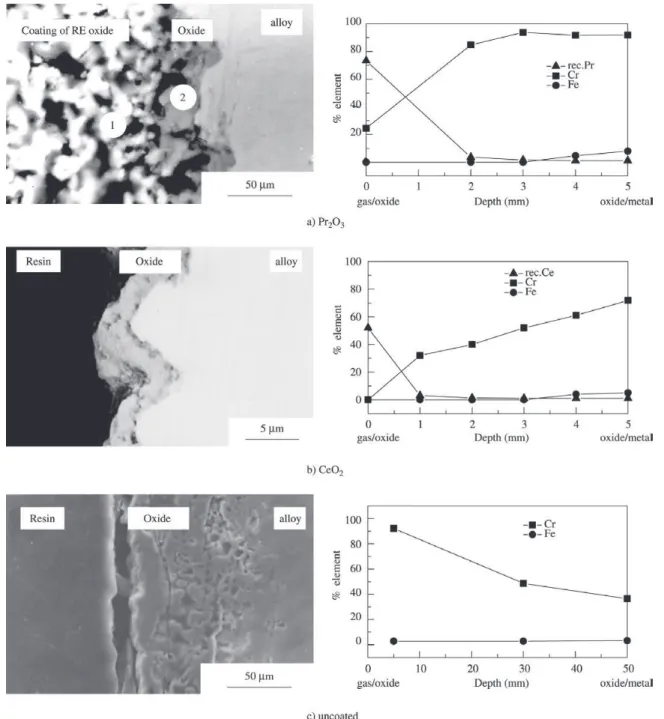
The micrographs of specimen cross-sections after oxi-dation at 1000 °C are shown in Fig. 2. This figure also shows chemical composition profiles. The chemical composition
across the alloy/scale/coating interfaces was determined by EDS. The elemental percentages and the distances (depths) are relative values, to enable comparisons across the inter-faces to be made. Region 1 in Fig. 2a shows a high Pr tent and region 2 in the same figure reveals a high Cr con-tent. X-ray diffraction analysis showed the latter regions consist of chromia. The overall thickness of the chromia was 2.5 to 5 µm. The composition profile across the inter-faces on the specimen coated with La2O3 was similar to that in Fig. 2a for Pr2O3 and the specimens coated with CeO2 is shown in Fig. 2b. The average chromia thickness varied with the nature of RE oxide. Fig. 2c shows the cross-sectional micrograph and composition profile for an uncoated Fe-20Cr specimen oxidized at 1000 °C for 40 h.
4. General discussion
Comparison of the element profiles in Fig. 2 reveals that the oxide formed at 1000 °C under all the rare earth oxide coatings is chromia. The porous nature of this RE oxide permits oxygen from the air to react with the chromium to form chromia. The RE oxides are also considered to act as preferential nucleation sites for chromia formation15. En-trapment of RE oxide within the chromia layer has been observed. The marked reductions in the rate and extent of oxidation of specimens coated with RE oxides can be at-tributed to the presence of the RE oxides within the grow-ing chromia. Growth of chromia in the RE free Fe-Cr alloys is cation driven, and the oxide scale growth takes place at the oxide/oxygen interface, owing mainly to the higher mobility of chromium ions than oxygen ions. The reduced chromia growth rate in the presence of REs is directly at-tributable to reduction in chromium ion mobility. Since grain boundaries are the preferred paths for ion transport in com-pact scales, the reduced chromia growth rate in the pres-ence of REs is a result of the reduction in chromium ion movement along grain boundaries caused by the presence of barriers, in other words by the presence of RE ions3,16. Proof of this has been observed and similar observations were presented by Papaiacovou and Hussey for scale growth on ceria coated Fe-Cr alloys12.
The RE ions are significantly larger than Fe or Cr ions (RFe=0,63 and RCr=0,64), and the ionic radii of the RE ele-ments used in this investigation, as a function of the
chro-Table 1. Ratio of ionic radii of RE element and chromium.
Rare earth element RRE/RCr
Lanthanum 1.64
Cerium 1.60
Praseodymium 1.57
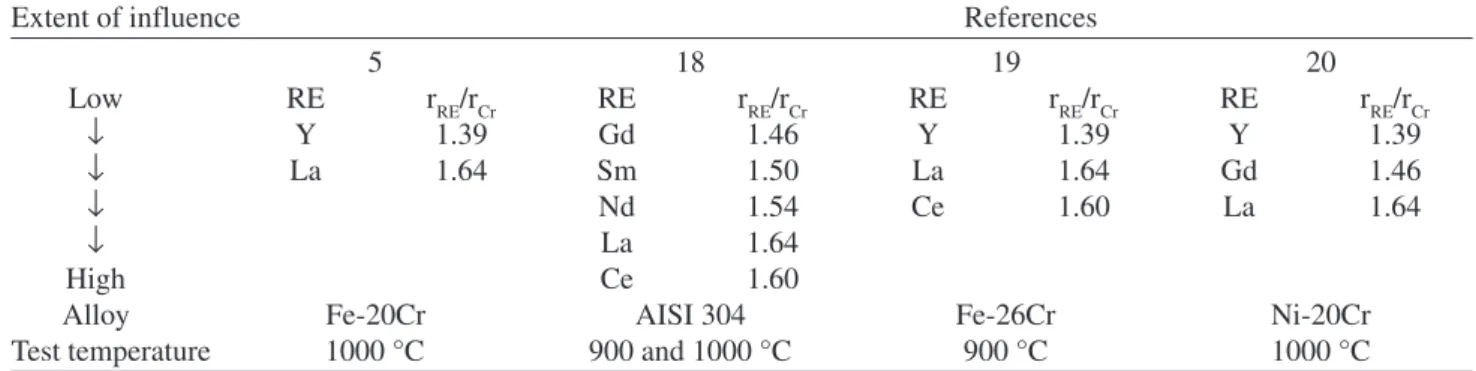
mium ion radius are shown in Table 1. The extent to which these RE elements affect oxidation rates is in general pro-portional to their ionic radii. The observations made in this investigation lend further proof to data presented
else-where17. The larger the RE ion, the greater is its influence on chromia growth rate. Variations in the extent of influ-ence of RE on chromia growth, extracted from published papers, are shown in Table 2 18-20. It can be seen that the
Figure 1. Scanning electron micrographs of Fe-20Cr substrates with given coatings after oxidation at 1000 °C for 40 h.
Table 2. Listing of RE elements in order of increasing influence on oxidation of chromia forming alloys. Data extracted from references mentioned. rRE/rCr - ratio of ionic radii of RE element and chromium.
Extent of influence References
5 18 19 20
Low RE rRE/rCr RE rRE/rCr RE rRE/rCr RE rRE/rCr
↓ Y 1.39 Gd 1.46 Y 1.39 Y 1.39
↓ La 1.64 Sm 1.50 La 1.64 Gd 1.46
↓ Nd 1.54 Ce 1.60 La 1.64
↓ La 1.64
High Ce 1.60
Alloy Fe-20Cr AISI 304 Fe-26Cr Ni-20Cr
extent of the influence on chromia growth rate follows the same rationale, substantiating the mechanism by which RE influence chromia scale growth, that is, the presence of RE ions at the oxide grain boundaries effectively block Cr ion transport, thereby making anion (oxygen ion) diffusion dominant.
Figure 2. Cross-sectional scanning electron micrographs and the corresponding element profiles of Fe-20Cr substrates with different
coatings after oxidation for 40 h at 1000 °C.
5. Conclusions
was significantly lower than that of the uncoated al-loy at 1000 °C. In decreasing order of influence on oxidation rate, the RE elements studied here were La, Ce, Pr and Y.
3. Pr2O3, La2O3 and CeO2 were more adherent to the al-loy surface even after extended periods of oxidation. 4. Composition profiles across RE oxide/scale/alloy in-terfaces revealed thinner chromia scales on RE oxide coated than on uncoated specimens.
5. Further evidence of the mechanism of chromia scale growth in RE containing Fe-Cr alloys has been pre-sented. The mechanism involves predominant oxygen ion diffusion (the large RE ions block chromium ion diffusion along grain boundaries) and consequently the chromia scales on RE oxide coated specimens are considerably thinner.
6. Direct correlation between RE ion radius and the ex-tent of influence on chromia growth at 1000 °C has been observed.
References
1. Stott, F.H. Mat. Sci. and Tech., v. 5, p. 734, 1989.
2. Stringer, J. Mat. Sci. and Eng., A120, p. 129, 1989.
3. Przybylski, K.; Garratt-Reed, A.J.; Yurek, G.J.
J.Electrochem. Soc., v. 135, n. 2, p. 509, 1988.
4. Funkenbusch, R.W.; Smegill, J.G.; Bornstein, N.S. Metall. Trans., 16A, p. 1164, 1985.
5. Nagai, H. Mat. Sci. Forum, v. 43, p. 75, 1989.
6. Rhys-Jones, T.N.; Grabke, H.J. Mat. Sci and Tech., v. 5,
n. 4, p. 446, 1988.
7. Antill, J.E.; Bennet, M.J.; Bernsley, R.F.A.; Fern, F.H.; Goode, P.D.; Myatt, B.L.; Furner, J.F.; Warburton, J.W.
Corros. Sci., v. 16, p. 729, 1976.
8. Landkof, M.; Levy, A.V.; Boone, D.H.; Gray, R.; Yanif, E. Corrosion, v. 41, p. 344, 1985.
9. Saito, Y.; Maruyama, T. Mat. Sci. and Eng., v. 87, p. 275,
1987.
10. Hou, P.Y.; Stringer, J. Mat. Sci and Eng., v. 87, p. 295,
1987.
11. Fransen, T.; de Jough, M.A.; Perik, M.M.A.; Gellings, P.J. “The sulfidation of high alloy steels at various sulfur partial pressures. The role of mechanical pre-treatments and the influence of superficially applied cerium (IV) oxide”, ( Paper presented at the 9th Int. Cong. On Metal-lic Corrosion, Canada, p. 311, 1984.
12. Papaiacovou, P.; Hussey, R.J. Corros. Sci., v. 30, n. 4/5,
p. 451, 1990.
13. Bennet, M.J. J.Vac. Sci. and Technol., B2, v. 4, p. 800,
1984.
14. Ramanathan, L.V. Corros. Sci., v. 35, p. 871, 1993.
15. Moon, D.P.; Bennet, M.J. UKAEA Rep. AERE-R 12757,
1987.
16. McLean, D. Grain Boundaries in Metals, Oxford
Uni-versity Press, London, 1957.
17. Fernandes, S.M.C.; Ramanathan, L.V. Surf. Engg., v. 16,
p. 4, v. 327, 2000.
18. Ramanathan, L.V. “Oxidation behavior of rare earth oxide covered stainless steels”, Proc. 9th Brazilian Con-ference on Materials Science and Engineering, v. 712, 1990.
19. Hussey, R.J.; Graham, M.J. Oxidation of Metals, v. 45,
n. 3, p. 349, 1996.
20. Nagai, H.; Takebayashi, Y.; Mitani, H. Metall. Trans. A,