ISSN 0104-6632 Printed in Brazil
www.abeq.org.br/bjche
Vol. 31, No. 01, pp. 251 - 258, January - March, 2014
Brazilian Journal
of Chemical
Engineering
SOLID-LIQUID STABLE PHASE EQUILIBRIA OF
THE TERNARY SYSTEMS MgCl
2
+ MgB
6
O
10
+ H
2
O
AND MgSO
4
+ MgB
6
O
10
+ H
2
O AT 308.15 K
Lingzong Meng
1,2*and Dan Li
31
School of Chemistry and Chemical Engineering, Phone/Fax: + 86-539-8766600, Linyi University, Linyi, 276005, China.
E-mail: [email protected] 2
Tianjin Key Laboratory of Marine Resources and Chemistry, Tianjin University of Science and Technology, Tianjin, 300457, China.
3
School of Media Communications, Linyi University, Linyi 276005, China.
(Submitted: January 15, 2013 ; Revised: March 5, 2013 ; Accepted: April 26, 2013)
Abstract - The solubilities and the relevant physicochemical properties of the ternary systems MgCl2 + MgB6O10 + H2O and MgSO4 + MgB6O10 + H2O at 308.15 K were investigated using an isothermal dissolution method. It was found that there is one invariant point, two univariant curves, and two crystallization regions of the systems. The systems belong to a simple co-saturated type, and neither double salts nor solid solutions were found. Based on the extended HW model and its temperature-dependent equations, the single-salt Pitzer parameters (0), (1), (2) and CØ for MgCl2, MgSO4, and Mg(B6O7)(OH)6, the mixed ion-interaction parameters
6 10
Cl,B O
θ ,
4 6 10
SO ,B O
θ ,
6 10
Mg,Cl,B O
Ψ ,
4 6 10
Mg,SO ,B O
Ψ of the systems at 308.15 K were fitted, In addition, the average equilibrium constants of the stable equilibrium solids at 308.15 K were obtained by a method using the activity product constant. Then the solubilities of the ternary systems are calculated. The calculated solubilities agree well with the experimental values.
Keywords: Phase equilibrium; Phase diagram;Solubility; Pitzer modeling; Mcallisterite.
INTRODUCTION
There are more than one thousand salt lakes in China, and a number of salt lakes with an abundance of lithium and boron resources are widely distributed in the Qaidam Basin of Qinghai-Tibet Plateau, China (Zheng et al., 1988). These brines belong mostly to the complex system Li + Na + K + Mg + Cl +SO4 + borate + H2O. It is well known that the thermody-namic phase equilibria and phase diagrams play an important role in exploiting the brine resources and describing the geochemical behavior of the brine and mineral system. Therefore, simulative experimental studies on stable phase equilibria containing magne-sium and boron are essential for predicting the path of mineral crystallization for the effective separation and purification of the boron-containing mixture
salts effectively. Although it has been pointed out that the structure of boron ion of mcallisterite is B6O7(OH)6
2-, B6O10
is used in this paper for con-venience (Li and Gao, 1993).
252 Lingzong Meng and Dan Li
Brazilian Journal of Chemical Engineering
pH) of the ternary systems MgCl2 + MgB6O10 + H2O and MgSO4 + MgB6O10 + H2O at 308.15 K, as well as the predicted solubilities using the Harvie-Weare (HW) solubility modeling approach, which incorpo-rates the Pitzer specific interaction formalism are presented.
EXPERIMENTAL SECTION
Apparatus and Reagents
A thermostatic shaker (model THZ-82) whose temperature can be controlled to ±0.1 K was used for the measurement of phase equilibria. When the solution temperature in the container was under (308.15 ± 0.1) K, the apparatus for controlling the temperature formed a circuit, and the heating apparatus began to heat with temperature at 308.15 K. Conversely, the circuit was broken, and the heating apparatus stopped working. Therefore, the tempera-ture in the thermostatic shaker was always main-tained at (308.15 ± 0.1) K. The solid phase minerals were identified using Schreinemaker’s method (Song, 1991) and an X-ray diffractometer (X’pert PRO, Spectris. Pte. Ltd., The Netherlands). The chemicals used were of analytical grade and obtained from Tianjin Kermel Chemical Reagent Ltd. [epsomite (MgSO4·7H2O, 0.99 by mass fraction), bischofite (MgCl2·6H2O, 0.99 by mass fraction)], and were re-crystallized before use. Mcallisterite (MgB6O10·7.5H2O, 0.99 by mass fraction) was synthesized in our laboratory with the method described in the literature (Meng et al., 2010). Doubly deionized water (DDW) with conductivity less than 1.2×10⁻⁴ S·m-1 at 298.15 K was used to prepare the series of artificial synthe-sized brines and for chemical analysis.
Experimental Methods
The isothermal dissolution method was used in this study. The series of complexes of the ternary systems were loaded into clean polyethylene bottles and capped tightly. The bottles were placed in the thermostatic rotary shaker, whose temperature was controlled to (308.15 ± 0.1) K, and rotated at 120 rpm to accelerate the equilibration of those com-plexes. The rotary system rested for 2 h before sam-pling, and a 1.0 mL sample of the clarified solution was taken from each polyethylene bottle with a pi-pette at regular intervals and then used for a refrac-tive index measurement. If the difference between two refractive index measurements was within ± 0.0002, then the equilibrium state was assumed. Otherwise, the solution was rotated continually until
the equilibrium state was achieved. Generally, it took approximately 90 days to reach the equilibrium state. Twice, at different times, a sample of approximately 5.0 mL was taken, weighed and diluted to a final volume of 250 mL using a volumetric flask filled with DDW. Then, a quantitative analysis was per-formed. If the difference between the compositions of the two liquid phases was within ± 0.3% in mass fraction, then the solubility of this equilibrium point, which was the average of the experimental data, was obtained. Some other solution samples were taken to determine the physicochemical properties. Mean-while, some of the wet residue was separated from the solution, and one portion of the wet residue was weighed and dissolved to a final volume of 250 mL using a volumetric flask filled with DDW for chemical analysis by Schreinemaker's wet residue method (i.e., the solid phase mineral point lies on the extension of the line on the phase diagram through the composition points of the liquid phase and the wet residue) (Song, 1991). Another portion was dried, ground into powder and analysed by X-ray diffraction. The solid phase could then be identified.
Analytical Methods
The solid phases were analyzed by Schreinemaker’s method and X-ray diffraction; magnesium borate in the two systems is mcallisterite (MgB6O10·7.5H2O). It shows that mcallisterite is not converted, so B6O102- can be used to express the boron ions in the aqueous and solid phases. The Mg2+ ion concentra-tion was determined by titraconcentra-tion with EDTA standard solution in the presence of the indicator Eriochrome Black-T. The average deviation of the determination was less than ± 0.3% (by mass). For the ternary system MgCl2 + MgB6O10 + H2O, the Cl
measurements were maintained at (308.15 ± 0.1) K through control of the thermostat.
RESULTS AND DISCUSSION
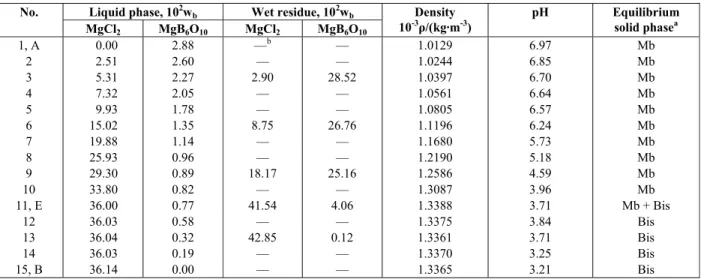
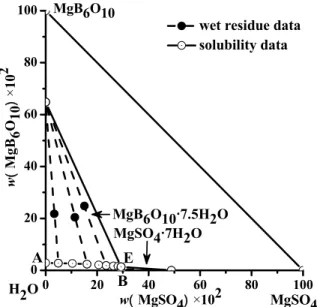
The solubility data and the relevant physico-chemical property data of the aqueous systems MgCl2 + MgB6O10 + H2O and MgSO4 + MgB6O10 + H2O at 308.15 K are presented in Tables 1 and 2. The ionic composition in the equilibrium solution of the isothermal dissolution is expressed as mass fraction. Using the experimental results in Tables 1 and 2, the phase diagrams of these systems at 308.15 K were plotted, as shown in Figures 1 and 2. Both of
the phase diagrams of the ternary systems in Figures 1 and 2 consist of one invariant point, two univariant curves and two crystallization fields. In Figure 1, the point labeled E is invariant for bischofite (MgCl2·6H2O) and mcallisterite (MgB6O10·7.5H2O), and the compositions of MgCl2, MgB6O10 in the liquid phase with mass fraction (wb × 10
2
) are 36.00 and 0.77, respectively. In Figure 2, the point labeled E is invariant for epsomite (MgSO4·7H2O) and mcallisterite (MgB6O10·7.5H2O), and the composi-tions of MgSO4, MgB6O10 in the liquid phase with mass fraction (wb × 102) are 29.29 and 1.33, respec-tively. Both of the ternary systems belong to a simple eutectic type, and neither double salts nor solid solutions were found.
Table 1: Solubility and physicochemical property data of the ternary system MgCl2 + MgB6O10 + H2O at
308.15 K.
Liquid phase, 102wb Wet residue, 102wb
No.
MgCl2 MgB6O10 MgCl2 MgB6O10
Density 10-3ρ/(kg·m-3)
pH Equilibrium solid phasea
1, A 0.00 2.88 —b — 1.0129 6.97 Mb
2 2.51 2.60 — — 1.0244 6.85 Mb
3 5.31 2.27 2.90 28.52 1.0397 6.70 Mb
4 7.32 2.05 — — 1.0561 6.64 Mb
5 9.93 1.78 — — 1.0805 6.57 Mb
6 15.02 1.35 8.75 26.76 1.1196 6.24 Mb
7 19.88 1.14 — — 1.1680 5.73 Mb
8 25.93 0.96 — — 1.2190 5.18 Mb
9 29.30 0.89 18.17 25.16 1.2586 4.59 Mb
10 33.80 0.82 — — 1.3087 3.96 Mb
11, E 36.00 0.77 41.54 4.06 1.3388 3.71 Mb + Bis
12 36.03 0.58 — — 1.3375 3.84 Bis
13 36.04 0.32 42.85 0.12 1.3361 3.71 Bis
14 36.03 0.19 — — 1.3370 3.25 Bis
15, B 36.14 0.00 — — 1.3365 3.21 Bis
a
Mb, MgB6O10·7.5H2O; Bis, MgCl2·6H2O; b
—, means not detected.
Table 2: Solubility and physicochemical property data of the ternary system MgSO4 + MgB6O10 + H2O at
308.15 K.
Liquid phase, 102wb Wet residue, 102wb
No.
MgSO4 MgB6O10 MgSO4 MgB6O10
Density 10-3ρ/(kg·m-3)
pH Equilibrium solid phasea
1, A 0.00 2.88 —b — 1.0129 6.97 Mb
2 4.95 2.75 3.34 21.75 1.0580 6.31 Mb
3 10.37 2.62 — — 1.1208 6.67 Mb
4 16.08 2.38 11.39 20.43 1.1792 6.53 Mb
5 20.63 2.06 — — 1.2380 6.40 Mb
6 23.51 1.86 15.04 24.78 1.2753 6.32 Mb
7 26.37 1.66 — — 1.3068 6.17 Mb
8 28.14 1.50 — — 1.3283 6.12 Mb + Eps
9, E 29.29 1.33 35.86 6.75 1.3386 6.07 Eps
10 29.21 1.04 — — 1.3370 6.02 Eps
11 29.26 0.47 36.15 0.30 1.3348 5.98 Eps
12, B 29.40 0.00 — — 1.3320 5.92 Eps
a
254 Lingzong Meng and Dan Li
Brazilian Journal of Chemical Engineering
0 20 40 60 80 100
0 20 40 60 80 100
wet residue data solubility data
B E
H2O
MgCl2·6H2O
w
(
Mg
B6 O10
)
×
10
2
MgCl2 MgB6O10
w(MgCl2)×102
MgB6O10·7.5H2O
A
Figure 1: Stable equilibrium phase diagram of the ternary system MgCl2 + MgB6O10 + H2Oat 308.15 K; ○, experimental solubility data; —, experimental stable isotherm curve; ●, wet residue data; …, wet residue curve.
0 20 40 60 80 100
0 20 40 60 80 100
B A
MgSO4·7H2O
MgB6O10·7.5H2O
wet residue data solubility data
w(MgSO4)×102
w
(
MgB
6
O10
)
×
10
2
H2O
MgSO4 MgB6O10
E
Figure 2: Stable equilibrium phase diagram of the ternary system MgSO4 + MgB6O10 + H2O at T = 308.15 K; ○, experimental solubility data; —, experimental stable isotherm curve; ●, wet residue data; …, wet residue curve.
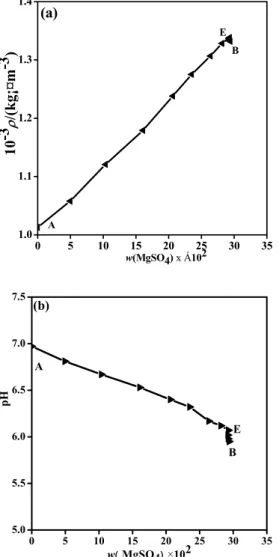
Using the experimental results in Tables 1 and 2, the relationships of the solution physicochemical properties (densities and pH) with mass fraction of magnesium chloride or magnesium sulfate are
plotted in Figures 3 and 4. It was found that the solution densities of the ternary systems were changed regularly with the increase of mass fraction of magnesium chloride or magnesium sulfate and reached the maximum value at the invariant, while the pH values of the stable equilibrium aqueous solution generally decreased gradually with increas-ing magnesium chloride or magnesium sulfate concentration, because the solution with magnesium chloride or magnesium sulfate is acidic and the pH values will decrease with increasing concentration. Using the diagrams (Figures 3 and 4), the physico-chemical properties (density and refractive index) could be used to roughly estimate the magnesium concentration in the ternary system.
0 10 20 30 40
1.0 1.1 1.2 1.3 1.4
(a)
B
A
10
-3 ρ
/
(
kg·m
-3 )
w(MgCl2)×102
E
0 10 20 30 40
2 4 6 8
pH
(b)
w(MgCl2)×102
B A
E
0 5 10 15 20 25 30 35 1.0
1.1 1.2 1.3 1.4
10
-3 ρ
/(kg¡¤m
-3 )
w(MgSO4) x Á102
B
A
E
(a)
0 5 10 15 20 25 30 35
5.0 5.5 6.0 6.5 7.0 7.5
pH
(b)
A
E
B
w(MgSO4)×102
Figure 4: Physicochemical properties versus compo-sition of the ternary system MgSO4 + MgB6O10 + H2O at 308.15 K. (a) density vs. composition; (b) pH vs. composition.
SOLUBILITY PREDICTION
Ion-Interaction Model
Pitzer has developed an ion-interaction model and published a series of papers (Pitzer 1973; Pitzer 1992), which gave a set of expressions for the os-motic coefficients of the solution and mean activity coefficient of electrolytes in the solution. Single ion activity coefficients, which are more convenient to use in solubility calculations, are given in the Harvie and Weare modeling approach (Harvie and Weare, 1980; Harvie et al., 1984). Because these equations are based on the excess free energy, all the activity
expressions are consistent and ready for application to different types of data (e.g., solubility data) for parameter evaluations and calculations of other ther-modynamic functions. Using the activity coefficients and the solubility products of the equilibrium solid phases allowed us to identify the coexisting solid phases and their compositions at equilibrium. Addi-tional work has centered on developing variable tem-perature models, which will increase the applicabil-ity to a number of diverse geochemical systems (Møller, 1988; Greenberg and Møller, 1989; Pabalan and Pitzer, 1987).The following equations are the main expressions related to the solubility calculation of this model.
Ø 3/2 1/2 i
i
Ø
c a ca ca c a
Ø
c c' cc' a cc'a c <c' a
Ø
a a ' aa ' c caa '
a a ' c
ø 1 2 / m A I / (1 bI )
m m B ZC
m
( ) ( ) [
( )
( )
(
m
m m m )]
m
<
− = − +
+ +
+ Φ + Ψ
+ + Φ + Ψ
∑
∑ ∑
∑∑
∑
∑∑
∑
(1)
2
M M a Ma Ma a
c Mc a Mca
c a
a a ' Maa ' M c a ca a a ' c a
ln z F m 2B ZC
m
( )
(2 m )
m m z m m C
<
γ = + +
+ Φ + Ψ
+ Ψ +
∑
∑
∑
∑
∑
∑
∑
(2)
2
X X c cX cX c
a Xa c cXa
a c
c c' cc' X X c a ca
c c' c a
ln z F m 2B ZC
m
( )
(2 m
m m z m C
)
m
<
γ = + +
+ Φ + Ψ
+ Ψ +
∑
∑
∑
∑∑
∑∑
(3)
256 Lingzong Meng and Dan Li
Brazilian Journal of Chemical Engineering
Solubility equilibrium constants are used to calculate solubility, i.e., a salt solution is saturated at a given temperature and pressure when the ion activity product is equal to the solubility equilibrium constant. For a hydrated salt
M X 0 2
Mυ Xυ ⋅υ H O, the solubility equilibrium constant (Ksp) at a definite temperature and pressure for the dissolution reaction is expressed as follows:
M X
M X
Z
0 2
Z
0 2 M X
Mυ Xυ ⋅υ H O=υ M ++υ X −+υ H O (4)
M M M X X X 0 w lnKsp=υ ln m( γ )+υ ln m( γ )+υlnα (5)
The activity of water is related to the osmotic coefficient ø, by the equation
w W
lnα = −øM ∑mi (6)
where, Mw is the molar mass of water and the sum covers all solute species. The activity coefficients, ln i, and the osmotic coefficients ø, can be calculated using the the Pitzer ion-interaction model and the extended HW model.
According to the Pitzer and extended HW models, the activity and osmotic coefficients are parametric functions of (0), (1), (2), CØ, θcc′ and
ψcc′a, (0), (1), (2), CØ are the parameters of a single salt, θcc′ represents the interaction of the two ions
with the same sign and ψcc′a represents the interac-tions among the three ions, in which the sign of the third one is different from the first two ions. Solubility of the systems MgCl2 + MgB6O10 + H2O and MgSO4 + MgB6O10 + H2O at 308.15 K could be calculated from Eqs. (1)-(6) when the Pitzer parame-ters and Ksp of the system are all known.
Model Parameterization
A high-temperature thermo-chemical model for the system (Na + K + Mg + Cl + SO4 + OH + H2O)
was presented by Pabalan and Pitzer (1987), including a range of temperature for the model. Take MgCl2 for example, the temperature-dependent equations for MgCl2 are as follows:
( )
21 2 3
P T =Q T +Q T+Q (7)
where P(T) in Eq. (7) refers to the binary parameters (0)
, (1), (2) and CØ of MgCl2 at 308.15 K of the solution model and the values of the fitting constant terms of Q1, Q2,and Q3 were introduced (Pabalan and Pitzer, 1987). The Debye–Hückel parameter AØ and the binary parameters of MgSO4 at 308.15 K can be calculated based on the temperature-dependent equations presented in the literature (Møller, 1988; Pabalan and Pitzer, 1987). The binary parameters
(0)
, (1), (2)and CØ of Mg(B6O7)(OH)6 and the mix-ing ion-interaction parameters
6 10
Cl,B O ,
θ
4 6 10
SO ,B O ,
θ
6 10
Mg,Cl,B O ,
Ψ
4 6 10
Mg,SO ,B O
Ψ were available by a
multiple linear regression procedure applied to the solubility data of the corresponding ternary system in this paper. All the parameters used in the prediction are presented in Table 3. According to the experi-mental solubility data in Tables 1 and 2, and Pitzer parameters in Table 3, the average equilibrium constants (lnKaver) for the solid phases were fitted in this study. These average equilibrium constants (lnKaver) of equilibrium solid salts for MgCl2·6H2O, MgSO4·7H2O, and Mg(B6O7)(OH)6·4.5H2O corre-spond to 10.7075, -4.114139 and -9.0057 at (308.15 ± 0.1) K. The uncertainties of the average equilibrium constants for MgCl2·6H2O, MgSO4·7H2O are ± 0.0278 and ± 0.0821, whereas the uncertainty for Mg(B6O7)(OH)6·4.5H2O is larger than ± 1.0000. The boron ions in the solution are very complicated, there are many different kinds of boron ions (Li and Gao, 1993), so the equilibrium constant of mcallis-terite has a comparatively large uncertainty; a similar situation has been described for Li2(B4O5)(OH)4·H2O (Meng, 2012).
Table 3: Single-salt and mixing ion-interaction parameters of the systems at 308.15 K.
Species β(0) β(1) β(2) C(ø) θ Ψ
MgCl2 0.345373 1.699490 0.00547362
MgSO4 0.220933 3.710150 -35.2046 0.0246099
Mg(B6O7)(OH)6 -1.731783 6.235616 -139.935780 -1.497872
Cl-,(B6O7)(OH)62- 1.054584
SO42-,(B6O7)(OH)62- 0.937438
Mg2+,Cl-, (B6O7)(OH)62- 0.738305
Calculated Solubility
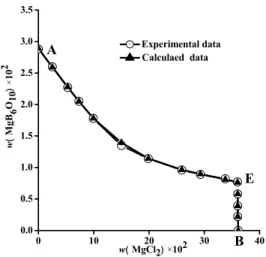
To determine the accuracy of the parameters and the solubility equilibrium constants of the solids, the solubilities of the two ternary systems at 308.15 K have been calculated based on the Pitzer ion-interaction model and the extended HW model for aqueous electrolyte solutions. It should be noted that solutes below their saturated solution molalities were fixed at their experimental values and the saturated solutes’ solubilities were calculated. The phase dia-grams according to the experimental and calculated data were constructed and are shown in Figures 5 and 6, respectively.
0 10 20 30 40
0.0 0.5 1.0 1.5 2.0 2.5 3.0 3.5
A
B E
w
(
Mg
B6 O10
)
×
10
2
w(MgCl2)×102 Experimental data Calculaed data
Figure 5: Comparison of the experimental and
calculated phase diagram of the ternary system MgCl2 + MgB6O10 + H2O at 308.15 K; ○, Experi-mental data;▲, calculated data; —, experimental isotherm curve; …, calculated isotherm curve.
0 5 10 15 20 25 30 35 0.0
0.5 1.0 1.5 2.0 2.5 3.0 3.5
B A Experimental data
Calculaed data
H2O
w
(
MgB
6
O10
)
×
10
2
w(MgSO
4)×102
E
Figure 6: Comparison of the experimental and
calculated phase diagram of the ternary system MgSO4 + MgB6O10 + H2O at 308.15K; ○, Experi-mental data;▲, calculated data; —, experimental isotherm curve; …, calculated isotherm curve.
It is shown that the calculated and the experimen-tal data for the ternary system MgCl2 + MgB6O10 + H2O and MgSO4 + MgB6O10 + H2O are in good agreement. These results indicate that the model ob-tained in this work that combines the Pitzer parameters and the equilibrium constants is reliable and is capable of predicting equilibria in the system studied.
CONCLUSIONS
The experimental solubility data and the relevant physicochemical property data of the aqueous systems MgCl2 + MgB6O10 + H2O and MgSO4 + MgB6O10 + H2O at 308.15 K were determined. The experimental stable phase diagrams and the variation of the physicochemical properties with composition were constructed for the first time. The results show that the systems belong to a simple co-saturated type and neither solid solutions nor double salts were formed in the two ternary systems. The single-salt Pitzer parameters, the mixing ion interaction parameters, the equilibrium constant of the minerals were fitted, and the Debye–Hückel parameter AØ in the systems were calculated based on the tempera-ture-dependent equations presented in the literature (Møller, 1988; Pabalan and Pitzer, 1987). Solubility calculations for the ternary systems at 308.15 K have been made using the Pitzer parameters and average equilibrium constants of the solids. The calculated solubilities agree well with experimental values. These results indicate that the parameters and the equilibrium constants obtained in this work are reliable.
ACKNOWLEDGEMENTS
Financial support from the Foundation of Tianjin Key Laboratory of Marine Resources and Chemistry at Tianjin University of Science & Technology (Grant 201101) and the Science Foundation of Linyi University (Grant BS201005) are greatly acknowl-edged.
NOMENCLATURE
AØ Debye–Hückel parameter
BØ parametric functions of Pitzer parameter
B parametric functions of Pitzer parameter
258 Lingzong Meng and Dan Li
Brazilian Journal of Chemical Engineering
CØ single-salt Pitzer parameter C parametric functions of Pitzer
parameter
f parametric functions of Pitzer parameter
g(x), g'(x) parametric functions of Pitzer parameter
I ionic strength mol/kg
Ksp solubility equilibrium constant
m molality mol/kg
M,C cation
n neutral molecules
X, A anion
z valence of ions
Z parametric functions of the molality of species i
Greek Letters
αw water activity
(0)
single-salt Pitzer parameter (1)
single-salt Pitzer parameter (2)
single-salt Pitzer parameter υ number of ions in the molecule
activity coefficient of the ions
ø osmotic coefficients
θ mixing ion interaction Pitzer parameter
Ψ mixing ion interaction Pitzer parameter
REFERENCES
Bi, W. B., Sun, B., Song, P. S. and Zhu, G. Q., Study on phase diagram of Mg2+/Cl-, borate-H2O ternary system at 25 °C. J. Salt Lake Res., 5, 42-46 (1997). Deng, T. L., Phase equilibrium for the aqueous system
containing lithium, sodium, potassium, chloride, and borate ions at 298.15 K. J. Chem. Eng. Data. 49, 1295-1299 (2004).
Greenberg, J. P. and Møller, N., The prediction of mineral solubilities in natural waters: A chemical equilibrium model for the Na-K-Ca-Cl-SO4-H2O system to high concentration from 0 to 250 °C. Geochim. Cosmochim. Acta, 53, 2503-2518 (1989). Harvie, C. E., Møller, N. and Weare, J. H., The
prediction of mineral solubilities in nature waters: The Na-K-Mg- Ca-H-SO4-OH-HCO3-CO3-H2O system to high ionic strengths at 25 °C. Geochim. Cosmochim. Acta, 48, 723-751 (1984).
Harvie, C. E. and Weare, J. H., The prediction of mineral solubilties in nature waters: The Na-K-Mg- Cl-SO4-H2O system from zero to high concentration at 25 °C. Geochim. Cosmochim. Acta, 44, 981-997 (1980).
Li, J. and Gao, S. Y., Chemistry of borates. J. Salt Lake Res., 1, 62-67 (1993).
Meng, L. Z., Solubility prediction for LiCl–Li2SO4– Li2B4O7–H2O system at 298.15 K using ion-interaction model. J. Chem. Eng. Jpn., 45, 563-567 (2012).
Meng, L. Z., Deng, T. L., Duan, C. W., Li, D. and Guo, Y. F., A synthesis method for mcallisterite. World Sci-tech R&D (China), 32, 825-826 (2010). Meng, L. Z., Deng, T. L., Guo, Y. F. and Li, D., The
phase diagrams of the systems (MgCl2 + MgB6O10 + H2O) and (MgSO4 + MgB6O10 + H2O) at 323.15 K and Pitzer model. Russ. J. Phys. Chem. A,86, 1526-1532 (2012).
Meng, L. Z., Li, D., Guo, Y. F. and Deng, T. L., Stable phase equilibrium of the aqueous qua-ternary system (MgCl2 + MgSO4 + MgB6O10 + H2O) at 323.15 K. J. Chem. Eng. Data, 56, 5060-5065 (2011).
Møller, N., The prediction of mineral solubilities in natural waters: A chemical equilibrium model for the Na-Ca-Cl-SO4-H2O system to high tempera-ture and concentration. Geochim. Cosmochim. Acta, 52, 821-837 (1988).
Pabalan, R. T. and Pitzer, K. S., Thermodynamics of concentrated electrolyte mixtures and the predic-tion of mineral solubilities to high temperatures for mixtures in the system Na-K-Mg-Cl-SO4 -OH-H2O. Geochim. Cosmochim. Acta, 51, 2429-2443 (1987).
Pitzer, K. S., Thermodynamics of electrolytes I: Theoretical general equation. J. Phys. Chem., 77, 268-277 (1973).
Pitzer, K. S., Activity coefficients in electrolyte so-lutions. 2nd Ed., CRC Press, London (1992). Song, P. S., Studies on the application of the wet
residues method in phase Equilibrium for the salt-water systems. J. Salt Lake Res., (China), 1, 42-46 (1991).
Zhai, Z. X., Cheng, Z. B., Hu, F., Wu, G. L., Xiao, Y. K. and Liu, F. M., Analytical Methods of Brines and Salts. 2nd Ed., Qinghai Institute of Salt Lakes, Chinese Academy of Science. Chin. Sci. Press, Beijing (1988).